Stanza · Audio guide
Laodikya Audio Guide
A place to remember. A story to take with you.
Laodicea on the Lycus was a rich ancient Greek city in Asia Minor located on the river Lycus. Its ruins are situated near the modern city of Denizli in Turkey.
Download Stanza, then search for “Laodikya”.
About the tour
One guide. Your kind of visit.
Laodicea on the Lycus was a rich ancient Greek city in Asia Minor located on the river Lycus. Its ruins are situated near the modern city of Denizli in Turkey.
Ready when you are.
- 01Get the free Stanza app.
iOS & Android
- 02Find your guide.
“Laodikya”
- 03Download before you go.
Works offline
Audio guide / 34 narrated stops
Inside the guide
Get to know a few of the stories before you go. Open a stop to read more.
01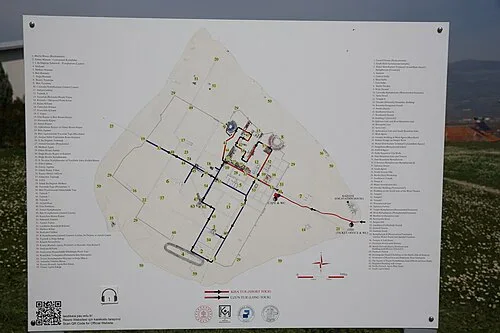 Laodicea Welcome & Ancient City Overview
Site Plan – Laodicea on the Lycus: City Overview
A Hellenistic king named this city after his wife. Antiochus the Second, king of the Seleucid empire, founded Laodicea between 261 and 253 BC, on a hill above the river Lycus where an older settlement had stood. Pliny the Elder recorded that the place had earlier been called Diospolis, City of Zeus, and then Rhoas, though that rests on his report alone. The founder also settled two thousand Jewish families from Babylonia in Phrygia, and that community would matter to the city's later story. Under Rome, Laodicea became a free city. Its position on a great trade route made it one of the richest cities of Asia Minor, busy with money-changing and commerce. Three threads run through everything here. Wealth: trade filled the city with private fortunes, and its citizens spent them on marble. Pride: when an earthquake levelled the town, the people refused imperial help and rebuilt at their own expense. Faith: Laodicea became one of the seven churches of Asia and an early seat of Christianity. The plan on the board shows how much ground that ambition covered — a whole city of numbered monuments, with two suggested walking routes through it.
Photo: Biologg · CC BY-SA 4.0
02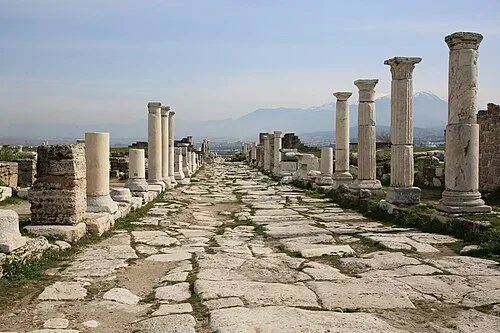 Laodicea Welcome & Ancient City Overview
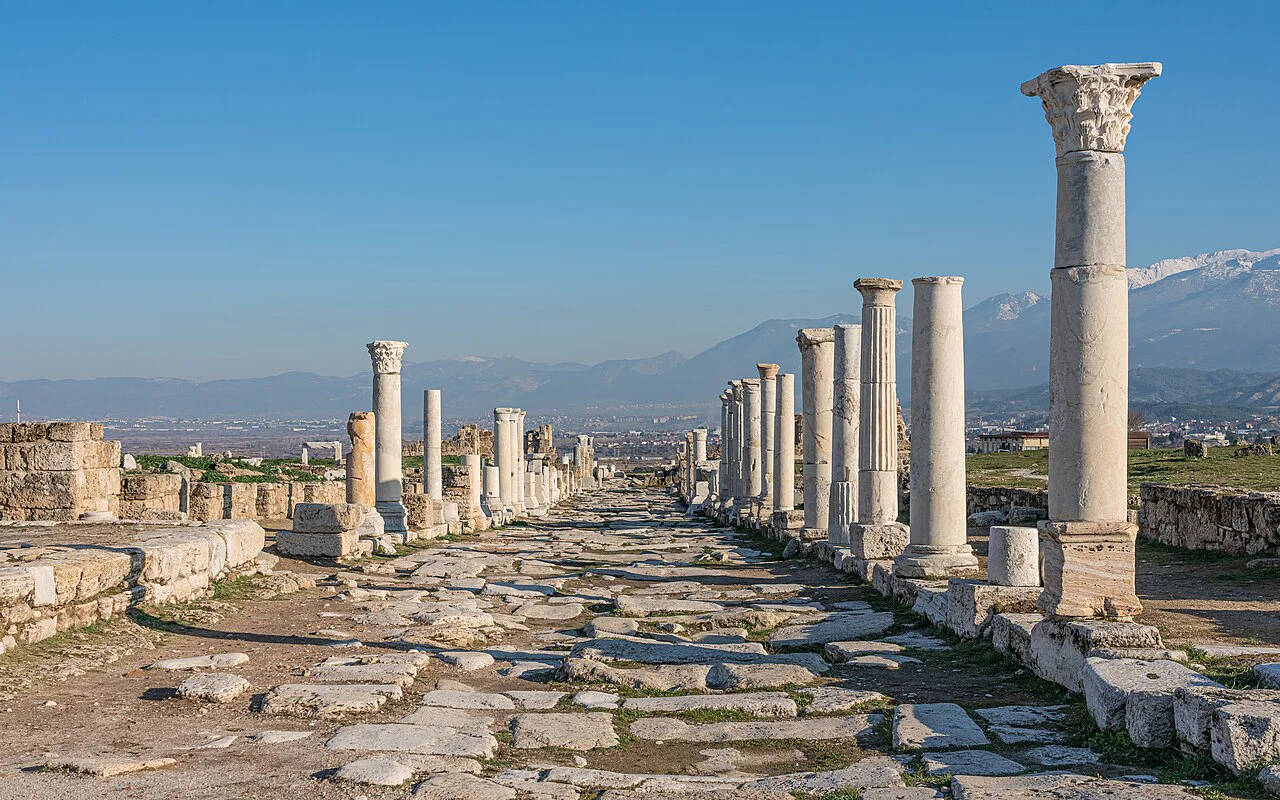
Colonnaded Street – Setting on the Hill
Laodicea occupies the long spur of a hill, squeezed between the narrow valleys of two small rivers. They are the Asopus and the Caprus, and both flow into the Lycus, the river that gives the city its full name. That ridge was the whole footprint of the city, and it is exposed ground, open to the sky and to distant mountains. Streets flanked by colonnades and pedestals ran across the town from end to end. The columns standing along the street are part of that skeleton, the frame onto which every public building was hung.
Photo: Biologg · CC BY-SA 4.0
03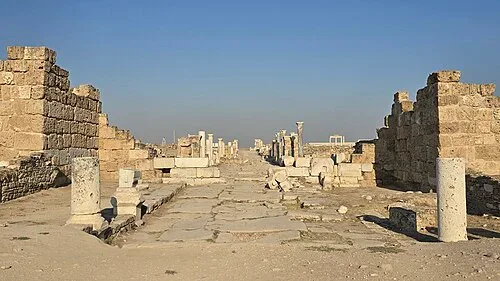 East Byzantine Gate
 – The City's Last Centuries
Laodicea's last centuries were violent ones, and this heavy stone gateway belongs among the defences of that era. In 1119 the Byzantine emperor John the Second Komnenos took the city back from the Seljuk Turks, the first major victory of his reign, won with his chief commander John Axouch. The city still lacked proper defences, so Emperor Manuel the First Komnenos fortified it in 1160. The respite lasted barely a year. In 1161 the Seljuks sacked Laodicea and enslaved much of its population. Further raids carried off captives and livestock, and the city passed through other hands before the end. The invasions of the Turks and the Mongols destroyed Laodicea altogether. What stands now is a corridor of rough stone between two massive blocks, with the ancient street still running through it toward the city.
Listen in the appPhoto: Rigorius · CC BY-SA 4.0
04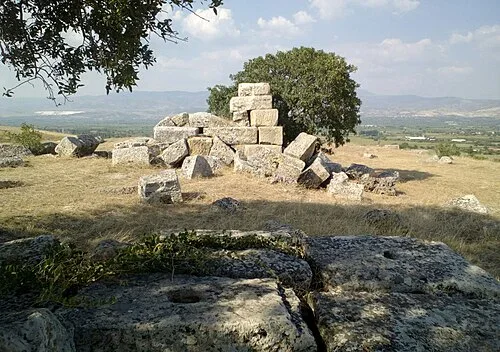 East Baths
 – Bathing at the City's Edge
These scattered blocks, tumbled across a dry slope under a tree, are what remains of the East Baths. The complex stood near the eastern approach to the city, and Roman bathhouses were often sited near gates, where they could serve travellers arriving off the road. That is a general habit of Roman town planning rather than something established for this building. Most of the structure has fallen. The stones lie where they dropped, and grass and trees have grown over them, so the baths read today as a low scatter of masonry in the landscape.
Listen in the appPhoto: Laszlovszky András · CC BY-SA 4.0
05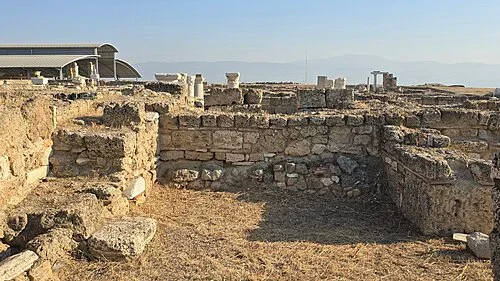 House A (Elite Roman Residence)
House A – An Elite Residence
Laodicea's public marble was paid for by private fortunes, and House A shows the domestic side of that money. This was a substantial elite residence, its walls now standing to about shoulder height beneath a protective shelter. Across the Roman world, rich families built houses around a peristyle — a colonnaded courtyard open to the sky — with fine reception rooms beside it for receiving guests. That is the general pattern of elite housing, and a house of this size fits it well. Who lived here, and exactly when, the excavation has not settled. What the standing walls show is scale: thick stone masonry and rooms of generous width, roofed now against the weather.
Listen in the appPhoto: Rigorius · CC BY-SA 4.0
06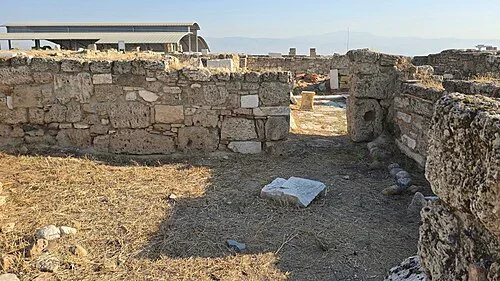 House A (Elite Roman Residence)
House A – Excavation and Protection
Since 2002, Pamukkale University has been excavating at Laodicea, season after season, with intensive restoration work following the digs. The site has grown into one of Anatolia's large active excavations. The shelter near House A is part of that effort: fragile remains are being progressively roofed and stabilised, so that what a season uncovers can survive the winters that follow.
Listen in the appPhoto: Rigorius · CC BY-SA 4.0
07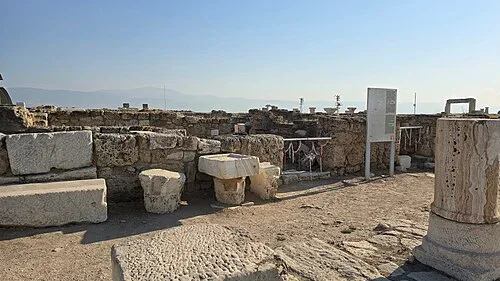 House A (Elite Roman Residence)
House A – Domestic Fittings
The worked stones of House A are still lying among its rooms. There are square column bases, blocks dressed for walls and thresholds, and a small marble basin with a hollowed bowl. Pieces like these were the fittings of a Roman house — for water, for doorways, for the colonnades of a courtyard. What each one originally did is still being worked out, so for now they sit where the excavators left them, in the rooms they were found in.
Listen in the appPhoto: Rigorius · CC BY-SA 4.0
08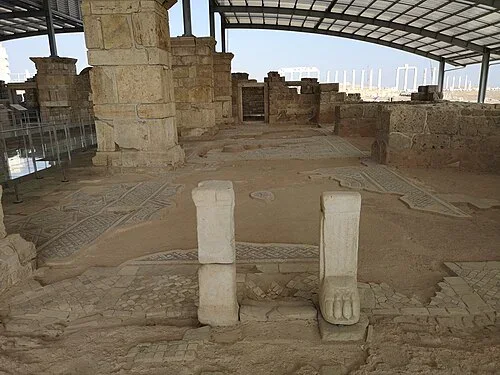 The Church of Laodicea (Church of Revelation)
The Church of Laodicea – Revelation's Seventh Church
The letter to Laodicea in the Book of Revelation is this city's most famous mention, and it was not a kind one. Laodicea is one of the seven churches of Asia, and its letter scolds the congregation for being neither hot nor cold — lukewarm, fit to be spat out. The city appears even earlier in the story of the faith. Paul's Epistle to the Colossians asks that a letter be read aloud to the Laodiceans, and sends greetings through Epaphras, who worked hard for the Christians of the three Phrygian cities: Colossae, Laodicea and Hierapolis. With its large Jewish community, Laodicea became a seat of Christianity and a bishopric very early. Some Greek manuscripts of the First Epistle to Timothy even end with the words: written at Laodicea, metropolis of Phrygia. The excavated basilica — stone piers, a nave under a modern canopy, floors protected in place — is the building that early story eventually grew into.
Listen in the appGargarapalvin · CC BY-SA 4.0
09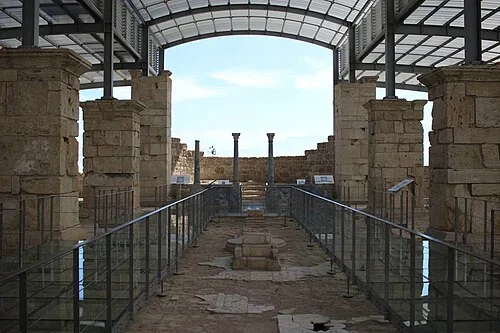 The Church of Laodicea (Church of Revelation)
Inside the Basilica – Council and Conservation
This city gave church law some of its earliest written rules. An assembly held at Laodicea produced sixty canons in Greek, and they survive to this day. The date is much argued over. Some thought the council met before Nicaea in 325, others before Constantinople in 381. The safer view places it after Constantinople. The canons are of great importance in the history of church discipline and liturgy, ordering how services were run and how clergy and faithful were to behave. One of them was even invoked by some Protestants against the veneration of angels. Overhead, the care continues in the present: a protective canopy spans the nave, and glass walkways carry visitors above the ancient floors, keeping the ruins open to see while shielding them from harm.
Listen in the appPhoto: Blcksprt · CC BY-SA 4.0
10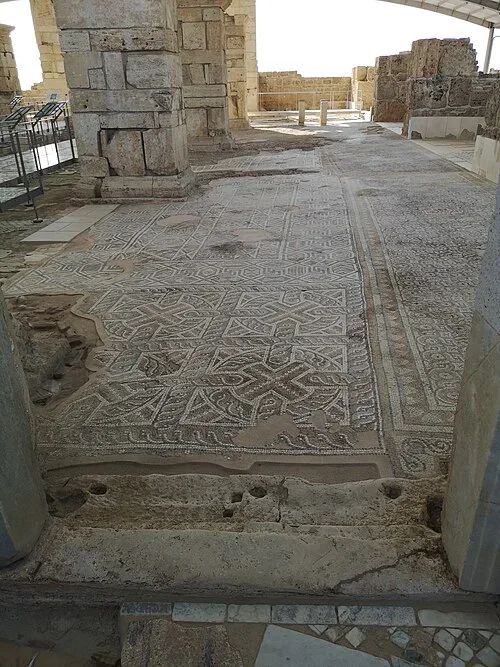 The Church of Laodicea (Church of Revelation)
Mosaic Floors of the Basilica
The floors are the best-preserved thing this church has to show. Broad fields of mosaic run across the building, laid in small stone tesserae: interlocking circles, cross motifs, borders of running pattern. Each cube was set by hand into wet mortar, row by row, until the whole floor became a stone carpet. Centuries of wear have dulled but not erased them, and the designs still read clearly.
Listen in the appGargarapalvin · CC BY-SA 4.0
- 11
The Baptistery – Entry into the Faith
A sunken cruciform basin where new converts were washed into the faith.
- 12
House with Church and Peristyle – Worship in a Private Home
A rich man's villa with a church inside it — Christianity's step from house to basilica.
- 13
Peristyle Courtyard – Columns of a Villa
A paved courtyard ringed with columns of many different marbles — the classic stage set of a rich Roman house.
- 14
An Apsed Room in the Villa
A formal room with a marble-clad curved end, and the open question of whether it was the house's chapel.
- 15
Floors of Hexagon and Square
Hexagonal and square marble pieces resetting into the earth, a glimpse of luxury flooring under conservation.
- 16
North Theater – The Second Stage
The second of Laodicea's two grand theaters, its terraced seats carved into the hillside above the Lycus valley.
- 17
North Theater – Ruins in the Poppies
Broken seats tumbling down the slope, and spring poppies blooming between the stones.
- 18
North (Sacred) Agora – Rebuilding Without Rome
The earthquake of 60 AD flattened Laodicea — and its citizens refused Rome's money and rebuilt with their own.
- 19
North Agora Colonnade – Civic Administration
A standing colonnade of carved Corinthian columns, and the city's role as chief town of a district of two dozen cities.
- 20
West Theater – The City at Play
The West Theater, first built in the Hellenistic period, its great curve of seats built for a whole community at play.
- 21
West Theater – The Spectator's View
From the top rows, the eye went past the stage to the valley and the hills beyond.
- 22
Caracalla Nymphaeum – A Fountain for an Emperor
A monumental fountain raised in honour of the emperor Caracalla's visit in 215, its carved reliefs lying where they fell.
- 23
Caracalla Nymphaeum – The Water Law
A marble block inscribed with the city's water law, and the steep fines for anyone who touched the pipes.
- 24
Septimius Severus Nymphaeum – Water Across the Valley
Springs kilometres away, a sealed stone pipeline diving under a valley, and pipes that choked with chalk.
- 25
Temple A – Gods of the City
A grand Roman temple, its gods known from the city's own coins, its dedication still a mystery.
- 26
Temple A – Spiral-Fluted Columns
Columns that twist like rope, a costly flourish of the temple's stonemasons.
- 27
Syria Street – The Riches of the Crossroads
How a crossroads on a great trade route, black wool and heavy money made Laodicea famous for wealth.
- 28
Syria Street – Pavement and Pedestals
Paving slabs, kerbs and the pedestals that once carried statues along the great street.
- 29
Central Agora – Scale of the Marketplace
A marketplace of vast size, its tall columns re-erected and its long frescoed back wall prized worldwide.
- 30
Central Agora – The Work in Progress
Fields of fallen capitals and column drums, and an excavation still working its way across the square.
- 31
Central Baths – Bathing in a Rich City
The Central Baths and the Roman habit of bathing: room after room of rising heat, and a city full of bathhouses.
- 32
Central Baths – Monumental Walls
Massive walls and arched chambers rising out of the spring grass, showing the size of the bathing establishment.
- 33
Central Baths – Doorway and Masonry
A marble lintel set into rough stone and brick, under a deep arched recess in the bathhouse wall.
- 34
Central Baths – Closing: The Silent Halls
Grass-floored halls under open sky, a quiet place to take in the whole arc of the city's rise and fall.
Laodikya
Frequently asked questions
How much does the guide cost?
Free app download. Listed guide price: $2.99. Guide price shown in the app. Audio guide only. Venue admission is separate.
Can I listen without internet?
Yes. Download the guide’s audio, images, and maps in the app before your visit. Your downloaded content is then available offline.
Can I listen in my language?
This audio guide is available in 15 languages, including English.
Do I need to follow a schedule?
No. This is a self-guided experience. Choose your stops, pause whenever you like, and return to a story at your own pace.
At your own pace
Explore Laodikya.
Download Stanza, then search for “Laodikya”.
Free app download · Guide price shown in the app
Keep exploring
Nearby audio guides
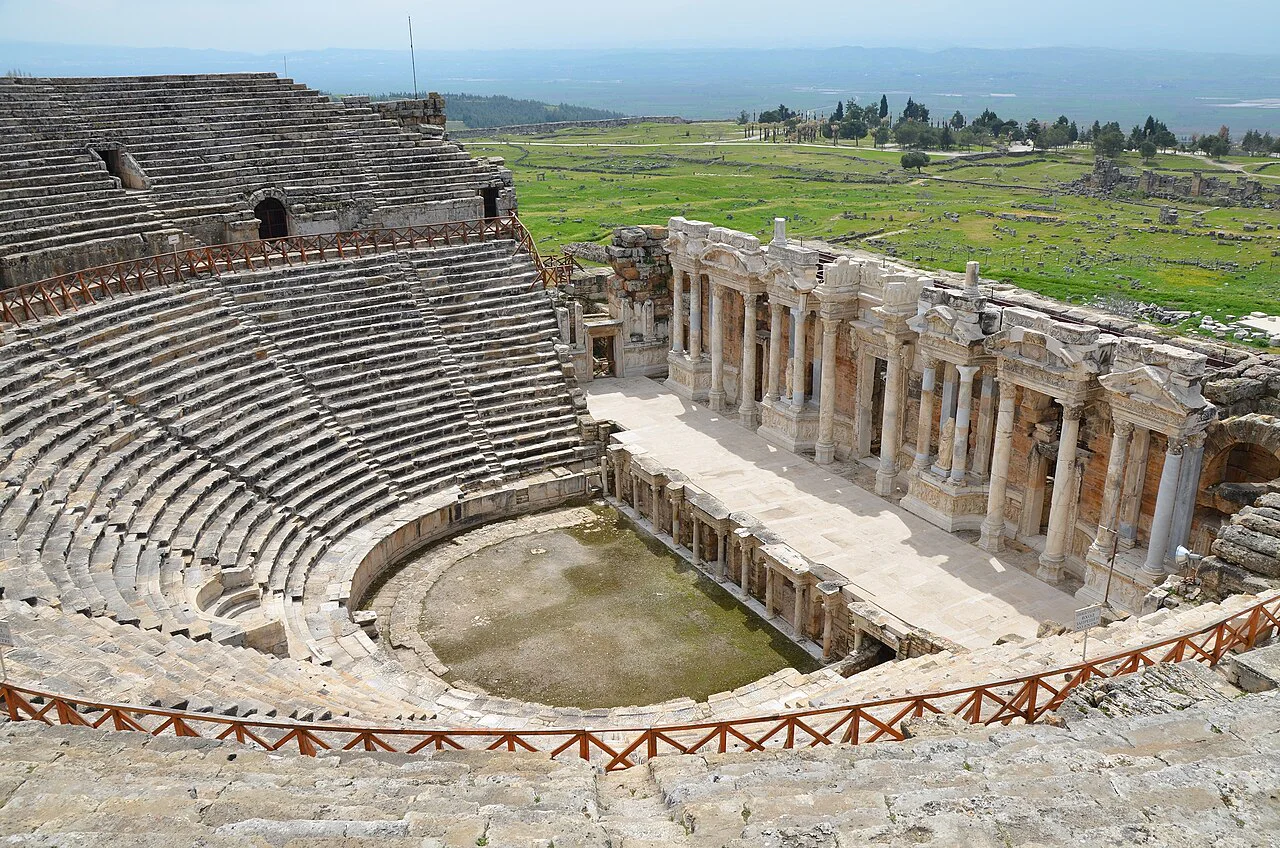
Pamukkale district · 10 km
Hierapolis
Content & sources
Carole Raddato · CC BY-SA 2.0
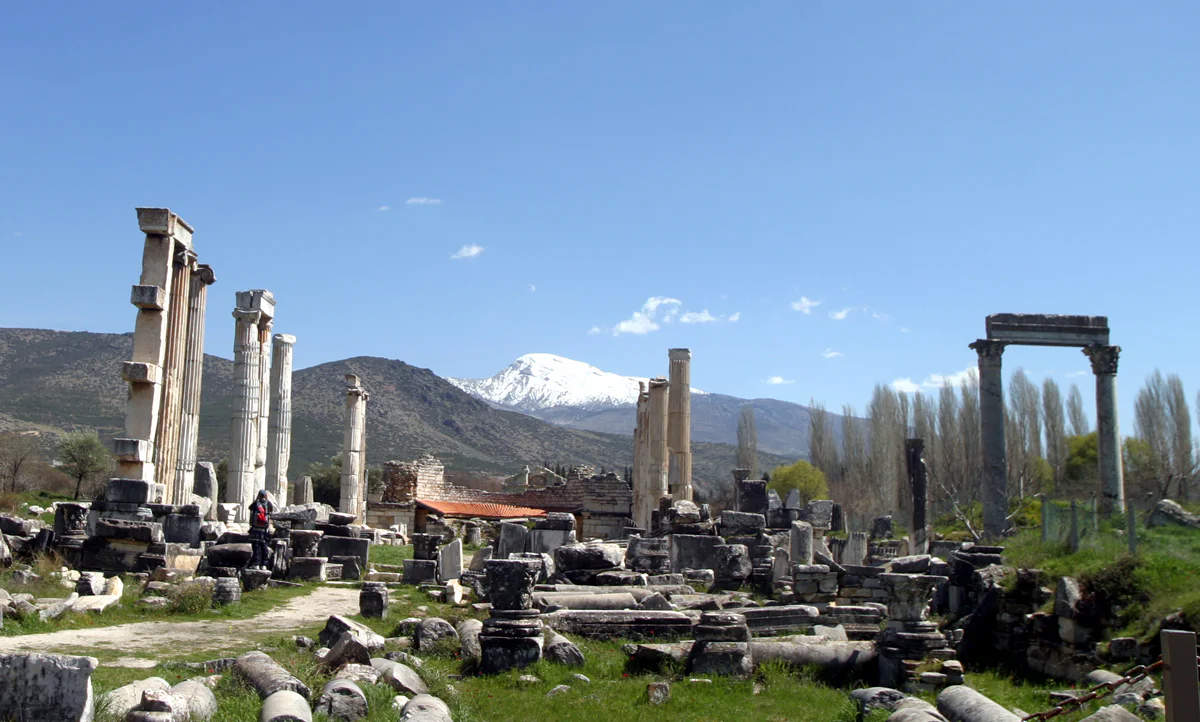
Geyre · 37 km
Afrodisias
Content & sources
Brocken Inaglory · CC BY-SA 4.0
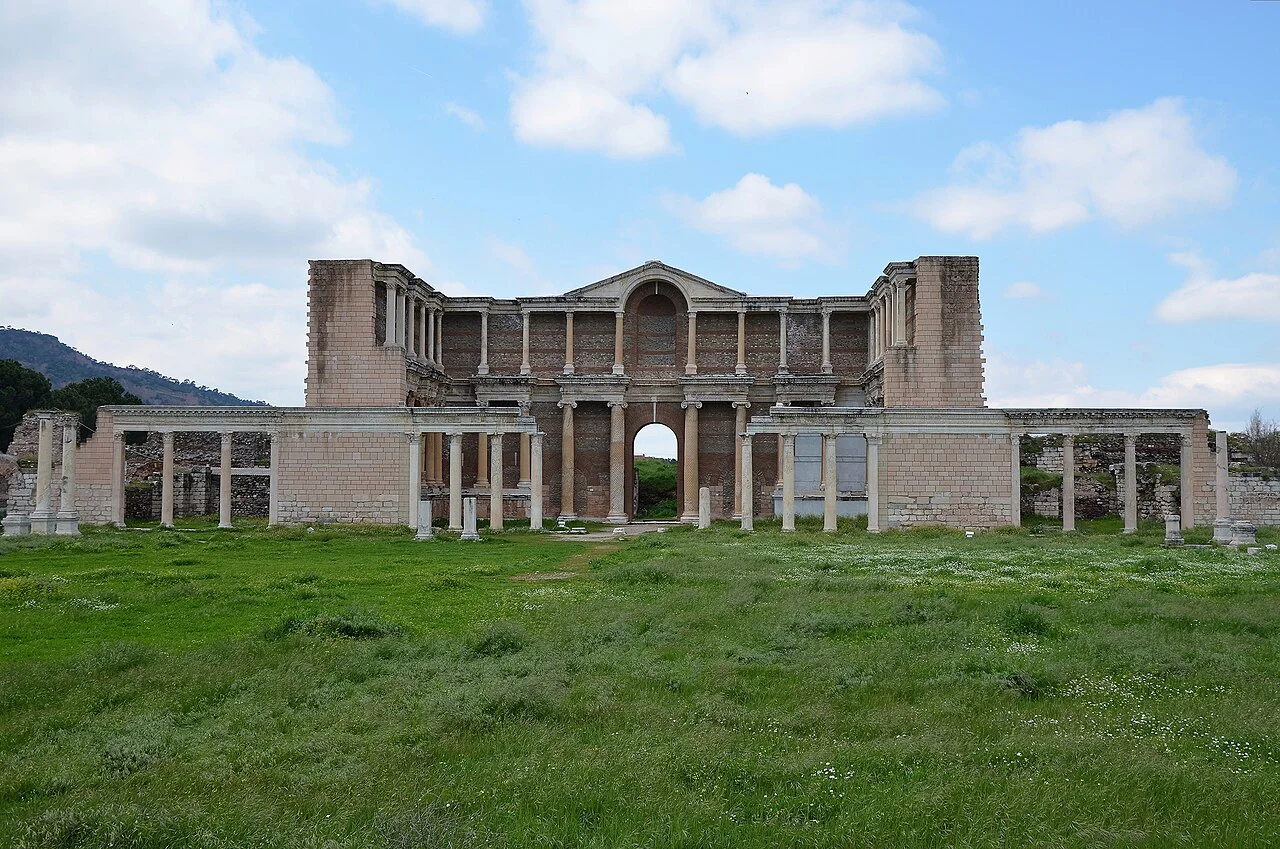
Salihli · 118 km
Sardis
Content & sources
Carole Raddato from FRANKFURT, Germany · CC BY-SA 2.0
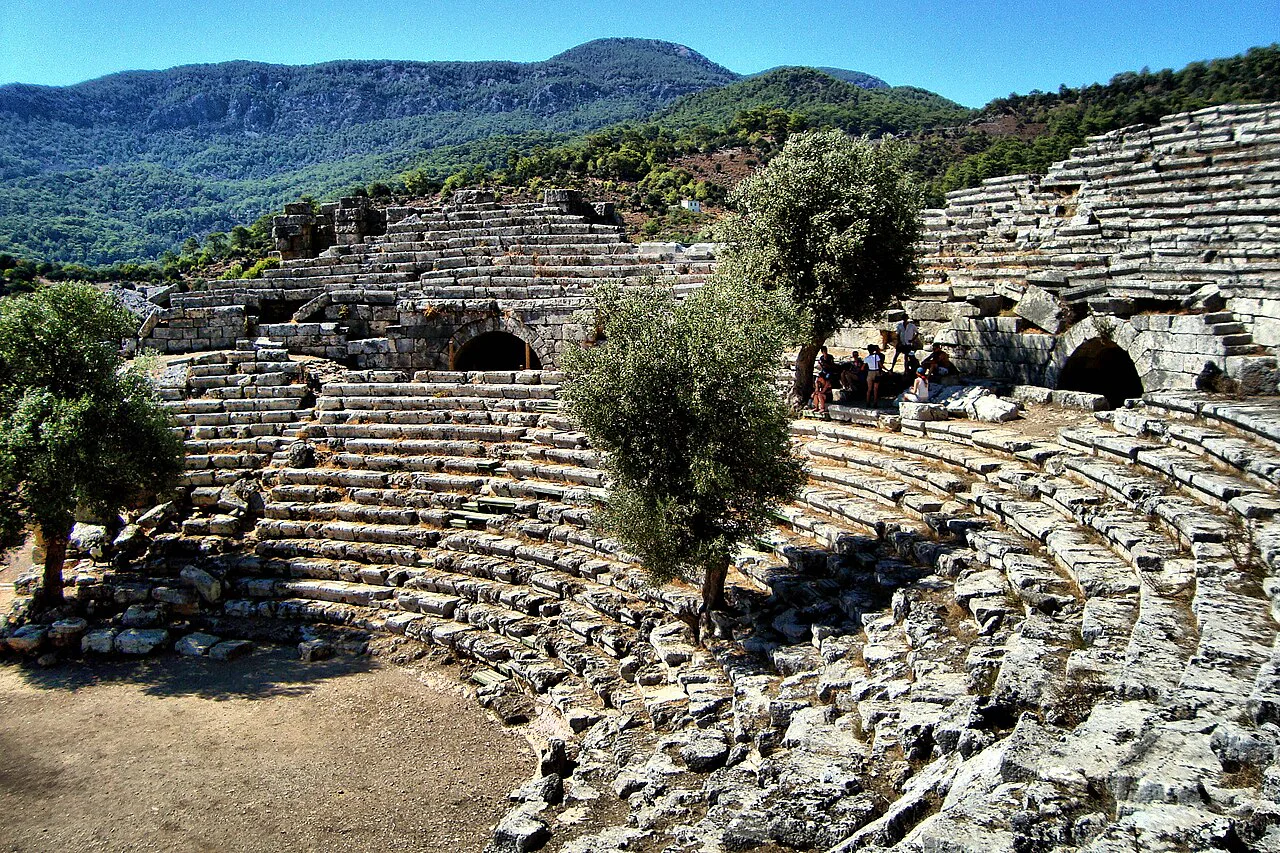
Dalyan · 120 km
Kaunos
Content & sources
HALUK COMERTEL · CC BY 3.0