Languages
15Bath Abbey Audio Guide
Bath Abbey is a landmark in Bath, United Kingdom. Explore it with Stanza's GPS-triggered offline audio guide — available in 15 languages.
Quick Facts
28
Stops
15
Languages
100%
Offline
📍 Bath, United Kingdom · 51.3814°N, -2.3589°E
About Bath Abbey
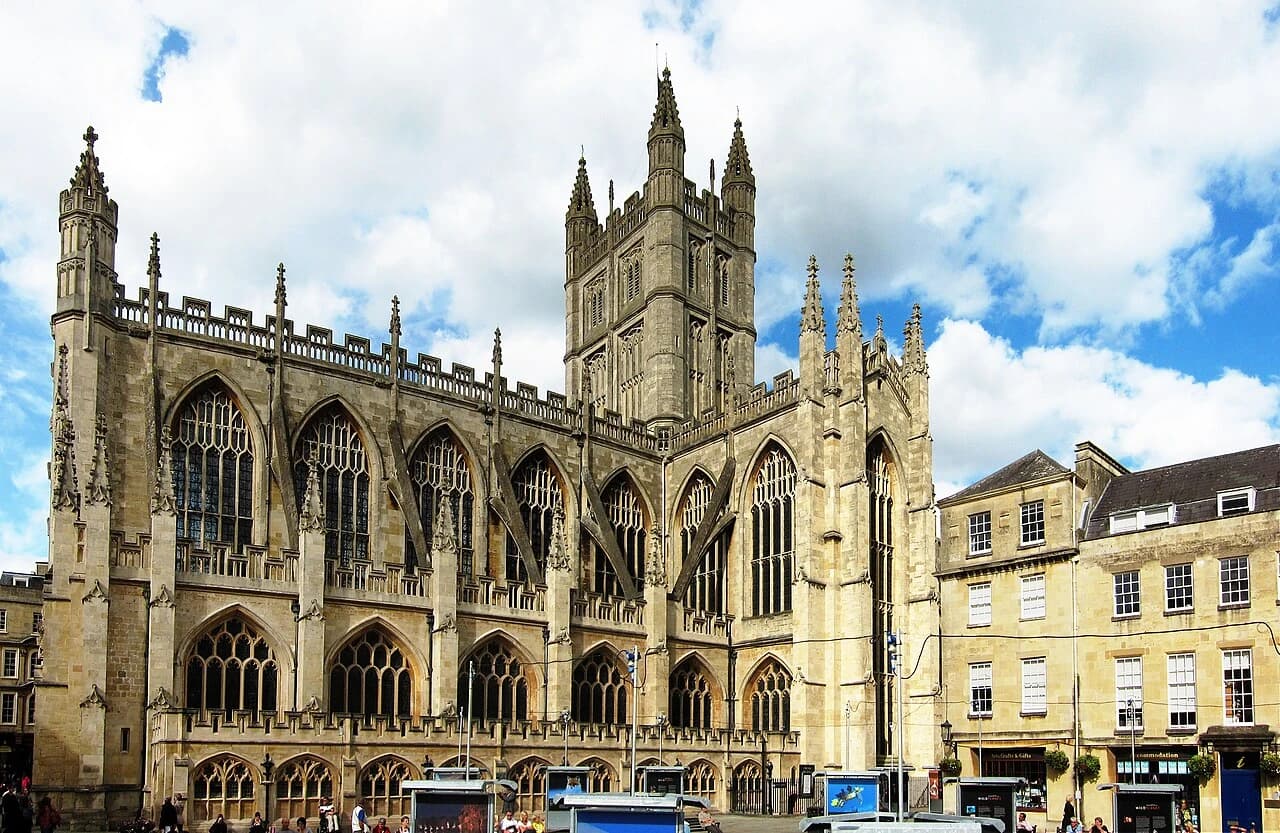
Bath Abbey is a Church of England parish church and a former Benedictine monastery in Bath, Somerset. It is a notable example of Perpendicular Gothic architecture, founded in the 7th century and rebuilt significantly in the 16th century.
Bath Abbey is also known as Abbey Church of St Peter and St Paul, Bath, Abbey Church of Saint Peter and Saint Paul, Bath.
This self-guided audio tour features 28 narrated stops organized across 6 sections, including The West Front and Jacob's Ladder, Abbey Churchyard and Rebekah Fountain, The Nave and Fan Vaulting, The Choir and Great East Window, The Klais Organ, Notable Monuments: Bingham and Waller. As a abbey, Bath Abbey offers a unique cultural experience in the heart of Bath, United Kingdom.
The Stanza audio guide is available in 15 languages and works entirely offline — download the complete tour including audio narration, maps, and images before your visit. As you walk through Bath Abbey, GPS-triggered narration plays automatically at each point of interest.
Last updated:
What you will hear
The West Front and Jacob's Ladder
Starting at the main exterior entrance to witness the unique 'Jacob's Ladder' carvings and the ornate west doors.
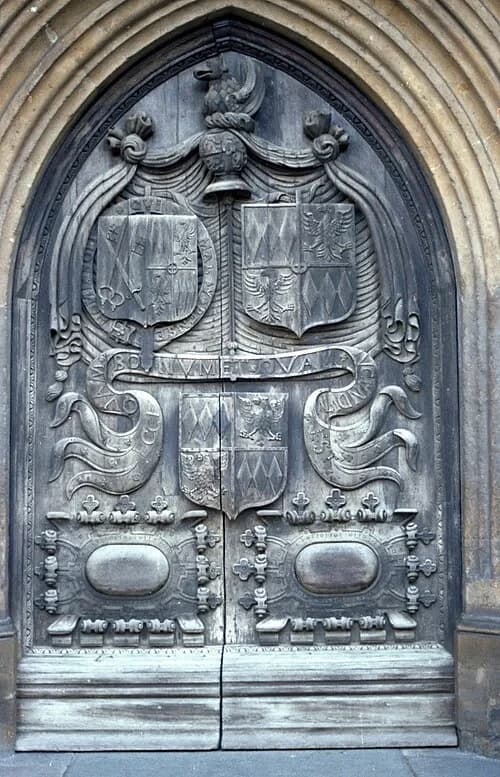
The Great West Doors
The heavy wooden doors at the main entrance command attention with their deep, intricate carvings. They were installed around 1611, marking the conclusion of the primary construction period that began over a century earlier. The woodwork is rich with symbolic imagery, including heraldic shields that represent the various benefactors and officials who supported the building's completion. If you look closely, you can find the Latin motto carved into the wood: 'Domine salvum fac regem,' which translates to 'Lord save the King.' This inscription reflects the period of political and religious transition during the reign of King James I, when the project was finally brought to a close. The doors provide a tactile link to the Jacobean era, bridging the gap between the medieval Gothic structure and emerging Renaissance influences. The craftsmanship involved in the recessed panels and floral motifs demonstrates the high level of skill possessed by seventeenth-century woodcarvers. While the stone facade reflects a collective religious effort over generations, these doors serve as a final, detailed signature on the building’s exterior before visitors step into the expansive interior space beyond. Notice the wear on the handles from centuries of use by worshippers and visitors alike.
Abbey Churchyard and Rebekah Fountain
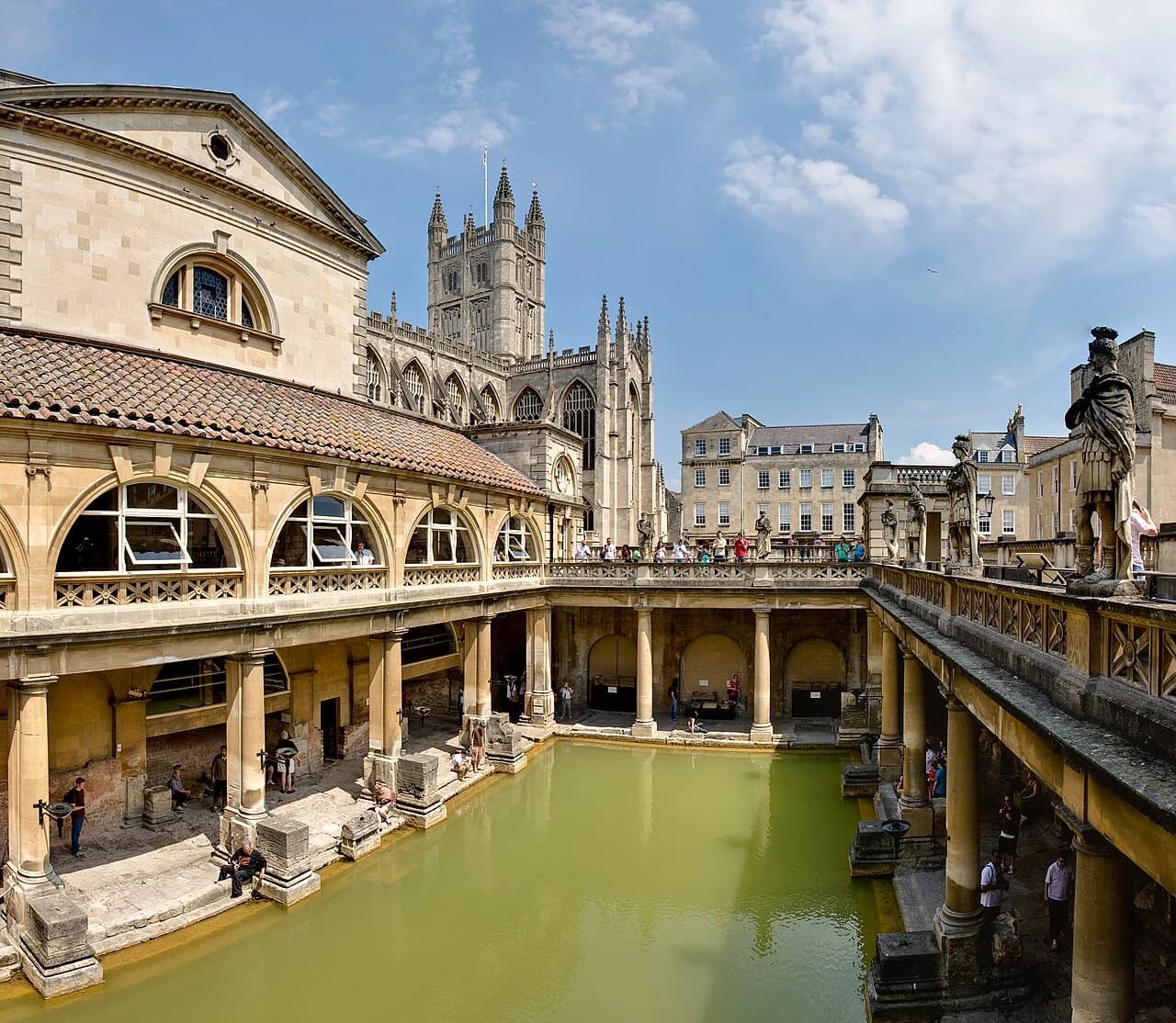
Contextualizing the Abbey's place in the city square, right next to the Roman Baths.
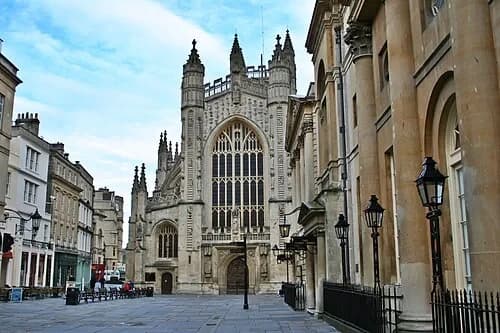
Abbey Churchyard
The Abbey Churchyard is the spiritual and social epicenter of the city. While the current Gothic building is impressive, this site has been occupied by religious structures since a monastery was first founded here in 675 AD. Today, the square offers a striking visual contrast between the medieval verticality of the Abbey and the surrounding Georgian buildings. These later structures, with their uniform heights and classical proportions, characterize the city's eighteenth-century expansion as a fashionable spa resort. The churchyard is located literally inches away from the Roman Baths, a reminder that the Abbey sits atop layers of ancient history and architectural styles. For centuries, this plaza has been a gathering place for residents, pilgrims, and tourists. In the medieval period, it would have been a bustling marketplace and a focal point for the monks living in the adjacent priory. Today, it remains a vibrant public space where musicians and performers often entertain crowds under the shadow of the Abbey’s towers. This open area allows for a full appreciation of the facade's scale, showing how the city has literally grown on top of itself over the past two thousand years.
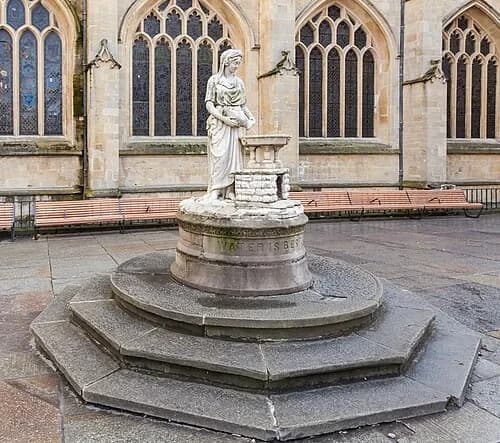
The Rebekah Fountain
Dating from 1861, this fountain stands as a functional piece of Victorian social history. It features a figure from the Bible, Rebekah, who is traditionally associated with providing water at a well. In the mid-nineteenth century, such fountains were essential public utilities, providing safe, clean drinking water to city residents long before modern indoor plumbing became common. On the base, you can find the carved inscription 'Water Is Best.' This phrase was more than just a health tip; it was a prominent slogan of the temperance movement, which campaigned against the consumption of alcohol. The movement gained significant traction during the Victorian era, and fountains like this one were often sponsored by temperance advocates to encourage people to choose water over beer or gin. The sculpture itself shows Rebekah holding a pitcher, a classic pose that reinforces the theme of replenishment and purity. While it no longer serves as the primary water source for the city, the fountain remains a characteristic landmark in the churchyard, illustrating the intersection of religious imagery, public health, and social reform in nineteenth-century Bath.
The Nave and Fan Vaulting
Entering the nave to see the world-renowned fan vaulting and the immense light from the windows.
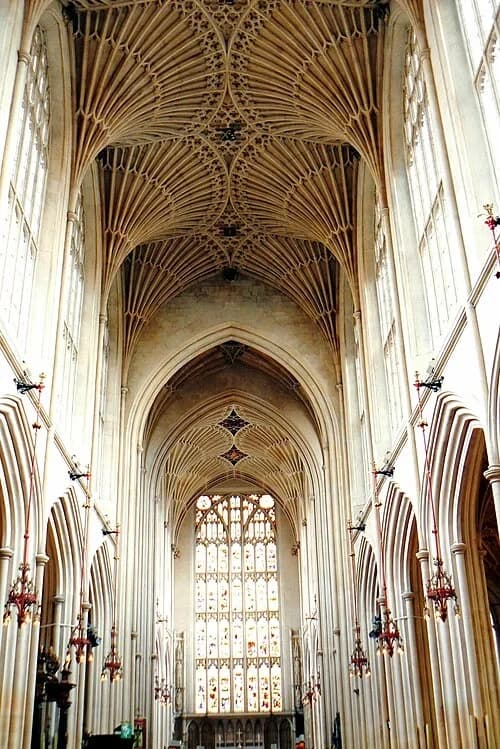
The Lantern of the West
The nickname 'Lantern of the West' becomes clear when you realize that glass occupies roughly eighty percent of the wall surface area. This extraordinary transparency was made possible by advanced Gothic engineering. Typically, massive stone walls were required to support the weight of a heavy roof, but here, the architects utilized external flying buttresses. These stone arches carry the outward thrust of the roof down to the ground, allowing the interior walls between the columns to be 'hollowed out' and filled with glass. This design turned the Abbey into a cage of light, a stark contrast to earlier medieval buildings with small, narrow windows. During the day, the shifting sun creates a constantly changing play of light and shadow across the honey-colored stone columns and floor. This revolutionary approach to space and light was intended to symbolize the divine presence within the sanctuary. By minimizing the solid stone and maximizing the windows, the builders created an environment where the boundary between the internal sacred space and the external world felt thin and permeable, allowing the building to glow like a lantern when lit from within at night.
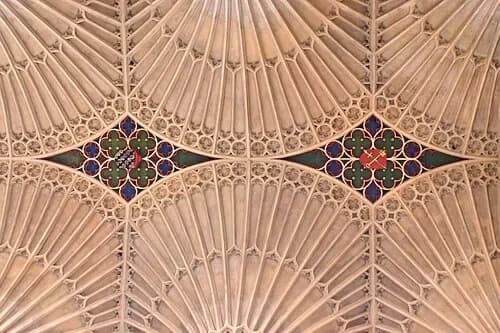
Fan Vaulted Ceiling
Looking up, you see the world-renowned fan vaulted ceiling, widely considered one of the finest examples of this architectural feat in the country. This lace-like stone structure was designed by architects William and Robert Vertue, who were among the most celebrated master masons of the early sixteenth century. Unlike traditional ribbed vaults, fan vaulting uses equidistant ribs that radiate from a single point, creating the appearance of open fans. Despite its delicate appearance, the ceiling is a marvel of engineering, composed of precisely cut stone blocks that support their own massive weight through the principles of the arch. Where the ribs meet at the center of the fans, you can see colorful heraldic shields known as bosses. These are not merely decorative; they serve as the 'keys' or keystone elements that hold the entire stone web in place. The shields represent various benefactors, including royal and ecclesiastical figures, who funded the Abbey's construction. This ceiling transformed the church into a work of art, combining structural necessity with a level of decorative detail that makes the heavy stone appear almost weightless against the light from the windows below.
The Choir and Great East Window
The spiritual center of the Abbey, featuring the massive Great East Window.
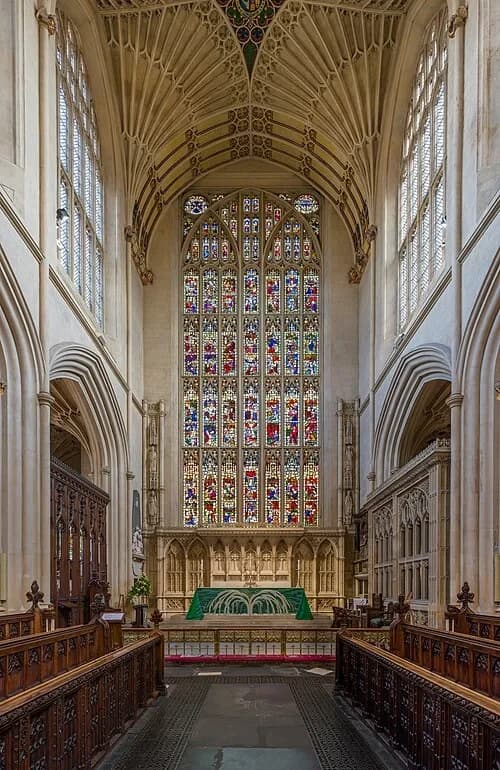
The Great East Window
The Great East Window serves as the visual and spiritual center of the Abbey. Filling the entire wall behind the High Altar, it contains fifty-six distinct panels that narrate the life, death, and resurrection of Jesus. This type of large-scale storytelling in glass was essential for teaching the Bible in an era when many in the congregation could not read. While the stonework dates back to the original construction period, much of the glass and the stability of the structure we see today are the result of extensive nineteenth-century efforts. Sir George Gilbert Scott, a prominent Victorian architect, led a major restoration of the Abbey to save it from structural decay. His work included reinforcing the window frame and ensuring the preservation of the interior's character. Scott's intervention was crucial in maintaining the Abbey's status as a masterpiece of Gothic architecture while adapting it for future generations. The window acts as a backdrop for daily services, casting a kaleidoscopic glow over the choir and altar area, reinforcing the central themes of the faith through light and color for all who gather here.
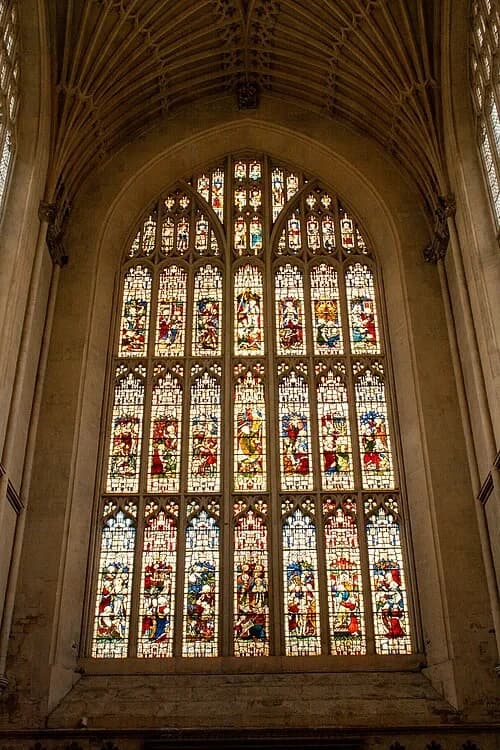
Stained Glass Detail
Study the individual panels of the stained glass to see how they follow a deliberate visual narrative. The designs typically transition from lower, more detailed panels in darker tones to brilliant, saturated colors toward the top, where the light is strongest. In the centuries before widespread literacy, these windows served a vital educational purpose known as 'Biblia Pauperum,' or the 'Bible for the poor.' By looking at the scenes, worshippers could understand complex theological stories and historical events through imagery alone. The figures are often depicted in contemporary medieval or early modern clothing, making the ancient stories feel more relatable to the people of the time. The craftsmanship involved in creating these pieces required a deep understanding of how light interacts with different types of glass and lead. Each segment of color is held in place by lead strips, forming a complex puzzle that remains durable over centuries. The result is a luminous storytelling medium that transforms the interior into a quiet gallery of history, where the natural world and the scriptural narrative are intertwined through the passage of the sun throughout the day.
The Klais Organ
Located in the North Transept, this modern masterpiece provides the Abbey's musical voice.
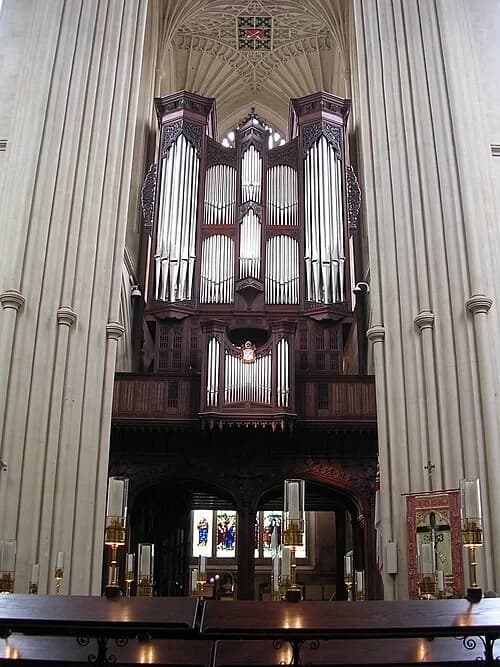
The Klais Organ
The Abbey’s powerful musical voice is provided by the Klais Organ, which underwent a major reconstruction in 1997. The project was carried out by the renowned German firm Klais Orgelbau, known for creating instruments that combine traditional craftsmanship with modern technological precision. This organ is a hybrid of old and new; it incorporates some of the original pipes dating back to the 1860s, preserving the tonal character of the earlier instrument. However, the internal mechanisms, the console, and the majority of the working parts are entirely modern, featuring state-of-the-art systems that allow for incredible control and a vast range of sound. The organ’s role is central to the life of the Abbey, supporting daily services and providing the backbone for its world-class choral tradition. Its design ensures that it can project sound effectively throughout the long, stone-vaulted nave, utilizing the building's natural resonance to its full potential. As a piece of functional art, it stands as a testament to the continued importance of music in the religious experience, bridging the gap between Victorian heritage and contemporary musical requirements for concerts and recitals.
Notable Monuments: Bingham and Waller
Highlighting two of the most significant and artistic tombs in the building.
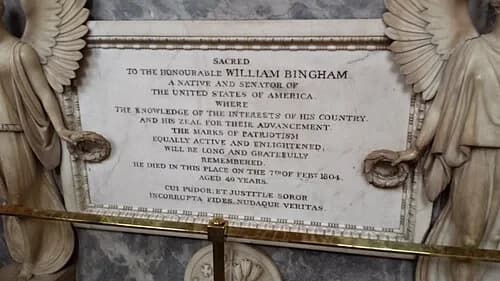
Senator William Bingham Memorial
Among the hundreds of tablets on these walls, this memorial highlights a significant connection between Bath and the early history of the United States. William Bingham, who died in the city in 1804, was far more than a typical visitor. As a founder of the Bank of North America and a United States Senator representing Pennsylvania, he was a major architect of the young nation's financial system. He spent his final years in Bath, which was a common destination for the international elite seeking health benefits from the local waters. The inscription specifically honors his patriotism and notes his service to his country as a native and senator. Flanked by carved figures holding wreaths, the text reminds us of the global reach of Bath’s eighteenth-century society. It lists his age as forty-nine years, ending with a Latin inscription regarding modesty, justice, and truth. This stone remains one of the most prominent markers of American history located within a British cathedral.
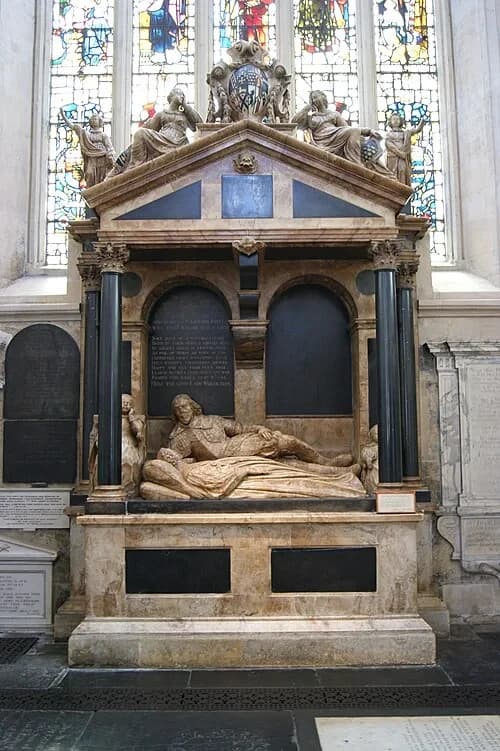
Tomb of Lady Jane Waller
This grand memorial features the reclining effigies of Sir William Waller and his wife, Jane. Sir William is depicted in his armor, resting his head on his hand as he looks toward his wife, a pose that suggests both mourning and contemplation. Below them, their children are represented in smaller scale, typical of the funerary art of the early 1600s. While the craftsmanship is evident in the detailed carving of the costumes and columns, the tomb also bears the physical marks of political conflict. Legend has it that during the English Civil War, James the Second personally damaged the knight’s face. Sir William had been a prominent Parliamentarian general, and the story goes that the King, in a fit of anger years later, used a tool to deface the image of his former enemy. Look closely at the knight’s facial features to see the worn, uneven surfaces that hint at this act of historical vandalism. The monument remains a fascinating intersection of personal grief and national political turmoil.
Want to hear the rest?
Download the Stanza app to unlock all 28 stops and full GPS-guided navigation.
Frequently Asked Questions
How long does the Bath Abbey audio tour take?
The Bath Abbey audio guide includes 28 narrated stops. Most visitors spend 45 minutes to 1.5 hours exploring the complete tour, though you can listen at your own pace and skip or revisit any stop.
Is the Bath Abbey audio guide available in my language?
Stanza supports 15 languages: English, Spanish, French, German, Italian, Portuguese, Russian, Japanese, Chinese, Korean, Arabic, Hindi, Polish, Dutch, Hebrew. Check the guide in the app to confirm the languages currently available for this tour.
Can I use the audio guide offline at Bath Abbey?
Yes! Download the complete Bath Abbey tour — including all audio, maps, and images — before your visit. The Stanza app works completely offline, so you don't need WiFi or mobile data at the venue.
How much does the Bath Abbey audio guide cost?
The Stanza app is free to download. Free and paid audio guides are available; current prices are shown in the app.
How do I use the Stanza audio guide at Bath Abbey?
Download the free Stanza app, search for "Bath Abbey", and download the tour. When you arrive at the venue, the app uses GPS to detect your location and automatically plays the relevant narration as you move between points of interest — completely hands-free.
What makes the Stanza audio guide different from other Bath Abbey tours?
Stanza offers GPS-triggered narration that plays automatically as you walk through Bath Abbey — no need to manually select stops. The tour is available in 15 languages, works fully offline, and includes 28 expertly narrated stops with images and historical context.
What other audio guides are available near Bath Abbey?
Stanza offers multiple audio guides in Bath, United Kingdom and nearby areas. After downloading the app, browse the map to discover all available tours near Bath Abbey. Each guide can be downloaded for offline use.