 Stanza / Audio guide
Content & sources
Stanza · Audio guide
Callanish Stones Audio Guide
A place to remember. A story to take with you.
The Calanais Stones are a prehistoric stone circle and stone alignment on the west coast of the Isle of Lewis in the Outer Hebrides of Scotland. The monument was built during the Neolithic period, around c…
Download Stanza, then search for “Callanish Stones”.
About the tour
One guide. Your kind of visit.
The Calanais Stones are a prehistoric stone circle and stone alignment on the west coast of the Isle of Lewis in the Outer Hebrides of Scotland. The monument was built during the Neolithic period, around c. 2750 BC.
Ready when you are.
- 01Get the free Stanza app.
iOS & Android
- 02Find your guide.
“Callanish Stones”
- 03Download before you go.
Works offline
Audio guide / 9 narrated stops
Inside the guide
Get to know a few of the stories before you go. Open a stop to read more.
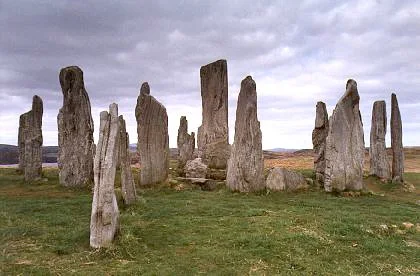
01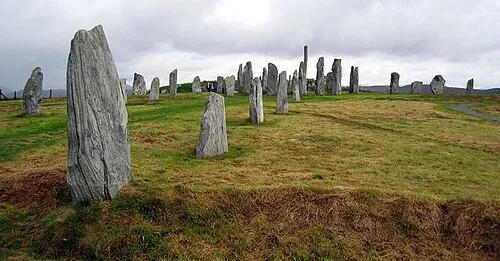 Ridge Approach and Megalithic Horizon
Arrival on the Calanais Ridge
Welcome to Calanais, on the west coast of the Isle of Lewis. In Gaelic this place is Clachan Chalanais, or more fully Tursachan Chalanais. Archaeologists call it Calanais I, because there are many other ancient sites here. What you see is a ring of standing stones with rows of others stretching out from it in several directions. The monument was raised during the Neolithic period, around 2750 BC. That makes it older than Stonehenge. It stands on a low ridge above the waters of Loch Roag, with the hills of Great Bernera behind it. Experts rank it among the most significant prehistoric stone settings in Britain. The question worth carrying through this visit is a simple one. What was this place for, and what happened here over the two thousand years that people used it?
Andrew Curtis · CC BY-SA 2.0
02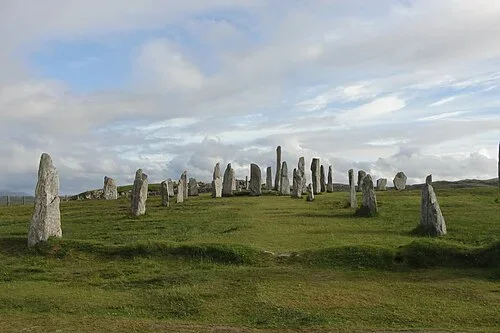 The Northern Avenue
: Gateway to the Sanctuary
Two long lines of stones run from the circle towards the north-northeast, forming an avenue about eighty-three metres long. Nineteen stones survive along it, nine on the eastern side and ten on the western. The rows are not parallel. They fan apart as they go, six metres wide at the circle and a little wider at the far end. The tallest stone, three and a half metres high, stands on the western side. There is a rhythm to the heights as well. From the circle the stones dip down towards the middle of the avenue, then rise again. The eastern stones reach only three-quarters of the height of their western partners. All of this looks deliberate, a route designed to pull people towards the ritual heart of the monument. Whether the rows were laid out at the same time as the circle, or added later, is still an open question.
Photo: Nessy-Pic · CC BY-SA 3.0
03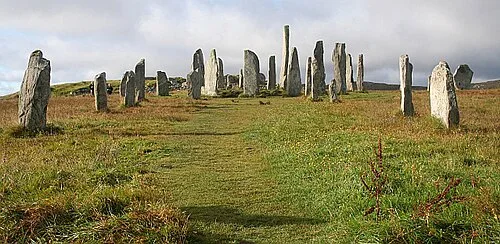 The Northern Avenue
Walking the Avenue at Dawn
Local tradition kept a story about this avenue. Early on midsummer morning, so the tale goes, a being called the Shining One walks its whole length. His coming is announced first by the call of the cuckoo. Then he passes between the stones, gliding down the corridor towards the ring. Nobody knows how old the story is, and it belongs to folklore rather than history. But it says something about how later communities experienced this place. The stones were not ruins to them. They were alive, and they kept their appointments.
Listen in the appBob Embleton · CC BY-SA 2.0
04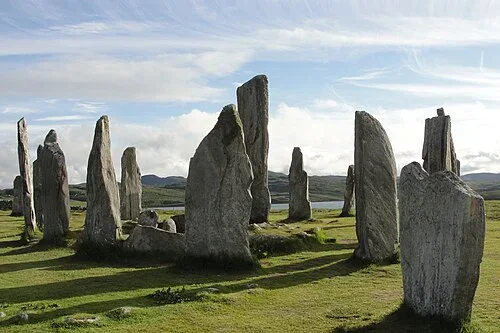 The Thirteen-Stone Ring
The circle at the centre holds thirteen stones. It is not a true circle but a ring with a flattened eastern side, about thirteen and a half metres across one way and twelve the other. The stones average three metres in height. For all its fame, the ring is small. Nearby Callanish II is two and a half times larger. The importance of Calanais lies in everything around it. Other circles, arcs, alignments and single stones dot the moorland within a few kilometres, many of them visible from this spot. All this implies that Calanais was an active focus for prehistoric religion for at least fifteen hundred years. What exactly happened inside the ring, no one can say.
Listen in the appPhoto: Nessy-Pic · CC BY-SA 3.0
05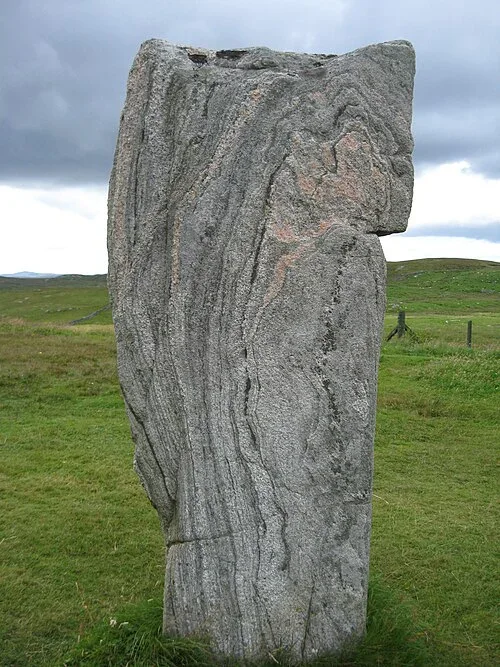 The Thirteen-Stone Ring
The Lone Stone and the False Men
Every stone at Calanais is made of the same rock, the local Lewisian gneiss. Its swirling bands and ribbons give each megalith its own weathered, almost sculptural face. This is some of the oldest rock in the world, roughly three billion years old. The banded figure-like forms of the stones caught people's imaginations long ago. Around 1680 a Lewis man, John Morisone, wrote the first known account of the site. He said the stones were men converted into stone by an enchanter, and set up in a ring for devotion. The tradition held that they were giants who refused to convert to Christianity. Locals called them fir bhrèige, the false men.
Listen in the appCarol Walker · CC BY-SA 2.0
06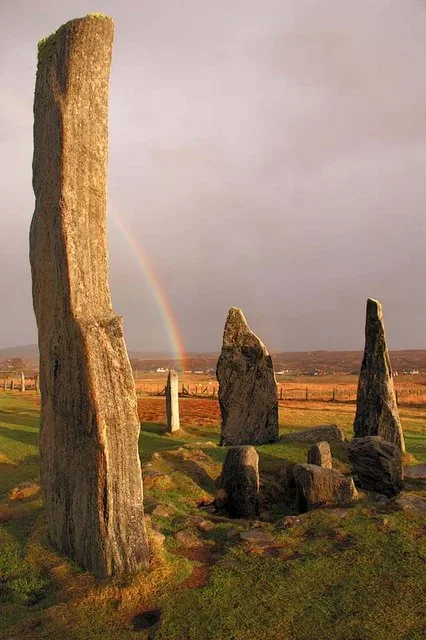 The Central Monolith
One stone rules this whole monument. The central monolith rises nearly five metres, a metre and a half wide but only about thirty centimetres thick. It is shaped like a ship's rudder and probably weighs around seven tonnes. It stands slightly off centre, just under a metre west of the true middle of the ring. Its broad faces look almost exactly north and south. Around 1695 the writer Martin Martin visited and asked the local people what the place had been. He was told it was a place appointed for worship in the time of heathenism. The chief priest, they said, stood near the big stone in the centre and addressed the people gathered around him. That account came from local memory centuries after the builders were gone, so treat it as an early observer's report rather than proven fact.
Listen in the appStephen Branley · CC BY-SA 2.0
07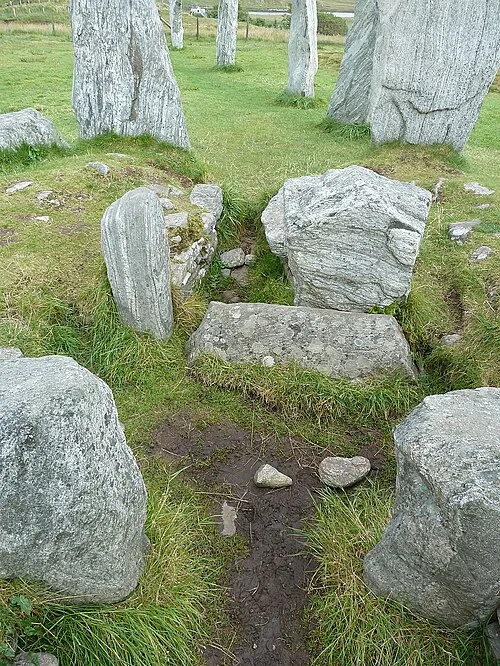 The Inserted Chambered Tomb
The Chambered Tomb
Inside the ring, east of the central stone, lies a chambered tomb about six and a half metres long. It was squeezed in some time after the circle was raised. Pottery fragments show it was used for burials over several centuries. Alongside local Hebridean pots were beaker vessels from around 2000 to 1700 BC, and sherds of grooved ware. Then the site declined. By the later Bronze Age the complex had fallen out of use, and fragments of pot appear to have been cast out of the chamber. Whether that was ordinary farming or some ritual cleansing remains undecided. Around 800 BC the place was abandoned. Blanket peat crept over the stones until only their tops showed. In 1857 the proprietor of Lewis, James Matheson, ordered a metre and a half of peat cut away. The work revealed the tomb and, for the first time in centuries, the true height of the stones.
Listen in the appRob Farrow · CC BY-SA 2.0
08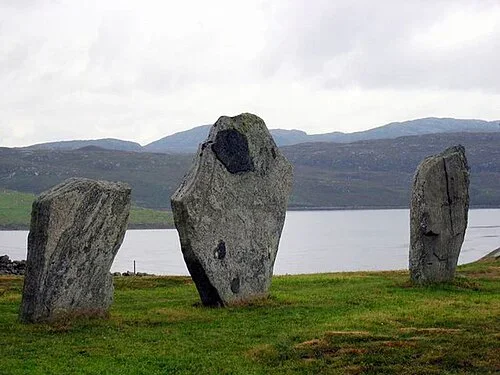 The Radial Stone Rows and Outer Hebrides Horizon
The Western Arm and the Wider Sky
Besides the avenue, three shorter rows of stones radiate from the circle. One runs to the east-northeast with five stones, one heads south with five, and one goes west-southwest with four. Together with the avenue they give Calanais its distinctive cross-shaped plan. Strangely, none of the rows aims at the centre of the ring. Each points a metre or two to one side, and no one knows why. Some have seen astronomy in the design. Alexander Thom and Gerald Hawkins suggested the stones formed a prehistoric lunar observatory, tracking the moon's slow cycles. Others proposed a link between the stones, the moon and the Clisham range in Harris, whose hills frame the horizon. Critics answer that chance alignments appear in any structure, and millennia of weathering and shifting stones make certainty impossible. The debate is still open.
Listen in the appSimon Hattinga Verschure webmarbles · CC0
09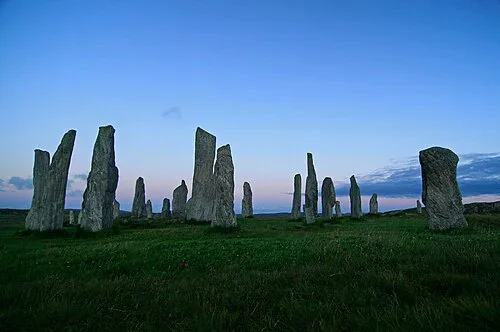 The Radial Stone Rows and Outer Hebrides Horizon
Five Thousand Years of Standing
Twilight is a good hour to weigh what happened here. The people who raised these stones were Neolithic farming communities, without writing, metal or the wheel. Yet they shaped and hauled a rudder-shaped anchor stone of seven tonnes, laid out a fanning avenue, and built a cross-shaped sanctuary that served their descendants for some two thousand years, through the whole Neolithic and Bronze Age. The monument entered state care in 1885, and today it is a scheduled monument, protected by law. Five thousand years after the first stone went up, people still come to stand among the false men.
Listen in the appSimon Hattinga Verschure webmarbles · CC0
Callanish Stones
Frequently asked questions
How much does the guide cost?
Free app download. Listed guide price: $0.99. Guide price shown in the app. Audio guide only. Venue admission is separate.
Can I listen without internet?
Yes. Download the guide’s audio, images, and maps in the app before your visit. Your downloaded content is then available offline.
Can I listen in my language?
This audio guide is available in 15 languages, including English.
Do I need to follow a schedule?
No. This is a self-guided experience. Choose your stops, pause whenever you like, and return to a story at your own pace.
At your own pace
Explore Callanish Stones.
Download Stanza, then search for “Callanish Stones”.
Free app download · Guide price shown in the app
Keep exploring
Audio guides — United Kingdom
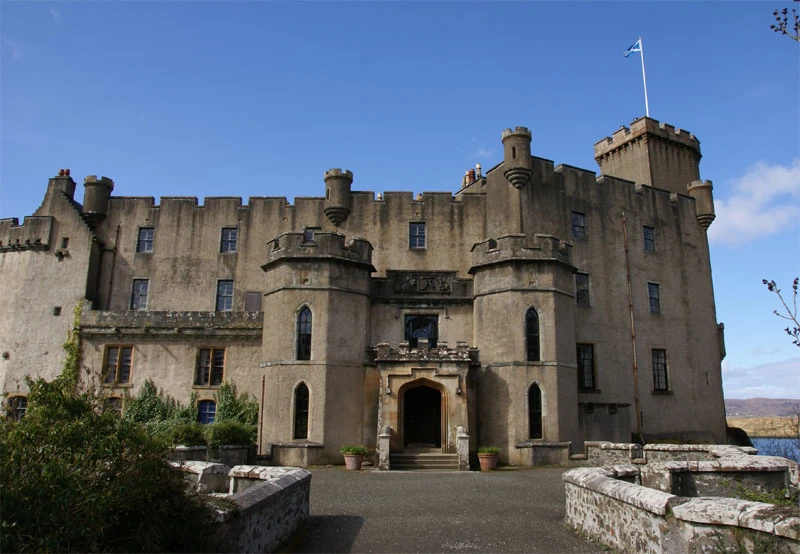
Dunvegan · 84 km
Dunvegan Castle
Content & sources
Photo: Otter · CC BY-SA 3.0

Dornie · 126 km
Eilean Donan Castle
Content & sources
Photo: Diliff · CC BY-SA 3.0
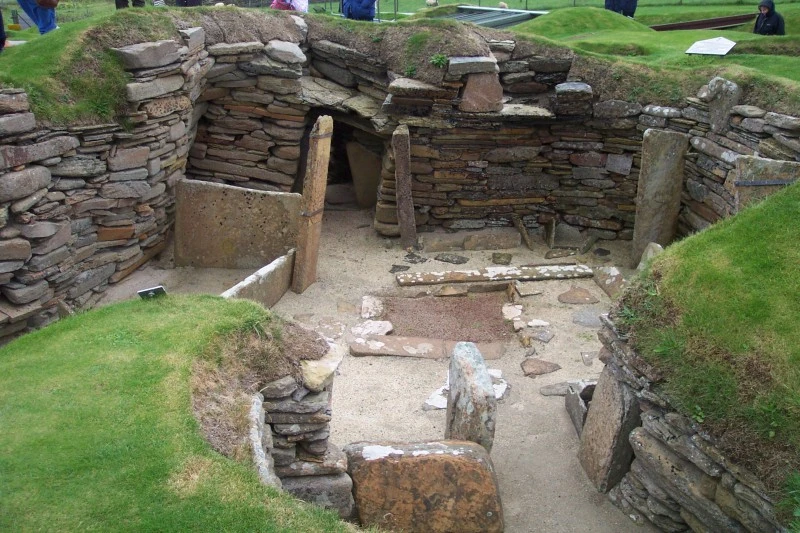
Orkney Islands
Skara Brae
Content & sources
Dr. John F. Burka · CC BY-SA 3.0
Stenness
Ring of Brodgar
Content & sources
User Guinnog on en.wikipedia · CC BY-SA 3.0
Reykjavik
Hallgrímskirkja
Content & sources
Photo: Steinninn · CC BY 4.0