Stanza · Audio guide
Glasgow Cathedral Audio Guide
A place to remember. A story to take with you.
Glasgow Cathedral is a parish church of the Church of Scotland located in Glasgow. It is the oldest cathedral in mainland Scotland and the oldest building in the city.
Download Stanza, then search for “Glasgow Cathedral”.
About the tour
One guide. Your kind of visit.
Glasgow Cathedral is a parish church of the Church of Scotland located in Glasgow. It is the oldest cathedral in mainland Scotland and the oldest building in the city.
Ready when you are.
- 01Get the free Stanza app.
iOS & Android
- 02Find your guide.
“Glasgow Cathedral”
- 03Download before you go.
Works offline
Audio guide / 12 narrated stops
Inside the guide
Get to know a few of the stories before you go. Open a stop to read more.
01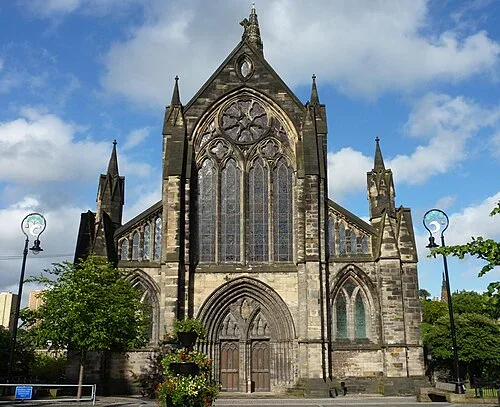 Cathedral Square and the West Front
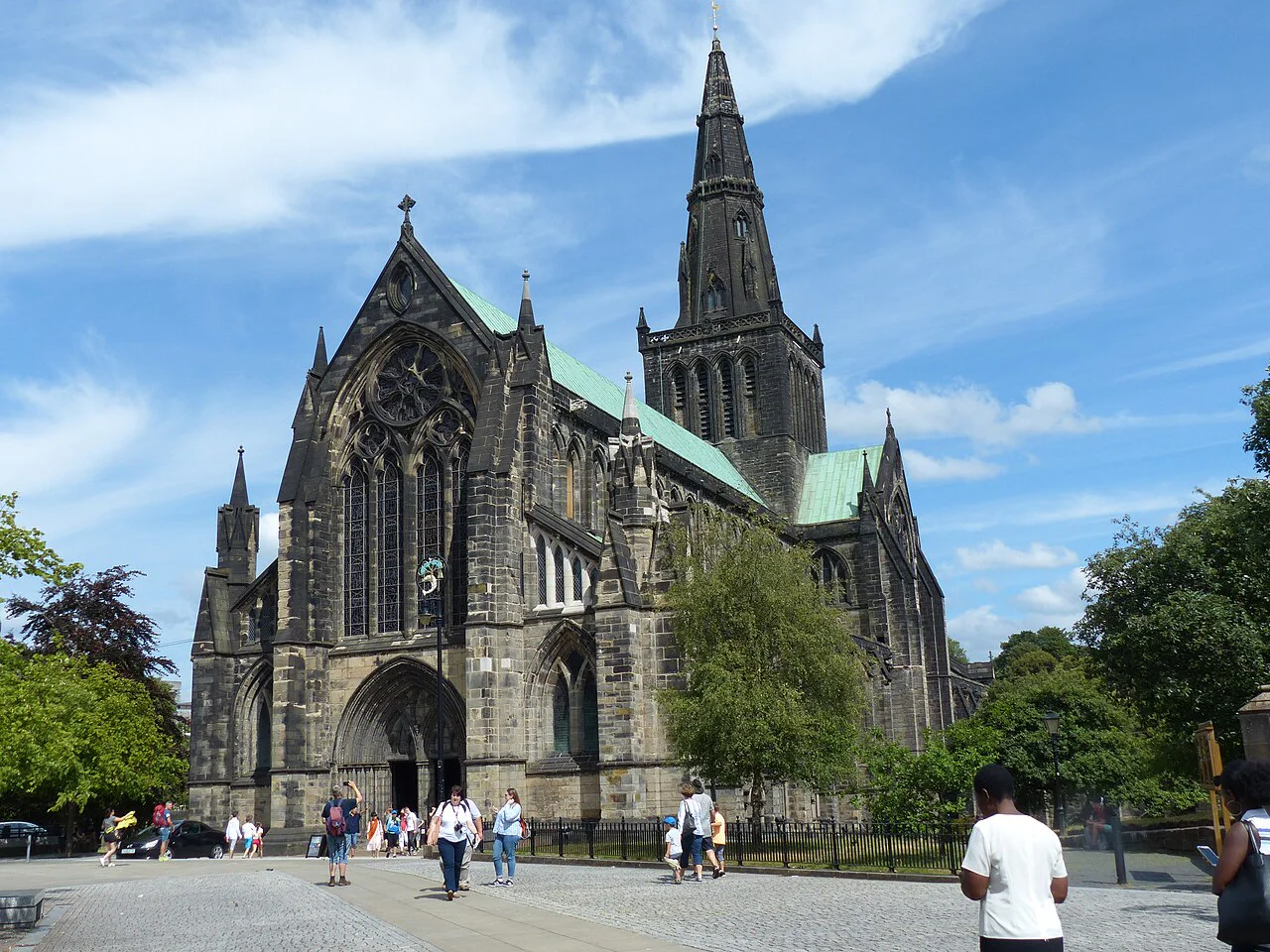
Glasgow Cathedral from Cathedral Square
Welcome to Cathedral Square, and to the oldest building in Glasgow. This is Glasgow Cathedral, and it has stood here, on this high ground, since the twelfth century. It is the oldest cathedral on the Scottish mainland, and here is the remarkable thing: with St Magnus Cathedral in Orkney, it is one of only two medieval cathedrals in the whole of Scotland to come through the Reformation virtually intact. Almost every other one was torn down or gutted. This one wasn't, and over the next few stops I'll show you why. The building is dedicated to Saint Mungo, the patron saint of Glasgow, and his story is waiting for you down in the Lower Church. For now, look up. That central spire rises about a hundred and five feet, and the roof sweeping either side of it is a distinctive green. That colour is copper, and it's younger than it looks. Between 1909 and 1912, the medieval timber roofs over the nave and choir were found to be unsafe, so they were taken out and replaced with new oak, under the architect William Thomas Oldrieve. To lighten the load on the old walls, the heavy lead and slate covering was swapped for copper sheeting, and that copper has weathered to the green you see today. So the silhouette you're looking at is medieval, with an early twentieth-century crown. Now let's go in through the main door, and I'll tell you how the stones themselves came to be.
Photo: Otter · CC BY-SA 3.0
02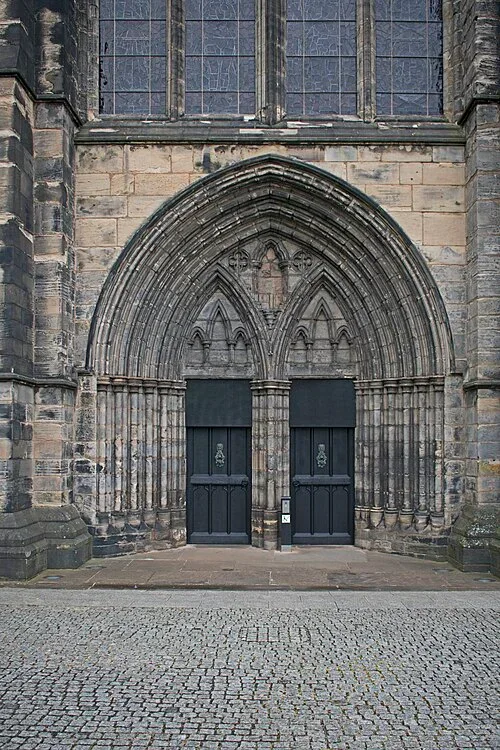 Cathedral Square and the West Front
The West Portal
Here at the great arched doorway, with its deep orders of carved mouldings drawing your eye inward, let's talk about how this building actually came to be. There have really been two stone cathedrals on this spot. The first was dedicated in 1136, in the presence of King David the First and his court, after David decided to establish a bishopric at Glasgow. It was built over the burial place of Saint Mungo. That first building didn't last in one piece. It was destroyed or severely damaged by fire, and the cathedral you're about to enter was dedicated in 1197. But even that isn't quite the building in front of you, because most of what surrounds you now dates from a major rebuilding in the thirteenth century, when the church was extended and reshaped on a grand scale. And the older cathedral hasn't entirely vanished. When archaeologists excavated here between 1988 and 1997, they found fragments of that 1136 building beneath the floor of the present one. So as you step through this portal, you're walking in over the bones of the first cathedral. Come inside, and let's see what happened here in the sixteenth century, when this place faced its greatest danger.
Photo: Ymblanter · CC BY-SA 4.0
03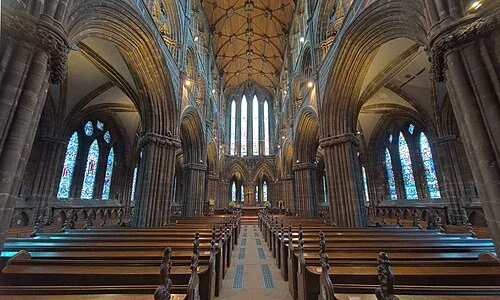 The Grand Nave and Great West Window
The Nave
Stand here in the nave and look down the great arcades toward the altar. This room is the reason the cathedral still exists. When the Scottish Reformation came in the sixteenth century, the cathedral was cleansed of its Catholic furnishings: altars and sculpture were removed, and the roof was apparently stripped of its lead. Archbishop James Beaton had fled to France, taking the diocesan records with him. But a decision was made that matters enormously: instead of demolishing the building, as happened elsewhere, it would be kept for Protestant worship. In 1562, David Wemyss became its first Protestant minister. The building still suffered. Vandalism and plunder took their toll, and by 1574 the town council was alarmed enough to record, in old Scots, the great decay and ruin the high kirk had come to, warning that so great a monument would utterly fall down without remedy. They even raised a tax of two hundred pounds for repairs. Then, in 1579, came the moment that saved it: the members of the Glasgow Trades House armed themselves and defended the cathedral from a mob that meant it further harm. That is how it survived the Reformation relatively unscathed. The price was compromise: the interior was partitioned to serve three separate Church of Scotland congregations, the Inner High, the Outer High, and the Barony. Now turn and look at the great window behind you, because its glass has a story of loss and renewal all of its own.
Listen in the appSteve Collis from Melbourne, Australia · CC BY 2.0
04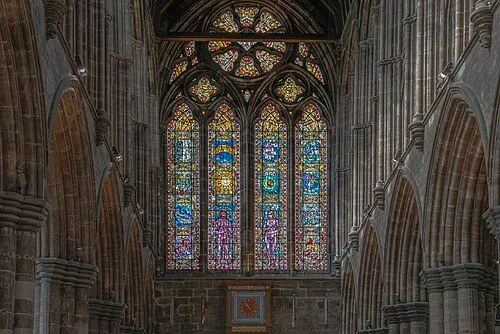 The Grand Nave and Great West Window
The Great West Window: The Creation
This is the Great West Window, and it's called The Creation, made by the artist Francis Spear in 1958. But the glass itself is the youngest character in an older story. After the Reformation, many of the cathedral's windows were simply bricked up, so for centuries these openings admitted no coloured light at all. In the 1860s, the windows of the nave and choir were filled with stained glass from the Royal Bavarian Stained Glass Establishment in Munich, a scheme so ambitious it counted as one of the largest public art commissions of the whole Victorian age. Yet by 1938, the colours of that Munich glass had faded and the leading had deteriorated so badly that it all needed replacing. And here is the interesting turn: instead of ordering another batch from abroad, the Society of Friends of Glasgow Cathedral decided the windows should be replaced by works of the best contemporary artists. That decision brought us Spear. Look at his window filling this medieval opening: the bright panels telling the story of creation, set within stone arches that have framed this west end for centuries. It's a nice thought, that a window made in the mid twentieth century now carries the light for a wall built in the Middle Ages. Now walk with me toward the screen ahead, where the nave ends and the choir begins.
Listen in the appMarek Śliwecki · CC BY-SA 4.0
05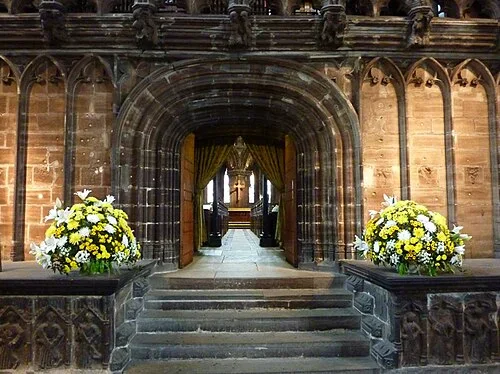 The Quire and Stone Pulpitum
The Stone Pulpitum
Pause here a moment at this stone screen, the pulpitum, with its arched opening drawing you through toward the choir. Screens like this once divided the public nave from the clergy's choir in cathedrals across Scotland, and at the Reformation most of them were swept away. That is what makes this one unusual: a medieval stone screen of this kind, still standing in place, is a rare thing in this country. Beyond it lies the choir, the eastern arm of the church. Let's go through.
Listen in the appPhoto: Otter · CC BY-SA 3.0
06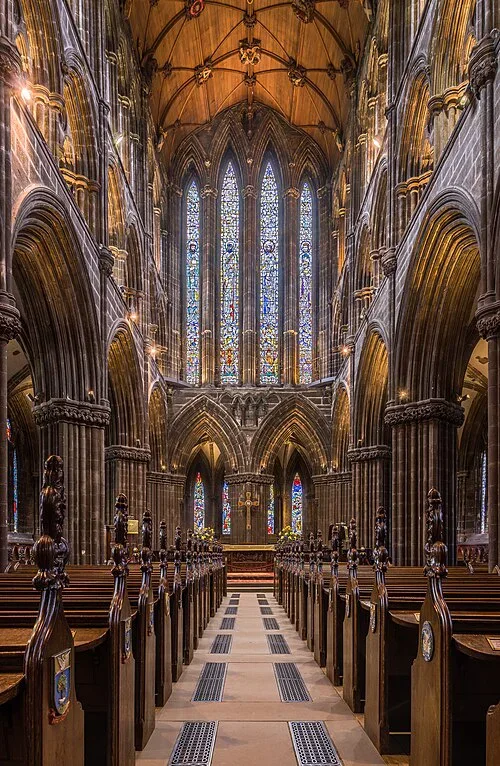 The Quire and Stone Pulpitum
The Choir and High Altar
This is the choir, and down at its east end stands the high altar, the spiritual centre of the cathedral. Worship has been offered here continuously since the Middle Ages, and two royal moments show just what this altar has witnessed. In August 1301, during the First War of Scottish Independence, Edward the First of England visited the cathedral and made offerings over four days, at the high altar and at the tomb of Saint Mungo below. A conquering king, paying his respects here. Then, on the tenth of December 1502, James the Fourth of Scotland came to this same altar to ratify the treaty of Perpetual Peace with England. James was actually a canon of this cathedral, and the peace, sadly, did not live up to its name for long. But the ceremony happened here, at the altar you're looking toward. One more thing to notice: the organ. The four-manual instrument by Henry Willis, installed in 1879, was the first organ in the cathedral since the Reformation, when organs had gone the way of the altars. Today a professional choir sings here at two services every Sunday. Now follow me to a room just off the cathedral where something remarkable began: a university.
Listen in the appPhoto: Colin · CC BY-SA 4.0
07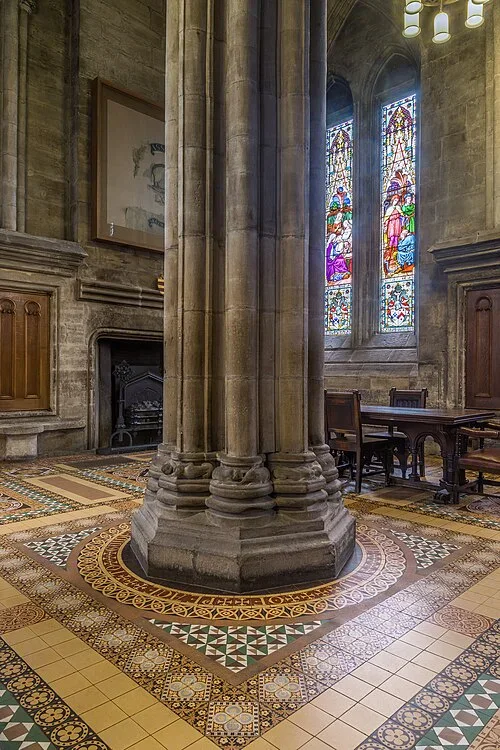 The Chapter House
This is the chapter house, and that great central pillar rising to meet the vault above is where our story begins, because this room is the birthplace of the University of Glasgow. In the mid fifteenth century, Bishop William Turnbull had an idea: Glasgow deserved a university. He prompted King James the Second, who happened to be a canon of this very cathedral, to write to Pope Nicholas the Fifth asking for one. The Pope answered with a papal bull issued on the seventh of January, 1451. It established what was called a Studium generale in Glasgow, a place of general study, for the teaching of theology, canon and civil law, the arts, and any other lawful faculty. And here is the detail I love: the Bishops of Glasgow were made the Chancellors of the new university, so the church kept a hand on its creation. The university held its first classes here, in this chapter house, with students gathered around this pillar, before moving on to buildings on the Rottenrow. Think about that the next time you hear the University of Glasgow mentioned among the great old universities: it started as a handful of lessons in a cathedral room. Now let's go down, to the sacred heart of the whole building, and the reason Glasgow exists at all.
Listen in the appPhoto: Colin · CC BY-SA 4.0
08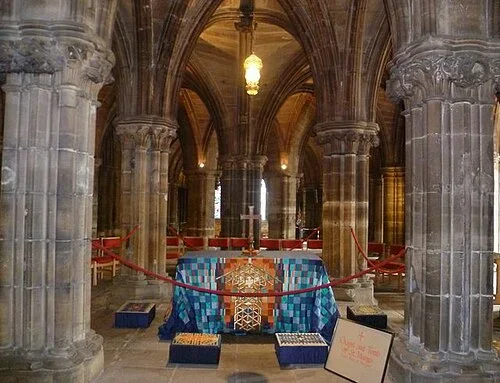 The Lower Church and Saint Mungo's Tomb
The Shrine of Saint Mungo
You're now in the Lower Church, at the shrine of Saint Mungo, and this is where the whole story starts. Mungo, also known by his other name, Kentigern, lived in the sixth century. The story goes that he brought the body of a holy man named Fergus for burial at a site called Cathures, on the western bank of the Molendinar Burn, the place that came to be known as Glasgow. There, in that burial ground, Mungo built himself a monastic cell. He died and was buried in his church there in the year 614. That burial place, most likely, is why the cathedral stands on this steep hillside site at all. His shrine here in the Lower Church became one of the most important places of pilgrimage in medieval Scotland. For centuries, people came from across the country to pray at the tomb of the saint, and that steady stream of pilgrims is what made Glasgow wealthy and important, long before it was a city of trade and industry. Let your attention rest on the idea that everything above us grew from this spot. Now look up at the vaulting around you, because the architecture here was shaped by those very pilgrims.
Listen in the appkim traynor · CC BY-SA 2.0
09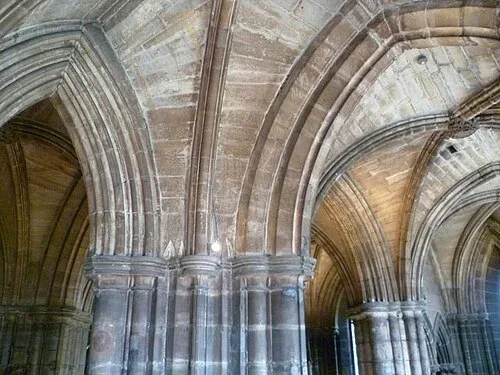 The Lower Church and Saint Mungo's Tomb
The Lower Church Vaulting
Look up at these stone ribs springing from their clustered shafts: this is the vaulting of the Lower Church, and it carries the story of the great thirteenth-century building campaign. Two bishops drove it forward. Between 1207 and 1232, Bishop Walter Capellanus completed the choir and this Lower Church, and worked out the layout that the transepts and nave would eventually follow. Then from 1233 to 1258, his successor, Bishop William de Bondington, kept the work going. His great addition was a new, longer eastern arm, which provided a shrine to Saint Mungo, and he added three projections onto the building: the chapter house you visited, the sacristy or treasury, and what later became the Blacader Aisle. Now, why two levels at all? The site is a steep slope above the Molendinar Burn, and the saint's tomb drew huge crowds. The design of this church, with an upper church and a lower church stacked on the hillside, allowed pilgrims to move through the lower level and reach the shrine without disrupting the services above. Next, I want to show you a tomb down here with a very different story: a bishop who went to war.
Listen in the appkim traynor · CC BY-SA 2.0
10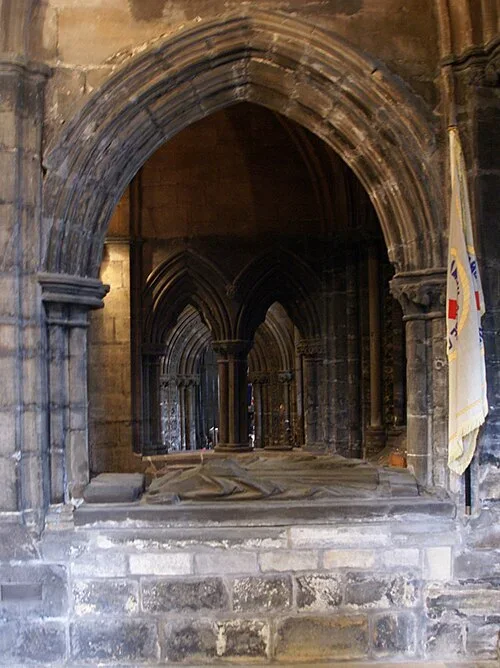 Tomb of Bishop Robert Wishart
The Tomb of Bishop Robert Wishart
Here lies Bishop Robert Wishart, and his is one of the most dramatic stories in this cathedral. Wishart was Bishop of Glasgow from 1271 until his death in 1316, and he lived through the Wars of Independence. In February 1306, John Comyn was killed at Greyfriars in Dumfries, in Wishart's own diocese. Robert the Bruce hurried to Glasgow, and here he met the bishop. Wishart granted Bruce absolution, urged the clergy throughout the land to rally to his cause, and then travelled with him to Scone, where Bruce was crowned as Robert the First. And the bishop didn't stop at blessings. The English had supplied timber to repair the cathedral's bell tower; Wishart used that timber to make siege engines instead. He laid siege to the English-held Kirkintilloch Castle, then crossed into Fife and took charge of the assault on Cupar Castle. A warrior bishop indeed. When he died in 1316, his body was entombed here, between the chapels of Saints Peter and Paul and Saint Andrew, at the east end of the Lower Church. Look at the effigy now: the tomb carries no inscription, and the head of the figure has been defaced at some point, probably during the Reformation. A man who shaped the fate of Scotland, lying anonymously among the arches. Now let's go back up, to one last flourish of the Middle Ages.
Listen in the appPhoto: Otter · CC BY-SA 3.0
- 11
The Blacader Aisle
Fan vaulting, carved bosses, a fifth-century tradition, and Glasgow's rise to an archbishopric.
- 12
The Great Bell
The Great Bell of 1583, remade in 1790, and a closing thought on the cathedral's endurance.
Glasgow Cathedral
Frequently asked questions
How much does the guide cost?
Free app download. Listed guide price: $0.99. Guide price shown in the app. Audio guide only. Venue admission is separate.
Can I listen without internet?
Yes. Download the guide’s audio, images, and maps in the app before your visit. Your downloaded content is then available offline.
Can I listen in my language?
This audio guide is available in 15 languages, including English.
Do I need to follow a schedule?
No. This is a self-guided experience. Choose your stops, pause whenever you like, and return to a story at your own pace.
At your own pace
Explore Glasgow Cathedral.
Download Stanza, then search for “Glasgow Cathedral”.
Free app download · Guide price shown in the app
Keep exploring
Nearby audio guides
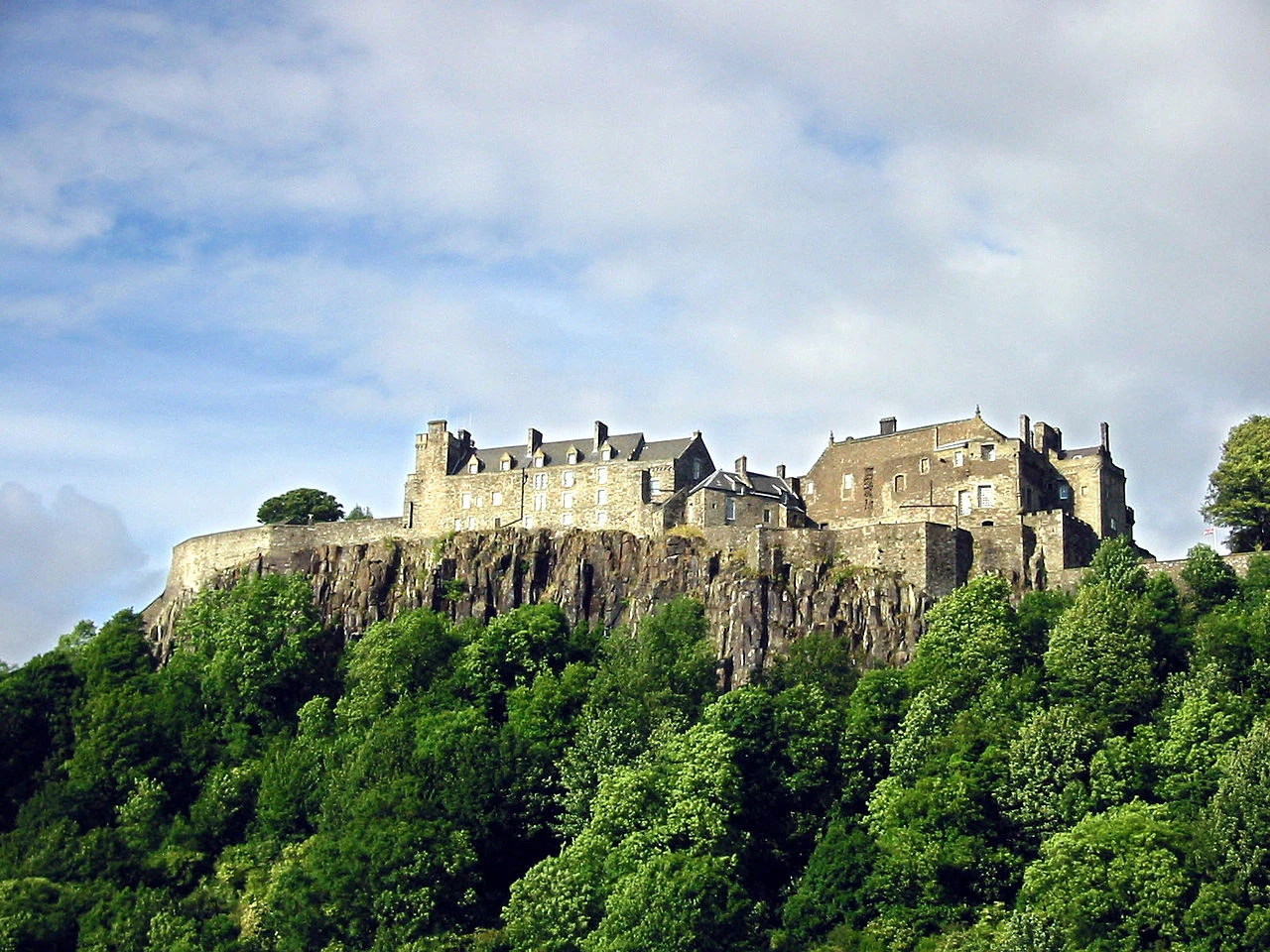
Stirling · 34 km
Stirling Castle
Content & sources
Photo: Citypeek · CC BY-SA 3.0
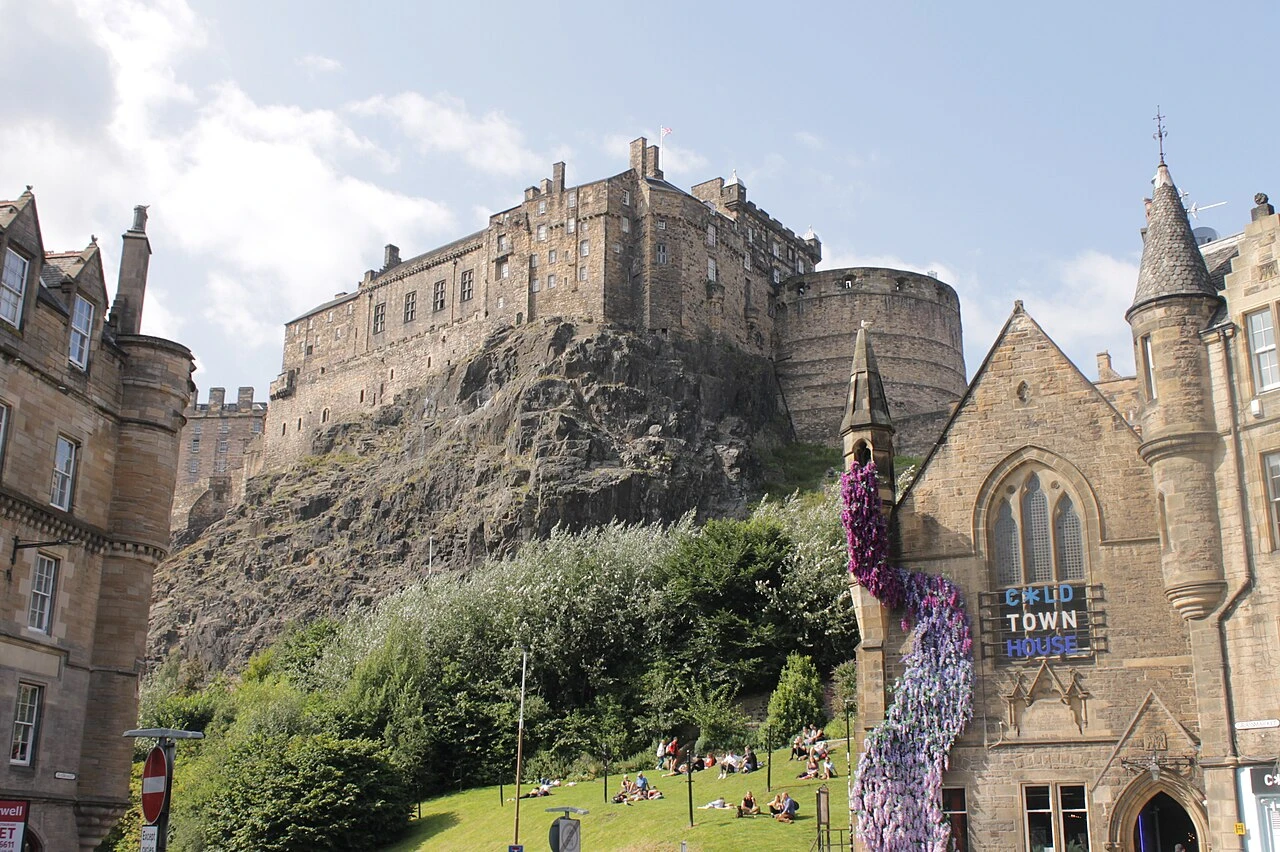
City of Edinburgh · 65 km
Edinburgh Castle
Content & sources
Photo: Stephencdickson · CC BY-SA 4.0
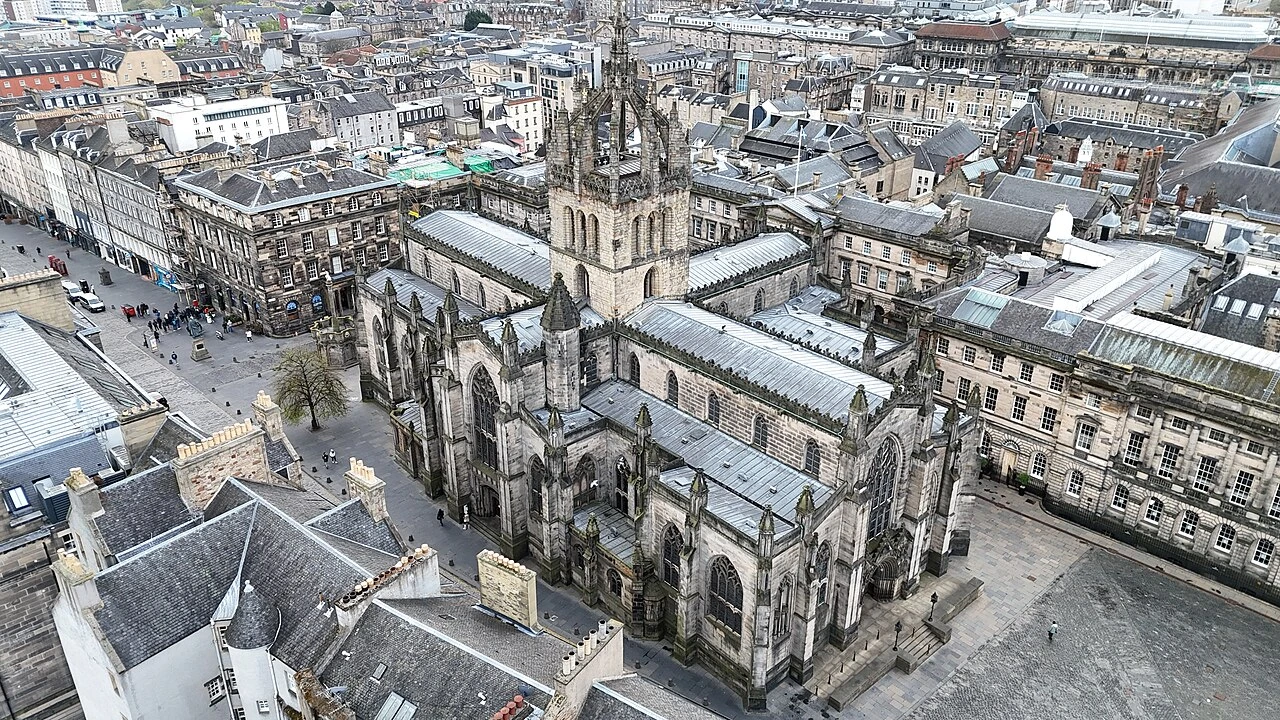
City of Edinburgh · 66 km
St Giles' Cathedral
Content & sources
Photo: 瑞丽江的河水 · CC BY-SA 4.0
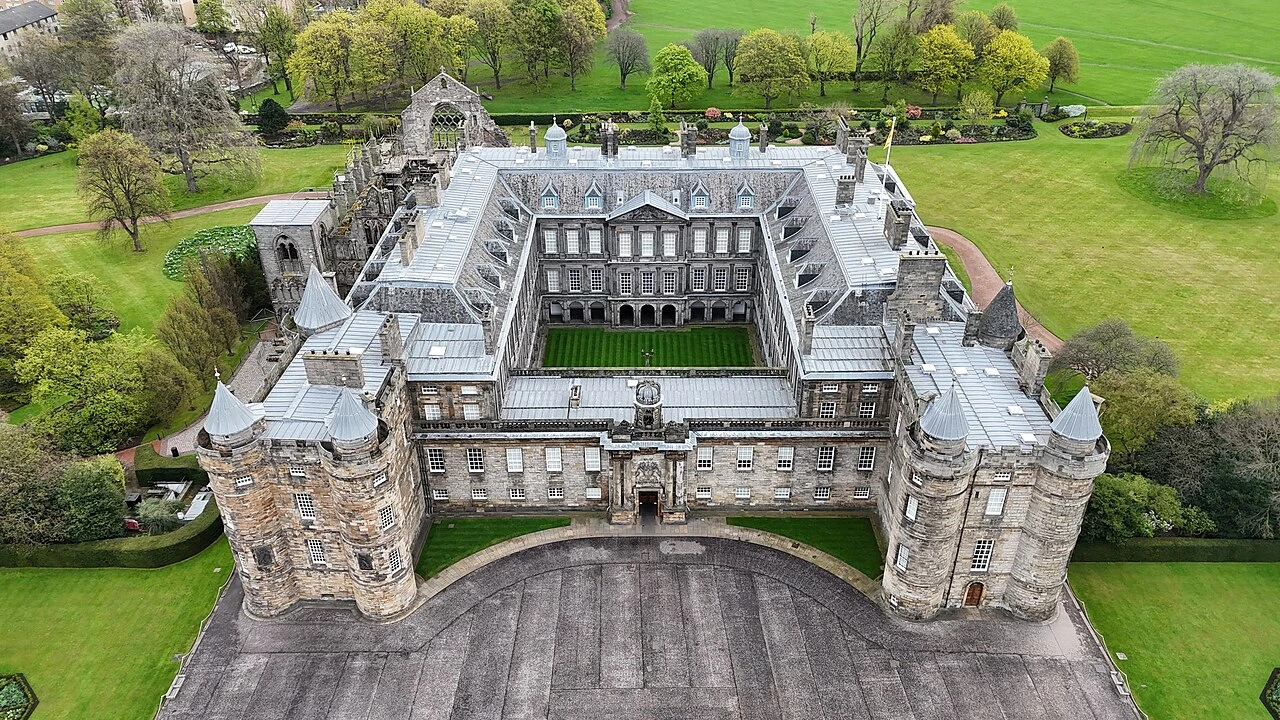
City of Edinburgh · 67 km
Holyrood Palace
Content & sources
Photo: 瑞丽江的河水 · CC BY-SA 4.0