Languages
15Tower Bridge Audio Guide
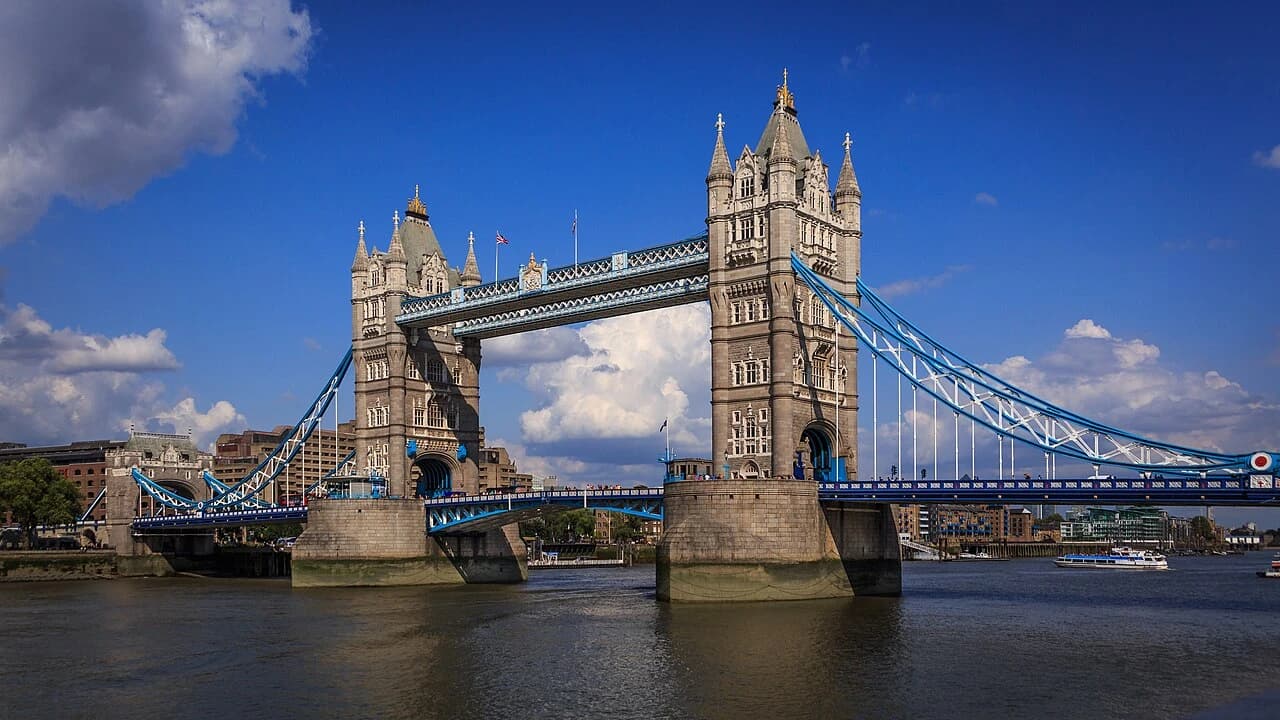
Tower Bridge is a landmark in Greater London, United Kingdom. Explore it with Stanza's GPS-triggered offline audio guide — available in 15 languages.
Quick Facts
18
Stops
15
Languages
100%
Offline
📍 Greater London, United Kingdom · 51.5056°N, -0.0753°E
About Tower Bridge
Tower Bridge is a historic bascule and suspension bridge in London, United Kingdom. It spans the River Thames and is a significant landmark and tourist attraction.
This self-guided audio tour features 18 narrated stops organized across 7 sections. in the heart of Greater London, United Kingdom.
The Stanza audio guide is available in 15 languages and works entirely offline — download the complete tour including audio narration, maps, and images before your visit. As you walk through Tower Bridge, GPS-triggered narration plays automatically at each point of interest.
Last updated:
What you will hear
The Gothic Façade: Steel and Stone
Focusing on the architectural 'deception' where Victorian Gothic stone hides a modern steel skeleton.
The Suspension Sections
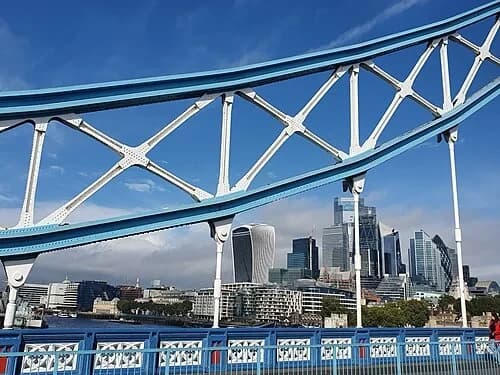
The sections of the bridge connecting the towers to the riverbanks function as suspension spans. These spans are supported by massive steel hangers and chains that carry the weight of the road deck. The engineering was led by Sir John Wolfe Barry and Henry Marc Brunel, who ensured the bridge could handle the heavy traffic of a growing metropolis. You might notice the distinctive blue and white color scheme of the steelwork. Originally, the bridge was painted a somber chocolate brown to suit Victorian tastes. The change to the current palette occurred in 1977 to celebrate the Silver Jubilee of Queen Elizabeth II. This vibrant choice highlights the intricate lattice of the steelwork, making the engineering features stand out against the grey London sky. The suspension chains are anchored deep into the ground on the shore and into the towers themselves, balancing the forces of the bridge. The rivets and joints in these sections are visible reminders of the manual labor required to assemble such a gargantuan structure. These side spans provide stability while allowing the central bascules the freedom to move. The blue paint is regularly maintained to protect the steel from the damp, salty air rising from the tidal Thames.
Inside the North Tower
The beginning of the interior exhibition, highlighting the workers and construction history.
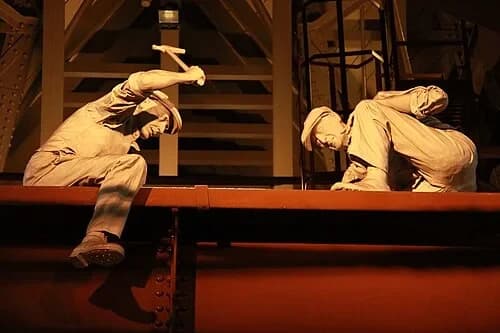
The Bridge Builders
Inside the North Tower, sculptures and displays bring the human cost of the bridge’s construction into focus. The 11,000-ton steel framework was held together by over two million rivets, each one hammered in by hand. The workers, known as riveters, operated in teams under incredibly challenging conditions. A typical team included a 'heater' who warmed the rivets until they were red-hot and a 'catcher' who caught them in a bucket before passing them to the 'basher' to be hammered home. Working at heights of up to 200 feet, these men often navigated narrow beams without safety harnesses or modern protection. The noise was deafening, and the risk of a fall was a constant reality of the job. These sculptures serve as a reminder that while the bridge is a triumph of design, it was also a feat of physical endurance and bravery for the 1,200 workers involved. The labor-intensive process took eight years to complete, reflecting the industrial might of the late 19th century. By looking at the detailed figures, you can appreciate the grit required to build what was then the most sophisticated bridge in the world. The rivets they placed remain the backbone of the structure today.
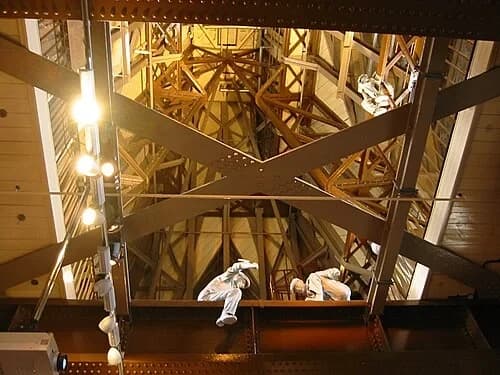
The Steel Skeleton
As you look up at the exposed girders inside the tower, you are seeing the true structural heart of the bridge. The ornate stone exterior is essentially a 'skin' draped over this massive steel skeleton. In fact, the steel framework alone weighs more than all the Cornish granite and Portland stone used for the facade. During the 1880s, workers moved through this lattice of iron and steel to assemble the towers. Navigating these narrow cross-beams and vertical supports required a steady head for heights, especially before the walkways were enclosed. The design used a staggering amount of steel to provide the strength necessary to support the central lifting bascules and the upper walkways. This internal structure represents the peak of Victorian engineering, utilizing the latest metallurgical advances of the era. The contrast between the industrial steel inside and the medieval-looking stone outside is one of the bridge’s most intriguing features. It demonstrates how Victorian engineers prioritized function and strength while architects ensured the project met the aesthetic expectations of the day. The rivets and plates visible here have supported the weight of millions of pedestrians and vehicles for over 130 years. Much of the original steel remains perfectly preserved within the protective stone towers.
The Glass Floor Experience
The 'Must-See' modern addition to the high-level walkways.
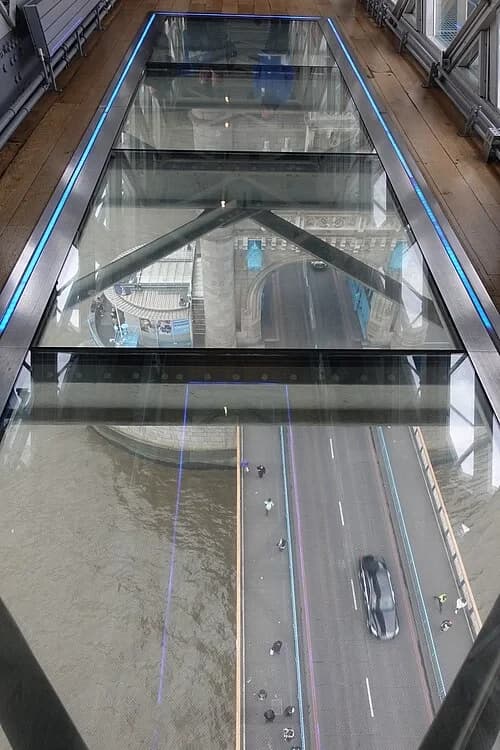
Watching the Road
The view from the high-level walkways offers a unique vantage point to watch the pulse of the city below. Every day, approximately 40,000 people and thousands of vehicles, including the iconic red London buses, cross the bridge. This level was originally designed for pedestrians to use when the bascules were raised for ships, ensuring that river traffic never fully halted the movement of people. However, climbing the stairs proved unpopular with many Victorians, who preferred to wait at street level for the bridge to close. Today, the walkways provide a serene escape from the noise of the traffic while offering a perfect look at the chaos below. You can watch the vehicles line up and wait during a bridge lift, a tradition that has continued since 1894. From here, the scale of the bridge relative to the surrounding city is obvious. The road deck is a vital link between the north and south sides of the river, connecting the City of London with Southwark. Observing the ebb and flow of traffic gives you a sense of the bridge’s ongoing importance to London’s infrastructure. The perspective highlights the constant movement that defines the capital, with the river traffic continuing its historic journey underneath.
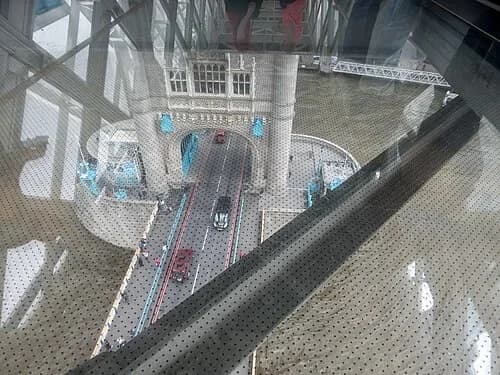
The Glass Floor Experience
The glass floor, installed in 2014, provides a perspective on the bridge that was previously only available to the workers who built it. You are standing exactly 42 meters above the River Thames. While it might feel precarious, the floor is engineered for absolute safety, consisting of six layers of glass that can support the weight of two elephants. Looking straight down, you can see the red London buses and black cabs passing directly beneath your feet, looking like miniature toys. Beyond the road, the swirling grey waters of the Thames flow toward the sea. This installation was designed to give visitors a deeper connection to the living mechanics of the bridge, allowing them to watch the bascules rise from a bird’s-eye view. The clarity of the glass offers a unique opportunity for photography, capturing the symmetry of the road deck and the surrounding skyline. It has become one of the most popular features of the bridge, turning a simple walk across the river into a memorable experience. The surrounding steel structure of the walkway frames this window to the world below, highlighting the heights at which the original high-level footbridges were situated. Each panel is regularly inspected to ensure it maintains its crystal-clear view of the bustling city.
The West Walkway and Pool of London
Exploring the history of the walkways and the panoramic views of the historic port area.
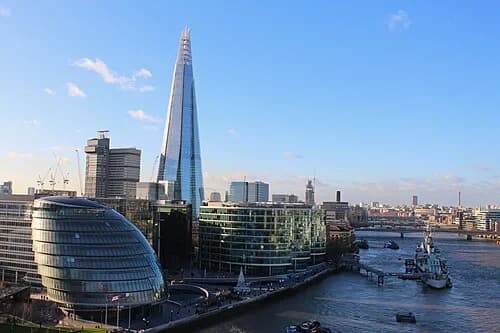
The Pool of London
Looking west from the walkway, you are overlooking the area known as the 'Pool of London.' Until the late 19th century, this stretch of the river was the busiest port in the world, packed with merchant ships from every corner of the globe. The necessity of building Tower Bridge here was driven by the need to manage this congestion while allowing tall ships to reach the upper wharves. Today, the landscape has shifted from industrial docks to a mix of historic and modern icons. You can see the grey hull of HMS Belfast, a Second World War light cruiser now serving as a floating museum. Beyond it, the Shard pierces the skyline, representing the modern financial power of the City. This view perfectly illustrates the evolution of London’s riverfront from a place of manual labor and trade to a center of tourism and global business. The bridge acts as the gateway between the old shipping heart of the city and the modern developments further downstream. The river remains a busy highway, though the cargo has changed from spices and tea to commuters and tourists. This panoramic vista captures centuries of history in a single glance, from the ancient Tower of London to the newest glass towers.
The Accumulator Tower
A key piece of external engineering infrastructure used to store hydraulic power.
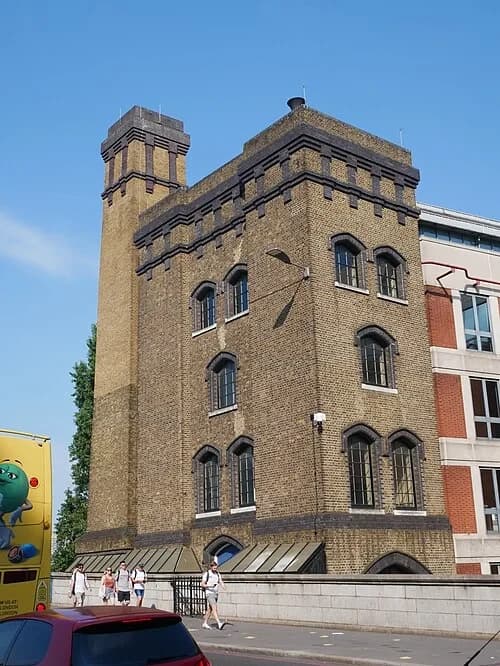
The Accumulator Tower
This brick tower played a crucial role in the bridge's original hydraulic power system. It functioned as an accumulator, which is essentially a giant mechanical battery. Inside the tower, massive weights were suspended and used to maintain a constant water pressure of 750 pounds per square inch within the system. When the steam engines were running, they pumped water into the accumulator, lifting the weights. This stored energy could then be released instantly to raise the heavy bascules, even if the engines were temporarily turned off or being serviced. This backup system ensured that the bridge remained reliable and could respond quickly to river traffic, which had the right-of-way. The hydraulic technology was state-of-the-art for the 1890s, allowing the 1,000-ton bridge sections to be moved with remarkable precision. Although the bridge was converted to an electro-hydraulic system in 1974, the Accumulator Tower remains a testament to the ingenuity of Victorian engineering. The building itself is a sturdy example of industrial brickwork, designed to withstand the immense pressures and weights housed within. It reflects the era's focus on redundancy and reliability in critical public works. Today, it stands as a silent sentinel of the bridge's original steam-powered heart.
The Victorian Engine Rooms
The 'Must-See' original heart of the bridge's hydraulic system.
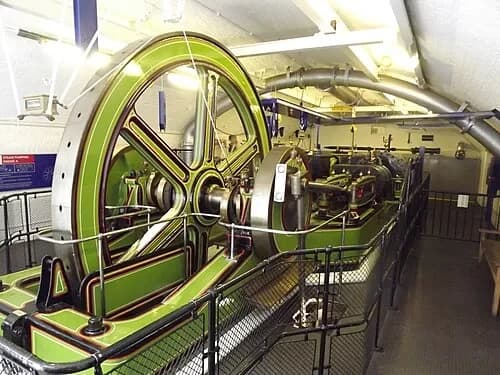
Engineering Pride
The atmosphere within the engine room reveals a surprising elegance that contrasts with the heavy, industrial function of the machines. Victorian engineers didn't just build for utility; they viewed their mechanical creations as masterpieces worthy of decoration. Deep green finish on the ironwork and the brilliant shine of the brass valves and railings characterize this space. This color scheme was intended to showcase the cleanliness and precision of the maintenance required for such massive equipment. Meticulous care extends to the architectural details on the machines themselves, which often feature ornate moldings and artistic flourishes. By giving the internal machinery the same decorative attention as the stone towers outside, the builders demonstrated that this bridge was a crowning achievement. This pride ensured that the stokers and engineers worked in an environment that felt as much like a palace of industry as it did a powerhouse. Even the smallest grease cup or control lever was crafted with an eye for beauty, proving that in the late nineteenth century, engineering and art were often inseparable disciplines.
The Bascule Mechanism
Concluding with the engineering marvel of the opening bridge sections.
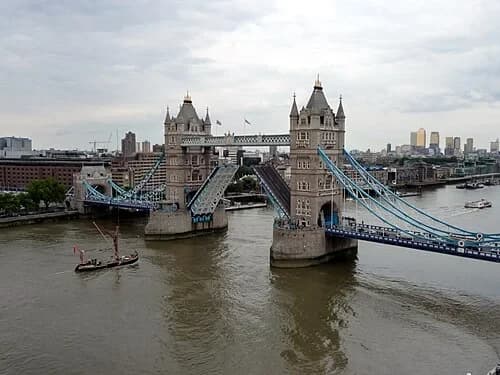
The Opening Bridge
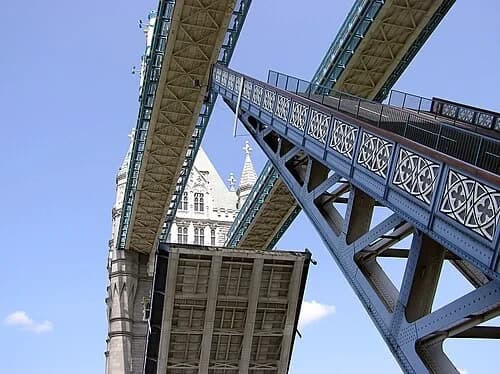
When the bridge begins its ascent, it carries out a ritual that has remained largely unchanged since the 1890s. In the early years of operation, the bridge was a hive of activity, opening as many as seventeen times every single day to accommodate the heavy maritime trade of the Victorian era. Today, while the river is quieter, the bridge still opens approximately one thousand times a year for various vessels, including historic tall ships and luxury yachts. Despite the massive volume of cars and buses waiting at the gates, river traffic still has the right-of-way over road traffic. For the bridge to rise today, a ship's captain must book an opening at least twenty-four hours in advance. Once the signal is given, the road gates close, and the mighty bascules sweep upward toward the sky. It is a rare moment in a modern city where the needs of the waterway take absolute precedence over the hustle of the streets, forcing the urban world to pause while a vessel glides through the heart of London.
The 1,070-Ton Bascules
Looking closely at the raised bascule mechanism, the sheer scale of the engineering becomes clear. Each of these two central arms weighs approximately 1,070 tons, a weight that would be impossible to move so smoothly without precision physics. The secret to this effortless motion lies in the principle of the counterweight. These bascules are not being pulled up by brute force alone; instead, they are perfectly balanced on giant hinges, much like a giant seesaw. Tucked away within the base of the towers are massive weights that offset the heavy spans. When the bridge needs to open, the hydraulic system only needs to overcome the friction of the hinges and provide a small nudge to set the motion in progress. This clever design means that, once the counterweights are set in motion, it takes surprisingly little energy to lift such a colossal mass. It is a triumph of design that allows these thousand-ton structures to rotate to their full eighty-two-degree angle in about five minutes. The heavy iron teeth and massive pivot points are the final components of a system designed to work with gravity, rather than against it.
Want to hear the rest?
Download the Stanza app to unlock all 18 stops and full GPS-guided navigation.
Frequently Asked Questions
How long does the Tower Bridge audio tour take?
The Tower Bridge audio guide includes 18 narrated stops. Most visitors spend 45 minutes to 1.5 hours exploring the complete tour, though you can listen at your own pace and skip or revisit any stop.
Is the Tower Bridge audio guide available in my language?
Stanza supports 15 languages: English, Spanish, French, German, Italian, Portuguese, Russian, Japanese, Chinese, Korean, Arabic, Hindi, Polish, Dutch, Hebrew. Check the guide in the app to confirm the languages currently available for this tour.
Can I use the audio guide offline at Tower Bridge?
Yes! Download the complete Tower Bridge tour — including all audio, maps, and images — before your visit. The Stanza app works completely offline, so you don't need WiFi or mobile data at the venue.
How much does the Tower Bridge audio guide cost?
The Stanza app is free to download. The current listed price for the Tower Bridge audio guide is $4.99; app-store region and currency may affect the final price.
How do I use the Stanza audio guide at Tower Bridge?
Download the free Stanza app, search for "Tower Bridge", and download the tour. When you arrive at the venue, the app uses GPS to detect your location and automatically plays the relevant narration as you move between points of interest — completely hands-free.
What makes the Stanza audio guide different from other Tower Bridge tours?
Stanza offers GPS-triggered narration that plays automatically as you walk through Tower Bridge — no need to manually select stops. The tour is available in 15 languages, works fully offline, and includes 18 expertly narrated stops with images and historical context.
What other audio guides are available near Tower Bridge?
Stanza offers multiple audio guides in Greater London, United Kingdom and nearby areas. After downloading the app, browse the map to discover all available tours near Tower Bridge. Each guide can be downloaded for offline use.