Languages
15Royal Observatory, Greenwich Audio Guide
Royal Observatory, Greenwich is a museum in Greater London, United Kingdom. Explore it with Stanza's visual scanner and offline audio guide — available in 15 languages.
Quick Facts
21
Stops
15
Languages
100%
Offline
📍 Greater London, United Kingdom · 51.4778°N, -0.0014°E
About Royal Observatory, Greenwich
The Royal Observatory is a historic astronomical observatory and a major tourist attraction located in Greenwich, London. It is renowned for its crucial role in the history of astronomy, navigation, and timekeeping.
Royal Observatory, Greenwich is also known as Royal Greenwich Observatory, Royal Observatory, Greenwich, Greenwich Observatory.
This self-guided audio tour features 21 narrated stops organized across 6 sections, including The Shepherd Gate Clock, Flamsteed House and the Time Ball, Meridian Courtyard and Dolphin Sundial, The Transit House and Airy Transit Circle, Harrison’s Marine Timekeepers, The South Building and Yuri Gagarin. As a science museum, Royal Observatory, Greenwich offers a unique cultural experience in the heart of Greater London, United Kingdom.
The Stanza audio guide is available in 15 languages and works entirely offline — download the complete tour including audio narration, maps, and images before your visit. As you walk through Royal Observatory, Greenwich, GPS-triggered narration plays automatically at each point of interest.
Last updated:
Artworks on display
The Shepherd Gate Clock
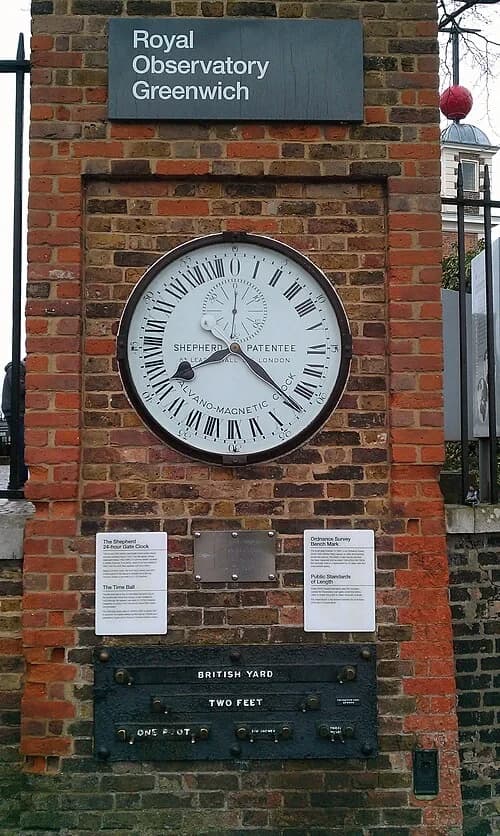
Starting at the main gate, this stop introduces the concept of Greenwich Mean Time (GMT) and the 24-hour clock. The primary image is the verified POI image of the clock face.
Shepherd Gate Clock
Charles Shepherd · 1852
The Shepherd Gate Clock is widely known as the first clock to display the 24-hour cycle directly to the public. Unlike standard clocks where the hour hand rotates twice a day, the hand on this dial only completes one full revolution every 24 hours. Notice how the numbers run from one to twenty-four around the perimeter. This instrument is what is known as an 'electric slave clock.' It was never meant to keep time on its own; instead, it was originally connected by a series of wires to a master clock located deep inside the building. This connection ensured that the time shown to the public was perfectly synchronized with the astronomical observations being conducted by the scientists within. By providing a highly accurate, visible standard, the Observatory transitioned from a private research facility to a public provider of reliable time. It helped standardize a chaotic system where different towns often kept their own local time, effectively linking the entire country to the precision of Greenwich Mean Time.
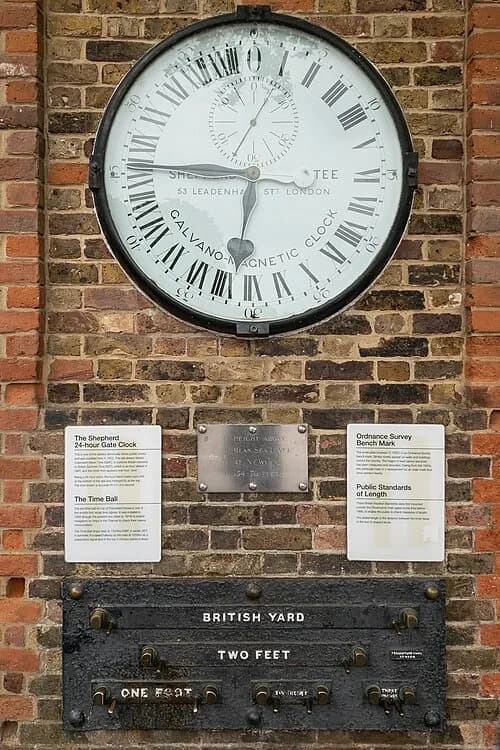
Public Standards of Length
These pins were placed here to establish the Observatory as a place of absolute scientific truth, extending its authority from the stars to the very tools used in trade and construction. You can see the markers for the British Yard, Two Feet, and One Foot. By making these standards public, the Observatory allowed anyone to verify their own measuring instruments against a government-sanctioned reference. While these pins represent order and precision, the history of Greenwich Park has its darker moments. In 1894, a French anarchist named Martial Bourdin was killed nearby when the explosive device he was carrying detonated prematurely. This attempted bombing was intended to target the Observatory, a symbol of scientific and imperial progress. The event gained literary fame when it inspired Joseph Conrad to write his acclaimed novel, 'The Secret Agent.' Today, the pins remain fixed in the wall as a quiet reminder of the Victorian quest to standardize the world through science and law, surviving the turbulence of the late 19th century.
Flamsteed House and the Time Ball
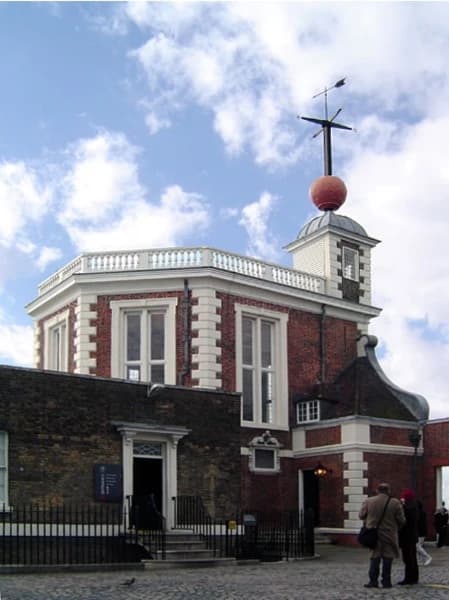
This stop covers the exterior of the original 1675 observatory building designed by Christopher Wren and its most famous visual signal: the red Time Ball.
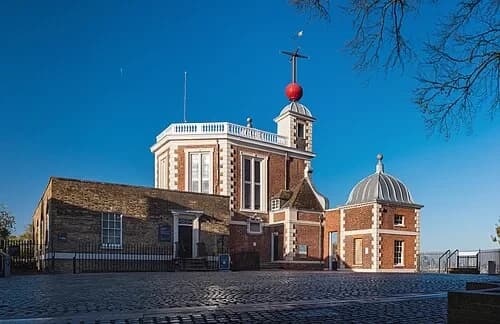
Flamsteed House
Construction began on this landmark building on August 10, 1675. To save money, King Charles II directed that it be built using recycled materials from other royal sites, and the final cost was exactly 520 pounds. The building sits 68 meters above sea level, utilizing the sturdy foundations of the medieval Duke Humphrey’s Tower. It was created specifically for John Flamsteed, who was appointed as the first Astronomer Royal. His mission was to map the stars with enough precision to help sailors find their longitude at sea. Wren, who was also an astronomer, designed the house with both aesthetics and utility in mind. While the red brick and stone dressings make it look like a grand residence, its position on the hill was strategically chosen to provide the clearest possible views of the horizon. It served as both a home for the Astronomer Royal and a workplace where the foundations of modern navigation were laid. This structure represents the birth of government-funded science in the United Kingdom.
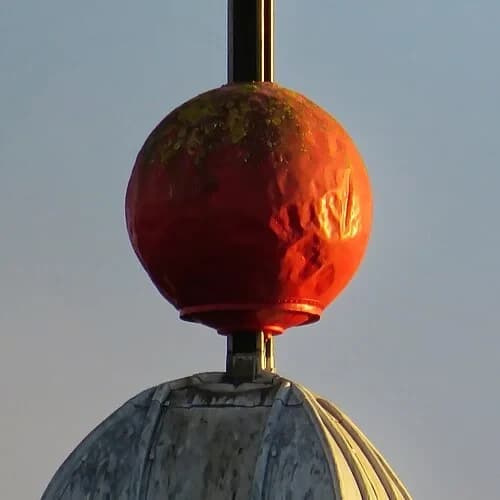
The Red Time Ball
First installed in 1833, this device was one of the world's first public time signals. Before the advent of radio, it provided a way for ship captains on the River Thames to accurately set their marine chronometers before heading out to sea. Accurate timekeeping was a matter of life and death for sailors, as it was the only way to determine longitude and avoid dangerous navigation errors. Every day, a specific ritual occurs: at 12:55 PM, the ball rises halfway up its mast. At 12:58 PM, it reaches the very top. Then, at exactly 1:00 PM, the ball drops. This sequence allowed observers to prepare their instruments and catch the precise moment of the drop. Although modern technology has long since replaced the need for such signals, the ritual continues every afternoon. It remains one of the most visible landmarks of the Observatory, signaling the time to the surrounding city and the river as it has for nearly two centuries.
Meridian Courtyard and Dolphin Sundial
Stepping back out into the courtyard, this area transitions from early timekeeping to the physical marking of the Prime Meridian. The Dolphin Sundial is a popular landmark here.
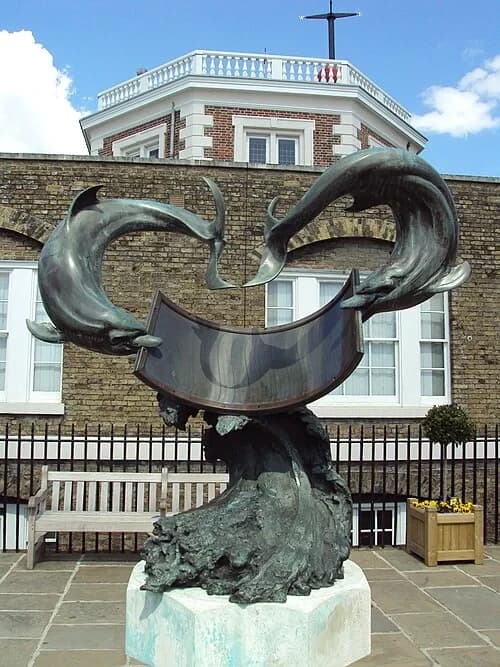
The Dolphin Sundial
Christopher Daniel · 1977
This sculpture is more than just an artwork; it is a functioning sundial that demonstrates the complex relationship between 'solar time' and the 'clock time' we use today. The sun does not move across the sky at a perfectly uniform rate throughout the year, meaning a simple sundial will often be fast or slow compared to a mechanical clock. This specific dial is curved and calibrated to reconcile these differences. It is specially adjusted for the exact longitude of Greenwich, ensuring it provides an accurate reading for this specific location on Earth. Sundials were the original basis for all timekeeping at the Observatory, as the motion of the sun and stars provided the only absolute reference for the passing of hours. The dolphins themselves are a nod to the maritime history of the site, as the Observatory's primary mission was always to assist sailors in safely navigating the oceans. It stands as a reminder that before the invention of atomic clocks, our lives were governed by the cast of shadows and the position of the sun.
The Transit House and Airy Transit Circle
This room houses the specific telescope that defined the Prime Meridian. The Airy Transit Circle was used from 1851 to calibrate the world's clocks.
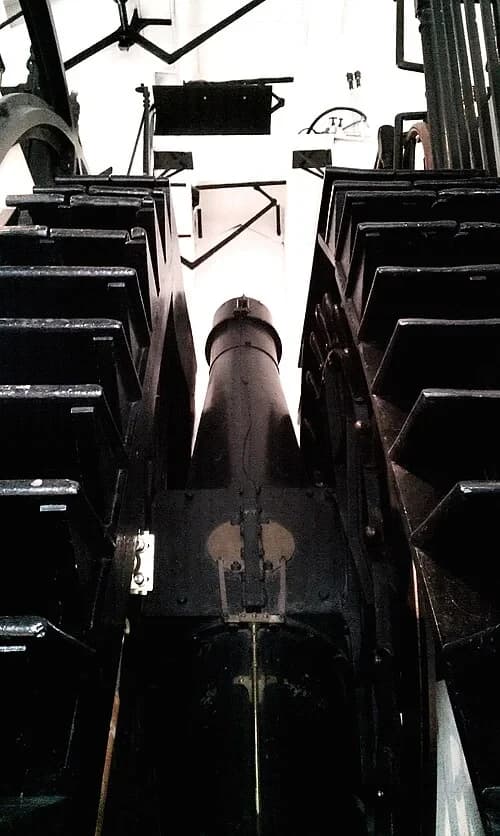
The Airy Transit Circle
Designed by George Biddell Airy, the 7th Astronomer Royal, this telescope was the pinnacle of 19th-century precision. It is a 'transit instrument,' meaning it was fixed to move only in a vertical arc, perfectly aligned with the north-south meridian. Its operation was a testament to patient, repetitive science. An astronomer would sit in a reclined chair and watch through the eyepiece as a star approached a series of fine vertical wires. At the exact moment the star crossed the central wire, the astronomer would strike a bell or press a button, signaling the clock room to record the time. By doing this night after night for thousands of stars, the staff could determine the exact time and the Earth's rotation with incredible accuracy. Because this specific telescope was used for the observations that defined zero degrees longitude at the 1884 conference, it remains the most important instrument in the history of global navigation. It provided the data that literally synchronized the world’s clocks.
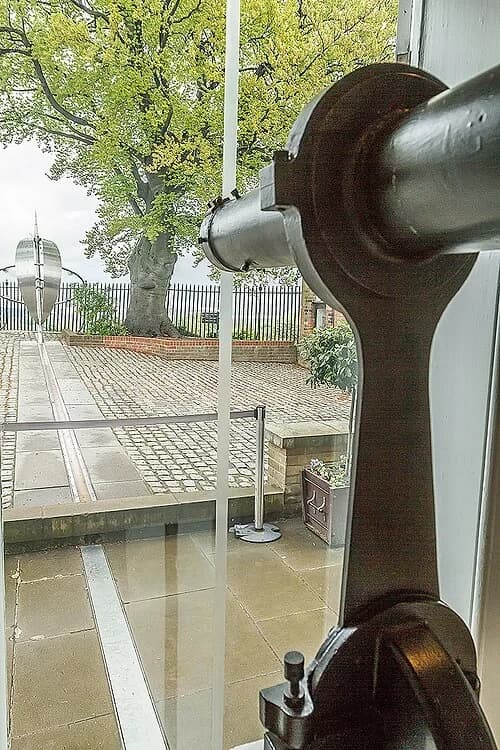
The Transit Slit
This vertical opening, or 'transit slit,' allowed the telescopes inside to have a clear view of the sky while remaining protected from the elements. The instruments housed here, like the Airy Transit Circle, were fixed to move only up and down, never left or right. This meant they could only see celestial objects at the precise moment they crossed the local meridian line. This limitation was actually a great advantage for precision. By focusing only on the moment of transit, astronomers could eliminate many of the errors that came with moving a telescope in multiple directions. The data gathered through this narrow slit was the lifeblood of the Observatory. It allowed the scientists to calibrate every clock on the site, which in turn set the time for the entire world. When you see the slit from the outside, you are looking at the 'eye' of the Observatory, the portal through which the stars were monitored to ensure that the time being signaled to ships and cities remained perfectly accurate.
Harrison’s Marine Timekeepers
Located in the museum galleries, these clocks represent the breakthrough in solving the problem of longitude at sea. John Harrison's H4 is the 'clock that changed the world.'
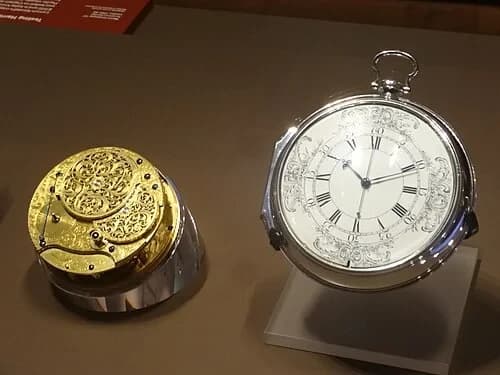
The H4 Chronometer
For centuries, sailors could easily find their latitude by looking at the sun or stars, but finding longitude was nearly impossible without an accurate clock. The problem was that 18th-century clocks used pendulums, which were useless on a rocking ship, and their mechanisms were easily ruined by the humidity and changing temperatures of a sea voyage. John Harrison, a self-taught carpenter and clockmaker, spent over 40 years trying to solve this problem to win the government's lucrative Longitude Prize. His final breakthrough was the H4, a masterpiece of miniaturization and engineering. Unlike his earlier, massive machines, H4 used a rapidly oscillating balance wheel that was unaffected by the motion of the ocean. During a trial voyage to Jamaica, it kept time so accurately that it allowed the navigator to predict their arrival with incredible precision. This device proved that a mechanical solution to the longitude problem was possible, saving countless lives by preventing ships from crashing into unexpected coastlines due to navigational errors.
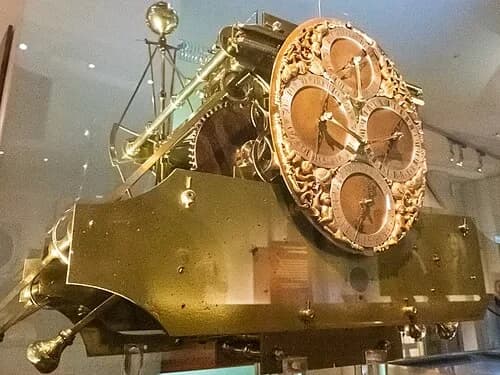
The Mechanics of Time
When you examine the complex gears and springs of these early chronometers, you are looking at a battle against the laws of physics. One of the biggest obstacles John Harrison faced was thermal expansion. In the 1700s, metal clock parts would expand in the heat and contract in the cold, causing the clock to slow down or speed up. To solve this, Harrison invented the 'bimetallic strip,' which used two different metals bonded together to counteract the effects of temperature changes. Another of his brilliant innovations was the 'grasshopper escapement,' a low-friction mechanism that didn't require the messy oils of the time, which would often thicken and clog in different climates. These internal details are what allowed his timekeepers to remain accurate during long voyages across the Atlantic, through both tropical heat and North Atlantic cold. Each gear was hand-finished to ensure the least possible resistance, representing the absolute peak of 18th-century craftsmanship and the birth of modern precision engineering.
The South Building and Yuri Gagarin
The South Building houses the Astronomy Centre. Outside stands the statue of Yuri Gagarin, the first human in space, linking the historic observatory to the space age.
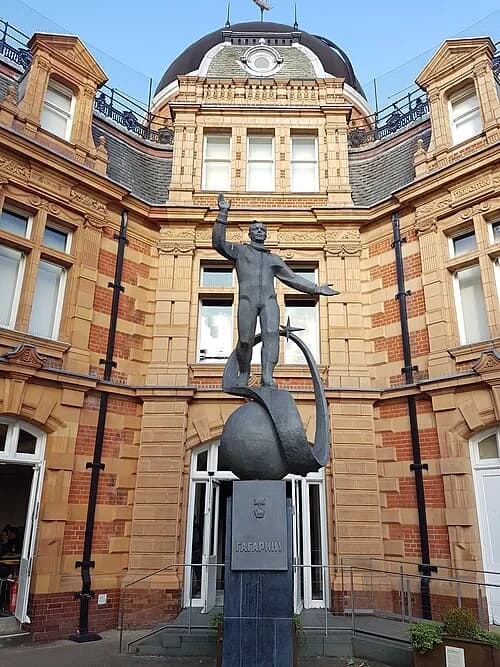
Statue of Yuri Gagarin
Anatoly Novikov · 2011
Standing in the shadows of historic telescopes, this statue of Yuri Gagarin represents the modern frontier of the Greenwich mission. A gift from the Russian Space Agency, Roscosmos, it was unveiled in 2011 to mark the 50th anniversary of Gagarin’s historic orbital flight in 1961. The figure is depicted in a flight suit, standing atop a globe encircled by a sweeping celestial arc, capturing the moment human exploration expanded beyond our atmosphere. Placing the first man in space here is highly intentional. For centuries, the Royal Observatory was the epicenter of maritime navigation, helping sailors cross vast oceans by charting the stars. Gagarin’s flight took those same stars and turned them from navigational markers into a physical destination. The statue serves as a bridge between two eras: one where we looked up to find our way home on Earth, and another where we looked up to find our way into the cosmos. It sits near the Prime Meridian, a symbolic crossroads where the history of terrestrial timekeeping meets the reality of space exploration.
Want to hear the rest?
Download the Stanza app to unlock all 21 artworks and the visual scanner feature.
Frequently Asked Questions
How long does the Royal Observatory, Greenwich audio tour take?
The Royal Observatory, Greenwich audio guide includes 21 narrated stops. Most visitors spend 45 minutes to 1.5 hours exploring the complete tour, though you can listen at your own pace and skip or revisit any stop.
Is the Royal Observatory, Greenwich audio guide available in my language?
Stanza supports 15 languages: English, Spanish, French, German, Italian, Portuguese, Russian, Japanese, Chinese, Korean, Arabic, Hindi, Polish, Dutch, Hebrew. Check the guide in the app to confirm the languages currently available for this tour.
Can I use the audio guide offline at Royal Observatory, Greenwich?
Yes! Download the complete Royal Observatory, Greenwich tour — including all audio, maps, and images — before your visit. The Stanza app works completely offline, so you don't need WiFi or mobile data at the venue.
How much does the Royal Observatory, Greenwich audio guide cost?
The Stanza app is free to download. The current listed price for the Royal Observatory, Greenwich audio guide is $2.99; app-store region and currency may affect the final price.
How do I use the Stanza audio guide at Royal Observatory, Greenwich?
Download the free Stanza app, search for "Royal Observatory, Greenwich", and download the tour. When you arrive at the venue, the app uses GPS to detect your location and automatically plays the relevant narration as you move between points of interest — completely hands-free.
What makes the Stanza audio guide different from other Royal Observatory, Greenwich tours?
Stanza offers GPS-triggered narration that plays automatically as you walk through Royal Observatory, Greenwich — no need to manually select stops. The tour is available in 15 languages, works fully offline, and includes 21 expertly narrated stops with images and historical context.
What other audio guides are available near Royal Observatory, Greenwich?
Stanza offers multiple audio guides in Greater London, United Kingdom and nearby areas. After downloading the app, browse the map to discover all available tours near Royal Observatory, Greenwich. Each guide can be downloaded for offline use.