 Stanza / Audio guide
Content & sources
Stanza · Audio guide
Cutty SarkAudio guide
A place to remember. A story to take with you.
The Cutty Sark is a historic British clipper ship built in 1869, famous for being one of the fastest of its era. It is now preserved as a museum ship and dry-docked in Greenwich, London.
Download Stanza, then search for “Cutty Sark”.
About the tour
One guide. Your kind of visit.
The Cutty Sark is a historic British clipper ship built in 1869, famous for being one of the fastest of its era. It is now preserved as a museum ship and dry-docked in Greenwich, London.
Ready when you are.
- 01Get the free Stanza app.
iOS & Android
- 02Find your guide.
“Cutty Sark”
- 03Download before you go.
Works offline
Audio guide / 20 narrated stops
Inside the guide
Get to know a few of the stories before you go. Open a stop to read more.
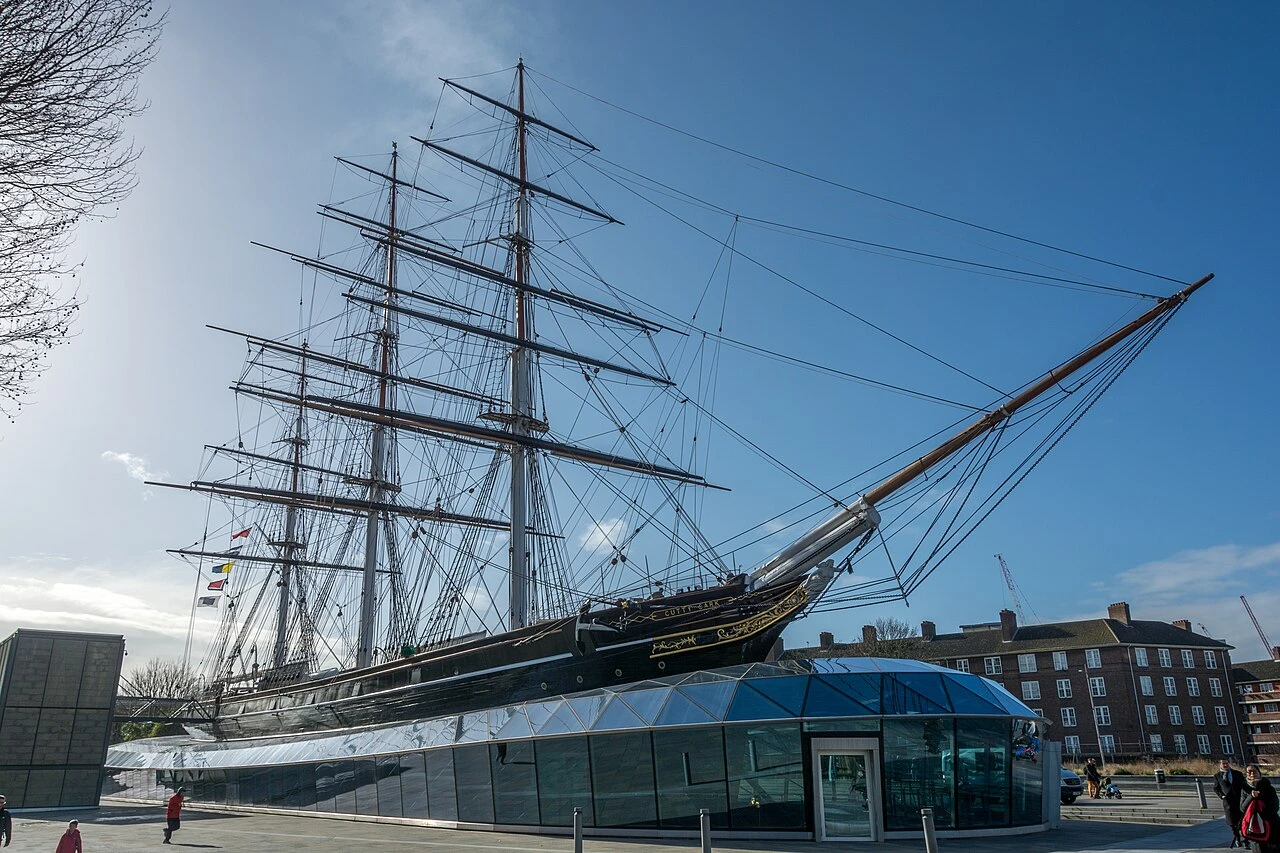
01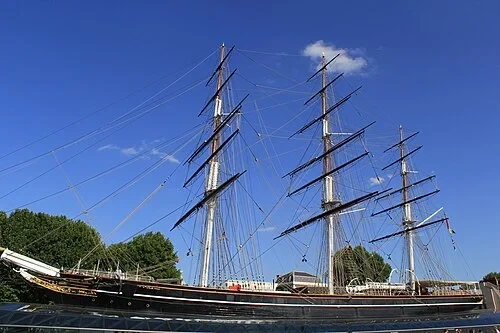 Arrival at Cutty Sark GardensThe World’s Last Tea Clipper
Construction on this maritime marvel began in 1869, with her official launch taking place on November 22 of that same year. She measures 212.5 feet at the hull, reaching a total length of 280 feet. During the Victorian era, the tea trade was a highly competitive business where speed equaled profit. The Cutty Sark was engineered to be the fastest ship of her kind, built to race the season's first crop of tea from China back to London. Arriving first meant securing the best prices, and these races were legendary events followed by the public. While steamships eventually took over these lucrative routes, the Cutty Sark represents the final, glorious peak of sail technology before the world transitioned to steam. Her sleek design and massive sail plan allowed her to maintain incredible speeds even in challenging conditions. As you explore, you will see how every inch of her design was optimized for cutting through the waves, marking the end of the great age of sail.
Katie Chan · CC BY-SA 3.0
02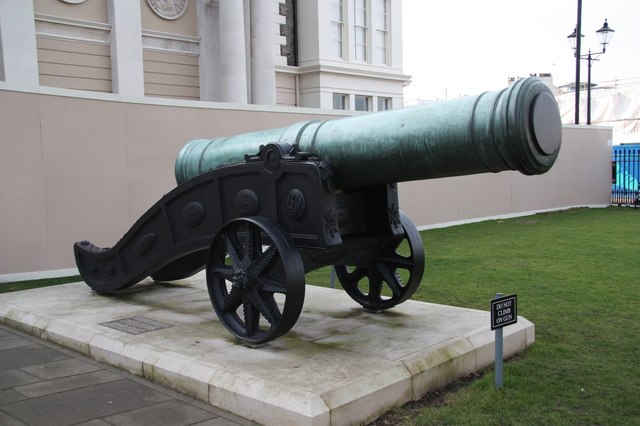 Arrival at Cutty Sark GardensThe Crimean War Cannon
Before entering the ship, take a look at this heavy piece of artillery. It was seized from the Russians in 1854 during the Crimean War, a conflict that saw Britain and its allies fighting in the Black Sea region. The presence of such artifacts in the Cutty Sark Gardens emphasizes the long-standing maritime and naval importance of Greenwich. For centuries, this area has been the heart of British seafaring, housing the Royal Naval College and the National Maritime Museum. This brass artillery piece represents the military side of the sea, contrasting with the merchant history you are about to explore. These gardens provide a historical bridge between the naval power of the past and the commercial shipping represented by the clipper. From here, transition toward the modern glass enclosure of the ship, which now protects this 19th-century vessel from the elements while allowing visitors to appreciate its full scale in a contemporary setting.
Richard Croft · CC BY-SA 2.0
03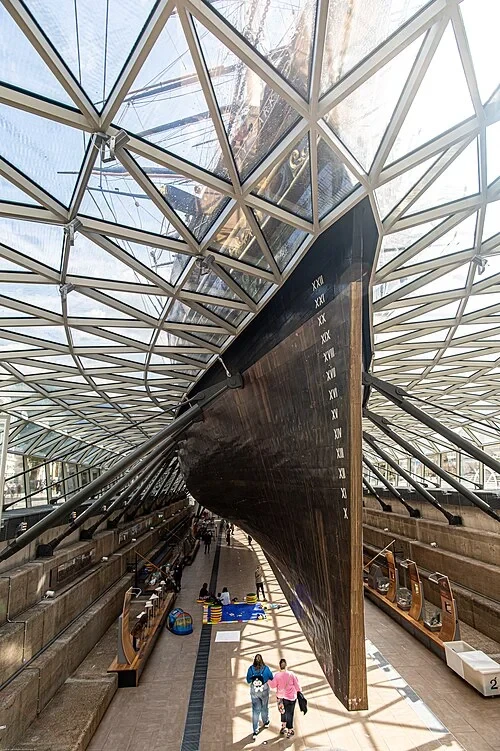 Beneath the Golden HullThe Floating Bow
Looking up from the floor of the dry dock, you can see the full scale of the hull suspended in the air. During the major restoration completed in 2012, engineers faced a significant challenge: the weight of the ship was causing the hull to sag and slowly collapse under its own gravity. To save the vessel, they lifted the entire 963-ton structure three meters up. A series of heavy steel struts now support the hull, distributing the weight evenly and preventing further structural distortion. This elevation allows you to walk directly beneath the keel, providing a perspective that sailors of the 1800s would only have seen during maintenance in a dry dock. Notice the series of Roman numerals carved into the very front of the bow. These are draft marks, used by the crew to tell exactly how deep the ship sat in the water depending on the weight of its cargo. The higher the water reached on these numbers, the more heavily the ship was loaded with goods.
Listen in the appwww.mgaylard.co.uk and thanks for looking · CC BY 2.0
04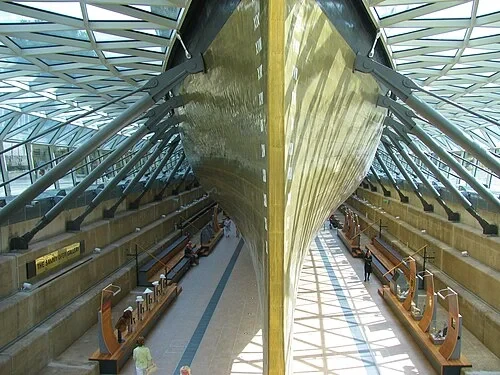 Beneath the Golden HullThe Golden Hull
The shimmering surface of the lower hull is covered in plates of Muntz metal, a specific alloy consisting of roughly 60 percent copper and 40 percent zinc. In the 19th century, this material was a cost-effective alternative to pure copper sheathing. Its primary function was to protect the wooden hull from the damaging effects of the sea, specifically by preventing the growth of barnacles, weeds, and the destructive shipworm. A hull covered in marine growth would create significant drag, slowing the vessel down and making it less competitive. By keeping the bottom of the ship smooth and clean, the Cutty Sark could reach its maximum speed of 17.5 knots. This was a blistering pace for a merchant vessel of the era, allowing her to outrun many of her competitors on the long journey back from China or Australia. The smooth finish you see today accurately reflects the original technology used to give the ship its legendary edge in the global race for trade.
Listen in the appPhoto: Dhowes9 · CC BY-SA 3.0
05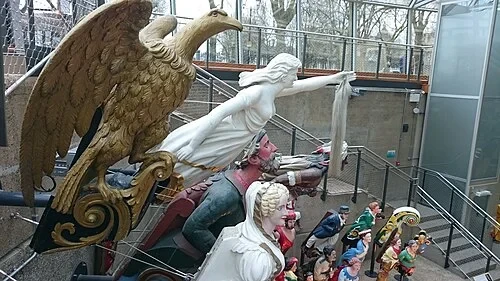 The Long John Silver Figurehead CollectionThe Long John Silver Collection
For centuries, figureheads were considered the 'soul' of a ship. They were not merely decorative; they were functional tools for an era when many sailors were illiterate. By looking at the distinctive figurehead, a sailor could identify a vessel in a crowded port even if they could not read the name painted on the stern. This specific collection was donated to the ship by Sydney 'Long John Silver' Cumbers, an avid collector of maritime artifacts. The figures here depict a wide range of characters, from historical leaders and literary figures to heroes from ancient mythology. Each one was carefully crafted to reflect the identity and spirit of the vessel it once adorned. They were often the most prized decorative element of a ship, representing the pride of the crew and the owner alike. As you look through the rows of these wooden giants, you are seeing a gallery of the diverse personalities and stories that once sailed the world's oceans.
Listen in the appPhoto: LondonHistoryatHome · CC BY-SA 4.0
06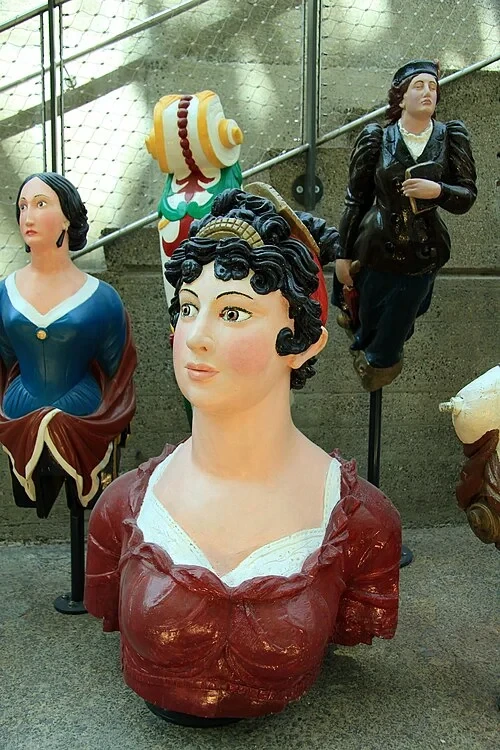 The Long John Silver Figurehead CollectionFaces of the Merchant Fleet
Observe the intricate carving and vibrant colors of these specific figures. Crafting a figurehead was a specialized art form, requiring a deep understanding of both aesthetics and the physical stresses of life at sea. Interestingly, these beautiful sculptures did not always remain on the bow during a voyage. Through heavy storms or particularly long passages, crews would often remove the figurehead and store it safely below deck to protect it from damage by waves or debris. The subjects chosen for these carvings were remarkably diverse, representing every level of society. You might see a noblewoman in a flowing dress, a stern military commander, or a representation of a common seaman. This variety reflects the different tastes and naming conventions of the shipping companies that commissioned them. The preservation of these carvings allows us to see the fashion, hairstyles, and social hierarchies of the Victorian era through a unique maritime lens, captured in wood and paint.
Listen in the appKaren Roe from Bury St Edmunds, Suffolk, UK · CC BY 2.0
07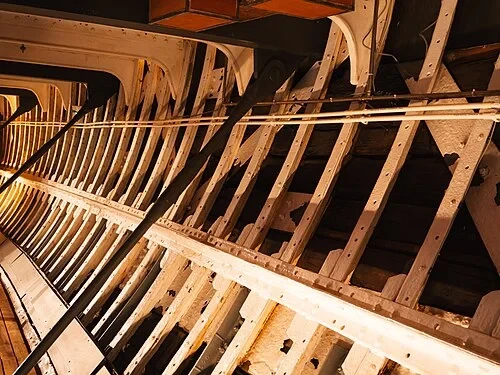 The Lower Hold and Tea TradeThe Iron Skeleton
Designed by the naval architect Hercules Linton, this composite construction method was the height of innovation in 1869. By using a wrought-iron frame instead of bulky timber ribs, Linton could design a much slimmer and more aerodynamic hull. This meant the ship was faster and more agile than all-wood vessels of a similar size. Furthermore, the iron skeleton took up much less room inside, providing significantly more space for valuable cargo like tea chests or wool bales. While all-iron ships were beginning to appear during this period, they often suffered from 'fouling,' where barnacles grew rapidly on the iron. The composite design avoided this by allowing wooden planks to be attached to the iron frame and then sheathed in protective metal. Today, the Cutty Sark is one of only three intact composite-built ships remaining anywhere in the world. As you look at the white-painted iron beams and the dark wooden planks, you are seeing the literal bones that made this ship a record-breaker.
Listen in the appTom Page · CC BY-SA 2.0
08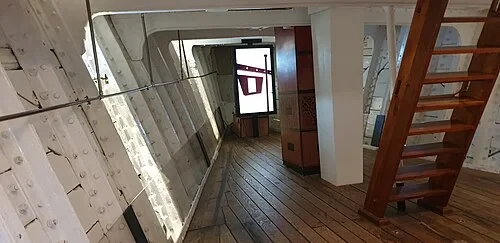 The Lower Hold and Tea TradeThe Lower Hold
In its heyday, this vast space would have been packed tightly with thousands of wooden chests. A full load consisted of approximately 600,000 pounds of tea. During those months at sea, the air down here would have been heavy with a distinct scent—a potent mixture of dried tea leaves, the tar used to seal the hull, and the sharp tang of saltwater. Maintaining the quality of the cargo was a primary concern for the crew. To keep the tea dry and prevent it from shifting during storms, they used a technique called 'dunnage.' They would carefully layer bamboo and mats around the chests to create a buffer against the damp hull. This ensured that the moisture from any leaks or condensation would not ruin the precious leaves. The ship's financial success depended entirely on this hold being packed efficiently and the cargo arriving in London in pristine condition, ready for the high-stakes tea auction houses.
Listen in the appChristine Matthews · CC BY-SA 2.0
09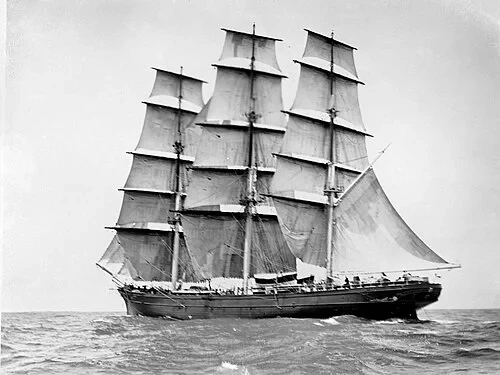 The Lower Hold and Tea TradeThe Great Tea Race
One of the most famous events in maritime history was the 1872 race against the rival clipper, Thermopylae. Both ships departed Shanghai at the same time, bound for London. Mid-voyage, disaster struck when the Cutty Sark lost her rudder in a violent storm in the Indian Ocean. Instead of giving up and heading for a port for repairs, the Captain refused to admit defeat. The crew performed a miraculous feat of engineering, forging and fitting a completely new rudder while still at sea in rough conditions. Despite this massive setback, they finished the race only one week behind the Thermopylae. Looking at the ship’s profile in this photo, you can see the immense scale of the sail plan required for such a journey. It was this determination and the ship's incredible speed that cemented her reputation as a legend of the tea trade. The race demonstrated not just the speed of the hull, but the resilience and skill of the men who sailed her.
Listen in the appAllan C. Green · Public domain
10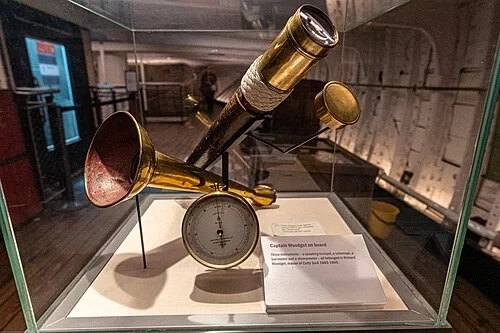 The Wool Trade and Captain WoodgetCaptain Woodget’s Tools
Richard Woodget commanded the Cutty Sark from 1885 to 1895, an era that saw her transition from tea to the wool trade. Under his leadership, she set some of her most enduring speed records, often outperforming even modern steamships of the time. Among his tools on display is the speaking trumpet, an essential device for amplifying his voice so orders could be heard over the deafening roar of a gale. You can also see his barometer, a critical instrument for navigating the treacherous Southern Ocean. By watching the atmospheric pressure, Woodget could predict incoming storms and adjust the sails accordingly. This was the age of 'high-latitude' sailing, where captains would dive far south to catch the powerful 'Roaring Forties' winds. Woodget was a master of this technique, pushing the ship to its absolute limits. These simple-looking objects were the high-tech navigation and communication equipment of their day, vital for the survival and success of the ship and her crew during months-long voyages.
Listen in the appwww.mgaylard.co.uk and thanks for looking · CC BY 2.0
Cutty Sark
Frequently asked questions
How much does the guide cost?
Free app download. Listed guide price: $3.99. Guide price shown in the app. Audio guide only. Venue admission is separate.
Can I listen without internet?
Yes. Download the guide’s audio, images, and maps in the app before your visit. Your downloaded content is then available offline.
Can I listen in my language?
Stanza supports 15 languages. Check the app for the languages available for this guide.
Do I need to follow a schedule?
No. This is a self-guided experience. Choose your stops, pause whenever you like, and return to a story at your own pace.
At your own pace
Explore Cutty Sark.
Download Stanza, then search for “Cutty Sark”.
Free app download · Guide price shown in the app
Keep exploring
Nearby audio guides
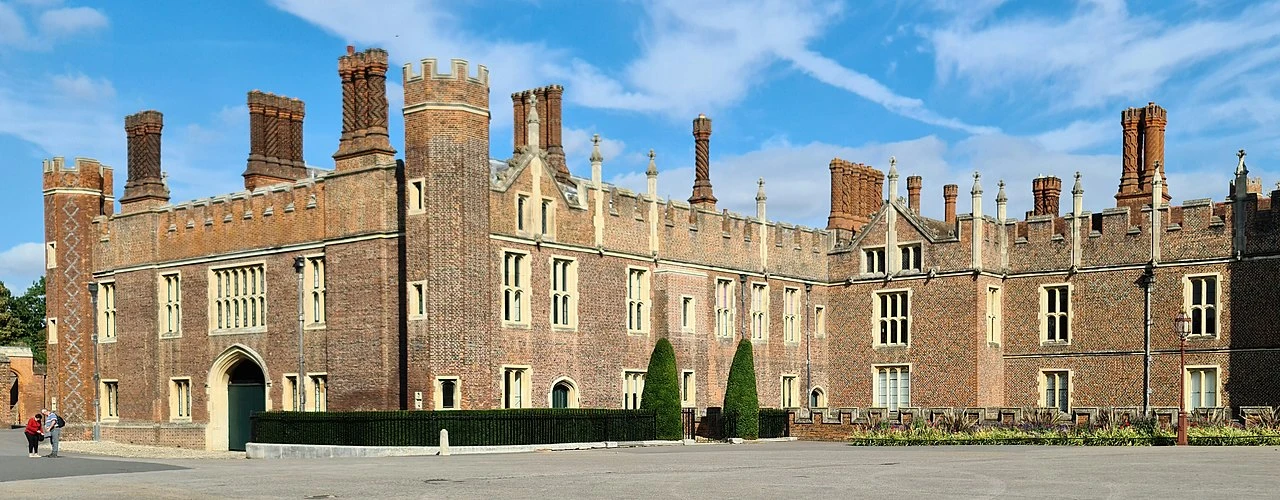
Greater London
Hampton Court Palace
Content & sources
Photo: Ricardalovesmonuments · CC BY-SA 4.0
Greater London
London Eye
Content & sources
Photo: Khamtran · CC BY-SA 3.0
Greater London
Royal Observatory, Greenwich
Content & sources
Photo: Shizhao · CC BY-SA 3.0
Greater London
Shakespeare's Globe
Content & sources
Diego Delso · CC BY-SA 4.0