Languages
15Hampton Court Palace Audio Guide
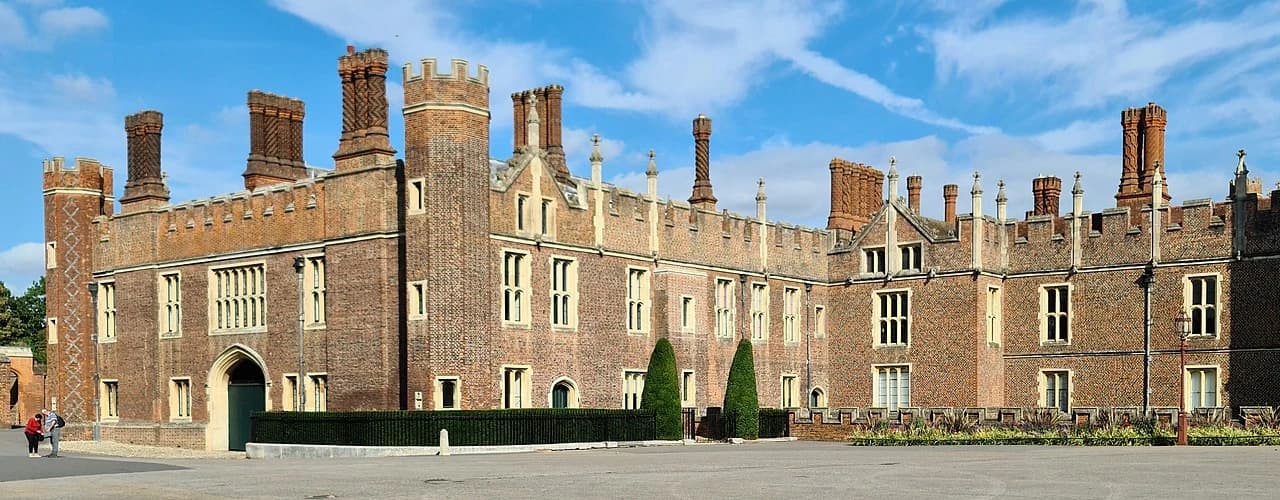
Hampton Court Palace is a landmark in Greater London, United Kingdom. Explore it with Stanza's GPS-triggered offline audio guide — available in 15 languages.
Quick Facts
35
Stops
15
Languages
100%
Offline
📍 Greater London, United Kingdom · 51.4034°N, -0.3375°E
About Hampton Court Palace
Hampton Court Palace is a historic royal palace in Richmond, Greater London, once a residence of King Henry VIII. It is renowned for its Tudor and Baroque architecture, extensive gardens, and famous maze.
Hampton Court Palace is also known as Hampton Court, Hampton Palace, Hampton Court Palace, London.
This self-guided audio tour features 35 narrated stops organized across 9 sections. As a palace, Hampton Court Palace offers a unique cultural experience in the heart of Greater London, United Kingdom.
The Stanza audio guide is available in 15 languages and works entirely offline — download the complete tour including audio narration, maps, and images before your visit. As you walk through Hampton Court Palace, GPS-triggered narration plays automatically at each point of interest.
Last updated:
What you will hear
The West Front and King's Beasts Bridge
Start at the main visual threshold. Include the grand facade and the heraldic beasts that serve as a symbolic family tree for Henry VIII.
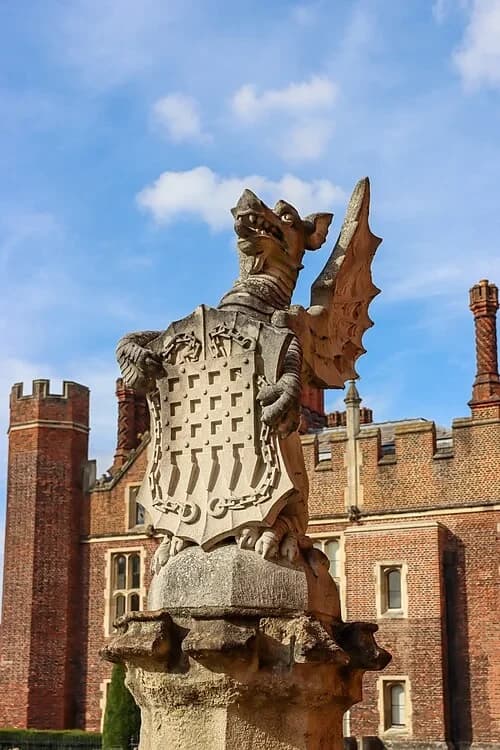
The Tudor Dragon
Take a moment to examine the intricate details of this specific heraldic beast: the Tudor Dragon. In the world of 16th-century heraldry, the dragon was a direct link to the Welsh ancestry of the House of Tudor, specifically referencing Cadwaladr, the last ancient British king. For Henry VIII, using this creature was a way to claim an ancient, almost mythic right to the throne of England. Notice the shield the dragon holds. It features a portcullis, a heavy sliding gate used in medieval fortifications. The portcullis was a favorite badge of the Tudor dynasty, originally used by Henry VIII's grandmother, Lady Margaret Beaufort. It symbolized strength and the security of the kingdom under Tudor rule. The craftsmanship required to carve such features—from the scales on the dragon's back to the delicate links of the portcullis chain—is remarkable. In an age where few people could read, these visual markers were essential. They communicated power, lineage, and the stability of the monarchy to everyone who entered the palace. This dragon is a reminder that in the Tudor court, even the stone carvings were carefully chosen to tell a story of political might.
The Tudor Kitchens
Explore the culinary logistics required to feed a court of 1,000 people. Focus on the massive hearths and the scale of food preparation.
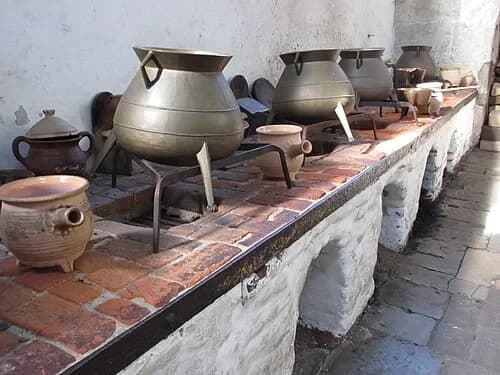
Copper Pots and Braziers
The Tudor kitchens were not just about roasting meat; they were highly specialized environments requiring an array of specialized tools. Here you can see a collection of heavy copper cookware, from massive boiling pots to smaller braziers used for simmering sauces. Each piece was essential for the 'Master Cooks' who oversaw this chaotic environment. These cooks were high-status individuals, managing dozens of scullions and turnspits in a workplace that was loud, hot, and often dangerous. Notice the design of the brick ovens and the raised charcoal braziers. These allowed for more precise temperature control than a simple open fire, which was necessary for baking bread or preparing the delicate pottages and stews favored by the court. The size of these vessels is a reminder of the quantities involved—a single pot might hold enough stew to feed dozens of people. The maintenance of these copper tools was a constant job in itself, as they had to be kept clean and polished to prevent poisoning. This specialized equipment reveals that Tudor cooking was a sophisticated craft, combining brute-force labor at the hearth with the refined skills needed to produce the elaborate multi-course meals that defined courtly life.
Clock Court
The inner sanctum of the Tudor palace. Note the terracotta medallions, which were a very early example of Italian Renaissance influence in England.
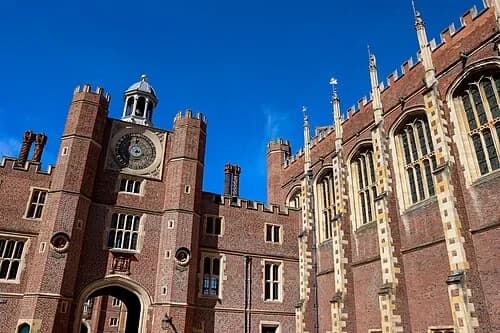
Clock Court Facade
Step back into the center of Clock Court to appreciate the architectural dialogue happening around you. This courtyard was the inner sanctum of the Tudor palace, where the most important guests were received. It is also where you can see a fascinating transition in English style. On one hand, you have the traditional Tudor brickwork—solid, familiar, and rooted in medieval building techniques. But look closer at the decorative details, and you will see something entirely new for the early 16th century. Set into the brick towers are decorative terracotta elements that look very different from the surrounding masonry. These details, influenced by the Italian Renaissance, were a radical departure from the Gothic style that had dominated England for centuries. This courtyard marks the moment when continental European ideas about symmetry and classical beauty began to arrive in Britain. Because this was the heart of the palace, it was designed to be the most sophisticated part of the building. It reflects the ambitions of both Cardinal Wolsey and Henry VIII to be seen not just as English rulers, but as cultured, worldly princes who were in touch with the latest trends from Italy and France. The mix of styles creates a unique visual texture that tells the story of an kingdom opening itself up to the wider world.
The Haunted Gallery and Tudor Portraits
Legend says the ghost of Catherine Howard haunts this space. It now serves as a gallery for the palace's most significant Tudor portraits.
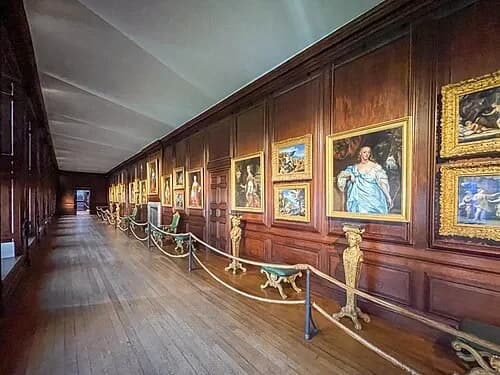
The Haunted Gallery
As you walk through this long, wood-paneled gallery, the atmosphere shifts to one of somber reflection. This space is famously known as the Haunted Gallery, tied to the tragic fate of Catherine Howard, Henry VIII’s fifth queen. In 1541, Catherine was accused of adultery and placed under house arrest in her rooms at the palace. Legend tells of a harrowing moment when she managed to escape her guards and ran down this very gallery toward the Royal Pew, where Henry was at prayer. She supposedly screamed for mercy, hoping to explain herself to the King, but she was caught and dragged back, her cries echoing through the palace. She was executed at the Tower of London shortly after. Over the centuries, many have claimed to hear a spectral scream or feel a sudden chill in this corridor, earning Catherine the title of the 'Screaming Lady.' Whether you believe in ghosts or not, the gallery serves as a poignant reminder of the high stakes and brutal realities of life within the Tudor court.
The King's Grand Staircase
The transition from Tudor to Baroque. This grand entrance to the state apartments features murals by Antonio Verrio intended to impress visitors.

The King's Grand Staircase
As you move through the palace, the atmosphere changes dramatically here at the King's Grand Staircase. You are stepping out of the Tudor past and into the Baroque world of King William III. Following the Glorious Revolution of 1688, William and his wife, Mary II, wanted a modern palace that could rival the splendor of Versailles in France. In 1689, they commissioned Sir Christopher Wren to design a massive expansion. This staircase was the formal entrance to the new King’s State Apartments. Notice how different this feels from the earlier sections of the tour—the scale is grander, and the space is flooded with light. The walls and ceilings are covered in vast, airy murals, a stark contrast to the heavy timbers and brickwork of the Tudor age. This was a deliberate architectural choice intended to signal a new era of enlightenment and Protestant rule, moving away from what William saw as the dark, cramped quarters of his predecessors.
Fountain Court and Wren’s Cloisters
The center of Sir Christopher Wren's Baroque expansion. The cloisters provide a serene walk around the symmetrical courtyard.
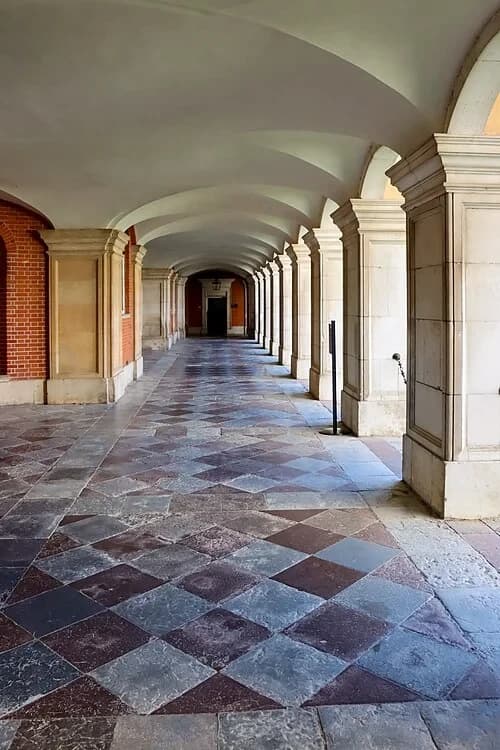
The Baroque Cloisters
Walking through the Baroque Cloisters, you can experience the elegance and order that Sir Christopher Wren brought to the palace. This serene, arched walkway was heavily inspired by the Renaissance architecture of Italy, which Wren admired for its mathematical precision and graceful form. The cloisters were designed to provide a sheltered route around Fountain Court, allowing courtiers and the royal family to move between the state apartments in comfort. Contrast this wide, airy space with the crowded and often dark corridors of the Tudor section. While the Tudor palace grew somewhat haphazardly over time to accommodate a massive, bustling household, Wren’s Baroque design is focused on clarity and grand, open vistas. The paving stones underfoot and the rhythmic repetition of the arches create a sense of calm and predictability. It is a space designed for slow, dignified movement—a place to see and be seen in the highly choreographed world of the late 17th-century court.
The East Front and Privy Garden
The grand garden facade of the palace. The Privy Garden is a meticulous restoration of the 1702 formal layout, featuring the famous Tijou iron screen.
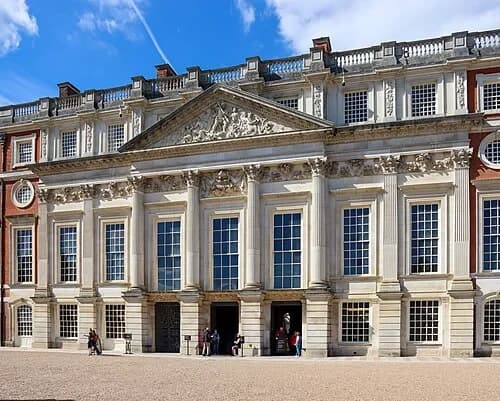
The East Front Facade
Emerging into the gardens, you can look back at the grand East Front, a view that has earned Hampton Court the nickname the 'Versailles of London.' This massive facade is made of Portland stone, a material favored for its durability and bright, stately appearance. It represents the height of Baroque ambition in England. If you look up at the triangular pediment above the central section, you’ll see a large-scale carving of the mythical hero Hercules. This wasn't a random choice; Hercules was a frequent symbol used by King William III to represent his own strength, his military victories, and his labor on behalf of the nation. The entire facade is designed to impress those approaching from the gardens, projecting an image of power, stability, and cultural refinement. It is the public face of William’s modern palace, a grand statement in stone that looks away from the Tudor past and toward a future of enlightened, absolute monarchy.
The Great Vine
Planted in 1768 by Lancelot 'Capability' Brown, this is the largest grape vine in the world and still produces a crop today.
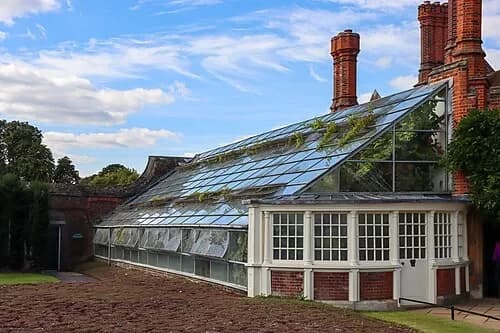
The Great Vine Glasshouse
This specialized glasshouse was constructed for one reason: to protect a single, extraordinary plant. Known as 'The Great Vine,' it was planted here in 1768 by Lancelot 'Capability' Brown, perhaps the most famous gardener in British history. At the time, grapes were a luxury item, and maintaining such a massive vine was a mark of significant status and horticultural skill. The glasshouse provides the controlled, warm environment necessary for the vine to flourish in the English climate. It acts as a protective shield, allowing the sun’s rays to nourish the sprawling canopy while keeping out the frost and wind. Remarkable for its longevity, the vine is not merely a museum piece; it remains a productive agricultural feature of the palace. Every year, it continues to yield a substantial crop of black dessert grapes, which are still harvested by hand using traditional methods. In the past, these grapes were reserved exclusively for the Royal Family, but today they are often sold to visitors during the harvest season. The structure itself has been renovated over the centuries to accommodate the vine's ever-expanding reach, standing as a testament to the ongoing care and dedication required to preserve such a unique botanical treasure within the palace grounds.
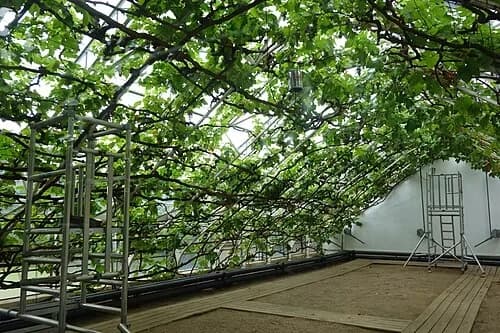
Inside the World's Largest Vine
Looking at the massive, gnarled trunk of the Great Vine, it is hard to believe that this entire sprawling canopy originated from a single small cutting over 250 years ago. The sheer scale of the plant is staggering. By 1968, records showed that the vine had reached a length of 100 feet, with the main trunk measuring an impressive 81 inches in circumference. Today, it fills the entire glasshouse, creating a ceiling of vibrant green leaves and heavy clusters of fruit. Maintaining a single living organism for this long requires an extraordinary level of dedication and specialized knowledge passed down through generations of royal gardeners. The vine must be meticulously pruned every winter to encourage new growth, and its roots, which extend far beneath the glasshouse floor into the rich soil outside, must be kept perfectly hydrated and nourished. The metal framework you see supporting the branches is essential to prevent the weight of the fruit and foliage from breaking the aged wood. This interior space offers a rare opportunity to stand inside a living historical monument. It serves as a reminder of the continuity of life at the palace, persisting through changes in monarchs, fashions, and even the very purpose of the estate itself, all thanks to the constant, watchful eyes of its caretakers.
The Hampton Court Maze
A final challenge before leaving. This world-famous hedge maze has been frustrating and delighting visitors for over 330 years.
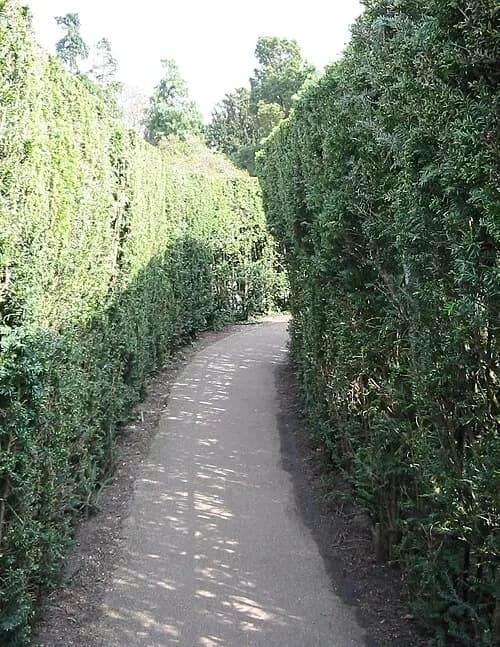
The Hampton Court Maze
Your journey through the history of Hampton Court concludes here, in the world-famous maze. Planted in the 1690s during the reign of William III, this is the oldest surviving hedge maze in the United Kingdom. It was originally part of a 'wilderness' garden, designed to offer a lighthearted diversion for the King and his guests. Unlike many modern mazes that are circular or square, this one features a distinct trapezoid shape, covering about a third of an acre with nearly half a mile of winding paths. For over 330 years, it has maintained its reputation for confusing and delighting those who enter its leafy corridors. The high hedges, traditionally composed of yew or hornbeam, are carefully maintained to ensure the 'puzzle' remains intact. As you find your way toward the center, reflect on how this space symbolizes the changing nature of the palace itself. Once a private retreat for the most powerful individuals in the land, these grounds have transformed over the centuries into a public treasure. What was once an exclusive royal amusement is now a playground for everyone, inviting visitors of all ages to share in the same sense of mystery and discovery that courtiers experienced three centuries ago. It is a fitting end to your tour, highlighting the enduring charm and playful spirit that continues to thrive within these historic walls.
Want to hear the rest?
Download the Stanza app to unlock all 35 stops and full GPS-guided navigation.
Frequently Asked Questions
How long does the Hampton Court Palace audio tour take?
The Hampton Court Palace audio guide includes 35 narrated stops. Most visitors spend 45 minutes to 1.5 hours exploring the complete tour, though you can listen at your own pace and skip or revisit any stop.
Is the Hampton Court Palace audio guide available in my language?
Stanza supports 15 languages: English, Spanish, French, German, Italian, Portuguese, Russian, Japanese, Chinese, Korean, Arabic, Hindi, Polish, Dutch, Hebrew. Check the guide in the app to confirm the languages currently available for this tour.
Can I use the audio guide offline at Hampton Court Palace?
Yes! Download the complete Hampton Court Palace tour — including all audio, maps, and images — before your visit. The Stanza app works completely offline, so you don't need WiFi or mobile data at the venue.
How much does the Hampton Court Palace audio guide cost?
The Stanza app is free to download. The current listed price for the Hampton Court Palace audio guide is $2.99; app-store region and currency may affect the final price.
How do I use the Stanza audio guide at Hampton Court Palace?
Download the free Stanza app, search for "Hampton Court Palace", and download the tour. When you arrive at the venue, the app uses GPS to detect your location and automatically plays the relevant narration as you move between points of interest — completely hands-free.
What makes the Stanza audio guide different from other Hampton Court Palace tours?
Stanza offers GPS-triggered narration that plays automatically as you walk through Hampton Court Palace — no need to manually select stops. The tour is available in 15 languages, works fully offline, and includes 35 expertly narrated stops with images and historical context.
What other audio guides are available near Hampton Court Palace?
Stanza offers multiple audio guides in Greater London, United Kingdom and nearby areas. After downloading the app, browse the map to discover all available tours near Hampton Court Palace. Each guide can be downloaded for offline use.