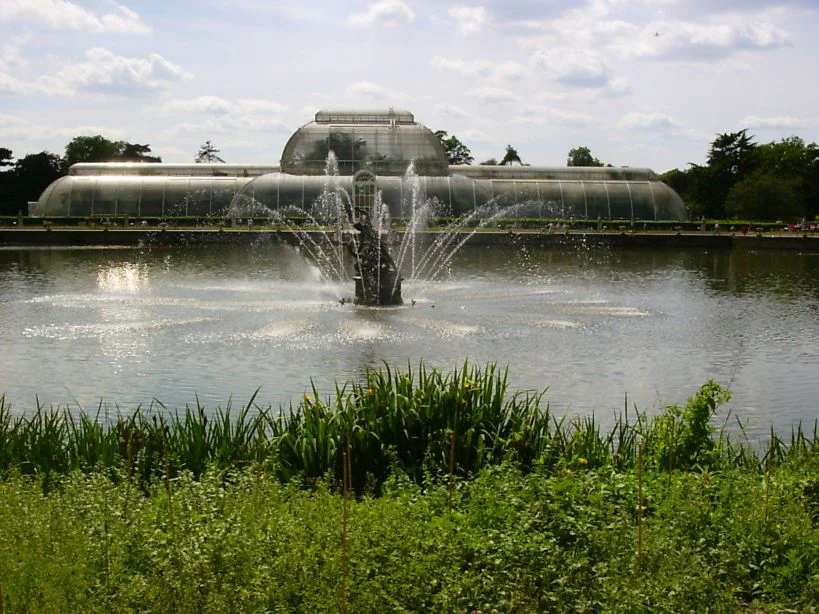
 Stanza / Audio guide
Content & sources
Stanza · Audio guide
Kew Gardens Audio Guide
A place to remember. A story to take with you.
Kew Gardens is a botanic garden in southwest London founded in 1759. It houses the largest and most diverse botanical and mycological collections in the world.
Download Stanza, then search for “Kew Gardens”.
About the tour
One guide. Your kind of visit.
Kew Gardens is a botanic garden in southwest London founded in 1759. It houses the largest and most diverse botanical and mycological collections in the world.
Ready when you are.
- 01Get the free Stanza app.
iOS & Android
- 02Find your guide.
“Kew Gardens”
- 03Download before you go.
Works offline
Audio guide / 58 narrated stops
Inside the guide
Get to know a few of the stories before you go. Open a stop to read more.
01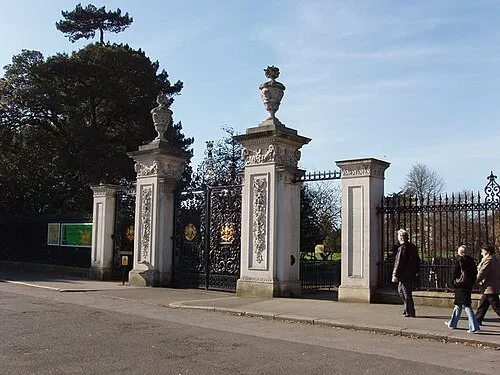 Elizabeth Gate
Kew began as a royal pleasure ground. The botanic garden formally started in 1759, growing out of an exotic garden at Kew Park laid out by Henry, Lord Capell of Tewkesbury. Augusta, Dowager Princess of Wales, enlarged that garden, and in 1772 the royal estates of Richmond and Kew were merged into one. In 1840 the gardens were adopted as the national botanic garden, largely through the efforts of the Royal Horticultural Society. Under the director William Hooker they grew steadily, until the grounds reached their present three hundred acres. Since 2003 the whole landscape has carried UNESCO World Heritage status. Along the route ahead stand royal follies, great Victorian glasshouses and the laboratories where plant science is still done.
David Hawgood · CC BY-SA 2.0
02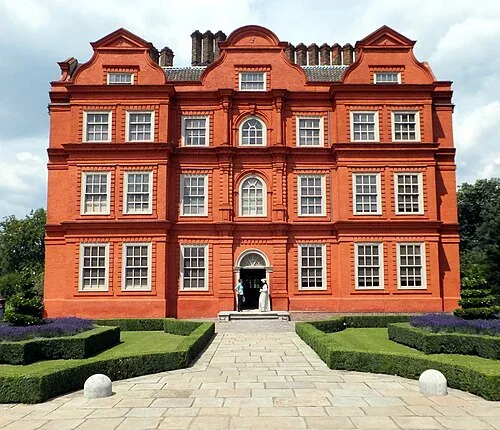 Kew Palace
The smallest of the British royal palaces is a plain red-brick house with a stepped, gabled front. A Dutch merchant named Samuel Fortrey built it around 1631. The bricks are laid long side and short side alternating, a method called Flemish bond, and together with the gables it gives the whole front a distinctly Dutch look. George III bought the house in 1781, as a nursery for the royal children. After significant restoration by conservation architects, it reopened to the public in 2006. It is administered separately from the gardens, by Historic Royal Palaces.
xlibber · CC BY 2.0
03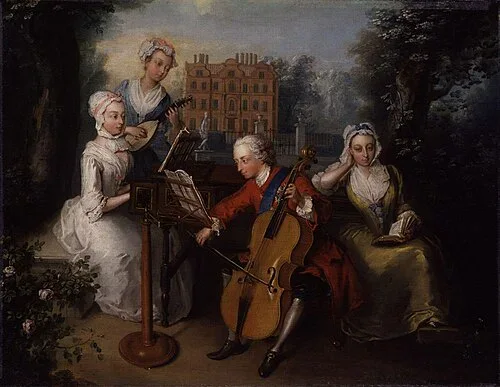 Kew Palace
Frederick, Prince of Wales and His Sisters
Philip Mercier painted the royal family at their music: Frederick, Prince of Wales, seated with a cello, his sisters beside him with a mandolin and sheet music, and a brick house rising behind the trees. Frederick matters to this place through two generations. His widow, Augusta, Dowager Princess of Wales, enlarged and extended the exotic garden at Kew. And his son became George III, the king who enriched the gardens further, aided by the botanist Sir Joseph Banks.
Listen in the appPhilippe Mercier · Public domain
04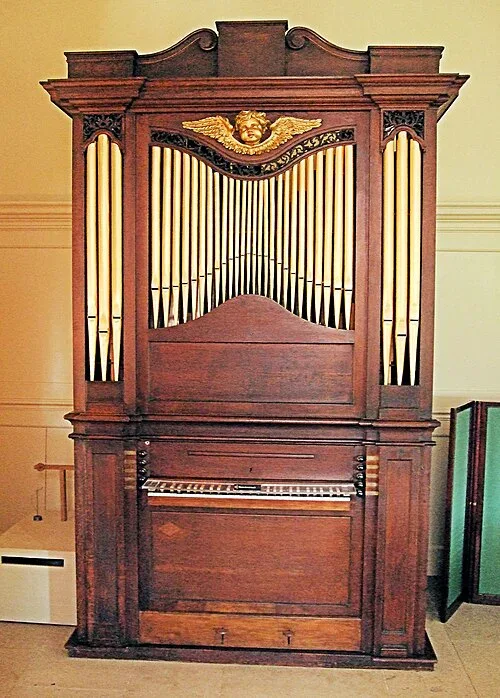 Kew Palace
Chamber Organ, Kew Palace
A chamber organ stands here, tall and dark-wooded, with pale pipes fanned out behind carved fretwork and a gilded cherub's head with spread wings above the case. Small enough for a room rather than a chapel, it was built for domestic music. The royal household at Kew gathered round such instruments of an evening, singing and playing together. The keyboard sits open, as though the players had only just stepped away.
Listen in the appJim Linwood from London · CC BY 2.0
05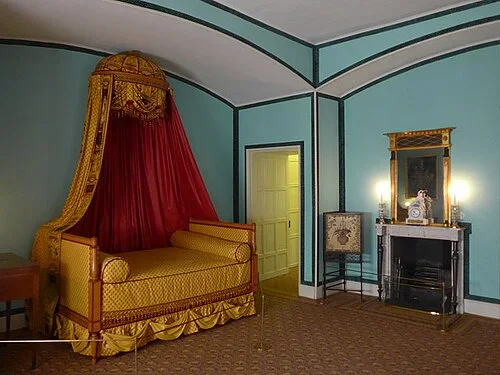 Kew Palace
Inside Kew Palace
A royal bedroom, but a modest one. The walls are painted a pale sea-green, the vaulted ceiling picked out with dark moulding, and a bed with a yellow silk coverlet sits beneath a canopy of heavy red drapery. There is a plain fireplace with a clock on the mantel, and a panelled door that would not shame a well-kept farmhouse. Nothing here was designed for ceremony. Rooms on this scale suggest a family living closely together, a house used as a home rather than a court.
Listen in the appBasher Eyre · CC BY-SA 2.0
06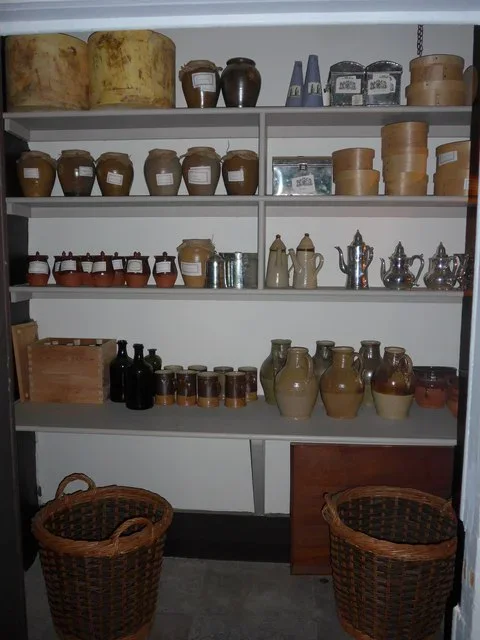 Kew Palace
The Royal Kitchens
The working end of a royal household looked like this. Shelves hold the equipment of a Georgian kitchen: stone jars with paper labels, pewter jugs and coffee pots, wooden tubs, and deep woven baskets waiting on the floor. A kitchen on this scale provisioned a royal family living in the country, keeping stores laid in against the seasons. Everything is stacked, labelled and orderly, the quiet machinery that kept the palace fed.
Listen in the appBasher Eyre · CC BY-SA 2.0
07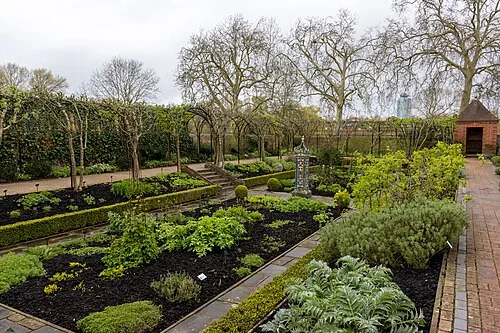 The Queen's Garden
Behind the palace lies the Queen's Garden, laid out in the formal style of the seventeenth century, with clipped hedges, brick paths and low compartments of planting. The rule governing it is strict. Only plants that grew in England by the seventeenth century are grown here, and many are species believed to have medicinal qualities. The garden shows what these grounds were before botany took charge, in the era when Kew was simply a royal garden.
Listen in the appPhotograph by Mike Peel (www.mikepeel.net). · CC BY-SA 4.0
08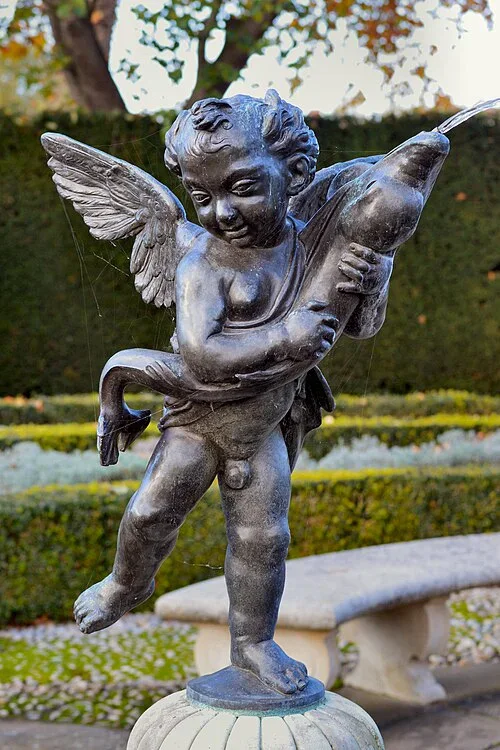 The Queen's Garden
Boy with a Dolphin Fountain
At the centre of the formal planting stands a fountain: a winged boy of bronze hugging a dolphin, water arching from the creature's mouth. Fountains and sculpture of this kind were the traditional ornaments of a formal garden, marking the middle of a plot or the meeting of paths. The bronze has darkened almost to black, so the child's pale face and curls stand out sharply against the hedge behind.
Listen in the appPhoto: AndyScott · CC BY-SA 4.0
09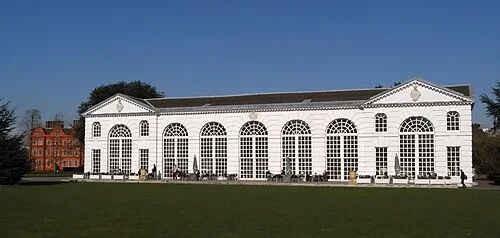 The Orangery
Sir William Chambers was the architect the royal family kept for their garden buildings, and the Orangery is his grandest survivor here. Completed in 1761, it runs ninety-two feet long and thirty-three deep, a neoclassical hall lined with tall arched windows. It was meant to shelter citrus trees through the winter, but it failed at that job. The interior was too dark, and the plants were moved out in 1841. After many changes of use since, the building now serves as a restaurant.
Listen in the appPhoto: Patche99z · CC BY-SA 3.0
10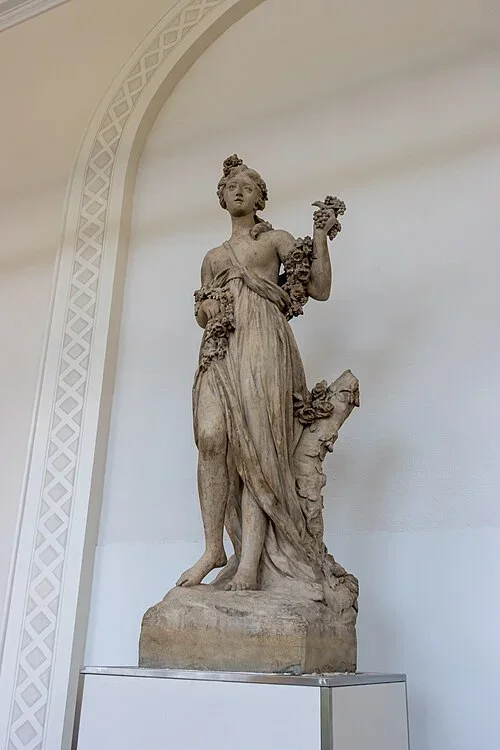 The Orangery
Statue of Flora
Flora, goddess of flowers, keeps her place among the Orangery's statues, garlands of carved roses draped over her arms and a small bouquet raised in one hand. Of all the classical figures gathered in this hall, she is the most at home in a garden. The stone has weathered to a soft grey, roses and all.
Listen in the appPhotograph by Mike Peel (www.mikepeel.net). · CC BY-SA 4.0
- 11
Statue of Diana
Diana with her hound, a goddess of the wild standing indoors among tender garden plants.
- 12
Statue of Eros
Eros, winged and flower-bearing, part of the fashionable company of gods assembled in the Orangery.
- 13
Statue of Apollo
Apollo in carved armour, the martial figure of the Orangery's classical ensemble.
- 14
Nash Conservatory
A glasshouse built for Buckingham Palace, carted to Kew by King William IV and put to work ever since.
- 15
Princess of Wales Conservatory
Kew's third great conservatory, opened in 1987 in memory of the garden's royal founder.
- 16
Titan Arum
The titan arum, the giant Sumatran plant that blooms for a day or two and smells of carrion.
- 17
Water Feature, Princess of Wales Conservatory
The conservatory's pond zone, where waterlilies share the water with a rotating orchid display.
- 18
Contemporary Art in the Glasshouses
Paper banners among the succulents: how temporary art takes over a living glasshouse.
- 19
Orchid Festival
The annual Orchid Festival, when the whole conservatory becomes a stage for one plant family.
- 20
The Hive
Wolfgang Buttress's seventeen-metre aluminium beehive, meant to be temporary and kept for good.
- 21
Inside The Hive
Looking up through the honeycomb: the Hive from within.
- 22
The Rock Garden
A mountain world in miniature, sorted by geography rather than beauty.
- 23
Davies Alpine House
The modern glasshouse built to keep alpines cool, bright and breezy.
- 24
The Waterlily House
A glass square built around one round pond, and one famous giant waterlily.
- 25
Inside the Waterlily House
Heat, humidity and lilies at eye level, with glass blooms drifting among the real ones.
- 26
Giant Waterlily Leaves
How the giant waterlily's enormous floating leaves are built.
- 27
The Waterlily Saved from Extinction
The world's smallest waterlily, lost in the wild and grown back from seed at Kew.
- 28
The Palm House
The first great wrought-iron glasshouse, hand-blown panes and all.
- 29
Under the Palm House Canopy
A rainforest under glass, from the inside.
- 30
Palm House Spiral Staircase
The white iron spiral that climbs into the palm canopy.
- 31
The Cycad Planted in 1775
A palm-like plant with a label reading 1775, growing today under a glass roof built about seventy years later.
- 32
Aerial Roots, Palm House
Why some tropical trees walk on stilts, and what those pale roots at the trunk's base are doing.
- 33
The Queen's Beasts
Ten heraldic stone beasts guarding the path to the Palm House, each carrying a shield of royal ancestry.
- 34
Museum No. 1
The museum Kew built in 1857 to show how much of human life depends on plants.
- 35
The Campanile
An Italian bell tower that is really a chimney, built to hide the Palm House's furnaces.
- 36
Shirley Sherwood Gallery
Kew's modern home for botanical art, where the paintings change with the seasons.
- 37
Marianne North Gallery
The Victorian woman who travelled the world alone to paint plants, and the gallery she left exactly as she wished.
- 38
Inside the Marianne North Gallery
A room hung floor to ceiling with 832 paintings, arranged exactly as one woman left it.
- 39
Bust of Marianne North
A marble portrait of Marianne North herself, at the threshold of her collection.
- 40
Leaf Insects and Stick Insects
One of Marianne North's paintings that is not about a plant at all, but about hiding among them.
- 41
The Ruined Arch
A Georgian arch built to look as if it had been crumbling for centuries, because ruins were fashionable.
- 42
The Temperate House
The largest surviving Victorian glasshouse in the world, twice the size of the Palm House and freshly rescued.
- 43
Inside the Temperate House
The world's temperate flora gathered under one iron roof, including species found almost nowhere else.
- 44
Temperate House Staircase
A cast-iron spiral stair among the foliage, where Victorian engineering dressed itself up.
- 45
Donatello's David Replica
A Renaissance masterpiece in marble, standing unexpectedly among the tree ferns.
- 46
The Shepherd by John Cheere
A lead shepherd from the Georgian fashion for garden figures, now keeping company with rare plants under glass.
- 47
Urn in the Temperate House
A carved urn with cherub supporters and a Greek-key band, classical ornament doing quiet service among the plants.
- 48
King William's Temple
Wyatville's Doric temple of 1837, whose iron panels march from Minden to Waterloo in memory of British victories.
- 49
The Treetop Walkway
A canopy walkway from 2008 that flexes, sways, and lets the arboretum be seen from inside the treetops.
- 50
The Great Pagoda
Chambers' fifty-metre tower of 1762, the royal folly that fed Europe's craze for Chinese design.
- 51
Inside the Great Pagoda
The pagoda's hidden inside: a wooden stair of 253 steps, and floors cut open for wartime bomb tests.
- 52
The Dragons of the Pagoda
Eighty dragons once lined the pagoda's roofs; the gold legend is a myth, and restoration has brought them back.
- 53
The Japanese Gateway (Chokushi-Mon)
A four-fifths scale Kyoto temple gateway, built for a 1910 exhibition and collected by Kew like a rare plant.
- 54
The Japanese Landscape
A reconstructed Japanese garden of raked gravel, rocks and lanterns, built to frame the gateway from Kyoto.
- 55
Queen Charlotte's Cottage
George III's thatched retreat for Queen Charlotte, a royal cottage built deliberately plain and rustic.
- 56
The Sackler Crossing
John Pawson's granite and bronze lake bridge of 2006, a double curve whose posts turn from wall to open slats.
- 57
The Bamboo Garden
Groves of bamboo closing into green shade, both a specialist plant collection and the setting for a Japanese farmhouse.
- 58
The Minka House
A thatched Japanese farmhouse reassembled at Kew by Japanese craftsmen, standing at the end of the bamboo walk.
Kew Gardens
Frequently asked questions
How much does the guide cost?
Free app download. Listed guide price: $3.99. Guide price shown in the app. Audio guide only. Venue admission is separate.
Can I listen without internet?
Yes. Download the guide’s audio, images, and maps in the app before your visit. Your downloaded content is then available offline.
Can I listen in my language?
This audio guide is available in 15 languages, including English.
Do I need to follow a schedule?
No. This is a self-guided experience. Choose your stops, pause whenever you like, and return to a story at your own pace.
At your own pace
Explore Kew Gardens.
Download Stanza, then search for “Kew Gardens”.
Free app download · Guide price shown in the app
Keep exploring
Nearby audio guides
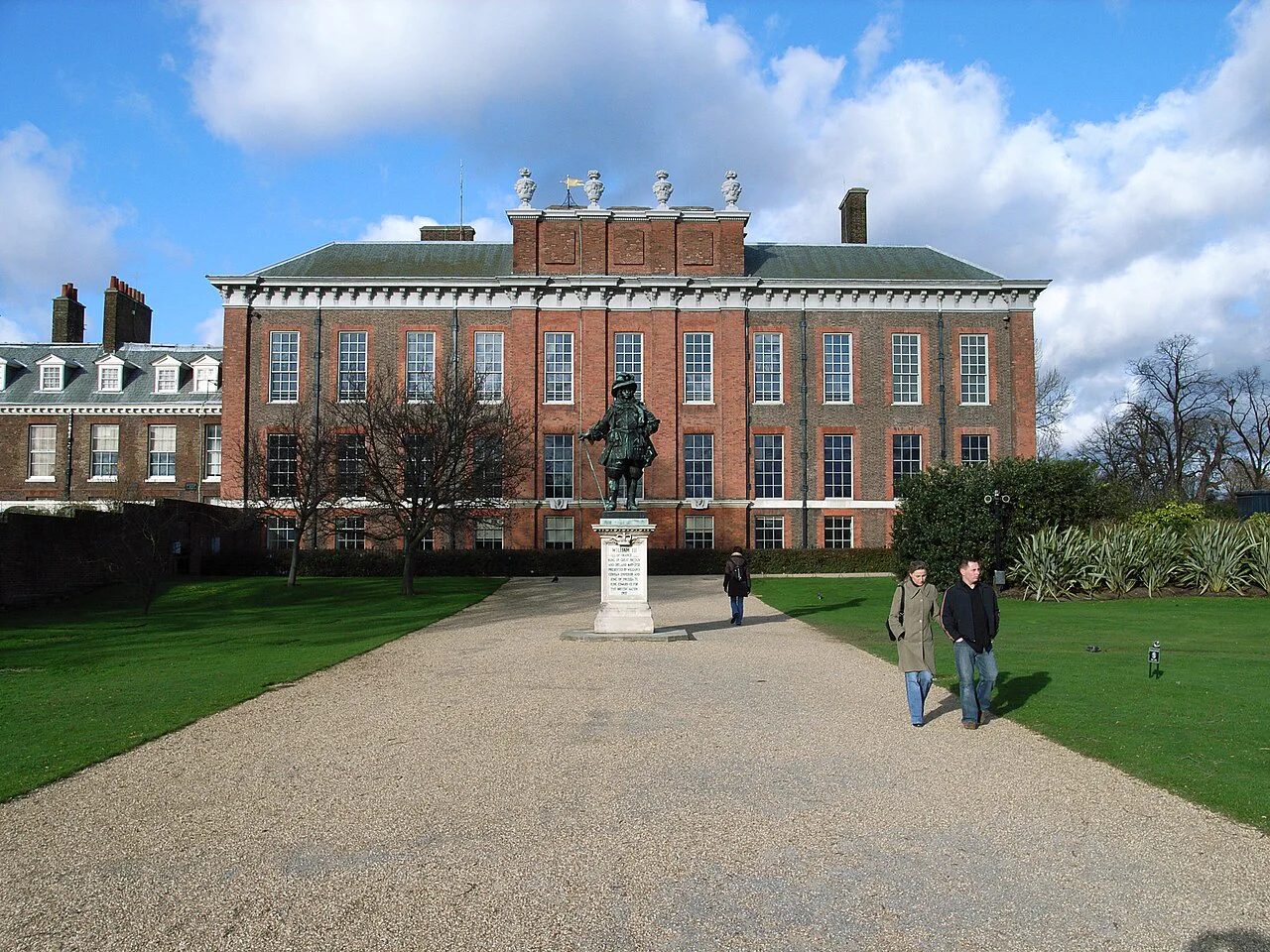
London · 8 km
Kensington Palace
Content & sources
Steve Cadman from London, U.K. · CC BY-SA 2.0
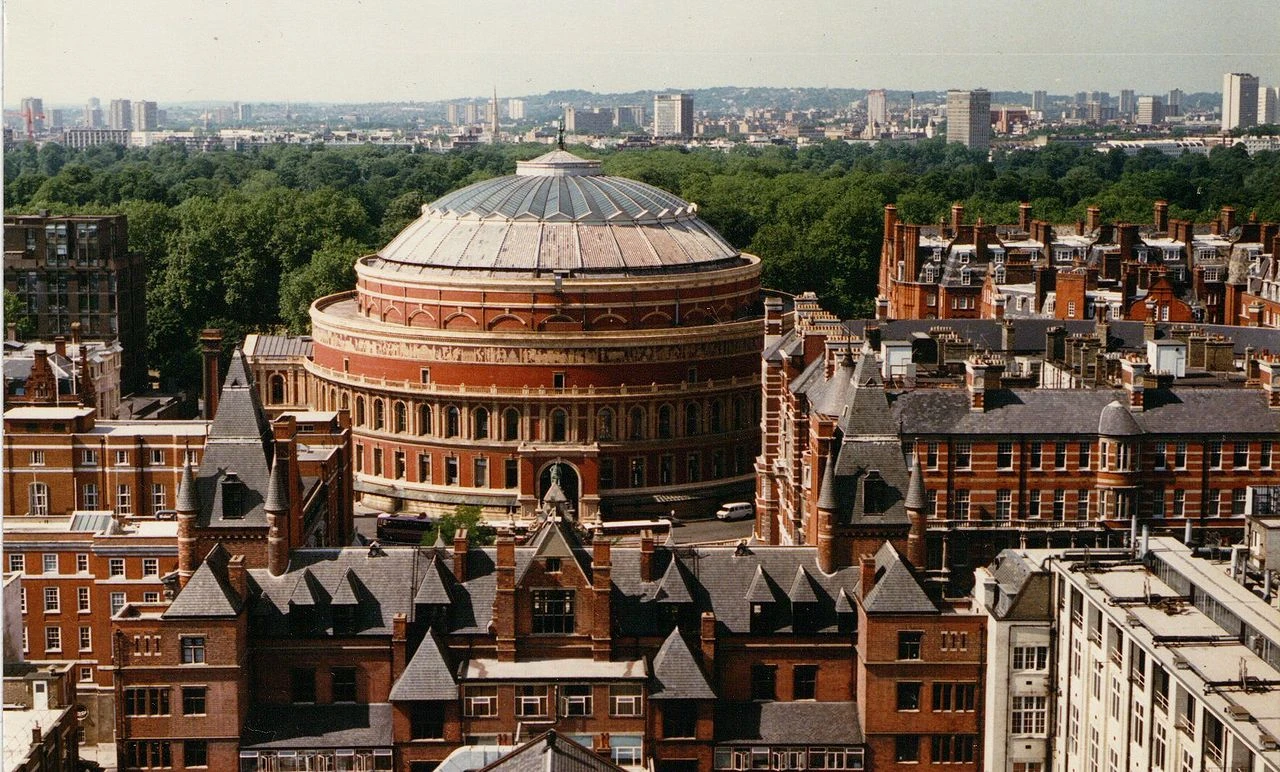
London · 8 km
Royal Albert Hall
Content & sources
Sandpiper · Public domain
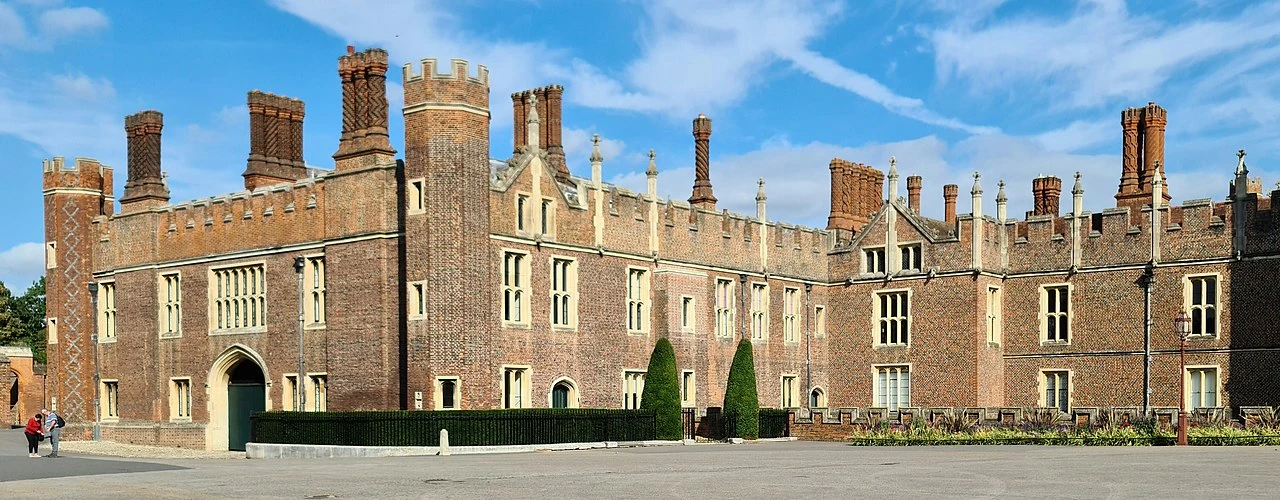
Greater London · 9 km
Hampton Court Palace
Content & sources
Photo: Ricardalovesmonuments · CC BY-SA 4.0
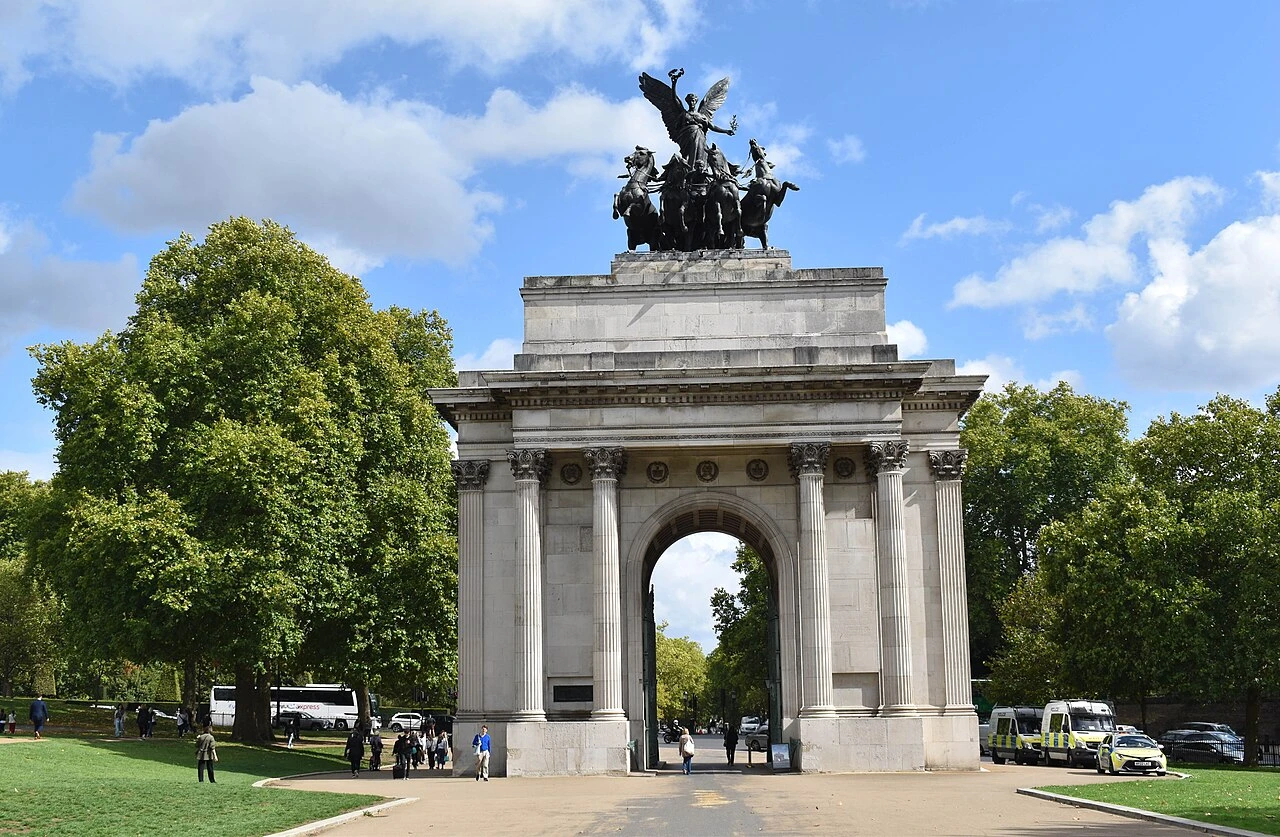
London · 10 km
Wellington Arch
Content & sources
Photo: Canaan · CC BY-SA 4.0