Languages
15Bodiam Castle Audio Guide
Bodiam Castle is a landmark in Rother, United Kingdom. Explore it with Stanza's GPS-triggered offline audio guide — available in 15 languages.
Quick Facts
15
Stops
15
Languages
100%
Offline
📍 Rother, United Kingdom · 51.0023°N, 0.5435°E
About Bodiam Castle
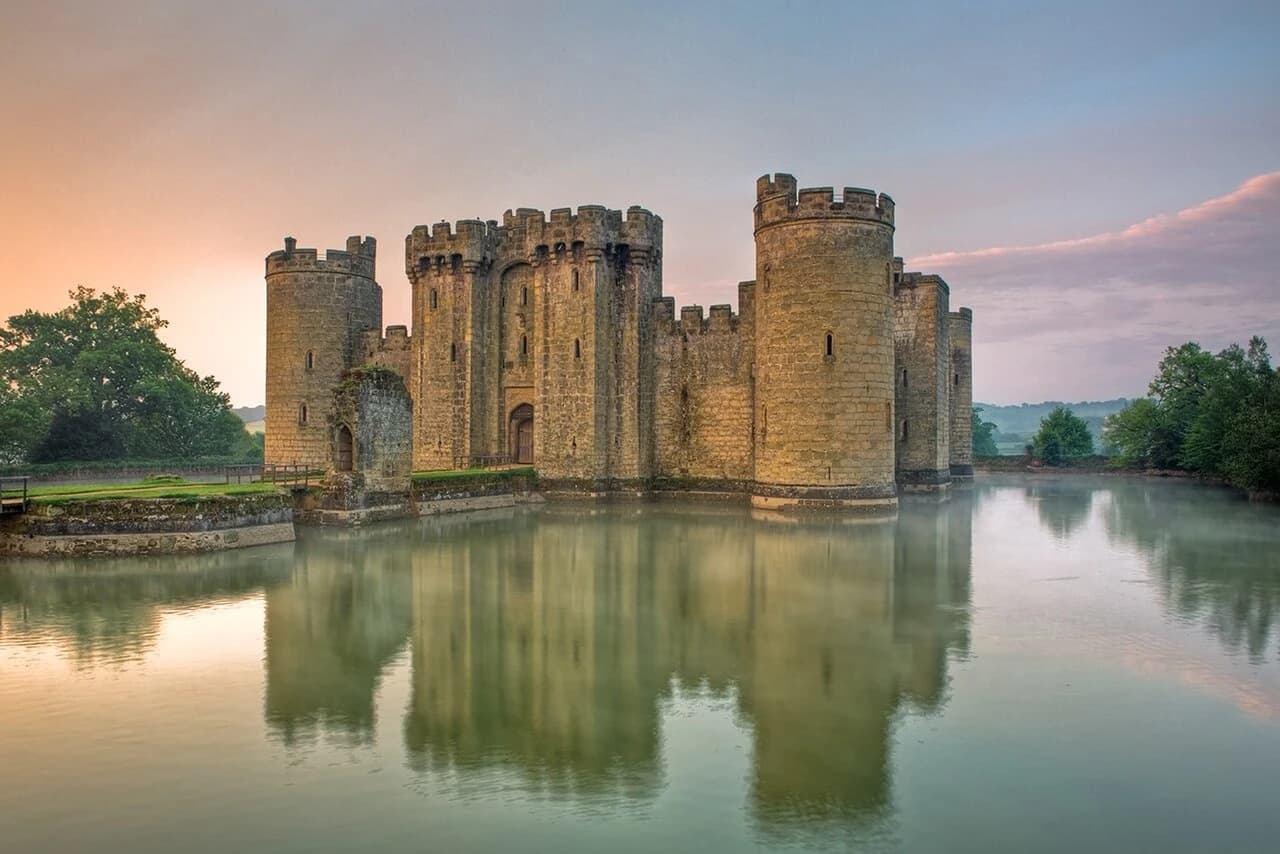
Bodiam Castle is a 14th-century moated quadrangular castle located near Robertsbridge in East Sussex, England. It is also recognized as a historic house museum, ruins, and an archaeological site.
This self-guided audio tour features 15 narrated stops organized across 9 sections. As a castle, Bodiam Castle offers a unique cultural experience in the heart of Rother, United Kingdom.
The Stanza audio guide is available in 15 languages and works entirely offline — download the complete tour including audio narration, maps, and images before your visit. As you walk through Bodiam Castle, GPS-triggered narration plays automatically at each point of interest.
Last updated:
What you will hear
The Indirect Approach: Octagon Island
Explains the unique defensive bridge system that forced visitors to take an exposed path.
The Octagon Obstacle
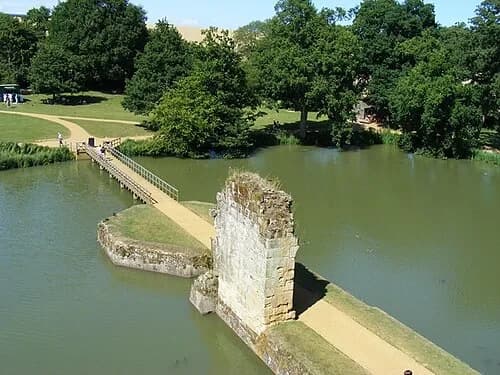
While the modern wooden bridge provides a direct path to the entrance, the original 14th-century approach was far more complex and dangerous. Visitors originally had to cross a causeway that led to a stone "Octagon Island" situated in the water. From that island, they were forced to make a sharp ninety-degree turn to reach the main gatehouse. This wasn't just an aesthetic choice; it was a lethal piece of defensive psychology. Most soldiers held their shields in their left hands, meaning that by turning ninety degrees to the right, they exposed their unshielded right side directly to the archers stationed in the gatehouse towers. As guests or invaders navigated this narrow path over the water, they were completely vulnerable to arrow fire from above. This layout ensured that even before reaching the heavy doors, anyone approaching was at the mercy of the castle's defenders. The stone foundations of this octagon obstacle can still be seen rising from the moat, marking the precise spot where the defensive turn began.
The Iron Grip: Main Gatehouse and Defenses
Focuses on the active defense features of the twin-towered entrance.
The Murder Holes
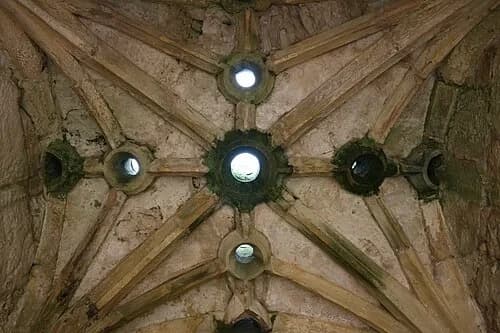
Look up at the ceiling inside the gatehouse passage to see several circular openings in the stone vaulting. These are the famous "murder holes." Popular legends often suggest these were used for pouring boiling oil, but that is a persistent myth. Oil was far too expensive and difficult to heat quickly to be used as a primary weapon. Instead, the soldiers stationed in the room above would have used these gaps to drop heavy stones, boiling water, or even heated sand onto any invaders trapped in the passage below. The gatehouse was designed with two portcullises; if an enemy breached the first, the second would be dropped, trapping them in a small stone "killing zone." From the safety of the upper floor, the garrison could then rain down projectiles through these holes, neutralizing the threat without ever having to engage in hand-to-hand combat. These holes provided a clear line of sight and a direct vertical path to target anyone attempting to force their way through the castle's primary entrance.
The Iron Portcullis
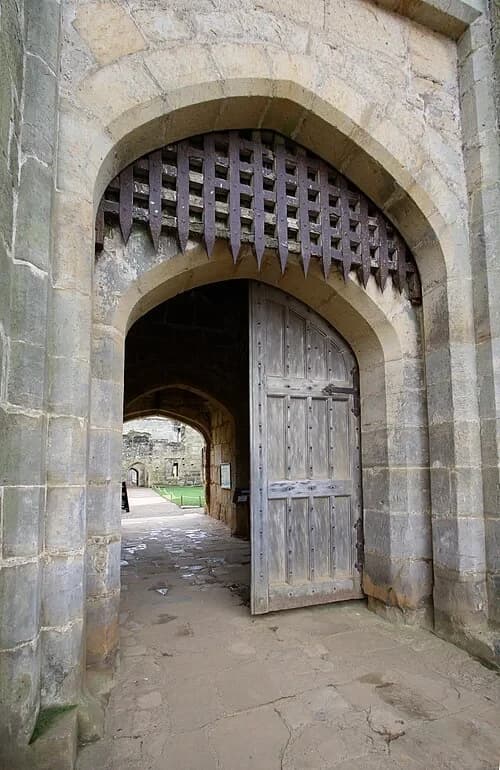
The main gatehouse of Bodiam is much more than a simple doorway; it is a formidable twin-towered fortress in its own right. Protecting the entrance is a heavy, iron-shod portcullis, which remains one of the finest surviving examples of its kind. This vertical gate, combined with massive wooden doors, formed a nearly impenetrable barrier. While the castle appears picturesque and peaceful today, these were active tools of war. During the late 14th century, the threat of a French invasion was very real, and the gatehouse was designed to withstand a serious, sustained assault. The winding mechanism for the portcullis was located in the room directly above, allowing guards to drop the heavy lattice in seconds. This entrance reflects the dual nature of Bodiam: it was built to be a grand home for a successful knight, but it was also a functional military installation designed to protect against the violent realities of the era. The iron reinforcements on the gate provided extra strength against battering rams and fire.
Living Against the Walls: The Central Courtyard
Introduces the quadrangular design where all living spaces are pushed to the outer walls.
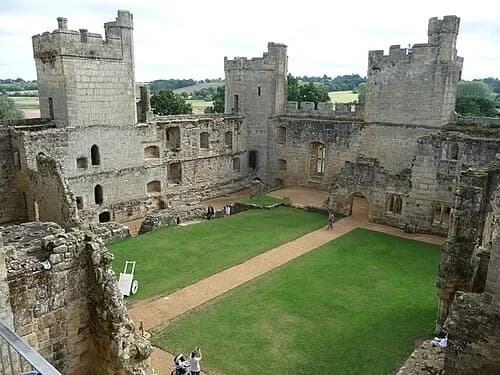
The Courtyard Square
Standing here in the center, you can appreciate the modern "quadrangular" layout of the castle. Unlike older Norman castles that relied on a massive central tower or "keep," Bodiam followed a cutting-edge 14th-century design. All the necessary living quarters, storage rooms, and service areas were pushed directly against the outer curtain walls. This efficient arrangement maximized the space inside the walls, creating this large, open central courtyard. In its prime, this wasn't just an empty lawn; it was a bustling communal space. Imagine it filled with the sounds of horses, blacksmiths at work, and servants moving between the various wings of the castle. By placing the rooms around the perimeter, the architect ensured that every part of the castle was easily accessible from this central hub while maintaining a strong, unified defensive shell against the outside world. This design allowed for better communication between the garrison and the household staff, making the castle function as a cohesive, self-contained community within its stone boundaries.
The Lord's Hospitality: Great Hall and Kitchens
The social heart of the castle where Dalyngrigge displayed his wealth through feasting.
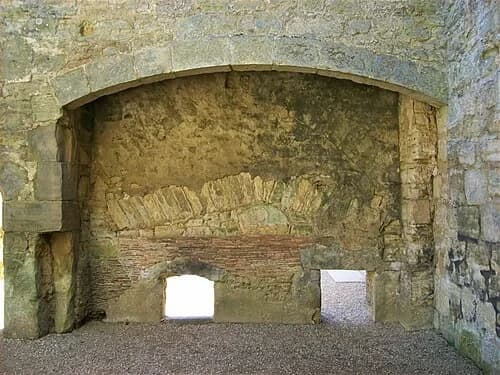
The Castle Kitchens
Nearby, you can find the remains of the castle kitchens, identifiable by their massive stone hearths. Feeding the inhabitants of a medieval fortress was a significant logistical feat. These kitchens were responsible for roasting entire animal carcasses and baking fresh bread daily for both the Dalyngrigge family and their retinue of soldiers. The sensory environment of this space centuries ago would have been intense, filled with the heat radiating from the open fires, thick clouds of wood smoke, and the constant clamor of servants and cooks. It was a place of perpetual motion, as workers prepared the elaborate multi-course meals required for the feasts in the Great Hall. The size of these fireplaces reflects the scale of hospitality expected of a knight of Dalyngrigge's standing, where the ability to provide abundant food was a key marker of power. Stone drainage channels in the floor suggest how the staff managed the significant amount of waste generated by such large-scale food preparation.
Vital Resources: The Southwest Tower Well
The essential water source that allowed the castle to survive a siege.
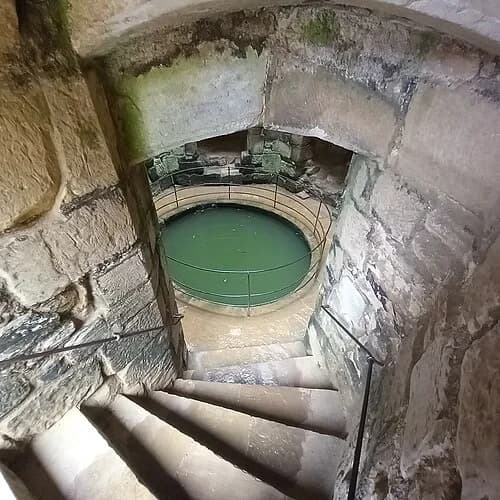
The Southwest Tower Well
At the base of the southwest tower lies the castle's circular stone well. This was perhaps the most vital resource within the entire fortress. While the castle is surrounded by an enormous body of water, the moat was far from drinkable. In fact, the moat functioned as the castle's primary sewer system. For a garrison to survive a prolonged siege, they needed a deep, reliable supply of fresh water that could not be poisoned or cut off by an enemy. This well provided exactly that. It demonstrates the careful planning that went into making Bodiam a self-sufficient unit. The proximity of the well to the kitchens and the garrison quarters ensured that water for cooking and cleaning was always close at hand. It serves as a reminder that behind the grand architecture and military posturing, the survival of the castle depended on very basic, essential logistics. The stone walls of the well descend deep into the earth to tap into a clean, protected aquifer.
The Soldier's Escape: The Postern Gate
The secondary entrance used for supplies and discreet departures.
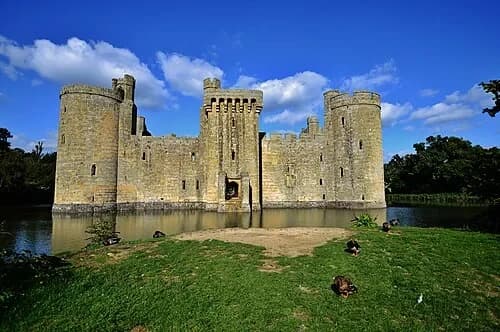
The Postern Gate
Identify the square tower located in the middle of the south wall; this is the Postern Gate. While the main northern gatehouse was designed for grand arrivals and military defense, the Postern Gate was a practical, secondary entrance. It served a vital logistical function, allowing supplies to be brought directly into the castle by boat from the River Rother, which was more navigable in the 14th century than it is today. This gate also provided a discreet way for the Lord and his inner circle to enter or leave the castle without the ceremony or public exposure of the main entrance. In the event of a siege, a postern gate could also be used for secret sorties or as a potential escape route. Its presence highlights the sophistication of Bodiam's design, balancing the needs of daily commerce and private movement with the castle’s primary defensive role. The tower itself provided additional protection for this vulnerable point in the south curtain wall.
Security and Sanitation: The Northwest Tower
Discusses the castle's 28 garderobes and the basement prison.
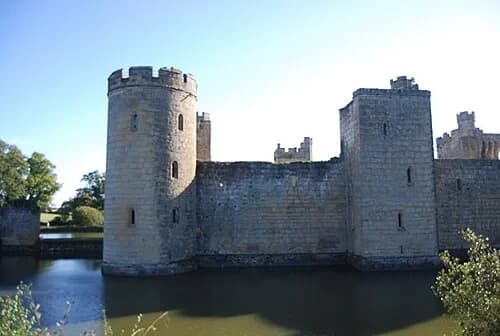
Security and Sanitation
The northwest tower reveals the less glamorous side of medieval life. Built into the towers of Bodiam were 28 garderobes, or medieval toilets. These simple stone chutes were a marvel of contemporary plumbing, though they drained directly into the moat below. This explains why the moat was never intended for swimming; the water was effectively an open sewer. Additionally, the basement of this particular tower served as the castle's prison. It was a dark, damp, and isolated space, far removed from the comfort of the Lord's private apartments. This combination of sanitation and security in one tower illustrates how every inch of the castle was utilized for a specific, often very practical purpose. The existence of so many toilets throughout the structure suggests that the castle was designed to house a significant number of people, all while maintaining a basic level of hygiene for the 14th century. The prison remains a stark reminder of the Lord's legal authority over the local area.
Sentinels of the Weald: Wall Walks and Summits
The climax of the visit, offering views over the moat and the surrounding landscape.
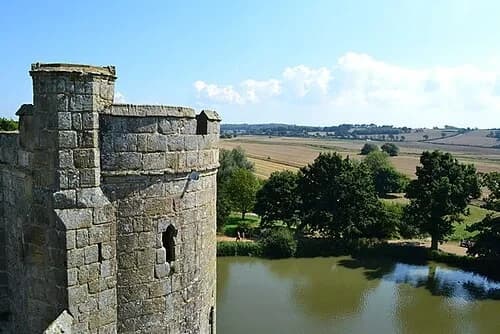
Sentinel's View
From the summit of the corner towers, you have a commanding view over the surrounding landscape of the High Weald. These towers stand three storeys high, significantly taller than the main curtain walls, providing a critical vantage point for the garrison. From here, sentries could watch the River Rother for any signs of French ships or raiding parties approaching from the coast. The strategic value of this height cannot be overstated; it allowed for early warnings and provided a superior position for defense. If you look at the narrow openings in the tower walls, you will see they were specifically designed to protect archers while giving them a clear line of sight to fire upon attackers. Some of the later modifications even include early loops designed for handguns, showing how Bodiam's defenses evolved along with military technology. The height of the towers ensured that no attacker could approach the walls without being spotted long before they reached the moat.
The Picturesque Ruin: Artistic Legacy
Concludes the tour by looking at how the castle's 'slighting' made it a romantic icon for artists.
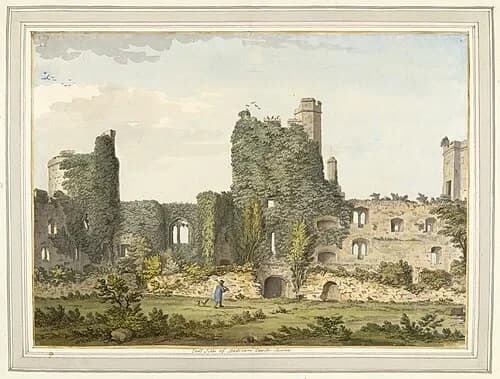
The Romantic Ruin
This 18th-century watercolor helps tell the final chapter of Bodiam’s story. The castle’s life as a functional fortress ended after the English Civil War, when Parliamentary forces "slighted" the building. This involved intentionally dismantling the interior rooms and roof to ensure it could never be used for war again. Surprisingly, this act of destruction is what saved Bodiam for us today. By the 1700s, the hollowed-out shell became a celebrated "picturesque" icon for Romantic artists like Grimm. Instead of being completely demolished for stone, the castle was preserved for its aesthetic beauty and dramatic appearance. In the early 20th century, Lord Curzon undertook an extensive restoration to stabilize the ruins, recognizing that Bodiam's true value lay in its evocative appearance as a majestic, water-bound shell. It remains today as a perfect snapshot of a medieval ideal, preserved through centuries of change and neglect. The image captures the thick ivy and wild growth that once characterized the ruins before modern conservation efforts began.
Want to hear the rest?
Download the Stanza app to unlock all 15 stops and full GPS-guided navigation.
Frequently Asked Questions
How long does the Bodiam Castle audio tour take?
The Bodiam Castle audio guide includes 15 narrated stops. Most visitors spend 45 minutes to 1.5 hours exploring the complete tour, though you can listen at your own pace and skip or revisit any stop.
Is the Bodiam Castle audio guide available in my language?
Stanza supports 15 languages: English, Spanish, French, German, Italian, Portuguese, Russian, Japanese, Chinese, Korean, Arabic, Hindi, Polish, Dutch, Hebrew. Check the guide in the app to confirm the languages currently available for this tour.
Can I use the audio guide offline at Bodiam Castle?
Yes! Download the complete Bodiam Castle tour — including all audio, maps, and images — before your visit. The Stanza app works completely offline, so you don't need WiFi or mobile data at the venue.
How much does the Bodiam Castle audio guide cost?
The Stanza app is free to download. The current listed price for the Bodiam Castle audio guide is $2.99; app-store region and currency may affect the final price.
How do I use the Stanza audio guide at Bodiam Castle?
Download the free Stanza app, search for "Bodiam Castle", and download the tour. When you arrive at the venue, the app uses GPS to detect your location and automatically plays the relevant narration as you move between points of interest — completely hands-free.
What makes the Stanza audio guide different from other Bodiam Castle tours?
Stanza offers GPS-triggered narration that plays automatically as you walk through Bodiam Castle — no need to manually select stops. The tour is available in 15 languages, works fully offline, and includes 15 expertly narrated stops with images and historical context.
What other audio guides are available near Bodiam Castle?
Stanza offers multiple audio guides in Rother, United Kingdom and nearby areas. After downloading the app, browse the map to discover all available tours near Bodiam Castle. Each guide can be downloaded for offline use.