Languages
15Shakespeare's Birthplace Audio Guide
Shakespeare's Birthplace is a museum in Stratford-on-Avon, United Kingdom. Explore it with Stanza's visual scanner and offline audio guide — available in 15 languages.
Quick Facts
14
Stops
15
Languages
100%
Offline
📍 Stratford-on-Avon, United Kingdom · 52.1939°N, -1.7080°E
About Shakespeare's Birthplace
This restored 16th-century half-timbered house is the site where playwright William Shakespeare was born and spent his childhood. It now functions as a museum dedicated to his life and works.
Shakespeare's Birthplace is also known as birthplace of William Shakespeare.
This self-guided audio tour features 14 narrated stops organized across 6 sections, including The Henley Street Facade, John Shakespeare's Glove Workshop, The Ground Floor Hall and Kitchen, The First Floor Birthroom, The Window of Famous Autographs, The Walled Garden. As a house museum, Shakespeare's Birthplace offers a unique cultural experience in the heart of Stratford-on-Avon, United Kingdom.
The Stanza audio guide is available in 15 languages and works entirely offline — download the complete tour including audio narration, maps, and images before your visit. As you walk through Shakespeare's Birthplace, GPS-triggered narration plays automatically at each point of interest.
Last updated:
Artworks on display
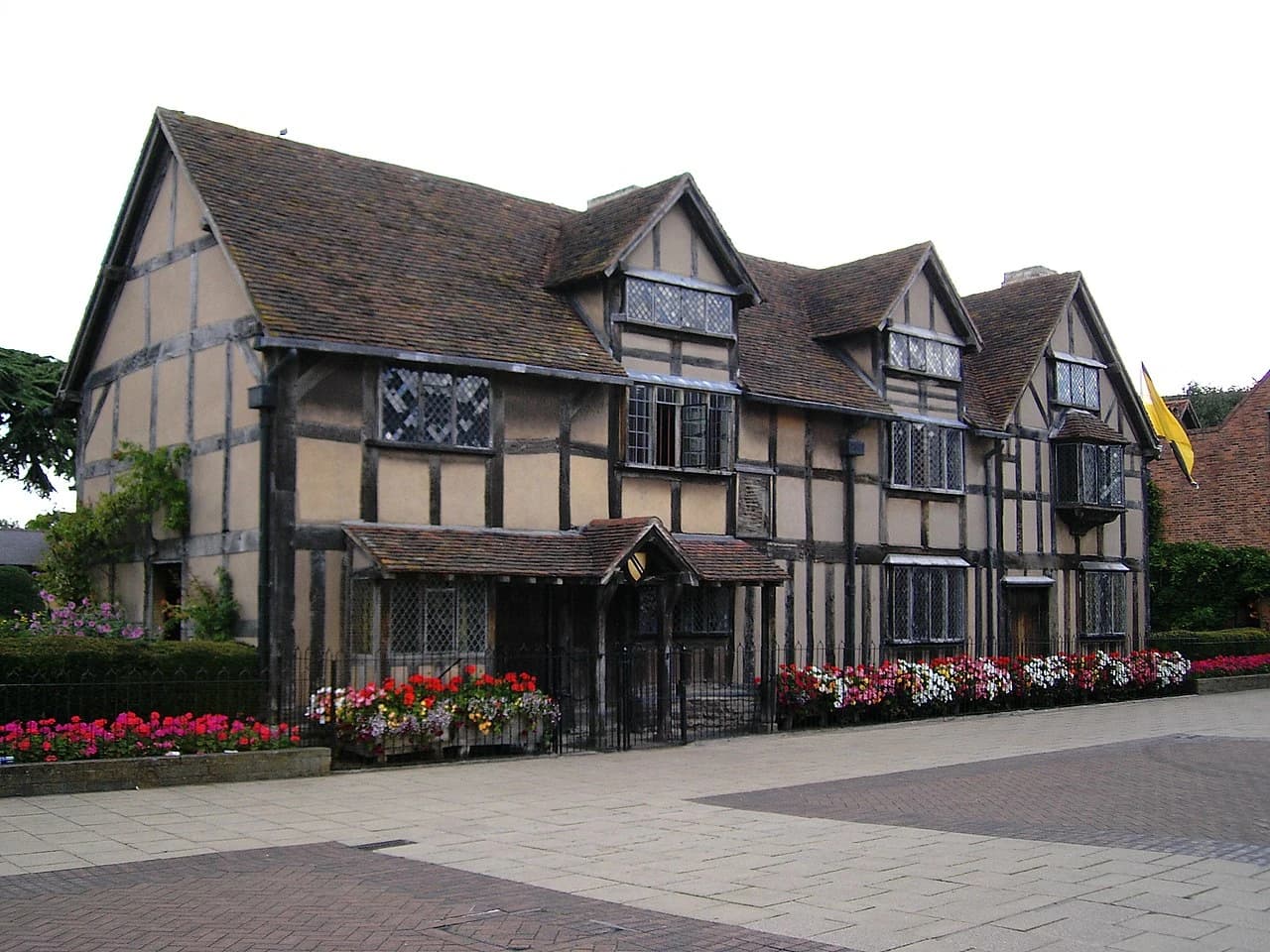
The Henley Street Facade
Step out onto Henley Street to see the iconic timber-framed house. This is where William was born in 1564 and where the Shakespeare Birthday Committee famously saved the property from being shipped to America by P.T. Barnum in 1847.
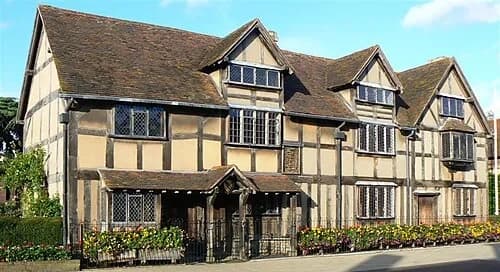
The Henley Street Facade
The half-timbered structure you see today likely dates back to before 1552, when William's father, John, was first recorded as living here. Its construction uses local oak for the heavy frame, which was then filled with a mixture of sticks and clay. One of the most intriguing stories in its history occurred in 1846, when the famous American showman P.T. Barnum proposed purchasing the entire building, dismantling it, and shipping it to the United States. This threat caused a local sensation and directly led to the formation of the Shakespeare Birthday Committee. They successfully raised £3,000 in 1847 to purchase the house for the British nation, ensuring it remained in its original location. Since 1951, the building has been recognized as a Grade I listed structure, the highest level of heritage protection in the United Kingdom. As you look at the facade, you are seeing the result of centuries of survival and a major restoration effort in the mid-1800s designed to return it to its most authentic Tudor-era appearance.
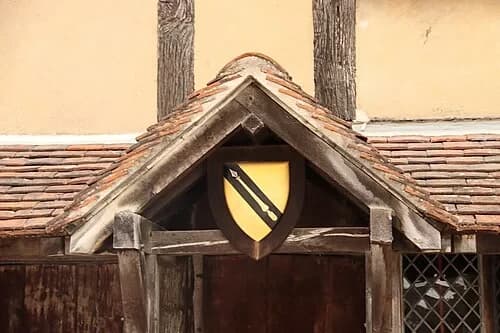
The Shakespeare Coat of Arms
The shield features a gold field with a black band, containing a silver spear with a gold tip. This imagery serves as a visual pun on the family name—a 'shaking spear.' The story behind this crest is one of social ambition. John Shakespeare, a successful tradesman and local official, first applied for a coat of arms in 1568 to signify his status as a 'gentleman.' His initial application was unsuccessful, but his son William, having achieved fame and wealth in the London theater, eventually secured the grant for his father in 1596. This allowed the family to bear a crest and use the title of 'gentleman,' a significant leap in the strict social hierarchy of the time. The motto on the coat of arms, though not visible here, is 'Non Sanz Droict,' which translates from French as 'Not Without Right.' This shield remains a physical reminder that the Shakespeares were a middle-class family on the rise, using their professional success to secure a higher social standing for future generations.
John Shakespeare's Glove Workshop
Enter the workspace of William's father, John Shakespeare. As a whittawer and glover, this workshop was the economic heart of the family home, filled with the scents of leather and the tools of a 16th-century tradesman.
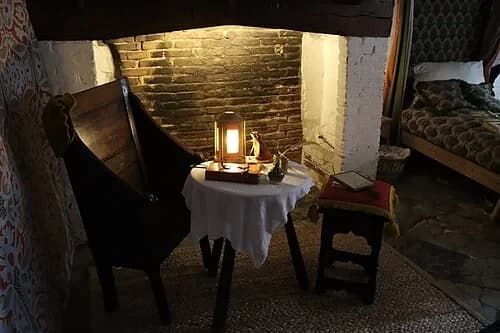
The Writing Table
In this corner, you can see a simple functional setup that would have been standard for a young person learning to read and write. The wooden writing table is solid and utilitarian, reflecting the middle-class status of the household. On the surface sits a quill pen, usually fashioned from a large bird's feather, and a small inkwell. While John Shakespeare was a successful glover, his home was not a place of luxury, and furniture was designed primarily for use rather than display. This modest arrangement represents the educational foundations of the young William. Grammar school students of the time spent hours practicing their penmanship and translating Latin texts, a rigorous training that would later serve as the foundation for a career in drama and poetry. The soft lighting in the room helps to show the texture of the wood and the simplicity of the tools. It is a quiet, domestic space that offers a glimpse into the everyday labor of sixteenth-century literacy, long before the fame of London's stages became a reality.
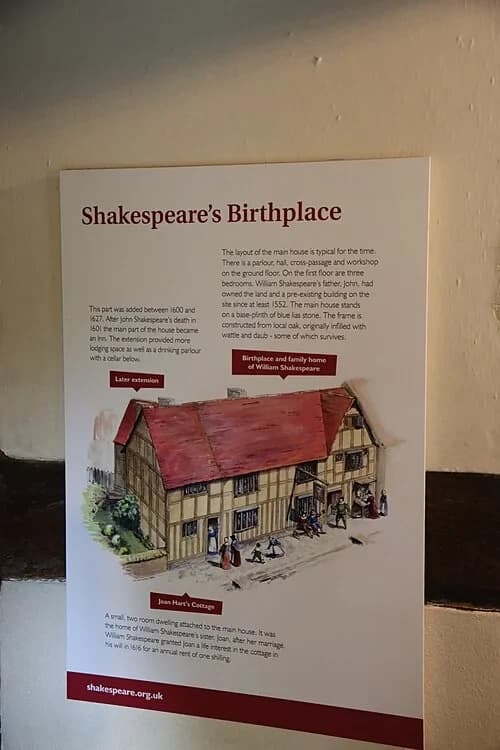
House Reconstruction Diagram
The informational board provides a clear breakdown of the house's internal structure. It reveals a layout consisting of three main ground-floor rooms: the parlor, the hall, and the workshop. Upstairs, there are three corresponding chambers or bedrooms. The diagram also details the 'wattle and daub' technique used to fill the spaces between the sturdy oak timbers. Wattle is a lattice of woven wooden strips, while daub is a plaster-like mixture of clay, lime, and straw. This combination was flexible and durable, though it required regular maintenance. Between 1857 and 1864, the house underwent a significant restoration program. At that time, many later additions—including brick facades from the 1700s—were removed to reveal the original timber frame and return the building to its sixteenth-century glory. The diagram helps explain how the house expanded over time, including an extension added between 1600 and 1627. By understanding these architectural layers, you can better appreciate the physical environment that shaped the daily life of the Shakespeare family during the Elizabethan period.
The Ground Floor Hall and Kitchen
Experience the domestic life of the Shakespeare family in the Hall and Parlor. These rooms were the center of household activity, from communal meals around the large fireplace to entertaining guests in the more formal parlor.
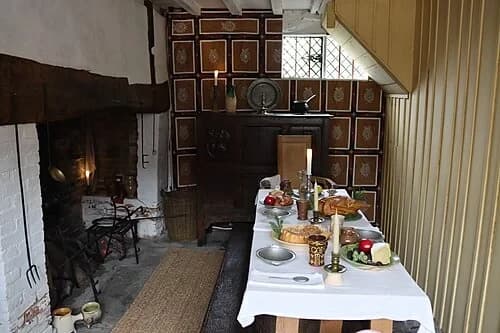
The Family Hall
This room served as the central hub for the entire household. It is anchored by a large stone fireplace, which provided essential warmth and light during the cold English winters. In the center of the room, a long dining table stands ready for service. One of the most distinctive features here is the decorative wall hangings. These colorful textiles were a popular choice for sixteenth-century families of comfortable means. They served two practical purposes: acting as a layer of insulation against drafts and providing a decorative touch that was significantly more affordable than solid wood paneling. The patterns on these hangings often mimicked more expensive tapestries or painted designs. Life in the Hall was communal; it was where the children were supervised, business was discussed, and the family’s status was displayed to visitors. The mix of functional furniture and decorative textiles illustrates the balance of practicality and social pride found in a successful tradesman's home. The atmosphere is intended to reflect the lived experience of a busy middle-class family during Shakespeare's youth.
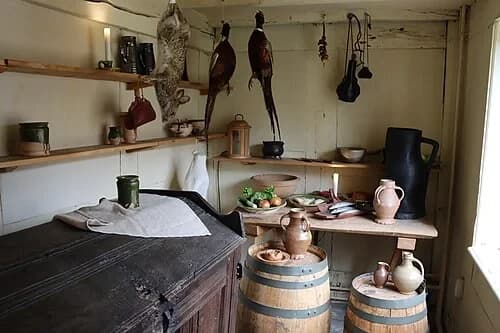
The Pantry and Store
In this storage area, you can see the raw materials of Elizabethan life. Hanging from the ceiling are game animals, such as pheasants and a rabbit, illustrating how the family sourced their meat. Various ceramic pots and wooden barrels line the shelves and floor, used for preserving and storing food and household supplies. This space also links to the professional life of William’s father, John Shakespeare. John was a 'whittawer'—a specialized tradesman who processed white leather—and a glover. The workshop would have been a place of constant activity, likely filled with the sharp, distinctive scents of tanned skins and curing hides. The specialized tools and materials found here represent the economic engine that supported the family and allowed them to live in a house of this size on Henley Street. It is a sensory reminder that the household was also a place of work. The presence of leather goods, ceramic jugs, and hanging game offers a detailed look at the practical, hardworking origins of the family that produced England's most famous poet.
The First Floor Birthroom
Climb the narrow stairs to the most significant room in the house. Identified by tradition as the chamber where William Shakespeare was born in 1564, this modest bedroom features a four-poster bed and a child's cradle.
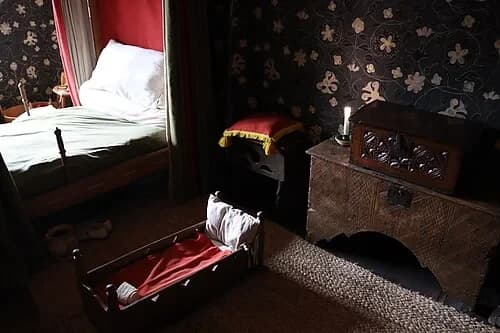
The Birthroom
This intimate chamber has long been held as the place where Mary Arden gave birth to her son William. The room is furnished with a period-accurate four-poster bed, complete with heavy drapes used for warmth and privacy. Beside the main bed sits a small, wooden child's cradle, typical of the mid-sixteenth century. The floral patterns on the wall hangings and the low, heavy ceiling create a sense of close, domestic life. Standing in this room, you are in the very space that marks the beginning of a life that would change literature forever. For centuries, this modest room has been the focal point for visitors who travel to Stratford to connect with Shakespeare's origins. The furniture and decorations have been carefully selected to represent a typical middle-class bedchamber of the 1560s. It was a space designed for rest and family bonding, far removed from the public life William would eventually lead in London. The simplicity of the room highlights the relatively humble beginnings of a figure whose influence now spans the globe.
The Window of Famous Autographs
Look closely at the window panes and walls to find the signatures of history's literary giants. Over the centuries, visitors like Charles Dickens, Sir Walter Scott, and John Keats etched their names here to mark their pilgrimage to the Bard's home.
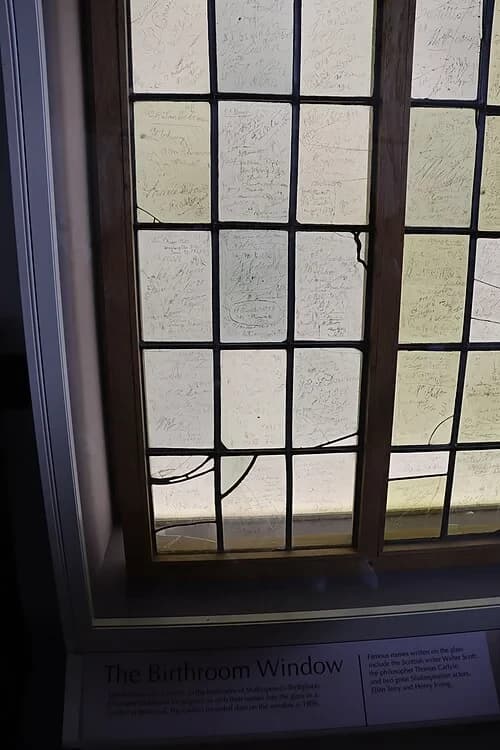
The Autograph Window
During the eighteenth and nineteenth centuries, it became a common tradition for literary 'pilgrims' visiting the house to scratch their names into the glass of the window panes. These signatures represent a wide cross-section of society, from local residents to some of history's most famous authors. If you look closely, you can find the names of notable visitors like Charles Dickens, Sir Walter Scott, and John Keats, who all came here to pay their respects to Shakespeare's legacy. This practice of etching glass was a way for visitors to permanently mark their presence at the site. Because of its historical value, the original glass is now protected and displayed as a museum object in its own right. The signatures vary in size and style, some showing the ornate cursive of the Victorian era, others simple and hurried. These etchings demonstrate the deep and enduring fascination that Shakespeare’s birthplace has held for people through the centuries. It transformed the window from a functional architectural feature into a documented record of the house's long history as a place of global cultural importance.
The Walled Garden
Step outside into the rear garden, planted with flowers and herbs mentioned in Shakespeare's plays. From spring tulips to traditional English herbs, this space reflects the botanical knowledge that infused his writing.
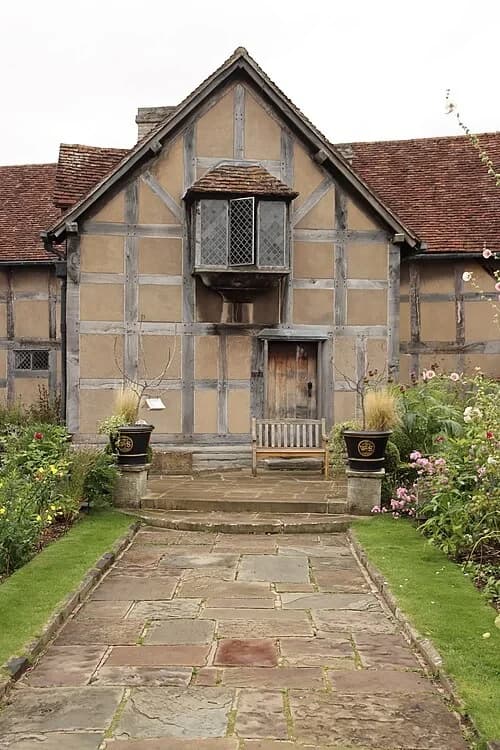
Rear Garden View
From the perspective of the garden, the house's architectural history is clearly visible. You can see the distinct oak timber framing and the gabled section that features a prominent bay window. This rear side offers a more peaceful look at the building, away from the street-front hustle. The house was not built all at once; instead, it evolved with various extensions to accommodate a growing family and changing needs. For instance, the section on the far side of the building was once the home of Shakespeare's sister, Joan Hart, and her family. The garden provides a quiet vantage point to observe how the levels of the house shift and how the timber structures lean slightly with age. The stonework at the base and the weathered tiles of the roof reflect the centuries of exposure to the English weather. This view helps visitors appreciate the sheer scale of the residence, which was one of the largest on Henley Street in the 1500s. It stands as a well-preserved instance of Tudor domestic architecture, shaped by the people who lived and worked within its walls.
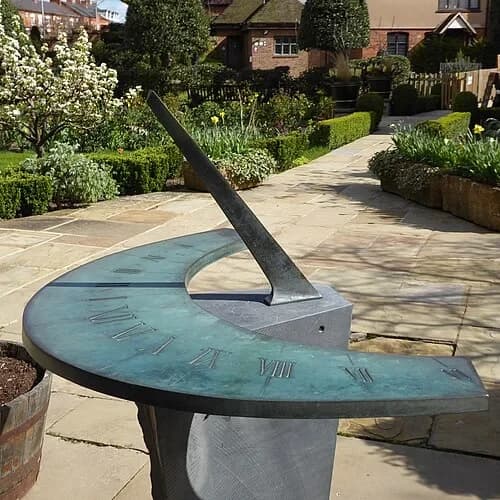
The Garden Sundial
The sundial stands on a stone pedestal, its weathered surface marked with Roman numerals for telling time. Surrounding it is a garden that serves as a living library of Shakespeare's botanical references. The plants and herbs here have been specifically chosen because they appear in his poetry and plays. You might recognize rosemary, which Ophelia mentions in Hamlet as being 'for remembrance,' or pansies, which she says are 'for thoughts.' This connection between the natural world and the playwright's imagery is central to the design of the space. In the Elizabethan era, gardens were essential for medicine, cooking, and symbolism, and Shakespeare used this common knowledge to add depth to his writing. As you look around, you can see how the colors and textures of these traditional plants contrast with the old stone and timber of the house. The garden provides a sensory link to the metaphors and themes found in his work, showing how the local flora of his childhood environment directly influenced some of the most famous lines in English literature.
Want to hear the rest?
Download the Stanza app to unlock all 14 artworks and the visual scanner feature.
Frequently Asked Questions
How long does the Shakespeare's Birthplace audio tour take?
The Shakespeare's Birthplace audio guide includes 14 narrated stops. Most visitors spend 45 minutes to 1.5 hours exploring the complete tour, though you can listen at your own pace and skip or revisit any stop.
Is the Shakespeare's Birthplace audio guide available in my language?
Stanza supports 15 languages: English, Spanish, French, German, Italian, Portuguese, Russian, Japanese, Chinese, Korean, Arabic, Hindi, Polish, Dutch, Hebrew. Check the guide in the app to confirm the languages currently available for this tour.
Can I use the audio guide offline at Shakespeare's Birthplace?
Yes! Download the complete Shakespeare's Birthplace tour — including all audio, maps, and images — before your visit. The Stanza app works completely offline, so you don't need WiFi or mobile data at the venue.
How much does the Shakespeare's Birthplace audio guide cost?
The Stanza app is free to download. Free and paid audio guides are available; current prices are shown in the app.
How do I use the Stanza audio guide at Shakespeare's Birthplace?
Download the free Stanza app, search for "Shakespeare's Birthplace", and download the tour. When you arrive at the venue, the app uses GPS to detect your location and automatically plays the relevant narration as you move between points of interest — completely hands-free.
What makes the Stanza audio guide different from other Shakespeare's Birthplace tours?
Stanza offers GPS-triggered narration that plays automatically as you walk through Shakespeare's Birthplace — no need to manually select stops. The tour is available in 15 languages, works fully offline, and includes 14 expertly narrated stops with images and historical context.
What other audio guides are available near Shakespeare's Birthplace?
Stanza offers multiple audio guides in Stratford-on-Avon, United Kingdom and nearby areas. After downloading the app, browse the map to discover all available tours near Shakespeare's Birthplace. Each guide can be downloaded for offline use.