Languages
15Warwick Castle Audio Guide
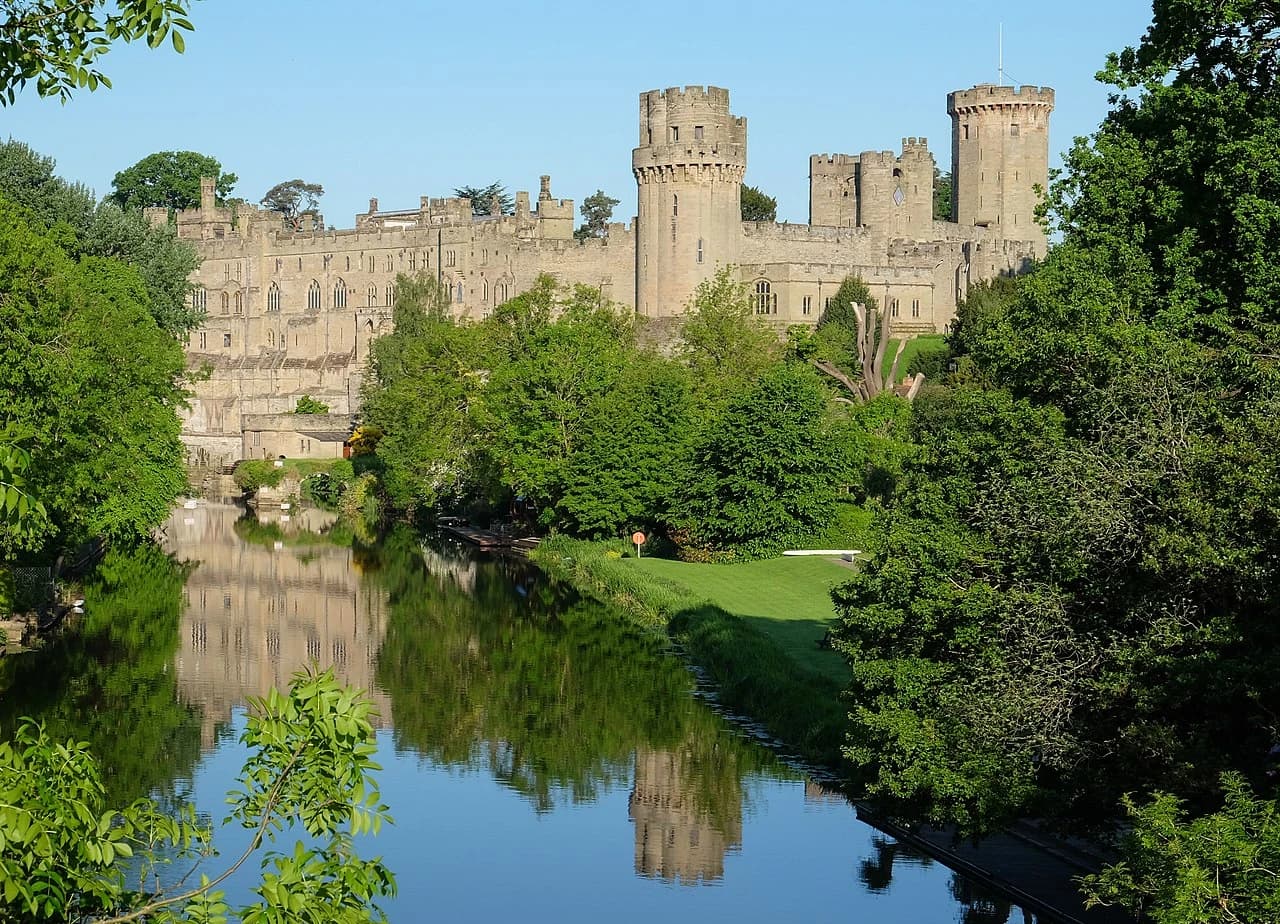
Warwick Castle is a landmark in Warwick, United Kingdom. Explore it with Stanza's GPS-triggered offline audio guide — available in 15 languages.
Quick Facts
18
Stops
15
Languages
100%
Offline
📍 Warwick, United Kingdom · 52.2796°N, -1.5856°E
About Warwick Castle
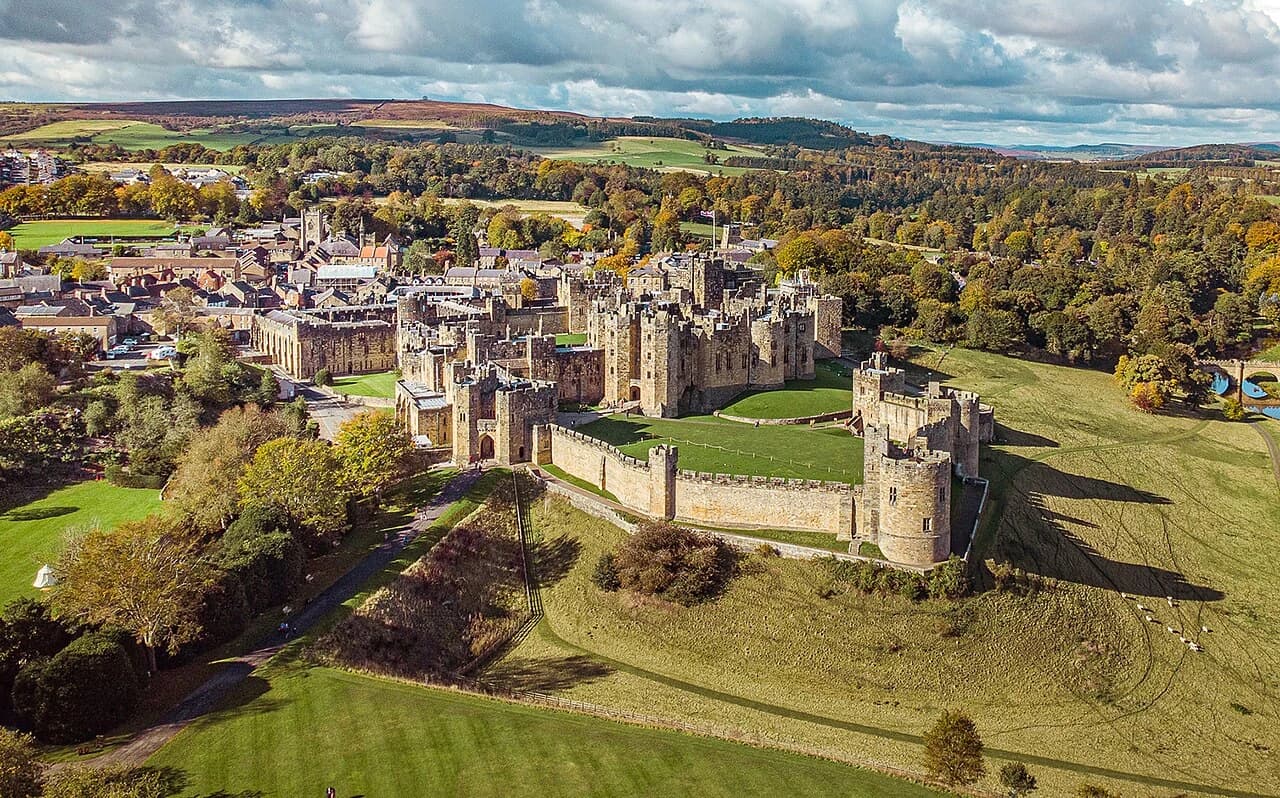
Warwick Castle is a medieval castle developed from an original wooden structure built by William the Conqueror in 1068. It is a major tourist attraction known for its well-preserved fortifications and historical exhibitions.
This self-guided audio tour features 18 narrated stops organized across 6 sections, including The Inner Courtyard and Norman Mound, The Great Hall and Armoury, The State Apartments and Royal Portraits, The Mighty Towers and Ramparts, The Riverbank and Castle Mill, Engines of Siege Warfare. As a castle, Warwick Castle offers a unique cultural experience in the heart of Warwick, United Kingdom.
The Stanza audio guide is available in 15 languages and works entirely offline — download the complete tour including audio narration, maps, and images before your visit. As you walk through Warwick Castle, GPS-triggered narration plays automatically at each point of interest.
Last updated:
What you will hear
The Inner Courtyard and Norman Mound
Covers the transition from the earliest Norman fortifications (1068) to the expansive heart of the medieval stronghold.
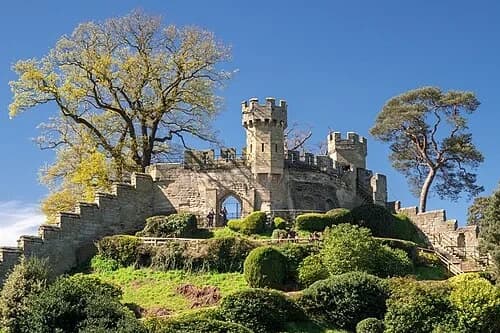
The Conqueror's Mound
This high ground represents the absolute foundation of the castle's history. It was here in 1068 that William the Conqueror ordered the construction of a wooden motte-and-bailey fort, just two years after his victory at the Battle of Hastings. The mound, or motte, was an artificial hill created to provide a tactical advantage, offering a clear line of sight over the River Avon and the Roman road that ran nearby. From this height, a small garrison could monitor any movement in the valley and detect approaching threats from miles away. As military technology evolved, the original timber structures were replaced with the stone walls and towers that now trace the contours of the original Norman earthwork. This continuity of defense shows how the initial tactical choice of the site influenced the entire layout of the stone castle built centuries later. The steep climb to the top of the mound today offers a glimpse into the defensive reality of the 11th century, where height was the most effective weapon against an invading force. The surrounding masonry follows the natural curve of the mound, demonstrating how medieval engineers adapted their stone fortifications to the pre-existing Norman topography.
The Great Hall and Armoury
Focuses on the military evolution and the castle's famous collection of weaponry, while mentioning the restoration after the Great Fire of 1871.
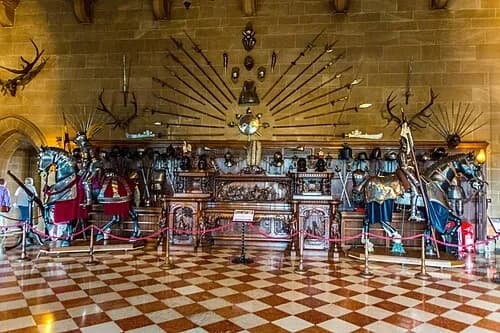
The Great Hall Armoury
The displays lining these walls constitute the second largest collection of arms and armor in Britain, a tally exceeded only by the national collection at the Tower of London. While many of the individual polearms and swords are functional weapons dating from the 14th to the 16th centuries, their current arrangement is a product of 19th-century aesthetic tastes. The Greville family, who held the earldom during the Victorian era, specifically curated these grand patterns to showcase their ancient noble heritage to visiting dignitaries and guests. Various types of medieval weaponry, including halberds, pikes, and broadswords, are grouped in fan-like shapes across the masonry. These weapons were once used in the bloody conflicts of the Middle Ages, but here they serve as decorative evidence of the family's long history as defenders of the realm. The scale of the collection reflects both the castle's genuine military past and the 19th-century romanticization of chivalry. Each piece was carefully cleaned and mounted to create a visual impact that emphasizes the power and longevity of the Warwick line. The heavy wooden stands and the way light catches the metal edges were designed to impress upon visitors the weight of the history surrounding them.
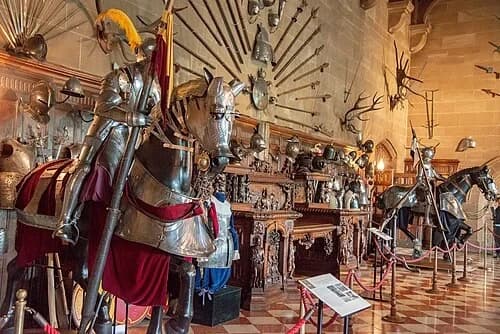
The Knight's Harness
These mounted figures showcase the technological pinnacle of personal protection: the full plate 'harness.' This style of armor replaced earlier, more flexible chainmail as weapons became more powerful and specialized. A complete suit like those on display could weigh approximately 25 kilograms, but because the weight was distributed across the entire body through a series of articulated joints, a trained knight could still move with surprising agility. The intricate construction of the visored helmets was designed to deflect the point of a lance while providing ventilation. The horses are also equipped with protective plates, known as barding, to shield them from projectiles and infantry polearms. Beyond their practical use on the battlefield, these suits were incredibly expensive to manufacture and served as vital status symbols for the nobility. Owning and maintaining such a harness signaled immense wealth and high social standing. The polished surfaces and custom fittings were often as much about looking impressive during a tournament as they were about surviving a skirmish. Even today, the presence of these armored figures evokes the specific blend of brutal utility and aristocratic display that defined the medieval knightly class.
The State Apartments and Royal Portraits
Explores the Greville family's transformation of the castle into a luxurious country house, featuring verified masterpieces from the collection.
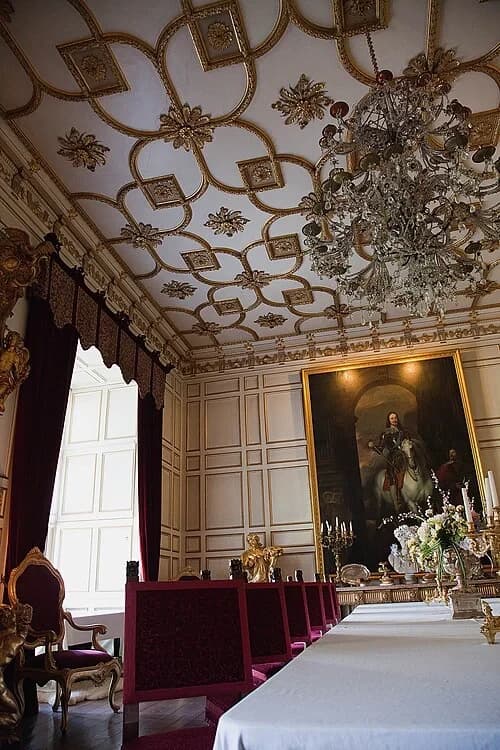
The State Dining Room
This grand space illustrates the castle's 19th-century transformation into a luxurious palace suitable for royal entertaining. Much of what is visible today is the result of a massive restoration project following the Great Fire of 1871, which gutted this wing of the castle. The disaster led the Greville family to undertake a lavish Victorian reconstruction, blending historic styles with the opulence expected by high society at the time. One of the most striking features is the ornate gilded ceiling, which reflects the wealth and influence the Earls of Warwick maintained during the Victorian era. The room was designed specifically to host high-status guests, including royalty; Queen Victoria herself dined here, cementing the castle's place at the center of British social life. The decor was intended to impress, with every surface carefully finished to project an image of timeless nobility and modern refinement. While the castle's exterior remained a rugged fortress, interiors like this provided the comfort and grandeur required for the elaborate dinner parties and political gatherings of the 1800s. The restoration aimed to preserve the spirit of the ancient site while ensuring it met the highest standards of 19th-century luxury.
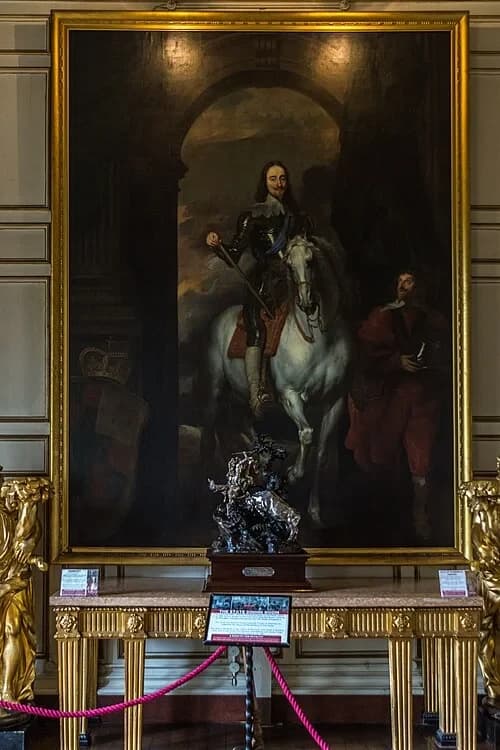
Equestrian Portrait of Charles I with his Grand Master of the Horse
http://www.wikidata.org/.well-known/genid/40409de4e335de1d8bf95e8399190eb6 · 17th century · canvas, oil paint
This large-scale equestrian portrait serves as a powerful piece of Royalist propaganda. It depicts King Charles I riding a white horse through a classical triumphal arch, a composition intended to project absolute divine authority and military leadership. His Grand Master of the Horse, Monsieur de Saint-Antoine, follows closely, carrying the King's helmet. The painting was designed to remind viewers of the monarch's supreme power and high social status. However, its presence in the Warwick collection is notably ironic. During the English Civil War in 1642, the castle was a major Parliamentarian stronghold under Lord Brooke. The castle was even subjected to a Royalist siege, which it successfully withstood. While the painting celebrates the absolute rule of the King, the very walls it hangs within were defended by men who actively fought to limit that power. The portrait remains one of the most important artworks in the castle, not just for its artistic merit, but for how it illustrates the complex and often contradictory loyalties of the noble families who lived through the upheaval of the 17th century. The King's calm expression and the grand setting were meant to convey a stability that was, in reality, quickly slipping away.
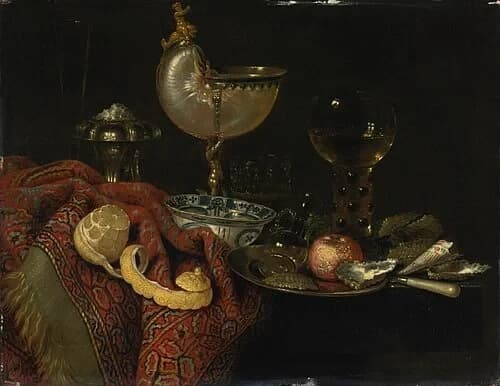
Still Life with Oysters and Nautilus Cup
Willem Claesz. Heda · 1662 · panel, oil paint
This exquisite work is a prime example of the Dutch Golden Age 'pronkstilleven,' or ostentatious still life. These paintings were designed to show off the artist's technical skill while celebrating the material wealth brought by global trade. Incredible detail is visible in the translucent flesh of the oysters, the moisture on the fruit, and the complex reflections on the glass and the polished nautilus cup. The artist has even captured the spiral of a partially peeled lemon, its rind curling down to reveal the textured fruit beneath. For the Earls of Warwick, who added this piece to their collection, such a painting was more than just decoration. It served as a symbol of their sophisticated taste and their awareness of the wider world. The items depicted—rare shells from distant seas, imported citrus, and fine glassware—were luxury goods that only the wealthiest could afford. The dark background ensures that every highlight on the metal and glass is emphasized, drawing the eye to the masterfully rendered textures. This style of painting became highly popular among the European elite, who prized the realism and the quiet display of worldly success that these intricate arrangements represented. Each element was chosen to demonstrate the owner's participation in the burgeoning global economy of the 17th and 18th centuries.
The Mighty Towers and Ramparts
Showcases the pinnacle of 14th-century military engineering through the two massive residential towers.
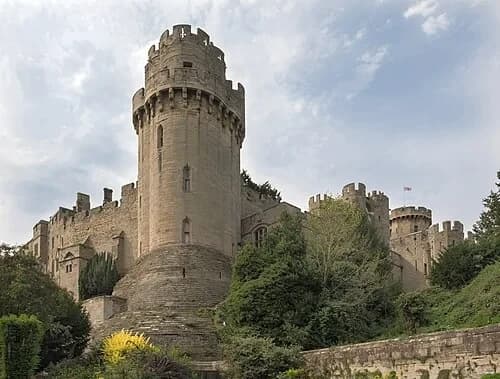
Caesar's Tower
Caesar's Tower is a remarkable example of 14th-century military engineering, built with a unique trilobed or clover-leaf shape. This design wasn't just for appearance; the rounded sections provided stronger defensive points and eliminated blind spots for the archers stationed above. The massive stone base slopes outward, serving two purposes: it prevented attackers from getting close to the foundation and was designed to deflect heavy stones dropped from above so they would bounce outward into enemy ranks. Inside, the tower served a grimly practical dual purpose. The upper floors were surprisingly luxurious, containing private chambers for high-ranking guests that featured fireplaces and large windows overlooking the river. However, the bottom level tells a very different story. It contains a windowless dungeon where prisoners were kept in total darkness, accessible only through a hatch in the floor of the room above. This contrast between the refined living spaces and the subterranean cell illustrates the cold reality of medieval life, where hospitality for some was maintained by the absolute control of others. The sheer thickness of the walls and the complexity of the internal layout made Caesar's Tower one of the most secure points in the entire castle complex.
The Riverbank and Castle Mill
Explores the strategic use of the River Avon and the industrial history of the castle's Victorian engine house.
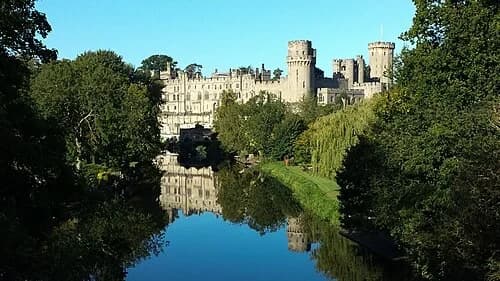
The River Facade
This iconic view of the castle reflecting in the River Avon is the result of a deliberate 18th-century landscape project. In the 1750s, the famous landscape architect Lancelot 'Capability' Brown was hired to transform the castle grounds. His goal was to move away from formal, geometric gardens and toward a more 'natural' parkland style that emphasized the grandeur of the architecture. To achieve this, Brown had several old buildings and orchards cleared away from the riverbank, opening up this dramatic vista. He used the river itself as a tool, turning it into a vast horizontal mirror that doubles the height and visual impact of the stone towers for anyone arriving from the south. This created an unforgettable first impression for the high-status guests who visited the Earls of Warwick during the Georgian era. The lush green banks and the carefully positioned clumps of trees are all part of this manufactured 'wildness,' designed to make the castle appear as if it rose naturally from a perfect English landscape. This transformation reflects the shift in the castle's identity from a defensive stronghold to a country estate where the primary purpose of the exterior was to be admired. The harmony between the massive stonework and the flowing water remains one of the most celebrated views in British architecture.
Engines of Siege Warfare
Highlights the signature trebuchet and other medieval artillery replicas on the riverbank.
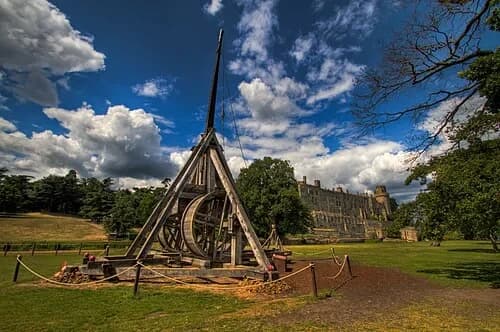
The Great Trebuchet
This massive structure is a meticulously crafted recreation of the world's largest working trebuchet. Standing 18 meters tall and weighing 22 tonnes, it is constructed from over 300 individual pieces of oak. This type of siege engine represented the peak of medieval mechanical warfare before the widespread use of gunpowder. It operates on the principle of a counterweight: a giant box filled with heavy weights is raised, and when released, it swings the long throwing arm with incredible force. This specific machine is capable of hurling 150-kilogram rocks over distances exceeding 300 meters, which was enough to shatter even the thickest stone castle walls. To reset the arm for another shot, two men must climb inside the giant wooden treadwheels on either side, using their body weight to winch the mechanism back into position. This process demonstrates the sheer amount of human labor required to operate such a weapon. In the Middle Ages, trebuchets were often built on-site during a siege, using local timber to create a terrorizing force that could break a stalemate. Seeing it here in the grounds provides a tangible sense of the terrifying scale and mechanical efficiency that medieval engineers brought to the battlefield. It stands as a reminder that the castle walls we admire today were built specifically to survive machines exactly like this.
The Siege Ballista
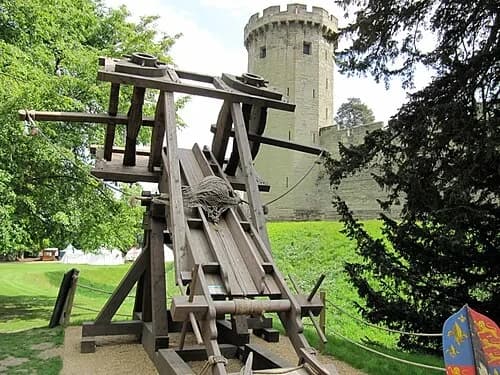
In the hierarchy of medieval artillery, if the trebuchet was a heavy hammer used to shatter stone walls, this ballista was a scalpel. It is essentially a torsion-powered crossbow of immense scale, designed not for indiscriminate destruction but for surgical precision. Instead of hurling boulders, a machine like this would fire heavy iron-tipped bolts or large stones with terrifying velocity. Look at the wooden frame to see the core of its power: the torsion springs. These aren't metal coils, but thick bundles of twisted rope or animal fiber. When the arms were pulled back, these bundles stored incredible tension. Releasing that energy translated into a projectile speed that could pick off defenders on ramparts or clear a path through tightly packed infantry. It brought a new level of mechanical efficiency to the battlefield, allowing commanders to target specific weak points or high-ranking individuals from a distance. The design highlights the shift from brute force to engineering during a siege. By concentrating power into a single, focused shot, the ballista forced defenders to remain behind cover, changing the tactical nature of castle defense.
Want to hear the rest?
Download the Stanza app to unlock all 18 stops and full GPS-guided navigation.
Frequently Asked Questions
How long does the Warwick Castle audio tour take?
The Warwick Castle audio guide includes 18 narrated stops. Most visitors spend 45 minutes to 1.5 hours exploring the complete tour, though you can listen at your own pace and skip or revisit any stop.
Is the Warwick Castle audio guide available in my language?
Stanza supports 15 languages: English, Spanish, French, German, Italian, Portuguese, Russian, Japanese, Chinese, Korean, Arabic, Hindi, Polish, Dutch, Hebrew. Check the guide in the app to confirm the languages currently available for this tour.
Can I use the audio guide offline at Warwick Castle?
Yes! Download the complete Warwick Castle tour — including all audio, maps, and images — before your visit. The Stanza app works completely offline, so you don't need WiFi or mobile data at the venue.
How much does the Warwick Castle audio guide cost?
The Stanza app is free to download. Free and paid audio guides are available; current prices are shown in the app.
How do I use the Stanza audio guide at Warwick Castle?
Download the free Stanza app, search for "Warwick Castle", and download the tour. When you arrive at the venue, the app uses GPS to detect your location and automatically plays the relevant narration as you move between points of interest — completely hands-free.
What makes the Stanza audio guide different from other Warwick Castle tours?
Stanza offers GPS-triggered narration that plays automatically as you walk through Warwick Castle — no need to manually select stops. The tour is available in 15 languages, works fully offline, and includes 18 expertly narrated stops with images and historical context.
What other audio guides are available near Warwick Castle?
Stanza offers multiple audio guides in Warwick, United Kingdom and nearby areas. After downloading the app, browse the map to discover all available tours near Warwick Castle. Each guide can be downloaded for offline use.