 Stanza / Audio guide
Content & sources
Stanza · Audio guide
Mesa Verde National Park Audio Guide
A place to remember. A story to take with you.
Mesa Verde National Park is a national park of the United States located in Montezuma County, Colorado. The park protects some of the best-preserved Ancestral Puebloan ancestral sites in the United States.
Download Stanza, then search for “Mesa Verde National Park”.
About the tour
One guide. Your kind of visit.
Mesa Verde National Park is a national park of the United States located in Montezuma County, Colorado. The park protects some of the best-preserved Ancestral Puebloan ancestral sites in the United States.
Ready when you are.
- 01Get the free Stanza app.
iOS & Android
- 02Find your guide.
“Mesa Verde National Park”
- 03Download before you go.
Works offline
Audio guide / 16 narrated stops
Inside the guide
Get to know a few of the stories before you go. Open a stop to read more.
01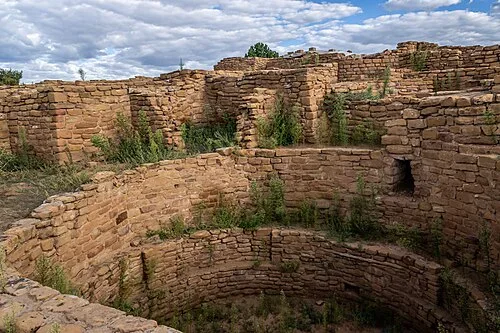 Far View Archaeological Complex & Ancient Waterworks
Far View Ruins: Life on the Mesa Top
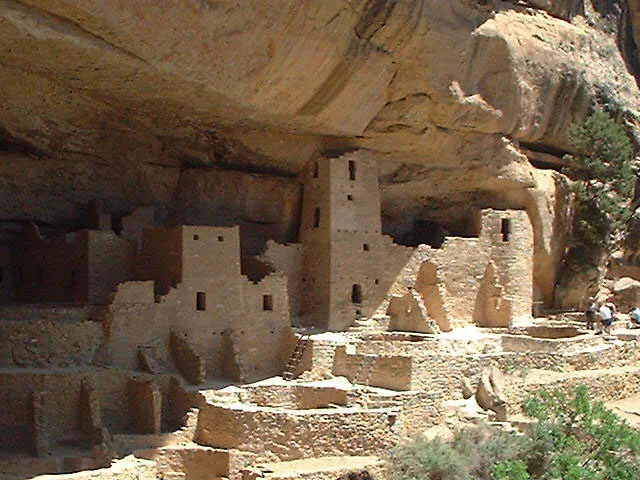
Welcome to Mesa Verde, Spanish for green table, a name given for the juniper and piñon forests on its flat top. This is the largest archaeological preserve in the United States. More than five thousand sites have been recorded within it. Six hundred of them are cliff dwellings, the structures the park is famous for. Yet the story here begins not in the canyons but out on the open mesa top, in farming villages like Far View. From the sixth century, families on this mesa grew corn, beans, squash, and gourds. Corn and beans together supplied a complete protein. In good years, a plot of three or four acres fed a family for a year, as long as game and wild plants filled the gaps. The mesa tilts slightly to the south, which gave the fields extra sun. Building changed here over the centuries, from posts and mud walls to stone masonry, which became widespread in the eleventh and twelfth centuries. The stone walls and the sunken circular chamber at Far View belong to that masonry world. The stops ahead follow where these people went next, down into the cliff alcoves.
mark byzewski · CC BY 2.0
02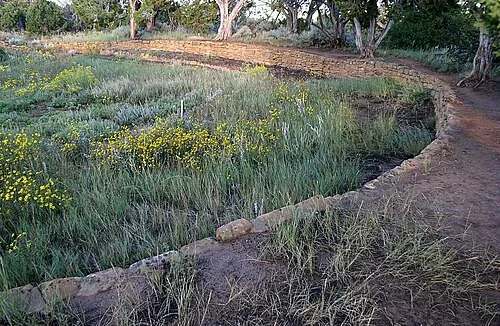 Far View Archaeological Complex & Ancient Waterworks
Far View Reservoir: Engineering Water on the Mesa
Farming on this mesa meant farming without a river. Around the year 750, Puebloan builders started two large water containment structures in the canyon bottoms, called Morefield and Box Elder. Soon after, work began on two more, Far View and Sagebrush, built on the mesa top itself, each about ninety feet across. All four lie on an east–west line running roughly six miles, which suggests the builders worked to a centralized plan. In 2004, the American Society of Civil Engineers designated the four as National Civil Engineering Historic Landmarks. The farmers also built check dams and terraces near drainages and slopes, to conserve soil and runoff and to buffer the danger of crop failure. Far View Reservoir itself keeps a puzzle. A 2014 geospatial analysis argued that water could neither be collected nor retained there. That reading sees the structure as a ceremonial space with procession roads, an adaptation of ideas from Chaco Canyon. The question remains open. Fires in the late nineteen-nineties and early two-thousands changed what could be seen here at all. They burned away dense undergrowth and exposed 593 sites no one had recorded. The same fires revealed more than a thousand check dams. Terraces and reservoirs came to light as well.
Photo: McGhiever · CC BY-SA 3.0
03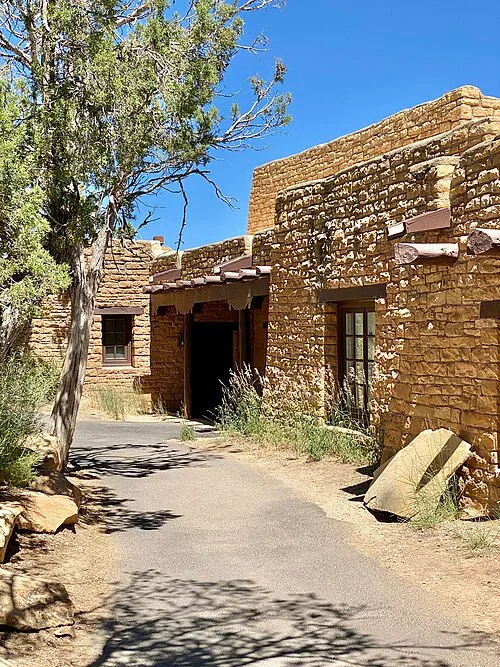 Chapin Mesa Archeological Museum & Material Heritage
Chapin Mesa Archeological Museum
A young Swede named Gustaf Nordenskiöld changed the fate of these ruins. He was the son of a polar explorer, and in 1891 he stayed with the Wetherill family, ranchers who hosted early visitors to the mesas. Trained as a mineralogist, he brought scientific methods to artifact collection, recording locations, photographing, and diagramming the sites. Then he shipped a large collection of artifacts toward Europe. The objects eventually went to the National Museum of Finland. When that shipment left the country, it stirred public concern over the need to protect Mesa Verde and its resources. Nordenskiöld published his account, The Cliff Dwellers of the Mesa Verde, in 1893. The alarm he helped provoke fed into the Federal Antiquities Act of 1906. That same year, President Theodore Roosevelt approved the creation of Mesa Verde National Park. It was the first park created to protect a location of cultural significance, an effort to preserve the works of man. The stone museum at this stop carries the story forward. It was the first museum ever built in the National Park System, and the Long Mesa fire of 2002 came close to destroying it. Inside, the artifacts trace the long arc from Basketmaker weavers to Pueblo potters.
Listen in the appw_lemay · CC BY-SA 2.0
04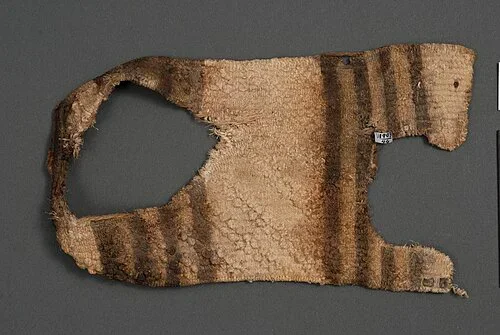 Chapin Mesa Archeological Museum & Material Heritage
A Woven Sandal from the Basketmaker World
Long before any stone village rose on this mesa, people here wove. This sandal, striped in bands of brown, comes from the Basketmaker tradition, named for the finely woven baskets made in the centuries before earthen pottery. Corn reached the Mesa Verde region around 1000 BCE, and families gradually settled into permanent pithouse villages, mixing farming with foraging. For hunting they used the atlatl, a throwing stick that launched spears. Plant and animal fibers became nearly everything a household needed, from sandals like this one to robes, pouches, mats, and blankets. By about 300, corn had become the mainstay of the diet, and wild foods mattered less with each passing generation. Change came around 500. The bow and arrow displaced the atlatl, and pottery began to displace the basket. A clay vessel could hold water and protect seed corn from mold, insects, and rodents, things a woven container could not do. The fine striping on this sandal shows how refined the craft already was, centuries before the cliff dwellings were built.
Listen in the appNPS Photo · Public domain
05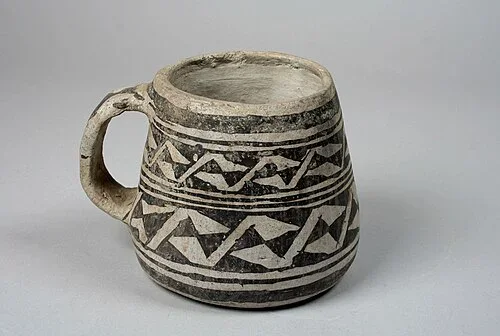 Chapin Mesa Archeological Museum & Material Heritage
Black-on-White Pottery
A small cup, painted in black on white, with rows of interlocking geometric patterns around its body. This is Mesa Verde black-on-white pottery, and the style reached its height in the middle of the Pueblo III era, when artisans adorned vessels with increasingly elaborate designs. The paints came from plants and minerals, including iron, manganese, beeplant, and tansy mustard, laid on with a brush of yucca leaf. The clay was local. Laboratory analysis shows most black-on-white pottery found at Mesa Verde was produced nearby, and nearly every household had at least one member who worked as a potter. Potters chose their clays and adjusted the firing to get particular colors. The care in these painted lines matches the precision of the region's fitted stonework. And the style did not end here. After 1285, black-on-white wares spread south with the people who carried them.
Listen in the appPhoto: Pharos · CC0
06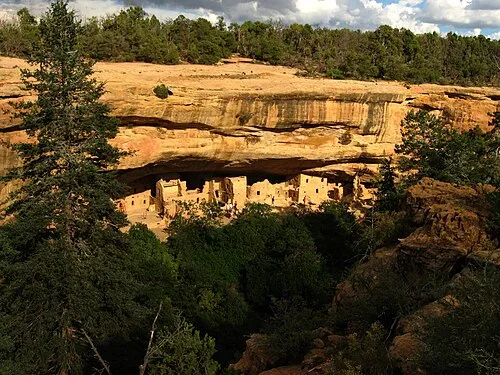 Spruce Tree House Overlook & Sacred Kivas
Spruce Tree House: Why Build Under a Cliff?
Late in the twelfth century, families began leaving mesa-top villages and moving into the cliff alcoves. The reason was climate, managed with nothing but stone and orientation. In winter, the low sun reached deep under the overhang and warmed the masonry of the dwellings. Air in the canyon alcoves ran ten to twenty degrees warmer than on the mesa top. In summer, with the sun high overhead, the rock shielded much of the village from direct light. Spruce Tree House, tucked beneath its sandstone shelf, is the third-largest cliff dwelling in the park. It was built between 1211 and 1278, beside natural canyon springs. About 130 rooms made up the village. Eight kivas served it. Perhaps sixty to eighty people lived in it at one time. The Long Mesa fire of 2002, the one that nearly destroyed the museum, also threatened this village. Because of its protective location, Spruce Tree House survives as one of the best-preserved dwellings in the park.
Listen in the appKen Lund from Las Vegas, Nevada, USA · CC BY-SA 2.0
07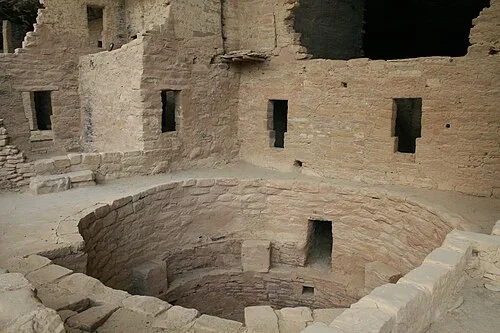 Spruce Tree House Overlook & Sacred Kivas
Inside the Kiva: The Sacred Center
Sunk into the ground at Spruce Tree House is a round chamber called a kiva. These rooms were the religious, civic, and social heart of a community, where ceremony and everyday gathering met. The Mesa Verde form evolved from earlier pit structures known as protokivas, taking shape by the mid-tenth and early eleventh centuries. Most measured twelve to fifteen feet across. On the floor, toward the north side, a small hole was dug into the earth. It is called a sipapu, and it stands for the place where the people emerged into this world from the underworld. That one feature ties these chambers to beliefs that Pueblo communities still carry in ceremony today.
Listen in the appAndreas F. Borchert · CC BY-SA 4.0
08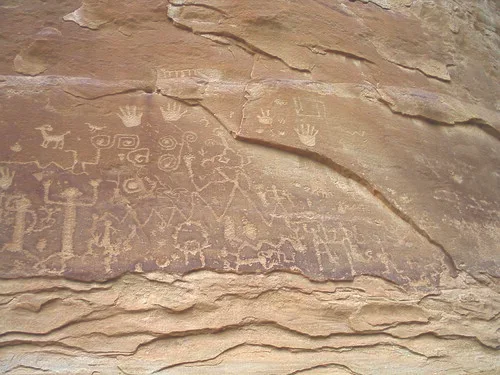 Petroglyph Point Trail
The Petroglyph Point Panel
A panel of petroglyphs is cut into the sandstone along the Petroglyph Point Trail. Handprints, spirals, animals, and human-like figures were pecked into the rock long ago. What each figure meant is not fully known today. Modern Hopi have interpreted the figures at Petroglyph Point as depictions of various clans of people. Rock art appears unevenly across the Mesa Verde region, with handprints, animal tracks, spirals, and hunting scenes among the common motifs. The landscape around the panel never lost its meaning. The Ute people have long occupied this region, and a treaty of 1868 recognized their ownership of all Colorado land west of the Continental Divide. They regarded the cliff dwellings as sacred ancestral sites, and they did not live in them. In the late nineteenth century, a Ute man named Acowitz told the Wetherill family about a great dwelling deep in one of the canyons. Utes never go there, he said. It is a sacred place.
Listen in the appNPS · Public domain
09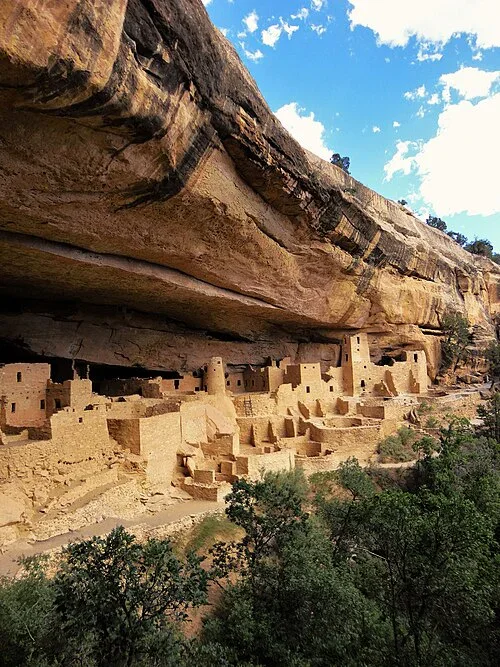 Cliff Palace: The Alcove Metropolis
Cliff Palace: The Largest Cliff Dwelling
Under the long sandstone overhang, Cliff Palace spreads out in tiers of stone rooms. It is the largest cliff dwelling in Mesa Verde, and one of the largest in North America. The alcove that shelters it runs about two hundred and seventy-five feet from end to end. It reaches nearly ninety feet into the rock. Roughly a hundred and fifty rooms stand within that space. Twenty-three kivas served them. Everything was built of sandstone, wooden beams, and mortar, more than seven hundred years ago. On a snowy December day in 1888, two ranchers spotted these walls from the top of the mesa. Richard Wetherill and Charlie Mason had been riding out after lost cattle. Wetherill gave the ruin its name, Cliff Palace. He and his family and friends explored the rooms and gathered artifacts, selling some to the Historical Society of Colorado.
Listen in the appPhoto: Rationalobserver · CC BY-SA 4.0
10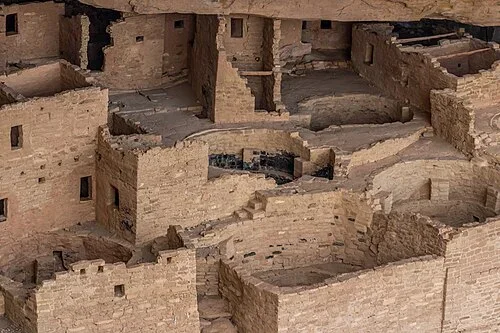 Cliff Palace: The Alcove Metropolis
Life Inside Cliff Palace
The palace breaks into blocks of rooms and round kivas, fitted stone by stone against the rock. About a hundred and twenty-five people made this their home. It was likely an important part of a larger community. Sixty nearby pueblos together housed six hundred people or more. The mesa as a whole held about twenty-two thousand people at the start of the thirteenth century. Growth accelerated through the middle of that century. By 1260, most families lived in large pueblos. Many held more than a hundred people. Masonry buildings of this era were typically occupied for about fifty years. Some stayed in use for two centuries or more. What each room in this view was used for is hard to say now. These were the fullest decades the mesa ever knew.
Listen in the appmark byzewski · CC BY 2.0
- 11
Mural 30: Paint on Plaster
Original painted plaster inside Cliff Palace, one of the few murals to survive anywhere in the region.
- 12
The Way In: Ladder and Tunnel
A thirty-two-foot ladder, a crawl through a tunnel, and a sixty-foot climb out of the canyon ledge.
- 13
Balcony House: A Fortified Village
A cold, fortified ledge village, built in the final years before the great departure.
- 14
Square Tower House: The Tall Tower
The tallest structure in Mesa Verde, and the vertical ambition of the final building century.
- 15
The Mesa Top Under Strain
The cold, failing rains and the maize dependence that emptied the mesa after 1260.
- 16
Sun Temple and the Great Departure
Sun Temple's sun-and-moon alignments, and the migration that carried the people south to today's living Pueblo nations.
Mesa Verde National Park
Frequently asked questions
How much does the guide cost?
Free app download. Listed guide price: $1.99. Guide price shown in the app. Audio guide only. Venue admission is separate.
Can I listen without internet?
Yes. Download the guide’s audio, images, and maps in the app before your visit. Your downloaded content is then available offline.
Can I listen in my language?
This audio guide is available in 15 languages, including English.
Do I need to follow a schedule?
No. This is a self-guided experience. Choose your stops, pause whenever you like, and return to a story at your own pace.
At your own pace
Explore Mesa Verde National Park.
Download Stanza, then search for “Mesa Verde National Park”.
Free app download · Guide price shown in the app
Keep exploring
Audio guides — United States
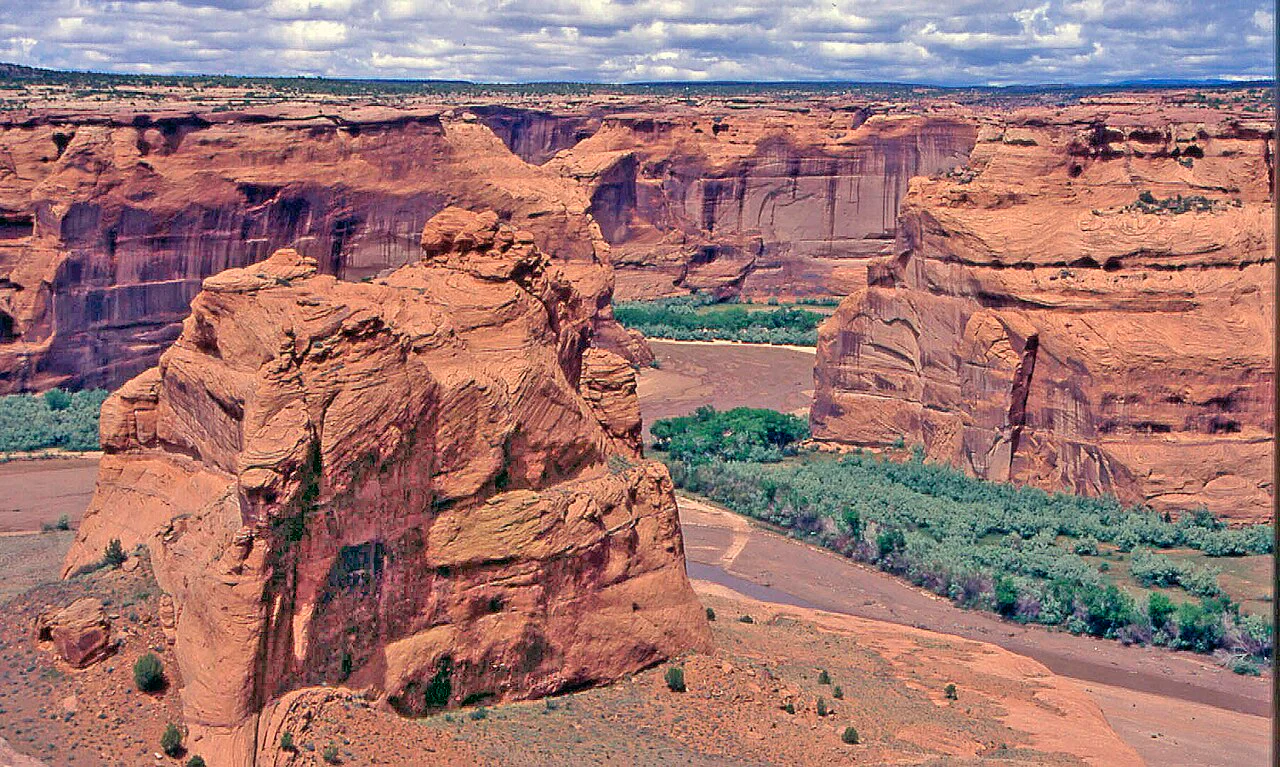
Chinle
Canyon de Chelly National Monument
Content & sources
Photo: W. Bulach · CC BY-SA 4.0
Boulder City
Hoover Dam
Content & sources
Western Area Power · CC BY 2.0
Keystone
Mount Rushmore
Content & sources
Thomas Wolf, www.foto-tw.de · CC BY-SA 3.0
Garden Grove
Christ Cathedral
Content & sources
Photo: Farragutful · CC BY-SA 4.0
Casas Grandes
Paquimé
Content & sources
Photo: Levi bernardo · CC BY-SA 3.0