Languages
15Washington Monument Audio Guide
Washington Monument is a landmark in Washington, United States. Explore it with Stanza's GPS-triggered offline audio guide — available in 15 languages.
Quick Facts
12
Stops
15
Languages
100%
Offline
📍 Washington, United States · 38.8895°N, -77.0352°E
About Washington Monument
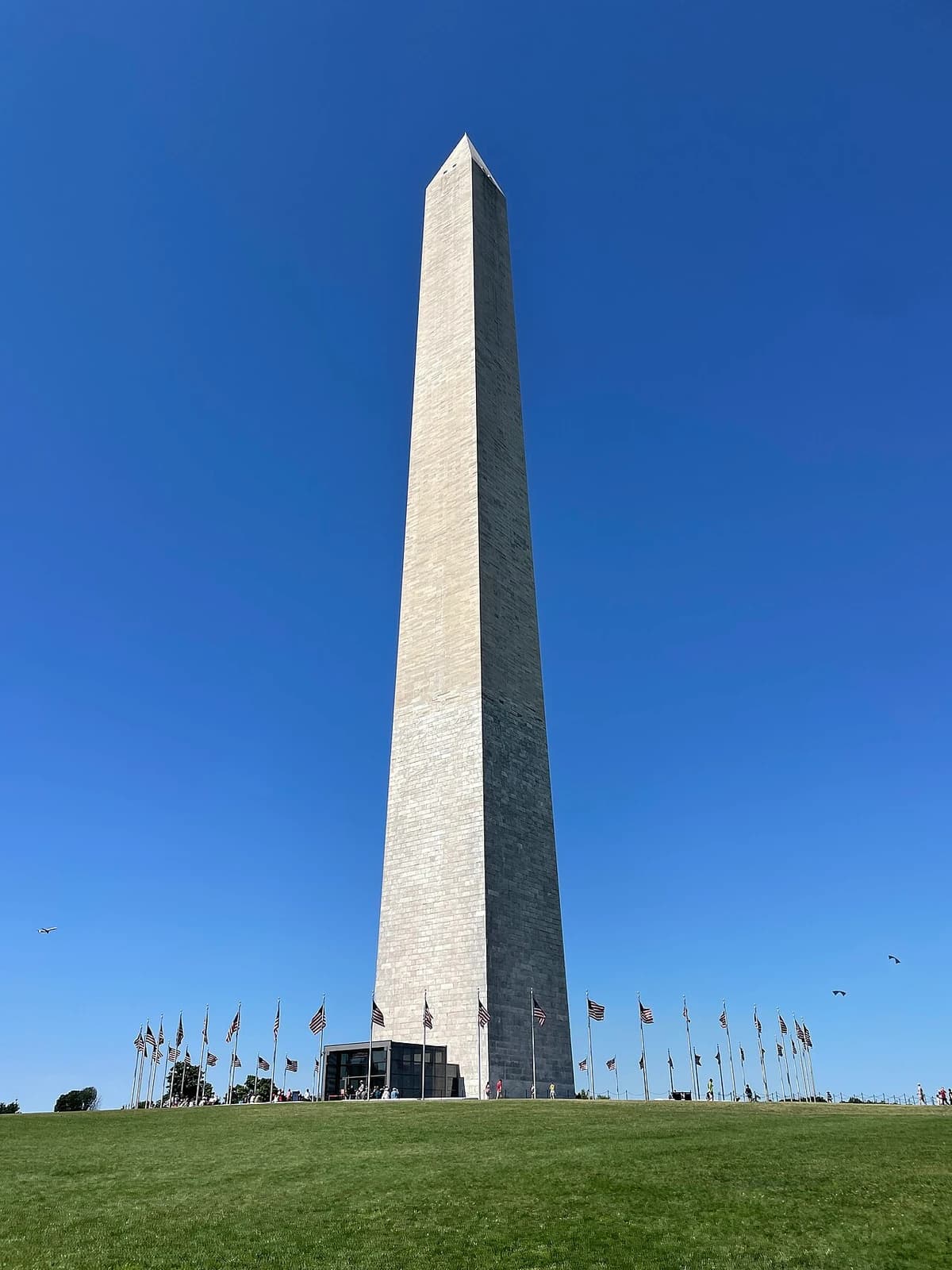
The Washington Monument is an obelisk on the National Mall in Washington, D.C. It serves as a national memorial to George Washington.
Washington Monument is also known as WAMO, Washington National Monument.
This self-guided audio tour features 12 narrated stops organized across 6 sections, including The Great Two-Tone Obelisk, The Ground Floor Lobby, The 500-Foot Observation Deck, The Pyramidion and Apex, The Memorial Stones, Departure and Reflection. As a memorial, Washington Monument offers a unique cultural experience in the heart of Washington, United States.
The Stanza audio guide is available in 15 languages and works entirely offline — download the complete tour including audio narration, maps, and images before your visit. As you walk through Washington Monument, GPS-triggered narration plays automatically at each point of interest.
Last updated:
What you will hear
The Great Two-Tone Obelisk
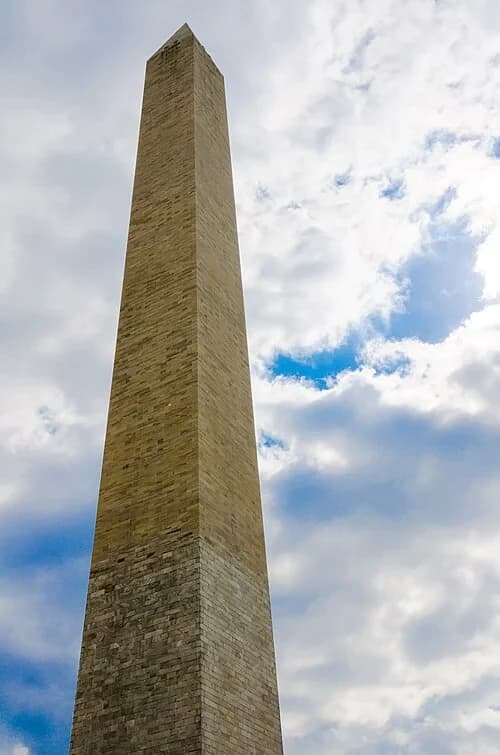
Focuses on the exterior architecture and the distinct color change caused by the construction delay.
The Two-Tone Marble
If you look closely at the exterior of the monument about 150 feet up, you will notice a distinct visual 'tide mark' where the color of the stone changes. This line tells the story of a project that took 40 years to complete. Construction began in 1848, but work ground to a halt in 1854 due to a lack of funding and the rising tensions that led to the American Civil War. A massive 23-year gap followed, leaving the monument a stub on the horizon. During this delay, politics also played a role; the 'Know-Nothing' party actually seized control of the project after they famously stole a commemorative stone donated by Pope Pius IX. When work finally resumed in 1877, the original quarry in Maryland was no longer able to provide matching stone. Builders had to source marble from different locations, resulting in the slight color variation you see today. While the lower section has a slightly warmer, creamier tone, the upper portion appears whiter. This horizontal line is a permanent record of the era when the nation was divided, reflecting the literal and figurative fractures that the monument eventually overcame to stand whole.
The Ground Floor Lobby
Introduces the interior experience, focusing on the tribute to George Washington and the ornate elevator entrance.
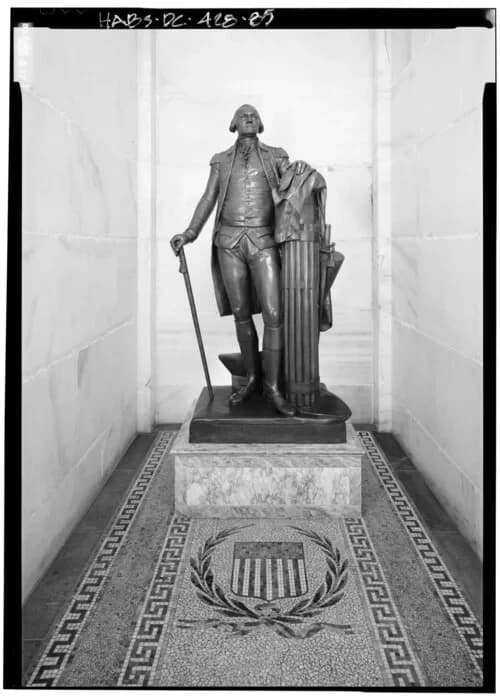
Statue of George Washington
Inside the ground floor lobby, you are surrounded by the sheer density of the monument. The walls at this level are 15 feet thick, designed to support the incredible weight of the hundreds of feet of stone above. In this heavy, quiet space stands a bronze statue of George Washington. This figure is a cast of a famous life-sized sculpture by Jean-Antoine Houdon, who was considered the premier sculptor of his era. The choice of an obelisk for Washington's memorial was deeply intentional. Architects looked to the Egyptian Revival style, which was popular in the 19th century, because the obelisk form suggested timelessness and stability. By choosing a shape associated with the ancient world, the founders of the monument sought to convey that Washington's legacy and the American Republic were built to last for the ages. The bronze figure here presents Washington not as a mythical deity, but as a leader of the people, standing within a structure that bridges the gap between ancient history and modern democracy. As you move through this lobby, the tapering of the walls begins, a structural necessity that allows the monument to rise to its pointed summit.
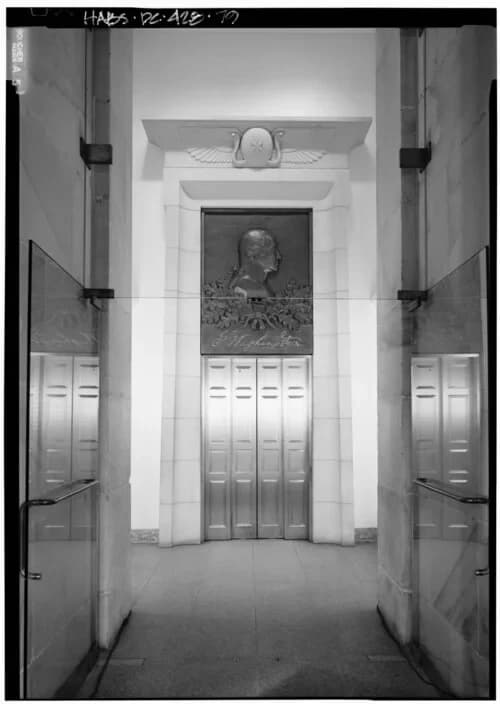
The Elevator Lobby
The transition to the summit happens here at the elevator lobby. The modern elevator is framed by an ornate bronze surround, which features a profile medallion of George Washington at the top. While the original steam-powered elevator took nearly 12 minutes to reach the top—a journey that was initially considered too dangerous for women and children—the current high-speed system completes the trip to the 500-foot observation deck in just 70 seconds. For many decades, adventurous visitors would climb the 897 steps that wind through the interior of the monument. However, these stairs are now closed to the public for safety reasons, leaving the elevator as the exclusive way to reach the summit. As the doors close, you are traveling through the center of a hollow stone chimney. The engineering required to maintain this vertical lift within a tapering stone structure is a marvel of both 19th-century vision and 21st-century technology. The elevator ride serves as a brief moment of anticipation before the narrow interior gives way to the expansive panoramic views of the city below. The bronze medallion above the door serves as a final reminder of the man whose life is celebrated by this journey.
The 500-Foot Observation Deck
Showcases the primary reason for visiting: the panoramic views of the nation's capital from the highest point in D.C.
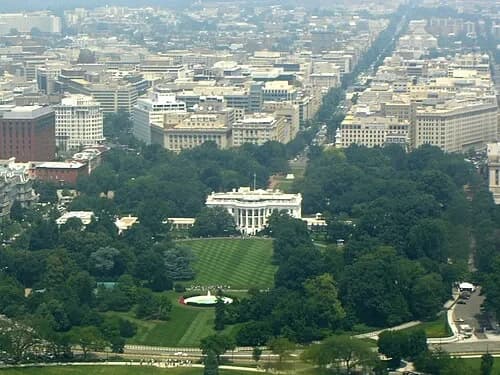
View of the White House
The view from the northern windows focuses on the White House and the large circular lawn known as the Ellipse. Interestingly, this view reveals a secret of the monument's geography. According to the original city plans, the monument was intended to stand at the exact intersection of the White House and the Capitol. However, when construction began, engineers discovered that the ground at that specific point was too swampy and unstable to support such a massive weight. As a result, the monument was moved about 370 feet to the southeast, placing it slightly off the main axis. Despite this shift, the view clearly illustrates the 'L’Enfant Plan' of the city. You can see how the major streets radiate outward from the President’s home like spokes on a wheel, a design intended to make the city easy to navigate and visually impressive. From 500 feet up, the White House appears smaller and more domestic compared to the grand scale of the Mall, emphasizing its role as both a residence and an office. This perspective highlights the intentionality of the city's design, where every street and building was placed to create specific lines of sight.
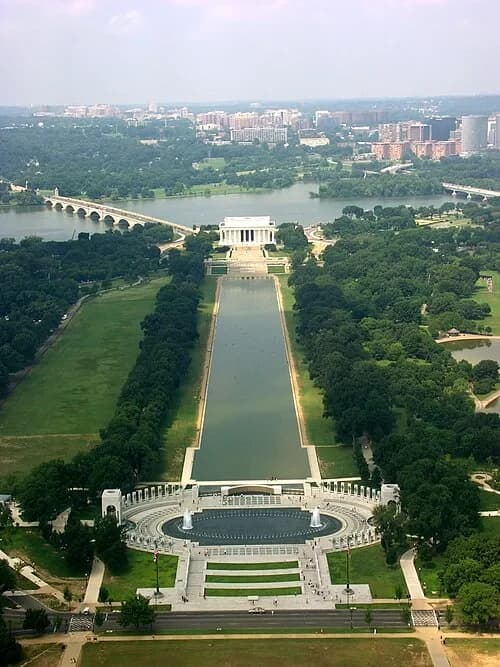
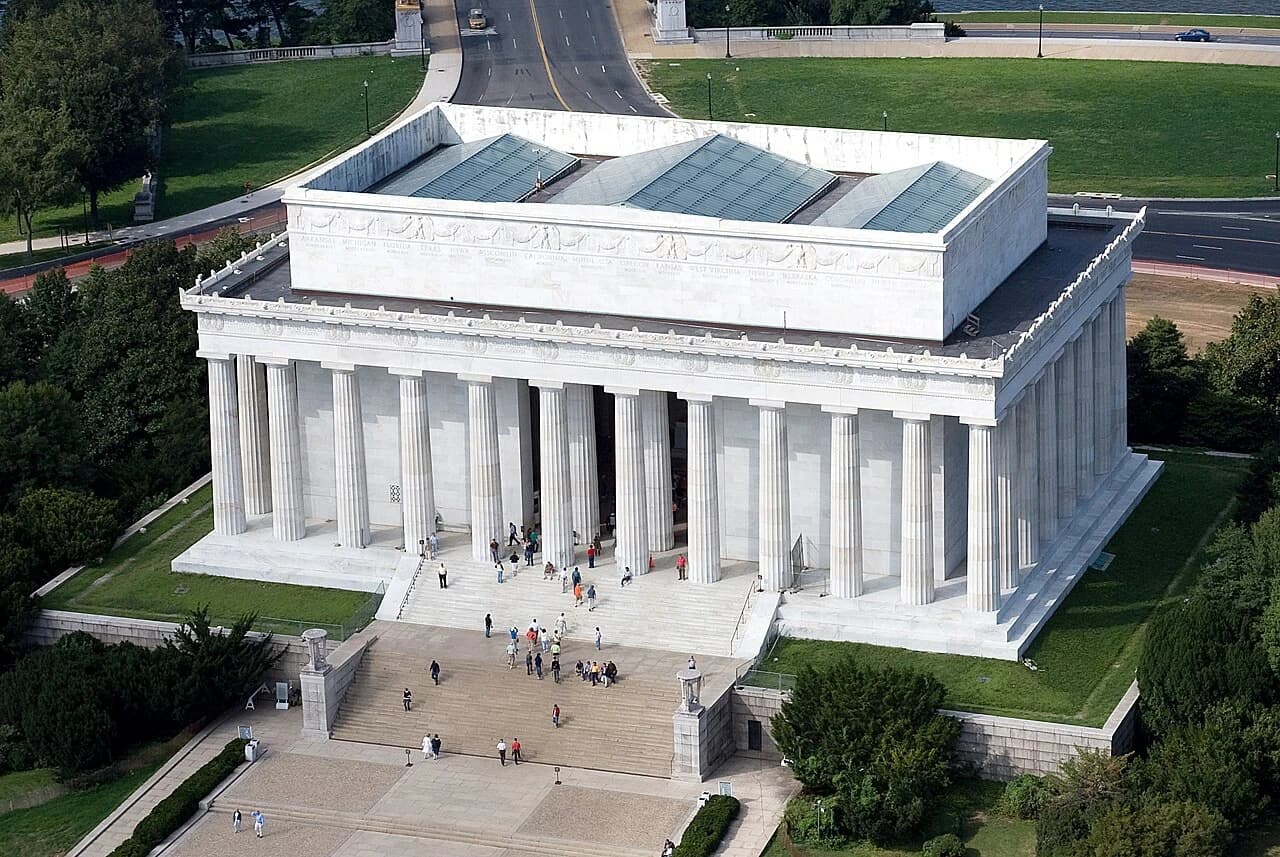
View of the Lincoln Memorial
Looking out from the western windows of the 500-foot observation deck, you see one of the most famous vistas in the United States. Below, the perfectly straight axis of the Reflecting Pool stretches toward the Lincoln Memorial. This view is a primary example of the 1901 McMillan Plan, a visionary architectural project that sought to reorganize the city's central parklands into a grand, monumental core. The symmetry of the water and the surrounding trees creates a sense of order and purpose that defines the capital's layout. Beyond the Lincoln Memorial, the Potomac River flows by, and on clear days, you can see up to 30 miles into the rolling hills of Virginia. This high vantage point allows you to appreciate how the city was designed as a living map, with large open spaces preserved to highlight national monuments. The Reflecting Pool is designed specifically to capture the monument's image in its water, though from this height, you are seeing the original rather than the reflection. The distance between these two memorials represents a significant span of American history, connected by a single, green, and watery corridor that guides the eye toward the horizon.
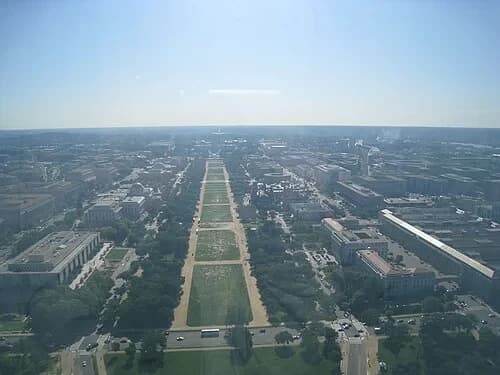
View of the National Mall
The eastern windows offer a panoramic look down the length of the National Mall toward the United States Capitol. Flanking the long green lawn are the many buildings of the Smithsonian Institution, the nation's premier collection of museums and research centers. This vast open space is often referred to as 'America's front yard.' It has served as the stage for some of the most pivotal moments in the nation's history, from presidential inaugurations to massive peaceful protests and celebrations. From this height, the Mall looks like a lush green carpet that connects the different branches of government and the institutions of culture and science. The layout emphasizes the accessibility of the government to the people, providing a public space where citizens can gather. You can see the distinct lack of skyscrapers, a result of local height act regulations that ensure the monument remains the tallest structure in the city. The clear line of sight from here to the Capitol dome was a key feature of the city's original design, ensuring that the legislative heart of the country remained visible and connected to the memorials of its greatest leaders.
The Pyramidion and Apex
Highlights the engineering marvel at the very tip, including the famous aluminum capstone.
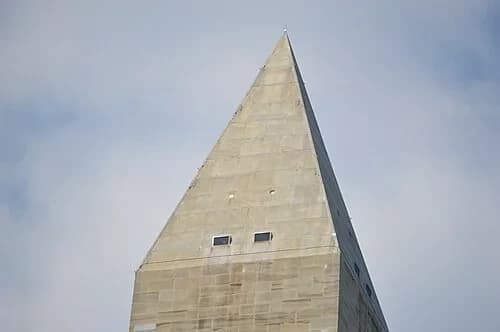
The Pyramidion
The pointed top of the monument is known as the pyramidion. At the very summit sits a small, four-sided cap made of 100 ounces of aluminum. Today, aluminum is common, but in 1884, it was an incredibly rare and precious metal, costing as much as silver. Because of its rarity, the apex was displayed at Tiffany's in New York City before it was installed, allowing curious members of the public to 'step over' the very top of what would become the world's tallest structure. This aluminum cap also serves as a lightning rod to protect the masonry. If you look closely at the upper stones of the pyramidion, you might see evidence of more recent history. In 2011, a rare 5.8-magnitude earthquake struck the region, causing visible cracks in these stones. The monument was closed for several years as specialized workers rappelled down the sides to repair the damage and reinforce the structure. This tip is the final piece of the 40-year puzzle, the point where the massive weight of the lower stones finally meets the sky. It remains a focal point for the city, catching the first light of dawn and the last rays of sunset.
The Memorial Stones
Explores the 194 commemorative stones embedded in the interior walls, visible during the descent.
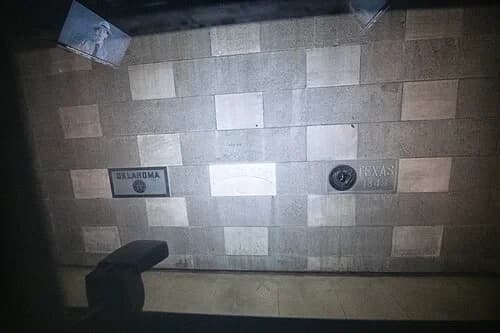
State Memorial Stones
As the elevator makes its descent, the lighting changes to reveal a hidden feature of the monument's interior. Embedded into the walls are 194 memorial stones. These were donated by various states, cities, and civic organizations as a 'tribute from the world' to the character of George Washington. During the descent, the elevator slows down so you can catch glimpses of these diverse markers. You might see the stones for Oklahoma, Colorado, and Texas, each with its own unique design and typography. Some stones are simple and rugged, while others feature intricate carvings or symbols representing the regions they came from. These stones were a way for different parts of the growing nation to feel a personal connection to the monument during its long construction. They were contributed during both the first and second phases of building, meaning some have been in the dark interior for over 150 years. This interior gallery transforms the monument from a solid stone pillar into a collaborative project, where nearly two hundred different groups left their permanent mark in honor of the first president. They are a patchwork of history that only those inside the monument get to see.
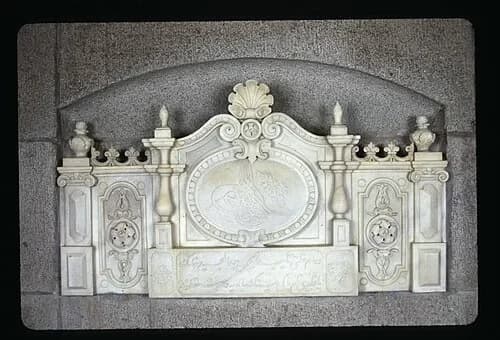
Ottoman Tribute Stone
Among the most beautiful of the interior memorial stones is this intricate marble slab, which was donated by Sultan Abdulmecid I of the Ottoman Empire in 1854. It is immediately recognizable for its elegant Arabic calligraphy, which features a poem praising the character and leadership of George Washington. The presence of this stone illustrates that the Washington Monument was not merely a national project; it was an international gesture of respect. Sovereigns and citizens from as far away as China, Japan, and the Vatican sent stones to be included in the walls. This Ottoman tribute was one of the many that arrived during the first phase of construction before work was halted. The craftsmanship of the calligraphy and the decorative borders stand in contrast to some of the more utilitarian stones nearby. It serves as a reminder that Washington's influence as a revolutionary leader and the first president of a new republic was studied and admired by world leaders across the globe. By including these international tributes, the monument's builders created a space where the entire world could participate in honoring a man whose legacy of leadership transcended cultural and geographic boundaries.
Departure and Reflection
Provides a concluding view of the monument from the Reflecting Pool, allowing for a final summary of its legacy.
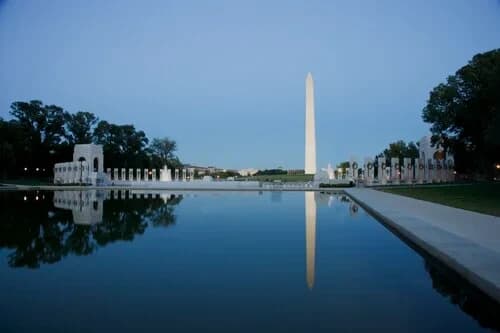
The Mirror Image
Your tour concludes here at the edge of the Reflecting Pool, where you can see the monument's full stature mirrored in the water. This view has become one of the most iconic images of American democracy, symbolizing the stability and endurance of the Republic. While the journey to complete the monument was fraught with difficulty—including decades of delays, political squabbling, and the shadow of the Civil War—its final completion in 1888 was a triumph of national persistence. From this distance, the two tones of the marble blend together, and the monument appears as a single, unified needle of light. It stands as a silent observer to the history that continues to unfold on the National Mall. The reflection in the pool doubles the visual impact of the structure, creating a sense of perfect symmetry between the sky and the earth. As you look at the towering obelisk and its watery twin, you are seeing the result of forty years of labor and the contributions of thousands of people from around the world. It remains a steady point of reference in a city that is constantly changing, a permanent landmark dedicated to the man who helped define the nation's identity.
Want to hear the rest?
Download the Stanza app to unlock all 12 stops and full GPS-guided navigation.
Frequently Asked Questions
How long does the Washington Monument audio tour take?
The Washington Monument audio guide includes 12 narrated stops. Most visitors spend 45 minutes to 1.5 hours exploring the complete tour, though you can listen at your own pace and skip or revisit any stop.
Is the Washington Monument audio guide available in my language?
Stanza supports 15 languages: English, Spanish, French, German, Italian, Portuguese, Russian, Japanese, Chinese, Korean, Arabic, Hindi, Polish, Dutch, Hebrew. Check the guide in the app to confirm the languages currently available for this tour.
Can I use the audio guide offline at Washington Monument?
Yes! Download the complete Washington Monument tour — including all audio, maps, and images — before your visit. The Stanza app works completely offline, so you don't need WiFi or mobile data at the venue.
How much does the Washington Monument audio guide cost?
The Stanza app is free to download. The current listed price for the Washington Monument audio guide is $1.99; app-store region and currency may affect the final price.
How do I use the Stanza audio guide at Washington Monument?
Download the free Stanza app, search for "Washington Monument", and download the tour. When you arrive at the venue, the app uses GPS to detect your location and automatically plays the relevant narration as you move between points of interest — completely hands-free.
What makes the Stanza audio guide different from other Washington Monument tours?
Stanza offers GPS-triggered narration that plays automatically as you walk through Washington Monument — no need to manually select stops. The tour is available in 15 languages, works fully offline, and includes 12 expertly narrated stops with images and historical context.
What other audio guides are available near Washington Monument?
Stanza offers multiple audio guides in Washington, United States and nearby areas. After downloading the app, browse the map to discover all available tours near Washington Monument. Each guide can be downloaded for offline use.