Languages
15Lincoln Memorial Audio Guide
Lincoln Memorial is a landmark in Washington, United States. Explore it with Stanza's GPS-triggered offline audio guide — available in 15 languages.
Quick Facts
15
Stops
15
Languages
100%
Offline
📍 Washington, United States · 38.8893°N, -77.0501°E
About Lincoln Memorial
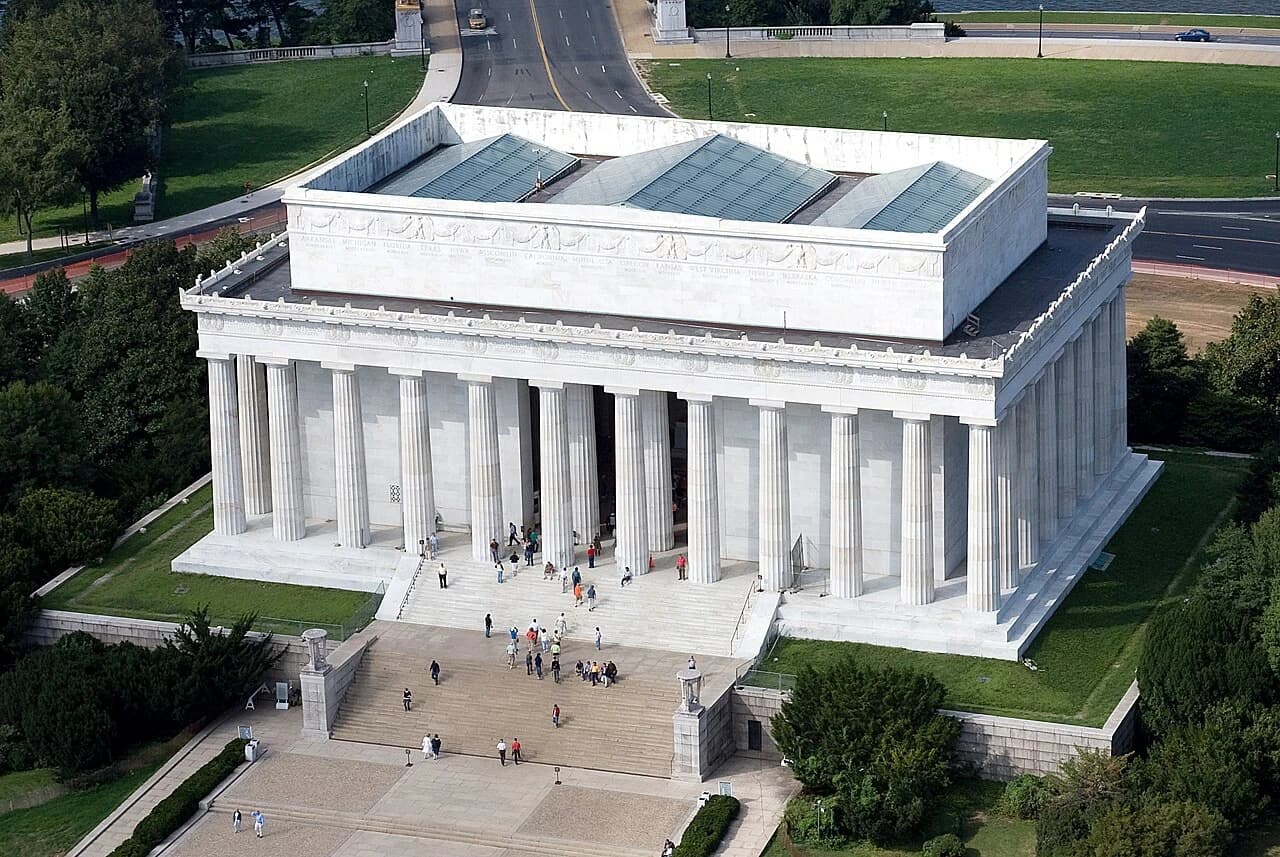
The Lincoln Memorial is a national memorial dedicated to Abraham Lincoln, located on the National Mall in Washington, D.C. It serves as a prominent tourist attraction and a site for public gatherings.
Lincoln Memorial is also known as LINC.
This self-guided audio tour features 15 narrated stops organized across 7 sections. in the heart of Washington, United States.
The Stanza audio guide is available in 15 languages and works entirely offline — download the complete tour including audio narration, maps, and images before your visit. As you walk through Lincoln Memorial, GPS-triggered narration plays automatically at each point of interest.
Last updated:
What you will hear
The Reflecting Pool Approach
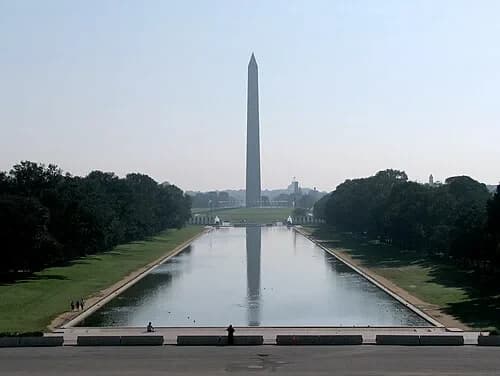
Start at the eastern end of the Reflecting Pool to capture the iconic symmetrical view of the memorial and its reflection before walking toward the monument.
View From the Landing
Rising from the edge of the Reflecting Pool, a series of granite steps leads up to the main chamber. There are exactly 87 steps in this ascent. While many visitors believe this number was a deliberate tribute to the 'four score and seven years' mentioned in the Gettysburg Address, historical records show it was actually a happy coincidence of the architectural design. Standing at this elevation provides a unique perspective on the scale of Washington, D.C. The National Mall stretches out for over two miles toward the United States Capitol. This space serves as the city’s front yard and a stage for some of the most significant events in American history. It is a popular destination, with the memorial alone hosting over 8 million visitors every year. The height of the landing was intentionally set to provide clear sightlines over the tree line, ensuring that the visual link between the different branches of government remains unobstructed. The broad platforms offer a space to pause and observe the crowds moving across the grass below.
The Grand Staircase and Civil Rights History
Ascend the steps where historic moments for equality occurred, specifically looking for the marker where Dr. King gave his most famous speech.
I Have a Dream Marker
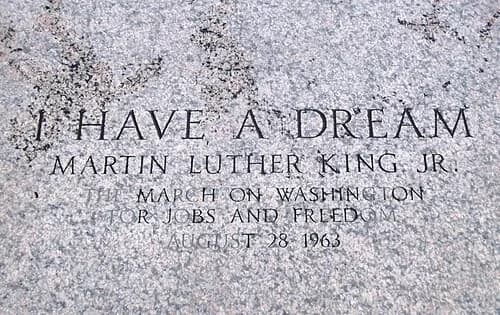
Look closely at the landing just below the top steps for a specific granite carving. This marker indicates the exact spot where Dr. Martin Luther King Jr. stood on August 28, 1963, during the March on Washington for Jobs and Freedom. From this vantage point, he addressed a crowd of over 250,000 people spread across the Mall. The organizers of the march chose this location with great intentionality. They wanted to invoke the memory of the 'Great Emancipator' sitting just a few yards away inside the chamber. By standing here, Dr. King linked the promise of the 19th-century Emancipation Proclamation to the active struggle for civil rights in the 20th century. The text on the stone is modest, identifying the speaker and the date of the address. It remains a focal point for visitors who often pause here to align their own view with the one Dr. King had that summer day. The stone itself is the same grey granite used for the rest of the landing, allowing it to blend into the floor until you are standing directly over it.

I Have a Dream
The 1963 March on Washington was not the first time these steps served as a platform for racial justice. In 1939, world-renowned singer Marian Anderson was barred from performing at the nearby Constitution Hall because of her race. In response, First Lady Eleanor Roosevelt and the Department of the Interior arranged for her to perform here. Anderson sang for an audience of 75,000 people, effectively transforming the memorial into a symbol of civil rights long before the 1960s. These events shifted the public's perception of the building. While it was originally intended to honor the man who saved the Union, it became a site where the unfinished work of democracy was debated and celebrated. This legacy of protest and performance has made the steps a sacred space for many. When you stand here, you are in a location that has hosted countless rallies, concerts, and vigils. This historical layering adds depth to the architecture, making the stone feel like a witness to the ongoing evolution of the country’s social landscape. The proximity to the Lincoln statue inside creates a constant dialogue between the past and the present.
The Exterior Colonnade
Examine the Greek Revival architecture and the 36 Doric columns that symbolize the unity of the states at the time of Lincoln's death.
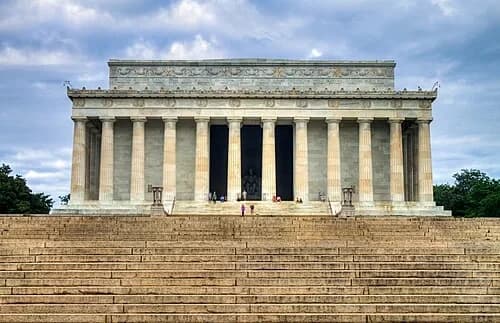
The Greek Revival Facade
Architect Henry Bacon looked to the Parthenon in Athens for inspiration when designing this facade. For the exterior walls and columns, he selected Colorado Yule marble. This specific stone is known for its pure white color and smooth grain, which helps the building glow in the sunlight. Construction on the project began on February 12, 1914, which was Lincoln's birthday. It was a massive undertaking that lasted eight years, through the challenges of World War I, before finally opening to the public in 1922. The design avoids the use of traditional mortar in many visible joints, relying instead on the sheer weight and precision-cut of the stones to hold the structure together. Notice how the building tilts slightly inward; this is an architectural technique called entasis, used by the ancient Greeks to prevent the building from appearing to lean outward to the human eye. The heavy attic story above the columns adds a sense of gravity to the design, emphasizing the memorial's role as a temple of remembrance. It took hundreds of skilled laborers and carvers to bring Bacon’s vision to life over nearly a decade of work.
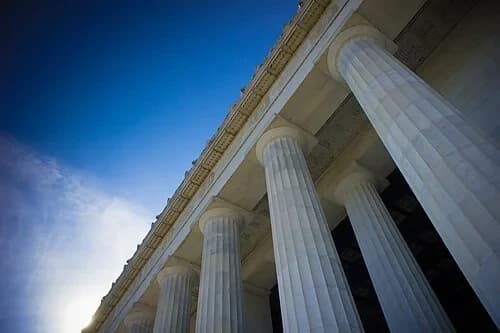
The Circle of States
Encircling the memorial are 36 massive Doric columns. Each one stands 44 feet high and is composed of several stacked drums of marble. This specific number was chosen because there were 36 states in the Union at the time of Abraham Lincoln's death in 1865. The columns serve as a symbolic guard, representing the nation that Lincoln fought to hold together. If you look at the frieze—the horizontal band directly above the column capitals—you will see the names of these 36 states carved into the stone. They are arranged in the order they entered the Union, with wreaths carved between the names. Above this, on the higher attic walls, are the names of the 48 states that existed when the memorial was dedicated in 1922. This layering of history shows how the country continued to grow and expand following the Civil War. The columns themselves are fluted, meaning they have vertical grooves that create a play of light and shadow, making the heavy stone appear more graceful and upward-reaching. Standing at the base of these columns, you can appreciate the immense scale of the individual blocks required to build them.
The Central Chamber: Lincoln Enshrined
Step into the heart of the memorial to face the 19-foot-tall seated statue of Abraham Lincoln, carved from 28 blocks of Georgia marble.
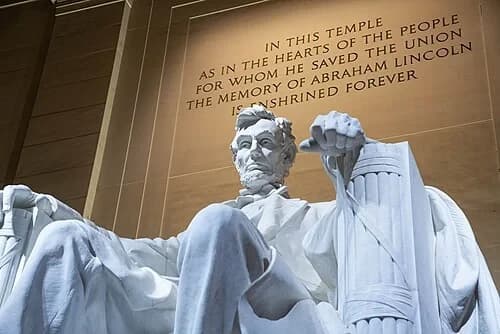
The Memorial Epitaph
Directly above the seated statue, carved into the wall of the central chamber, is a four-line epitaph. The text was written by Royal Cortissoz, a prominent art critic of the time. It states that the memory of Abraham Lincoln is 'enshrined forever' in this temple. This inscription acts as the formal dedication for the site, defining Lincoln as the man who saved the Union. Below the text, a local legend often draws the attention of visitors regarding Lincoln’s hands. Some believe that his hands are forming the American Sign Language initials 'A' and 'L.' While the National Park Service officially maintains that this is just a coincidence of the natural resting positions of his hands, many note that sculptor Daniel Chester French had a son who was deaf and was familiar with sign language. This has left the interpretation open to ongoing debate among visitors. Whether intentional or not, the detail adds a layer of mystery to the sculpture. The font used for the epitaph is a classic Roman style, carved deep into the stone to ensure it remains legible even as the light in the chamber changes throughout the day.
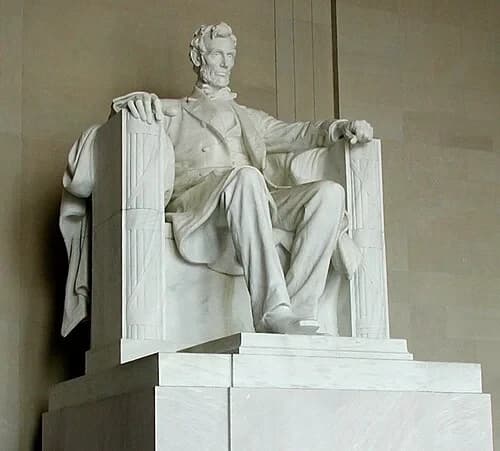
Statue of Abraham Lincoln
Daniel Chester French · 1920 · Murphy marble
The seated figure of Abraham Lincoln is the focal point of the entire memorial. It was designed by sculptor Daniel Chester French and stands 19 feet tall from head to foot. If the figure were to stand up, it would reach a height of 28 feet. The statue was not carved from a single piece of stone; instead, it is composed of 28 separate blocks of white Georgia marble. These pieces were so perfectly joined by the Piccirilli Brothers, a family of master stone carvers, that the seams are almost invisible to the naked eye. The carving process took four years to complete. French spent a great deal of time studying photographs and life masks of Lincoln to ensure the facial expression and posture were accurate. Notice the contrast in his hands: one is clenched in a fist, suggesting strength and determination, while the other is relaxed, perhaps signifying compassion. The chair is draped with an American flag, and the sides are decorated with fasces—bundles of rods that were ancient symbols of authority and unity. The lighting in the chamber is carefully managed to highlight the deep furrows in Lincoln's brow and the texture of his clothing.
The South Chamber: The Second Inaugural Address
The South Chamber contains Lincoln's final major speech, focused on healing the nation with 'malice toward none and charity for all.'
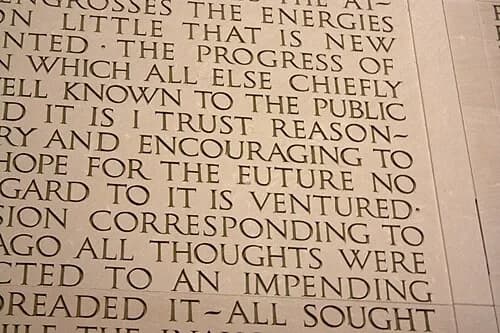
The Stone Typo
Even in a monument as meticulously planned as this one, human mistakes can happen. If you look closely at the Second Inaugural Address on the south wall, find the word 'FUTURE' in the final paragraph. If you examine the first letter of that word, you will see a subtle correction. The stone carver accidentally began by carving the letter 'E' instead of 'F.' Once the mistake was realized, the bottom horizontal bar of the 'E' had to be filled in with a small patch of stone and mortar. Over a century later, the patch has aged slightly differently than the surrounding marble, making it visible to those who know where to look. This 'typo' is one of the most popular details for guides to point out to visitors. It provides a brief, relatable human moment in an otherwise perfect and grand structure. The fact that such a permanent error exists in one of the most important inscriptions in the country is a reminder of the hand-carved nature of the building. The patch is small, only about an inch long, but it stands as a unique mark of the individuals who physically built the memorial.
The Interior Murals
Look high above the inscriptions to see the allegorical murals by Jules Guérin representing principles like Emancipation and Reunion.
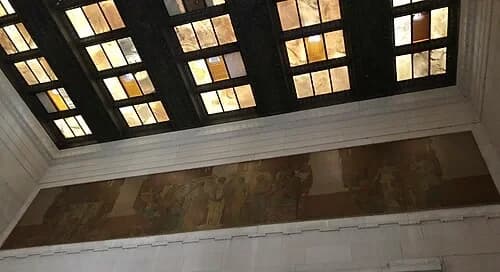
The Emancipation Mural
Artist Jules Guérin was commissioned to create two large murals for the interior of the memorial, located above the Gettysburg and Second Inaugural addresses. The mural in the south chamber represents the principles of Freedom and Liberty. Guérin did not paint these directly onto the stone walls. Instead, he painted them on massive canvases in his New York studio. Once finished, they were transported to Washington and adhered to the walls using a special mixture of white lead and linseed oil. This technique was used to ensure the paintings would not peel away from the stone over time. The figures in the mural are allegorical, meaning they represent abstract ideas rather than specific people. You can see a central figure representing the Angel of Truth, surrounded by others depicting Justice and the breaking of chains. The colors are muted, dominated by earth tones and soft blues, designed to harmonize with the surrounding marble without distracting from the statue below. The murals are quite large, measuring 60 feet long and 12 feet high. They add a layer of classical storytelling to the monument, providing a visual representation of the ideals Lincoln championed throughout his presidency.
The Rear View and Watergate Steps
Walk around to the back of the memorial for views of the Potomac River and the monumental Watergate Steps leading down to the water.
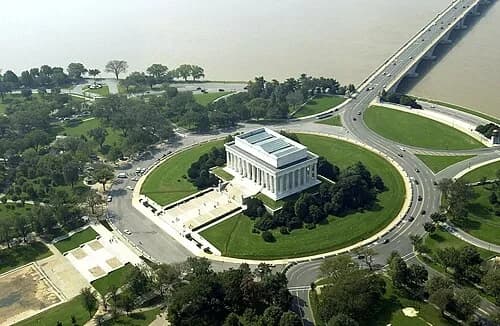
The Hidden Undercroft
What you see above ground is only part of the story. Because the Lincoln Memorial was built on reclaimed land that was once a tidal marsh, a massive foundation was required to prevent the building from sinking. Directly beneath the marble floor is an area known as the undercroft. This space is filled with a dense forest of concrete pillars, some of which go down 65 feet to reach solid bedrock. These pillars support the immense 175-ton weight of the Lincoln statue and the thousands of tons of marble that make up the walls and roof. Over the decades, an interesting natural phenomenon has occurred in this hidden basement. Moisture seeping through the concrete has dissolved minerals, creating small stalactites and stalagmites, much like those found in a natural cave. While the undercroft is generally closed to the public, it is a vital piece of engineering that ensures the memorial remains level. From an aerial view, you can appreciate the footprint of the building and the surrounding circular road, but it is this unseen substructure that allows the monument to stand safely at the edge of the Potomac River.
Want to hear the rest?
Download the Stanza app to unlock all 15 stops and full GPS-guided navigation.
Frequently Asked Questions
How long does the Lincoln Memorial audio tour take?
The Lincoln Memorial audio guide includes 15 narrated stops. Most visitors spend 45 minutes to 1.5 hours exploring the complete tour, though you can listen at your own pace and skip or revisit any stop.
Is the Lincoln Memorial audio guide available in my language?
Stanza supports 15 languages: English, Spanish, French, German, Italian, Portuguese, Russian, Japanese, Chinese, Korean, Arabic, Hindi, Polish, Dutch, Hebrew. Check the guide in the app to confirm the languages currently available for this tour.
Can I use the audio guide offline at Lincoln Memorial?
Yes! Download the complete Lincoln Memorial tour — including all audio, maps, and images — before your visit. The Stanza app works completely offline, so you don't need WiFi or mobile data at the venue.
How much does the Lincoln Memorial audio guide cost?
The Stanza app is free to download. The current listed price for the Lincoln Memorial audio guide is $4.99; app-store region and currency may affect the final price.
How do I use the Stanza audio guide at Lincoln Memorial?
Download the free Stanza app, search for "Lincoln Memorial", and download the tour. When you arrive at the venue, the app uses GPS to detect your location and automatically plays the relevant narration as you move between points of interest — completely hands-free.
What makes the Stanza audio guide different from other Lincoln Memorial tours?
Stanza offers GPS-triggered narration that plays automatically as you walk through Lincoln Memorial — no need to manually select stops. The tour is available in 15 languages, works fully offline, and includes 15 expertly narrated stops with images and historical context.
What other audio guides are available near Lincoln Memorial?
Stanza offers multiple audio guides in Washington, United States and nearby areas. After downloading the app, browse the map to discover all available tours near Lincoln Memorial. Each guide can be downloaded for offline use.