Stanza · Audio guide
St. Peter's Basilica Audio Guide
A place to remember. A story to take with you.
St. Peter's Basilica is a church of the Italian Renaissance located in Vatican City. It was planned to replace the ageing Old St. Peter's Basilica and construction was completed in 1626.
Download Stanza, then search for “St. Peter's Basilica”.
About the tour
One guide. Your kind of visit.
St. Peter's Basilica is a church of the Italian Renaissance located in Vatican City. It was planned to replace the ageing Old St. Peter's Basilica and construction was completed in 1626.
Ready when you are.
- 01Get the free Stanza app.
iOS & Android
- 02Find your guide.
“St. Peter's Basilica”
- 03Download before you go.
Works offline
Audio guide / 24 narrated stops
Inside the guide
Get to know a few of the stories before you go. Open a stop to read more.
01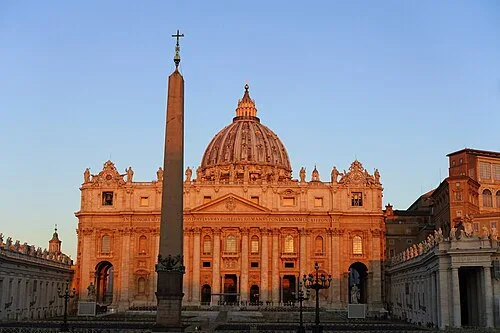 St. Peter's Square and Bernini's Colonnade
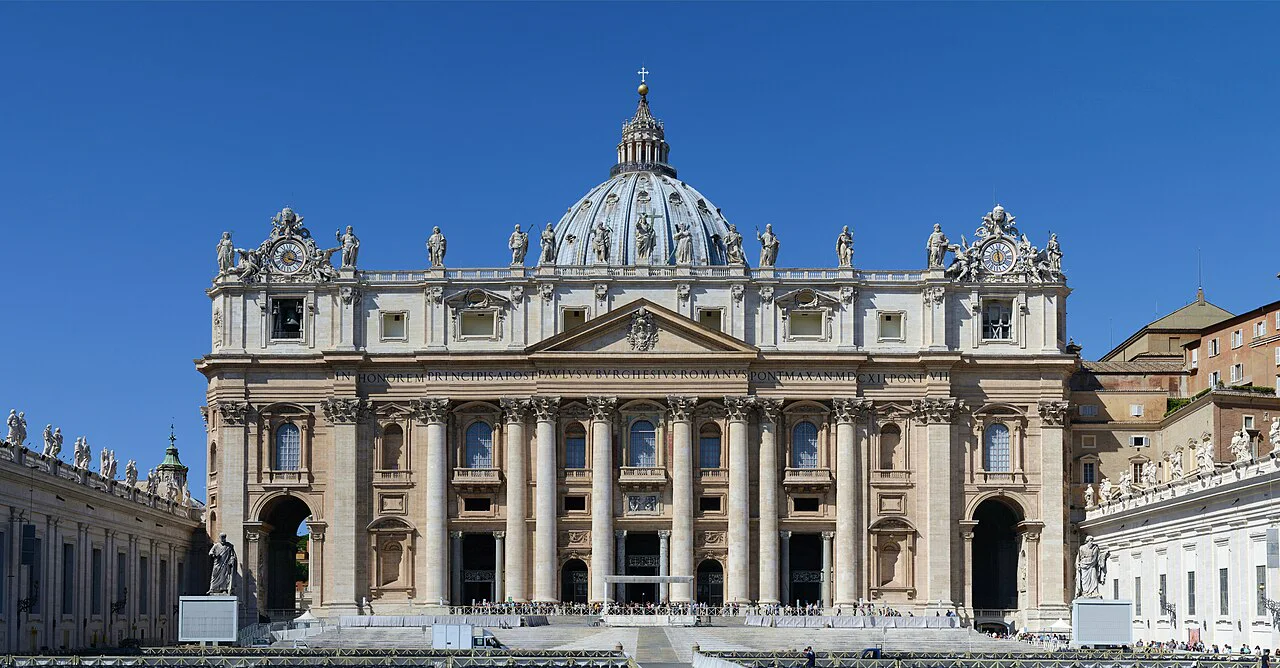
St. Peter's Basilica from the Square
Welcome to Saint Peter's, the great church of the Catholic world, built over the tomb that tradition holds to be the Apostle Peter's. Tradition holds that Peter, head of the twelve apostles, came to Rome and was buried here, and from the earliest years popes chose to be laid to rest near him. The fourth-century church that the Emperor Constantine raised over that grave had grown old and fragile by the fifteenth century. Pope Nicholas V first planned a replacement, and Pope Julius II carried the plan through. On 18 April 1506 the foundation stone of the new basilica was laid. The work went on for a hundred and twenty years. On 18 November 1626 Pope Urban VIII solemnly dedicated the finished church. It remains a shrine of pilgrimage and the stage for papal liturgies that draw tens of thousands of people. From the square, the whole building composes itself as one picture. Facade and dome rise together, the ancient obelisk stands out front, and the curving colonnades frame the edges. The tour follows that composition inward, from the square to the tomb below and the dome above.
Photo: Daderot · CC0
02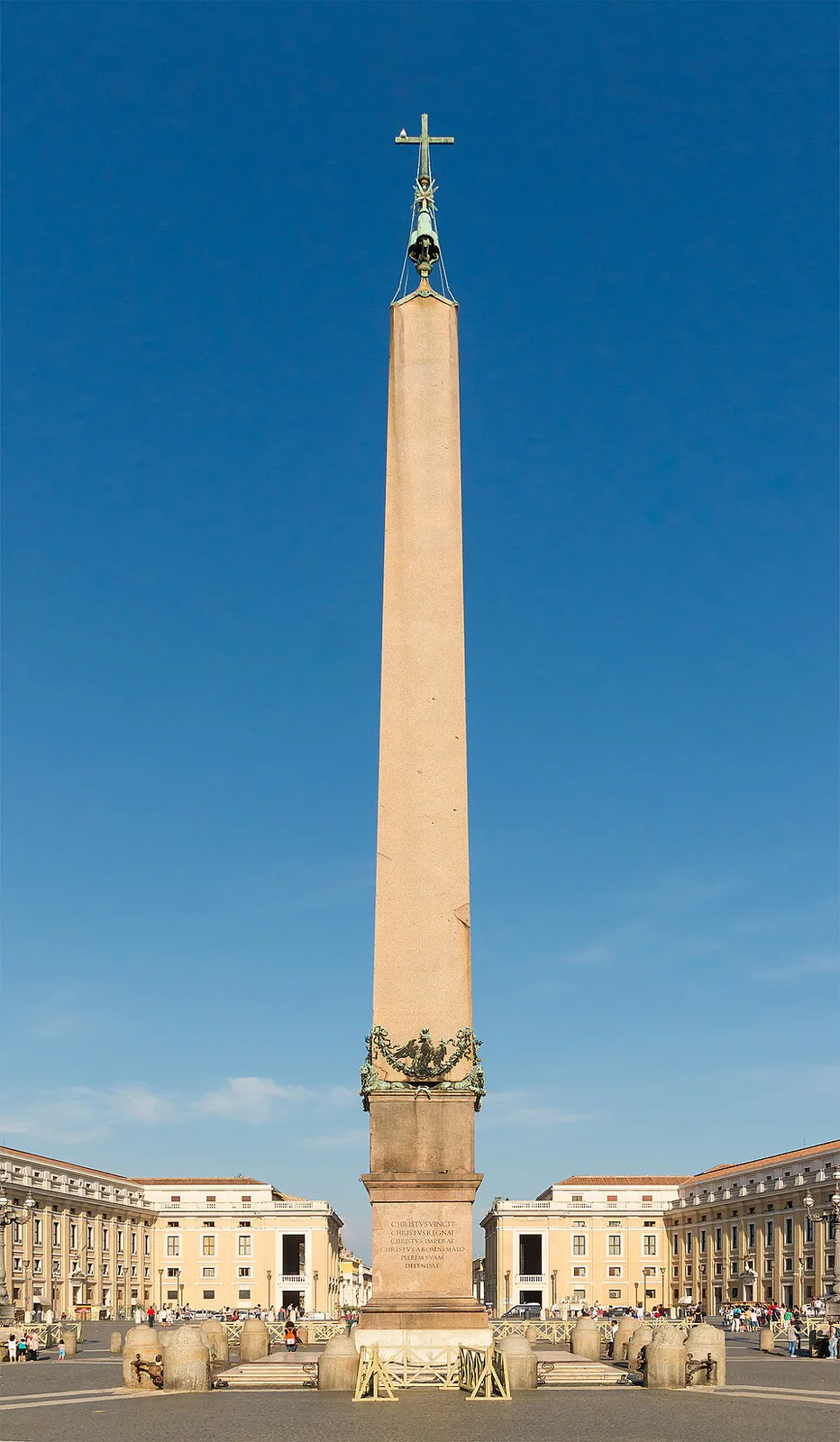 St. Peter's Square and Bernini's Colonnade
The Vatican Obelisk
Before the basilica, before any church stood here, this ground was a place of burial. The area by the Vatican had served as a cemetery for years, lying close to the Circus of Nero, where executions were carried out. After the burial of Saint Peter, many Christians chose to be buried near him. The tall monolith at the centre of the square is the oldest thing in view. It is an Egyptian obelisk, carved from a single block, standing about twenty-five metres high, and reaching some forty metres with its base and the cross on top. It is the second largest standing obelisk, and the only one that has never fallen since it was taken from Egypt and re-erected at the Circus of Nero in the year 37. Tradition calls it the Witness, because the crucifixion of Saint Peter is said to have taken place near it. A pagan imperial marker now carries a cross and stands at the heart of a Christian piazza. Pope Sixtus V ordered it moved here, and the architect Domenico Fontana raised it on 28 September 1586. The story goes that the ropes began to smoke from friction as it hung, and a sailor from Sanremo spotted the danger in time. His town was granted the honour of supplying the palms for Palm Sunday at the basilica, a privilege it keeps still.
Photo: Jebulon · CC0
03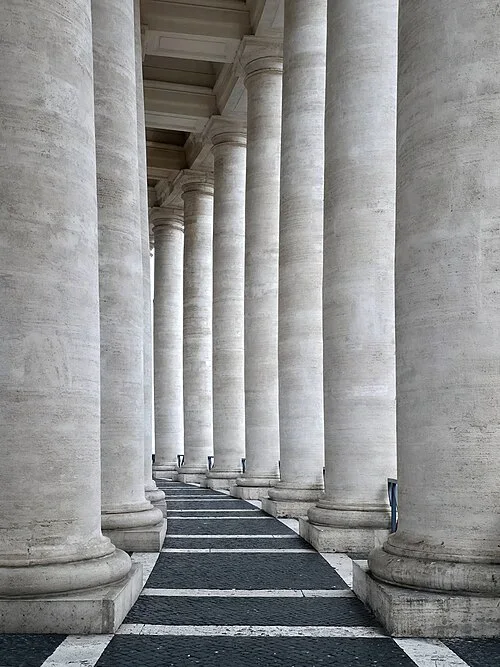 St. Peter's Square and Bernini's Colonnade
Inside Bernini's Colonnade
Bernini shaped this piazza between 1656 and 1667, and he built it in two parts. The part nearest the basilica is a trapezoid that narrows toward the facade instead of fanning out. That reversal plays a trick on the eye. From the open square the building looks nearer than it really is, its breadth shrinks and its height grows in proportion. The second part is a vast ellipse, sloping gently down to the obelisk at its centre. Around it runs the colonnade, made of doubled pairs of columns in the plain Tuscan order, supporting a simple entablature. The two arcs do not close the ellipse completely. Bernini meant them as the arms of the Catholic Church reaching out to welcome its communicants, and the gap is the doorway through which they reach. Water marks the widest line of the piazza. Maderno had set one fountain beside the obelisk in 1613, and Bernini balanced the design with a matching fountain of his own in 1675.
Listen in the appPhoto: NateBergin · CC BY 4.0
04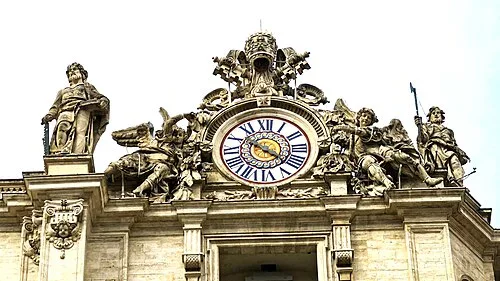 Maderno's Grand Facade and Historic Portals
Maderno's Facade and the Bells
Carlo Maderno was appointed in 1602, and his task was to finish the church. To Michelangelo's central plan he added three further bays of nave, stretching the Greek cross into a Latin one, the shape the Counter-Reformation came to prefer. He even tilted the axis of the nave very slightly, so that it would align with the obelisk standing outside. His facade is built of travertine stone and runs about a hundred and fifteen metres wide. It rises some forty-five metres high, carried on a giant order of Corinthian columns. Above the cornice, a tall attic bears thirteen statues. Christ the Redeemer stands at the centre, flanked by eleven of the Apostles and John the Baptist. Saints Peter and Paul flank the entrance stairs below. At the two corners of the attic sit the clocks. They replaced bell towers designed by Bernini, which had to be torn down because the structure beneath them could not bear the weight. The left clock keeps the mean time of the time zone, the right one keeps the old Italian solar hour, counted from sunset.
Listen in the appBurkhard Mücke · CC BY-SA 4.0
05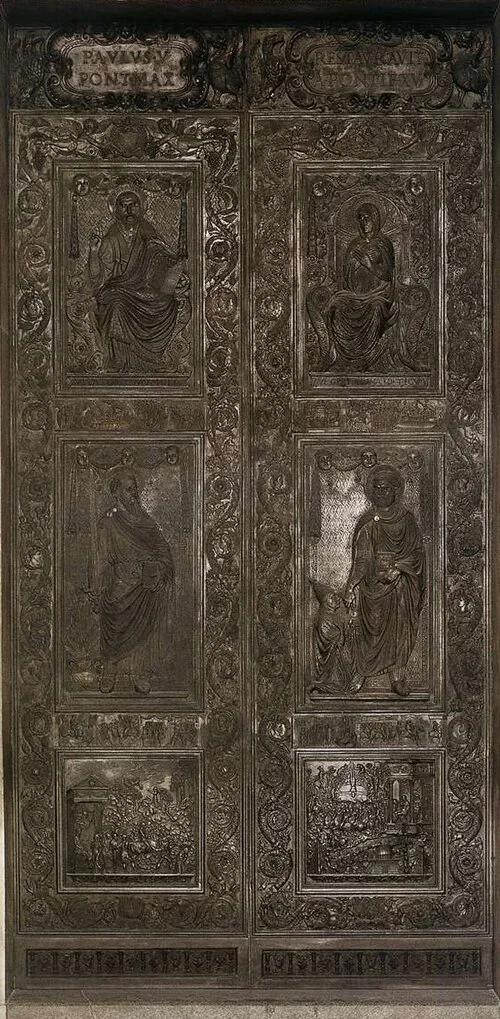 Maderno's Grand Facade and Historic Portals
The Filarete Door
The bronze door in the central portal is older than the building around it. Antonio Averulino, called Filarete, made it in the mid-fifteenth century for the old Constantinian basilica, and it was later enlarged to fit the new entrance. It had already hung for some sixty years when the new basilica was begun. Its panels show Christ enthroned, the Virgin and saints, each scene framed in dense vine scrolls that fill the bronze from edge to edge. At the top, medallions carry the names of popes. Of the five portals between the narthex and the interior, three hold notable doors. Passing through this one means crossing a threshold that outlived the church it was made for.
Listen in the appsee filename or category · Public domain
06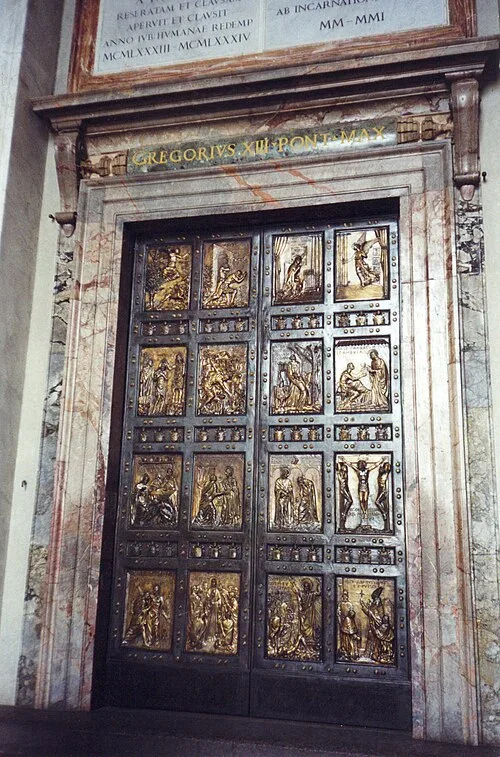 Maderno's Grand Facade and Historic Portals
The Holy Door
The northernmost door is not opened like the others. By tradition it is walled up with bricks, and only the Pope breaks through the wall, for a holy year such as the Jubilee. The bronze door now in place was designed by Vico Consorti in 1950 and cast in Florence. Its sixteen gilded panels show scenes of the door's own history, among them Pope Pius XII and the document by which Boniface VIII proclaimed the first Jubilee in 1300. Above the door, inscriptions record the popes who opened and closed it in past Jubilees.
Listen in the appPhoto: Archeologo · Public domain
07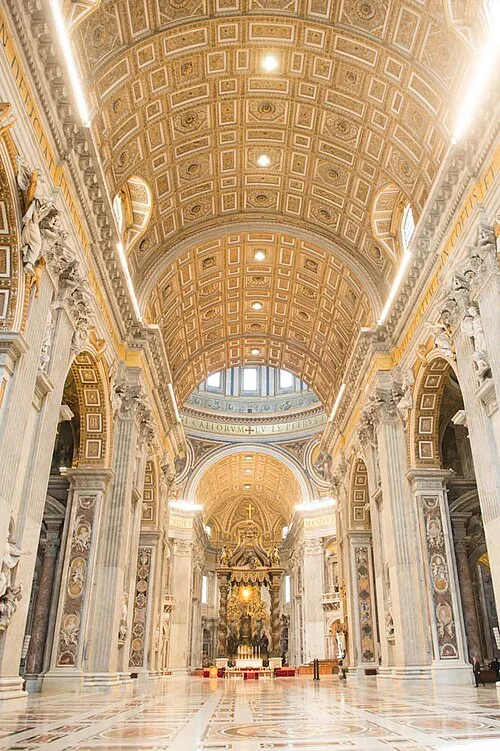 The Central Nave and Coronation Stone
The Central Nave
Inside, the nave runs toward the dome under a barrel vault, the highest of any church. This is the largest Christian church in the world measured by interior area, more than fifteen thousand square metres of floor. The paired pilasters along the nave follow Michelangelo's design, and the whole interior is finished in marble, reliefs, architectural sculpture and gilding. A building on this scale devoured money. The records put the cost of construction at more than forty-six million ducats. Raising such sums drew the Church into funding the work through the preaching of indulgences, and the resentment that practice stirred helped feed the movement that became the Protestant Reformation. The result here was a space made to hold worship on a scale few buildings ever attempted. Even the large altarpieces along the chapels, with a single exception, have been reproduced in mosaic.
Listen in the appThe White House from Washington, DC · Public domain
08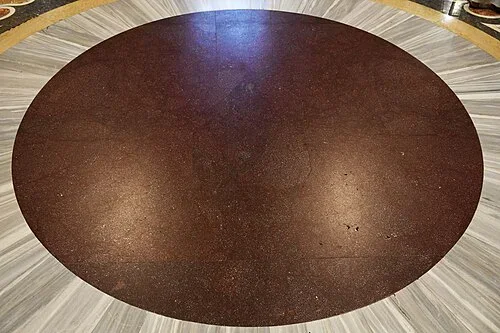 The Central Nave and Coronation Stone
The Porphyry Rota
Set into the nave floor lies a great circular slab of deep red stone. It is porphyry, the stone the Romans reserved for their emperors, so prized that its use marked the very highest rank. This roundel is the spot traditionally pointed out as linked with Charlemagne's coronation. In the year 800, in the old basilica that stood here before the present church, Charlemagne was crowned emperor. Whether the ceremony happened exactly on this stone cannot now be settled. The tradition has long attached the event to this disk, and it is the place people have been shown for generations. The old church is gone, but the floor keeps a piece of its memory.
Listen in the appPhoto: Phyrexian · CC BY-SA 4.0
09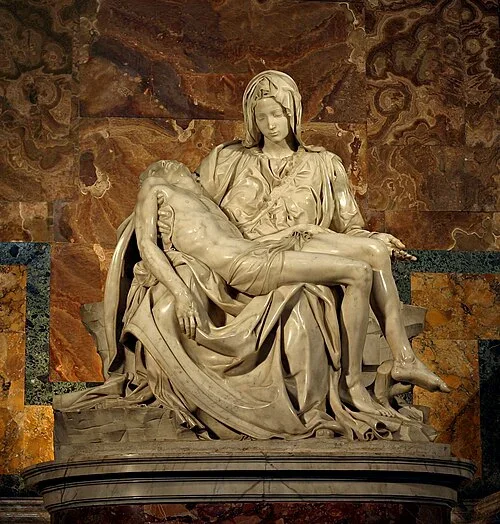 The Right Aisle and Michelangelo's Pietà
Michelangelo's Pietà
In the north aisle stands a sculpture Michelangelo carved in 1498 and 1499, when he was still in his twenties. The marble came from Carrara. The Virgin, young-faced and calm, supports the body of Christ across her lap, her drapery falling in deep polished folds against the rough masonry wall behind. It is the only work Michelangelo is known to have signed. The story goes that he overheard strangers praising the Pietà but crediting it to another sculptor, and returned by night to cut his name into the band across the Virgin's chest. Whether it happened that way, the signature is there, cut small and proud into the marble. He was not yet thirty, and he never signed anything again.
Listen in the appStanislav Traykov · CC BY 2.5
10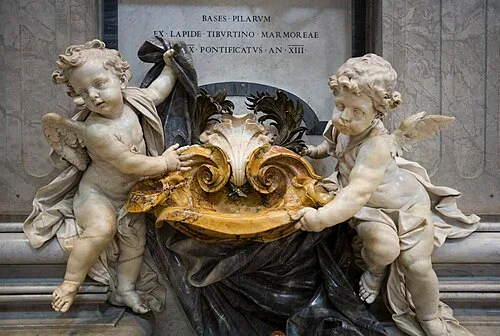 The Right Aisle and Michelangelo's Pietà
The Cherub Holy-Water Stoups
Against the first piers of the nave, two pairs of cherubs hold basins of holy water. Pope Benedict XIII commissioned them in the 1720s, Agostino Cornacchini drew the design, and Francesco Moderati carved the putti, sharing the work with Giovanni Battista de Rossi. Each cherub stands over two metres tall. The basins themselves are of giallo di Siena, the honey-yellow marble, worked by Giuseppe Lironi. At a glance they look like ordinary children. Only when someone walks up to them does the trick appear, that a real child could never reach the water without scrambling up the marble draperies. It takes a church this size to make two-metre angels look small.
Listen in the appJorge Royan · CC BY-SA 3.0
- 11
Bernini's Tabernacle in the Blessed Sacrament Chapel
Bernini's last work at Saint Peter's, a gilt-bronze tabernacle modelled on Bramante's Tempietto.
- 12
Algardi's Meeting of Leo I and Attila
Algardi's marble relief of Pope Leo the Great turning back Attila, heaven defending the papacy in stone.
- 13
Bernini's Saint Longinus
How Bernini turned the dome's four mighty piers into shrines for the basilica's holiest relics.
- 14
The Bronze Saint Peter
The bronze apostle whose foot has been kissed nearly smooth by centuries of pilgrims.
- 15
Bernini's Baldacchino
Bernini's giant bronze canopy over the high altar, twisted like the columns of Solomon's Temple.
- 16
Under the Baldacchino: the Holy Spirit
The hidden dove at the heart of the baldacchino, seen only from below.
- 17
The Cathedra Petri
The ancient chair of Peter, encased in bronze and held aloft by the four great Doctors of the Church.
- 18
The Holy Spirit Window
The alabaster window that floods the apse with light, sized on an old painter's advice for the eye at the door.
- 19
Bernini's Tomb of Alexander VII
A pope at prayer, and Death rising from the doorway with an hourglass in its hand.
- 20
Pollaiuolo's Tomb of Innocent VIII
Pollaiuolo's Renaissance bronze of Pope Innocent VIII, shown twice: alive on his throne, dead on his tomb.
- 21
The Confessio
The sunken chapel where pilgrims once descended to come close to Peter's grave.
- 22
In the Grottoes at Peter's Tomb
The grottoes beneath the altar, where tradition locates the tomb of the Apostle Peter.
- 23
Inside Michelangelo's Dome
Michelangelo's dome, the tallest in the world, and the one drawing of it that survived him.
- 24
Rome from the Dome: the Whole Composition
The view from the lantern: Bernini's embrace, the obelisk, and the avenue that changed Rome's approach.
St. Peter's Basilica
Frequently asked questions
How much does the guide cost?
Free app download. Listed guide price: $2.99. Guide price shown in the app. Audio guide only. Venue admission is separate.
Can I listen without internet?
Yes. Download the guide’s audio, images, and maps in the app before your visit. Your downloaded content is then available offline.
Can I listen in my language?
This audio guide is available in 15 languages, including English.
Do I need to follow a schedule?
No. This is a self-guided experience. Choose your stops, pause whenever you like, and return to a story at your own pace.
At your own pace
Explore St. Peter's Basilica.
Download Stanza, then search for “St. Peter's Basilica”.
Free app download · Guide price shown in the app
Keep exploring
Nearby audio guides
Rome · 1 km
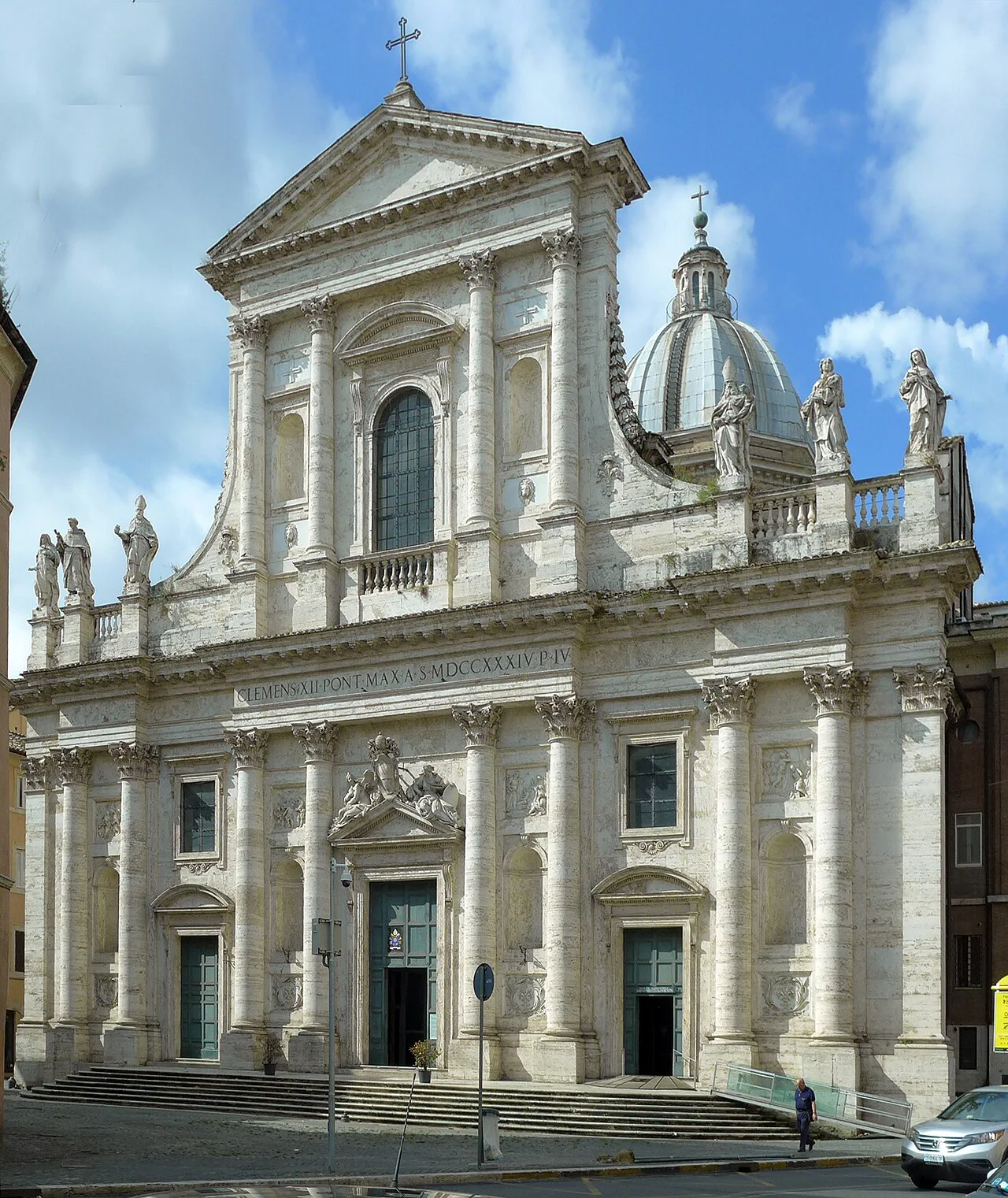
Basilica di San Giovanni Battista dei Fiorentini
Content & sources
Photo: Peter1936F · CC BY-SA 4.0
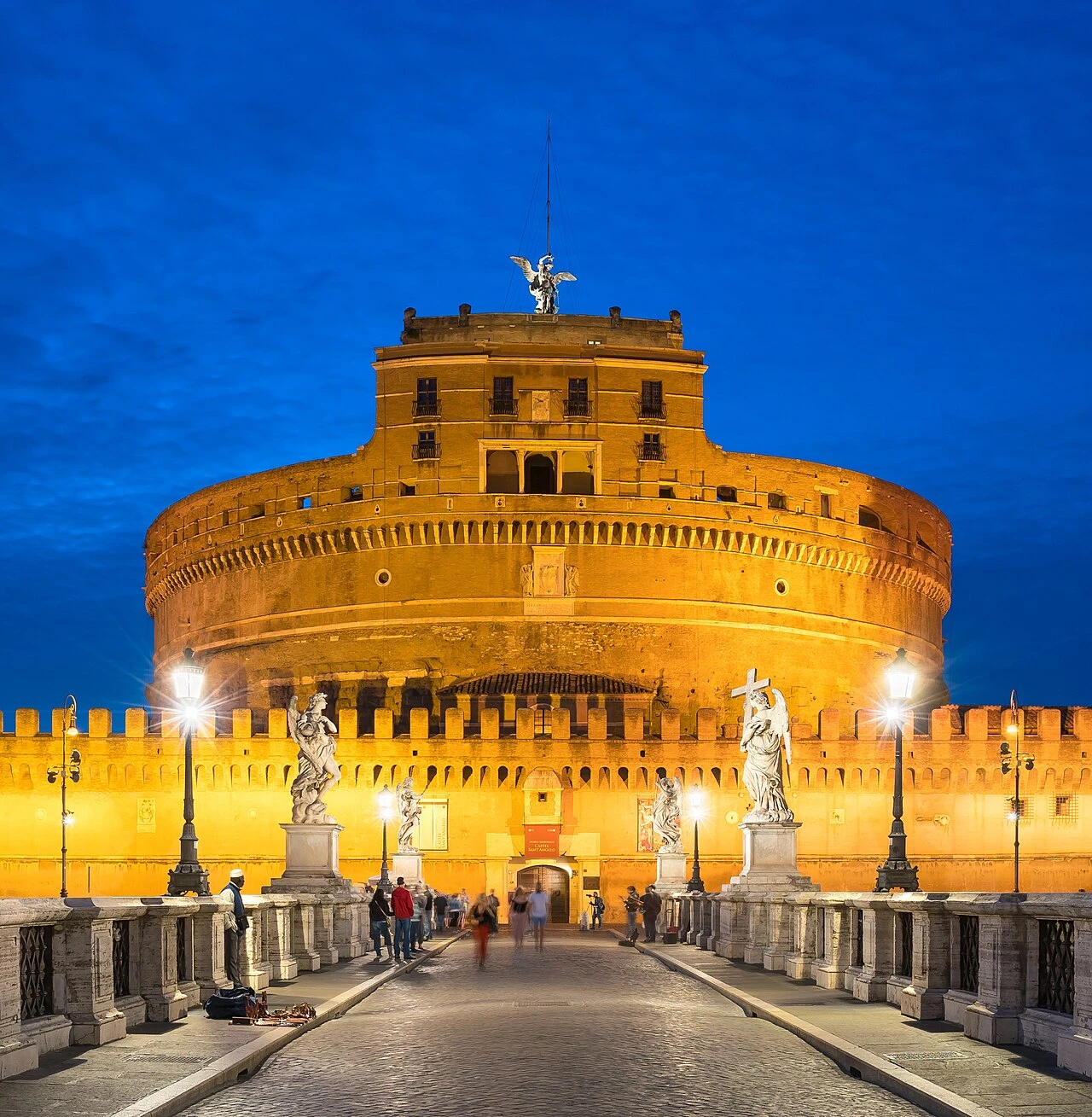
Rome · 1 km
Castel Sant'Angelo
Content & sources
Thomas Wolf, www.foto-tw.de · CC BY-SA 3.0 de
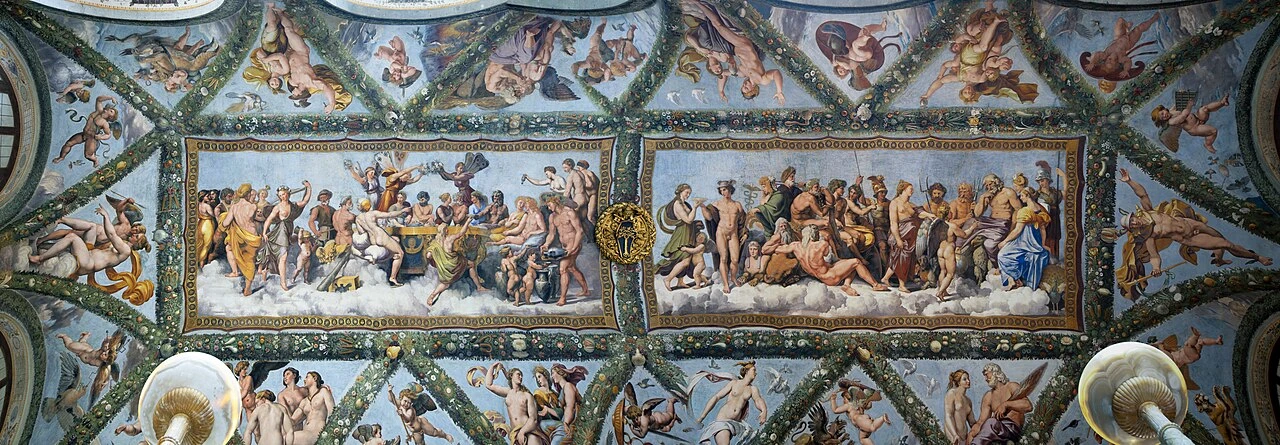
Rome · 2 km
Villa Farnesina
Content & sources
Paris Orlando · CC BY-SA 4.0
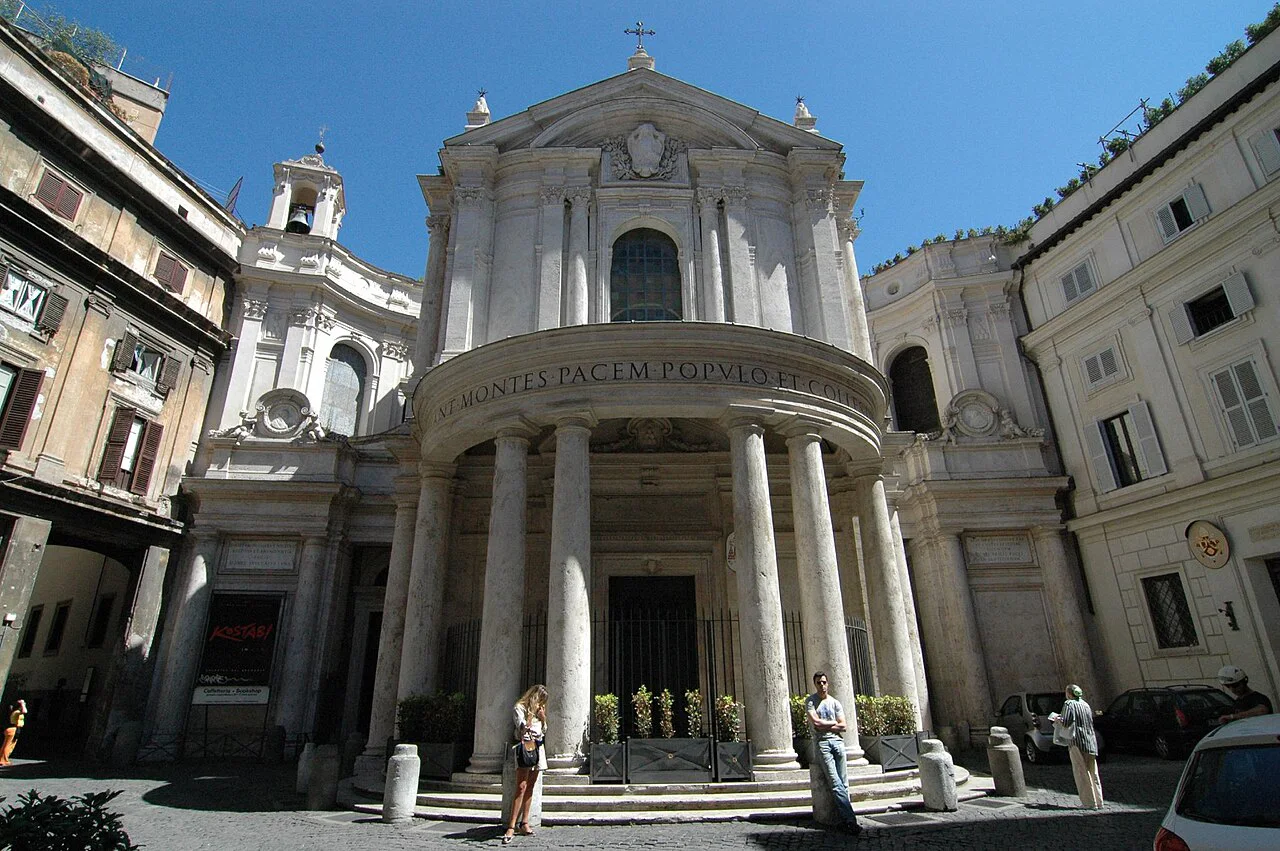
Rome · 2 km
Chiesa di Santa Maria della Pace
Content & sources
gaspa · CC BY 2.0