Stanza · Audio guide
Temple of Isis in Philae Audio Guide
A place to remember. A story to take with you.
The Temple of Isis is an ancient Egyptian temple complex dedicated to the goddess Isis. Originally located on Philae Island, it was relocated to Agilkia Island to protect it from submersion.
Download Stanza, then search for “Temple of Isis in Philae”.
About the tour
One guide. Your kind of visit.
The Temple of Isis is an ancient Egyptian temple complex dedicated to the goddess Isis. Originally located on Philae Island, it was relocated to Agilkia Island to protect it from submersion.
Ready when you are.
- 01Get the free Stanza app.
iOS & Android
- 02Find your guide.
“Temple of Isis in Philae”
- 03Download before you go.
Works offline
Audio guide / 27 narrated stops
Inside the guide
Get to know a few of the stories before you go. Open a stop to read more.
01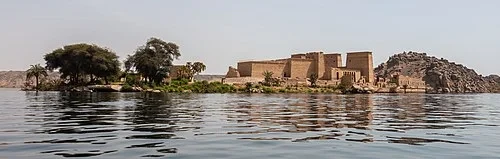 Arrival at Agilkia Island and the Great Salvage
The Salvaged Island
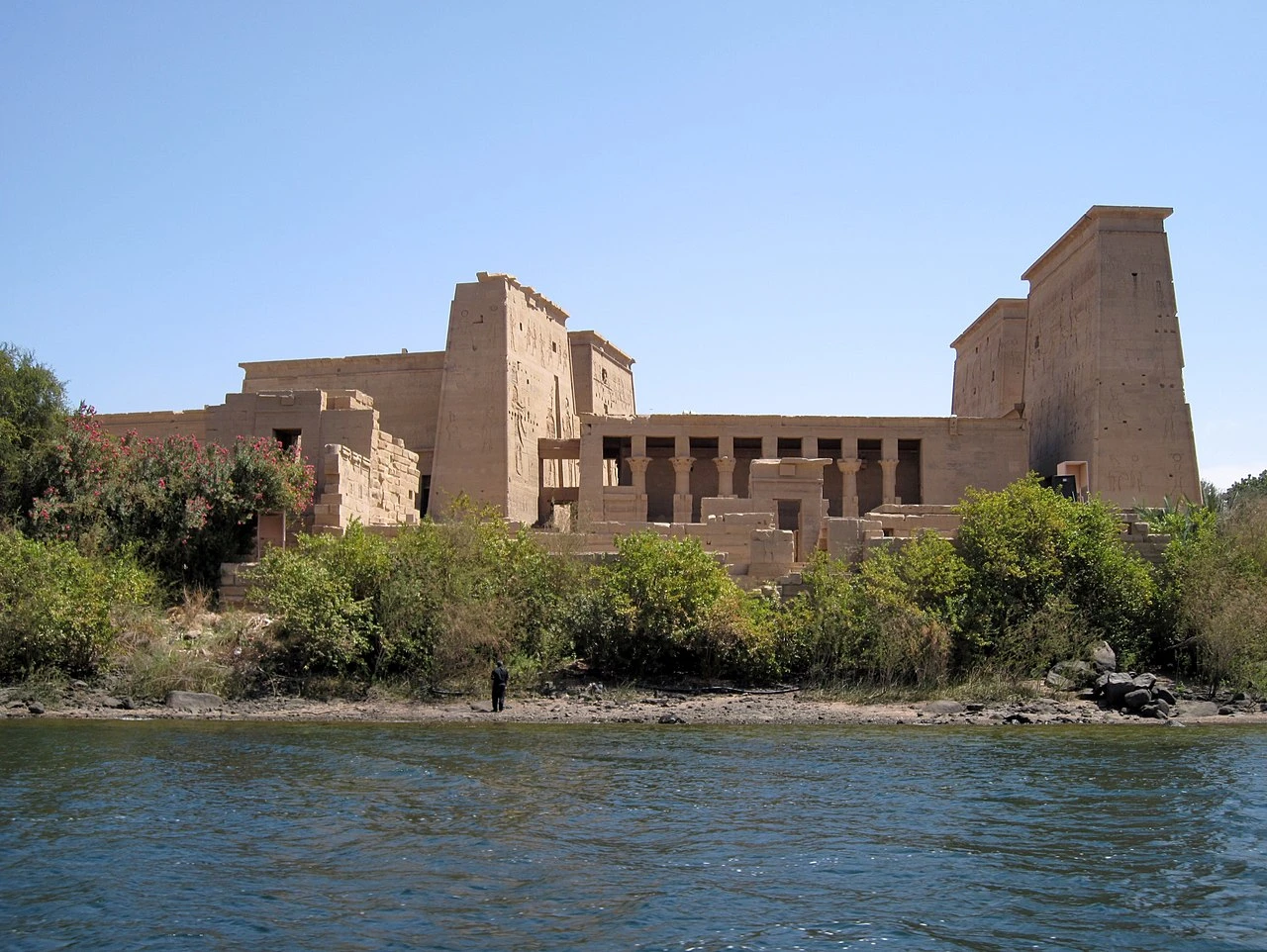
Welcome to the Temple of Isis at Philae, a site that exists today due to one of history's most complex engineering rescues. Between 1977 and 1980, the entire temple complex was facing total destruction as rising Nile waters threatened to submerge it forever. In a massive international effort led by UNESCO, the complex was meticulously dismantled into approximately 40,000 individual stone blocks, some weighing up to 25 tons. Each block was numbered and transported to higher ground on the nearby Agilkia Island. Before the reconstruction could begin, engineers had to reshape Agilkia itself, carving the granite landscape to precisely match the topography of the original Philae Island. This was done to ensure the temples would sit in the same relative positions and orientations as they had for centuries. This incredible project preserved both the architecture and the sacred geography of the site, allowing visitors to walk through these ancient spaces exactly as they were originally laid out. The project remains a landmark achievement in heritage preservation, ensuring this Greco-Roman era sanctuary survived for future generations to explore. Today, you are standing on a landscape literally carved to save a piece of the ancient past.
Diego Delso · CC BY-SA 4.0
02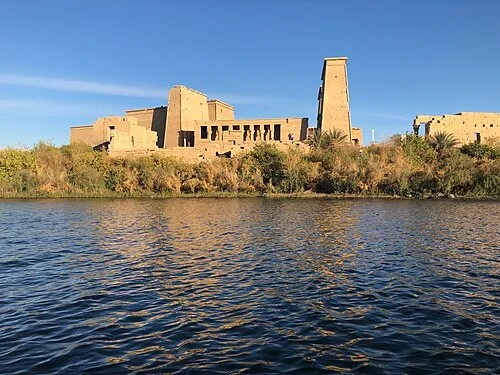 Arrival at Agilkia Island and the Great Salvage
The Pearl of the Nile
The approach to this island temple by water is an experience shared by pilgrims and travelers for over two thousand years. Long known as the 'Pearl of the Nile,' Philae was considered one of the most beautiful sites in the ancient world, combining the stark beauty of the surrounding granite hills with the elegant sandstone architecture of the sanctuary. For centuries, this island served as a major center for the cult of Isis, a goddess associated with healing, motherhood, and magic. Remarkably, it remained the last bastion of ancient Egyptian religion in a world that had largely converted to Christianity. The temple functioned until the 6th century AD, long after other pagan sites had been closed by Roman decree. Arriving by boat allows you to see the temple as the ancients did, with its massive pylons rising directly from the riverbank. This traditional mode of transport highlights the site's isolation and its role as a spiritual oasis. The transition from the flowing river to the solid, silent stone of the docks marks the beginning of the pilgrim's journey into the divine domain.
Photo: RndmCrs · CC0
03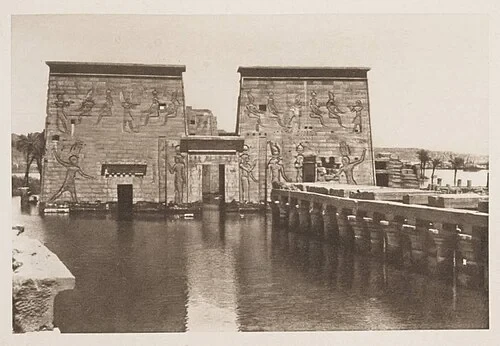 Arrival at Agilkia Island and the Great Salvage
Philae Before the Rescue
The dry, preserved site you see today stands in stark contrast to how it appeared in the early 20th century. After the construction of the first Aswan Low Dam in 1902, the original Philae Island was flooded for several months every year. Historic photographs like the one on your screen show the temple standing in the river; those from 1905 show a 'ghostly' landscape where only the upper halves of pylons and columns were visible above the water level. During this period, tourists would often hire boats to row through the flooded halls, passing between the capitals of columns that were usually high overhead. This annual submersion took a heavy toll on the stone, washing away the original vibrant paint that once decorated the reliefs. While the water caused damage, it also ironically helped preserve the stone from wind erosion and sandblasting. This history of submersion is why many of the lower sections of the temple walls appear more worn than the upper registers. Then came the High Dam, which would have left the complex permanently underwater. It prompted the decision to move the temple in the 1970s: the rescue you heard about at the start, which finally brought it out of the river for good.
Listen in the appDunning, H.W. (Photographer) · CC BY-SA 2.5
04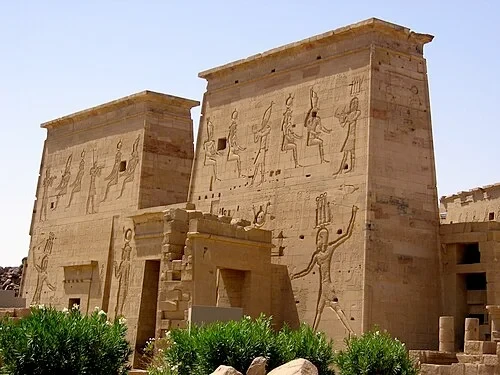 The First Pylon: The Gate of the Pharaohs
The First Pylon
The First Pylon stands as the grand entrance to the main temple of Isis. This massive structure consists of two towers joined by a lower central gateway, creating a formidable barrier between the outside world and the sacred courtyard within. In ancient Egyptian architecture, the pylon represented the 'Akhet' or horizon, the place where the sun rises and sets. By passing through this gate, a visitor was symbolically moving from the chaotic, profane world into the ordered, cosmic space of the gods. The scale of the pylon was intended to strike awe into the hearts of arriving pilgrims, emphasizing the power of both the goddess and the king who built the structure. The flat surfaces of the pylon served as a giant canvas for religious and political messaging. Looking up, you can see the sheer height of the sandstone walls, which were designed to dominate the landscape. This entrance was the first of many thresholds that regulated access to the temple's mysteries, ensuring that only those who were purified could proceed deeper into the sanctuary of the goddess.
Listen in the appVyacheslav Argenberg · CC BY 4.0
05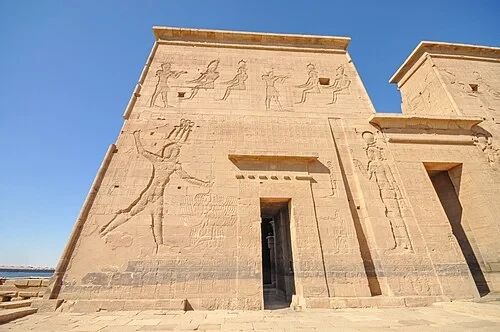 The First Pylon: The Gate of the Pharaohs
The Smiting King
Dominating the face of the First Pylon is a colossal relief of Ptolemy the Twelfth, the father of the famous Cleopatra. He is depicted in a traditional pose known as the 'smiting scene,' a standard piece of royal propaganda used by Egyptian rulers for thousands of years. The king is shown holding a cluster of captive enemies by their hair, raising a mace to strike them down in the presence of the gods. This image was not necessarily a record of a specific battle, but rather a symbolic representation of the Pharaoh’s primary duty: maintaining 'Maat,' or cosmic order. By defeating the forces of chaos, represented by the foreign enemies, the king ensured that the sun would rise, the Nile would flood, and the Egyptian state would remain secure. Notice the scale of the king compared to the smaller figures of the enemies; this hierarchy of scale clearly identifies the Pharaoh as the most important human in the scene. Even though the Ptolemaic rulers were of Greek origin, they adopted this ancient Egyptian iconographic style to legitimize their rule and demonstrate their commitment to the traditional religious duties of the Pharaoh.
Listen in the appJorge Láscar from Melbourne, Australia · CC BY 2.0
06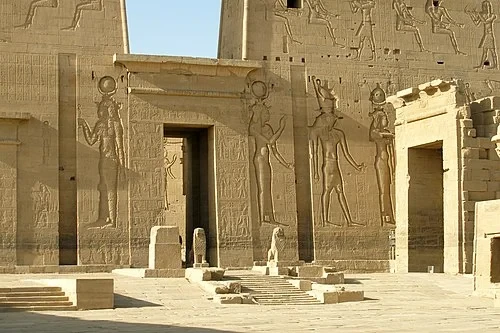 The First Pylon: The Gate of the Pharaohs
The Sacred Gateway
The central doorway of the First Pylon marks a significant transition in the temple's layout. Beyond this threshold, the open atmosphere of the exterior gives way to a more enclosed and structured environment. Within the pylon itself, there are smaller doors and staircases that lead to upper rooms and the roof, areas once reserved for the temple priests who performed astronomical observations and rituals. As you move through the gateway, the style of the reliefs begins to change, becoming more detailed and intimate as they move closer to the inner sanctum. Two granite lions sit here as guardians of the gate, and a pair of granite obelisks originally stood beside them. At the next stop, you will look more closely at these guardians. The stone walls around the doorway are covered in inscriptions and scenes of the king presenting offerings to the gods, serving as a permanent record of his piety. The narrowing of the path and the increase in religious detail were intentional design elements meant to prepare the mind for the sacred mysteries that lay further within the temple complex.
Listen in the appVyacheslav Argenberg · CC BY 4.0
07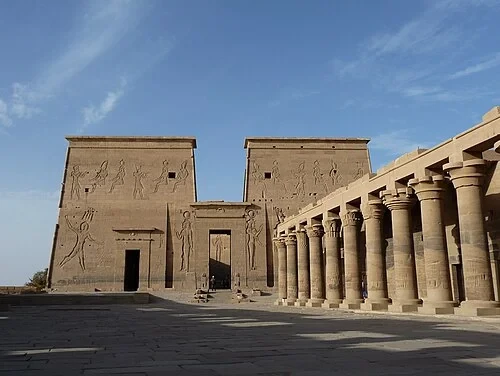 The Grand Forecourt and Colonnades
Guardians of the Gate
Lower down on the pylon registers, near the ground level, you can find the remains of granite statues that served as the threshold's guardians. These include depictions of lions and falcons, animals deeply associated with royal power and divine protection. The falcon specifically represents Horus, the son of Isis, who was the patron deity of kingship. These statues were strategically placed to impress the pilgrims who had just arrived at the temple dock, which was located directly below these steps. In ancient times, these figures would have been brightly painted and polished, their dark granite contrasting sharply with the light sandstone of the pylon walls. Their presence signaled that the visitor was entering a space protected by the gods themselves. Even in their weathered state, these figures retain a sense of watchful authority. They remind us that the temple was not just a place of worship, but a fortress of faith designed to be defended both physically and spiritually. The granite used for these statues was brought from the nearby quarries of Aswan, linking the temple to the local landscape and its enduring strength.
Listen in the appRoland Unger · CC BY-SA 3.0
08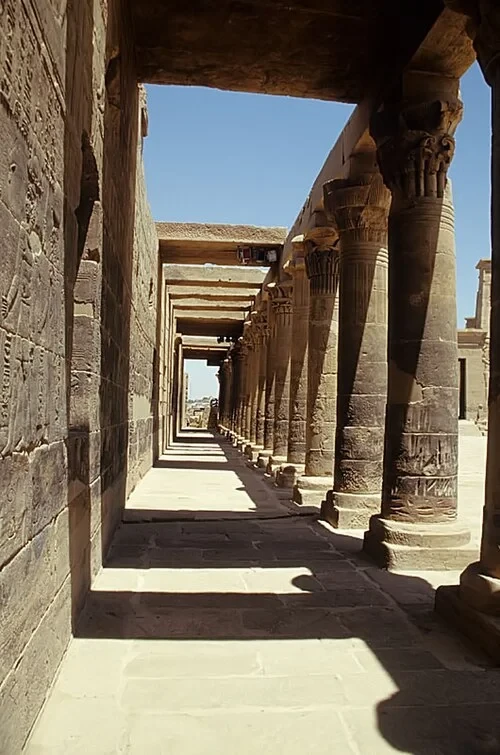 The Grand Forecourt and Colonnades
The Western Colonnade
Running along the western side of the forecourt is a long colonnade consisting of thirty-two massive columns. This architectural feature was more than just decorative; it provided essential shade for the pilgrims and priests who moved through the temple grounds. During the temple’s peak, this area would have been a hive of activity, functioning as a marketplace and gathering space for those who traveled from far and wide to bring offerings to Isis. Pilgrims might have purchased incense, small votive statues, or food offerings from stalls set up between these stone pillars. The architecture here is a masterclass in variety within a repetitive form. While the columns are of the same height and spacing, creating a powerful sense of rhythm, a closer look reveals that no two of the capitals are exactly alike. This deliberate variation is a hallmark of the late period and Greco-Roman temple style in Egypt. The colonnade also served to frame the courtyard, leading the visitor’s eye toward the First Pylon and the main entrance, ensuring that the goddess’s sanctuary remained the central focus of the entire complex.
Listen in the appRoland Unger · CC BY-SA 3.0
09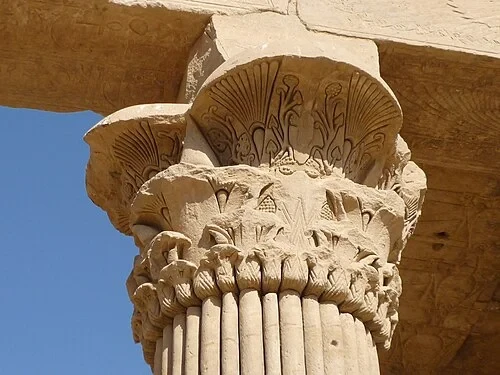 The Grand Forecourt and Colonnades
Floral Capitals
The capitals at the top of the columns are among the most beautiful features of the Philae temple. These intricate carvings represent various plants that were native to the Nile Valley, including the papyrus, the lotus, and the palm frond. This design choice was not merely aesthetic; it was deeply rooted in Egyptian creation myths. The temple was intended to be a physical representation of the 'primeval swamp'—the marshy environment where life was believed to have first emerged at the beginning of time. In this symbolic landscape, the floor of the temple represented the earth, and the columns were the vegetation rising toward the sky. By using different floral motifs for each capital, the ancient architects created the impression of a natural, wild thicket of stone. Some capitals show the plants in full bloom, while others depict them as closed buds. This variety suggests the cycle of life, growth, and rebirth that was central to the worship of Isis. As you look up, imagine these carvings painted in vibrant greens, blues, and reds, bringing the stone forest to life under the bright Egyptian sun.
Listen in the appPhoto: Rémih · CC BY-SA 3.0
10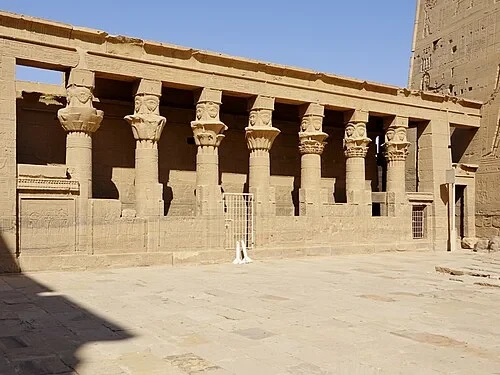 The Mammisi: The Divine Birth House
Hathor Column Detail
While many of the columns feature floral designs, several others are topped with the unique 'Hathor-headed' capital. These depict the face of the goddess Hathor, recognizable by her cow ears and a heavy, braided wig. Hathor was one of the most beloved deities in ancient Egypt, associated with motherhood, joy, music, and love. Her presence here is not accidental; she was often closely linked with Isis, and the two goddesses frequently shared attributes. These capitals are a specialized architectural form known as a 'sistrum' column, named after a musical rattle used in religious ceremonies. The square block above Hathor’s head represents the instrument itself. Her inclusion in the temple's architecture connects specifically to the function of the nearby Birth House, or Mammisi, where the divine birth of the god Horus was celebrated. Hathor was seen as a protector of women in childbirth and a patron of the arts, making her an essential guardian for a site dedicated to the divine family. The repetition of her face throughout the colonnade ensured that her benevolent gaze followed every pilgrim as they moved toward the sanctuary.
Listen in the appOlaf Tausch · CC BY 3.0
- 11
The Mammisi
Adjacent to the main temple sits the Mammisi, a specialized building dedicated to the mystery of divine birth.
- 12
Nursing the God
Intricate reliefs within this space capture an intimate moment between a goddess and her divine child.
- 13
The Second Pylon
Beyond the first courtyard stands a second massive pylon, acting as another layer of protection for the temple's inner sanctum.
- 14
Royal Offerings
The walls here depict the King in ritual communication with the gods, a scene central to the temple's daily function.
- 15
The Hypostyle Hall
Moving inside, you enter a hall where ten massive columns once supported a heavy roof, plunging the space into twilight.
- 16
The Christian Transformation
These carved crosses mark the moment when this ancient sanctuary transitioned from a pagan temple to a Christian church dedicated to Saint Stephen.
- 17
Bishop Theodore's Inscription
This Greek inscription provides a rare written record of the temple's official conversion, documenting the end of one era and the birth of another.
- 18
The Inner Sanctuary
Deep within the temple lies the most sacred chamber, where the architecture itself changes to create a sense of profound mystery and holiness.
- 19
The Stone Pedestal
This granite base once supported the most important object on the island: the small, golden statue of Isis housed within its shrine.
- 20
Reliefs of the Sanctuary
The walls of this sanctuary are covered in intricate reliefs that depict a celestial court of gods eternally attending to the goddess Isis.
- 21
The Last Hieroglyphs
On these walls, you can find the final echo of an ancient civilization—the last known hieroglyphic inscription ever carved in human history.
- 22
Hadrian's Gate
Located to the west of the main temple, this gate features a fascinating mix of ancient scripts used by a community in transition.
- 23
Temple of Augustus
Even the Roman emperors recognized the power of Isis, as seen in this northern structure built by Augustus to honor the goddess.
- 24
Trajan's Kiosk
Often called the 'Pharaoh's Bed,' this iconic structure served as a grand ceremonial entrance for the goddess during her river festivals.
- 25
The Unfinished Masterpiece
A close look at Trajan's Kiosk reveals a project frozen in time, where the intricate decorations were never fully completed.
- 26
The Pharaoh's Bed
Positioned right at the water's edge, this kiosk was the stage for a dramatic religious spectacle involving the goddess and the river.
- 27
Farewell to the Pearl
As the tour concludes, reflect on the millennia of history and the modern rescue effort that preserved this island sanctuary for the world.
Temple of Isis in Philae
Frequently asked questions
How much does the guide cost?
Free app download. Listed guide price: Free guide. Guide price shown in the app. Audio guide only. Venue admission is separate.
Can I listen without internet?
Yes. Download the guide’s audio, images, and maps in the app before your visit. Your downloaded content is then available offline.
Can I listen in my language?
This audio guide is available in 15 languages, including English.
Do I need to follow a schedule?
No. This is a self-guided experience. Choose your stops, pause whenever you like, and return to a story at your own pace.
At your own pace
Explore Temple of Isis in Philae.
Download Stanza, then search for “Temple of Isis in Philae”.
Free app download · Guide price shown in the app
Keep exploring
Audio guides — Egypt
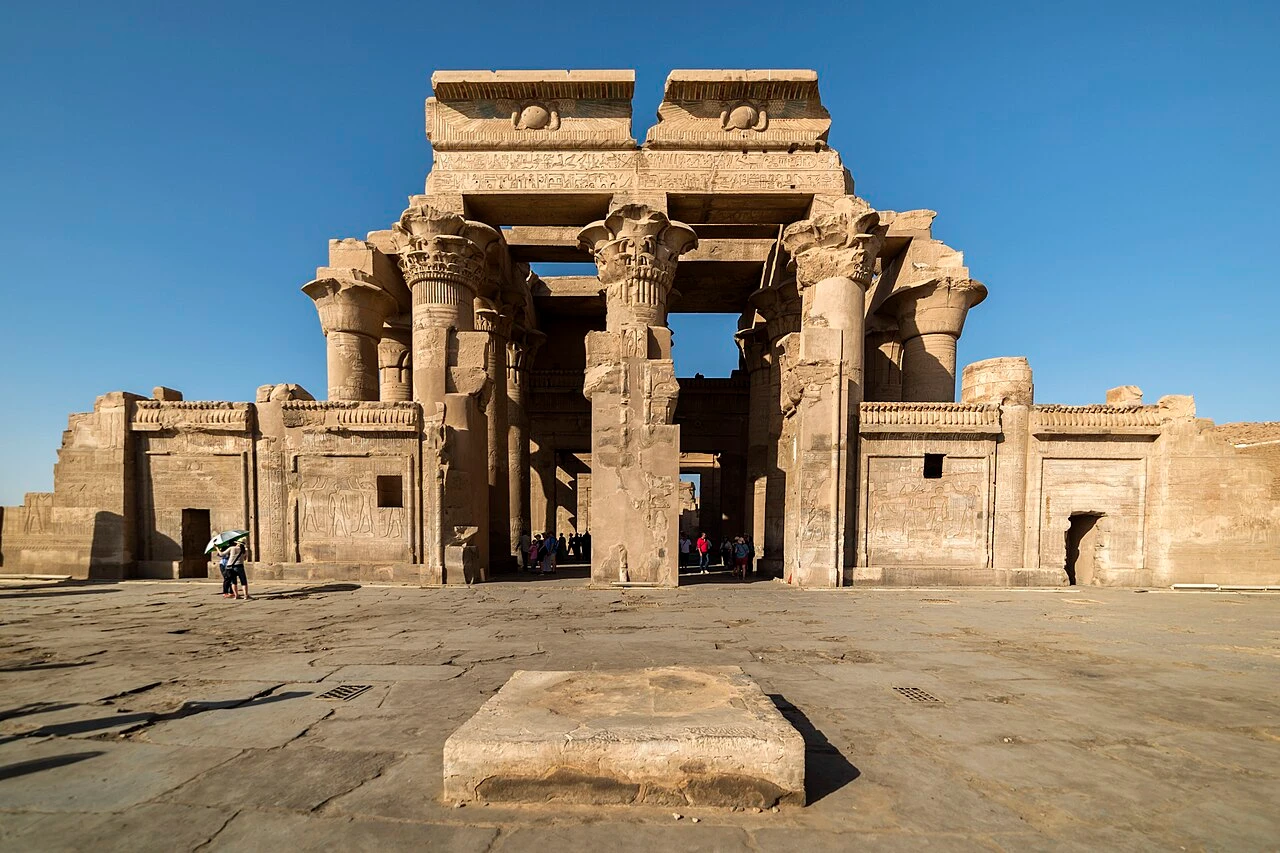
Koum Ombo City · 48 km
Temple of Kom Ombo
Content & sources
Photo: Ahmed Yousry Mahfouz · CC BY-SA 4.0
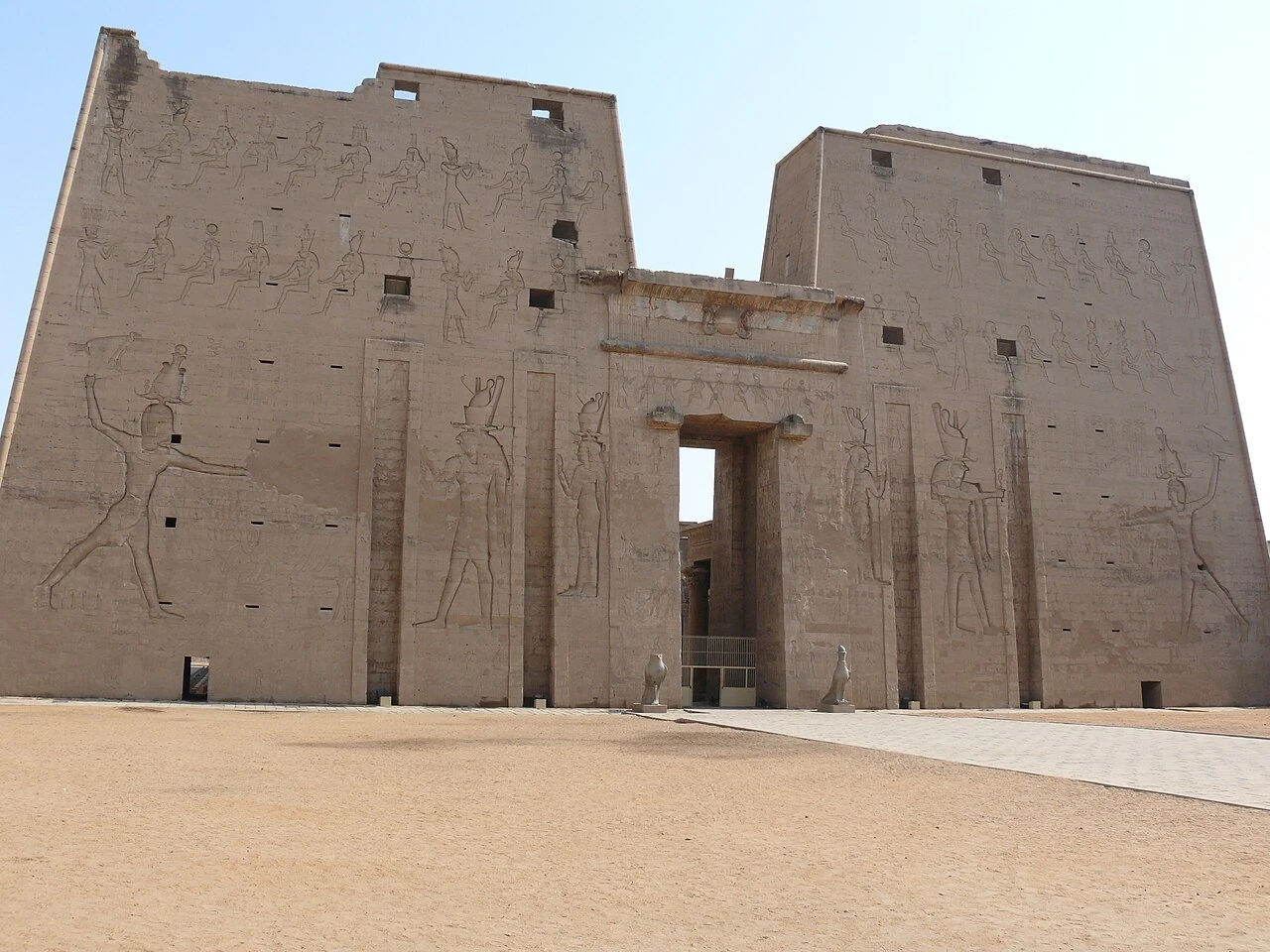
Idfu City · 106 km
Temple of Edfu
Content & sources
Photo: Ad Meskens · CC BY-SA 3.0
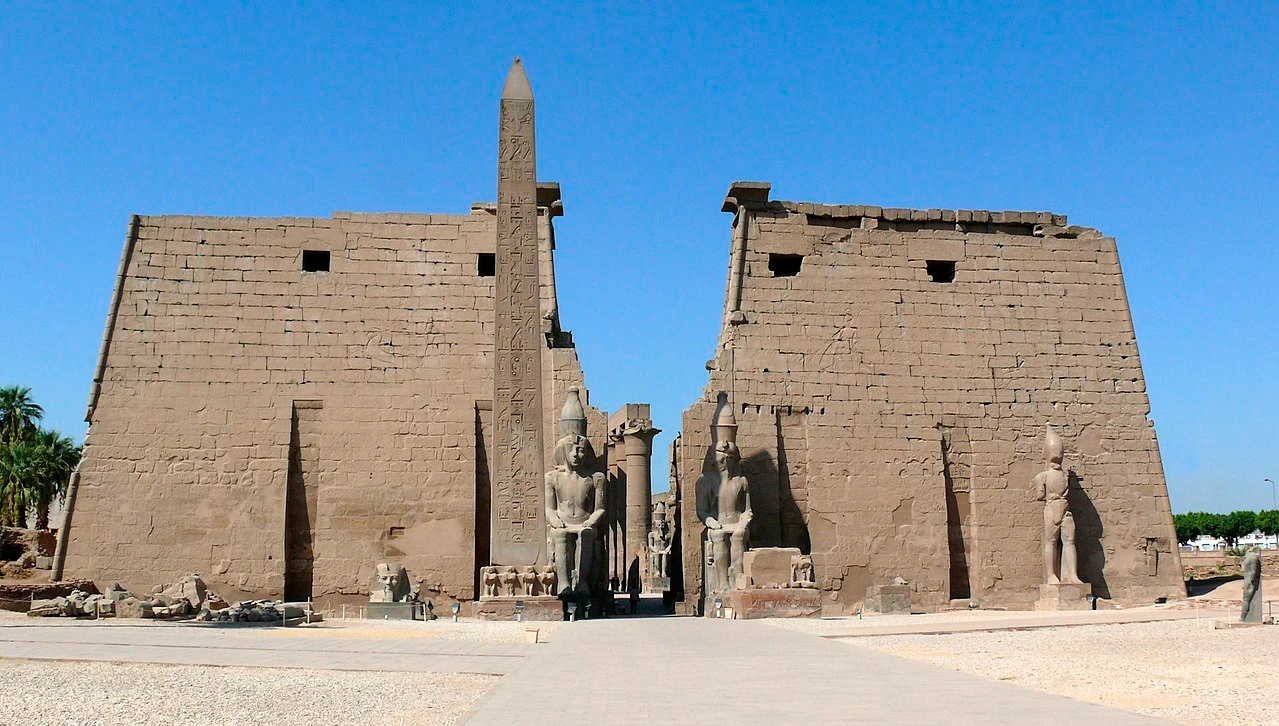
Luxor
Luxor Temple
Content & sources
Ad Meskens · CC BY-SA 3.0
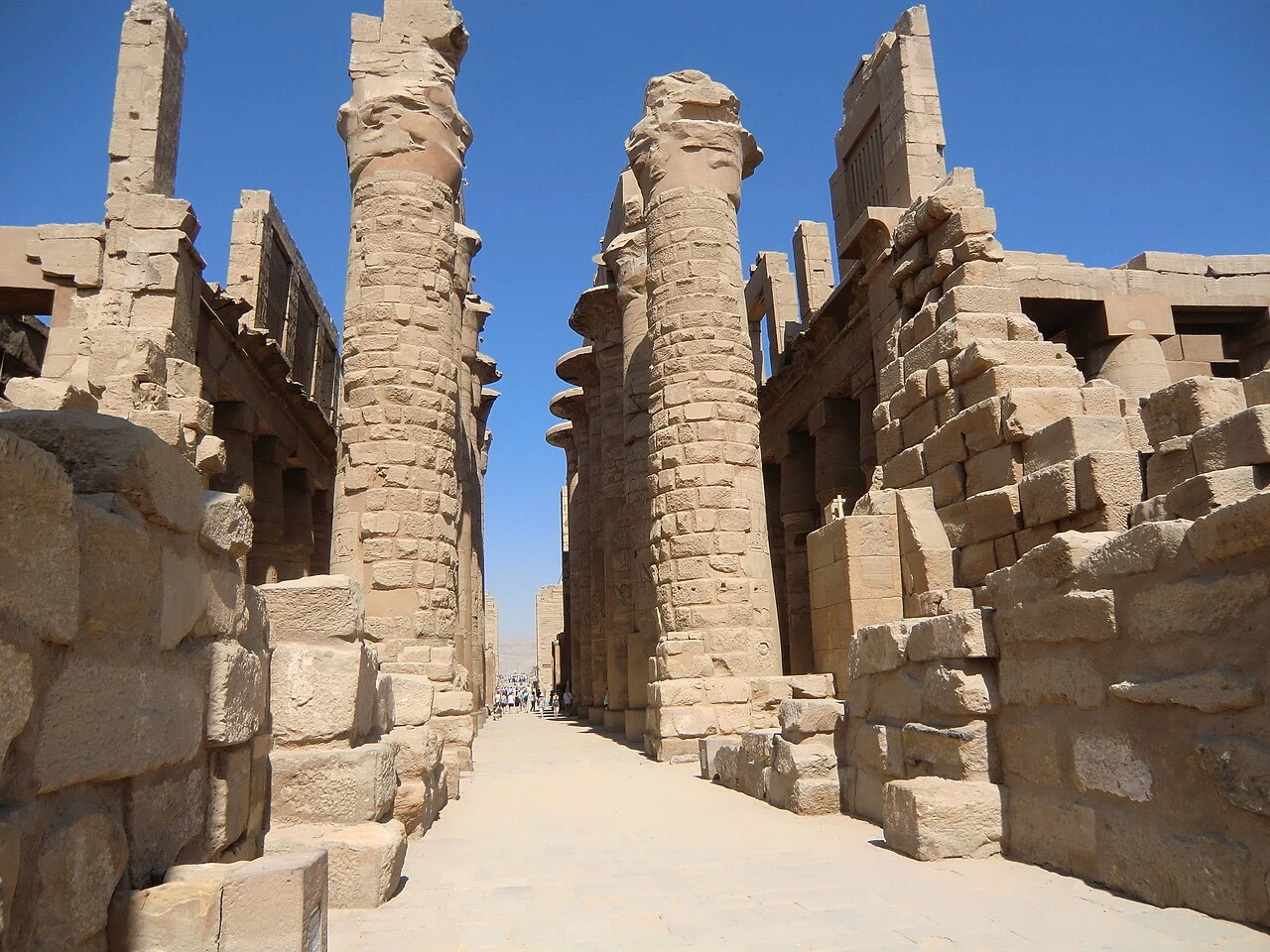
Old Karnak
Karnak Temple Complex
Content & sources
René Hourdry · CC BY-SA 4.0
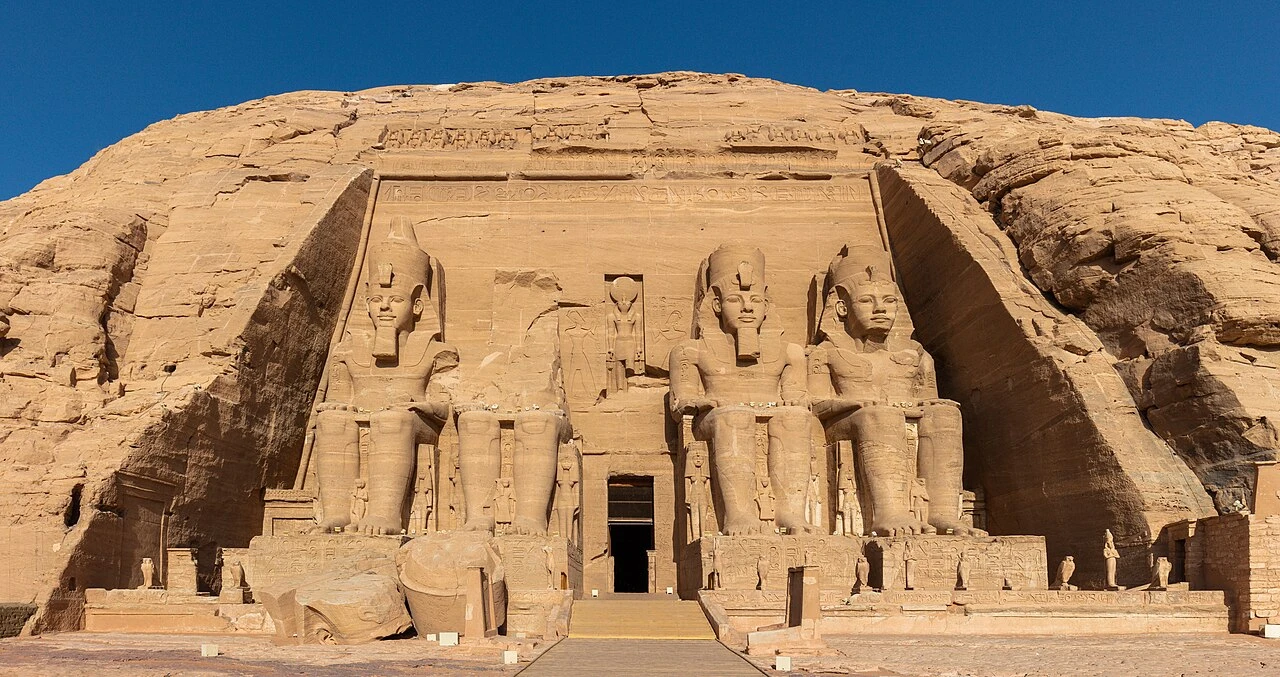
Abu Simbel City
Abu Simbel
Content & sources
Diego Delso · CC BY-SA 4.0