Stanza · Audio guide
Βιβλιοθήκη του Αδριανού Audio Guide
A place to remember. A story to take with you.
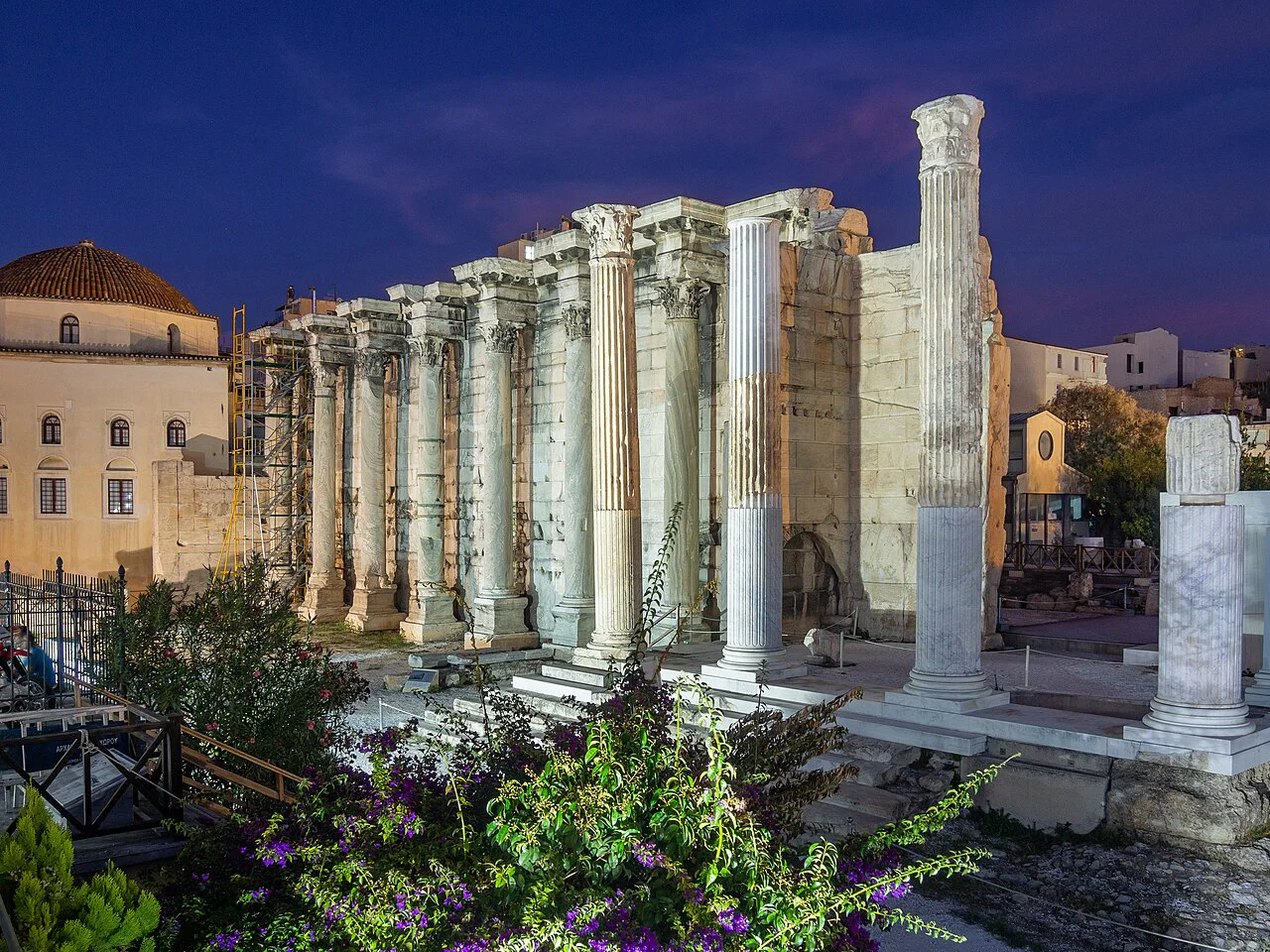
Hadrian's Library is the ruin of a monumental building created by Roman Emperor Hadrian in AD 132. It is located on the north side of the Acropolis of Athens.
Download Stanza, then search for “Βιβλιοθήκη του Αδριανού”.
About the tour
One guide. Your kind of visit.
Hadrian's Library is the ruin of a monumental building created by Roman Emperor Hadrian in AD 132. It is located on the north side of the Acropolis of Athens.
Ready when you are.
- 01Get the free Stanza app.
iOS & Android
- 02Find your guide.
“Βιβλιοθήκη του Αδριανού”
- 03Download before you go.
Works offline
Audio guide / 9 narrated stops
Inside the guide
Get to know a few of the stories before you go. Open a stop to read more.
01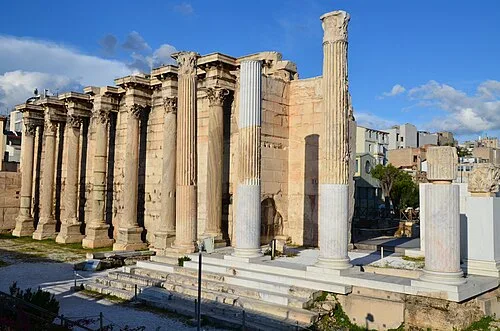 Monumental West Façade and Propylon
The West Façade and Its Columns
Emperor Hadrian founded this library in 132, on the north side of the Acropolis. He was a devoted admirer of Greek culture, and he visited Athens often during his reign. Besides the library, he put up many other buildings in Athens. He also widened the Roman Agora, and the library opened onto it. The west wall is built of Pentelic marble. Along it runs a row of columns that stand out from the stone. A few accounts describe these columns as green Karystian stone. The columns rise above a flight of steps. Of the two facade walls that once ran out from the entrance, only this western one survives.
Listen in the appCarole Raddato from FRANKFURT, Germany · CC BY-SA 2.0
02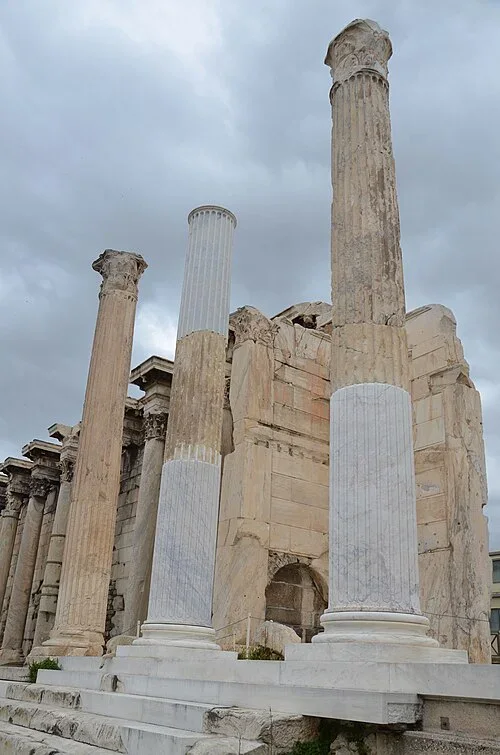 Monumental West Façade and Propylon
Propylon Columns of the Main Entrance
The complex had only one entrance, and this gateway was it. A propylon is a monumental gate, and this one led into the inner courtyard. Four columns with Corinthian capitals stood across its front. An entablature and a pediment rose above them. One account links the gateway to a covered colonnade called the Stoa of Hadrian. Another describes a separate gate standing on its own. Tall fluted columns stand here on stepped bases. Behind them rises a wall of large cut blocks, with a small arched opening low down.
Listen in the appCarole Raddato from FRANKFURT, Germany · CC BY-SA 2.0
03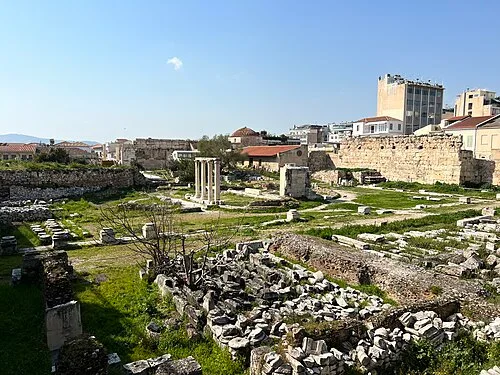 Peristyle Courtyard and Reflecting Pool
The Central Peristyle Courtyard
The inner courtyard was laid out like a Roman forum, and it measured about one hundred metres by seventy. A colonnade of Corinthian columns ran all the way around it, built from pink Phrygian marble and from Pentelic marble. In the middle lay a long, narrow pool, and the book rooms stood along the eastern side. Today the open ground holds the remains of a church, with stone fragments lying in the grass and a long wall running along one side. Under Ottoman rule the site was the seat of the Turkish governor, the voivode, and in 1835 a barracks was built on the spot where his quarters had stood.
Listen in the appPhoto: Chabe01 · CC BY-SA 4.0
04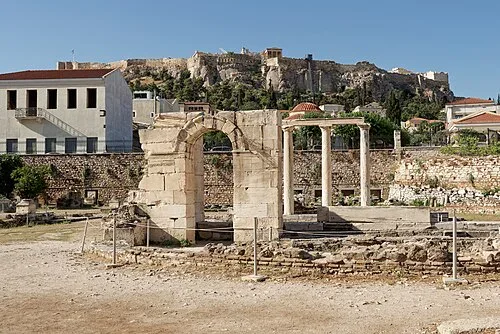 The Christian Churches and Byzantine Tetraconch
Marble Arch and Columns with the Acropolis Beyond
On the site itself once stood a bazaar of more than a hundred small shops. On the ninth of August, 1884, a fire destroyed those shops along with other buildings nearby. It was arson. The medieval church of Megali Panagia burned too. The cleared ground then gave archaeologists room to work. Digging began in 1885 under the Archaeological Society at Athens. Stefanos Koumanoudis and Wilhelm Dörpfeld supervised the work. Today a marble arch and a short row of columns stand on the open ground, with the Acropolis rising behind them. Right beside the library stands the eighteenth-century Tzistarakis Mosque.
Listen in the appJakub Hałun · CC BY 4.0
05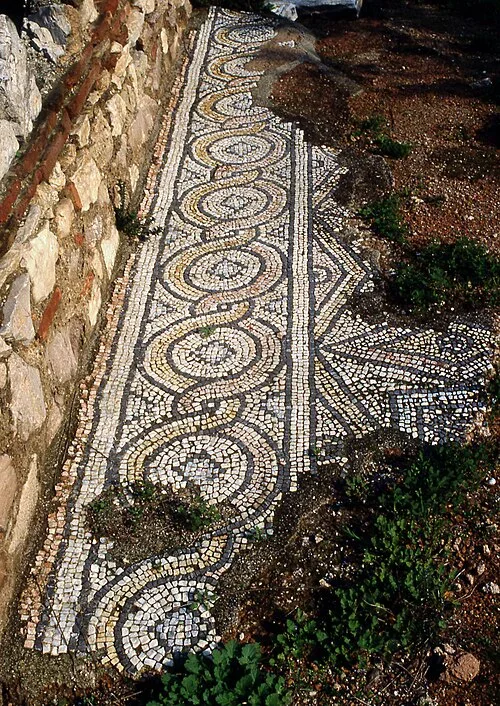 The Christian Churches and Byzantine Tetraconch
Tetraconch Mosaic Fragment
During Byzantine times, three churches were built on the site. The first was a tetraconch, dating from the fifth century. That word means a church with four apse-like lobes around its central space. In the seventh century, a Christian church in the inner courtyard was widened into a three-aisled basilica. That change saved the old library building from demolition. Later, in the Middle Ages, a simple church called Megali Panagia rose on the same foundations. It was the city's first cathedral. Beside a wall of stone and brick, a long strip of mosaic floor survives. Its interlocking circles are made of small dark and pale stones. Whether it belonged to one of these churches is not certain.
Listen in the appMark Landon (photographed in 1991; digitized in 2021) · CC BY 4.0
06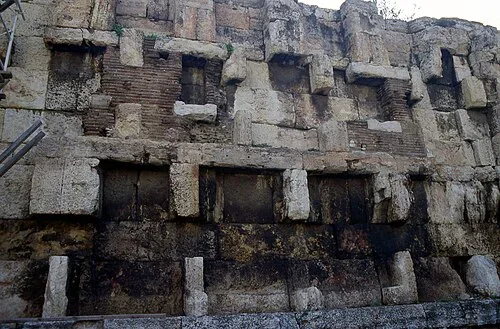 Eastern Library Archive and Scroll Repository
East Wall of the Central Hall
The central hall held the library's books. It was the middle one of five rooms along the eastern side of the courtyard. Its walls are cut with rectangular recesses, set in rows, and these are thought to have held the shelves and cupboards for the book rolls. Estimates put the capacity at between eighteen and twenty thousand rolls. Brick courses run through the upper part of the wall. Today it is bare brick and stone, but the whole building was once richly dressed: the ceilings were gilded wood, and the walls were covered in marble and paintings. One view holds that this hall rose three storeys high.
Listen in the appMark Landon (photographed in 1991; digitized in 2021) · CC BY 4.0
07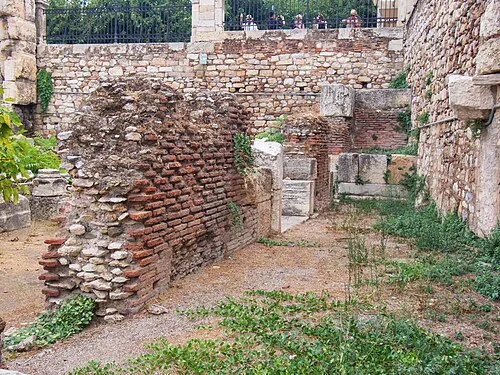 Auditoriums and Lecture Halls
The Reading and Teaching Rooms
Low walls of brick and stone lie in the grass here, with a pale block beside them. Two reading rooms flanked the central hall, one on either side. Two more rooms stood at the corners, probably for teaching, and others call them lecture halls. The whole complex was also known as the University of Athens. The name suited a building given to a city that had made Hadrian one of its own. He had been appointed eponymous archon of Athens, the city's chief magistrate, for a brief time in 112, years before he became emperor. He later revised the Athenians' constitution and added a new tribe named after him.
Listen in the appPhoto: C messier · CC BY-SA 4.0
08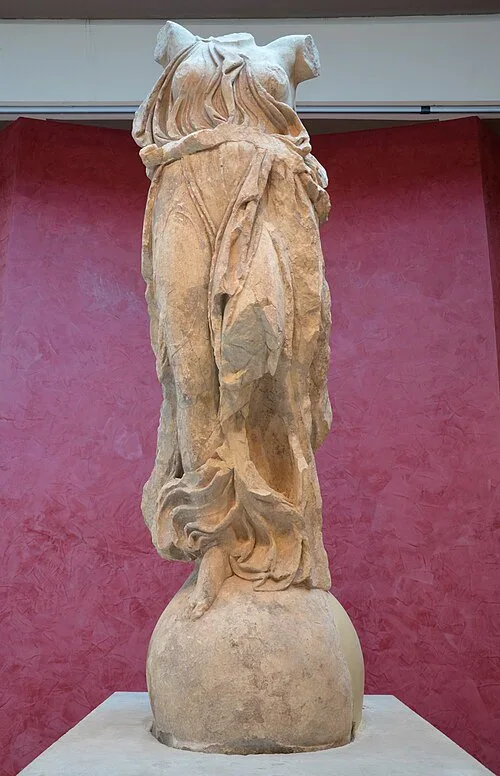 On-Site Museum Pavilion and Winged Nike
Colossal Statue of Nike
The statue shows Nike, the Greek goddess of victory, whom the Romans called Victoria. It was excavated on this site in 1988, and it now stands in the small museum here. It is a colossal Roman statue from the first century before Christ. So it is at least a century older than the library. The goddess has no head, and she stands on a round base with drapery falling around her. Where the statue first stood in the complex is not clear.
Listen in the appCarole Raddato from FRANKFURT, Germany · CC BY-SA 2.0
09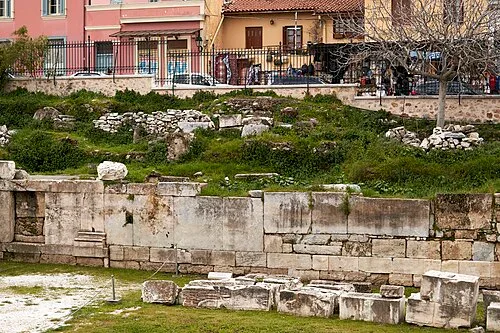 Late Roman Fortification Wall and Site Exit
Late Roman Wall Remains
In 267 the Heruli, a Germanic people, swept into Athens, and the library was badly damaged. Athens answered by drawing in its defences. A much smaller circuit of wall was built around the centre of the city, and what survived of the library was built into it. Early in the fifth century the building was repaired on the orders of a Roman official, the prefect Herculius, between 407 and 412. A long wall of large cut blocks rises here, with loose stones lying in front of it and modern houses behind. Once the library stood inside that wall, the protected ground became the heart and the economic centre of medieval Athens.
Listen in the appPhoto: George E. Koronaios · CC BY-SA 4.0
Βιβλιοθήκη του Αδριανού
Frequently asked questions
How much does the guide cost?
Free app download. Listed guide price: $0.99. Guide price shown in the app. Audio guide only. Venue admission is separate.
Can I listen without internet?
Yes. Download the guide’s audio, images, and maps in the app before your visit. Your downloaded content is then available offline.
Can I listen in my language?
This audio guide is available in 15 languages, including English.
Do I need to follow a schedule?
No. This is a self-guided experience. Choose your stops, pause whenever you like, and return to a story at your own pace.
At your own pace
Explore Βιβλιοθήκη του Αδριανού.
Download Stanza, then search for “Βιβλιοθήκη του Αδριανού”.
Free app download · Guide price shown in the app
Keep exploring
Nearby audio guides
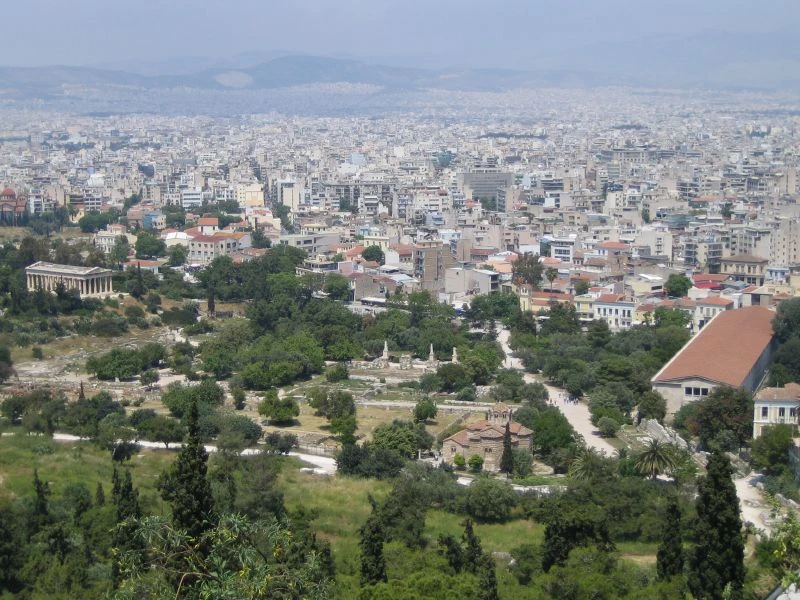
Athens · 1 km
Ancient Agora of Athens
Content & sources
https://www.flickr.com/people/jonezes/ · CC BY-SA 2.0
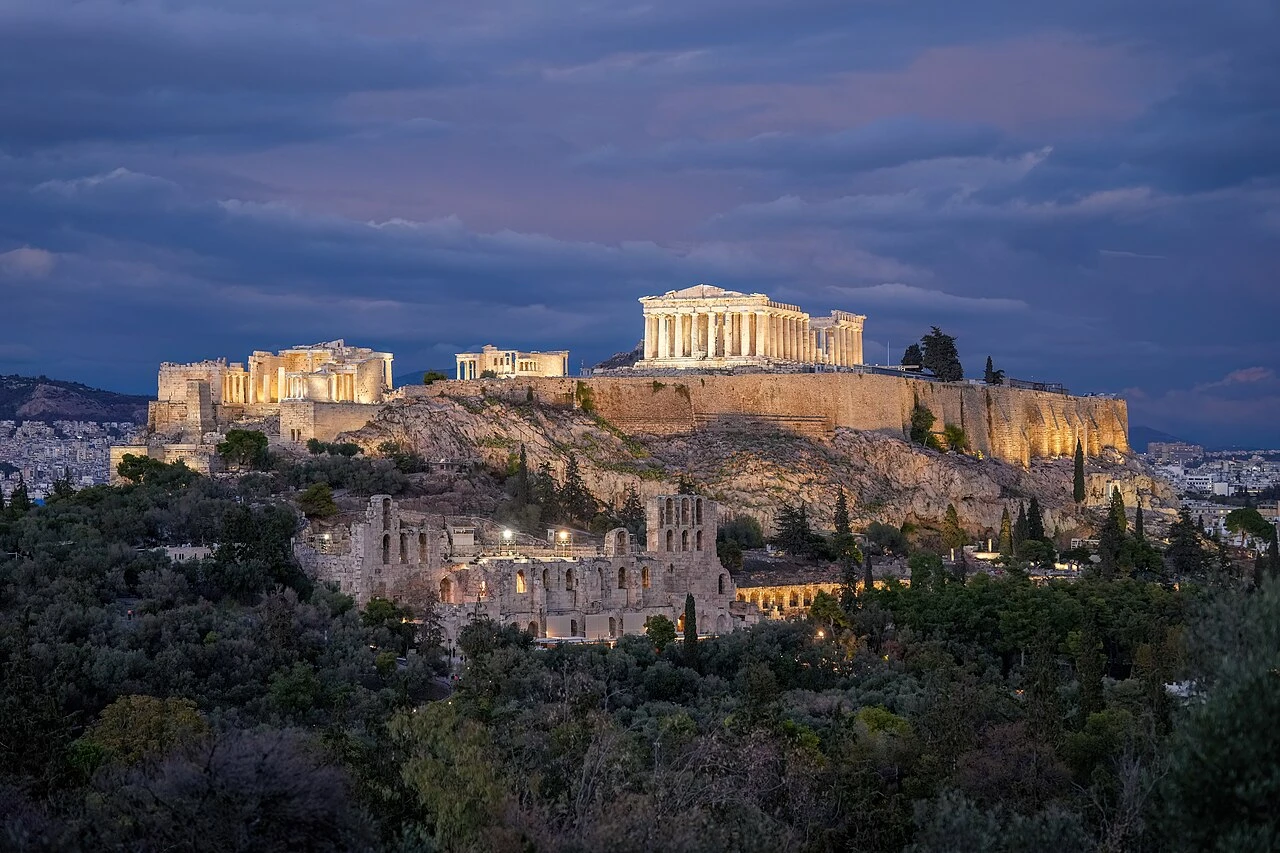
Athens · 1 km
Acropolis of Athens
Content & sources
Photo: Giles Laurent · CC BY-SA 4.0
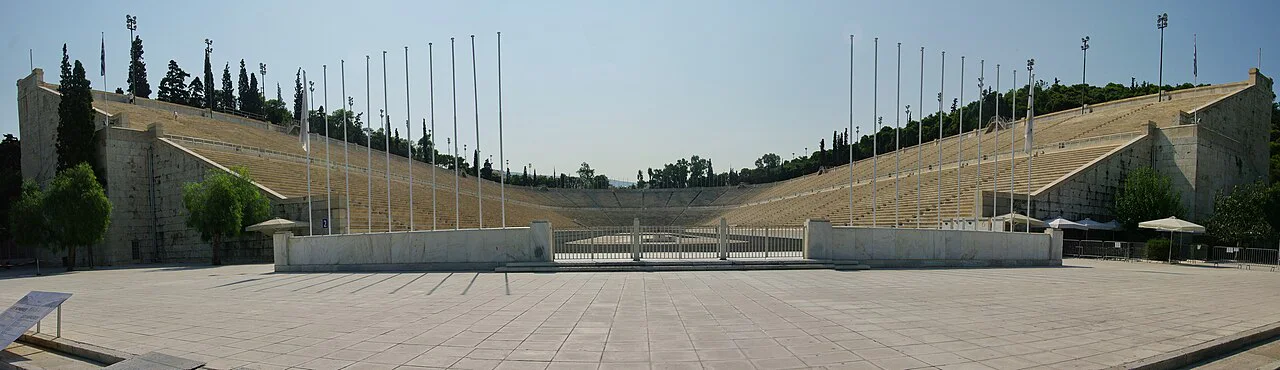
Athens · 2 km
Παναθηναϊκό Στάδιο
Content & sources
Bgabel · CC BY-SA 3.0
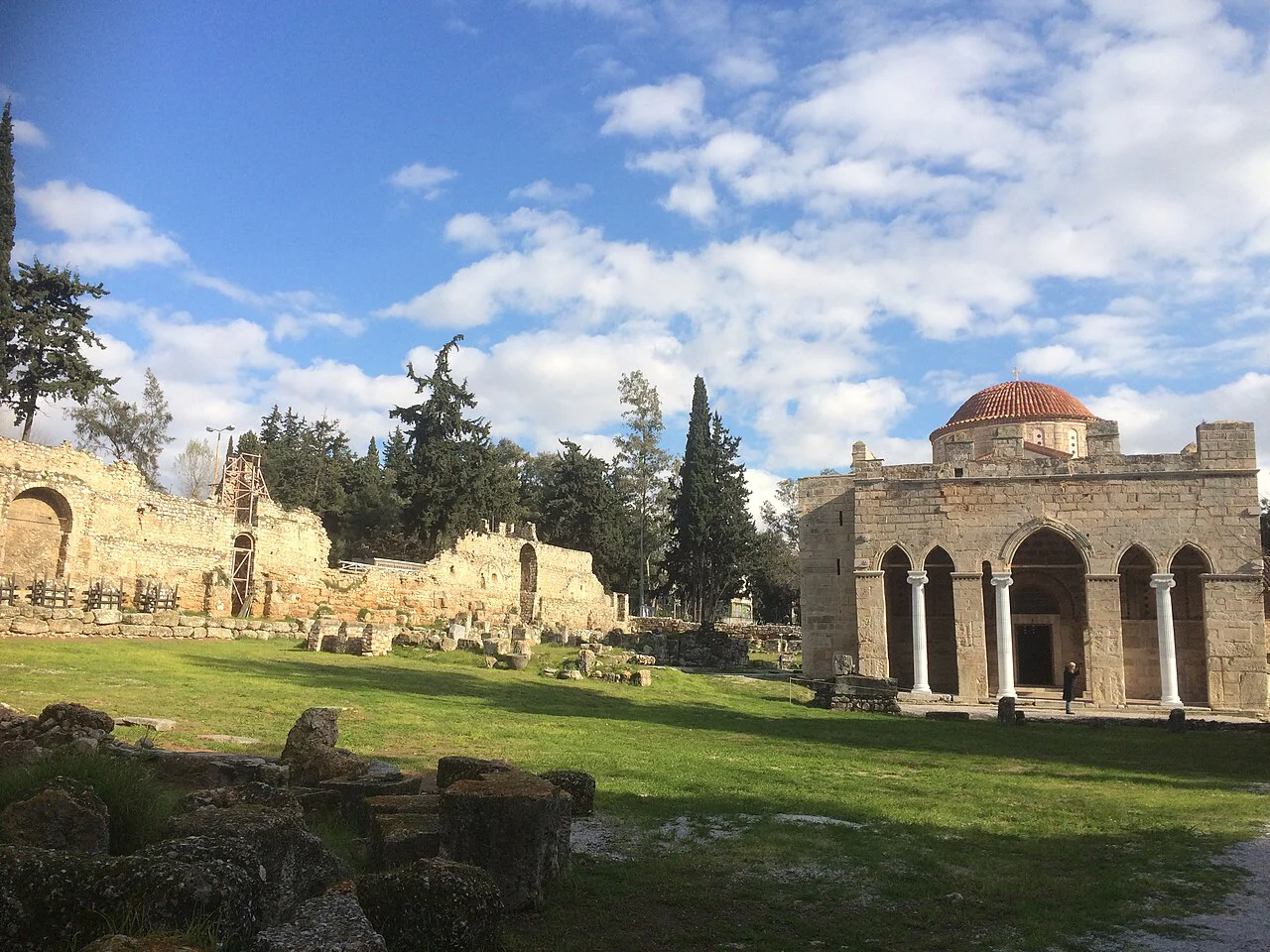
Chaidari Municipality · 9 km
Μονή Δαφνίου
Content & sources
Photo: Sp!ros · CC BY-SA 4.0
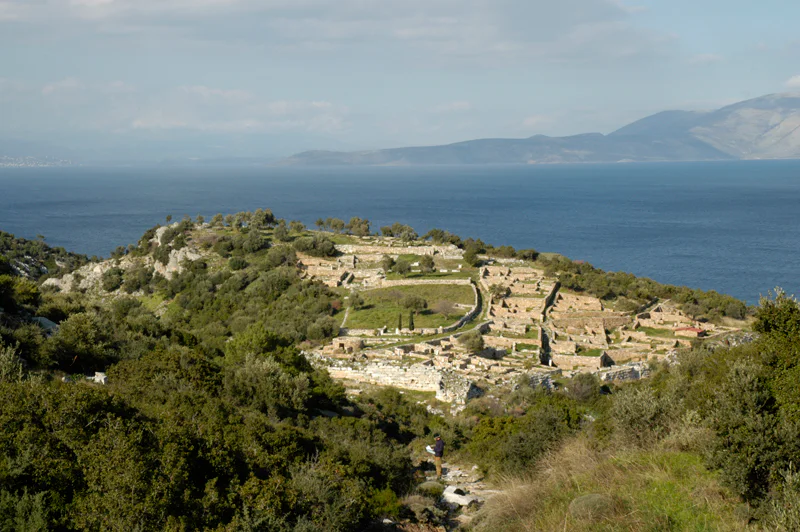
Municipality of Marathonas · 38 km
Ραμνούντας
Content & sources
Nefasdicere at English Wikipedia · CC BY 2.5