Stanza · Audio guide
Μονή Δαφνίου Audio Guide
A place to remember. A story to take with you.
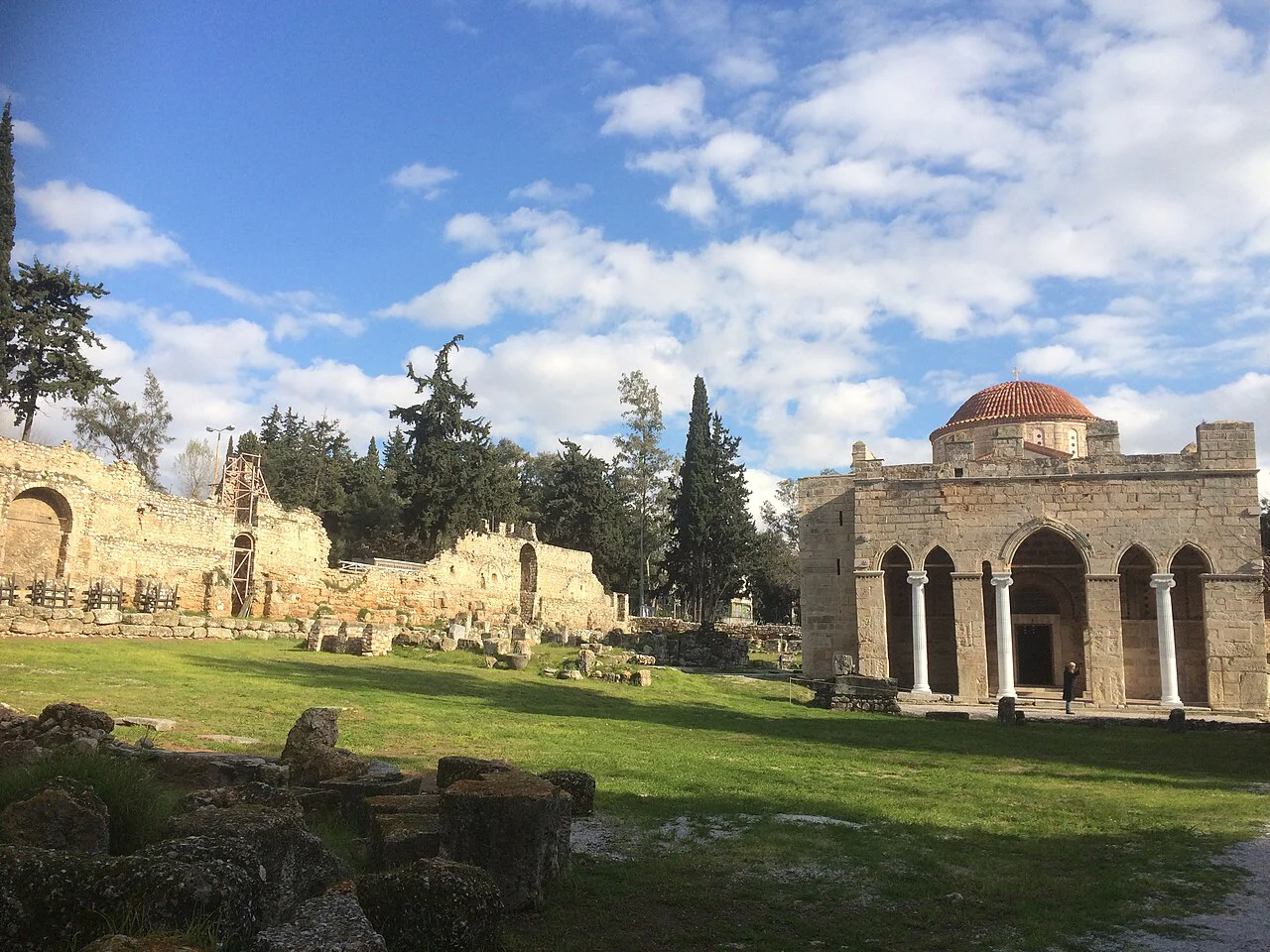
Daphni is an eleventh-century Byzantine monastery located eleven kilometers northwest of central Athens. It is situated on the Sacred Way that historically led to Eleusis.
Download Stanza, then search for “Μονή Δαφνίου”.
About the tour
One guide. Your kind of visit.
Daphni is an eleventh-century Byzantine monastery located eleven kilometers northwest of central Athens. It is situated on the Sacred Way that historically led to Eleusis.
Ready when you are.
- 01Get the free Stanza app.
iOS & Android
- 02Find your guide.
“Μονή Δαφνίου”
- 03Download before you go.
Works offline
Audio guide / 14 narrated stops
Inside the guide
Get to know a few of the stories before you go. Open a stop to read more.
01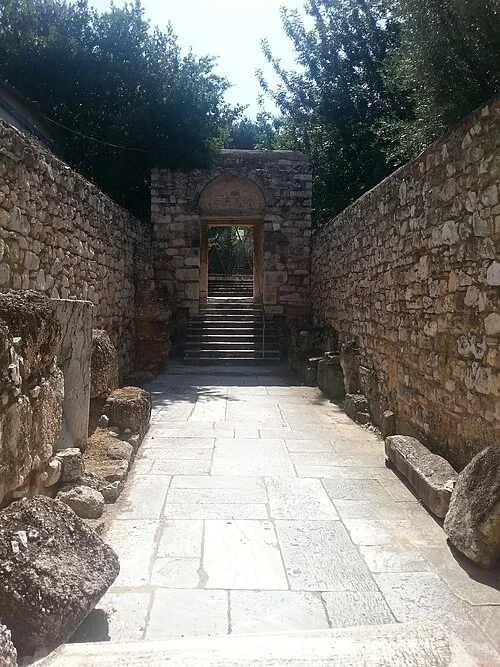 Fortified Gateway & Ancient Temple Spolia
Central Entrance to the Monastery
Daphni is a Byzantine monastery about eleven kilometres north-west of central Athens. Its name is the modern Greek word for laurel grove, and the forest beside it shares that name. The monastery sits on the Sacred Way, the road that once led from Athens to Eleusis. This tour moves from the ancient ruins to the gold mosaics inside. UNESCO added Daphni to its World Heritage list in 1990. It shares that listing with Hosios Loukas near Delphi and Nea Moni on Chios. All three are prized as masterpieces of middle Byzantine architecture, especially for their gold-background mosaics. An earthquake in 1999 badly damaged Daphni. It then stayed closed for about two decades while it was restored. It reopened to visitors in 2018.
Photo: ΠΑΡΑΣΚΕΥΗ · CC BY-SA 4.0
02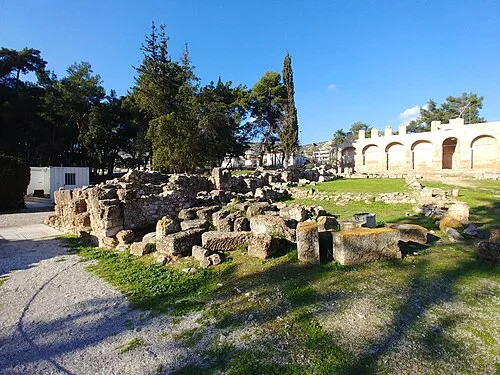 Fortified Gateway & Ancient Temple Spolia
Ancient Temple Remains in the Courtyard
Long before the monastery, this ground was sacred to Apollo. A sanctuary honouring Apollo Daphnios stood here. Its temple was built in the Ionic style, known for slender columns. Around 395, after the emperors Theodosius and Gratian ordered pagan temples closed, the temple was destroyed. Goths probably sacked it. Fallen blocks and column drums lie in the grass here, remains of that ancient temple. A column drum is one of the round stone sections a column is stacked from. Later, Christians built on the same ground. In the sixth century, a first monastery rose here, centred on a basilica, a church believed to have had three aisles.
Photo: GeorgiosPap · CC0
03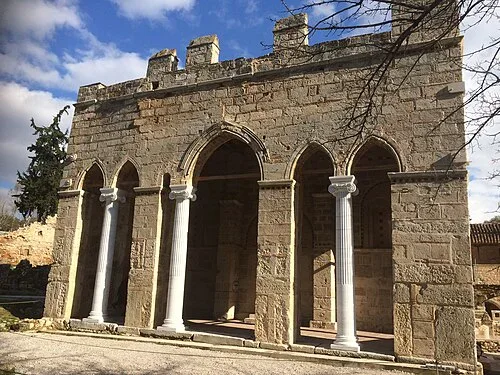 Western Exonarthex & The Spolia Portico
Western Porch with Ancient Ionic Columns
The monastery reused stone from Apollo's old temple. The pointed arches on this porch are a later medieval change. One of the temple's four Ionic columns survives on the site, reused in the monastery. The other columns were taken to London by Thomas Bruce, the Earl of Elgin. He is best known for taking the Parthenon marbles from Athens. The British Museum now holds those columns, their bases and their tops.
Listen in the appPhoto: Sp!ros · CC BY-SA 4.0
04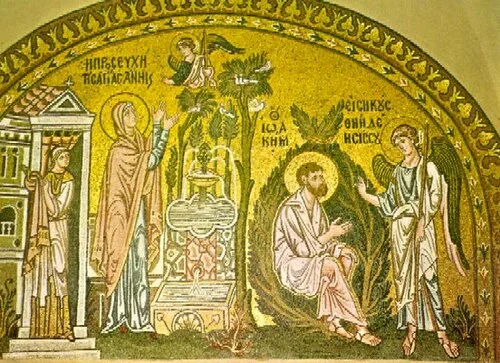 The Inner Narthex: Marian and Passion Cycles
Mosaic of the Annunciation of Anna
Scenes of Mary's life are told in gold mosaic in the narthex, the inner porch of the church. The first monastery on this site was dedicated to the Virgin Mary. In many early and medieval churches, the narthex is a threshold, the step from everyday life into the sacred. This panel takes its name from Anna, Mary's mother, and an angel's message of a child to come. On the left, a haloed woman raises one hand beside a small building. On the right, a haloed man sits beside an angel. Other scenes of Mary's life include the Prayers of Joachim and Anna, and the Virgin with Anna.
Listen in the appUnknown author · Public domain
05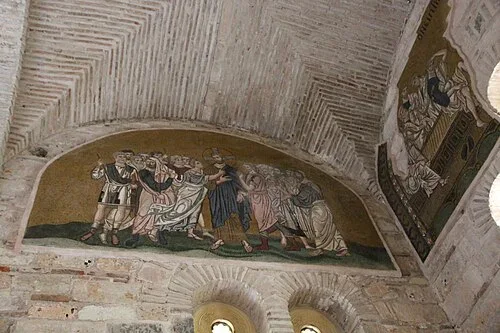 The Inner Narthex: Marian and Passion Cycles
Mosaic of the Arrest of Jesus
The Passion is the story of Jesus's last days, and this panel is taken to show his arrest, the scene known as the Betrayal of Judas. A crowd of robed figures moves across the curved surface. The narthex tells that story as a row of scenes. Other Passion scenes in the church include the Washing of the Disciples' Feet, the Last Supper, the Crucifixion, and the Resurrection. The brickwork above the panel is laid in a herringbone pattern, with bricks set at angles to form zigzags.
Listen in the appGiovanni Dall'Orto · CC BY-SA 2.5 it
06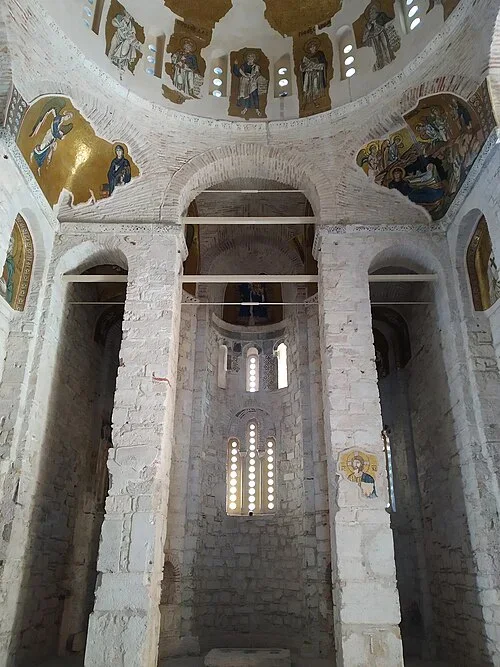 Central Naos & The Dome of Christ Pantokrator
Interior of the Katholikon: Piers, Squinches and Dome
Daphni was rebuilt in the eleventh and twelfth centuries, when the monastery was prosperous again. The old basilica was taken down, but its enclosing walls and cells were kept and built into the new church. The plan forms a Greek cross, with four arms of equal length. Each arm is roofed with a barrel vault, a tunnel-shaped ceiling. Small vaulted bays fill the corners and give the building its rectangular outline. At the centre, a square bay carries a broad dome. Four squinches turn that square into an octagon. A squinch is a small half-dome built across a corner, which lets a square support a round dome. Tall L-shaped piers, solid supports, help carry the dome. Windows at the base of the dome light the space above, so it grows brighter as it rises.
Listen in the appPhoto: Christinelle · CC BY-SA 4.0
07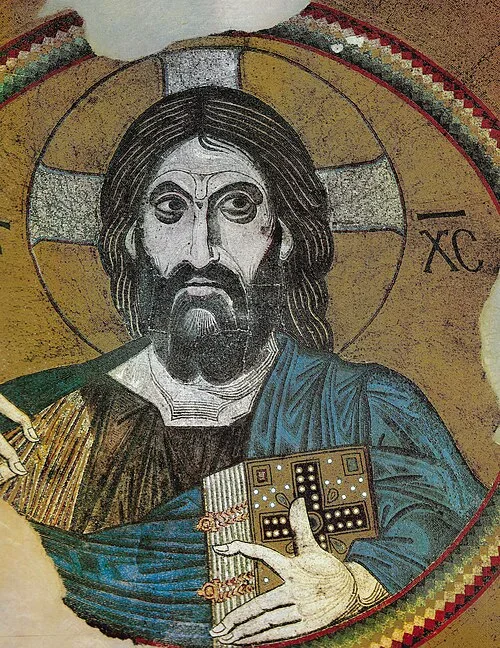 Central Naos & The Dome of Christ Pantokrator
The Christ Pantokrator Medallion
Pantokrator means Lord of the Universe, or All-powerful. The medallion shows Christ in glory, not in suffering on the cross. The face is stern, with arched brows and a steady gaze. The long nose meets the horizontal lines of the halo, forming a cross. On either side of the halo are the letters I C and X C, short for Jesus Christ. The mantle is blue, and one hand holds a book with a jewelled-looking cover. The mosaic dates to around 1100, early in the Komnenian period. That period takes its name from the Komnenos family, who ruled Byzantium. Its artist is unknown. The gold background is made of tesserae, small cube-shaped pieces of stone covered in glass, silver or gold. It is believed the glass was made at Daphni itself. One assessment calls it one of the greatest creations in art. It also judges it the most awe-inspiring and convincing of all the Pantokrators, from Kiev to Cefalu. Studies of its restoration generally agree the face has not changed much.
Listen in the appUnknown author · Public domain
08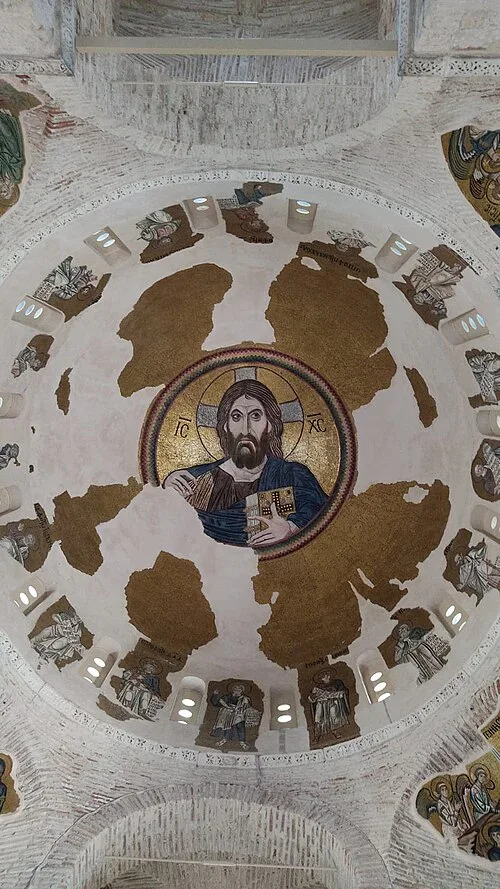 Central Naos & The Dome of Christ Pantokrator
Dome with Christ Pantokrator and Ring of Prophets
In Byzantine belief, a church building was a symbol of the Christian universe. It was meant to reflect the splendour of heaven. At Daphni, the upper church and the dome stand for heaven, and the lower area stands for earth. The Encyclopaedia Britannica describes the whole interior as a visualization of the Christian cosmos. In that design, Christ presides from the dome, above a host of saints who fill the lower part of the room. At the dome's centre, in places the gold has broken away to show pale plaster. Around the base of the dome, sixteen prophets stand between the windows. They hold scrolls whose text proclaims the glory of Christ, or the Second Coming, his expected return.
Listen in the appPhoto: Papesse Hortense · CC0
09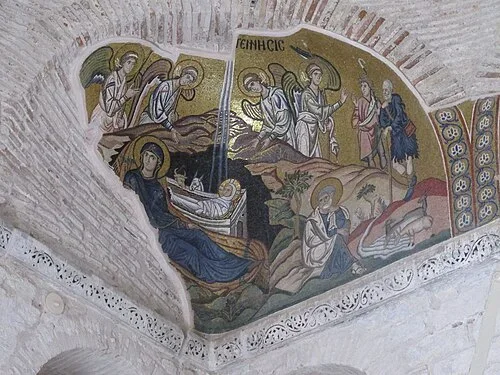 The Squinches: Masterpieces of the Great Feasts
Mosaic of the Nativity in a Squinch
The Nativity fills one of the curved corners beneath the dome. The scene bends with the curved surface. The birth of Christ is shown in a dark, cave-like opening. The infant lies in a manger at the centre. A woman in blue appears at the left, and angels show at the upper left and in the gold above. A haloed figure sits low in the scene. A Greek label names the scene, and its word means birth.
Listen in the appJacob Freeland · CC BY 4.0
10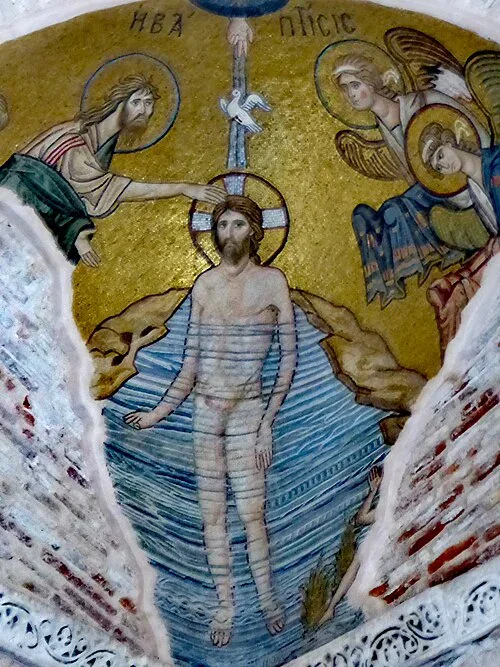 The Squinches: Masterpieces of the Great Feasts
Mosaic of the Baptism of Jesus
Christ stands in the water, and John the Baptist rests a hand on his head. A dove is set above Christ, and at the very top a hand appears. Angels stand at the right. A Greek label names the scene as the baptism. Daphni's art is often described as a return to classical traditions. Its figures look more natural and blend into their surroundings. Yet faces in this period are often austere and unemotional. Christ's body is modelled in light and shade, so it looks solid.
Listen in the appKtiv · CC BY-SA 4.0
- 11
Apse Mosaic of the Theotokos
The Mother of God in the apse, and why the most sacred images sit highest.
- 12
Cistercian Cloister Arcade
Frankish crusaders sack the monastery, and Cistercian monks add a cloister.
- 13
Carved Shield on a Sarcophagus
A carved shield on a stone coffin, and the knights who chose Daphni for their burial.
- 14
Ruins Within the Monastic Enclosure
Enclosing walls, the cells inside them, and the monks who kept the community going.
Μονή Δαφνίου
Frequently asked questions
How much does the guide cost?
Free app download. Listed guide price: $0.99. Guide price shown in the app. Audio guide only. Venue admission is separate.
Can I listen without internet?
Yes. Download the guide’s audio, images, and maps in the app before your visit. Your downloaded content is then available offline.
Can I listen in my language?
This audio guide is available in 15 languages, including English.
Do I need to follow a schedule?
No. This is a self-guided experience. Choose your stops, pause whenever you like, and return to a story at your own pace.
At your own pace
Explore Μονή Δαφνίου.
Download Stanza, then search for “Μονή Δαφνίου”.
Free app download · Guide price shown in the app
Keep exploring
Nearby audio guides
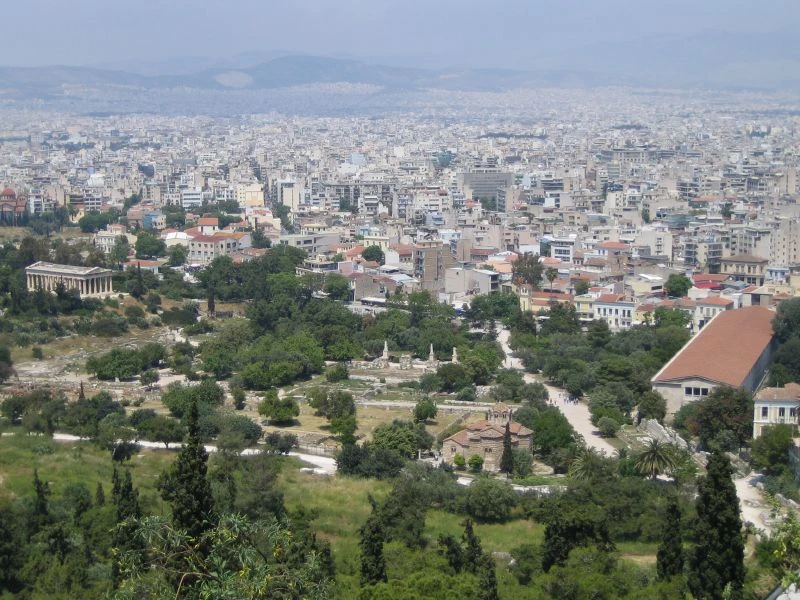
Athens · 9 km
Ancient Agora of Athens
Content & sources
https://www.flickr.com/people/jonezes/ · CC BY-SA 2.0
Athens · 9 km
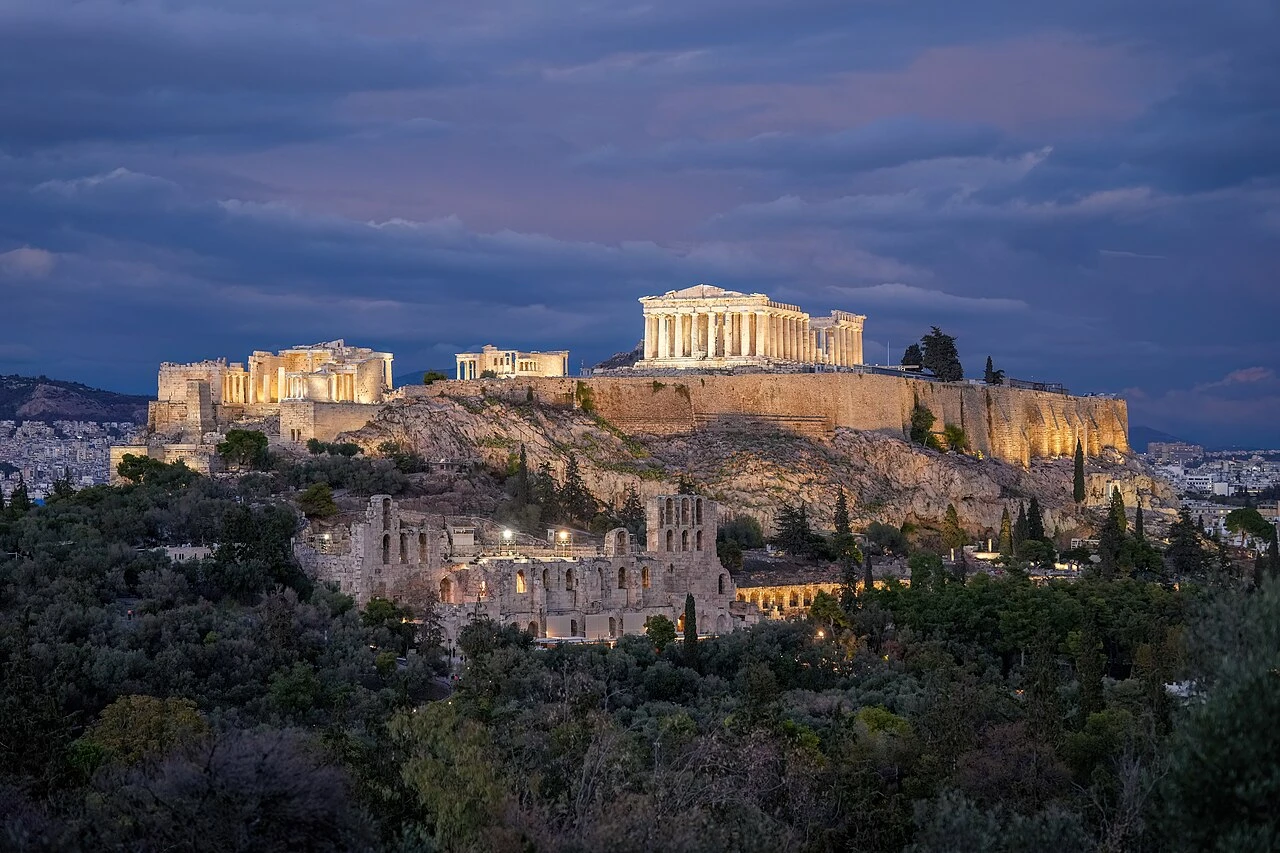
Acropolis of Athens
Content & sources
Photo: Giles Laurent · CC BY-SA 4.0
Athens · 10 km
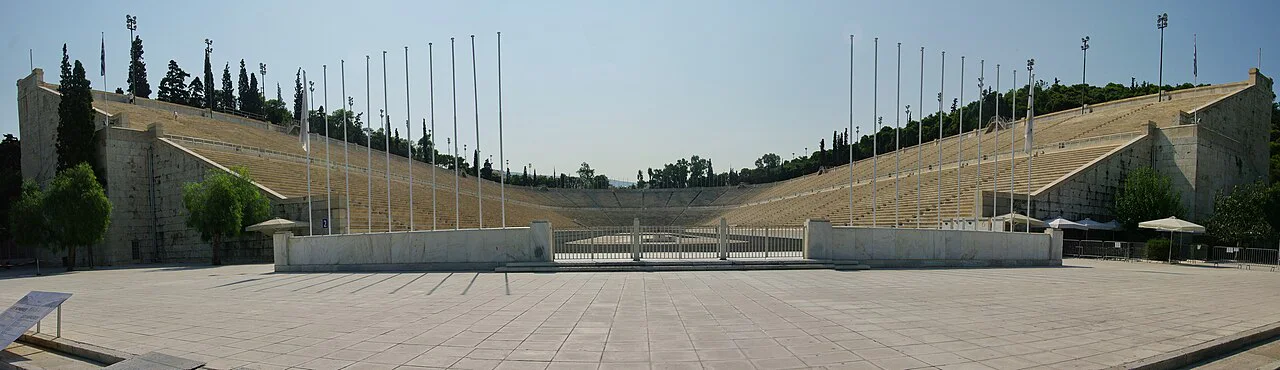
Παναθηναϊκό Στάδιο
Content & sources
Bgabel · CC BY-SA 3.0
Mesagros · 30 km
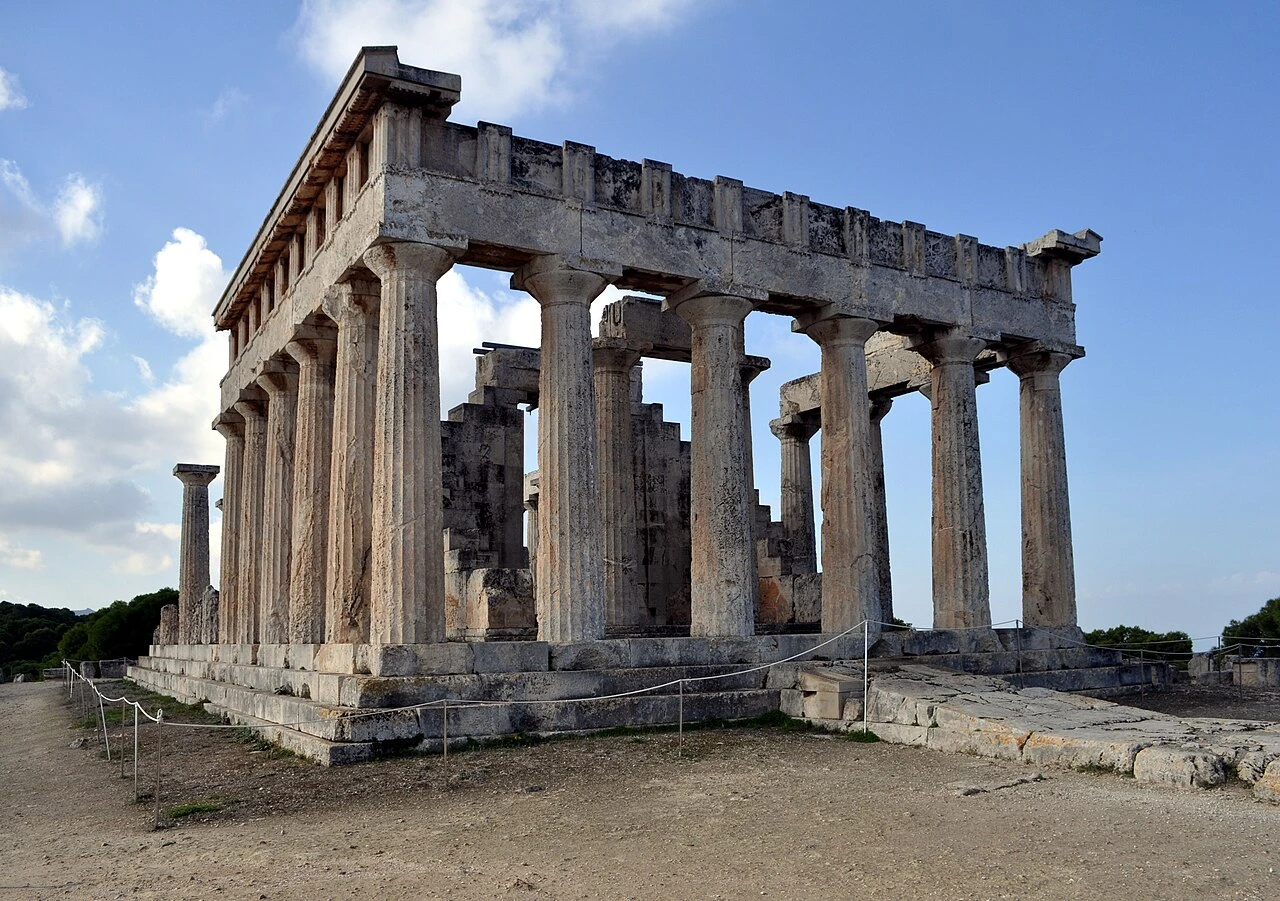
Temple of Aphaea
Content & sources
Paweł 'pbm' Szubert (talk) · CC BY-SA 3.0