Languages
15Μονή Οσίου Λουκά Audio Guide
Μονή Οσίου Λουκά is a landmark in Distomo Municipal Unit, Greece. Explore it with Stanza's GPS-triggered offline audio guide — available in 15 languages.
Quick Facts
41
Stops
15
Languages
100%
Offline
📍 Distomo Municipal Unit, Greece · 38.3951°N, 22.7463°E
About Μονή Οσίου Λουκά
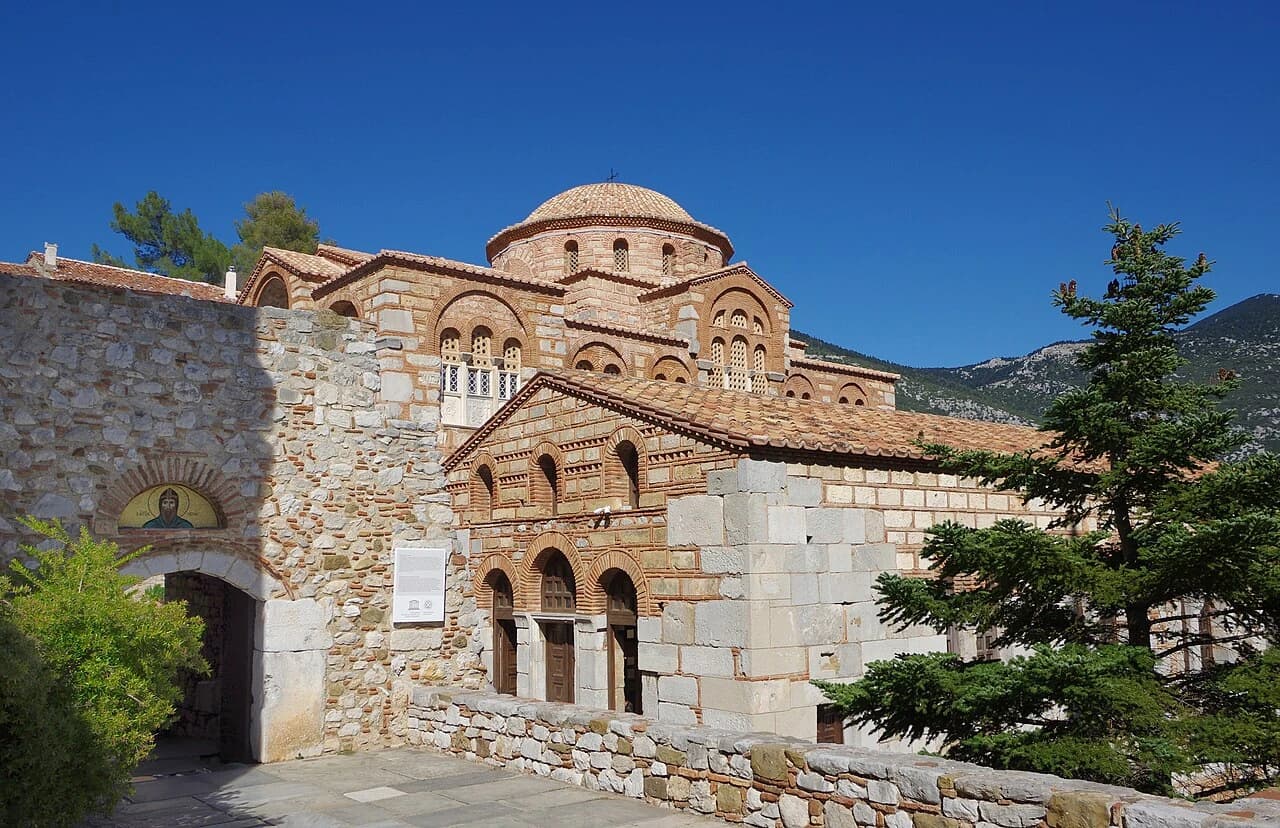
Hosios Loukas is a historic walled monastery known for its exquisite Byzantine architecture and well-preserved 11th-century mosaics. It is a UNESCO World Heritage site and one of the most important monuments of Middle Byzantine art and architecture.
Μονή Οσίου Λουκά is also known as Μονή Οσίου Λουκά Βοιωτίας.
This self-guided audio tour features 41 narrated stops organized across 7 sections. As a monastery, Μονή Οσίου Λουκά offers a unique cultural experience in the heart of Distomo Municipal Unit, Greece.
The Stanza audio guide is available in 15 languages and works entirely offline — download the complete tour including audio narration, maps, and images before your visit. As you walk through Μονή Οσίου Λουκά, GPS-triggered narration plays automatically at each point of interest.
Last updated:
What you will hear
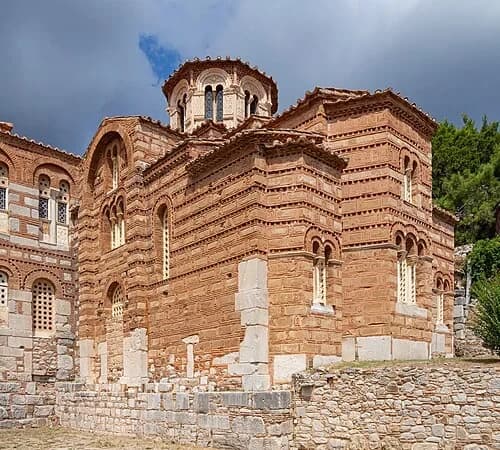
The Church of the Panagia Exterior
Focusing on the oldest part of the complex with its unique Middle Byzantine brickwork.
The Church of the Panagia
The Church of the Panagia, or the Theotokos, is a definitive example of the 'cross-in-square' architectural style. This design became the standard model for Middle Byzantine churches, featuring a central square area with four columns supporting a dome, while the overall floor plan forms a cross. Built in the late 10th century, shortly after the death of Saint Luke, it showcases the high sophistication of Byzantine masonry. The exterior is particularly notable for its warm, textured facade, created by the careful arrangement of brick and stone. This technique, often called 'cloisonné' masonry, surrounds each stone block with bricks, a method that provided both structural stability and a decorative finish. The rhythm of the brickwork adds a human scale to the large building, while the various patterns integrated into the walls demonstrate the skill of the 10th-century masons. The church was designed to be intimate yet spiritually imposing, with its proportions carefully calculated to create a balanced interior space. As you examine the exterior, notice how the light catches the different planes of the walls, highlighting the intricate details of the brickwork that have weathered over a millennium. This church served as the template for much of the later construction at the monastery, establishing the aesthetic and spiritual tone for the entire complex.
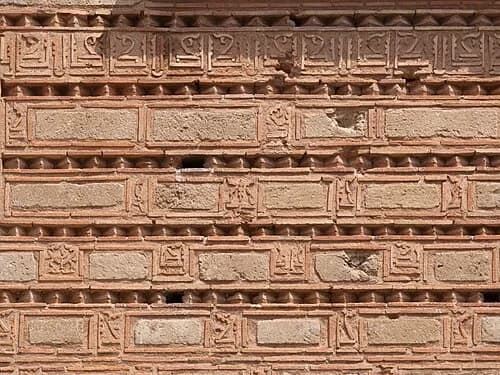
Pseudo-Kufic Brick Decoration
A striking feature of the exterior brickwork is the inclusion of 'pseudo-Kufic' motifs. These decorative patterns are designed to imitate Kufic, an early form of Arabic script. While the Byzantine masons were not writing actual words, they were inspired by the visual elegance of Islamic calligraphy, which they had encountered through trade, diplomacy, and conflict with the Arab world. This stylistic choice reflects the deep cultural exchange occurring between the Byzantine Empire and Islamic civilizations during the 10th and 11th centuries. These motifs were purely ornamental for the Byzantines, valued for their geometric complexity and the exotic flair they added to a building’s facade. Often placed in bands or friezes, the pseudo-Kufic patterns contrast with the surrounding stonework, creating a visual rhythm that breaks up the mass of the walls. This integration of foreign artistic elements into a Christian sacred space demonstrates the cosmopolitan nature of Byzantine culture at its peak. It shows that despite religious and political tensions, the empire's artisans were highly receptive to the aesthetics of their neighbors. The presence of these designs here at Hosios Loukas serves as a permanent record of the interconnected Mediterranean world of a thousand years ago, where artistic ideas moved as freely as merchants and armies.
Interior of the Church of the Panagia
Exploring the cross-in-square design and the fine marble carvings inside the oldest church.
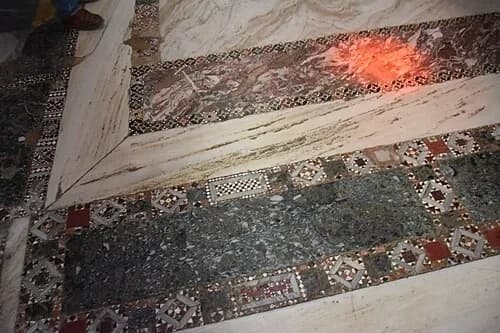
Opus Sectile Marble Floor
The floors of the monastery are decorated with a technique known as 'opus sectile,' which translates to 'cut work.' Unlike traditional mosaics made of small cubes, opus sectile uses larger pieces of colored marble and stone, cut and fitted into complex geometric patterns. This method was considered more luxurious and technically demanding than mosaic work. The materials used for these floors were often sourced from different regions of the Byzantine Empire, including purple porphyry from Egypt and green marble from Laconia. This variety of colors and textures creates a durable and visually rich surface that has withstood the footsteps of millions of pilgrims over the last millennium. The patterns are not merely decorative; they often serve to define the sacred spaces within the church, guiding the movement of worshippers and participants in the liturgy. The persistence of these floors today is a testament to the engineering quality of the original construction. The different stones were meticulously polished and fitted to create a surface that remained level and beautiful despite the heavy use. In the dim light of the church, the marble patterns would have shimmered, adding to the sensory experience of the sacred space. These floors are among the best-preserved examples of their kind from the 10th and 11th centuries.
The Katholikon West Facade
Arrival at the main cathedral, highlighting the grand entrance and the mosaic of the patron saint.
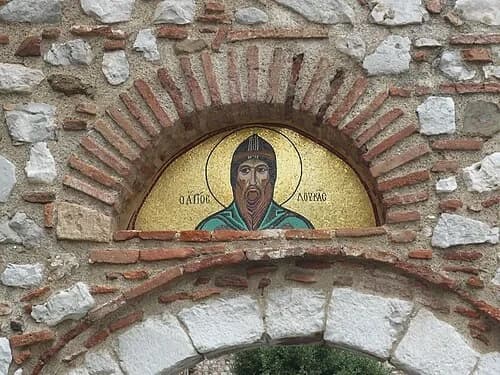
Saint Luke Mosaic Portal
Positioned prominently in the lunette above the main entrance is a mosaic of the monastery's founder, Saint Luke the Hermit. He is depicted in traditional monastic garb, with a thin, ascetic face that reflects his life of fasting and prayer. This image serves as a permanent greeting to all who enter the Katholikon. Saint Luke’s reputation was largely cemented by a famous prophecy he made during his lifetime: the reconquest of the island of Crete from the Arabs. When the prophecy came true in 961, several years after his death, his fame exploded across the empire. This successful prediction led to significant imperial patronage from the capital, Constantinople, which funded the construction of the grand buildings you see today. The mosaic itself is a fine example of Middle Byzantine art, using small glass and stone tesserae to create a detailed and enduring portrait. By placing his image over the door, the monks were reminding visitors of the saint's powerful connection to the divine and his role as a protector of the empire. The gold background of the mosaic signifies the heavenly realm, placing the humble hermit within a divine context. This portal was the starting point for pilgrims who came from far and wide to seek the saint's intercession and healing.
The Narthex Mosaic Program
Detailed look at the world-famous 11th-century mosaics in the entrance hall of the Katholikon.
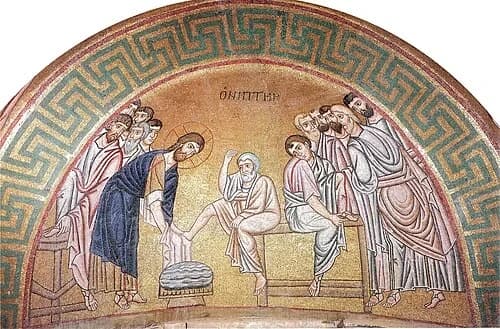
The Washing of the Feet
Inside the narthex, the entrance hall of the church, you will find the mosaic depicting 'The Washing of the Feet.' This scene is a masterpiece of the 'Macedonian Renaissance' style, which flourished in the 11th century. Notice the sophistication of the composition; the figures are not flat icons but appear to have volume and weight. The artist has captured realistic folds in the clothing and expressive, human gestures. Look specifically at Saint Peter, who raises a hand in a gesture of hesitation and surprise as Christ kneels before him. This moment, taken from the Gospels, is intended to emphasize the theme of humility, a core value of monastic life. The use of a shimmering gold background serves a theological purpose, representing the divine, uncreated light of heaven. This light makes the figures appear as if they are floating in a timeless, sacred space. The attention to detail in the apostles' faces and the bowl of water demonstrates the high level of skill possessed by the mosaicists. This work is one of the best-preserved examples of Byzantine mosaic art in the world, showing how the church used visual storytelling to educate and inspire monks and pilgrims as they prepared to enter the main sanctuary.
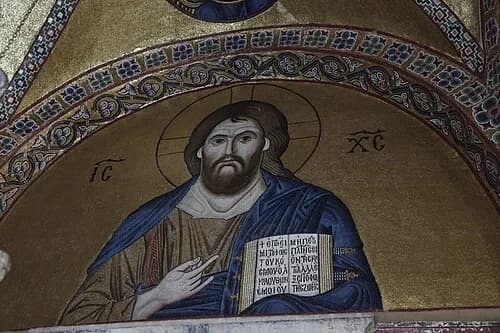
Christ Pantocrator
The image of Christ Pantocrator, or 'Ruler of All,' is one of the most significant and common depictions in Byzantine art. In the narthex of the Katholikon, this powerful figure gaze down at those entering the church. Christ is shown in a traditional posture: his right hand is raised in a gesture of blessing, while his left hand holds a jewel-encrusted book of the Gospels. The face is characterized by a stern but compassionate expression, intended to evoke both the authority of a judge and the mercy of a savior. Surrounding the figure is a vast expanse of gold mosaic, which reflects the light to create a shimmering, otherworldly environment. This gold is not merely decorative; it symbolizes the divine light that transcends the physical world. The artist used different shades of glass and stone to create depth in Christ’s robes and facial features, showcasing the technical mastery of the 11th-century workshops. Placed at the entrance, the Pantocrator reminds the faithful of the divine presence and the ultimate sovereignty of God before they pass into the holiest parts of the cathedral. It is a central element of the church's theological program, reinforcing the hierarchy of the spiritual world through visual means.
The Squinch Mosaics Masterpieces
Examining the four major feast scenes that occupy the corners of the central space.
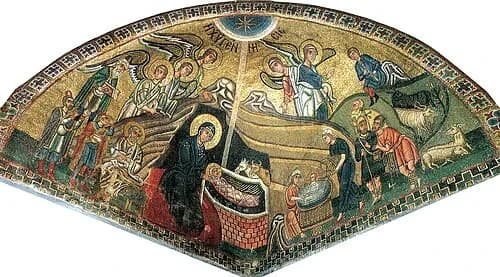
The Nativity
Tucked into the south-east squinch is a detailed mosaic depicting the Nativity. Before focusing on the scene itself, notice the shape of the space it occupies. A squinch is a curved, arch-like structure built across the corners of a square room to support a round dome. These architectural features provided unique triangular canvases for Byzantine artists. Here, the Nativity is portrayed against a rocky, mountainous landscape that likely felt familiar to the monks living here on Mount Helicon. In the center, the Virgin Mary rests, while the infant Jesus is shown in a manger. Surrounding them are the various figures from the biblical narrative, including the magi and the shepherds, each arriving to witness the event. The artist has used a wide palette of colored glass and stone cubes to create depth and texture, from the craggy outlines of the cave to the soft folds of the robes. This placement in the corner of the church allows the scene to be viewed from multiple angles as you move through the naos. Look for the small, stylized animals gathered near the center of the composition, rendered with surprising detail for such a large-scale work.
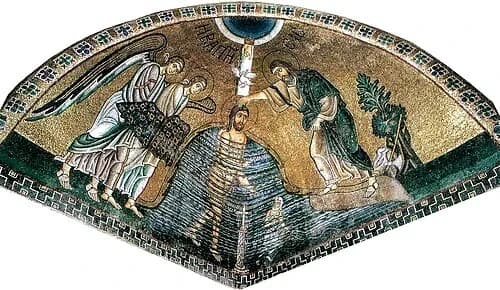
The Baptism of Christ
Moving your gaze to the south-west corner of the dome's support structure, you will find the mosaic of the Baptism of Christ. This scene is a masterpiece of symbolic representation, where the Jordan River is depicted not as a realistic waterway, but as a series of stylized, wavy blue lines that surround Christ's figure. On the banks, you can see angels standing ready with cloths to dry and clothe him after his immersion. Above the central figure, look for the representation of the Holy Spirit descending in the form of a dove, marking the divine nature of the event. The use of gold tesserae in the background makes the scene appear to glow, a technique used to signify that the event is happening in a spiritual, timeless realm rather than a specific physical location. This specific mosaic is one of the best-preserved in the Katholikon, allowing you to appreciate the fine craftsmanship of the individual tiles. The expressions on the faces of the angels are remarkably calm and serene, reflecting the Middle Byzantine aesthetic of restrained emotion. Notice how the figure of Christ appears partially transparent beneath the stylized waves, showcasing the artist's attempt to depict the clarity of the water.
The Reliquary of Saint Luke
The spiritual focus of the monastery, where pilgrims historically sought healing.
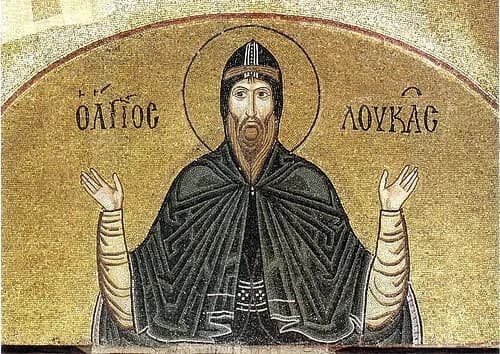
Mosaic of Saint Luke the Hermit
This mosaic portrait offers a direct look at Saint Luke the Hermit, the founding figure of this mountain sanctuary. Unlike the grand, imperial depictions of Christ or the Virgin Mary, this image focuses on Luke’s identity as an ascetic. You can see this in his thin, weathered face and his simple monastic clothing, which reflect a life of self-denial, prayer, and solitude. Luke was not a priest or a high-ranking official, but a simple monk whose reputation for healing and prophecy grew so great that even emperors sought his counsel. This specific image was placed within the church to remind the monks and visitors of the human foundation of their spiritual home. The mosaic technique uses smaller tesserae for the face to capture subtle details in his expression, which is one of calm, focused devotion. His hands are often shown in a gesture of prayer or holding a scroll, representing his wisdom and communication with the divine. It was his fame that transformed this once-isolated peak into one of the most important pilgrimage sites in the Byzantine world. Notice the way the gold background makes his humble figure appear radiant, signaling his sanctification.
The Castle and Defensive Walls
Understanding the monastery as a fortified complex overlooking the valley.
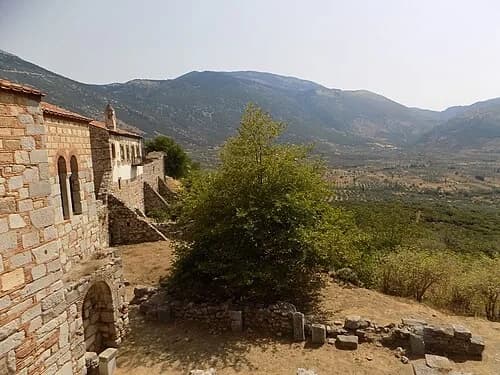
Overlooking the Helicon Valley
Standing atop the monastery walls and looking out over the Helicon Valley, the strategic nature of this location becomes clear. The high elevation provided the monks with an unobstructed view of the surrounding landscape, offering early warnings of anyone approaching, whether they were friendly pilgrims or potential threats. This panoramic vista was essential for the security of a fortified community. Beyond its military value, the location was chosen for its rugged beauty and the sense of solitude it provided. The architecture of the monastery was built to harmonize with this terrain, utilizing the natural cliffs and slopes to enhance its defenses. The valley below is filled with the olive groves that have sustained the monastery for over a thousand years, illustrating the deep connection between the religious community and the land. This view serves as a reminder of the original hermit, Saint Luke, who sought this remote spot for quiet contemplation. The silence and the scale of the mountains continue to provide the same atmosphere of peace that first drew him to these slopes in the tenth century.
Want to hear the rest?
Download the Stanza app to unlock all 41 stops and full GPS-guided navigation.
Frequently Asked Questions
How long does the Μονή Οσίου Λουκά audio tour take?
The Μονή Οσίου Λουκά audio guide includes 41 narrated stops. Most visitors spend 45 minutes to 1.5 hours exploring the complete tour, though you can listen at your own pace and skip or revisit any stop.
Is the Μονή Οσίου Λουκά audio guide available in my language?
Stanza supports 15 languages: English, Spanish, French, German, Italian, Portuguese, Russian, Japanese, Chinese, Korean, Arabic, Hindi, Polish, Dutch, Hebrew. Check the guide in the app to confirm the languages currently available for this tour.
Can I use the audio guide offline at Μονή Οσίου Λουκά?
Yes! Download the complete Μονή Οσίου Λουκά tour — including all audio, maps, and images — before your visit. The Stanza app works completely offline, so you don't need WiFi or mobile data at the venue.
How much does the Μονή Οσίου Λουκά audio guide cost?
The Stanza app is free to download. Free and paid audio guides are available; current prices are shown in the app.
How do I use the Stanza audio guide at Μονή Οσίου Λουκά?
Download the free Stanza app, search for "Μονή Οσίου Λουκά", and download the tour. When you arrive at the venue, the app uses GPS to detect your location and automatically plays the relevant narration as you move between points of interest — completely hands-free.
What makes the Stanza audio guide different from other Μονή Οσίου Λουκά tours?
Stanza offers GPS-triggered narration that plays automatically as you walk through Μονή Οσίου Λουκά — no need to manually select stops. The tour is available in 15 languages, works fully offline, and includes 41 expertly narrated stops with images and historical context.
What other audio guides are available near Μονή Οσίου Λουκά?
Stanza offers multiple audio guides in Distomo Municipal Unit, Greece and nearby areas. After downloading the app, browse the map to discover all available tours near Μονή Οσίου Λουκά. Each guide can be downloaded for offline use.