Languages
15Ναός του Ποσειδώνα στο Σούνιο Audio Guide
Ναός του Ποσειδώνα στο Σούνιο is a landmark in Lavreotiki Municipal Unit, Greece. Explore it with Stanza's GPS-triggered offline audio guide — available in 15 languages.
Quick Facts
12
Stops
15
Languages
100%
Offline
📍 Lavreotiki Municipal Unit, Greece · 37.6502°N, 24.0246°E
About Ναός του Ποσειδώνα στο Σούνιο
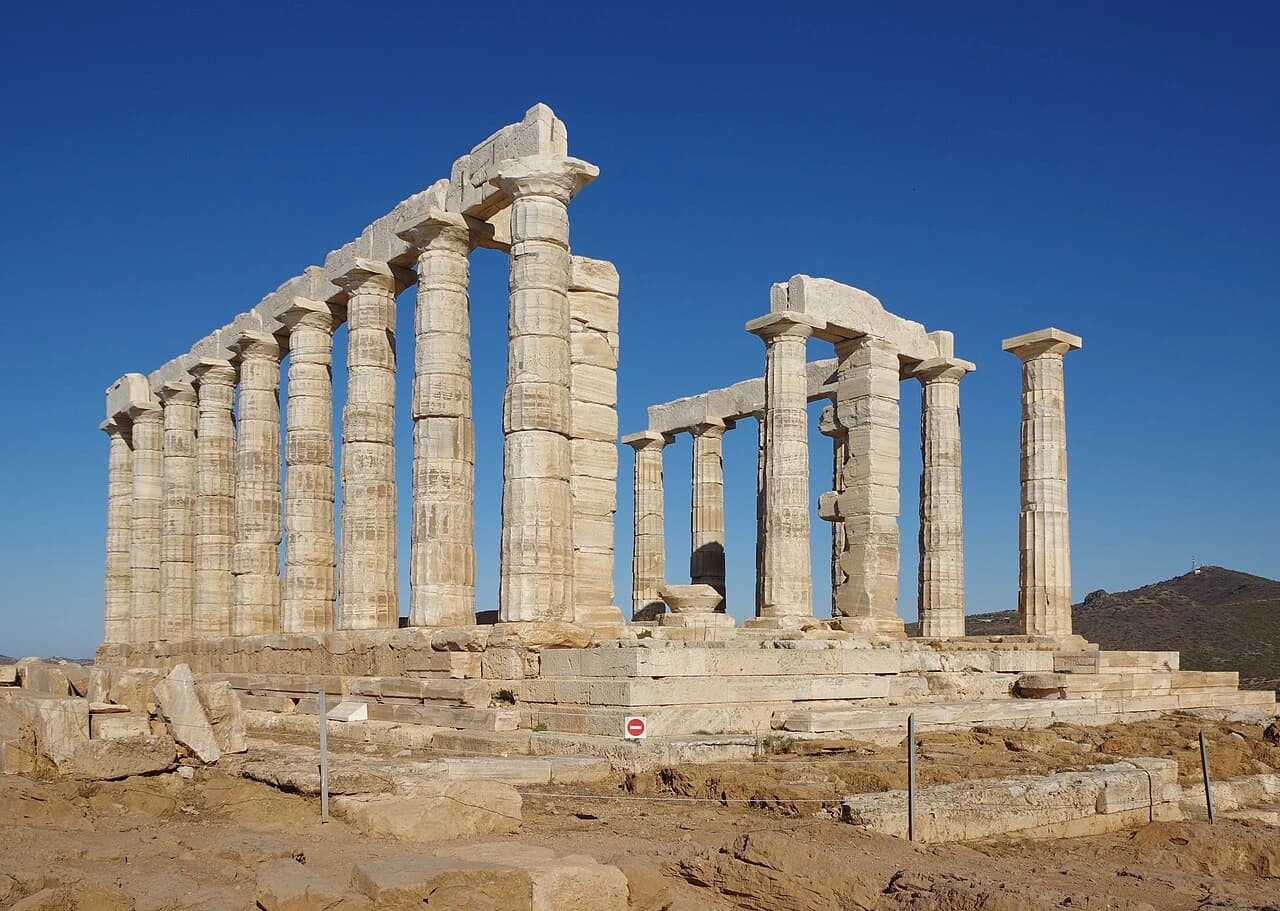
The Temple of Poseidon at Cape Sounion is a prominent ancient Greek temple dating back to the 5th century BC. It stands as a significant landmark overlooking the Aegean Sea at the southernmost tip of the Attica peninsula.
Ναός του Ποσειδώνα στο Σούνιο is also known as Temple of Poseidon at Sounion, Sounio temple, Ναός Σουνίου, Ναός Ποσειδώνος (Σούνιο), and 2 other names in various languages.
This self-guided audio tour features 12 narrated stops organized across 8 sections. As a ancient temple, Ναός του Ποσειδώνα στο Σούνιο offers a unique cultural experience in the heart of Lavreotiki Municipal Unit, Greece.
The Stanza audio guide is available in 15 languages and works entirely offline — download the complete tour including audio narration, maps, and images before your visit. As you walk through Ναός του Ποσειδώνα στο Σούνιο, GPS-triggered narration plays automatically at each point of interest.
Last updated:
What you will hear
Doric Architectural Mastery
Examines the 16 remaining fluted columns, explaining the temple's Doric order and its construction during the Golden Age of Athens.
Columns of the Sea God
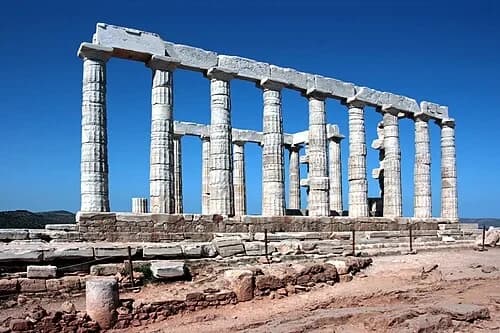
The temple’s original design featured a peristyle—a continuous row of columns—consisting of thirty-four individual pillars. Six of these stood along the front and back, while thirteen lined each side. Today, only sixteen of these columns remain upright. They are made from a specific variety of marble quarried nearby at Agrileza. Unlike the famous Pentelic marble used for the Parthenon in Athens, which has a high iron content and turns golden over time, Agrileza marble is known for its coarse, white grain. The ancient architects specifically selected this material because it lacked the iron that causes staining. More importantly, this stone possesses a unique resistance to the corrosive effects of the salt-laden air. On a cliff surrounded by the sea on three sides, constant exposure to salt spray would have quickly eroded softer or more reactive stone. By using this local resource, the builders ensured the temple would maintain its brilliant white appearance despite centuries of buffeting winds and sea mist. Each column stands approximately six meters high, and their survival through earthquakes and wars is a feat of ancient engineering.
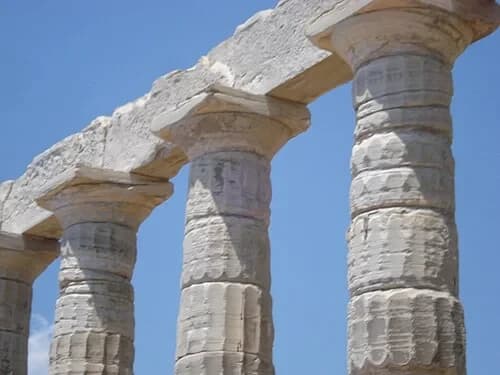
Doric Architectural Precision
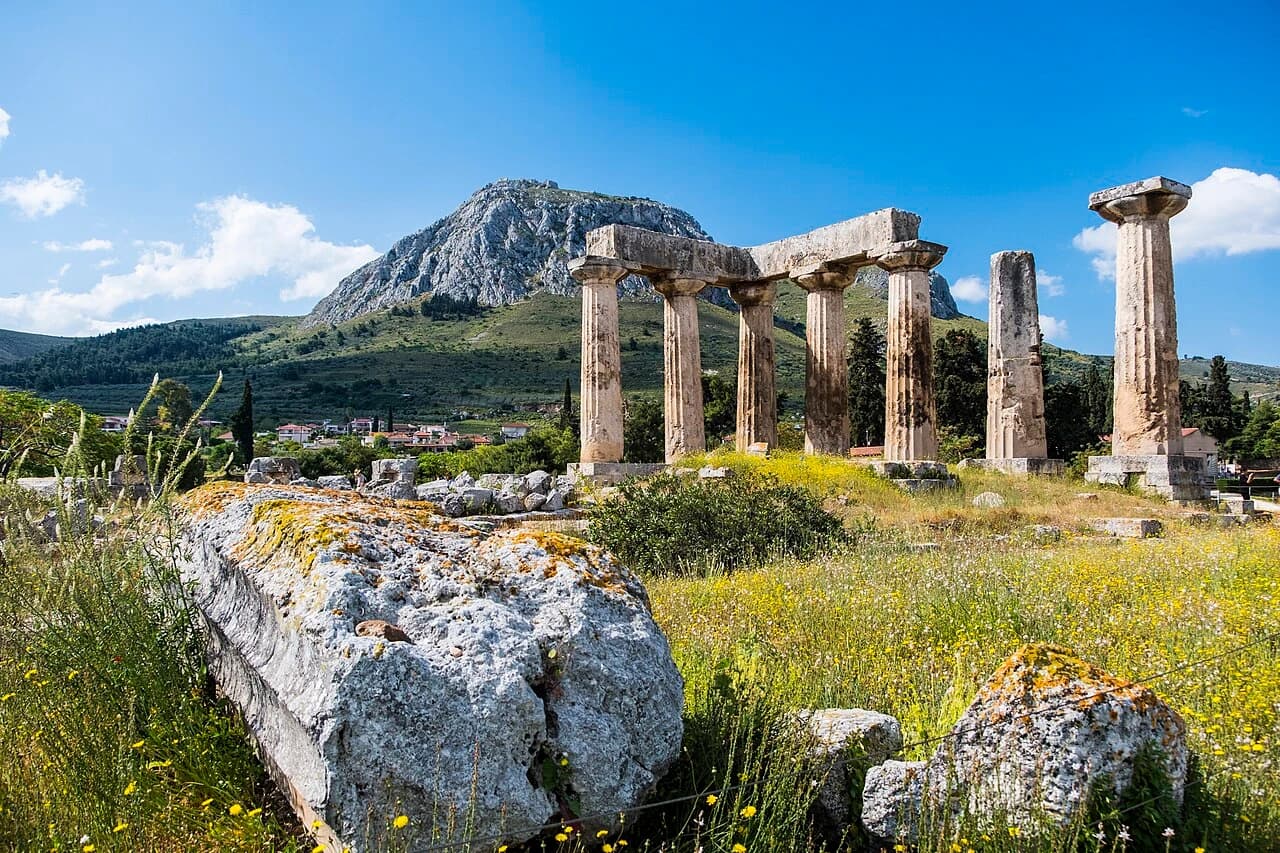
Examining the architecture, you can see the defining features of the Doric order, the oldest and simplest of the three classical Greek architectural styles. Look toward the top of any column to see the capital. It consists of a plain, rounded element called an echinus topped by a flat square block known as an abacus. There are no scrolls or leaf carvings here; the beauty lies in the geometry and proportion. The shafts of the columns feature deep vertical grooves, or fluting, which draw the eye upward and create a play of light and shadow. A key characteristic of Doric design is that these columns have no base. They sit directly on the stylobate, the top step of the temple floor. This lack of a pedestal creates a sense of rootedness, making the structure feel as though it is an extension of the rugged limestone cliff itself. The architects likely chose this robust style to match the harsh, wind-swept environment of Cape Sounion. The simplicity of the Doric forms provides a harmonious contrast to the jagged natural landscape below.
The Sounion Column in Venice
A 'where are they now' stop featuring a verified POI: a Doric column from this temple that now stands in Venice.
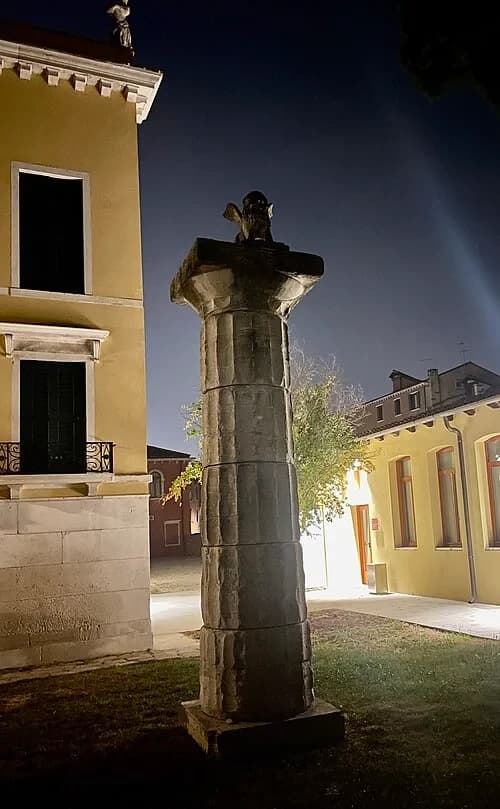
The Sounion Temple Column in Venice
450 BCE · marble
While sixteen columns remain here at Sounion, others have found their way across the Mediterranean over the centuries. One specific Doric column from this site currently stands in Venice, Italy. It was removed from these grounds during a period when the Republic of Venice exerted significant influence over the Aegean. For maritime powers like the Venetians, ancient ruins were often viewed as a convenient source of high-quality building material or as prestigious trophies to adorn their own cities. This practice of repurposing, or "spolia," was common throughout history. It reflected a desire to connect modern empires with the perceived glory and authority of classical antiquity. Seeing a piece of Sounion in a Venetian courtyard highlights the complex afterlife of these ruins, which were frequently looted or traded by travelers, collectors, and conquerors long before modern conservation efforts began. This single displaced pillar serves as a physical link between the naval legacy of Athens and the later dominance of the Venetian sea traders. It underscores the global reach and enduring appeal of Greek architectural forms, even when stripped from their original sacred context.
The Sacred Sanctuary of Poseidon
Explores the inner area where the colossal statue of the sea god once stood and where sailors offered sacrifices for safe passage.
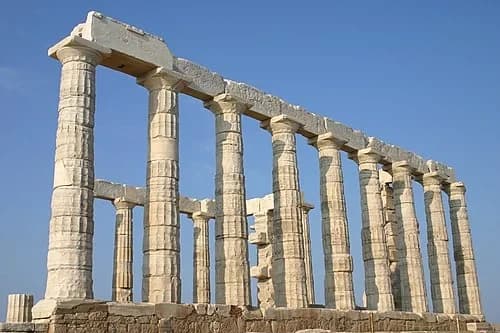
The Periclean Masterpiece
Construction of the current temple began in 444 BC, taking only four years to complete. Although no historical records name the specific architect, scholars often refer to him as the "Hephaisteion Master." This is because the proportions and subtle technical refinements found here are almost identical to those seen in the Temple of Hephaestus in Athens and the Temple of Nemesis at Rhamnous. The design belongs to the same sophisticated school of thought that produced the Parthenon. Despite the remote location, no expense was spared in the temple's execution. The symmetry and precision suggest a highly skilled team of stonemasons who likely traveled from the city center to work on this project. Every element was calculated to produce a sense of perfect balance when viewed from the sea. By the time the temple was finished in 440 BC, it had become a focal point for the Sounion festival, which took place every four years and included a regatta of sacred ships. This period of construction represents a moment when Athens was at its most confident, using architecture to project its cultural and religious values to the edge of its territory.
The Strategic Naval Lookout
Highlights the temple's role as a military outpost used to monitor ship traffic entering the Saronic Gulf toward Athens.
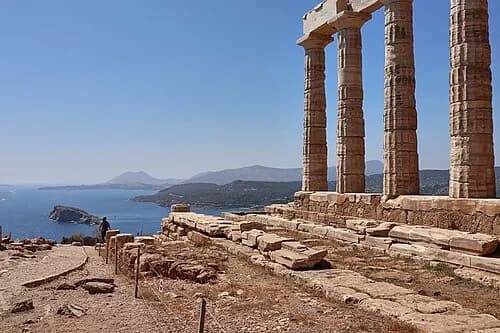
The Naval Sentinel
From this height, you can look out over the Saronic Gulf and understand the temple's critical military importance. In antiquity, the sanctuary was enclosed by a defensive wall, turning the entire headland into a fortified naval base. This was the primary lookout point for the Athenian navy. Guards stationed here could monitor any ships approaching from the direction of Aegina, a rival city-state, or keep a wary eye out for the Persian fleet. Any hostile movement would be relayed back to Athens using signal fires or fast messenger ships. The temple functioned as a sentinel, protecting the vital sea lanes used for importing grain and silver. During the Peloponnesian War, the site was heavily fortified to prevent enemy blockades. The combination of a sacred temple and a military garrison was common in Greek strategy, as it ensured the gods protected the city's most vulnerable borders. Even as you admire the architecture, remember that for a soldier on watch, these columns were the backdrop to a high-stakes effort to preserve the independence of Athens.
The Precipice of Sounion
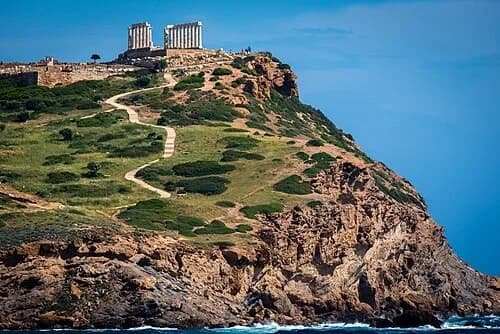
Standing near the edge of the temple platform, the wind off the water is almost constant, and the ground falls away into a sheer sixty-meter precipice. This dizzying drop is the legendary site of one of Greek mythology's most famous tragedies. Tradition holds that King Aegeus of Athens stood on this very spot, waiting for his son, Theseus, to return from Crete after facing the Minotaur. Theseus had promised to change his ship's black sails to white if he survived the encounter. However, in his excitement, he forgot. When Aegeus saw the black sails on the horizon, he was overcome with grief, believing his son was dead. According to the story, the king threw himself from this cliff into the water below. From that day forward, the body of water has been known as the Aegean Sea in his honor. While the story is mythical, the geography of the site makes it a plausible setting for such a tale. The unobstructed view of the horizon allows you to scan the waves just as Aegeus once did, searching for a sign of a returning fleet. The crashing waves against the rocks far below add a visceral layer to this ancient narrative of loss and naming.
The Votive Pit (Bothros)
Discusses the archaeological discovery of hundreds of offerings left by ancient worshippers to appease the god of the sea.
The Sacred Precinct
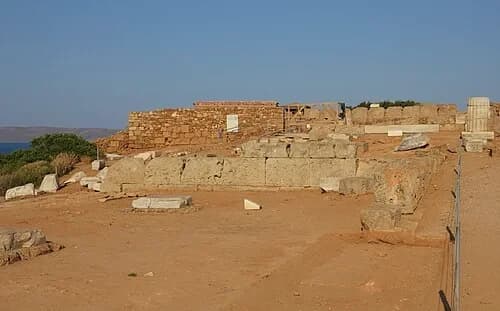
While the columns are the most visible remnants, the archaeological history of the site extends far beyond the stone platform. Archaeologists discovered a "bothros," or sacred votive pit, containing hundreds of offerings left by ancient worshippers. These finds date back as far as the eighth century BC, centuries before the marble temple was even conceived. The pit contained a wealth of artifacts, including intricate bronze figurines, jewelry, and pottery. These items were dedicated to the gods by travelers and locals alike, seeking protection for sea voyages or giving thanks for a safe return. The sheer number of offerings indicates that Sounion was a major center of religious life long before the Golden Age of Athens. The sacred precinct also included smaller shrines and administrative buildings that supported the daily life of the sanctuary. These discoveries shift the focus from the grand architecture to the individual people who climbed this hill to pray. Each bronze figure or piece of jewelry represents a personal story and a moment of faith. The study of these smaller artifacts provides insights into the rituals of the people who inhabited this coastline over two millennia ago.
The Sounion Kouros
Features the famous colossal sculpture discovered at the site, now a masterpiece of the National Archaeological Museum.
The Sounion Kouros
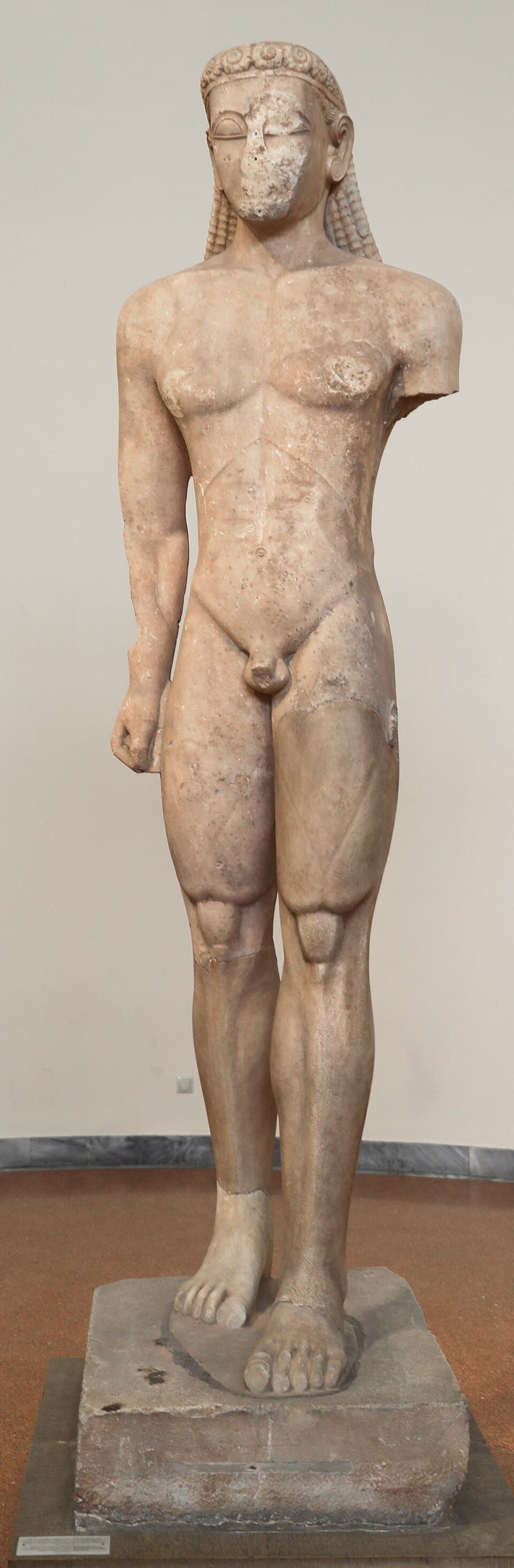
One of the most significant archaeological finds at Sounion was a massive, three-meter-tall marble statue known as the Sounion Kouros. A "Kouros" is an archaic Greek sculpture representing an idealized nude male youth. These statues were often used as grave markers or, in this case, as votive offerings to the gods. The Sounion Kouros dates to around 600 BC and is characterized by a rigid, frontal pose with one foot forward and a subtle, enigmatic expression known as the "Archaic smile." When the Persians destroyed the earlier limestone temple in 480 BC, this statue was among the items toppled. Remarkably, it was later buried in a pit along with other broken temple debris. This burial, while intended to clear the site for new construction, ironically acted as a time capsule. It protected the delicate surface of the marble from the elements for over two thousand years until it was unearthed in 1906. Today, the original is housed in the National Archaeological Museum in Athens, but its discovery here underscores the immense scale and wealth of the sanctuary during the Archaic period. It stands as a reminder of the artistic ambition that preceded the classical marble ruins we see today.
Lord Byron’s Famous Graffiti
Visits the column where the English poet Lord Byron carved his name in the early 19th century, a testament to the site's Romantic-era fame.
Lord Byron's Inscription
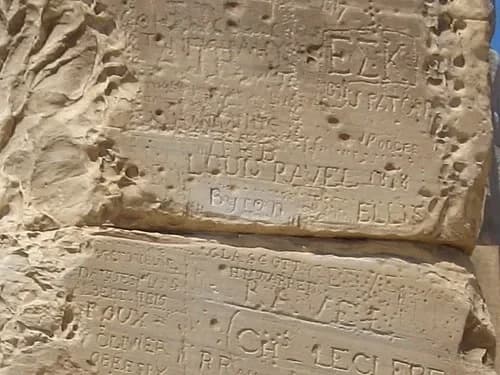
Look at the weathered surfaces of the temple blocks and you will find a layer of more recent history: centuries of graffiti. The most famous inscription belongs to the English Romantic poet Lord Byron, who visited the site twice in 1810 and 1811. His name is carved into the square base of one of the columns. During the nineteenth century, Sounion became a mandatory stop for wealthy Europeans embarking on the "Grand Tour," an educational journey through the Mediterranean to study classical ruins. Byron was deeply moved by the temple, later referencing it in his poem Don Juan with the line, "Place me on Sunium’s marbled steep." At the time, such carvings were not viewed as vandalism but rather as a way for travelers to connect themselves with the timeless beauty of the ancient world. This signature highlights the Romantic era's obsession with ruins as symbols of lost glory and the passage of time. While modern visitors are strictly prohibited from adding their own marks, these old inscriptions tell the story of how the Western world rediscovered and celebrated Greek antiquity. The presence of Byron’s name links the era of classical builders with the poets who brought these ruins back into global consciousness.
The Golden Hour Farewell
Concludes the tour with the temple's most iconic modern experience: the sunset over the Aegean Sea.
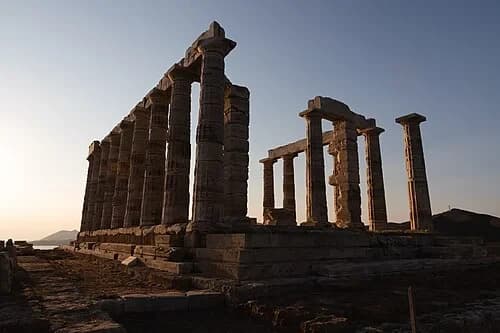
Sunset at Sounion
As the sun begins to dip toward the horizon, the Temple of Poseidon takes on a completely different character. Throughout the day, the white Agrileza marble stands in sharp, bright contrast against the deep blue of the sky and sea. However, in the late afternoon, the stone begins to absorb the warm oranges, pinks, and purples of the sunset. This visual transformation has made Sounion one of the most famous sunset viewpoints in the world. What began twenty-five hundred years ago as a gritty military outpost and a solemn place of sacrifice has evolved into a global icon of aesthetic beauty. The strategic lookout towers are gone, and the triremes that once patrolled these waters have long since vanished, but the temple remains. There is a profound quiet that settles over the site at this hour, as the wind often dies down and the shadows of the columns lengthen across the stone floor. It is easy to see why this sight has inspired countless artists, writers, and travelers over the centuries. The enduring presence of the columns against the backdrop of the setting sun serves as a final, wordless reminder of the incredible longevity of the ancient world’s architectural vision.
Want to hear the rest?
Download the Stanza app to unlock all 12 stops and full GPS-guided navigation.
Frequently Asked Questions
How long does the Ναός του Ποσειδώνα στο Σούνιο audio tour take?
The Ναός του Ποσειδώνα στο Σούνιο audio guide includes 12 narrated stops. Most visitors spend 45 minutes to 1.5 hours exploring the complete tour, though you can listen at your own pace and skip or revisit any stop.
Is the Ναός του Ποσειδώνα στο Σούνιο audio guide available in my language?
Stanza supports 15 languages: English, Spanish, French, German, Italian, Portuguese, Russian, Japanese, Chinese, Korean, Arabic, Hindi, Polish, Dutch, Hebrew. Check the guide in the app to confirm the languages currently available for this tour.
Can I use the audio guide offline at Ναός του Ποσειδώνα στο Σούνιο?
Yes! Download the complete Ναός του Ποσειδώνα στο Σούνιο tour — including all audio, maps, and images — before your visit. The Stanza app works completely offline, so you don't need WiFi or mobile data at the venue.
How much does the Ναός του Ποσειδώνα στο Σούνιο audio guide cost?
The Stanza app is free to download. Free and paid audio guides are available; current prices are shown in the app.
How do I use the Stanza audio guide at Ναός του Ποσειδώνα στο Σούνιο?
Download the free Stanza app, search for "Ναός του Ποσειδώνα στο Σούνιο", and download the tour. When you arrive at the venue, the app uses GPS to detect your location and automatically plays the relevant narration as you move between points of interest — completely hands-free.
What makes the Stanza audio guide different from other Ναός του Ποσειδώνα στο Σούνιο tours?
Stanza offers GPS-triggered narration that plays automatically as you walk through Ναός του Ποσειδώνα στο Σούνιο — no need to manually select stops. The tour is available in 15 languages, works fully offline, and includes 12 expertly narrated stops with images and historical context.
What other audio guides are available near Ναός του Ποσειδώνα στο Σούνιο?
Stanza offers multiple audio guides in Lavreotiki Municipal Unit, Greece and nearby areas. After downloading the app, browse the map to discover all available tours near Ναός του Ποσειδώνα στο Σούνιο. Each guide can be downloaded for offline use.