Languages
15Αρχαιολογικός Χώρος Αιγών Audio Guide
Αρχαιολογικός Χώρος Αιγών is an archaeological site in Veria Municipality, Greece. Explore it with Stanza's guided offline audio tour — narrated in 15 languages.
Quick Facts
28
Stops
15
Languages
100%
Offline
📍 Veria Municipality, Greece · 40.4874°N, 22.3193°E
About Αρχαιολογικός Χώρος Αιγών
The archaeological site of Aigai contains the remains of the ancient capital of the Kingdom of Macedon, including the famous royal tombs of Philip II. It is a UNESCO World Heritage site known for its well-preserved frescoes and elaborate grave goods.
Αρχαιολογικός Χώρος Αιγών is also known as Βασιλικοί τάφοι των Αιγών.
This self-guided audio tour features 28 narrated stops organized across 6 sections, including The Descent into the Great Tumulus, The Grave Stelae Gallery, The Tomb of Persephone (Tomb I), The Art of the Underworld, The Facade of Philip II (Tomb II), The Great Hunting Frieze. As a archaeological site, Αρχαιολογικός Χώρος Αιγών offers a unique cultural experience in the heart of Veria Municipality, Greece.
The Stanza audio guide is available in 15 languages and works entirely offline — download the complete tour including audio narration, maps, and images before your visit. As you walk through Αρχαιολογικός Χώρος Αιγών, GPS-triggered narration plays automatically at each point of interest.
Last updated:
What you will hear
The Descent into the Great Tumulus
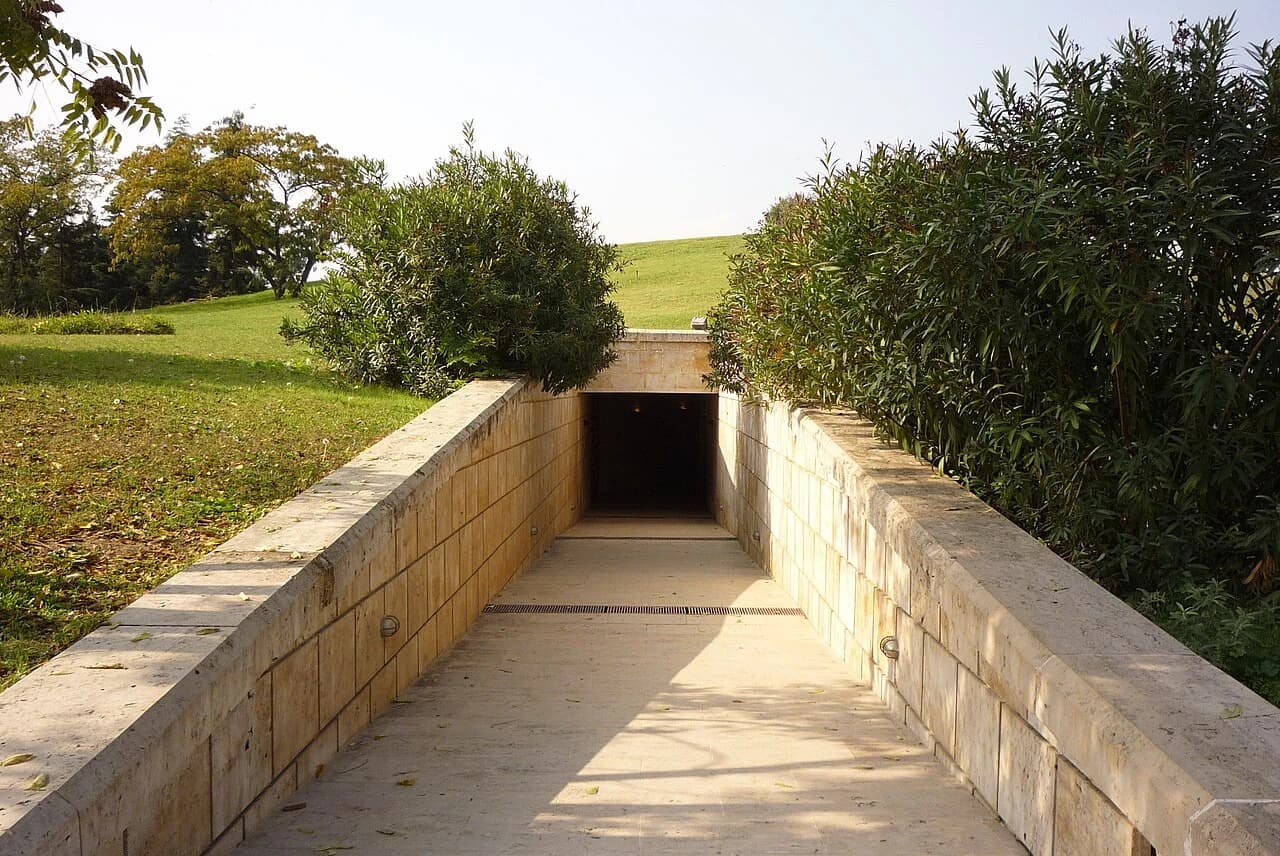
Establishing the unique underground atmosphere of the museum. Includes the exterior of the mound and the modern entrance ramp.
The Great Tumulus
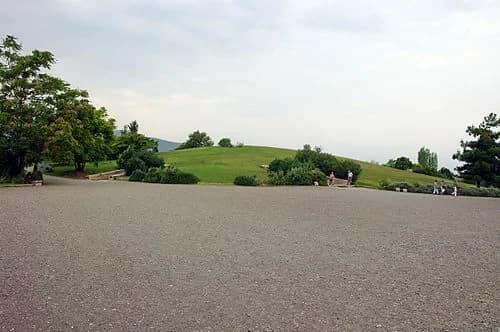
The massive artificial hill covering this site is known as the Great Tumulus. Standing approximately 40 feet high and stretching 360 feet across, this enormous mound was constructed over a period of a thousand years, from the Archaic era through to the Roman period. Its primary purpose was to protect the resting places of the Argead kings from tomb raiders, who were a constant threat to royal burials even in antiquity. The foundation of this monumental site dates back to approximately 750 BC. Over centuries, the mound was expanded as more members of the royal family were interred. The sheer scale of the hill reflects the status of the capital, Aigai, and the power of the Macedonian monarchy. Excavating such a vast area required immense precision to ensure the structural stability of the burial chambers hidden deep beneath the layers of compressed soil. Today, the tumulus serves as a permanent marker for one of the most important archaeological finds of the twentieth century, housing the undisturbed burials of one of history's most influential dynasties.
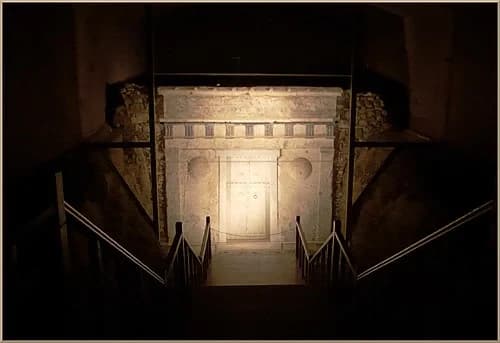
Entrance to Philip II's Tomb
Notice the architectural facade of Tomb II, identified as the final resting place of King Philip II. The design features a pair of Doric columns flanking a central entrance, which is sealed by massive stone double doors. When archaeologist Manolis Andronikos uncovered this entryway in 1977, he made history. It was the first time a royal Macedonian tomb had ever been discovered completely undisturbed by looters. The facade follows the style of a classical temple, intended to elevate the status of the deceased to a heroic level. The sheer weight of the stone blocks and the precision of the joints reflect the high level of Macedonian engineering in the 4th century BC. This discovery fundamentally changed our understanding of ancient Greek burial practices and the sophistication of the Macedonian court. Looking at these heavy doors, you are seeing the original entryway that was sealed over 2,300 years ago, protecting a treasure trove of artifacts that lay hidden and forgotten until the modern era.
The Grave Stelae Gallery
Introduction to the citizens of Aigai through the stone markers found in the tumulus fill.
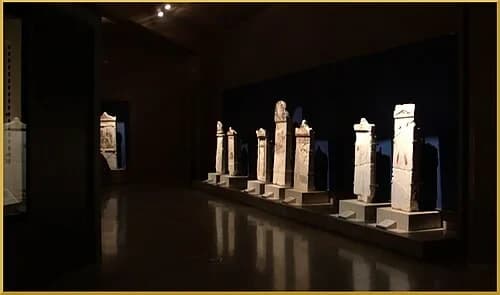
The Citizens Gallery
This gallery displays a collection of grave stelae recovered from the soil fill used to build the Great Tumulus. Unlike the grand, temple-like tombs of the royal family, these markers were originally created for the ordinary citizens of Aigai. They were found discarded and repurposed as building material when the burial mound was expanded centuries after their initial use. These stone slabs feature painted names and simple carvings that offer a direct link to the daily lives of people who inhabited this capital 2,400 years ago. Each stela tells a small part of a personal story, identifying a father, a daughter, or a local merchant. While the kings claimed the historical headlines, these citizens formed the backbone of the Macedonian state that eventually conquered much of the known world. Seeing these names preserved in stone brings a human scale to the vast historical events associated with the site, reminding us that the ancient capital was a living city populated by individuals beyond the royal court.
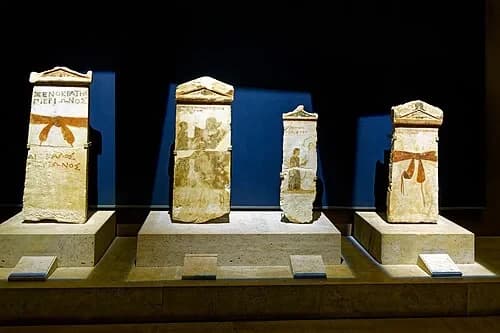
Painted Grave Markers
Looking closely at these stone slabs, you can still see the remnants of original pigments used by ancient craftsmen. The simple red and black lettering identifies the deceased, preserving names that would otherwise have been lost to history. These stones likely served as markers in an earlier, simpler cemetery located nearby. When the Great Tumulus was expanded to protect the royal tombs, these older markers were utilized as basic construction fill for the mound. This recycling of materials was a common practice, but for modern historians, it provided a fortuitous archive of the local population. The use of basic mineral pigments shows how even modest burial markers were decorated to ensure the name of the deceased remained legible. The survival of these colors is rare, as paint on stone usually fades quickly when exposed to the weather. Their preservation within the dark, dry layers of the mound fill allows us to see the actual handwriting and color choices of the people of Aigai from the fourth century BC.
The Tomb of Persephone (Tomb I)
Focusing on the first, sadly looted tomb, which contains one of the most famous wall paintings of antiquity.
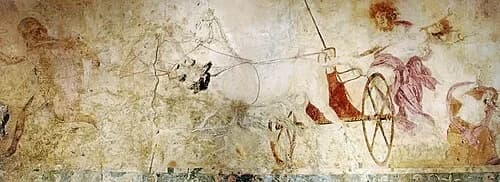
The Abduction of Persephone
The wall painting from Tomb I captures a moment of intense drama and movement, depicting the abduction of Persephone. This 4th-century BC mural is a rare and precious survivor, representing one of the few existing examples of large-scale painting from the Classical Greek era. Notice the dynamic rendering of the chariot wheels, which are blurred to suggest high speed. The figure of Persephone is particularly striking, with her arms reaching out in a gesture of desperation as she is carried away to the underworld. The artist used fluid brushstrokes to convey the chaos and emotion of the mythological scene. Most ancient Greek paintings have perished over time, but the sealed environment of this tomb protected these pigments for millennia. The scale and quality of the work suggest it was commissioned by a high-ranking individual, possibly a member of the royal family itself. The mural provides a window into the artistic sophistication of the time, showing that Macedonian artists were masters of composition and emotional expression.
The Art of the Underworld
Detailing the mastery of Macedonian painting through the Persephone fresco details.
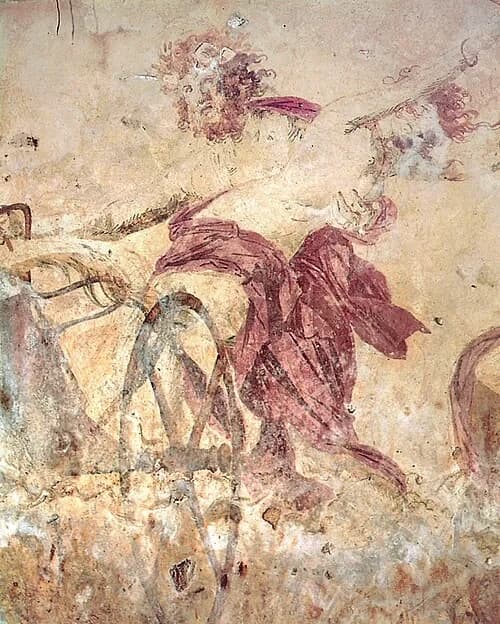
The Grieving Witnesses
Among the secondary figures in this mural is a seated woman representing Demeter, the Earth goddess and mother of the abducted Persephone. Her posture and expression convey a deep sense of sorrow and loss, echoing the grief of the family who commissioned this tomb. The artist utilized a somber palette of ochre, terra-cotta, and deep reds to reinforce the melancholy nature of the scene. These earth tones were derived from natural minerals, ground into fine powders and applied directly to the damp plaster. It is a striking thought that these elaborate paintings were never meant to be seen by the living once the tomb was sealed. They were created solely for the benefit of the deceased in the afterlife, serving as a permanent ritual backdrop for their final rest. The presence of Demeter links the private grief of a royal family to the grand mythological traditions of the Greek world. This mural remained a secret masterpiece, hidden beneath the earth for over two thousand years until archaeologists carefully brought it back into the light.
The Facade of Philip II (Tomb II)
The grand entrance to the most significant tomb, where the father of Alexander the Great was laid to rest.
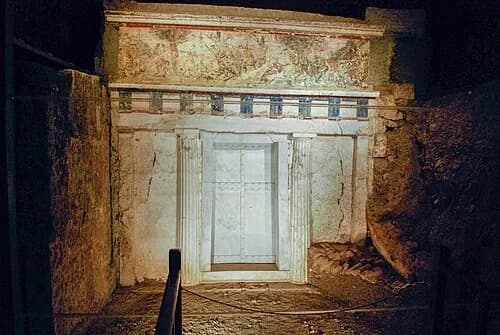
The Royal Hunting Frieze
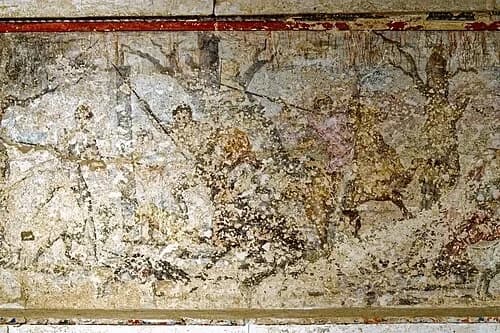
Running along the top of the Doric entrance is a long painted band known as the Royal Hunting Frieze. This artwork depicts a grand hunt taking place within a sacred grove, a favorite pastime and vital social ritual of the Macedonian nobility. Various hunters are shown pursuing a range of wild animals through a landscape of trees and rocks. Among the prey is a lion, a creature that held significant symbolic weight in ancient Macedonia as an emblem of royal power and personal bravery. Successfully hunting a lion was considered a rite of passage for kings and princes, proving their fitness to lead. The frieze captures the frantic energy of the chase, with horses in mid-stride and hunters poised with spears. The detail in the animals' forms and the varied terrain shows a commitment to realism that was a hallmark of the Macedonian court style. This mural served as a permanent record of the king's prowess in life, intended to accompany him into eternity as a symbol of his status.
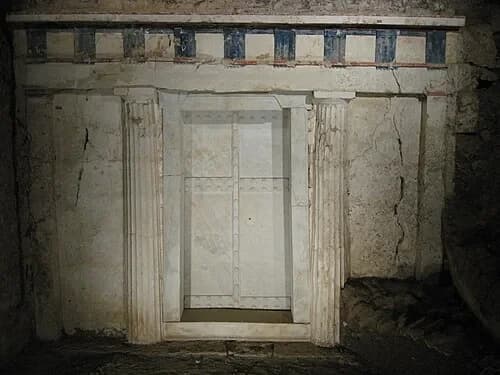
The Sealed Marble Doors
These two marble door leaves once sealed the entrance to the royal burial chamber, providing a formidable barrier against the outside world. The preservation of the stone is exceptional, but opening them without causing damage presented a major physical challenge for the archaeological team. The surrounding plaster and stone were extremely fragile, meaning any excessive force could have caused the entire facade to crumble. After centuries of being undisturbed, the tomb was so perfectly sealed that when researchers finally gained entry, they found ancient footprints still visible in the thick layer of dust on the floor. This rare preservation allowed historians to see the tomb exactly as the mourners had left it thousands of years ago. The doors themselves are carved to mimic the appearance of wooden doors, complete with decorative metal studs and hinges rendered entirely in marble. Their discovery provided undeniable proof that the tomb had never been looted, making it a unique time capsule of 4th-century BC Macedonian culture and funeral practices.
The Great Hunting Frieze
Detailed look at the unique fresco depicting a royal hunt, possibly featuring both Philip II and a young Alexander.
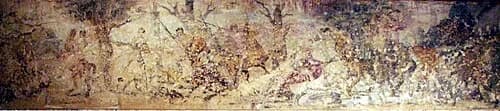
Portraits of Kings
Within the hunting scene, two central figures draw the most attention from researchers. The bearded rider in the middle of the action is widely believed to be a portrait of King Philip II himself. To the right, a younger youth on horseback is identified as his son, the future Alexander the Great. This painting represents a rare contemporary depiction of history's most famous father and son, captured together before Alexander’s conquests changed the world. The riders are shown with distinct features and expressions, moving away from the idealized types common in earlier Greek art. This focus on individual portraiture was a significant development in Macedonian art, emphasizing the personal identity and status of the rulers. Seeing them side-by-side provides a fascinating glimpse into the royal family dynamics at the height of their power. The frieze documents not just a hunt, but a political statement about the succession and the shared military heritage of the Argead dynasty, making it a valuable document of world history.
Landscape and Pursuit
The background of the hunting frieze features realistic landscape details that were groundbreaking for ancient art. Look for the leafless trees and the rocky, uneven terrain that mirrors the actual environment of northern Macedonia. The artist used sophisticated techniques of depth and perspective to place the hunters and animals within a convincing three-dimensional environment. Instead of the flat, single-plane compositions seen in many earlier works, this mural creates a sense of space where figures overlap and diminish in the distance. This move toward realism was a major breakthrough in the 4th century BC, showing a keen observation of nature. The sparse, wintry appearance of the trees might suggest the specific season when the hunt, or perhaps the funeral, took place. By grounding the royal action in a recognizable physical world, the artist made the scene more immediate and powerful. This landscape painting represents a pinnacle of classical naturalism, setting a standard for detail and spatial arrangement that influenced artistic traditions for centuries to come.
Want to hear the rest?
Download the Stanza app to unlock all 28 stops and the complete guided audio tour.
Frequently Asked Questions
How long does the Αρχαιολογικός Χώρος Αιγών audio tour take?
The Αρχαιολογικός Χώρος Αιγών audio guide includes 28 narrated stops. Most visitors spend 45 minutes to 1.5 hours exploring the complete tour, though you can listen at your own pace and skip or revisit any stop.
Is the Αρχαιολογικός Χώρος Αιγών audio guide available in my language?
Stanza supports 15 languages: English, Spanish, French, German, Italian, Portuguese, Russian, Japanese, Chinese, Korean, Arabic, Hindi, Polish, Dutch, Hebrew. Check the guide in the app to confirm the languages currently available for this tour.
Can I use the audio guide offline at Αρχαιολογικός Χώρος Αιγών?
Yes! Download the complete Αρχαιολογικός Χώρος Αιγών tour — including all audio, maps, and images — before your visit. The Stanza app works completely offline, so you don't need WiFi or mobile data at the venue.
How much does the Αρχαιολογικός Χώρος Αιγών audio guide cost?
The Stanza app is free to download. Free and paid audio guides are available; current prices are shown in the app.
How do I use the Stanza audio guide at Αρχαιολογικός Χώρος Αιγών?
Download the free Stanza app, search for "Αρχαιολογικός Χώρος Αιγών", and download the tour. When you arrive at the venue, the app uses GPS to detect your location and automatically plays the relevant narration as you move between points of interest — completely hands-free.
What makes the Stanza audio guide different from other Αρχαιολογικός Χώρος Αιγών tours?
Stanza offers GPS-triggered narration that plays automatically as you walk through Αρχαιολογικός Χώρος Αιγών — no need to manually select stops. The tour is available in 15 languages, works fully offline, and includes 28 expertly narrated stops with images and historical context.
What other audio guides are available near Αρχαιολογικός Χώρος Αιγών?
Stanza offers multiple audio guides in Veria Municipality, Greece and nearby areas. After downloading the app, browse the map to discover all available tours near Αρχαιολογικός Χώρος Αιγών. Each guide can be downloaded for offline use.