Languages
15Ruínas de Conímbriga Audio Guide
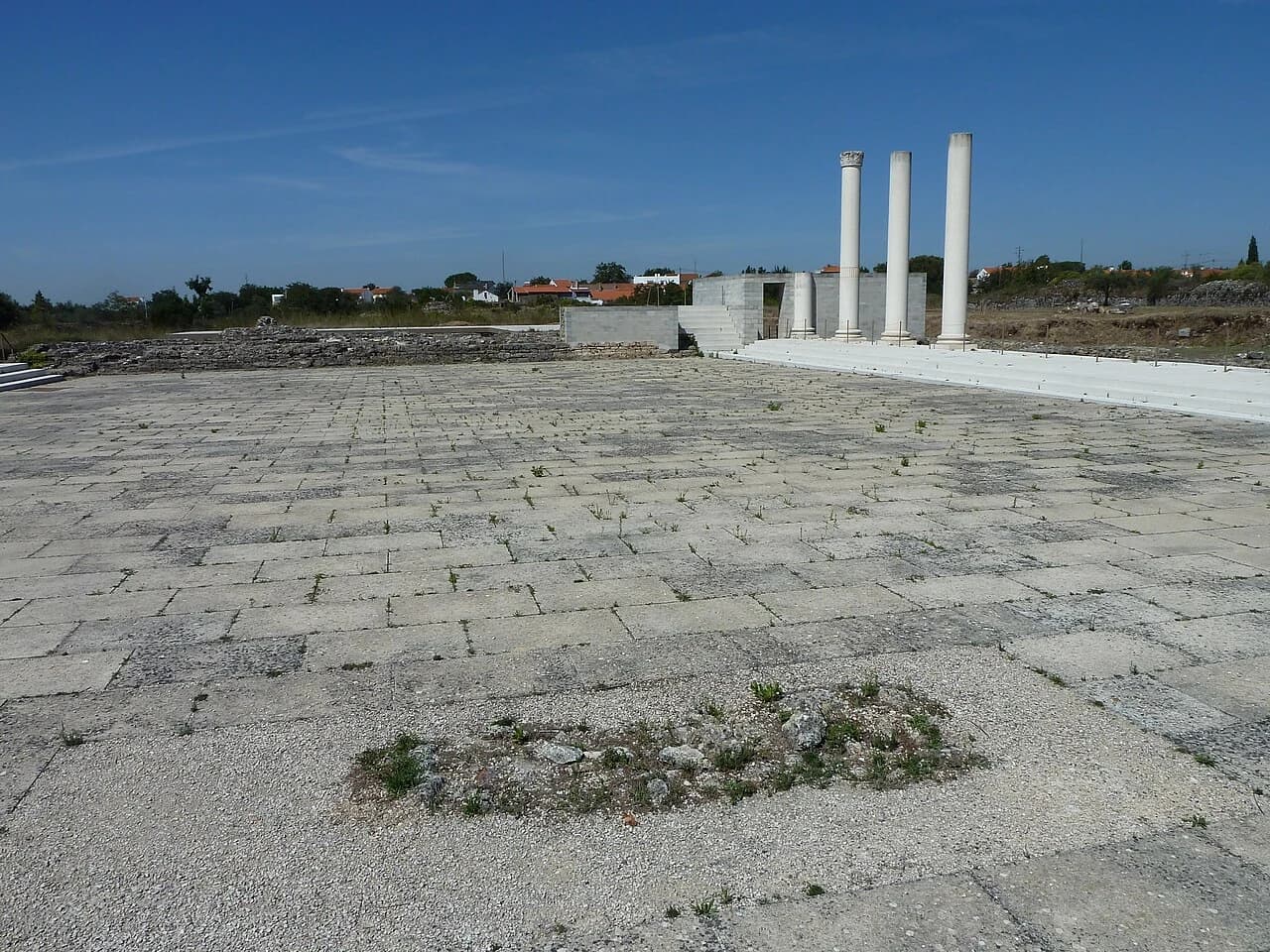
Ruínas de Conímbriga is an archaeological site in Condeixa-a-Nova, Portugal. Explore it with Stanza's guided offline audio tour — narrated in 15 languages.
Quick Facts
33
Stops
15
Languages
100%
Offline
📍 Condeixa-a-Nova, Portugal · 40.0989°N, -8.4933°E
About Ruínas de Conímbriga
Conímbriga is one of the largest and best-preserved Roman archaeological sites in Portugal, featuring extensive mosaics and ruins of ancient urban structures. It served as a significant Roman city before its abandonment during the 5th century.
This self-guided audio tour features 33 narrated stops organized across 5 sections, including Monographic Museum of Conimbriga, House of the Fountains, House of the Swastika, House of the Skeletons, Alley of the Baths. As a archaeological site, Ruínas de Conímbriga offers a unique cultural experience in the heart of Condeixa-a-Nova, Portugal.
The Stanza audio guide is available in 15 languages and works entirely offline — download the complete tour including audio narration, maps, and images before your visit. As you walk through Ruínas de Conímbriga, GPS-triggered narration plays automatically at each point of interest.
Last updated:
What you will hear
Monographic Museum of Conimbriga
The essential starting point where the site's most delicate treasures, from imperial busts to intricate phallic amulets, are preserved.
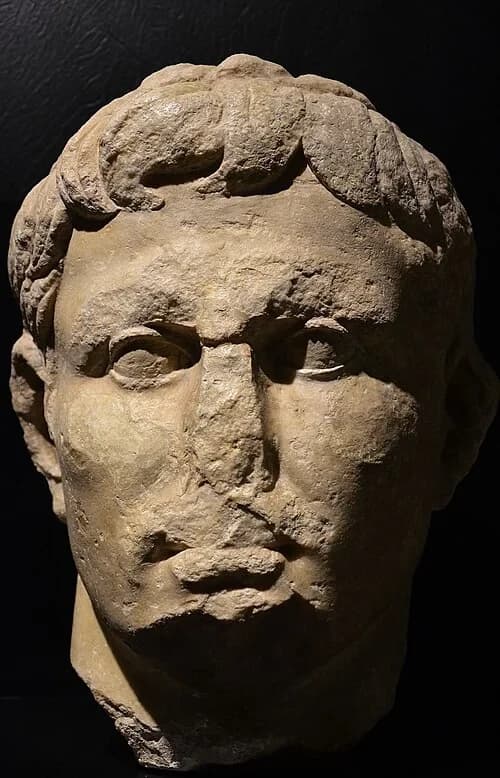
Head of Emperor Augustus
Discovered among the ruins of the Forum, this head represents the man who transitioned Rome from a republic to an empire. In an age without mass media, sculptures like this were the primary way for people across vast territories to recognize their ruler. A key detail to observe is the hairstyle. The distinctive, comma-shaped fringe was a carefully chosen trademark for Augustus, repeated in countless portraits sent to every corner of the Roman world. This wasn't merely a piece of art; it was a sophisticated form of political propaganda. By placing this image in the most public square of Conímbriga, the Roman administration ensured that even here, at the edge of the known world in the province of Lusitania, the population was reminded of the distant, god-like figure who governed them. The head reflects the idealized, youthful style Augustus maintained throughout his long reign, projecting a message of stability, divine favor, and eternal strength to all who gathered in the city's civic heart. It stands as a physical link to the seat of power thousands of miles away.
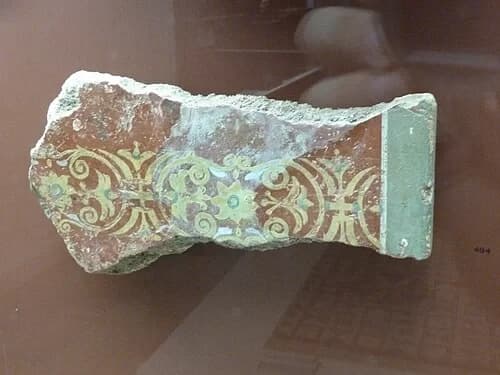
Roman Wall Painting Fragment
While we often view ancient ruins as monochrome stone, the homes of Conímbriga were originally explosions of color. This fragment features delicate floral scrolls set against a deep, vibrant red background. Wealthy homeowners hired skilled, traveling artists to create these 'frescoes' by painting directly onto layers of wet plaster. This technique allowed the pigment to be absorbed into the wall, helping the colors endure. The specific shade of red seen here is often referred to as 'Pompeian Red.' It was an expensive and prestigious pigment, used primarily to demonstrate the homeowner's financial success and refined taste. Finding such a well-preserved piece is exceptional, as plaster is incredibly fragile and prone to crumbling or dissolving over thousands of years of exposure to the elements. Pieces like this prove that the interior spaces of the city were just as meticulously designed and opulent as the grand mosaic floors. They transformed simple stone rooms into lush, vibrant environments that reflected the status and cultural ambitions of the elite families living here, proving that Roman taste was consistent even on the edges of the empire.
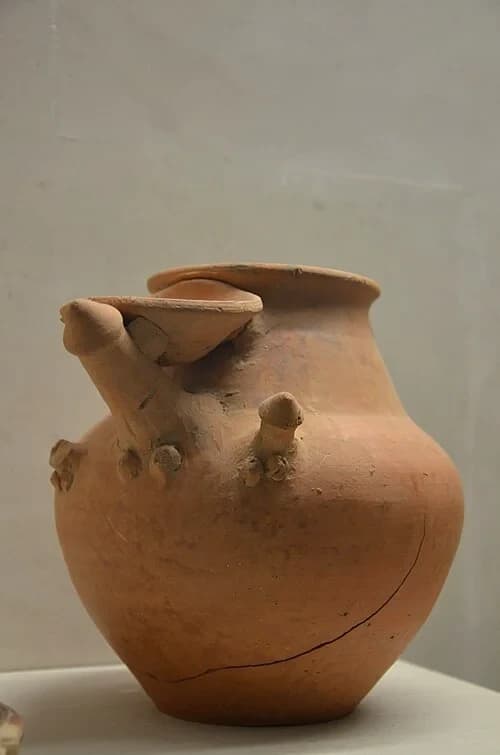
The Phallic Good Luck Vase
This intriguing vessel is a remarkable example of how the Romans integrated their spiritual beliefs into everyday objects. The surface is covered with phallic symbols, known as the 'fascinum.' Far from being considered scandalous, these images were essential bad-luck repellents intended to protect the owner from the 'Evil Eye' or the jealousy of others. To a Roman family, these were comforting symbols of fertility, abundance, and general prosperity. Such motifs were ubiquitous, appearing on everything from household pottery and jewelry to the entrances of shops and private homes. They functioned as a sort of magical shield for the household’s wealth. The vase itself is made of 'terra sigillata,' a type of fine, reddish-orange pottery that was highly popular across the empire. This durable ceramic was the mass-produced tableware of its time, found in nearly every Roman household. The earthy color and smooth finish made it both practical and attractive, while the added symbols provided a spiritual layer of security for the people who used it over two millennia ago. It is a fascinating peek into the superstitions of the ancient world.
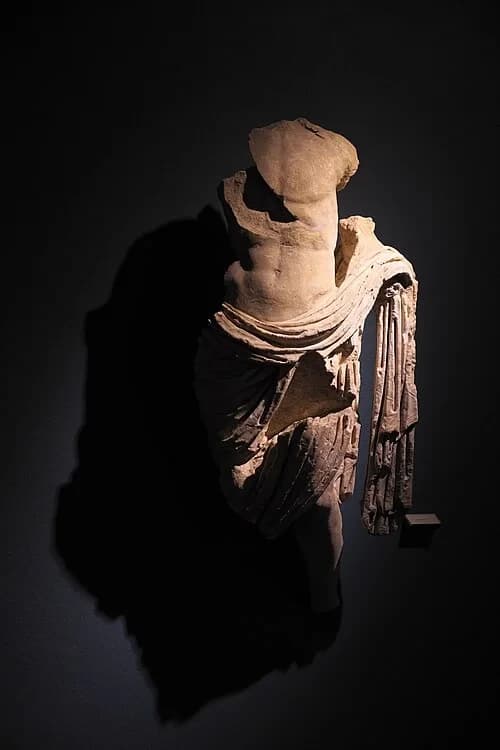
Torso of a Roman Dignitary
This sculpture emphasizes the importance of clothing in Roman society. The figure wears a toga, a garment that was much more than just a piece of fabric; it was a strictly regulated uniform of citizenship. Only male Roman citizens were permitted to wear it, and the complex way it was draped signaled the wearer's specific social rank and prestige. An interesting aspect of Roman sculpture was the method of production. Bodies like this were often mass-produced in workshops, with the robes and posture fully finished before a client was even found. Once a local official or wealthy merchant commissioned a statue, a specific portrait head would be carved and slotted into the hollowed-out neck. This efficient system allowed the local elite in provinces like Lusitania to possess high-quality statues that bore their likeness without the need for a master sculptor to travel from Italy for every project. It was a practical way to participate in the imperial culture of self-promotion and public display, ensuring their influence was visible to the community. You can still see the intricate carving in the deep, heavy folds of the fabric.
House of the Fountains
Conímbriga's most famous residence, renowned for its perfectly preserved garden mosaics and hydraulic fountain system.
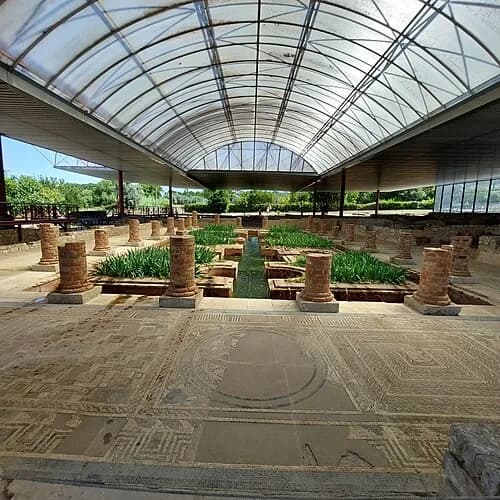
The Dancing Water Garden
Look closely at the narrow gaps and small channels cut into the stone around the garden beds. These were the locations of ancient water jets. This garden was far more than a quiet place for plants; it was a dynamic entertainment space. When the hydraulic system was activated, multiple streams of water would shoot into the air, creating a rhythmic display. The surrounding floor is covered in detailed mosaics depicting hunting scenes and mythological tales, which provided the perfect backdrop. During an evening banquet, the water would catch the flickering light from lamps and reflect the vibrant colors of the stones beneath, creating a shimmering, almost magical atmosphere. This level of theatricality was a hallmark of the Roman elite's social life. It demonstrated the owner's mastery over nature and technology, providing a stunning visual spectacle for visitors. The garden remains a testament to the Roman love for combining art, water, and engineering to create luxurious environments that appealed to all the senses. Standing here today, one can almost hear the soft splash of the fountains against the quiet of the ruins.
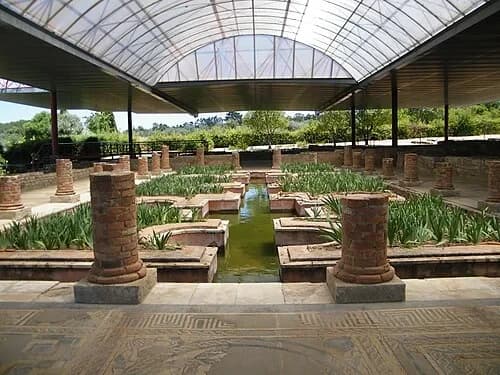
House of the Fountains
This sprawling villa represents the absolute height of luxury in Roman Conímbriga. At its heart lies a large 'peristyle'—a central garden completely surrounded by elegant colonnaded walkways. What truly set this home apart, however, was its marvel of Roman engineering: a complex hydraulic system. Archaeologists discovered that more than 500 hidden lead pipes were integrated into the structure to feed dozens of small fountains. When in operation, these fountains would spray and dance, creating a cooling mist that lowered the temperature of the air during the hot summer months. This was a high-tech sensory experience designed to impress any guest. The owner was likely a top-tier government official or an immensely wealthy merchant who had the means to replicate the sophisticated urban lifestyle found in Rome itself. The combination of architecture, running water, and lush greenery made this villa a private oasis, reflecting a world where engineering was used not just for utility, but for the ultimate expression of comfort and social standing. The sheer scale of the ruins provides a window into the life of the city’s most elite class.
House of the Swastika
A fine example of a Roman peristyle house named for the geometric swastika motifs in its floor mosaics.
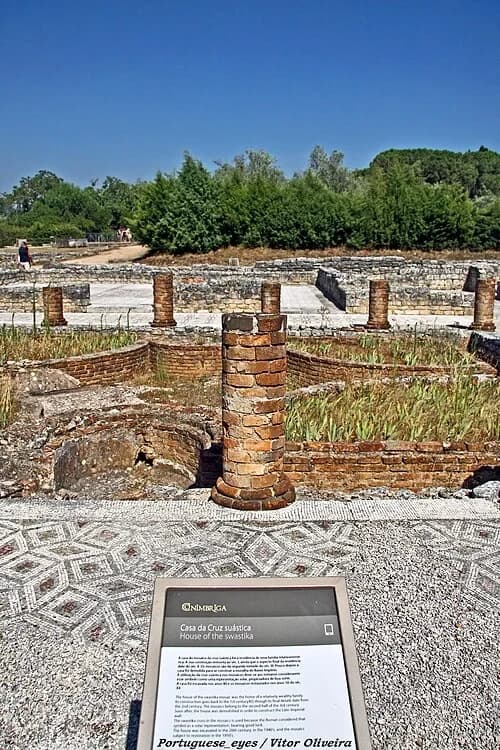
House of the Swastika
The name of this residence comes from the striking geometric patterns visible in its floor mosaics. It is important to note that in the 2nd century, the 'swastika' motif had a completely different meaning than it does today. To the Romans, it was an auspicious solar symbol, representing the movement of the sun, prosperity, and good luck. It was one of the most frequently used decorative designs across the ancient world. If you look at the mosaic, you can see how the pattern was meticulously crafted using small stones in their natural colors: crisp white, deep black, and warm ochre. This house offers a clear look at the layout of a residence belonging to a family of moderate wealth. The rooms are arranged around a central open courtyard, a classic Mediterranean design that allowed natural light and fresh air to circulate through the interior spaces while maintaining the family's privacy from the busy streets outside. It’s a well-preserved example of how even average citizens integrated artistic meaning and functional design into their daily lives. The repetitive nature of the pattern creates a hypnotic and orderly effect on the eye.
House of the Skeletons
Named for the burials found within its ruins, this house features exceptionally well-preserved geometric mosaic patterns.
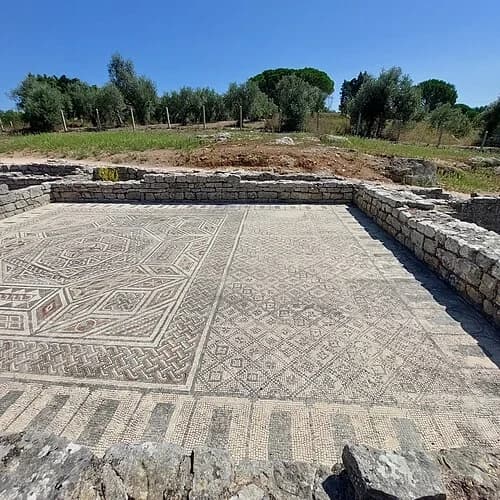
House of the Skeletons
The name 'House of the Skeletons' comes from a discovery made by archaeologists: several human remains were found buried directly beneath the floors. This wasn't the result of an ancient crime, but rather a sign of the city’s long decline. After the grand villa was abandoned, later inhabitants utilized the ruins as a protected cemetery, seeking safety within the old city walls. Aside from this later history, the house is notable for its exquisite mosaic floor. It features a complex labyrinth design and various geometric patterns. For the Romans, these intricate, repeating shapes were more than just decoration; they were a visual representation of the idea that Roman civilization brought structure and order to what they perceived as a wild and chaotic world. The precision required to lay these thousands of tiny tesserae reflected a culture that valued mathematical harmony and logic. Even as the empire around them began to fade, these floors remained as a permanent record of the high-level craftsmanship and the intellectual values that defined the height of Roman Conímbriga. The patterns remain remarkably crisp against the weathered stone of the foundations.
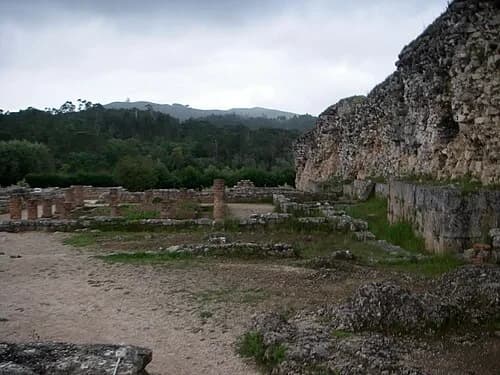
House of the Skeletons
The imposing stone structure you see here represents a turning point in the city's history. By the 5th century, the Roman Empire was fracturing, and 'barbarian' tribes like the Suebi were advancing across the peninsula. The people of Conímbriga found themselves in a state of crisis. Lacking the time or resources to encircle the entire city with a traditional wall, they were forced to make a brutal decision: they sacrificed nearly half of their own town. This emergency fortification was built with incredible speed, slicing right through the middle of existing streets and grand villas. If you look at the masonry, you will see a patchwork of materials. In their haste, the residents tore down their own houses and used the rubble—including broken statues, decorative columns, and discarded building blocks—to form this thick defensive barrier. It was a desperate 'circle the wagons' moment, where the luxury of the past was literalized into the armor of the present. This radical defensive measure forever altered the layout of the city in a frantic attempt to survive the coming storms of the Middle Ages.
Alley of the Baths
A narrow Roman street providing a glimpse into the dense urban layout of the city's eastern sector.
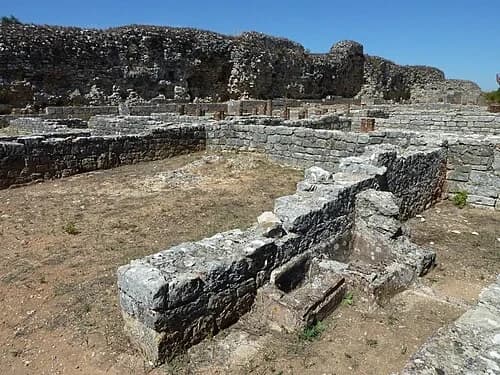
Alley of the Baths
Standing in this narrow alleyway, you can get a real sense of the density of ancient Conímbriga. The high stone foundations on either side once supported multi-story buildings, and this street served as a vital urban artery. Notice the flat paving stones underfoot; they were specifically designed to withstand the daily wear and tear of thousands of pairs of sandals and the occasional heavy cart. This particular route was a frequent path for citizens heading from their homes to the city’s thermal baths. While it looks like a simple walkway today, Roman streets were highly engineered, multi-functional spaces. Hidden beneath these very stones was a sophisticated system of sewage and drainage channels. These underground conduits were essential for keeping the city clean and preventing flooding during heavy rains. The combination of durable surface paving and hidden utility infrastructure is a prime example of the Roman commitment to urban hygiene and efficient city planning. It ensures that even the most mundane parts of the city were designed with longevity and functionality in mind. You can still see the grooves and wear patterns left by centuries of use.
Want to hear the rest?
Download the Stanza app to unlock all 33 stops and the complete guided audio tour.
Frequently Asked Questions
How long does the Ruínas de Conímbriga audio tour take?
The Ruínas de Conímbriga audio guide includes 33 narrated stops. Most visitors spend 45 minutes to 1.5 hours exploring the complete tour, though you can listen at your own pace and skip or revisit any stop.
Is the Ruínas de Conímbriga audio guide available in my language?
Stanza supports 15 languages: English, Spanish, French, German, Italian, Portuguese, Russian, Japanese, Chinese, Korean, Arabic, Hindi, Polish, Dutch, Hebrew. Check the guide in the app to confirm the languages currently available for this tour.
Can I use the audio guide offline at Ruínas de Conímbriga?
Yes! Download the complete Ruínas de Conímbriga tour — including all audio, maps, and images — before your visit. The Stanza app works completely offline, so you don't need WiFi or mobile data at the venue.
How much does the Ruínas de Conímbriga audio guide cost?
The Stanza app is free to download. Free and paid audio guides are available; current prices are shown in the app.
How do I use the Stanza audio guide at Ruínas de Conímbriga?
Download the free Stanza app, search for "Ruínas de Conímbriga", and download the tour. When you arrive at the venue, the app uses GPS to detect your location and automatically plays the relevant narration as you move between points of interest — completely hands-free.
What makes the Stanza audio guide different from other Ruínas de Conímbriga tours?
Stanza offers GPS-triggered narration that plays automatically as you walk through Ruínas de Conímbriga — no need to manually select stops. The tour is available in 15 languages, works fully offline, and includes 33 expertly narrated stops with images and historical context.
What other audio guides are available near Ruínas de Conímbriga?
Stanza offers multiple audio guides in Condeixa-a-Nova, Portugal and nearby areas. After downloading the app, browse the map to discover all available tours near Ruínas de Conímbriga. Each guide can be downloaded for offline use.