Languages
15Igreja de São Francisco Audio Guide
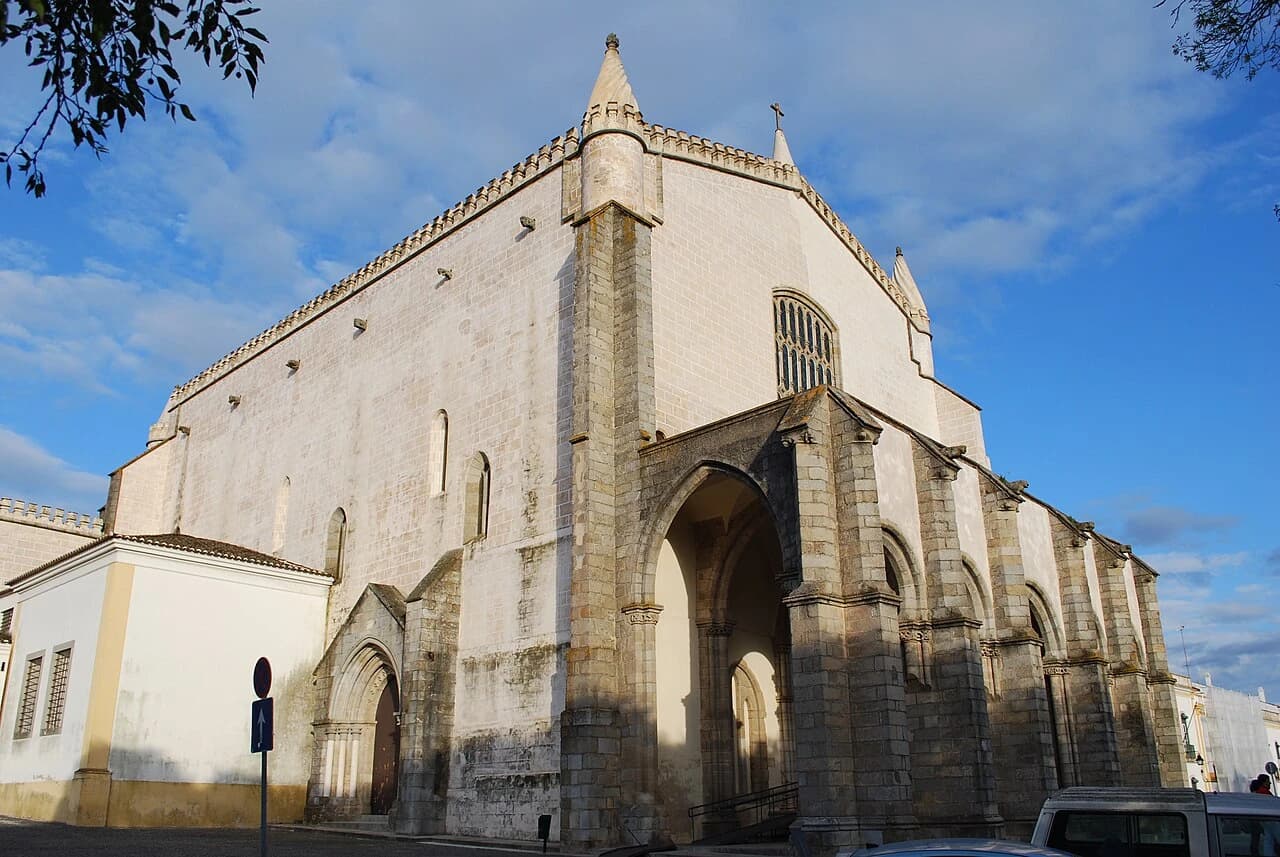
Igreja de São Francisco is a landmark in Évora, Portugal. Explore it with Stanza's GPS-triggered offline audio guide — available in 15 languages.
Quick Facts
25
Stops
15
Languages
100%
Offline
📍 Évora, Portugal · 38.5690°N, -7.9086°E
About Igreja de São Francisco
This Gothic-style church is famous for its Chapel of Bones (Capela dos Ossos), which is adorned with human bones and skulls. It originally served as part of a former Franciscan convent and is a prominent cultural heritage site in Évora.
Igreja de São Francisco is also known as Church of São Francisco, Igreja de São Francisco de Évora, Convento e Igreja de São Francisco (Évora), Igreja de Sao Francisco.
This self-guided audio tour features 25 narrated stops organized across 6 sections, including Narthex and the Manueline Portal, The Great Manueline Nave, The Side Chapels of the Golden Convent, The Baroque Pipe Organ, The Chancel and Royal Gallery, The Chapter House. As a church, Igreja de São Francisco offers a unique cultural experience in the heart of Évora, Portugal.
The Stanza audio guide is available in 15 languages and works entirely offline — download the complete tour including audio narration, maps, and images before your visit. As you walk through Igreja de São Francisco, GPS-triggered narration plays automatically at each point of interest.
Last updated:
What you will hear
Narthex and the Manueline Portal
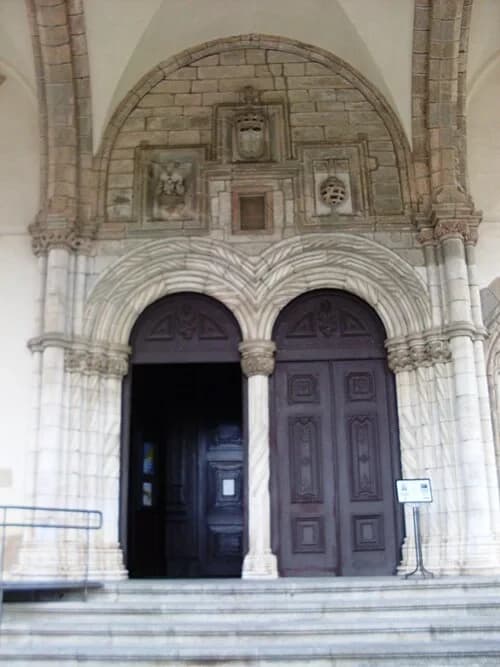
Establishing shot of the sunset-lit exterior followed by the unique Gothic-Moorish arches of the narthex and the ornate stone carvings of the main portal.
The Manueline Portal
The main entrance portal serves as a prime example of the Manueline style, a uniquely Portuguese architectural movement that flourished during the Age of Discovery. This style is characterized by its ornate, almost organic decorative elements that often reference seafaring and exploration. As you examine the carvings in the stone, look for the royal emblems that proclaim the authority of the crown. You can spot the armillary sphere, the personal heraldic device of King Manuel I, which represents the world and Portugal’s global reach. Nearby is the Cross of the Order of Christ, a symbol deeply tied to the financing and religious mission of the Portuguese voyages. These carvings were more than mere decoration; they were a form of political branding. By placing these symbols at the threshold of the church, the monarchy reinforced the idea that their earthly power and the church's spiritual authority were inextricably linked. The sheer density of the detail reflects the immense wealth flowing into Portugal at the turn of the sixteenth century.
The Great Manueline Nave
A wide view of the massive single nave, focusing on the 24-meter-high vaulted ceiling and the royal emblems of King Manuel I and King João II.
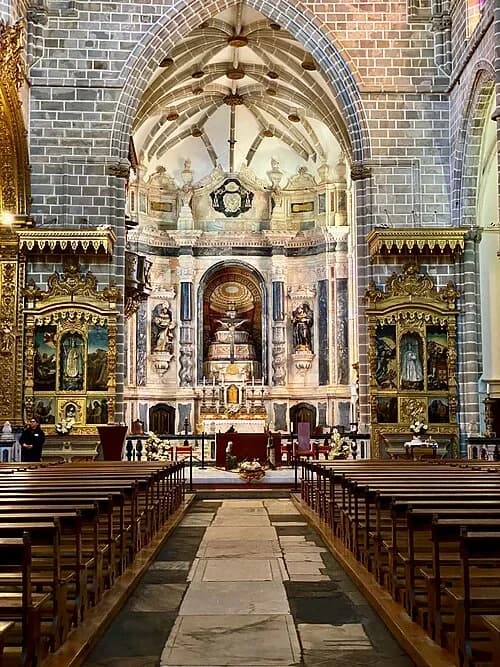
Portugal's Largest Nave
Entering the main body of the church reveals a stunning sense of scale and openness. This space is recognized as the largest single nave of its type in Portugal, measuring thirty-six meters in length and reaching a height of twenty-four meters. Unlike many Gothic cathedrals that use rows of columns to support the roof, this interior is a single, uninterrupted hall. This engineering choice was a deliberate design by master masons Martim Lourenço and Pero de Trilho. Their goal was to create a massive, clear area capable of hosting grand royal ceremonies and large congregations without visual obstruction. The lack of central pillars allows natural light to fill the space more evenly, emphasizing the sheer volume of the room. This architectural feat was particularly important for the Portuguese court, as the church functioned as a venue for state events and royal proclamations. Standing here, the height and width of the masonry create an atmosphere of regal solemnity, reflecting the ambitions of the sixteenth-century architects who pushed the boundaries of traditional Gothic construction.
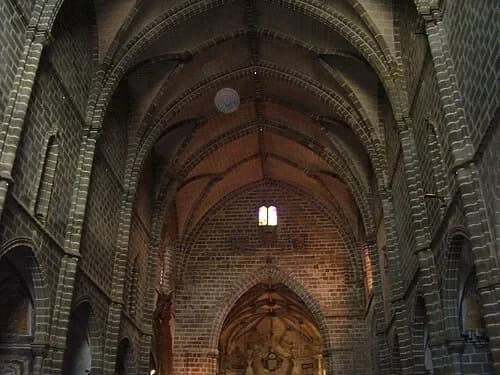
The Vaulted Ceiling
High above, the stone ceiling forms a complex network of ribs and vaults that seem to defy gravity. Spanning the entire width of the nave without any internal columns, this ceiling is considered a significant engineering accomplishment of the late fifteenth century. The ribbed Gothic structure acts as a skeleton, distributing the immense weight of the stone downward into the thick exterior walls. At twenty-four meters high, the verticality of the design was intended to draw the gaze of the faithful upward toward the heavens, a central theme in Gothic religious architecture. The precision required to set these stones so far above the floor meant that any minor error in calculation could have led to a structural failure. Instead, the masons created a stable, enduring canopy that has survived for over five centuries. This soaring height, combined with the wide, open floor plan, creates the distinctive acoustic and visual environment that defines the Igreja de São Francisco, making the human figures below seem small in comparison to the divine and royal aspirations built into the stone.
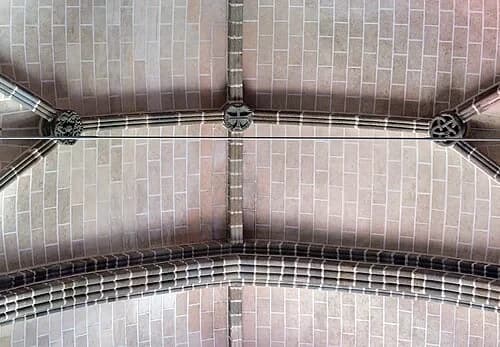
Royal Emblems in Stone
Where the stone ribs of the vaulted ceiling intersect, you will find decorative circular stones known as bosses. While these serve a structural purpose by locking the ribs in place, here they also function as powerful political statements. Many of these bosses are carved with specific symbols representing the Portuguese monarchy. Look for the image of a pelican, which was the personal emblem of King João II. According to medieval lore, the pelican was a symbol of sacrifice and devotion. You will also see the armillary sphere of his successor, King Manuel I. By placing these royal marks at the highest points of the church, the monarchs ensured that their presence was literally woven into the fabric of the building. This reinforces the church’s historical status as a royal pantheon and a primary site of monarchical authority. These carvings served as a constant reminder to everyone below that the church was built under the patronage and protection of the Crown, blending the divine order with the royal hierarchy of Portugal.
The Side Chapels of the Golden Convent
Representative views of the twelve side chapels, focusing on the gilded wood carvings and Renaissance paintings that earned the church its 'Golden' nickname.
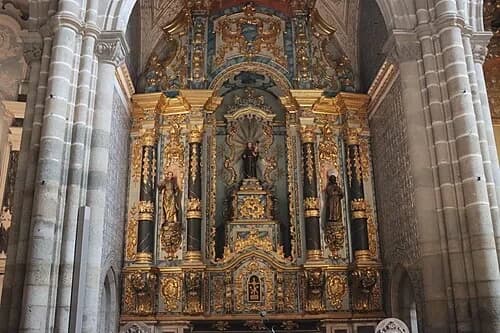
Altar of Blue and Gold
One of the most distinctive sights in this church is the visual dialogue between different artistic mediums within the side chapels. Notice how the exuberant, three-dimensional gilded wood carvings frame panels of traditional Portuguese "azulejos," or blue and white ceramic tiles. This combination of shimmering gold and cool, painted ceramics is a signature element of Portuguese sacred art. The tiles often depict narrative scenes from the lives of saints or biblical stories, providing a flat, illustrative backdrop to the high-relief carvings of the altar. This pairing represents a unique blend of local craft traditions and the vast wealth of the empire. While the gold represents the riches of the colonies, the tiles reflect a long-standing Iberian ceramic heritage. The contrast between the warm glow of the gold and the crisp blue of the tiles creates a rich visual texture that was intended to dazzle the senses of seventeenth-century worshippers. It remains one of the most recognizable and beloved features of Portugal’s religious heritage, showcasing a level of craftsmanship that defined the country's Baroque period.
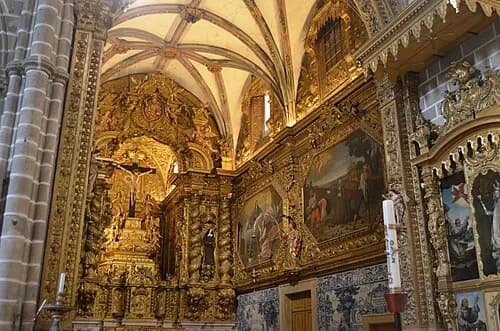
The Golden Side Chapels
Lining the sides of the vast nave are twelve individual chapels, each showcasing a dramatic shift in style from the church's Gothic origins. These areas are defined by "talha dourada," the traditional Portuguese art of gilded wood carving. While the exterior of the church and the main nave structure are rooted in the late fifteenth century, these ornate Baroque additions were created primarily during the seventeenth and eighteenth centuries. This was a period of incredible wealth for Portugal, fueled by the influx of gold discovered in Brazil. The artisans of the time used this wealth to transform what was once a relatively sober Gothic interior into the "Golden Convent." The wood is carved into elaborate, swirling patterns of vines, cherubs, and religious figures before being meticulously covered in thin layers of gold leaf. Each chapel was often sponsored by a wealthy family or religious brotherhood, resulting in a series of highly detailed, shimmering environments that contrast sharply with the gray stone of the vaulted ceiling and the plain white walls.
The Baroque Pipe Organ
Focusing on the ornate 18th-century pipe organ with its painted floral panels and gilded pipes, set against the Gothic walls.
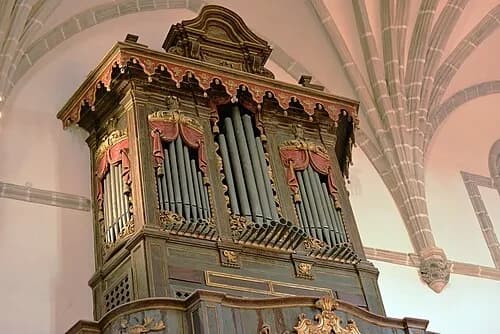
Detail of the Organ Pipes
Taking a closer look at the organ, you can see the intricate details of its ornamentation, including painted floral panels that add a splash of color to the dark wood. One of the most striking features is the arrangement of the horizontal pipes, known as "en chamade." Unlike standard organ pipes that stand vertically, these project outward directly toward the listener, much like a row of trumpets. This style of pipe placement was a specific innovation developed in Spain and Portugal during the Baroque era. The purpose was both functional and dramatic; by pointing the pipes horizontally, the organ could produce a much more powerful, piercing sound that could cut through the acoustics of a large stone nave. This allowed the organist to create bold, fanfare-like musical passages that were a staple of Iberian liturgical music. The sight of these metal tubes jutting out from the ornate woodwork adds a sense of aggressive elegance to the instrument, reflecting the Baroque period's love for theatricality and sensory impact in religious spaces.
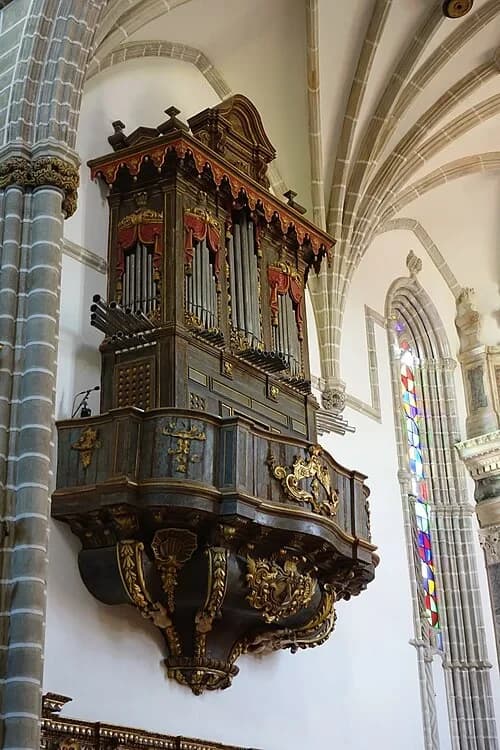
The Baroque Pipe Organ
Looking toward the wall, you will see the massive Baroque pipe organ, a masterpiece of eighteenth-century musical engineering and decorative art. The instrument is housed in a grand case made of dark wood, embellished with the same gilded accents found throughout the side chapels. This organ is not merely a historical relic; it remains fully functional today. Its pipes are designed to fill the vast, resonant nave with music, creating a powerful acoustic experience that has changed very little over the centuries. The placement of the organ high above the floor allows the sound to carry efficiently through the thirty-six-meter-long hall, reflecting off the stone vaults to reach every corner of the church. The visual design of the organ case is intended to harmonize with the surrounding "talha dourada" altars, ensuring that the instrument is as much a part of the church’s artistic identity as its spiritual one. When played, the deep bass and bright treble tones interact with the unique geometry of this column-free space, providing a link to the liturgical atmosphere of the 1700s.
The Chancel and Royal Gallery
The spiritual heart of the church, featuring the marble high altar and the gallery where the Portuguese royal family attended services.
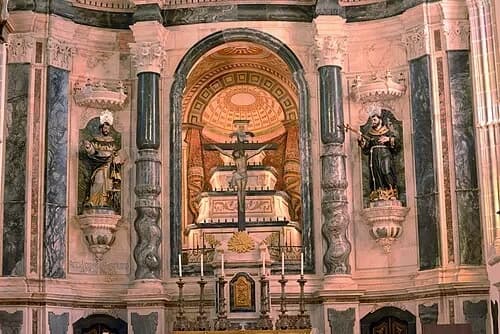
The High Altar
The high altar stands as the focal point of the entire church, framed by stately marble columns that provide a sense of classical dignity. Flanking the central crucifix are figures of Saint Francis and Saint Dominic, the founders of the two great mendicant orders that were highly influential in medieval and Renaissance Portugal. If you look upward, you will notice a gallery overlooking the altar area. This was a private space reserved specifically for the royal family during religious services. From this vantage point, the King and his relatives could participate in the mass while remaining physically separated from the general congregation. This arrangement served two purposes: it ensured the safety and privacy of the monarchy while also reinforcing their social elevation. Even during a moment of spiritual humility like a mass, the architecture of the church maintained a clear hierarchy. The rich materials used here, from the polished marble to the finely carved statues, underscore the importance of this space as a venue for royal devotion and the primary site of religious ceremony in the city.
The Chapter House
A room of local devotion housing the image of Senhor dos Passos, characterized by its stunning gilded ceiling and azulejo tiles.
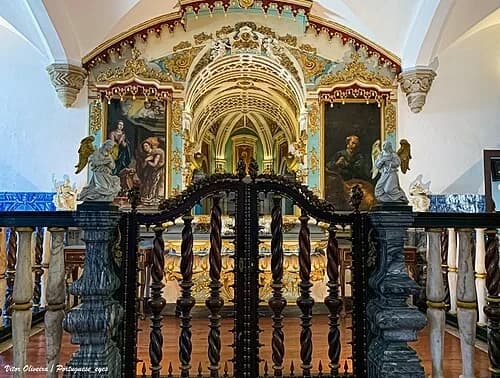
Altar of the Lord of the Steps
Located within the Chapter House, this altar is dedicated to the "Senhor dos Passos," or the Lord of the Stations of the Cross. This specific image of Christ is a figure of intense local devotion in Évora and throughout Portugal, often becoming the focus of major religious processions. The central figure is housed within an exceptionally intricate gilded frame, showcasing the swirling Baroque detail typical of the region. Surrounding the altar are large panels of "azulejo" tiles, which provide a narrative contrast to the gilded centerpiece. These blue and white ceramic panels depict various scenes from the life of Saint Peter, offering a detailed and illustrative backdrop to the space. The combination of the sacred image, the shimmering gold, and the historic tilework makes this one of the most culturally significant altars in the complex. It serves as a place for both private contemplation and the celebration of local traditions that have continued for hundreds of years, blending high art with deeply rooted popular faith.
Want to hear the rest?
Download the Stanza app to unlock all 25 stops and full GPS-guided navigation.
Frequently Asked Questions
How long does the Igreja de São Francisco audio tour take?
The Igreja de São Francisco audio guide includes 25 narrated stops. Most visitors spend 45 minutes to 1.5 hours exploring the complete tour, though you can listen at your own pace and skip or revisit any stop.
Is the Igreja de São Francisco audio guide available in my language?
Stanza supports 15 languages: English, Spanish, French, German, Italian, Portuguese, Russian, Japanese, Chinese, Korean, Arabic, Hindi, Polish, Dutch, Hebrew. Check the guide in the app to confirm the languages currently available for this tour.
Can I use the audio guide offline at Igreja de São Francisco?
Yes! Download the complete Igreja de São Francisco tour — including all audio, maps, and images — before your visit. The Stanza app works completely offline, so you don't need WiFi or mobile data at the venue.
How much does the Igreja de São Francisco audio guide cost?
The Stanza app is free to download. Free and paid audio guides are available; current prices are shown in the app.
How do I use the Stanza audio guide at Igreja de São Francisco?
Download the free Stanza app, search for "Igreja de São Francisco", and download the tour. When you arrive at the venue, the app uses GPS to detect your location and automatically plays the relevant narration as you move between points of interest — completely hands-free.
What makes the Stanza audio guide different from other Igreja de São Francisco tours?
Stanza offers GPS-triggered narration that plays automatically as you walk through Igreja de São Francisco — no need to manually select stops. The tour is available in 15 languages, works fully offline, and includes 25 expertly narrated stops with images and historical context.
What other audio guides are available near Igreja de São Francisco?
Stanza offers multiple audio guides in Évora, Portugal and nearby areas. After downloading the app, browse the map to discover all available tours near Igreja de São Francisco. Each guide can be downloaded for offline use.