Stanza · Audio guide
Rock Carvings in Tanum Audio Guide
A place to remember. A story to take with you.
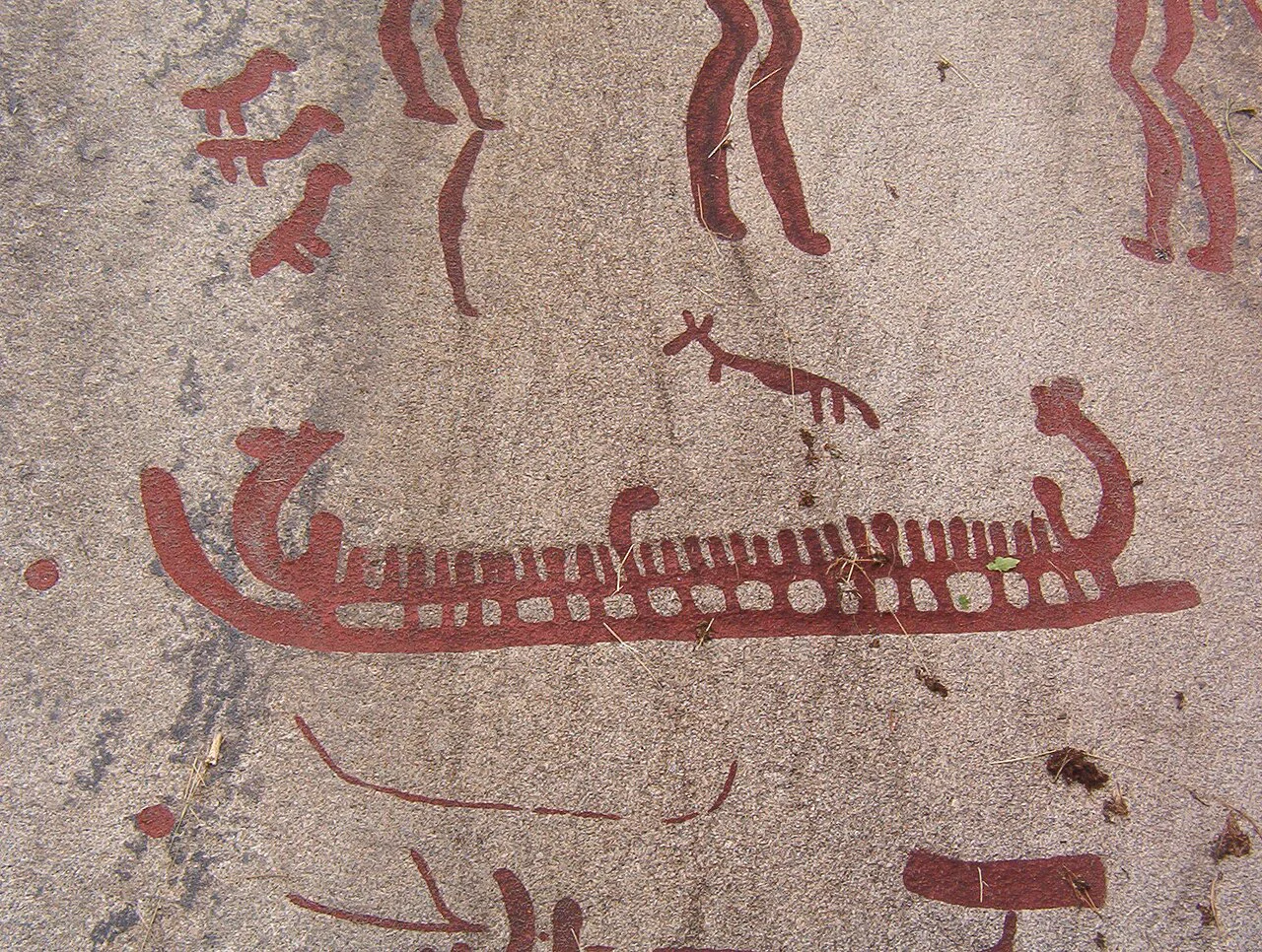
The Rock Carvings in Tanum are a collection of petroglyphs located near Tanumshede, Sweden. They were declared a UNESCO World Heritage Site in 1994 due to their high concentration.
Download Stanza, then search for “Rock Carvings in Tanum”.
About the tour
One guide. Your kind of visit.
The Rock Carvings in Tanum are a collection of petroglyphs located near Tanumshede, Sweden. They were declared a UNESCO World Heritage Site in 1994 due to their high concentration.
Ready when you are.
- 01Get the free Stanza app.
iOS & Android
- 02Find your guide.
“Rock Carvings in Tanum”
- 03Download before you go.
Works offline
Audio guide / 22 narrated stops
Inside the guide
Get to know a few of the stories before you go. Open a stop to read more.
01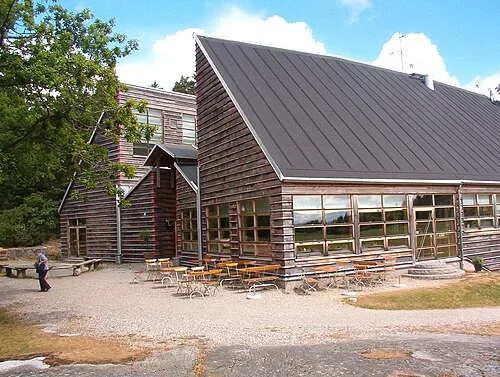 Vitlycke Museum
Near Tanumshede in Bohuslän, on Sweden's west coast, lies one of the densest collections of rock carvings in the world. Between about 1700 and 500 BC, people cut images into the smooth granite slabs here: ships, warriors, ploughmen, animals and small hollow cups. There are thousands of images in all, spread across hundreds of panels along a stretch of some twenty-five kilometres. In 1994 UNESCO declared the area a World Heritage Site, on the strength of that concentration and the quality of the art. One thing sets these pictures apart from most ancient art. They were sacred images, and again and again they show people performing rituals rather than scenes of everyday life. The museum at Vitlycke, built not far from the largest of the carved rocks, is the natural starting point, with indoor exhibitions and reconstructed Bronze Age buildings. The carvings have drawn curious eyes for a long time. The first ink drawings of them were made in 1627 by Peder Alfsön, a Norwegian doctor and lector. Four centuries of study later, the images still keep most of their meaning to themselves.
No machine-readable author provided. Fred J assumed (based on copyright claims). · CC BY-SA 1.0
02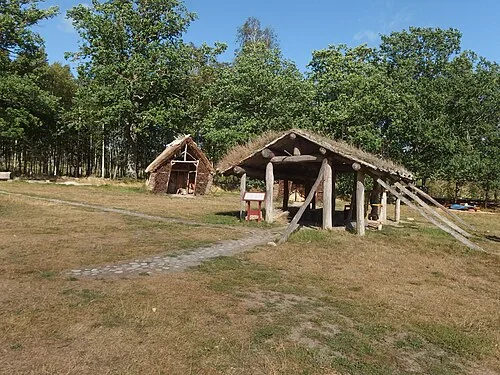 Vitlycke Museum
Reconstructed Bronze Age Farm at Vitlycke Museum
The low, turf-roofed buildings here are modern reconstructions, built to suggest the world the carvers lived in. The Bronze Age people of this coast were farmers and seafarers, keeping animals and crops and travelling by water. Farming even found its way into the sacred images. One Tanum carving shows a human figure at a plough drawn by two oxen. The ploughman holds something in his hand, and it is hard to say what. It might be a branch, or a goad made of strips of hide, used to urge the oxen on. Even this humble scene may not be a picture of work. The carvings consistently show people performing rituals, so ploughing here could be a sacred act rather than a farm chore. Which of the two it was, no one can say.
Photo: Palickap · CC BY-SA 4.0
03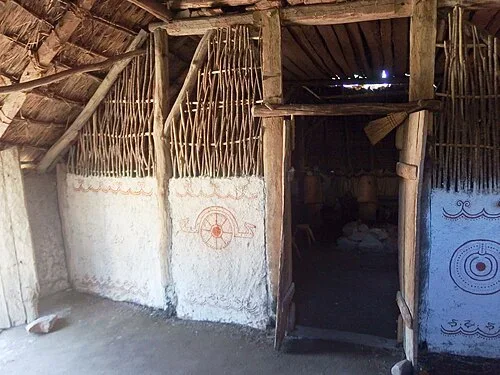 Vitlycke Museum
Inside the Reconstructed Longhouse: Painted Walls
Inside the reconstructed longhouse, the woven wattle walls are painted with circles, sun-wheels and zigzag lines in red and ochre. Those painted walls are a modern guess at decoration, and they raise a question that hangs over the whole site. No one knows whether the rock carvings were ever coloured when they were new. The carved lines might have stood bare on the grey stone, or they might have been filled with pigment that time has long since washed away. In modern times, many of the glyphs have been filled in with red paint so that visitors can pick them out against the rock. That practice has drawn criticism, because the paint alters the original state of the drawings. The bright red figures people photograph today are, in that sense, partly modern work.
Listen in the appPhoto: Palickap · CC BY-SA 4.0
04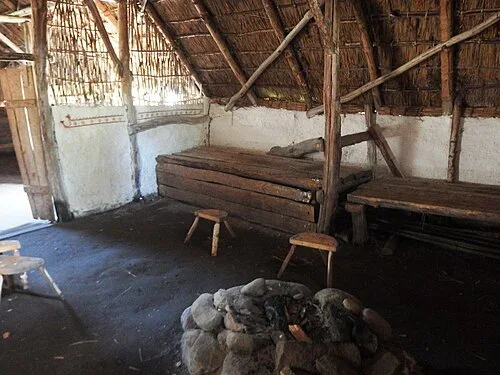 Vitlycke Museum
The Longhouse Hearth
The hearth sits at the centre of this reconstructed room, with wooden benches and stools gathered around it. The room is a museum's suggestion of a Bronze Age interior, not evidence of how any particular family here once lived. The original carved rocks, though, need active care. Acid rain erodes the granite surfaces, and some panels are now covered, either permanently or for part of the year, to shield them. Around a hundred thousand people come to see the carvings each year. None of them may walk on the carved surfaces or touch the drawings.
Listen in the appPhoto: Palickap · CC BY-SA 4.0
05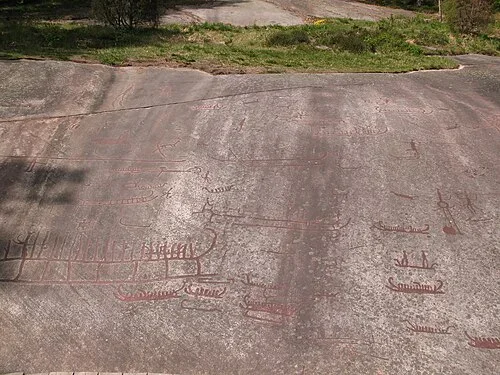 The Great Vitlycke Panel (Tanum 1:1)
The great rock at Vitlycke is the largest carved surface in the area. It stretches about twenty-two metres and is six metres wide. Nearly 300 figures are cut into it. Alongside them are roughly 170 cup marks, small round hollows ground into the stone. The image gives a sense of the whole: ships with crews of line-drawn figures, animals, processions and single scenes layered over one another across a sheared granite slope. The carvers seem to have returned to the rock again and again, adding new images beside the old. Among the figures here is perhaps the most famous scene in all of Tanum, two figures known as the Bridal Couple. What the panel shows above all is abundance: one rock holding a dense, crowded picture-world built up over centuries.
Listen in the appPhoto: SM6XSG · CC BY-SA 3.0
06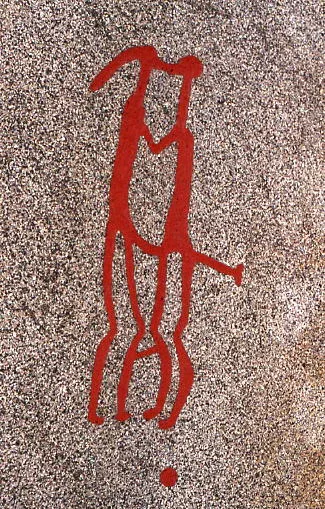 The Great Vitlycke Panel (Tanum 1:1)
The Bridal Couple (Brudparet)
Two figures stand close together, one with an arm reaching around the other. People have long called them the Bridal Couple, and it is perhaps the best-known scene among all the Tanum carvings. The reading most often given is a holy marriage: a ritual union performed to secure fertility and prosperity for the community. Nearby, a larger figure holding an axe is often understood as presiding over the act, blessing it. All of this is interpretation. The carvers left no explanation, and the true meaning of the scene is unknown. Even the identities and genders of the two figures are not settled. Whether this pair records a marriage of humans, of gods, or of something else entirely, the stone does not say.
Listen in the appPhoto: Michel-georges bernard · CC BY-SA 3.0
07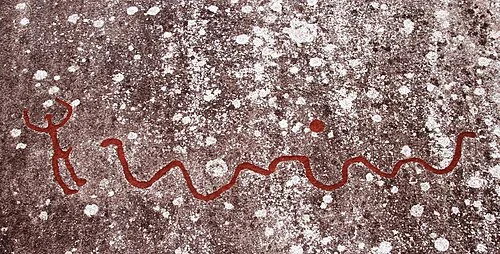 The Great Vitlycke Panel (Tanum 1:1)
Man and Serpent Scene
A small human figure stands with arms raised beside a long, wavy line that runs across the rock. Tradition has named this scene a man calling on rain from a lightning-serpent, the line read as a serpent and the gesture as a summons. It is a traditional reading, not an established one. The meaning of the carved line is unresolved, and so is what the raised arms are meant to show. The scene is worth attention precisely because it shows how these images get read at all. Whatever the serpent, and whatever the rain, actually meant to its maker, this small vignette fits the ritual pattern.
Listen in the appPhoto: Bjoertvedt · CC BY-SA 3.0
08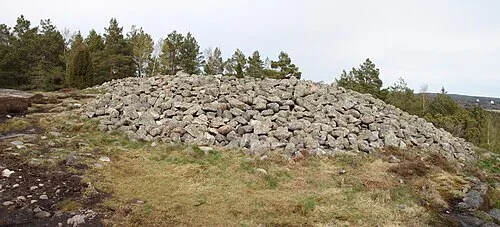 The Bronze Age Burial Cairns (Tanum 2:1)
Burial Cairn above Vitlycke (Tanum 2:1)
High on the ridge above the carved rocks stands a burial cairn, a mound built of piled stone. Cairns like this are a familiar feature of the Scandinavian Bronze Age landscape, raised over the dead. Whatever its exact date, its presence completes the picture of the ritual landscape here. The carved sanctuaries did not stand alone. They shared the ground with the graves of the community's dead, visible on the heights above. Ancestors, ritual images and territory framed one another in a single landscape, where the living carved their sacred pictures with the resting places of earlier generations in view. Who was buried in this cairn, and with what ceremony, is not known. The mound of stone, and its place above the carved slopes, is what remains.
Listen in the appPhoto: Bjoertvedt · CC BY-SA 3.0
09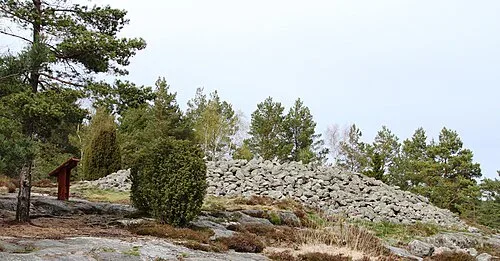 The Bronze Age Burial Cairns (Tanum 2:1)
Second Cairn on the Ridge
A second cairn rises on the same ridge, with an information sign at its foot. The burial mounds stand as a group here. Whether the builders placed them on the ridge on purpose is not documented. The sightlines may be chance, or design, or something in between. The stones keep that answer to themselves.
Listen in the appPhoto: Bjoertvedt · CC BY-SA 3.0
10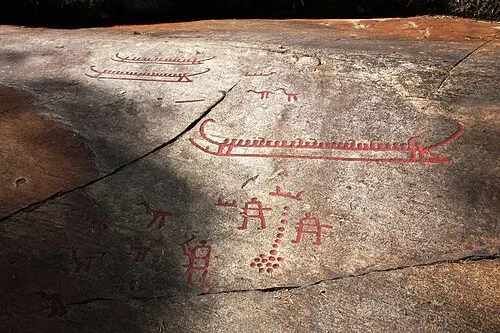 The Hunter and Ship Panel (Tanum 9:1)
This quieter panel shows how wide the carvers' visual language ranged. Alongside the ships, there are animals and human figures, and scenes that are read as hunting. Small cup-shaped hollows appear too, some of them joined by lines of dots that cross the rock in deliberate paths. Cup marks are among the most common motifs in Scandinavian rock art, and among the least understood. What the hollows meant to the people who ground them, and what the dotted lines connected, is unresolved. The same open question hangs over the hunting scenes. They may record real hunts, or hunts performed as ritual, and the images alone cannot settle it. What is clear is the variety. On one surface, ships, animals, hunters and cup marks share the same rock, each image cut with the same simple confidence.
Listen in the appPhoto: Bjoertvedt · CC BY-SA 3.0
- 11
Detail: Hunters, Animals and Cup Marks
A close look at the carving style itself: stick figures and outline ships, drawn with an economy of line that still reads clearly today.
- 12
The Bow-Bearing Man (Tanum 7:1)
A single archer, bow drawn, carved alone on his own small rock.
- 13
The Warrior Panel (Tanum 8:1)
A worn slab where the Bronze Age's armed figures once stood in force.
- 14
Warrior with Shield (Tanum 8:1)
One broad-chested warrior, drawn larger than life to show what he was worth.
- 15
The Great Ship of Tanum 6:1
The great ship of Tanum: a crewed vessel carved by people who lived on the sea.
- 16
Ship's Crew in Detail (Tanum 6:1)
A crew in lockstep, hands raised, frozen mid-ceremony on the hull of a carved ship.
- 17
The Rider Battle at Tegneby (Tanum 72:4)
Horsemen wheeling with spears and shields: the clearest battle scene in all of Tanum.
- 18
Rider with Axe and Shield (Tanum 72:4)
One horseman from the battle, drawn in a single flowing line with an axe and a shield.
- 19
The Litsleby Man (The Spear God)
A spearman over two metres long, the largest human figure in the Tanum carvings.
- 20
Litsleby Rock in Today's Forest
A carved rock deep in pine forest, which stood at the water's edge when its figures were cut.
- 21
The Fossum Panel
A panel set apart from the rest, so coherent that one master carver may lie behind it.
- 22
The Fossum Panel in the Historic Record
How the carvings came to light: ink drawings in 1627, and the long road to their true age.
Rock Carvings in Tanum
Frequently asked questions
How much does the guide cost?
Free app download. Listed guide price: $2.99. Guide price shown in the app. Audio guide only. Venue admission is separate.
Can I listen without internet?
Yes. Download the guide’s audio, images, and maps in the app before your visit. Your downloaded content is then available offline.
Can I listen in my language?
This audio guide is available in 15 languages, including English.
Do I need to follow a schedule?
No. This is a self-guided experience. Choose your stops, pause whenever you like, and return to a story at your own pace.
At your own pace
Explore Rock Carvings in Tanum.
Download Stanza, then search for “Rock Carvings in Tanum”.
Free app download · Guide price shown in the app
Keep exploring
Audio guides — Sweden
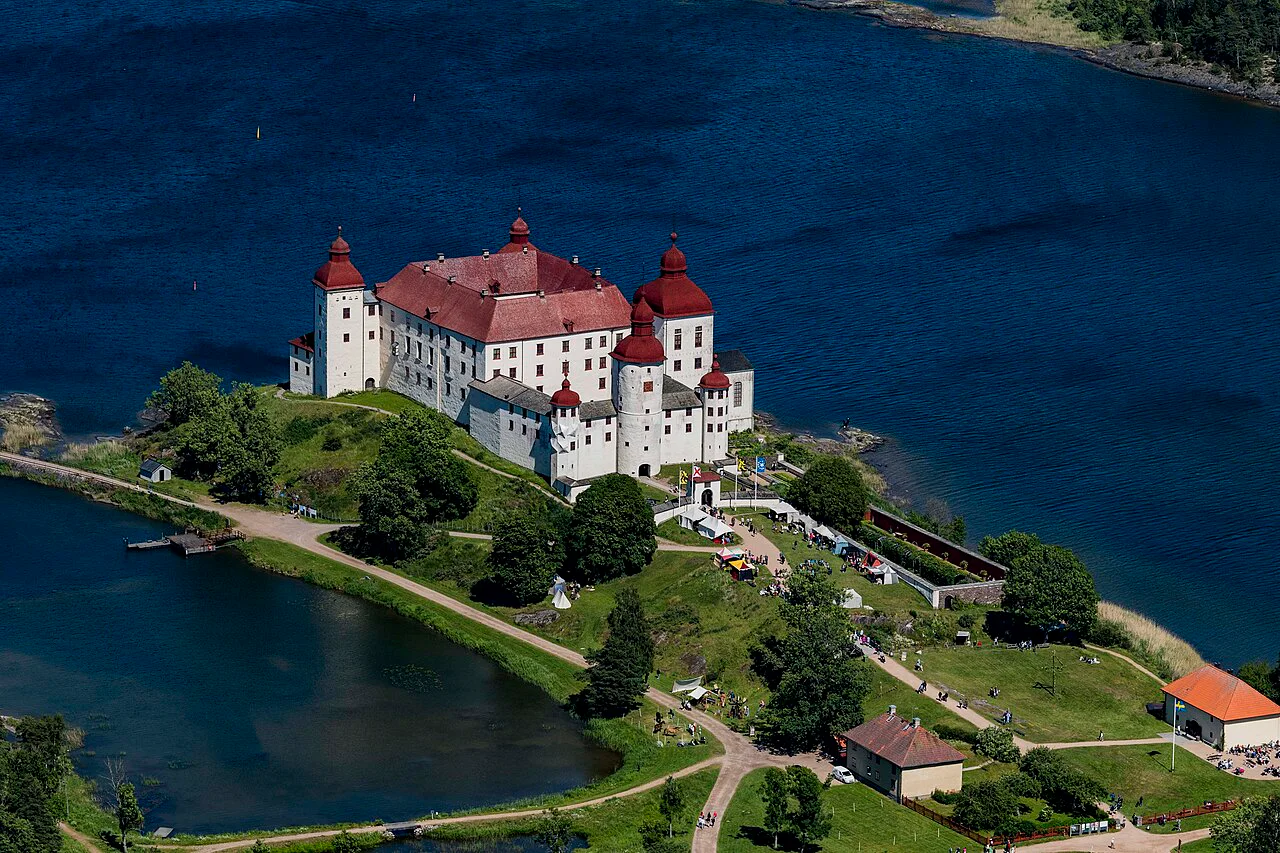
Lidköping Municipality · 109 km
Läckö Castle
Content & sources
Photo: L.G.foto · CC BY-SA 4.0
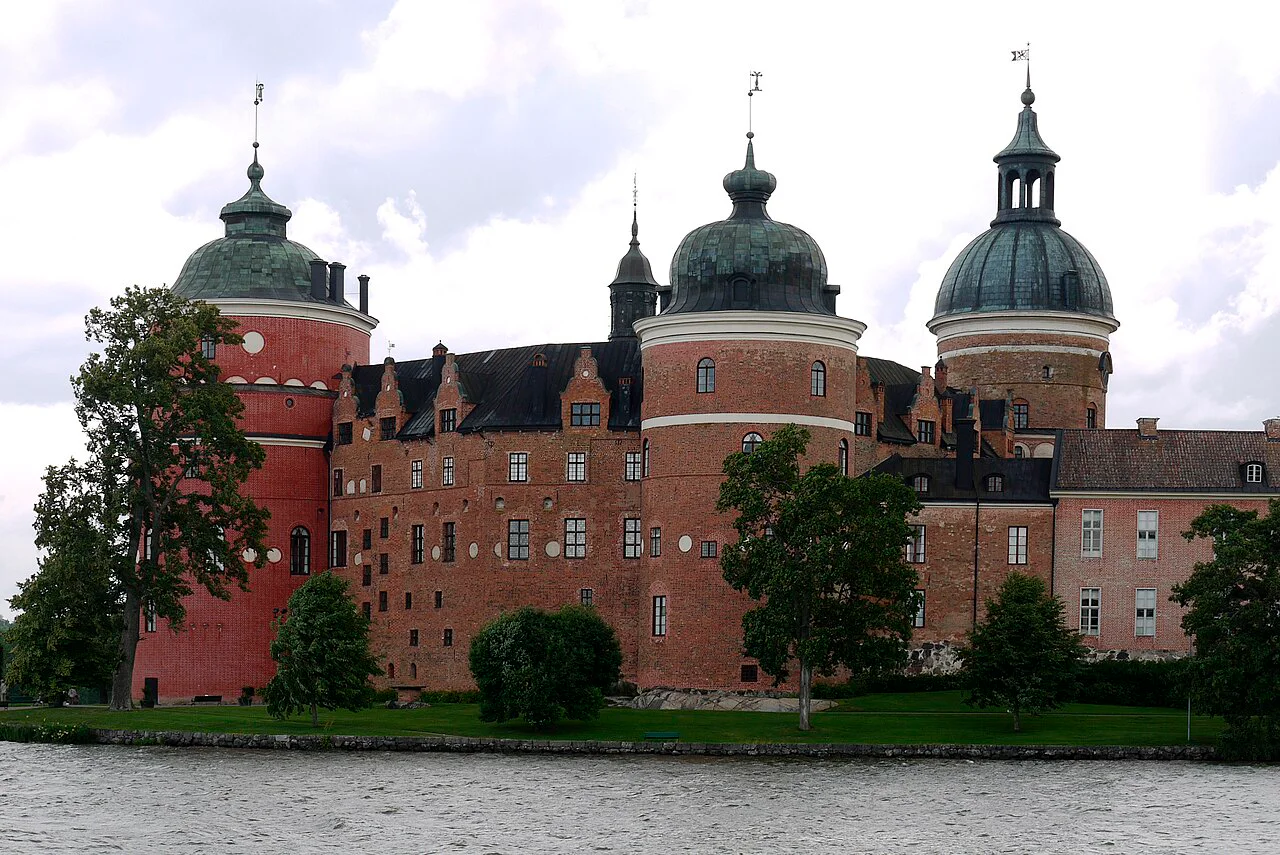
Mariefred
Gripsholm Castle
Content & sources
Xauxa Håkan Svensson · CC BY-SA 3.0
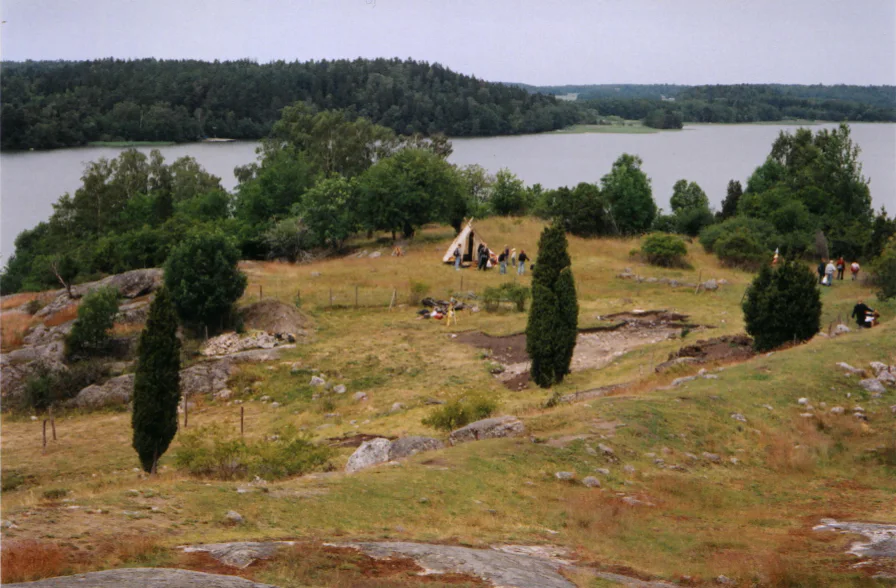
Ekerö kommun
Birka
Content & sources
Alex Peterson · CC BY-SA 3.0
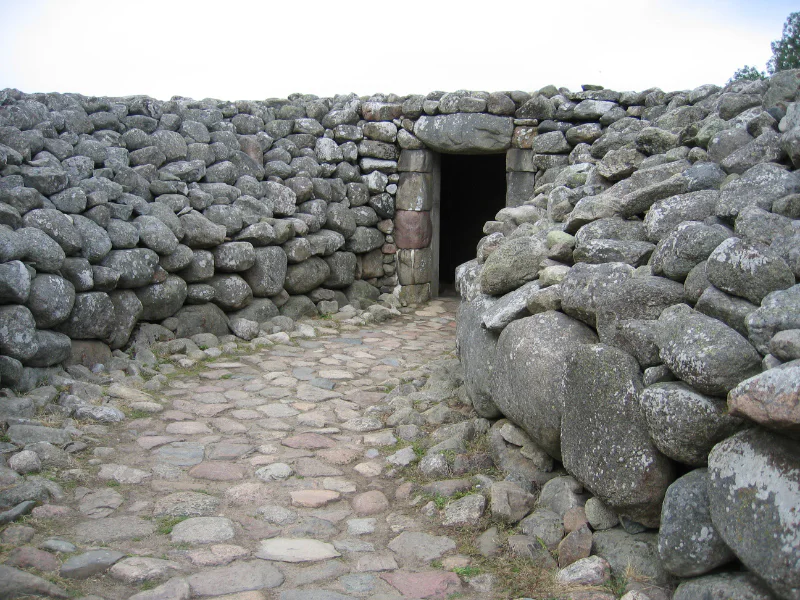
Kivik
The King's Grave
Content & sources
Abelson at English Wikipedia · CC BY 2.5
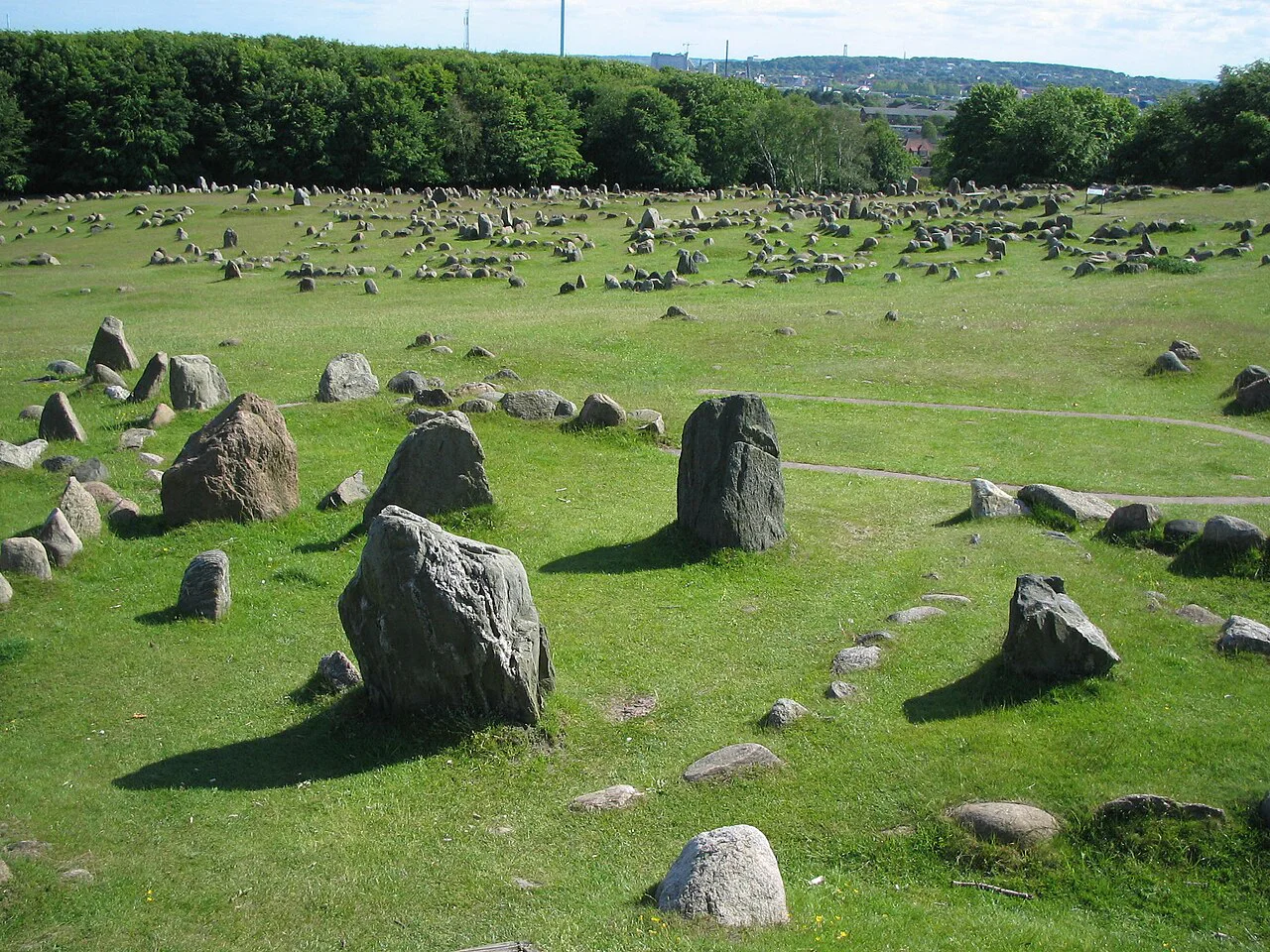
Aalborg
Lindholm Høje
Content & sources
Simon Wedege Petersen · CC BY 3.0