Languages
15Pergamon Audio Guide
Pergamon is an archaeological site in Bergama, Turkey. Explore it with Stanza's guided offline audio tour — narrated in 15 languages.
Quick Facts
20
Stops
15
Languages
100%
Offline
📍 Bergama, Turkey · 39.1167°N, 27.1833°E
About Pergamon
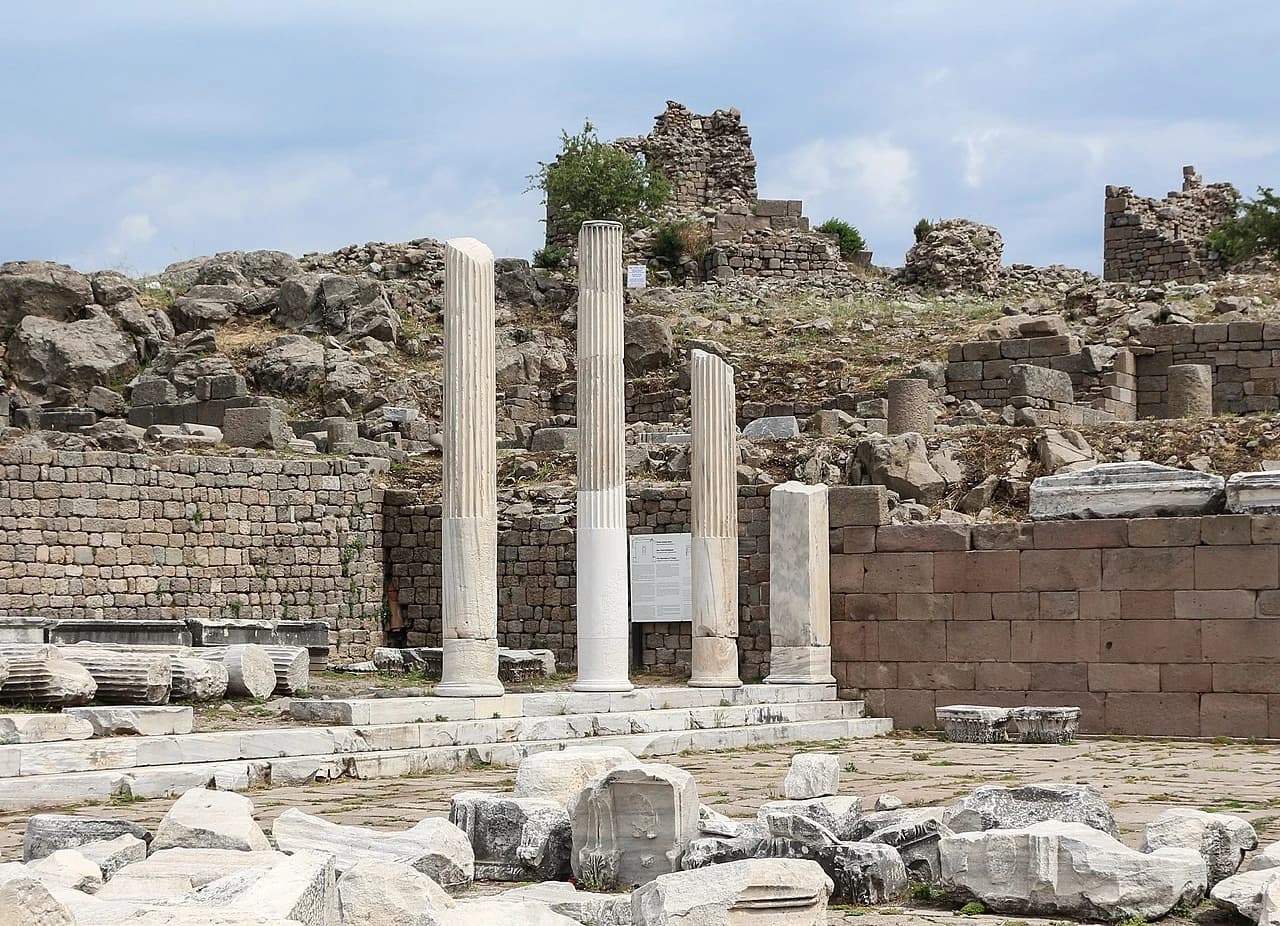
Pergamon is an ancient Greek city in Ionia, located in modern-day Turkey. It is a UNESCO World Heritage Site known for its archaeological remains.
This self-guided audio tour features 20 narrated stops organized across 8 sections. As a ancient city, Pergamon offers a unique cultural experience in the heart of Bergama, Turkey.
The Stanza audio guide is available in 15 languages and works entirely offline — download the complete tour including audio narration, maps, and images before your visit. As you walk through Pergamon, GPS-triggered narration plays automatically at each point of interest.
Last updated:
What you will hear
Palace V
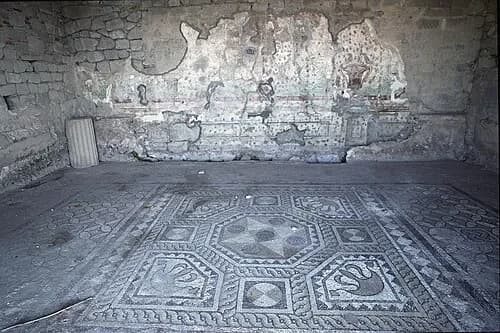
Explore the remains of the royal residence of Eumenes II, which once featured exquisite mosaics and luxury suitable for a Hellenistic monarch.
The Royal Palace Mosaic
While the massive temples on the Acropolis were built for the public and the gods, this mosaic floor belonged to the private world of King Eumenes the Second. Part of Palace Five, this space was once a highly decorated, heated room designed for royal comfort. The floor features complex geometric patterns made from thousands of tiny stone pieces known as tesserae. In the ancient world, the size of these stones was a direct indication of the owner's status; the smaller and more detailed the mosaic, the wealthier the person who commissioned it. These palace rooms were not just about the floors; the walls were once covered in richly colored paintings, and the spaces would have been filled with some of the most expensive furniture available in the Mediterranean. Most of the Acropolis feels monumental and cold, but here, you get a sense of the kings as individuals who valued luxury and intellectual pursuits within their own homes. The high quality of these mosaics reflects a period when Pergamon was at the height of its wealth, attracting the finest craftsmen from across the Greek world.
Temple of Trajan
The highest point of the Acropolis, this gleaming white marble temple was dedicated to the Roman Emperor Trajan and his successor Hadrian.
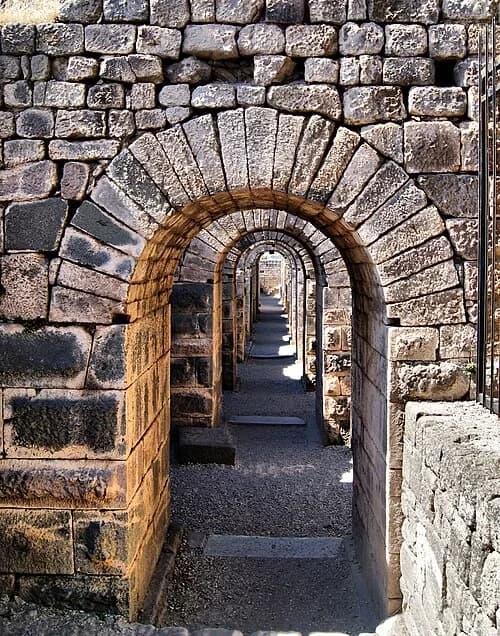
The Underground Corridors
The underground corridors here solved a primary problem for the city’s builders: how to construct a massive temple on a seventy-degree slope without it sliding into the valley. These tunnels provided a cool, dark environment that was likely used for storage, but their most important job was architectural. As you look through the long series of arches, you're seeing a sophisticated system of pressure management. Each arch pushes against its neighbor, creating a continuous force that effectively pins the hillside in place. The stonework in these hidden passages is often even more precise than what you see on the surface. This is because the entire stability of the temple above depended on the integrity of these blocks; if even one slipped, the marble structure overhead would have cracked and fallen. This subterranean world allowed the Romans to expand the footprint of the Acropolis far beyond its natural boundaries. While most visitors focus on the white columns above, it is this hidden network of stone that demonstrates the true technical genius of the Roman builders, who mastered the physics of stone to reshape the very mountain.
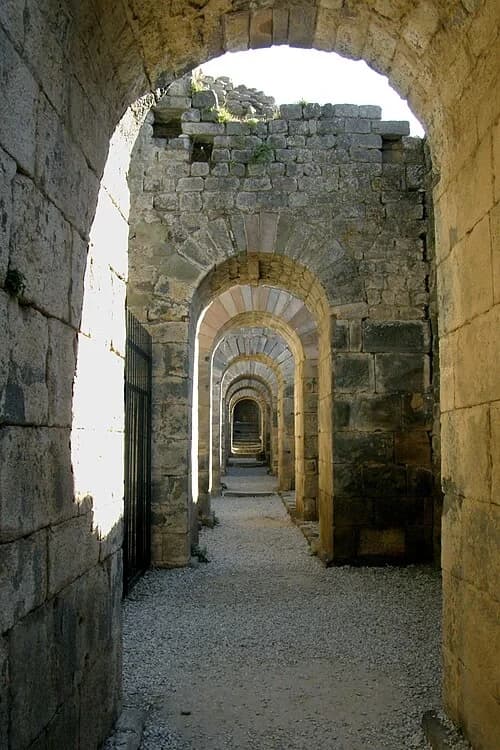
The North Slope Vaults
At the end of these tunnels, you can see the fascinating transition where Roman masonry directly meets the raw, dark andesite of the natural mountain. These vaults were an essential part of an massive land-reclamation project. By building out from the rock face, engineers created an artificial terrace over sixty meters wide. Without this clever expansion of the earth, the Temple of Trajan would have had to be less than half its current size. These sturdy tunnels represent a literal expansion of the mountain’s usable surface area. While they were originally built for structural support, their utility didn't end when the Roman Empire fell. In later centuries, as the grand temples above crumbled, these well-preserved vaults were repurposed as shelters, stables, and workshops by the people who continued to live among the ruins. Their durability is proof of the high quality of the construction; the vaults remain largely intact today, still performing their original job of holding up the edge of the Acropolis. They provide a unique perspective on the sheer scale of the terraforming required to make Pergamon the architectural marvel that it eventually became.
Temple of Athena
The oldest temple on the Acropolis, built in the 4th century BC in the Doric style to honor the city's patron goddess.
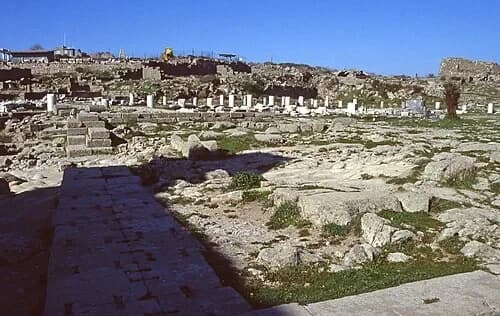
Temple of Athena
This simple footprint of stone marks the site of the Temple of Athena, the oldest and most historically significant structure on the Acropolis. Dating back to the fourth century BC, it predates the grand Roman marble temples found elsewhere on the hill. It was built in the severe Doric style using the local dark volcanic rock. This sanctuary was the original core around which the rest of the city developed. Over time, it became much more than just a religious site; it served as a massive trophy room for the Attalid kings. After their famous victories over the invading Galatian tribes, the kings surrounded this temple with an elegant two-story colonnade. They filled the space with captured enemy shields and weapons, putting their military success on permanent display in the presence of their patron goddess. By walking through this area, you are standing at the very beginning of Pergamon's history, in a place that combined deep religious devotion with the proud celebration of the kingdom’s survival and military might. The simplicity of these ruins contrasts with the surrounding grandeur, highlighting the city's ancient roots.
Propylon of the Sanctuary of Athena
This was the monumental gateway to the Athena precinct; while the original stands in Berlin, you can still see its footprint here.
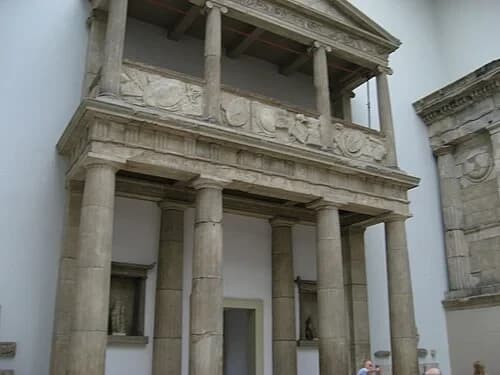
Upper City Gate
This gate was the grand entrance to the most sacred and intellectual part of the city. As you passed through it, you were leaving the public spaces and entering the courtyard of the Temple of Athena and the Great Library. The architecture of the gate was intentionally designed to create a sense of transition and anticipation. Visitors would walk through a relatively dark, narrow passage before emerging into the bright, open courtyard. If you look at the carvings on the upper level, you can see depictions of captured enemy weapons and armor. These reliefs were a constant reminder of the military power of the Attalid dynasty and their role as protectors of Greek civilization. The gate wasn't just a functional doorway; it was a celebratory monument. While the original structure was moved and reconstructed in Berlin during the nineteenth century, the foundations remain here, showing the exact path ancient scholars and priests would have taken. It marked the threshold into a space where the city’s most precious treasures—its books and its oldest religious traditions—were kept under the watchful eye of the goddess of wisdom.
The Great Altar (Pergamon Altar)
Once the site of the world-famous Gigantomachy frieze, only the massive horseshoe-shaped foundations remain here today.
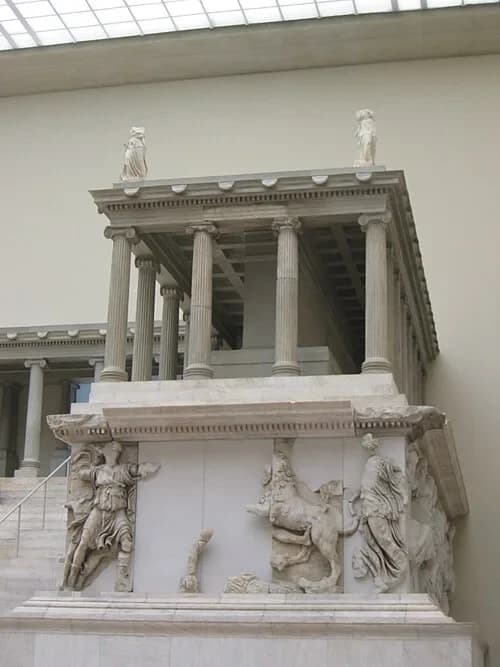
The Great Altar of Pergamon
The Great Altar of Pergamon is home to one of the most famous examples of ancient sculpture: the Gigantomachy frieze. This hundred-and-thirteen-meter-long marble relief depicts the mythic battle between the Greek gods and the giants. The detail is extraordinary, featuring figures with snakes for legs, bulging muscles, and faces contorted in agony. This style, known as 'Pergamene Baroque,' was revolutionary for its time because it prioritized intense emotion and dynamic movement over classical calm. For the people of Pergamon, this wasn't just an old myth. The battle served as a powerful metaphor for their own real-world struggles to defend their city and civilization against 'barbarian' invaders from the north. The carvings are so deep that many figures appear to be completely detached from the background, a technique that creates a sense of three-dimensional drama. This artistic style had a profound impact on later Western art, directly influencing world-famous works like the Laocoön statue. Every inch of the relief is filled with action, capturing a cosmic struggle that defined the identity of the kingdom and its place as a defender of order against chaos.
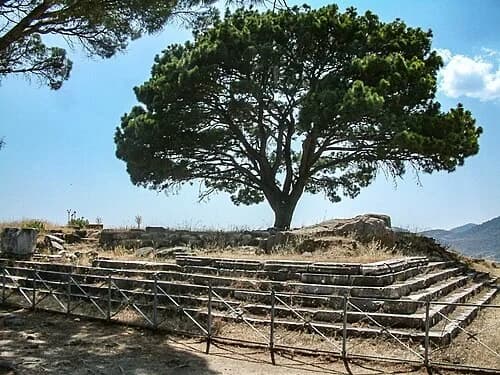
Site of the Great Altar
You are looking at the footprint of a monument so imposing that many scholars believe it to be the 'Throne of Satan' mentioned in the Biblical Book of Revelation. In antiquity, this was a massive open-air platform where the smoke from burnt sacrifices would have been visible across the valley for miles. While the intricate carvings are preserved elsewhere, the scale of this structure is best understood here. A grand staircase, twenty meters wide, once led up to the top level where priests performed their rituals in full view of the city. Today, the space is marked by a single large pine tree growing in the center, a quiet contrast to the bustling activity of the past. The altar functioned as a spiritual anchor for Pergamon, reinforcing the city's identity through public displays of piety and sacrifice. The foundation stones allow us to trace the unique horseshoe shape that distinguished this altar from more traditional temple designs found in other Greek cities.
Upper Agora of Pergamon
The commercial and social heart of the upper city, where citizens gathered to trade and discuss politics.
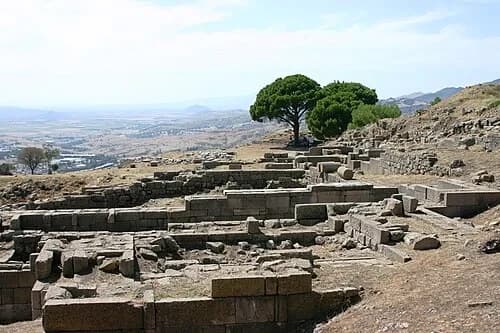
Agora of Pergamon
Think of this space as the high-end retail district for Pergamon's elite. Unlike the bustling, often chaotic marketplaces located further down the hill, this upper Agora was a tightly controlled environment. It was surrounded by elegant shops where the wealthy residents of the Acropolis could purchase imported luxuries like fine silks and exotic spices. If you look closely at the stone floor, you can still find the remains of the stalls and the ancient drainage channels used to keep the area clean. This was a place for political deal-making as much as for commerce, where members of the royal court would gather under the shade of the long colonnades to see and be seen. The architectural layout reflects the city's strict social hierarchy, ensuring that the most important citizens had a private space to conduct their business away from the common population. The stone drainage channels are still clearly visible in the floor of the northern section.
Temple of Hera
As you begin your descent to the Middle City, you pass this sanctuary dedicated to the queen of the gods.
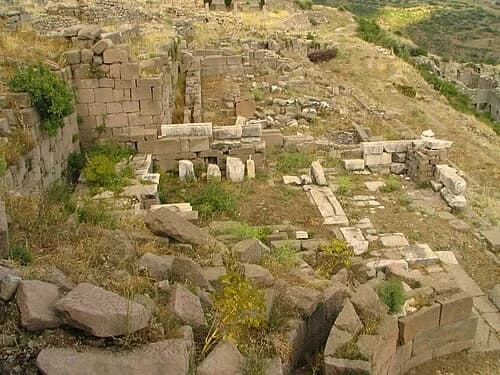
Temple of Hera
This temple sits on a dedicated terrace tucked between the upper and middle sections of the city. It was a particularly important sanctuary for royal women, who came here to offer sacrifices to Hera, the protector of marriage and childbirth. Compared to the massive Roman structures nearby, like the Temple of Trajan, this building has a much smaller and more compact design. This reflects its role as a more intimate center for the religious and social lives of the city's aristocracy. From this specific terrace, the view looks directly down over the vast Gymnasium complex below, where the city’s youth underwent rigorous training. The temple’s placement allowed those participating in rituals to overlook the development of the next generation of leaders. Its foundations and scattered architectural fragments show the transition between the different levels of the city, highlighting how religion was woven into every terrace of this steep mountain. If you look down from the edge, you can see the distinct levels of the gymnasium complex starting just below.
Pergamon Gymnasium
A massive three-tiered complex serving the youth, adults, and elders of Pergamon for athletic and intellectual training.
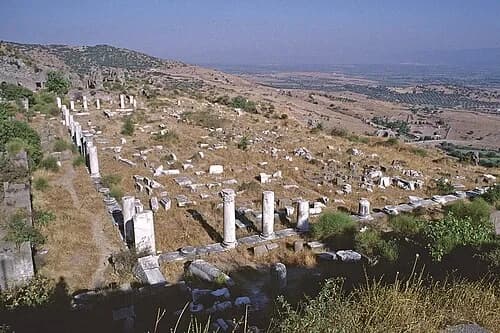
Pergamon Gymnasium
Education in the ancient world was a demanding blend of physical grit and intellectual study, and nowhere was this more apparent than in this three-level complex. The structure followed a strict social hierarchy: the lowest level was reserved for young boys, the middle for teenagers, and the top for adults. Within these walls, students would spend an hour wrestling in the dirt before moving directly into a lecture hall to study philosophy or rhetoric. This holistic approach aimed to mold the city’s youth into balanced citizens. One of the most impressive features of the site is the stadium track, which stretches over two hundred meters in length. As you look across the ruins, try to spot the remains of the lecture benches and the areas once used for oiling and cleaning the skin after exercise. The scale of the Gymnasium underscores the priority the Attalid kings placed on civic excellence. The track, which stretches over two hundred meters, was where the final phase of athletic training took place.
Want to hear the rest?
Download the Stanza app to unlock all 20 stops and the complete guided audio tour.
Frequently Asked Questions
How long does the Pergamon audio tour take?
The Pergamon audio guide includes 20 narrated stops. Most visitors spend 45 minutes to 1.5 hours exploring the complete tour, though you can listen at your own pace and skip or revisit any stop.
Is the Pergamon audio guide available in my language?
Stanza supports 15 languages: English, Spanish, French, German, Italian, Portuguese, Russian, Japanese, Chinese, Korean, Arabic, Hindi, Polish, Dutch, Hebrew. Check the guide in the app to confirm the languages currently available for this tour.
Can I use the audio guide offline at Pergamon?
Yes! Download the complete Pergamon tour — including all audio, maps, and images — before your visit. The Stanza app works completely offline, so you don't need WiFi or mobile data at the venue.
How much does the Pergamon audio guide cost?
The Stanza app is free to download. The current listed price for the Pergamon audio guide is $0.99; app-store region and currency may affect the final price.
How do I use the Stanza audio guide at Pergamon?
Download the free Stanza app, search for "Pergamon", and download the tour. When you arrive at the venue, the app uses GPS to detect your location and automatically plays the relevant narration as you move between points of interest — completely hands-free.
What makes the Stanza audio guide different from other Pergamon tours?
Stanza offers GPS-triggered narration that plays automatically as you walk through Pergamon — no need to manually select stops. The tour is available in 15 languages, works fully offline, and includes 20 expertly narrated stops with images and historical context.
What other audio guides are available near Pergamon?
Stanza offers multiple audio guides in Bergama, Turkey and nearby areas. After downloading the app, browse the map to discover all available tours near Pergamon. Each guide can be downloaded for offline use.