Stanza · Audio guide
Coit Tower Audio Guide
A place to remember. A story to take with you.
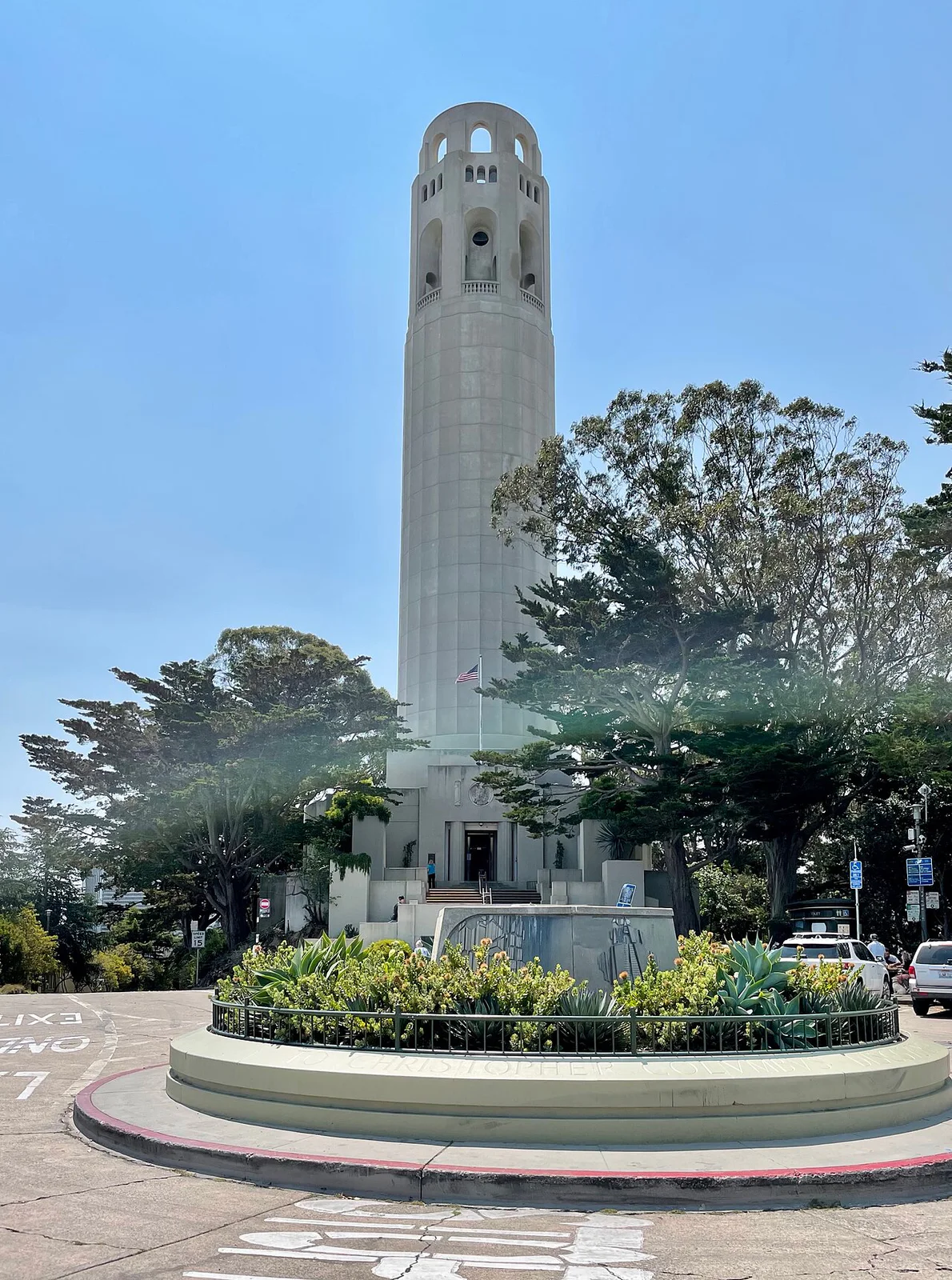
Coit Tower is a 210-foot tower located in the Telegraph Hill neighborhood of San Francisco. It was built between 1932 and 1933 using a bequest to beautify the city.
Download Stanza, then search for “Coit Tower”.
About the tour
One guide. Your kind of visit.
Coit Tower is a 210-foot tower located in the Telegraph Hill neighborhood of San Francisco. It was built between 1932 and 1933 using a bequest to beautify the city.
Ready when you are.
- 01Get the free Stanza app.
iOS & Android
- 02Find your guide.
“Coit Tower”
- 03Download before you go.
Works offline
Audio guide / 9 narrated stops
Inside the guide
Get to know a few of the stories before you go. Open a stop to read more.
01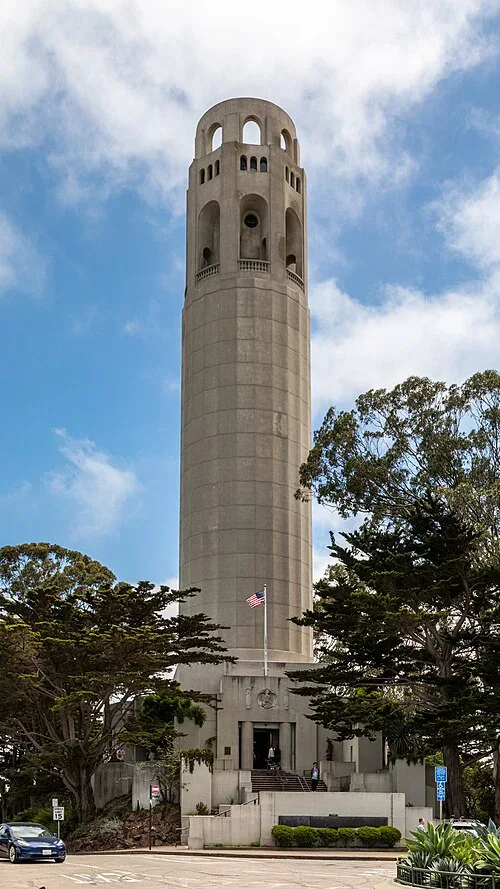 Pioneer Park Approach and Art Deco Facade
Coit Tower from the Approach
Coit Tower rises 210 feet above Telegraph Hill, in San Francisco's Pioneer Park. It is an Art Deco tower of unpainted concrete, so its grey is the material itself. The main shaft tapers as it climbs, its surface fluted with vertical grooves. Near the top, a row of arched openings breaks up the smooth wall. The tower was dedicated in October 1933, and a bequest from Lillie Hitchcock Coit paid for it. The design competition was won by the architect Arthur Brown Jr. The architect Henry Temple Howard is also credited as a designer. The tower is built from three nested concrete cylinders. The outer one is the tapering shaft that carries the viewing deck. The middle one holds a stairway, and the innermost holds the elevator. A story says the tower was designed to look like a fire hose nozzle. The story credits Coit's fondness for the city's firefighters. Stories like that are called apocryphal, meaning their truth is doubtful. The resemblance is coincidental.
Listen in the appDietmar Rabich · CC BY-SA 4.0
02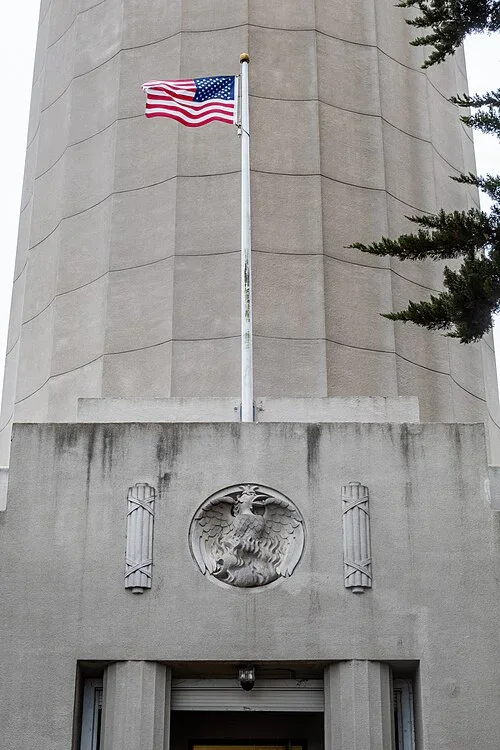 Pioneer Park Approach and Art Deco Facade
Main Entrance and Phoenix Relief
When she was fifteen, Lillie Hitchcock Coit watched a fire company answer a call on Telegraph Hill. The Knickerbocker Engine Company Number Five was short of hands. She threw her school books to the ground and pitched in. She shouted to bystanders to help get the engine up the hill, so the first water could reach the blaze. After that, she became the company's mascot. Her parents could barely keep her from running to every fire bell. She often rode with the company in parades, and through her youth and adulthood she was recognized as an honorary firefighter. She also wore trousers and smoked cigars, long before that was socially acceptable. She dressed like a man to gamble in the men-only places of North Beach. Coit died in 1929. Her will left money for a memorial to the city's volunteer firefighters, in the form of statues in Washington Square, and for a gift to beautify the city. The tower came from that gift. It is often said the tower honors the volunteer firemen, but that is not accurate. Above the main doorway, a round relief shows a bird with spread wings over flame-like shapes. The architect commissioned the sculptor Robert Boardman Howard to make it, and it was cast as part of the building. It is identified as a phoenix, the legendary bird said to rise from fire.
Listen in the appDietmar Rabich · CC BY-SA 4.0
03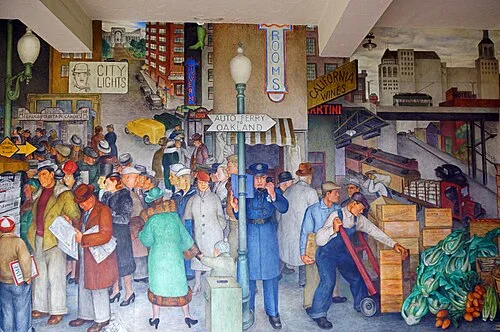 Ground Floor Rotunda: Social Realism and California Life
City Life (Victor Arnautoff)
The ground floor murals were a pilot project for the Public Works of Art Project. That federal program was the first of the New Deal's programs to employ artists. Ralph Stackpole and Bernard Zakheim won the commission in 1933, and they supervised the painters. Many of the painters were teachers or students at the California School of Fine Arts. Victor Arnautoff's City Life is a crowded street scene in San Francisco's Financial District. It is based on the corner of Montgomery and Washington streets. Men in hats and coats fill the sidewalk, and many hold newspapers. Signs read City Lights and Auto Ferry to Oakland. A police officer in a dark blue uniform stands near the center. A worker wheels a hand truck of crates past stacks of green melons. A news stand rack holds copies of The New Masses and The Daily Worker.
Listen in the appAllie_Caulfield · CC BY 2.0
04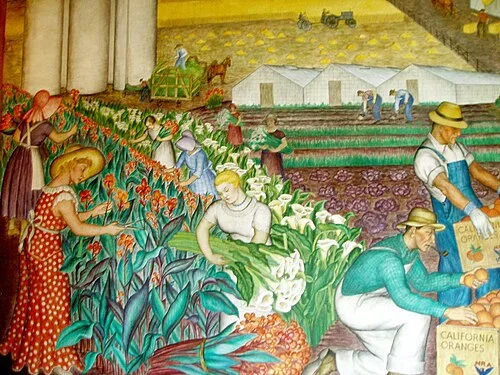 Ground Floor Rotunda: Social Realism and California Life
Agriculture in California (Maxine Albro)
Farm work is an important theme in these murals, alongside industry in the city. Maxine Albro painted this panel of California's farms and flower fields. A woman in a red dress with a spotted pattern stands among bright red and orange flowers. Beside her, another worker gathers armfuls of white lilies. Farther back, rows of crops run toward long white greenhouses, and workers bend over the fields. A man in a straw hat kneels beside a crate marked CALIFORNIA ORANGES. Painters of American Social Realism in the 1930s often made ordinary working people their subject, and this panel does the same. Albro painted many of her friends into the scene. Her future husband, Parker Hall, is shown beside trays of apricots.
Listen in the appMaxine Albro · Public domain
05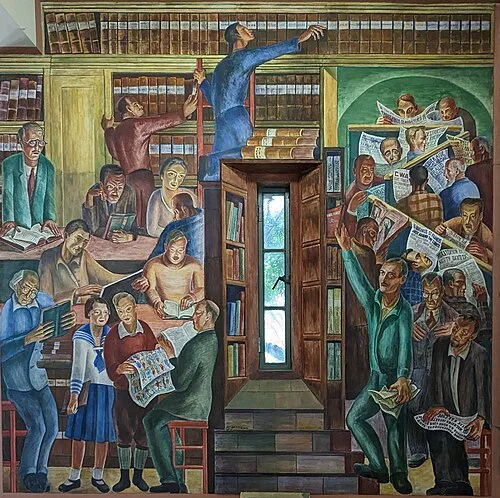 The Library Alcove and the 1934 Red Scare
Library (Bernard Zakheim)
Bernard Zakheim's Library panel shows workers of all races as equals. Readers crowd the tables, and a man on a ladder reaches for books high on the shelves. The painters held leftist and Marxist ideas to differing degrees, and their paintings express those ideas strongly. Among the readers, a fellow painter crumples a newspaper in one hand. With the other, he reaches for a book said to be Karl Marx's Das Kapital. In 1934, a West Coast waterfront strike was under way at the foot of Telegraph Hill. Officials, shipping companies, and the press grew afraid of communist agitation. In June, a banker with great power over the project's money asked for the art to be inspected. The museum director who checked it telegraphed back a warning. Some details and symbols, his telegram said, might be read as communist propaganda. Newspaper editors would turn against the whole project unless those details were removed. The official opening, planned for July seventh, was canceled. The tower was closed, and its windows were blocked so passersby could not see in. Clifford Wight refused to remove the hammer and sickle from his fresco. Federal officials decided the offending parts had to be painted over. Sixteen artists signed a statement that the hammer and sickle “has no place in the subject matter assigned.” In the end, only the hammer and sickle and a banner for the Western Worker, a communist periodical, were removed. The tower finally opened in October 1934.
Listen in the appPhoto: Mliu92 · CC BY-SA 3.0
06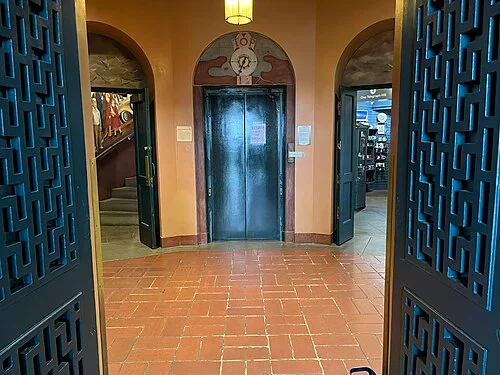 The Library Alcove and the 1934 Red Scare
Elevator Lobby
This is the elevator lobby of Coit Tower, and the tower has had its own residents. For a time, a former army lieutenant and his wife lived in a small second-floor apartment. They were paid to guard the art and the building. No one knows when the couple moved out. In the 1980s, the city renovated the art and once again hired a permanent guardian, Tim Lillyquist. He became the last permanent resident of the tower. The competition design had put a restaurant in the tower, but the final version made that space an exhibition area. The rotunda at the base holds display space and a gift shop. Most of the murals are fresco, which means paint applied to wet plaster. The exceptions are Jane Berlandina's Home Life, in egg tempera, and the works in the elevator foyer, which are oil on canvas. Most of the murals were restored in 1990. They were restored again in 2014, cleaned and touched up where they had scratches. Lucien Labaudt's Powell Street runs along the spiral staircase up to the observation platform. It was never restored. Instead, it was painted over with a durable epoxy coating. In 2012, San Francisco voters approved Proposition B, the Coit Tower Protection Initiative. It requires the city to pay for preserving the murals and the building.
Listen in the appPhoto: Cornflower123 · CC0
07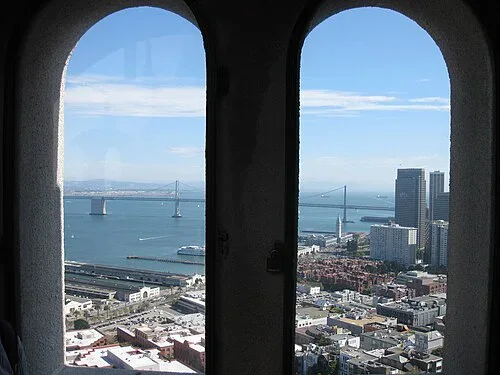 Summit Observation Arcade: 360-Degree Bay Panorama
View from the Observation Arcade
One description calls Telegraph Hill the most optimal spot for a full circle view of San Francisco Bay and five surrounding counties. Through the two arched openings, a long bridge crosses the water, and a ship sits near the waterfront piers. From the observation level, the view takes in the crooked Lombard Street, Nob Hill, and Russian Hill. Angel Island and Alcatraz lie out on the bay. In 1849, an observation deck on the hill passed word of incoming ships to the city. It used an optical semaphore, a system of visible signals. In 1853, an electrical telegraph replaced it. A storm destroyed that telegraph in 1870. A state plaque for Telegraph Hill, in the tower's lobby, marks the site of the original signal station.
Listen in the appderor_avi · CC BY-SA 3.0
08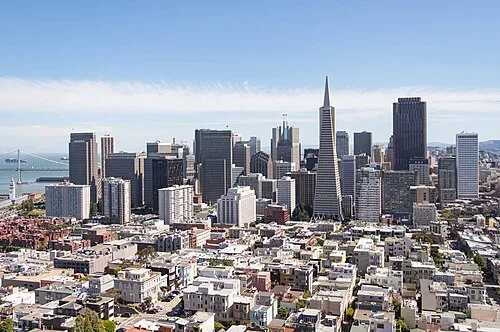 Summit Observation Arcade: 360-Degree Bay Panorama
Downtown Skyline from the Summit
Coit Tower has been on screen since the 1930s, and the downtown skyline in front of you is part of that setting. In 1936, in the film After the Thin Man, the roundabout in front of the tower served as the driveway of the San Francisco home of the characters Nick and Nora Charles. From 1967 to 1975, images of the tower appeared in the opening footage of most episodes of the television series Ironside. The best known appearance is in Alfred Hitchcock's 1958 film Vertigo, which is set largely in San Francisco. In one exchange, Madeleine tells Scottie she used the tower to find his apartment, because she did not know his street address. Scottie replies that it is the first time he has been grateful for the tower. The art director, Henry Bumstead, remembered that Hitchcock insisted the tower be seen from that apartment.
Listen in the appSupercarwaar · CC BY-SA 4.0
09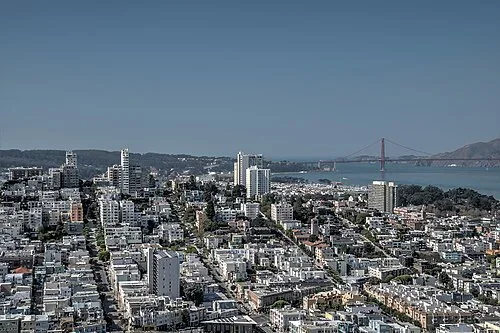 Summit Observation Arcade: 360-Degree Bay Panorama
How the Tower Came to Telegraph Hill
Across the water, the red towers of the Golden Gate Bridge rise above the bay, and the hillsides below are packed with houses. The tower you are in was nearly a road. When Lillie Coit died, she left one third of her fortune, 118,000 dollars, for adding to the beauty of the city she had always loved. The county supervisors proposed spending it on a road at Lake Merced. Her executors objected: they wanted a memorial that would be a thing in itself, not one more piece of public works. Herbert Fleishhacker, president of the Art Commission, suggested a monument on Telegraph Hill, and the executors approved. The city added 7,000 dollars, and a design competition followed. A month after the tower was dedicated, the owner of the Dead Fish Cafe, an artists' restaurant on the hill, was charged with firing a pistol at it. The owner, Honore Bowlby-Gledhill, was charged under the name Helen Smith, and had objected that the tower looked like a silo.
Listen in the appPhoto: Dsdugan · CC0
Coit Tower
Frequently asked questions
How much does the guide cost?
Free app download. Listed guide price: $0.99. Guide price shown in the app. Audio guide only. Venue admission is separate.
Can I listen without internet?
Yes. Download the guide’s audio, images, and maps in the app before your visit. Your downloaded content is then available offline.
Can I listen in my language?
This audio guide is available in 15 languages, including English.
Do I need to follow a schedule?
No. This is a self-guided experience. Choose your stops, pause whenever you like, and return to a story at your own pace.
At your own pace
Explore Coit Tower.
Download Stanza, then search for “Coit Tower”.
Free app download · Guide price shown in the app
Keep exploring
Audio guides — United States
San Francisco · 3 km
Alcatraz Island, Alcatraz
Content & sources
Photo: Frank Schulenburg · CC BY-SA 4.0
San Francisco · 7 km
Golden Gate Bridge
Content & sources
Rich Niewiroski Jr. · CC BY 2.5
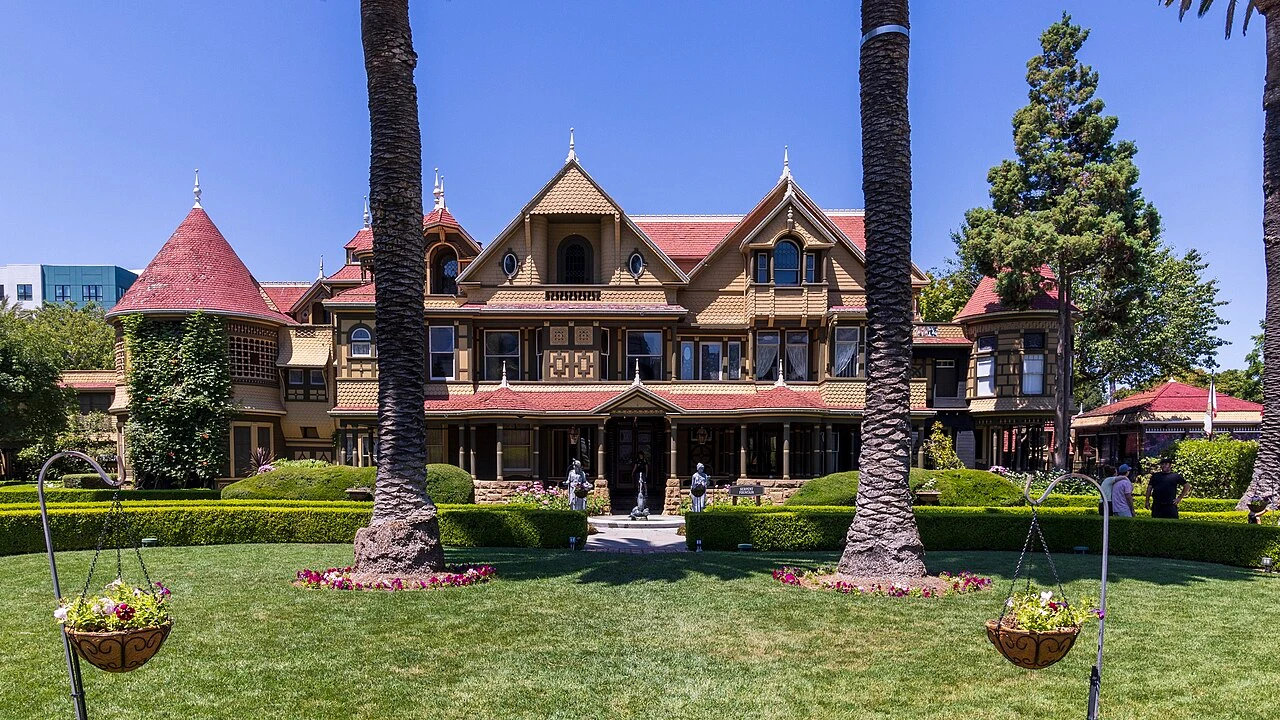
San Jose · 67 km
Winchester Mystery House
Content & sources
Photo: The wub · CC BY-SA 4.0
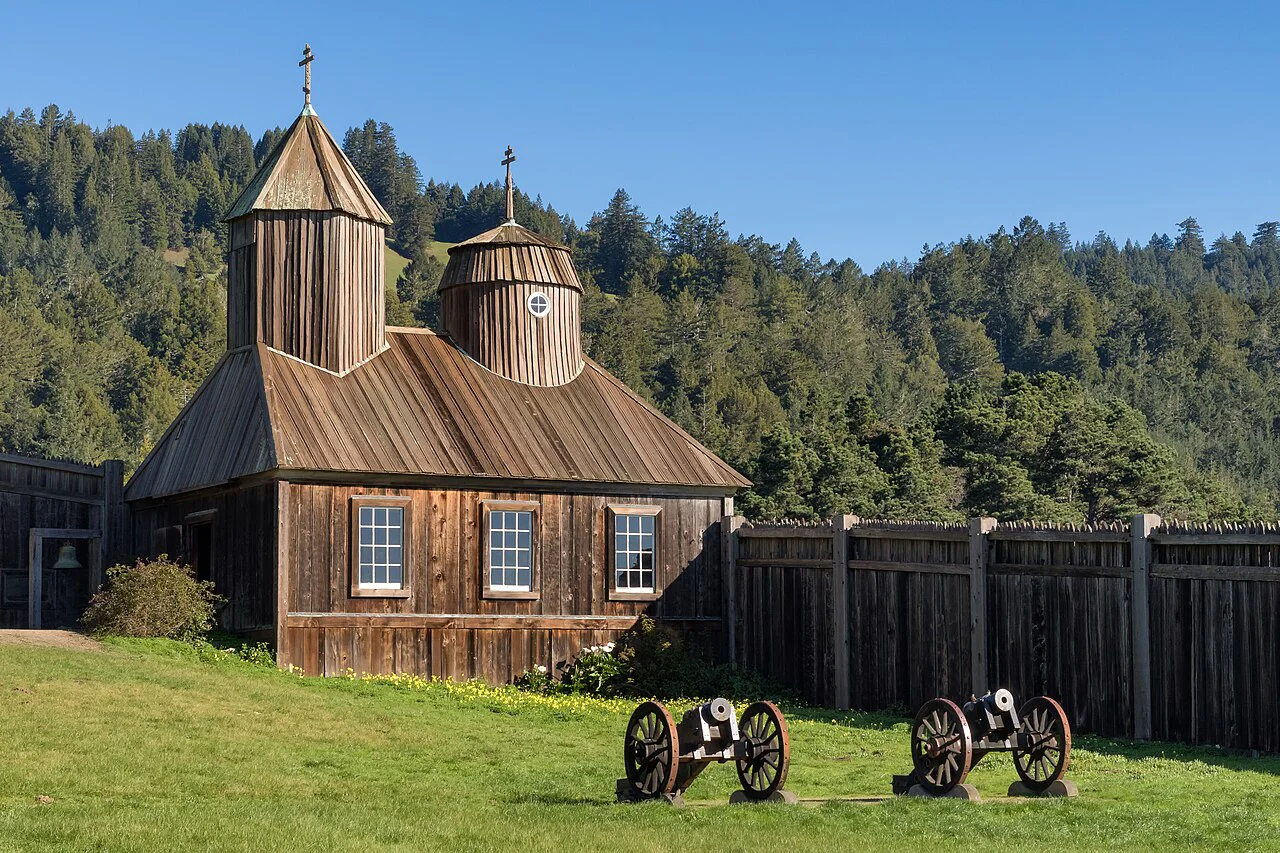
Sonoma County · 108 km
Fort Ross, California
Content & sources
Photo: Frank Schulenburg · CC BY-SA 4.0
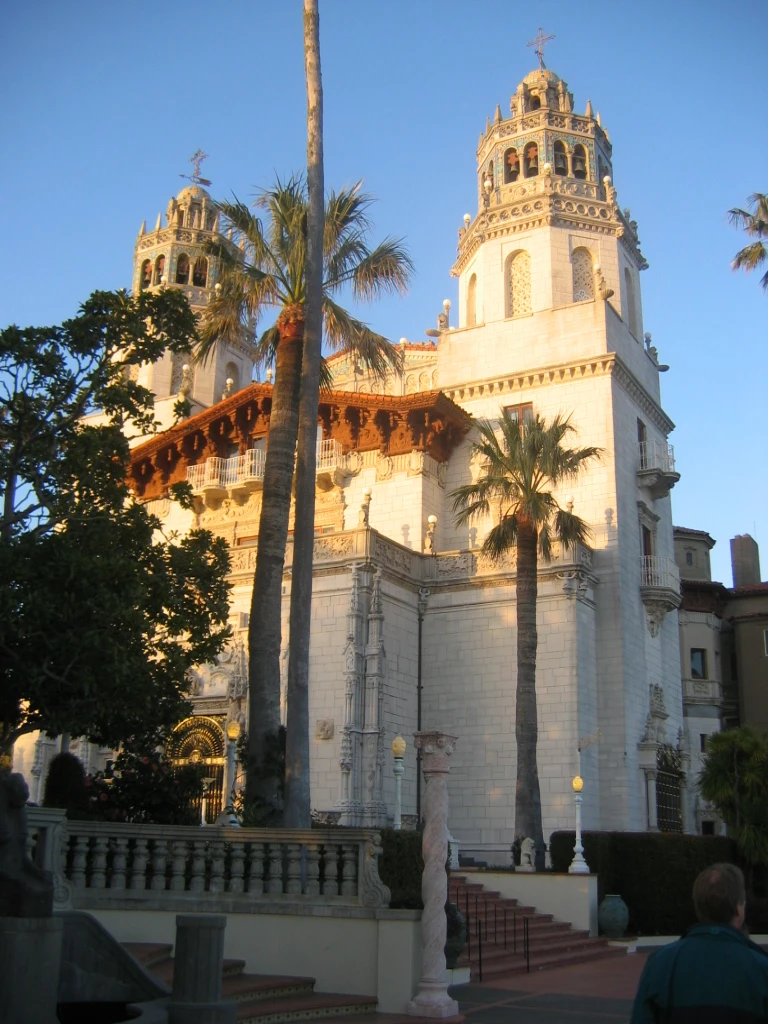
San Simeon
Hearst Castle
Content & sources
No machine-readable author provided. Urban~commonswiki assumed (based on copyright claims). · CC BY-SA 3.0