Languages
15Wiener Staatsoper Audio Guide
Wiener Staatsoper is a landmark in Vienna, Austria. Explore it with Stanza's GPS-triggered offline audio guide — available in 15 languages.
Quick Facts
24
Stops
15
Languages
100%
Offline
📍 Vienna, Austria · 48.2033°N, 16.3692°E
About Wiener Staatsoper
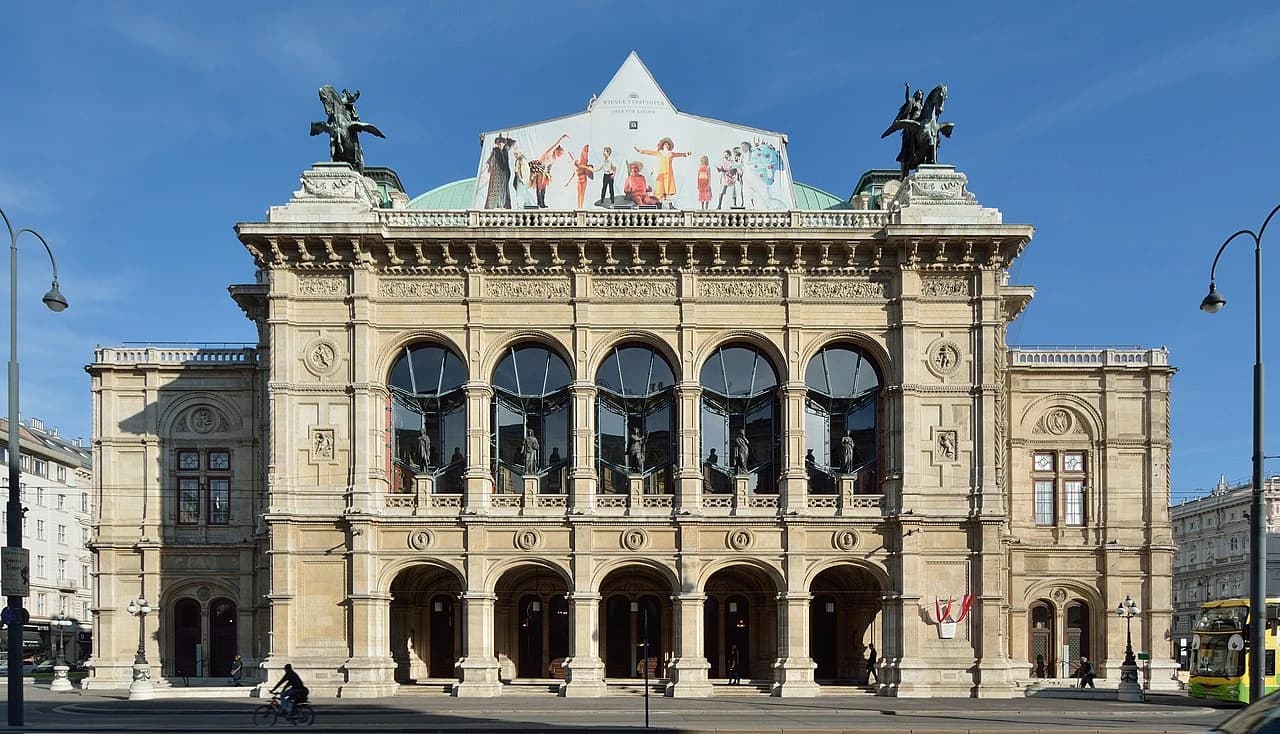
The Vienna State Opera House is a renowned opera house located in Vienna, Austria. It is one of the world's leading opera companies and a major cultural landmark in the city.
Wiener Staatsoper is also known as Vienna Operahouse, K. K. Hof-Operntheater, KK Hof Opera Theater, Wiener Oper, and 8 other names in various languages.
This self-guided audio tour features 24 narrated stops organized across 6 sections, including The Renaissance Revival Facade, Opernbrunnen and Karajan-Platz, The Grand Staircase and Vestibule, The Schwind Foyer, The Gustav Mahler Hall, The Auditorium and Standing Room. As a opera house, Wiener Staatsoper offers a unique cultural experience in the heart of Vienna, Austria.
The Stanza audio guide is available in 15 languages and works entirely offline — download the complete tour including audio narration, maps, and images before your visit. As you walk through Wiener Staatsoper, GPS-triggered narration plays automatically at each point of interest.
Last updated:
What you will hear
The Renaissance Revival Facade
Start with the grand exterior to establish the architectural style and the tragic history of the architects, Sicardsburg and van der Nüll. Historical images and architectural drawings provide context for its 1869 inauguration.
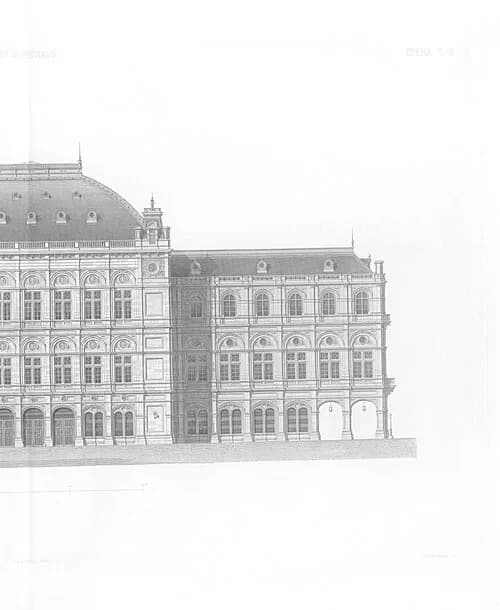
Architectural Section Study
This architectural drawing from 1885 provides a detailed look at the side elevation of the house, emphasizing the repetitive arches of the loggia and the decorative stonework. The design was carefully calculated to echo the grandeur of the Italian Renaissance, a choice that signaled Vienna's ambition to be recognized as the global center for musical excellence. By using classical elements like the rounded arches and ornate pilasters, the architects created a sense of timelessness and stability. This study shows the complex layering of the facade, where every window and cornice is treated with the same level of detail as a standalone work of art. The loggia arches were particularly important, as they provided a sheltered outdoor space for guests during intermissions, allowing them to overlook the Ringstrasse. The stonework includes various textures and relief carvings that catch the light at different angles throughout the day. These drawings were essential for maintaining the consistency of the design during the long eight-year construction period, ensuring the vision of Sicardsburg and van der Nüll was followed precisely.
Opernbrunnen and Karajan-Platz
Focus on the social space surrounding the opera house, featuring the Opernbrunnen fountain and the square named after the legendary conductor Herbert von Karajan.
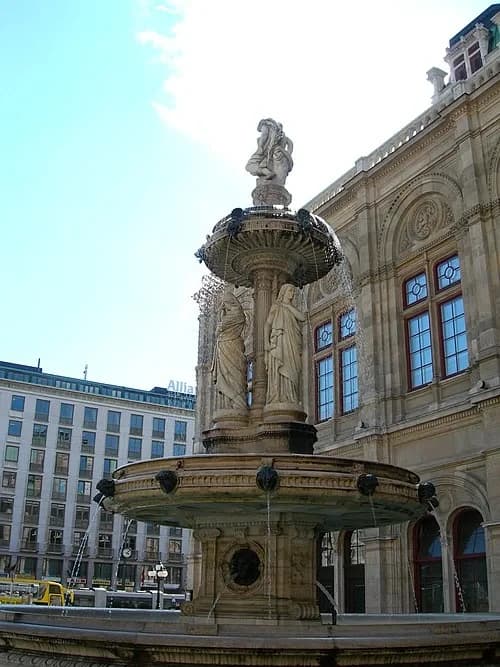
The Opera Fountain
Known as the Opernbrunnen, this stone fountain is a key feature of the building's public footprint. It was designed to make the high art of the interior accessible to every person walking along the Ringstrasse. The structure is adorned with allegorical figures that represent the core pillars of the opera house: music, dance, and drama. These figures are depicted in classical poses, holding symbols associated with their respective crafts. For example, the figure representing music is often seen with a lyre or similar instrument. By placing these sculptures outside in a functional water feature, the architects extended the building’s cultural reach beyond the paying audience in the auditorium. The fountain served as a social gathering point in the late 19th century and continues to be a landmark for visitors today. Its presence provides a cooling effect and a moment of aesthetic contemplation before guests enter the grand foyer. The stone used in the fountain is designed to withstand the Viennese elements, though decades of weather have given it a distinctive aged character.
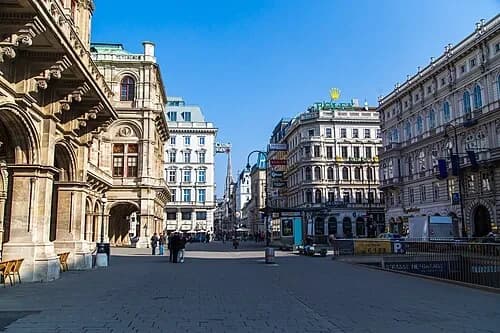
Herbert von Karajan Square
The space you see here is officially known as Herbert-von-Karajan-Platz. It is named in honor of one of the most famous and influential conductors of the 20th century. Herbert von Karajan served as the artistic director of the Vienna State Opera from 1956 to 1964, a period often remembered for its high artistic standards and ambitious productions. Karajan was known for his pursuit of musical perfection and his early adoption of new technologies for recording and broadcasting opera. This square acts as a vital transition point, moving people from the bustling traffic of the Ringstrasse and the narrow streets of the historic center toward the hushed, gilded atmosphere of the opera’s interior. It is often filled with people waiting for performances or tourists admiring the facade. The naming of this space after Karajan in 1996 ensures that the legacy of his leadership remains visible to every visitor. This area is also a popular spot for outdoor broadcasts during the spring and autumn months, when live performances are projected onto a large screen for the public.
The Grand Staircase and Vestibule
This area survived the 1945 bombings and represents the original 19th-century splendor. Look for the marble steps and imperial monograms.
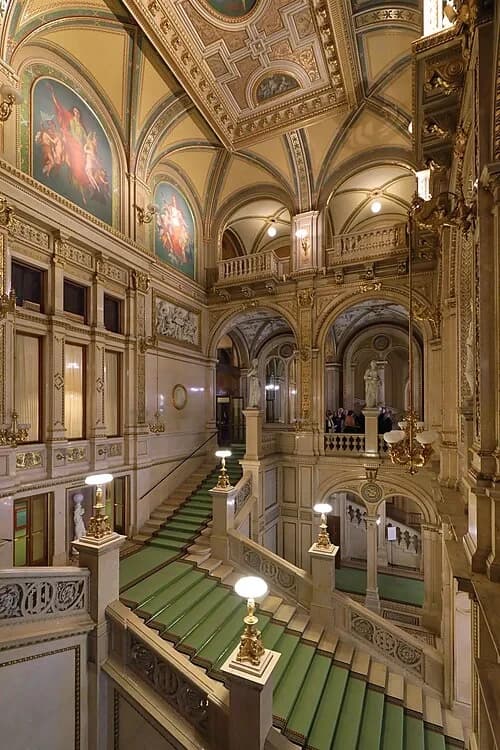
The Grand Staircase
This grand staircase is a significant historical artifact within the building. While much of the opera house was destroyed by Allied bombings in March 1945, this specific area survived largely intact, making it a rare piece of the original 1869 interior. The staircase is constructed using several different colors of marble, creating a rich visual texture that is further enhanced by ornate gold leafing on the balustrades and ceilings. Historically, this area served as much more than just a way to reach the upper floors; it was a primary social stage. During intermissions, the Viennese elite would gather here to see and be seen, showing off their fashion and social standing. The mirrors and wide landings were designed specifically to facilitate these social interactions. Look at the ceiling above to see the frescoes that were carefully restored after the war to match the original designs. The sheer scale and luxury of the space were intended to overwhelm the visitor, signaling that they had entered a realm dedicated to the highest forms of human creativity and imperial prestige.
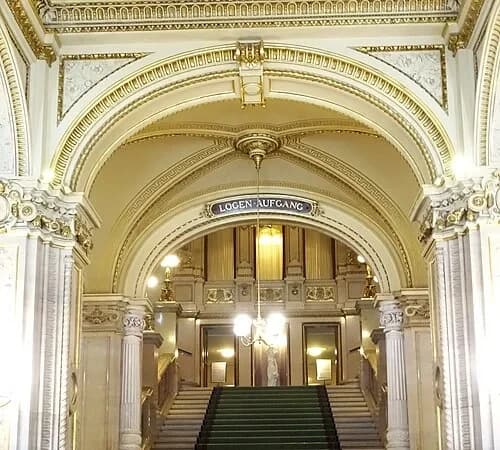
The Loge Entrance
Above this doorway, you can see the sign for the 'Logen-Aufgang,' which translates to the 'Box Entrance.' In the 19th century, the layout of the opera house reflected the rigid social hierarchy of the Austro-Hungarian Empire. While the upper tiers were accessible to the general public via separate entrances, these grand stairways were reserved exclusively for those wealthy enough to own or rent a private box. Owning a loge was a significant status symbol, and entering through these dedicated portals ensured that the elite did not have to mingle with the crowds in the cheaper seats. The decor in these entrance areas is notably more refined and luxurious than in other parts of the house, featuring polished stone and gilded accents. Today, while the social barriers have largely disappeared and the house is open to all, these signs and architectural divisions remain as reminders of the building's aristocratic origins. They illustrate how architecture was used to organize society and reinforce the prestige of the imperial court and its associates during the height of the Ringstrasse era.
The Schwind Foyer
Named after painter Moritz von Schwind, this foyer is a tribute to opera history, particularly Mozart. It serves as a social heart for intermission.
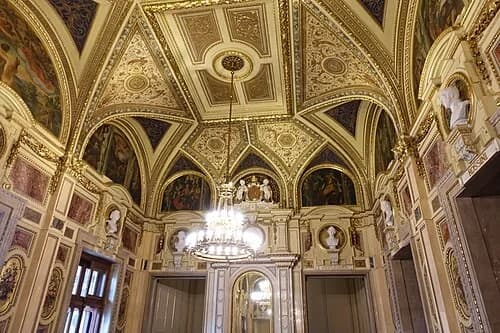
The Schwind Foyer
This elegant space is known as the Schwind Foyer, named after the painter Moritz von Schwind who was responsible for its extensive decoration. The foyer is famous for its vaulted ceilings and the sequence of frescoes that run along its walls. These paintings depict scenes from legendary operas, serving as a visual tribute to the masterpieces performed on the stage just a few meters away. Schwind focused many of these works on the operas of Wolfgang Amadeus Mozart, who is central to the identity of this house. The frescoes are painted in a style that emphasizes drama and narrative, helping guests transition from the outside world into the fictional realms of musical theater. The architectural details of the foyer, including the slender columns and ornate arches, complement Schwind's work and create a sense of being inside a three-dimensional gallery. For many visitors, a stroll through this foyer is a highlight of their intermission, offering a chance to study the stories that have defined the operatic tradition for centuries. The paintings were meticulously maintained to preserve their vibrant colors and historical accuracy.
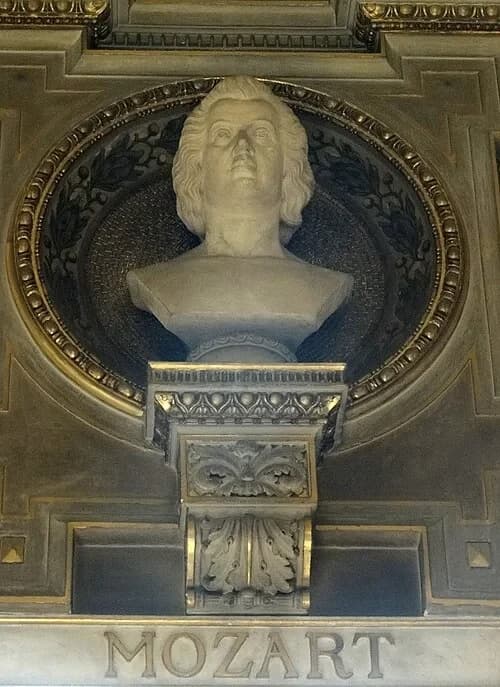
Bust of Mozart
This marble bust depicts Wolfgang Amadeus Mozart, a figure so central to this institution that he is often called the 'genius loci,' or the presiding spirit, of the house. Mozart's connection to Vienna is profound, and his works form the very core of the opera's identity. To honor this legacy, the house maintains what is known as the 'Mozart-Ensemble' tradition. This involves a specific performance style that prioritizes a light, transparent, and chamber-like sound, which is considered essential for capturing the nuances of Mozart’s compositions. The bust itself is placed in a prominent position to remind visitors and performers alike of the high standards set by his genius. This dedication to Mozart isn't just about the past; it influences the casting and conducting choices for his operas today. Many of the world’s greatest Mozart singers have considered this house their artistic home. As you look at the figure, notice the classical style of the carving, which reflects the reverence with which the composer was viewed during the late 19th-century construction of the building.
The Gustav Mahler Hall
Formerly a tea room, this hall commemorates the director who revolutionized the opera's standards. It features tapestries and crystal chandeliers.
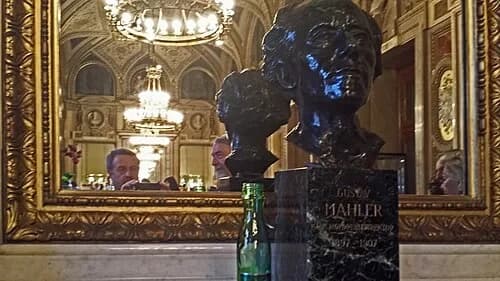
Bust of Gustav Mahler
This bronze bust captures the features of Gustav Mahler, who served as the director of the opera from 1897 to 1907. It was created by the legendary French sculptor Auguste Rodin, a testament to Mahler’s international standing during his lifetime. Mahler’s decade-long tenure was transformative for the institution. He is credited with modernizing and professionalizing almost every aspect of the house. He famously demanded absolute discipline from both the performers on stage and the audience in the seats, even going so far as to forbid latecomers from entering the auditorium until an intermission—a practice that was unheard of at the time. Beyond discipline, Mahler collaborated with innovative designers like Alfred Roller to move away from cluttered, realistic stage sets toward more symbolic and atmospheric designs. This revolution in stagecraft helped redefine how opera was staged throughout Europe. Rodin's sculpture captures the intensity and focused energy that Mahler was known for, preserving the likeness of a man who fundamentally changed the artistic trajectory of this house.
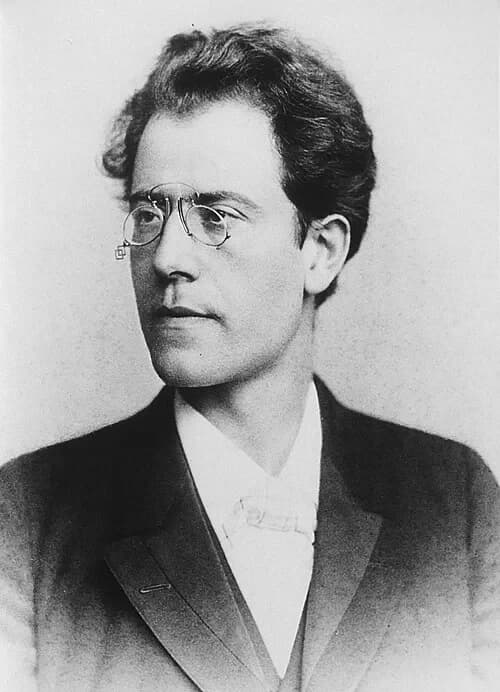
Portrait of Gustav Mahler
This photograph, taken in 1896, shows Gustav Mahler shortly before he began his legendary ten-year run as the director of the Vienna State Opera. His focused expression hints at the personal intensity and uncompromising artistic vision that he brought to the role. One of Mahler's most significant contributions was the development of the 'Mozart-Ensemble' concept. He worked tirelessly to rebuild the opera's reputation by refining the orchestra and singers into a cohesive unit that could perform with the precision and clarity he believed the music deserved. Under his leadership, the Vienna State Opera rose to become arguably the most important and artistically rigorous house in the world. He was not only a director but also a world-class composer and conductor, roles that informed his deep understanding of musical drama. This portrait reminds us that the house’s global prestige is built upon the work of individuals like Mahler, who was willing to challenge established traditions in the pursuit of artistic excellence. His legacy still influences the high standards expected by audiences today.
The Auditorium and Standing Room
The heart of the house, where the repertory system and standing room culture create a unique atmosphere. Explain the 567 standing room places and the 1,709 seats.
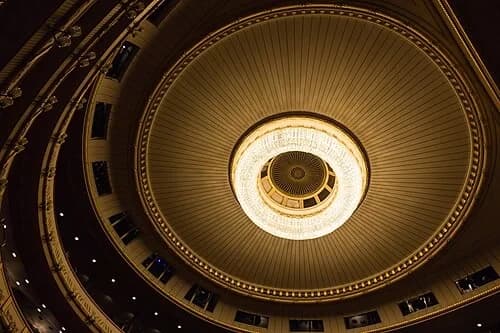
The Main Chandelier
Dominating the ceiling of the auditorium is the massive central chandelier, a feat of mid-century engineering. Installed during the 1955 reconstruction, this luminaire replaced the original 1869 version which was lit by gas. The current chandelier weighs approximately three tons and is outfitted with over 1,000 individual bulbs, creating a brilliant halo over the audience. Its design is notably more streamlined and modern than its predecessor, reflecting the aesthetic shifts of the 1950s while still providing the necessary grandeur for a world-class opera house. During the overture, the chandelier is slowly dimmed and raised slightly toward the ceiling to improve the acoustics and sightlines for those in the highest galleries. Maintenance of such a large object is a major logistical undertaking; it is lowered to the floor once a year for cleaning and bulb replacement. The light it casts is designed to be warm and inviting, illuminating the red velvet and gilded details of the tiers below. It hangs as a permanent fixture of the 1955 reopening, serving as one of the primary light sources for the thousands of guests who fill the house each season. Its scale is best appreciated from the upper galleries, where you can see the complexity of its structure.
Want to hear the rest?
Download the Stanza app to unlock all 24 stops and full GPS-guided navigation.
Frequently Asked Questions
How long does the Wiener Staatsoper audio tour take?
The Wiener Staatsoper audio guide includes 24 narrated stops. Most visitors spend 45 minutes to 1.5 hours exploring the complete tour, though you can listen at your own pace and skip or revisit any stop.
Is the Wiener Staatsoper audio guide available in my language?
Stanza supports 15 languages: English, Spanish, French, German, Italian, Portuguese, Russian, Japanese, Chinese, Korean, Arabic, Hindi, Polish, Dutch, Hebrew. Check the guide in the app to confirm the languages currently available for this tour.
Can I use the audio guide offline at Wiener Staatsoper?
Yes! Download the complete Wiener Staatsoper tour — including all audio, maps, and images — before your visit. The Stanza app works completely offline, so you don't need WiFi or mobile data at the venue.
How much does the Wiener Staatsoper audio guide cost?
The Stanza app is free to download. The current listed price for the Wiener Staatsoper audio guide is $2.99; app-store region and currency may affect the final price.
How do I use the Stanza audio guide at Wiener Staatsoper?
Download the free Stanza app, search for "Wiener Staatsoper", and download the tour. When you arrive at the venue, the app uses GPS to detect your location and automatically plays the relevant narration as you move between points of interest — completely hands-free.
What makes the Stanza audio guide different from other Wiener Staatsoper tours?
Stanza offers GPS-triggered narration that plays automatically as you walk through Wiener Staatsoper — no need to manually select stops. The tour is available in 15 languages, works fully offline, and includes 24 expertly narrated stops with images and historical context.
What other audio guides are available near Wiener Staatsoper?
Stanza offers multiple audio guides in Vienna, Austria and nearby areas. After downloading the app, browse the map to discover all available tours near Wiener Staatsoper. Each guide can be downloaded for offline use.