Stanza · Audio guide
Museum Folkwang Audio Guide
A place to remember. A story to take with you.
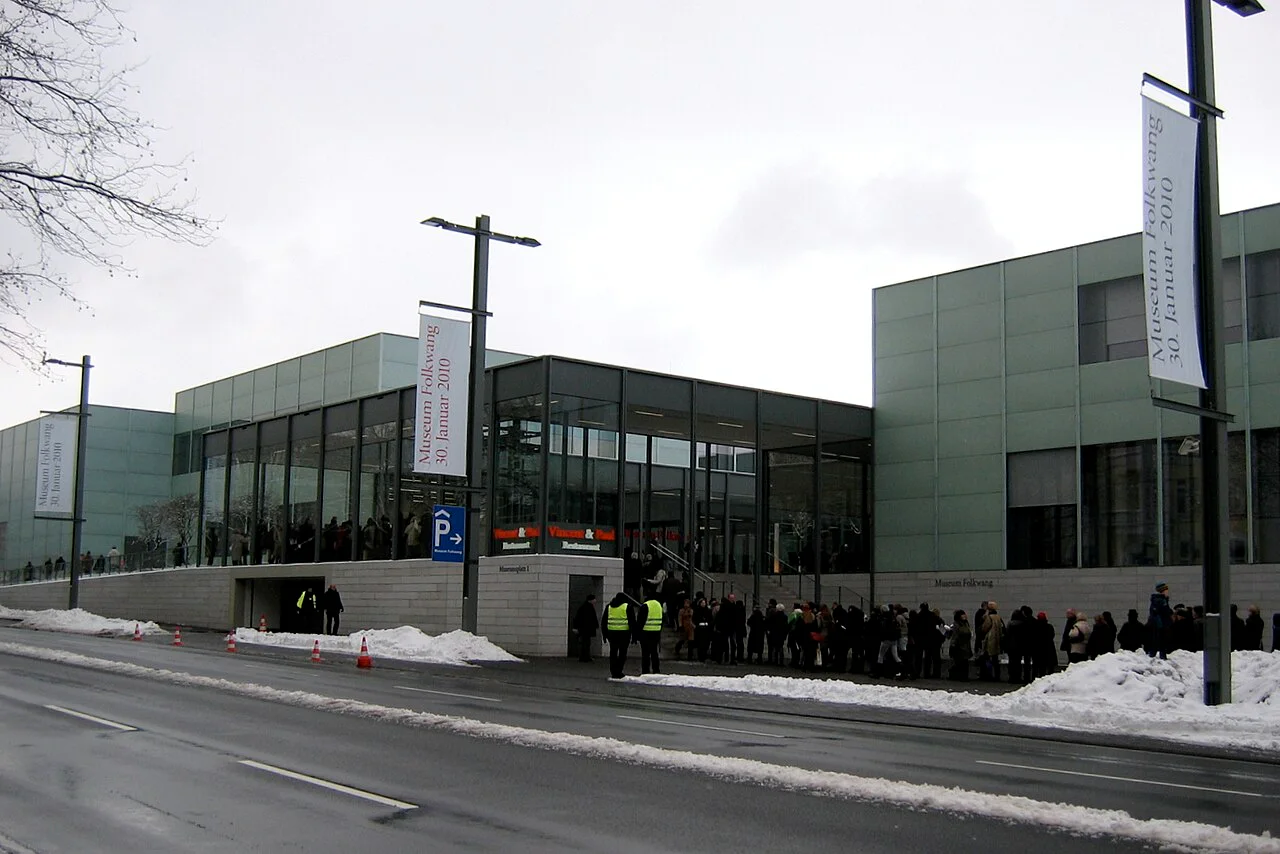
Museum Folkwang is a major collection of 19th- and 20th-century art in Essen, Germany. The museum was established in 1922 by merging the Essener Kunstmuseum, founded in 1906, and the private Folkwang Museum…
Download Stanza, then search for “Museum Folkwang”.
About the tour
One guide. Your kind of visit.
Museum Folkwang is a major collection of 19th- and 20th-century art in Essen, Germany. The museum was established in 1922 by merging the Essener Kunstmuseum, founded in 1906, and the private Folkwang Museum of the collector and patron Karl Ernst Osthaus in Hagen, founded in 1902.
The Museum Folkwang guide tells the stories of 16 artworks, including Lise with a Parasol (Pierre-Auguste Renoir), Mountain Landscape with Rainbow (Caspar David Friedrich), The Age of Bronze (Auguste Rodin), Portrait of Vincent Nubiola (Joan Miró), Mode: Woman with Parasol in front of Milliner's Shop (August Macke), Woman in Front of the Setting Sun (Caspar David Friedrich), Ecce homo (Honoré Daumier), and The Wheatfield behind Saint Paul's Hospital with a Reaper (Vincent van Gogh). Every artwork is free to hear in the Stanza app until 1 January.
Ready when you are.
- 01Get the free Stanza app.
iOS & Android
- 02Find your guide.
“Museum Folkwang”
- 03Download before you go.
Works offline
Audio guide / 16 artworks
Inside the guide
Get to know a few of the stories before you go. Open a stop to read more.
01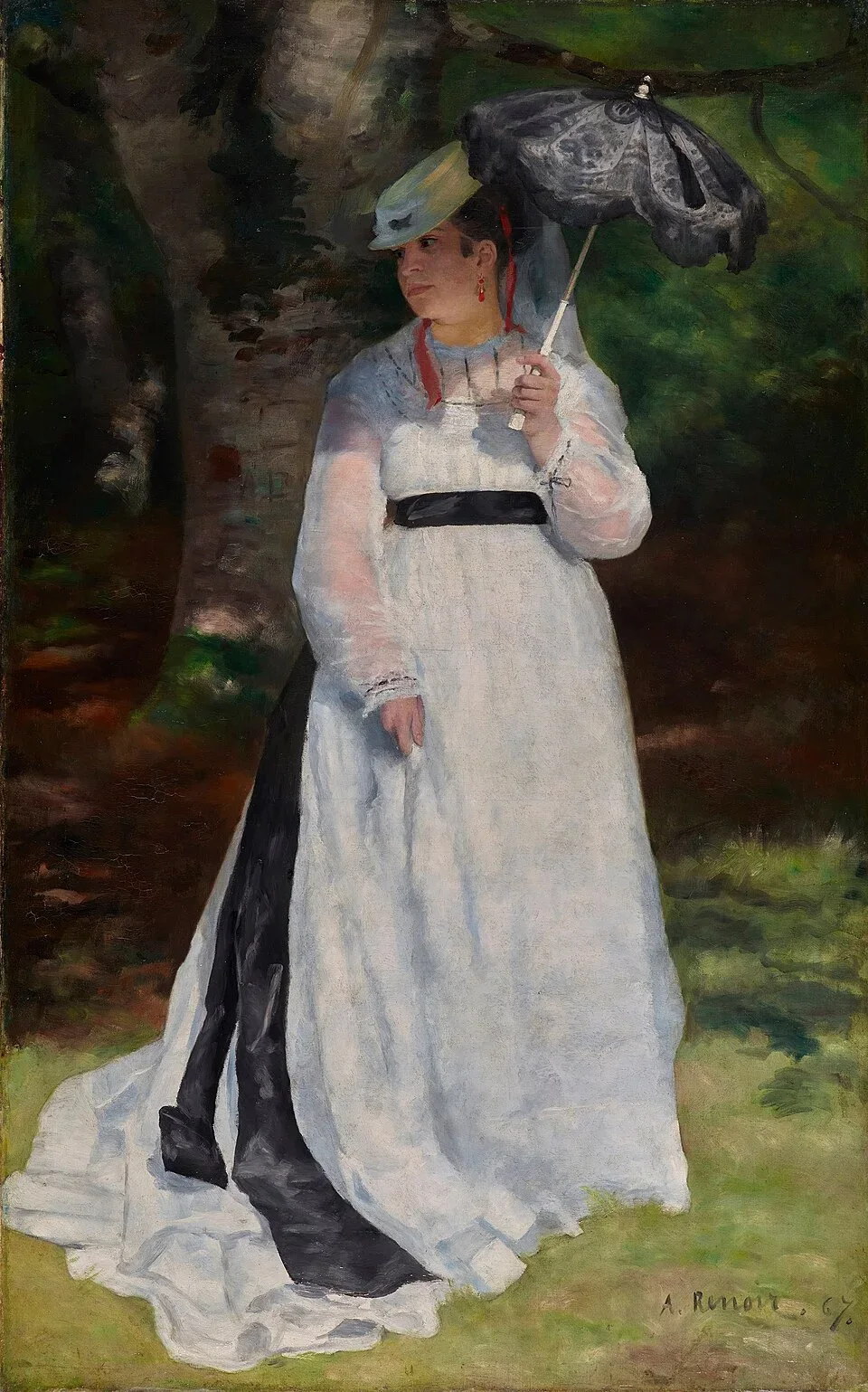
Lise with a Parasol
The new thing here was the light. Renoir set out to paint sunlight filtering down through leaves, and he began the picture in the summer of 1867. Lise stands at the edge of a forest clearing. A black lace parasol casts her face into shade, while her white muslin dress stands in full sun. It is the dress the light picks out, not her face. The size was daring too. She is almost life size, a scale kept for noble sitters. Yet this is Lise, his model and companion, and he gave her no family name. When it went on show in May 1868, several critics mocked the size and that strange contrast, and Renoir could not sell it. Théodore Duret, who backed the new painters, bought it from him. Behind her, on the trunk of the shaded tree, two letters are cut into the bark. A for Auguste, L for Lise. His name is there beside hers.
Listen in the appPierre-Auguste Renoir · Public domain
02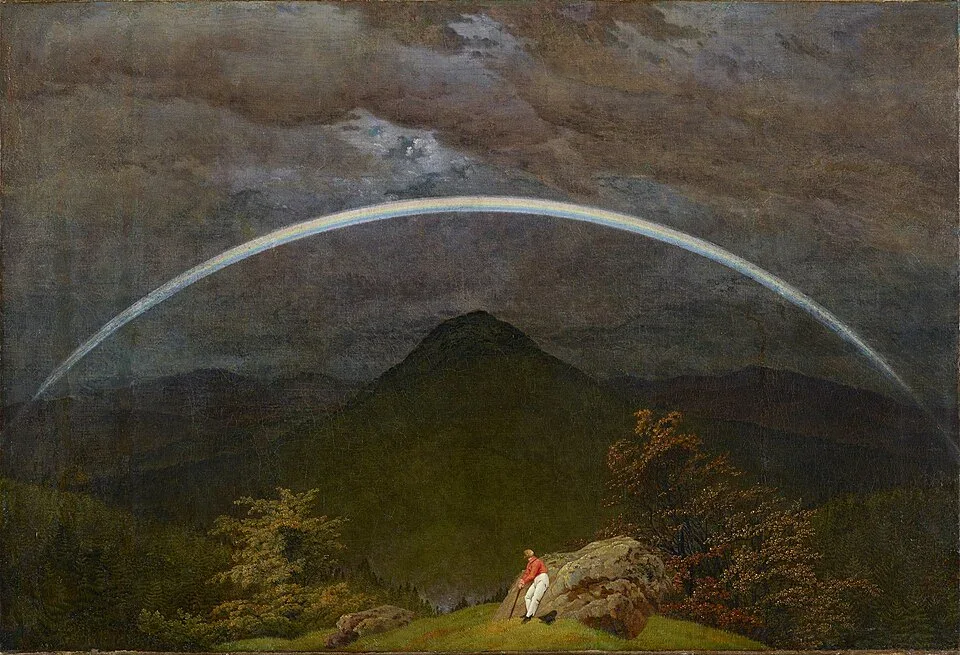
Mountain Landscape with Rainbow
Could you stand exactly where this traveler is standing? He has stopped at the edge of a chasm whose floor is lost in mist, and the whole view stretches away from you. His back is turned, so you cannot see what holds his attention, and you end up seeing the landscape through him. He is blond, with a thick beard, much like the painter himself. He leans on a tipped rock and a walking stick, his hat set down. His red shirt and white trousers cut sharply against all that brown and gray. Far off, one high mountain rises out of the darkness, with a rainbow arching over it in gray and yellow. But that rainbow could not be there. A rainbow needs the light behind whoever is looking, and here the light comes from two directions at once. The sun lights the traveler in the foreground, while a moon shines through the clouds above the rainbow. Neither could have made that arc. So no one could simply have come upon this view. It is nature as one man carries it inside him. Yet the mountain was real. Friedrich sketched it on a walk in 1808 and set it in a valley he invented.
Listen in the appCaspar David Friedrich · Public domain
03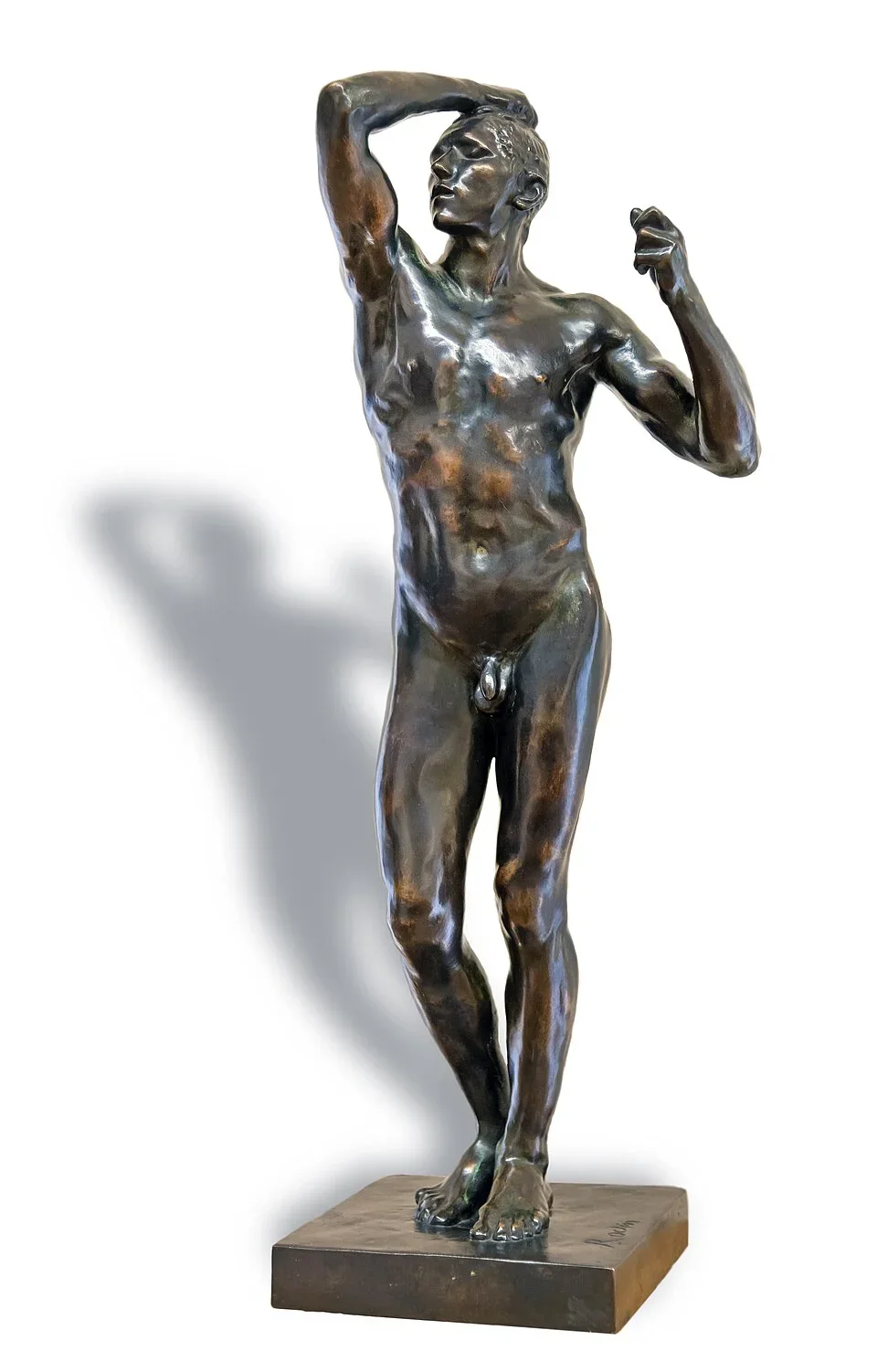
The Age of Bronze
His lips are relaxed. It is a small thing, easy to walk past, one of the details that make this body look almost too alive. People refused to believe a sculptor had shaped it. They said it had been cast straight from a living man. Rodin wanted poses that professional models could not hold, so he hired a soldier instead, a twenty-two-year-old Belgian named Auguste Neyt. He kept photographs of the soldier in that pose. The raised elbow comes in part from Michelangelo, whose work Rodin had studied on a trip to Italy. The soldier once held a spear, which made him a warrior on the edge of defeat. Rodin removed the spear before showing the work, freeing the arm and leaving the body to speak for itself. Without it, the figure was harder to read. When it went on show in Brussels in 1877, one viewer said Rodin had forgotten to explain his subject. Another decided it was a man about to kill himself. The accusation of casting from life only drew people in, eager to judge for themselves. His right hand rests against a wound on his head. With the spear gone, that hand is all that is left of the warrior, and still the figure will not settle into one story.
Listen in the appDidier Descouens · Public domain
04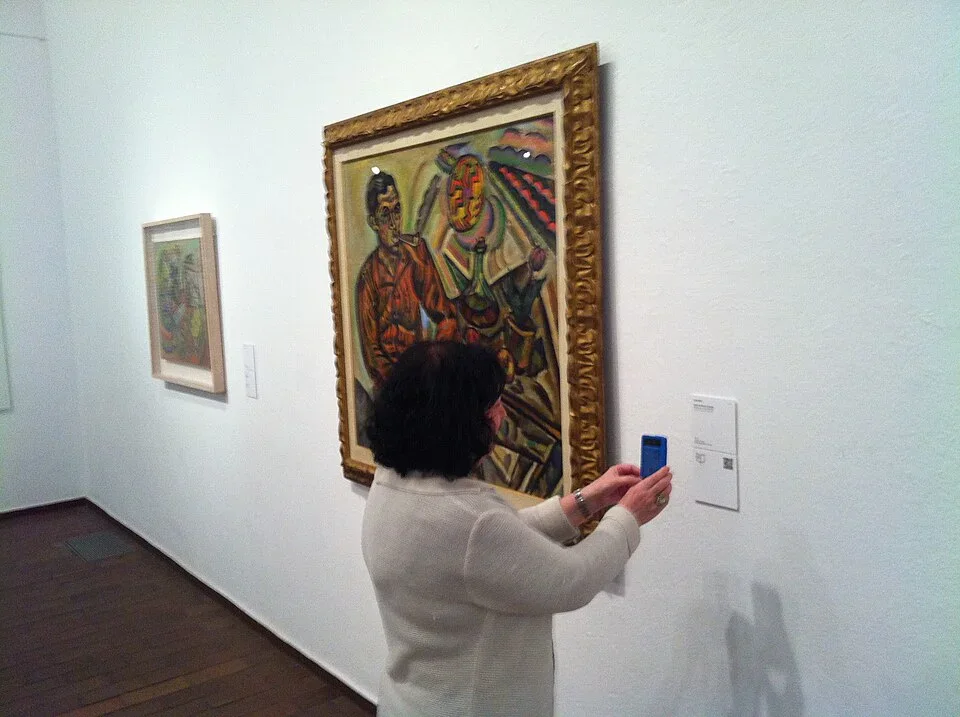
Portrait of Vincent Nubiola
Nubiola taught gardening at a school of fine arts in Barcelona, and his politics were radical. Miró shows that in the red of his open collar shirt. He had met Nubiola at an art society in the city in 1913 and painted this portrait in 1917, just before his own first exhibition. He was twenty four, trying out the styles called Cubism and Fauvism. Nubiola sits smoking a pipe. On the table at his right is a porró, a glass vessel with a tube for drinking wine straight from it, the Catalan way. Flat triangles and arcs pattern the backdrop behind him. That red shirt stayed with Miró. In 1919 he painted himself in an identical one, and Picasso bought that self portrait. Picasso owned this portrait for a time too. It may show the influence of Van Gogh, whom Miró always admired.
Listen in the appPhoto: Kippelboy · CC BY-SA 3.0
05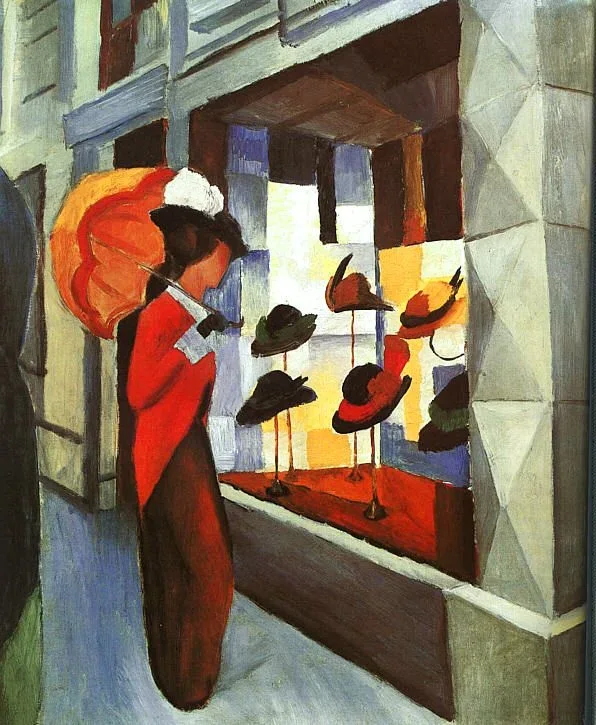
Mode: Woman with Parasol in front of Milliner's Shop
A woman stands in front of a hat shop, peeking into the window. She has an umbrella over her shoulder and a hat with a white bouquet. She wears an elegant suit. But she has no face. She stays anonymous, a fashion doll. She could have stepped straight out of an earlier picture of two women at a hat shop. Macke painted this in 1914, after he and his wife Elisabeth moved to Hilterfingen in Switzerland. Her mother had a house there, on Lake Thun. The quiet, orderly town drew him to everyday scenes, and above all to hat shop windows, which he painted again and again. Her warm reds and yellows match the hats on their stands inside, trimmed with ribbons and feathers. In the window the light breaks, and reflections mix the street with the shop. Stone facade, carved pilasters, shop window and the woman herself all break into geometric planes, and fit together like mosaic stones in one structure.
Listen in the appAugust Macke · Public domain
06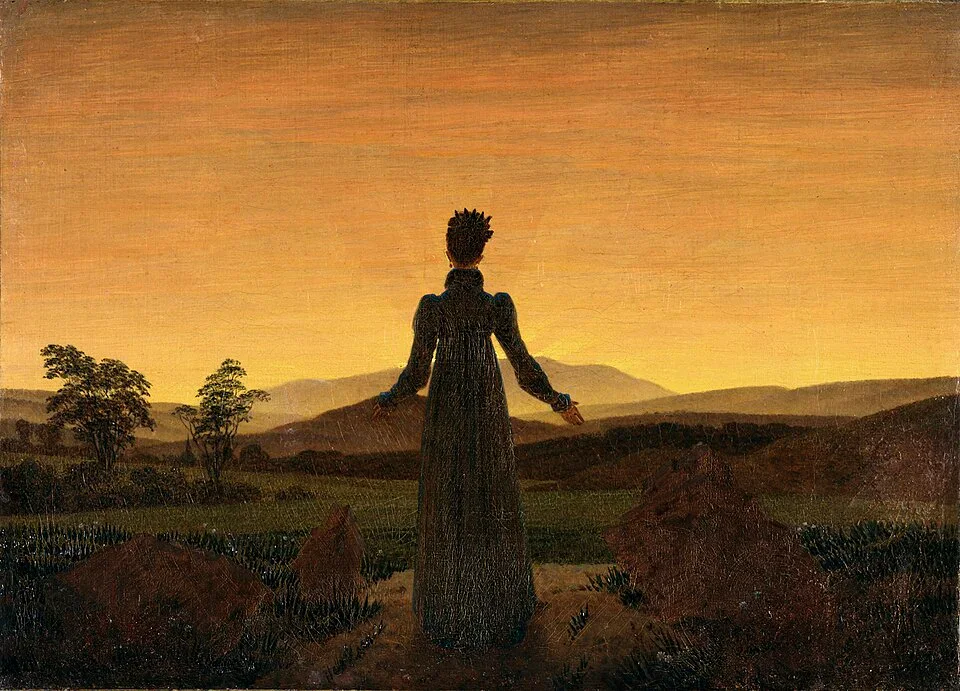
Woman in Front of the Setting Sun
She has come to the end of a narrow path, and the light is just ahead. She is about to step into it, but the path turns sharply right, and thick pointed leaves close the way. Her back is to us, and her arms are open, a dark shape against a sky that is orange in the middle and redder above. Rays fan out across the whole sky from behind distant mountains, though the sun that sends them stays out of sight. Her pose may be a prayer, like an early Christian's. The woman was probably modeled on Caroline Brommer, the cheerful young woman Friedrich married in 1818. After that, women began to appear more often in his pictures. The stones beside the path, one on her right and two on her left, may stand for faith.
Listen in the appCaspar David Friedrich · Public domain
07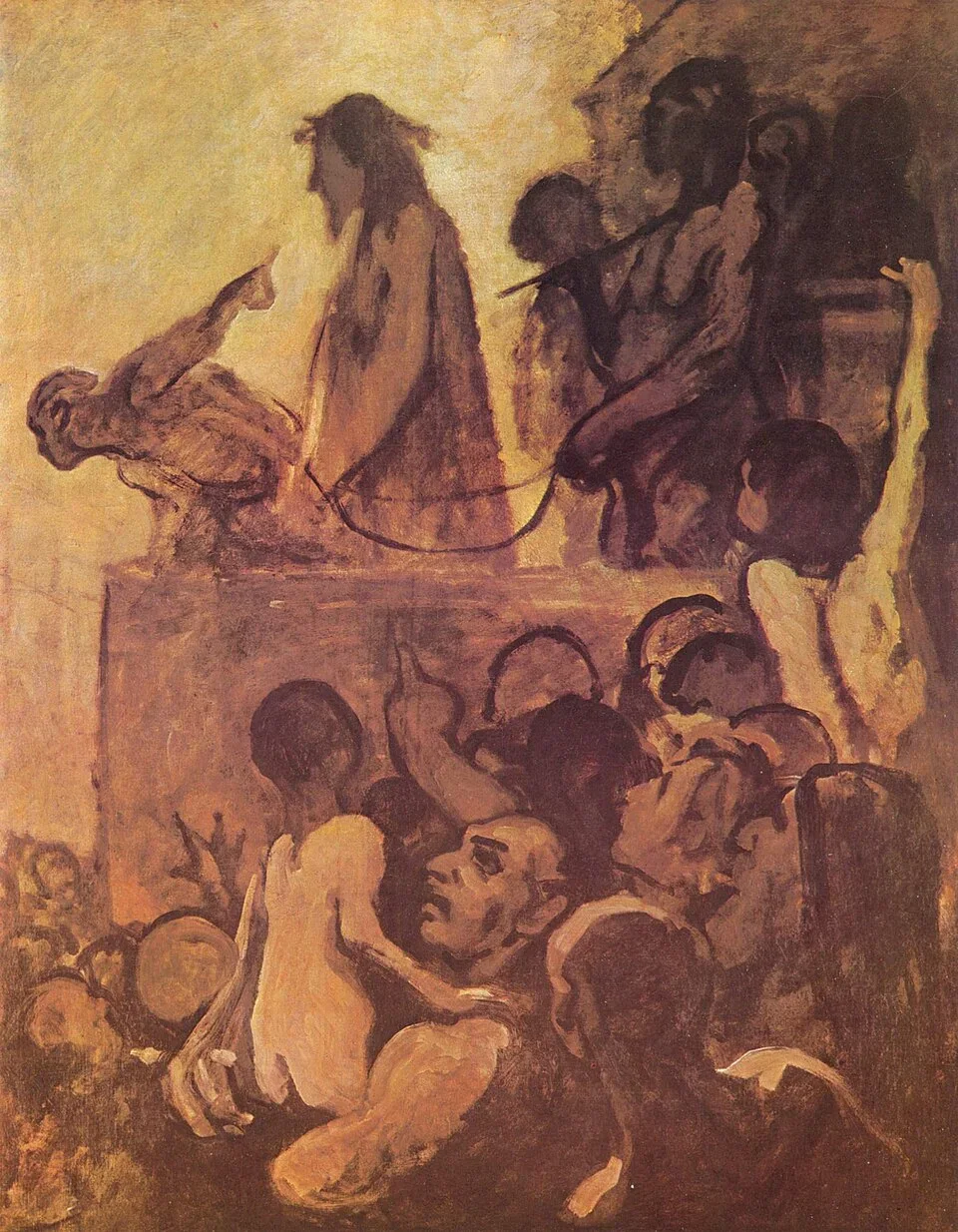
Ecce homo
Whose side are you on, his or the crowd's? You are standing in that crowd. Christ stands still and resolute before you, his figure thrown into outline by a sacred light behind him. All around him, people have gathered to mock him. Pilate presents him to the mob and speaks the words the painting takes its name from, translated as behold the man. But over that mocking crowd, they sound like an accusation. Look at this man. Daumier earned his living drawing caricatures for the newspapers, aiming them at people in power, at the clergy and the courts. A trial where a man is handed over to a jeering crowd was the corruption he attacked in those drawings. Religious scenes were rare for him, but this one carried the same criticism. The mob around him brings to mind the political unrest of his own century. He never finished it.
Listen in the appHonoré Daumier · Public domain
08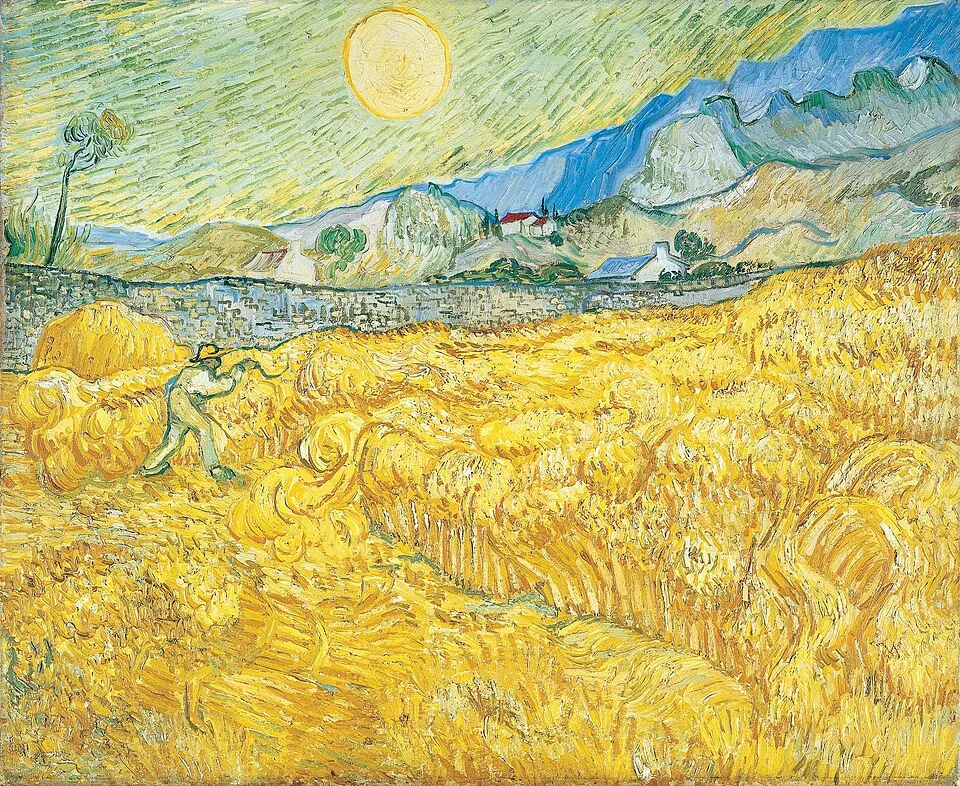
The Wheatfield behind Saint Paul's Hospital with a Reaper
A small figure works his way through all that yellow, fighting the heat to finish the cutting. Van Gogh looked at this reaper and saw death in him. He was painting the field behind the asylum at Saint Remy, where he had settled after several crises. In the reaper he pictured all of humanity cut down the way the wheat is cut. He called it the opposite of a sower he had painted earlier. This smaller version was for his mother's seventieth birthday, on the tenth of September in 1889. And he was careful to say there is nothing sad in this death. It takes place in full daylight, under a sun that floods everything with gold. What he wanted, he said, was the faintest trace of a smile. The field is all yellow except for a line of violet hills. He thought it funny that he had seen it all through the iron bars of a cell.
Listen in the appVincent van Gogh · Public domain
09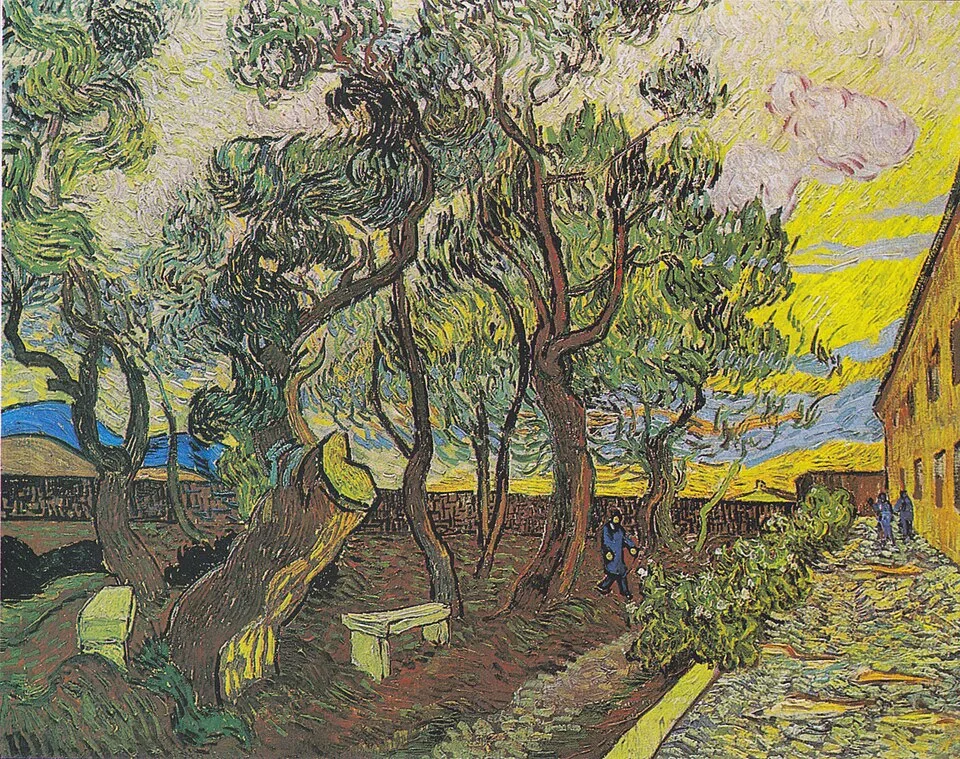
The garden of St. Paul's Hospital
Vincent van Gogh painted this as a patient in the hospital at Saint-Rémy. At the center of its walled garden he set one tree. It was a pine that lightning had struck. He had come there not long after losing part of his left ear. He did not yet trust himself to live alone, and painting was allowed there as a kind of therapy. In a letter to Émil Bernard he said the largest branch of that pine had to be cut off. The wounded trunk is the very middle of the picture, and one side branch still reaches toward the sky. More trees stand behind it, and twisted branches run through the whole picture. Against them the garden ground lies heavy and red, and a wall runs around everything. Three figures are there, tiny beside the trees. Of that pine he said it was a gloomy giant, and a proud, defeated one.
Listen in the appVincent van Gogh · Public domain
10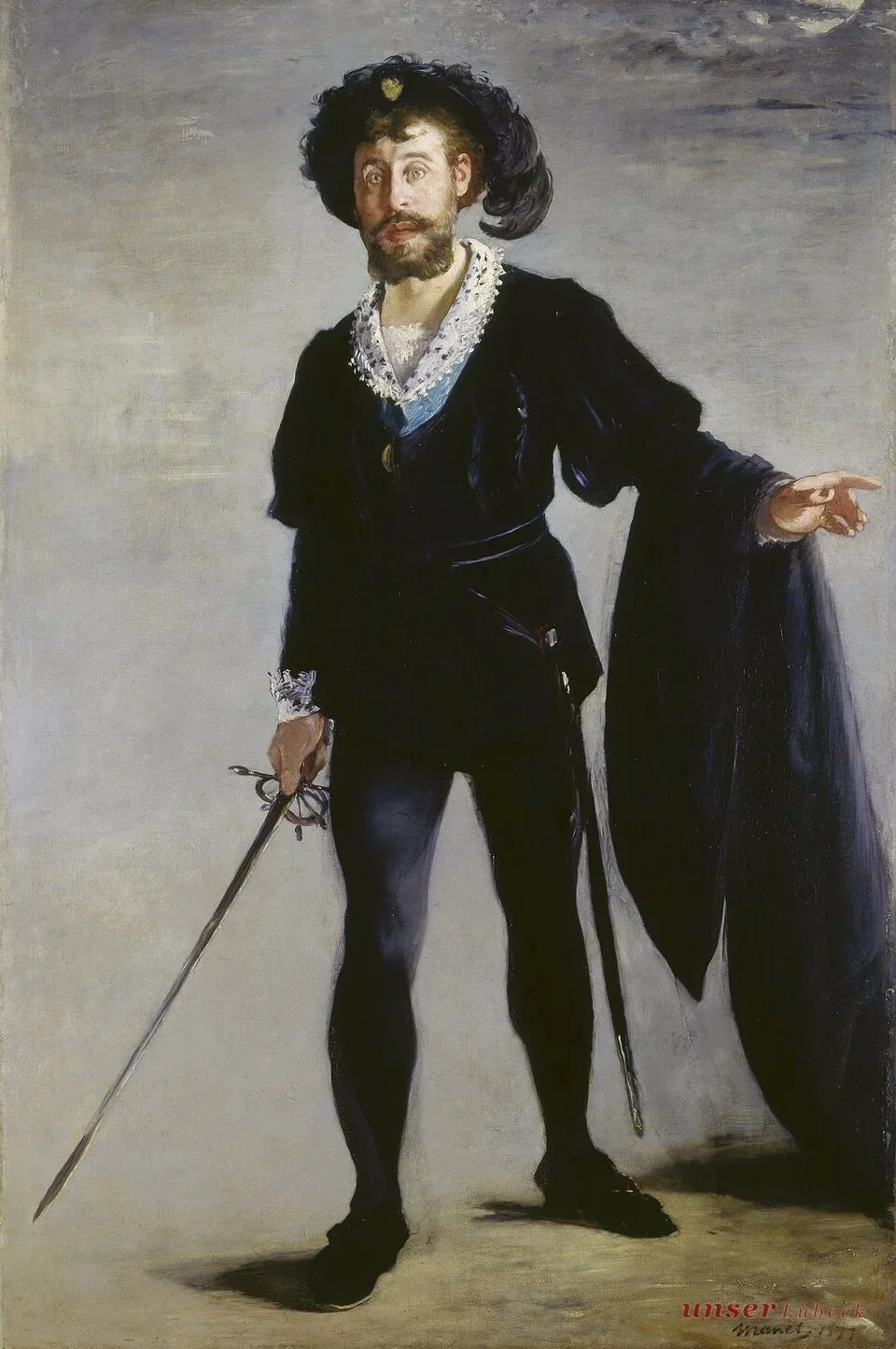
Portrait of Faure as Hamlet
No stage. No scenery. Only a flat background of one colour behind him, with no sense of place, and the whole picture given to this one man. He is the baritone Jean-Baptiste Faure, in the title role of Ambroise Thomas's opera Hamlet, after Shakespeare. That role was the high point of his career. From the premiere in 1868 to his farewell on thirteen May 1876, he sang it more than a hundred times. He also collected the painter's work, and owned sixty-eight of his paintings. So he probably asked Manet in 1875 to paint him in the part. The sittings went on and on. He posed nearly forty times. The painter started over nine times, and up to three times destroyed the canvas he was working on. Earlier versions still had pieces of the theatre. In the end they were gone, and only the singer remained against that even background. Faure still would not have it. He refused to buy the portrait, saying the likeness was not good enough. He allowed the painting to be shown at the Paris Salon in 1877, where it drew little response. Which moment it shows is not known, though it is probably Hamlet meeting his father's ghost, before swearing revenge on Claudius, his father's murderer.
Listen in the appÉdouard Manet · Public domain
- 11
Barbarian Tales
Paul Gauguin · 1902
- 12
View of Pillnitz Castle
Johan Christian Dahl · 1823
- 13
Still Life with Asphodels
Henri Matisse · 1907
- 14
The Red Tower in Halle
Ernst Ludwig Kirchner · 1915
- 15
Self-portrait with a Tyroler hat
Lovis Corinth · 1913
- 16
Male Baule cult figure blolo bian asie usu-Folkwang
Unknown Artist · 19th century
Museum Folkwang
Frequently asked questions
How much does the guide cost?
Free app download. Free until 1 January. Listed guide price: $0.99. Audio guide only. Venue admission is separate.
Can I listen without internet?
Yes. Download the guide’s audio, images, and maps in the app before your visit. Your downloaded content is then available offline.
Can I listen in my language?
In English for now. More languages soon.
Do I need to follow a schedule?
No. This is a self-guided experience. Choose your stops, pause whenever you like, and return to a story at your own pace.
Which artworks are in the Museum Folkwang audio guide?
16 artworks, including Lise with a Parasol (Pierre-Auguste Renoir), Mountain Landscape with Rainbow (Caspar David Friedrich), The Age of Bronze (Auguste Rodin), Portrait of Vincent Nubiola (Joan Miró), Mode: Woman with Parasol in front of Milliner's Shop (August Macke), Woman in Front of the Setting Sun (Caspar David Friedrich), Ecce homo (Honoré Daumier), and The Wheatfield behind Saint Paul's Hospital with a Reaper (Vincent van Gogh). The full list is on this page.
Is this the museum’s official audio guide?
No. Stanza is an independent audio guide app and is not affiliated with Museum Folkwang. Museum admission is separate.
At your own pace
Explore Museum Folkwang.
Download Stanza, then search for “Museum Folkwang”.
Free app download · Guide price shown in the app
Keep exploring
Nearby audio guides
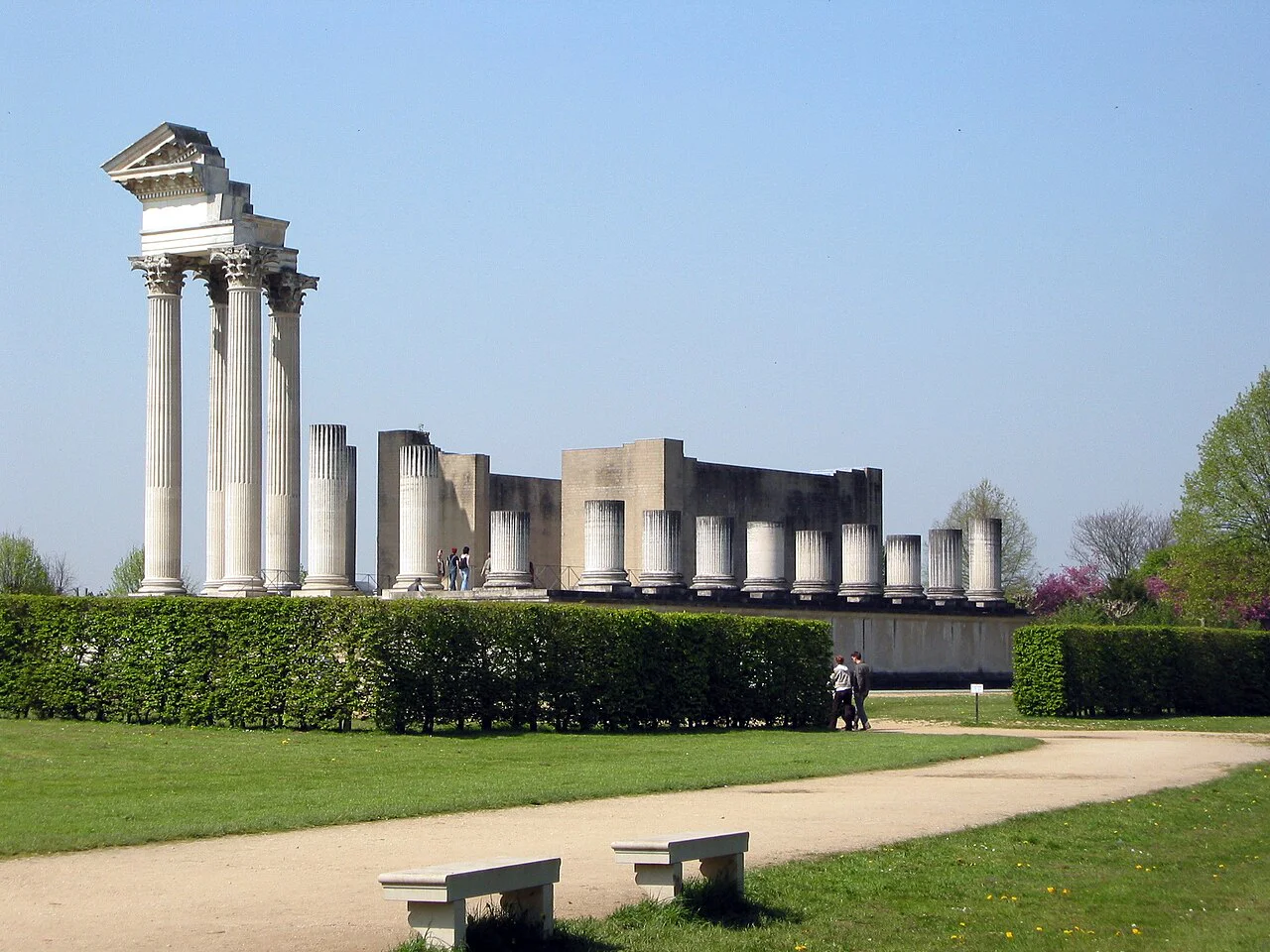
Xanten · 46 km
Colonia Ulpia Traiana
Content & sources
Photo: Magnus Manske · CC BY-SA 3.0

Cologne · 56 km
Cologne Cathedral
Content & sources
Raimond Spekking · CC BY-SA 4.0
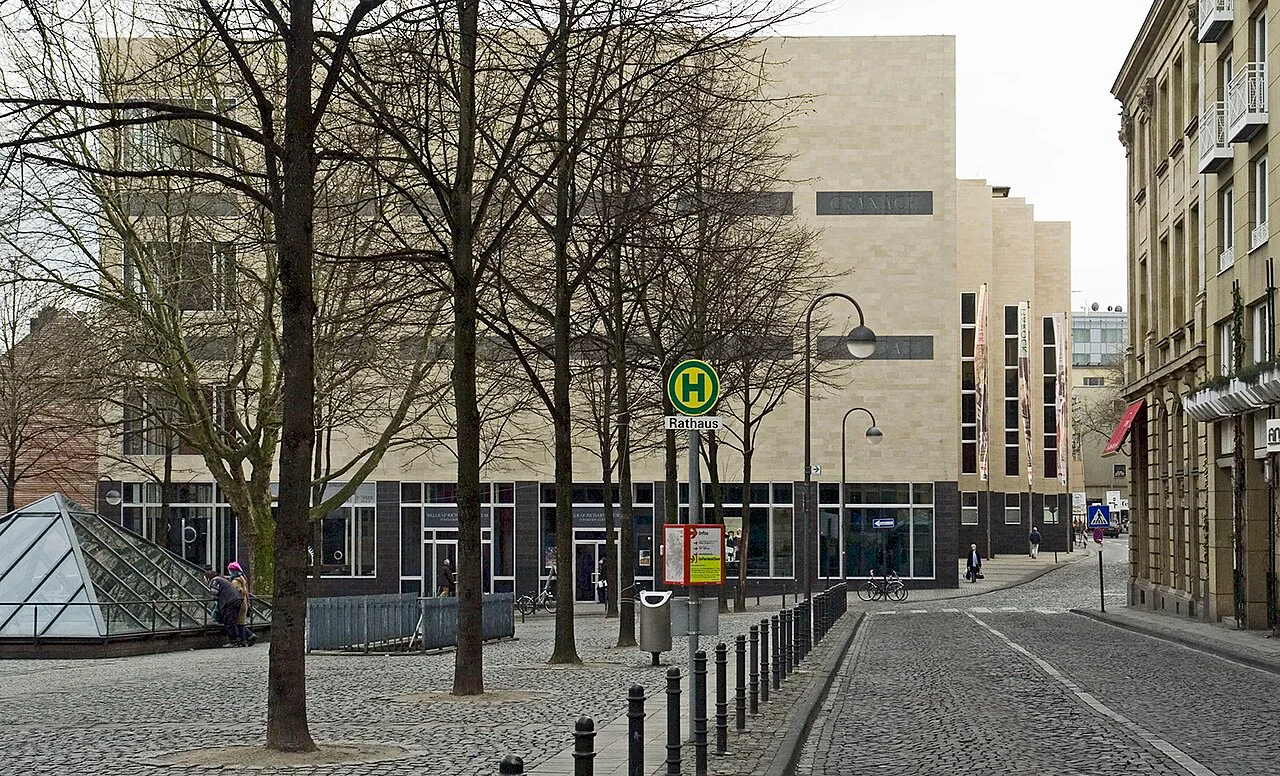
Cologne · 56 km
Wallraf-Richartz-Museum & Fondation Corboud
Content & sources
Hans Peter Schaefer - http://www.reserv-a-rt.de · CC BY-SA 3.0
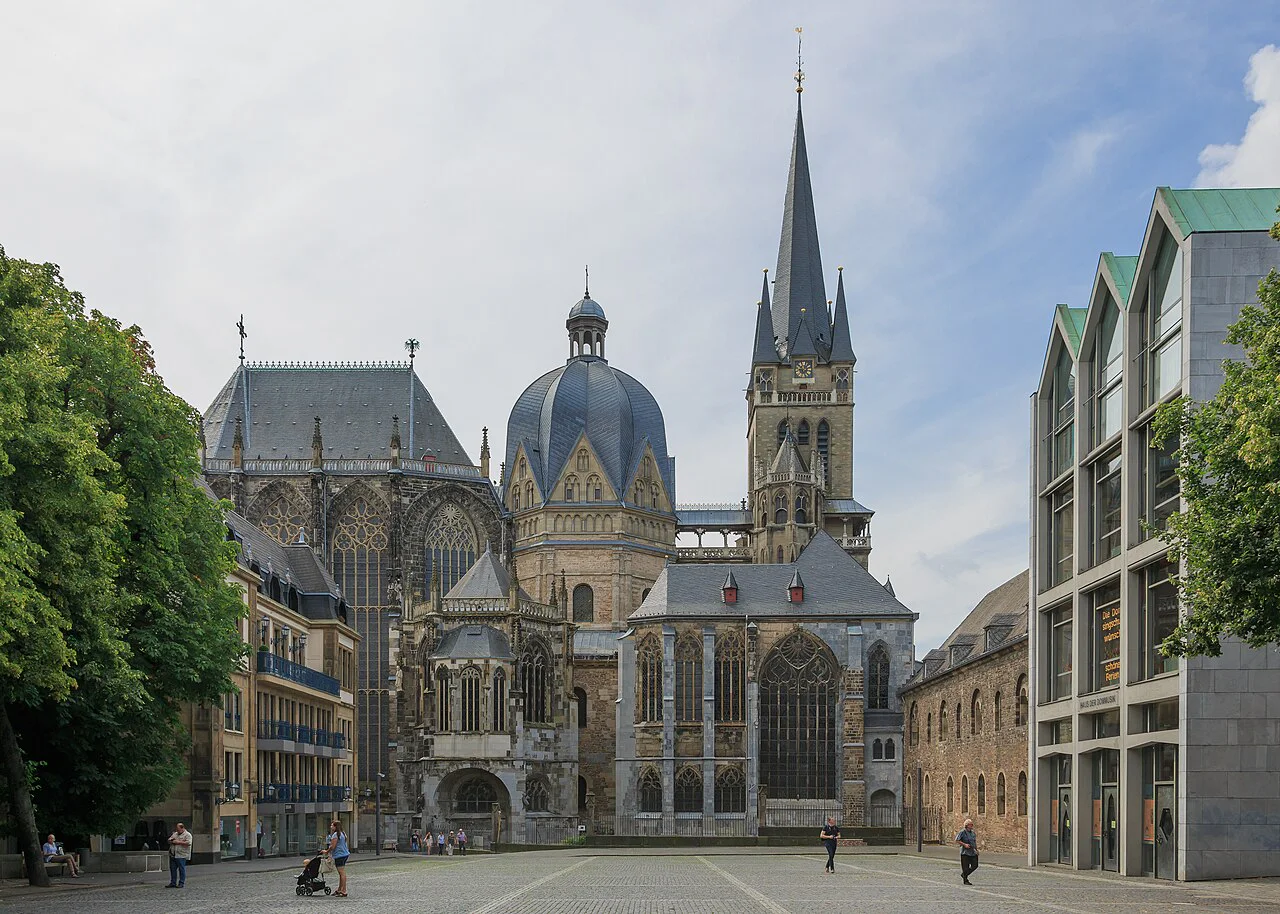
Aachen · 98 km
Aachener Dom
Content & sources
CEphoto, Uwe Aranas · CC BY-SA 3.0
Art museums
More art museum audio guides
Cologne · 87 artworks
Wallraf-Richartz-Museum & Fondation Corboud
Content & sources
Hans Peter Schaefer - http://www.reserv-a-rt.de · CC BY-SA 3.0
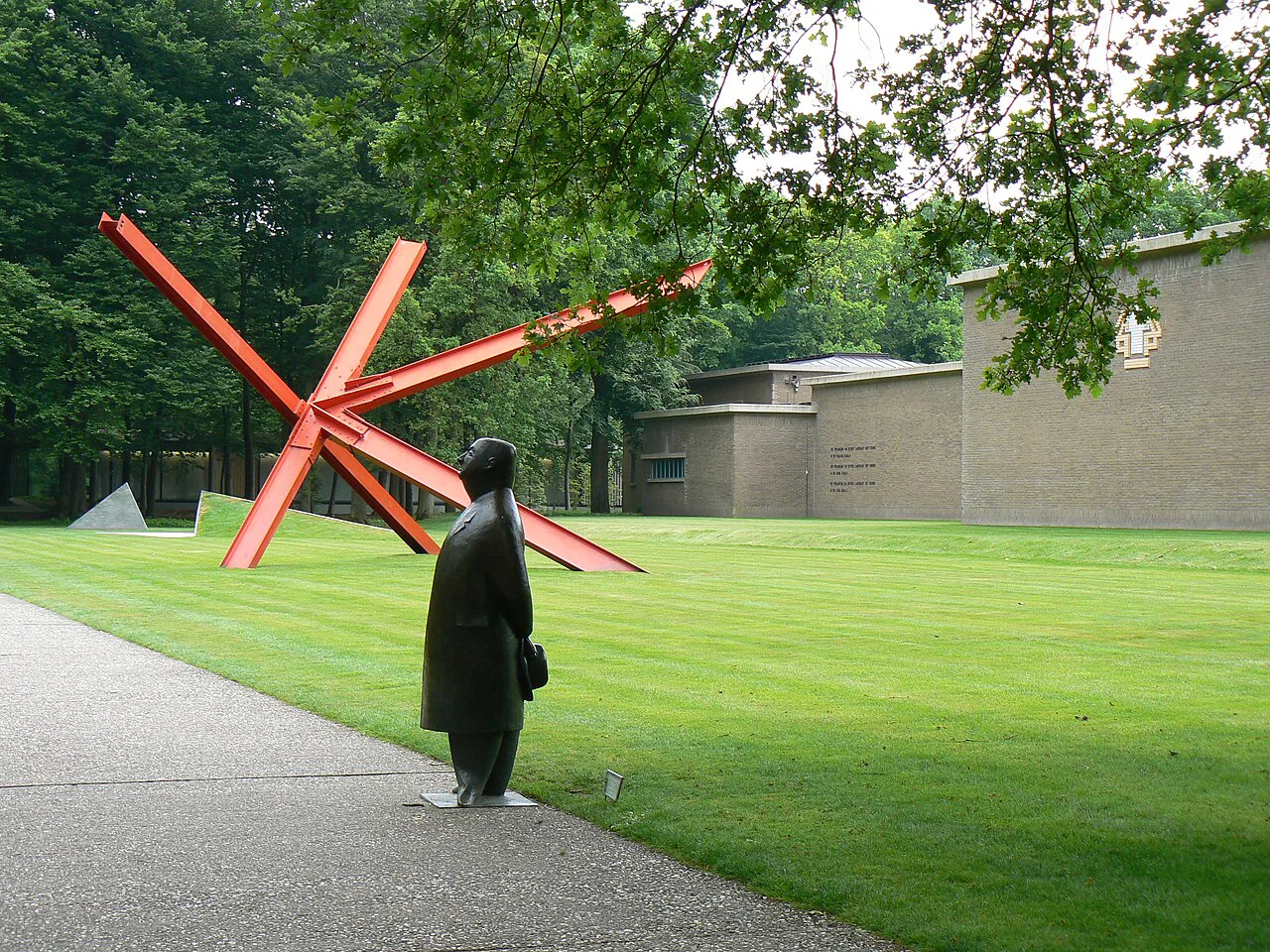
Otterlo · 60 artworks
Kröller-Müller Museum
Content & sources
Photo: Gerardus · Public domain
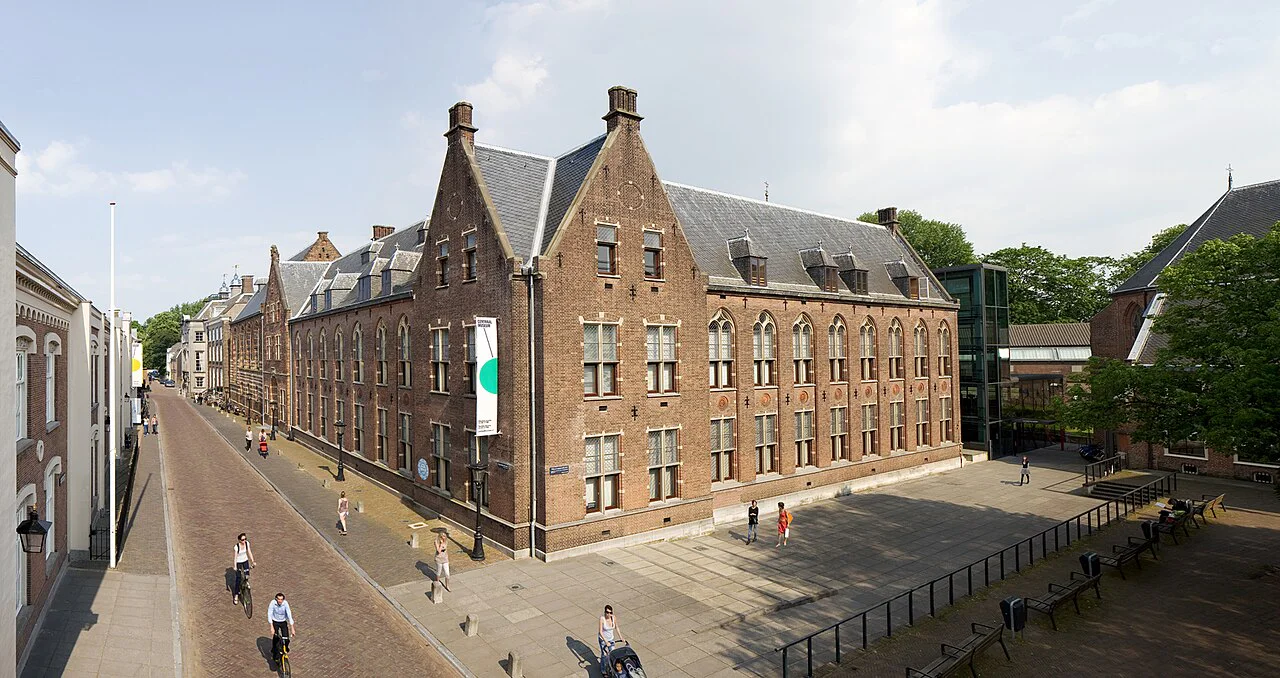
Utrecht · 63 artworks
Centraal Museum
Content & sources
Centraal Museum / fotograaf: Vincent Zedelius · CC BY-SA 3.0
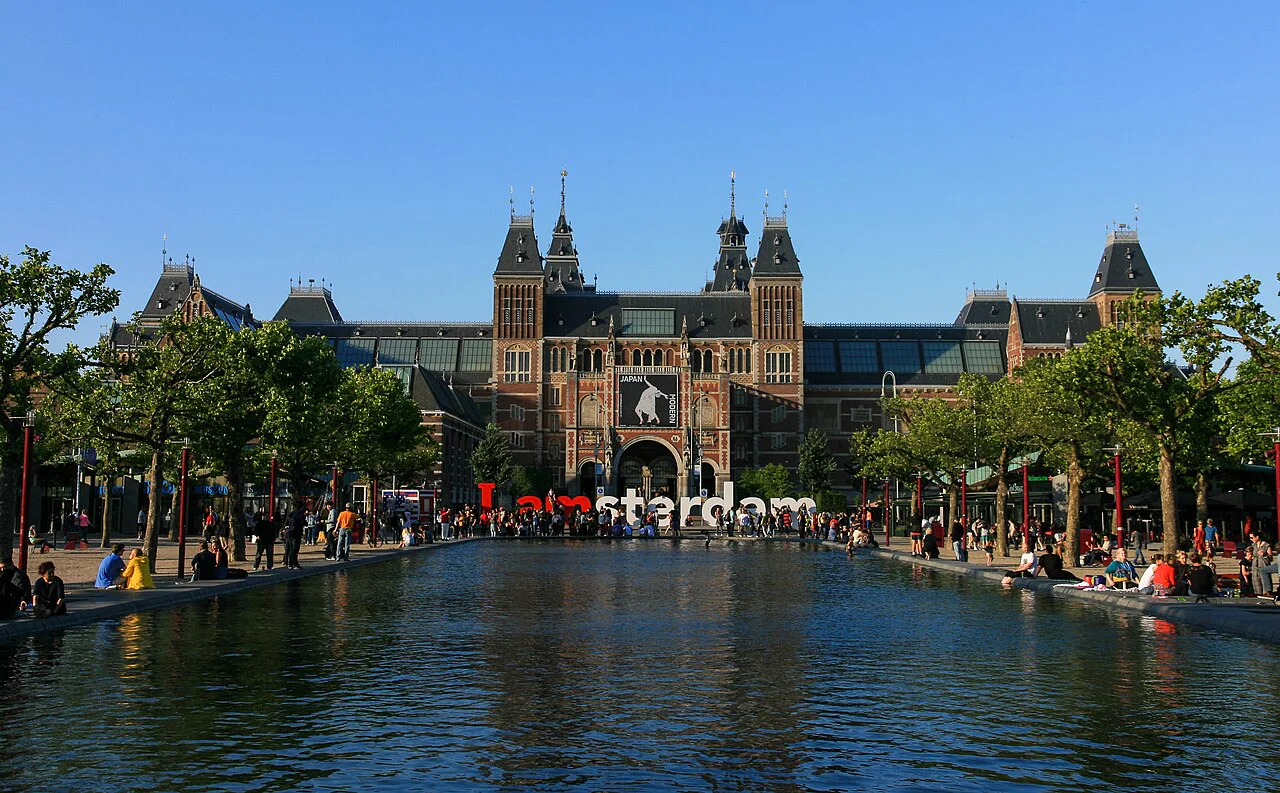
Amsterdam · 386 artworks
Rijksmuseum
Content & sources
Marco Almbauer · CC BY-SA 3.0
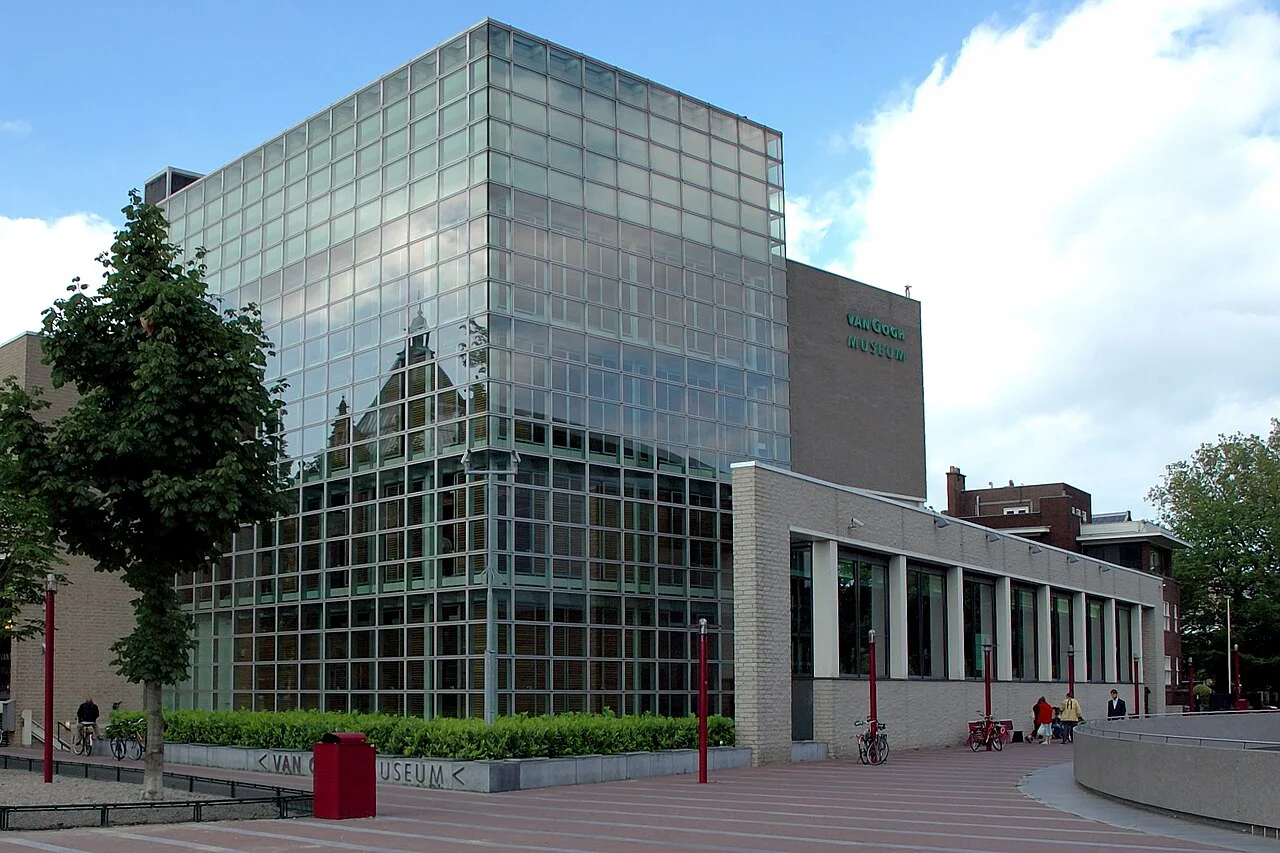
Amsterdam · 73 artworks
Van Gogh Museum
Content & sources
Warrox · CC BY 2.5
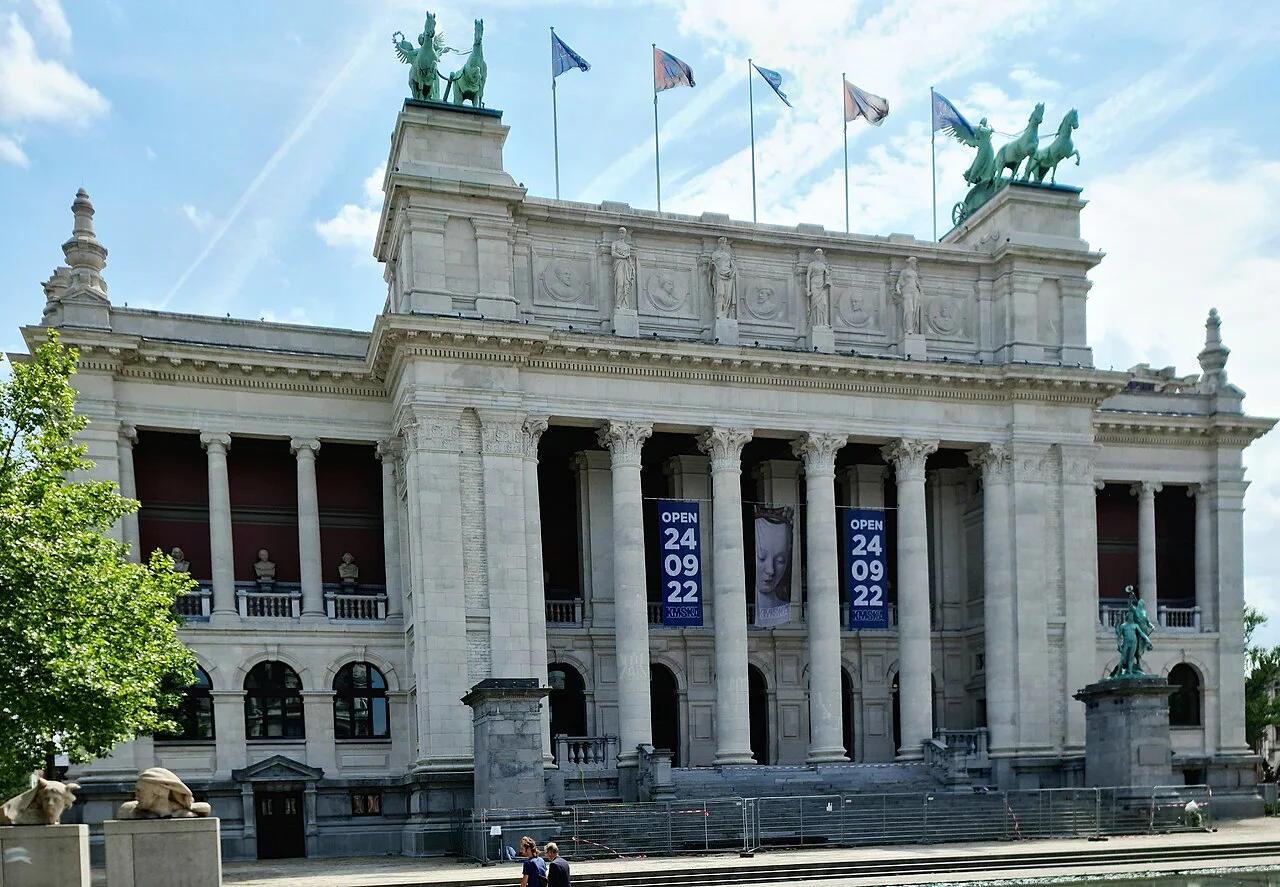
Antwerp · 146 artworks
Koninklijk Museum voor Schone Kunsten Antwerpen
Content & sources
Photo: Ricardalovesmonuments · CC BY-SA 4.0