Stanza · Audio guide
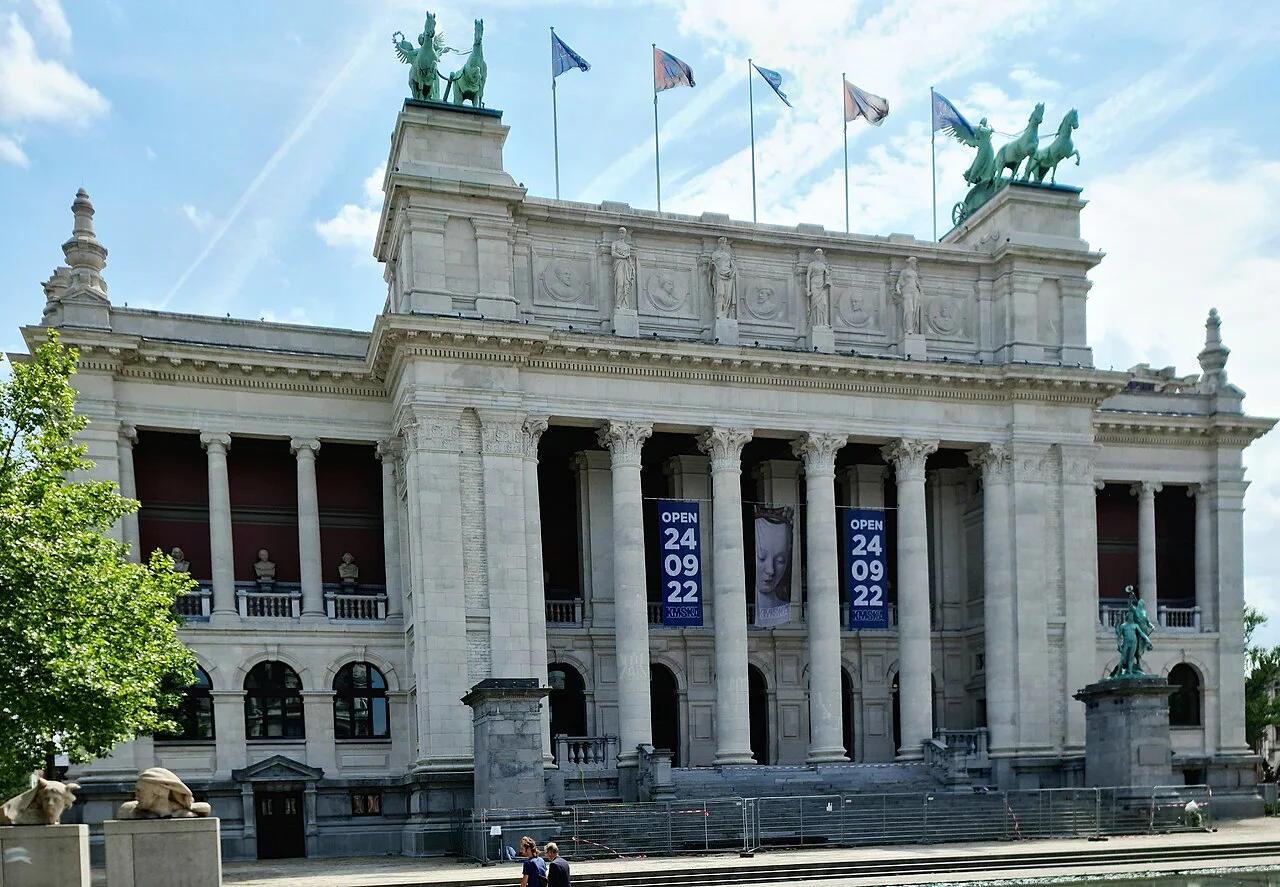
Koninklijk Museum voor Schone Kunsten Antwerpen Audio Guide
A place to remember. A story to take with you.
The Royal Museum of Fine Arts Antwerp is a museum founded in 1810 that houses a collection of paintings, sculptures and drawings from the fourteenth to the twentieth centuries. The collection represents the…
Download Stanza, then search for “Koninklijk Museum voor Schone Kunsten Antwerpen”.
About the tour
One guide. Your kind of visit.
The Royal Museum of Fine Arts Antwerp is a museum founded in 1810 that houses a collection of paintings, sculptures and drawings from the fourteenth to the twentieth centuries. The collection represents the artistic production and the taste of art enthusiasts in Antwerp and the Northern and Southern Netherlands since the 15th century.
The Koninklijk Museum voor Schone Kunsten Antwerpen guide tells the stories of 146 artworks, including Melun Diptych (Jean Fouquet), Jacopo Pesaro, Bishop of Paphos, being presented by Pope Alexander VI to Saint Peter (Titian), The Seven Sacraments (Rogier van der Weyden), Saint Barbara (Jan van Eyck), Rockox Triptych (Peter Paul Rubens), Cleopatra Testing Poisons on Condemned Prisoners (Alexandre Cabanel), Madonna at the Fountain (Jan van Eyck), and Christ with singing and music-making Angels (Hans Memling). Every artwork is free to hear in the Stanza app until 1 January.
Ready when you are.
- 01Get the free Stanza app.
iOS & Android
- 02Find your guide.
“Koninklijk Museum voor Schone Kunsten Antwerpen”
- 03Download before you go.
Works offline
Audio guide / 146 artworks
Inside the guide
Get to know a few of the stories before you go. Open a stop to read more.
01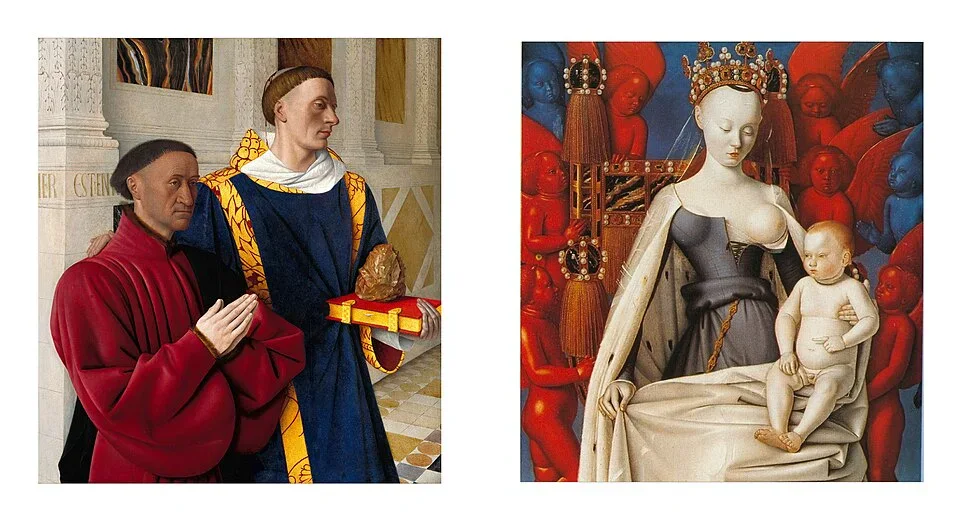
Melun Diptych
The child on the Virgin's lap points to the left with his left hand. He points at a kneeling man and his saint, on the other half of this work. That panel now hangs in Berlin, so the gesture reaches toward a picture no longer beside this one. The man is Étienne Chevalier, treasurer to King Charles the Seventh. He asked the court painter Jean Fouquet to make these pictures, to hang over his wife's tomb in the church at Melun. But the Virgin here is believed to be a portrait of Agnès Sorel, the king's mistress. She had died two years earlier, and many people then thought her the most beautiful woman of her day. Chevalier was the executor of her will. She sits on a gold throne in a blue dress and white mantle, crowned as Queen of Heaven. Blue and red cherubim surround her, standing out against her pale skin. Their colors may be the king's own, red, white and blue. The mood is dreamlike, as though she is caught between heaven and earth, at once a woman and something more. The panels were separated and sold, this half going to the mayor of Antwerp. Since then they have been brought back together at least three times, most recently in 2017.
Listen in the appJean Fouquet · Public domain
02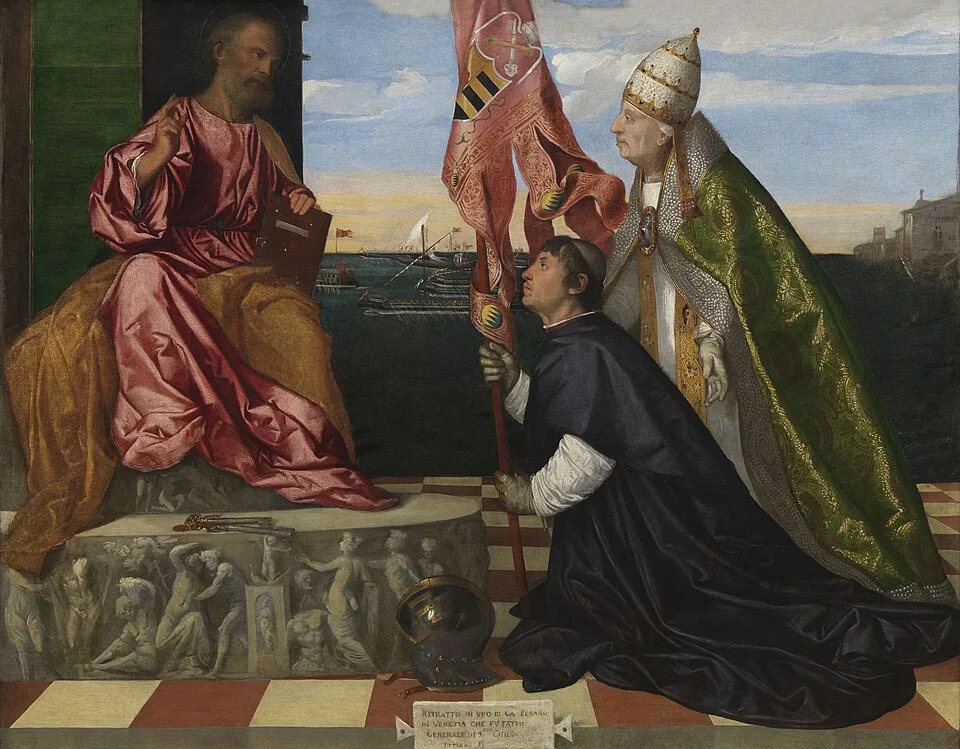
Jacopo Pesaro, Bishop of Paphos, being presented by Pope Alexander VI to Saint Peter
Jacopo Pesaro wanted a victory remembered. In August 1502 he led the papal fleet that took Santa Maura back from the Ottoman Turks, a rare win. So he had himself painted kneeling before Saint Peter, his helmet set down beside the dais. He holds a standard with Pope Alexander's coat of arms. Between his head and the saint, war galleys fight at sea. Alexander had contributed thirteen galleys to the fight, and it was Alexander who made Pesaro bishop of Paphos. That is why the pope is here, presenting him to Peter, enthroned at the left. Peter's gold and silver keys lie on the stone platform below him. Titian seems to have copied Alexander's face from a medal, so the pope looks less alive than the bishop, probably painted from life. Alexander died the next year, in 1503, and was generally despised afterward. Pesaro kept him here all the same. When he wrote his will in 1542, he left money for masses to be said for Alexander's soul.
Listen in the appTitian · Public domain
03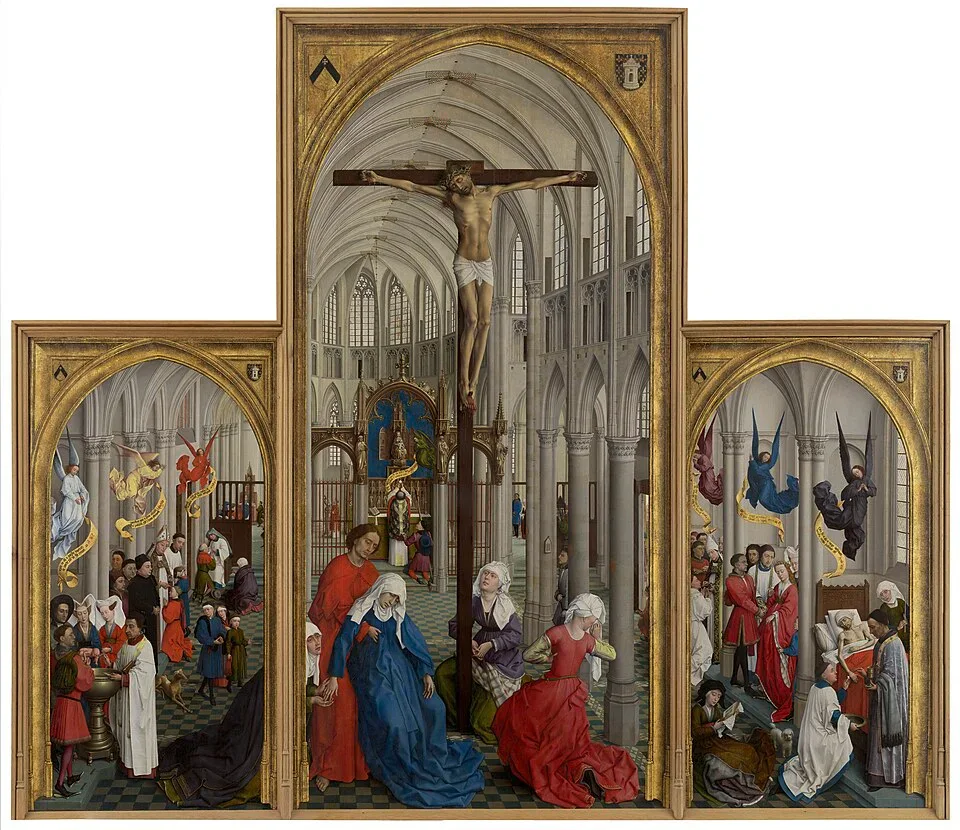
The Seven Sacraments
Yellowed varnish covered this altarpiece until a restoration between 2006 and 2009 stripped it away. The paint beneath had loosened and was flaking off, so the work needed repair. Some heads had been painted on sheets of pewter and fixed to the wood afterward, and fixing them was one of the repair's problems. When the varnish came off, it became clear who had painted what. Rogier van der Weyden painted the whole middle panel himself, and left parts of the architecture and figures on the side panels to his assistants. Those pewter heads may be portraits of real people. What holds it together is one Gothic church, with the nave leading toward the high altar, and all seven sacraments happening at once inside it. A baby is baptized at one end and a sick man anointed in his bed at the other. Between them lie all the stages of a life. Rich and poor share the same space, from a richly dressed bride to beggars at the church doors. The church and the clothes belong to his own day, much like Saint Gudula's cathedral in Brussels. At the center, behind the cross, a priest lifts the Host, linking Christ's death to the Eucharist. Putting every sacrament in one building at one moment was a new idea. Where this altarpiece was first meant to stand is still not known.
Listen in the appRogier van der Weyden · Public domain
04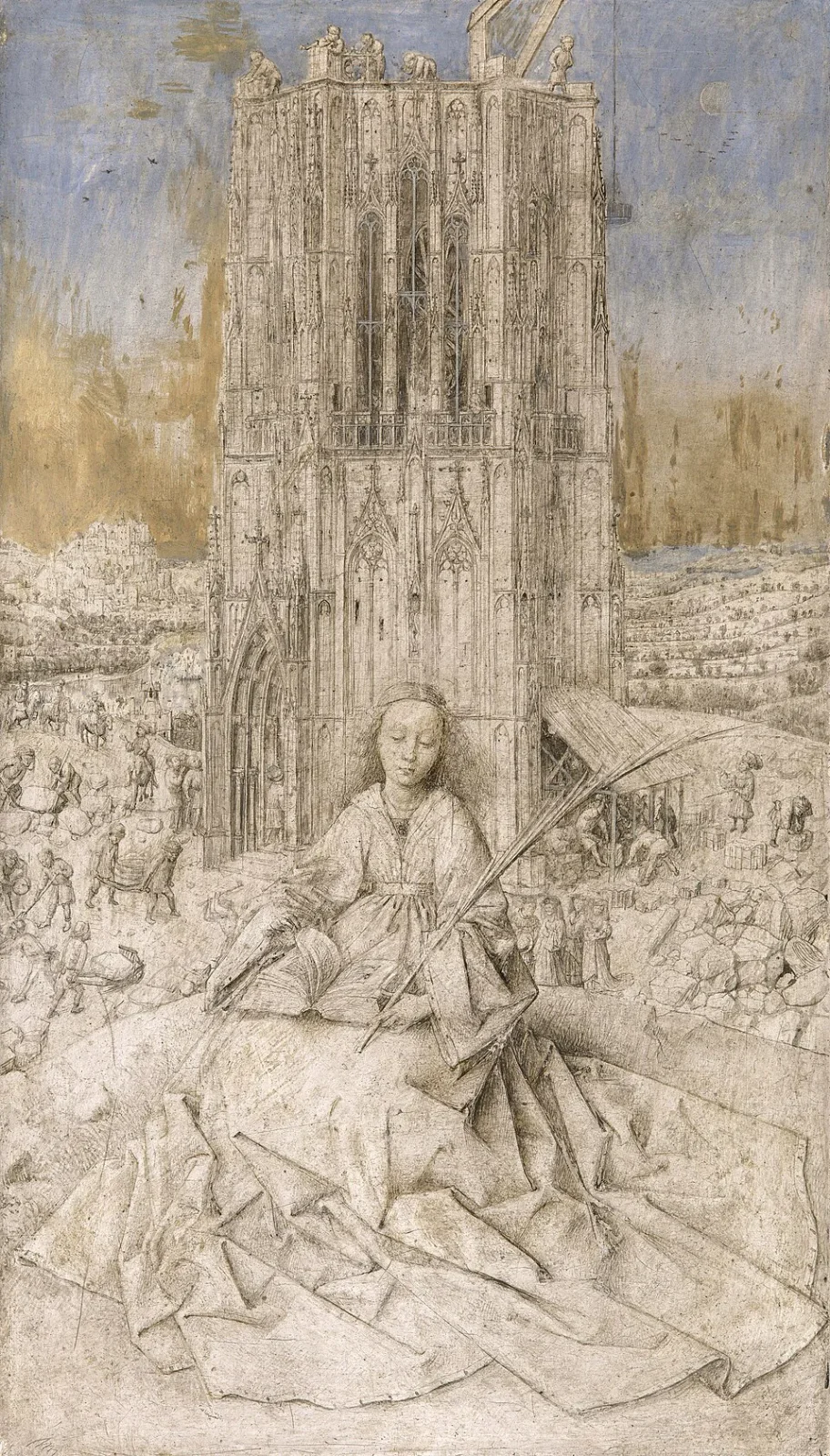
Saint Barbara
A woman sits reading a prayer book in front of a vast Gothic tower. Workmen carry stone on the ground, and others work high up on the tower. The whole place is a building site. But this tower is a prison. Barbara's father was a pagan who shut her away here, to keep her from suitors he did not approve of. While she was locked up, she became a Christian. She would not give it up, and her father handed her over to be tortured. In the end he beheaded her himself. Jan van Eyck gave her prison the form of a great cathedral, much like Cologne Cathedral, which was still being built in 1437. In her hand she holds a palm branch, and the palm stands for her victory over death.
Listen in the appJan van Eyck · CC0
05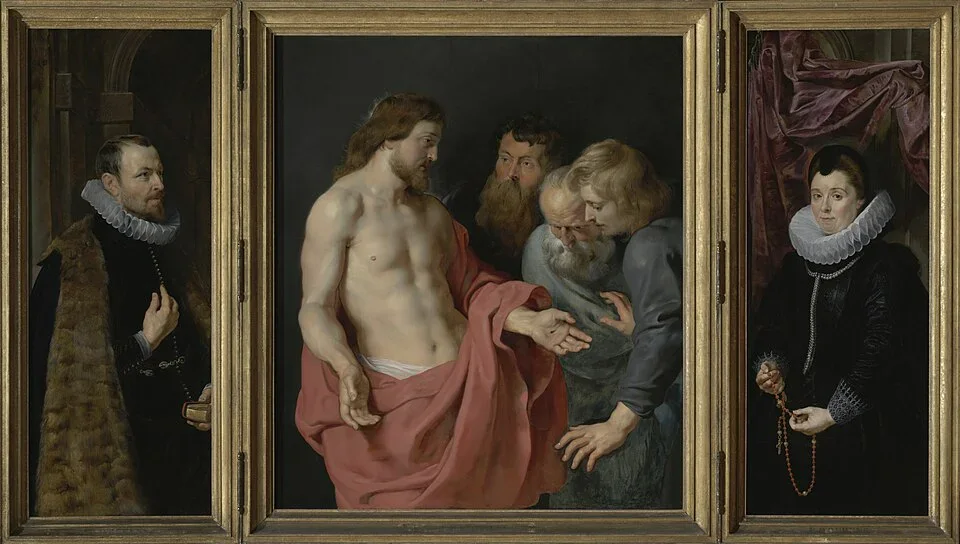
Rockox Triptych
Christ seems to have just appeared among the apostles, and they refuse to believe it is really him. He is about to show them the wounds he carries. This is the centre of a picture in three parts. It was made for the burial chapel of Nicolaas Rockox, mayor of Antwerp, and his wife Adriana Perez. They asked for it while both were still alive, as their funerary monument. It looks like the story of doubting Thomas. He would not believe until he put his finger into the wound in Christ's side. But there is no wound in Christ's side here. Rubens left it out on purpose. The account he seems to follow is the one in Luke's Gospel. There the wounds are in his hands and feet, and the apostles never touch them. They believe only after he eats broiled fish and a honeycomb. For the couple who commissioned it, this may have been a picture about believing without the evidence in your hands. On the outer panels are their portraits. Adriana holds a rosary, a sign of her faith, and Rockox rests a hand on his chest to show his love. French troops carried the picture off to the Louvre in 1794, and it came back to Antwerp in 1815.
Listen in the appPeter Paul Rubens · Public domain
06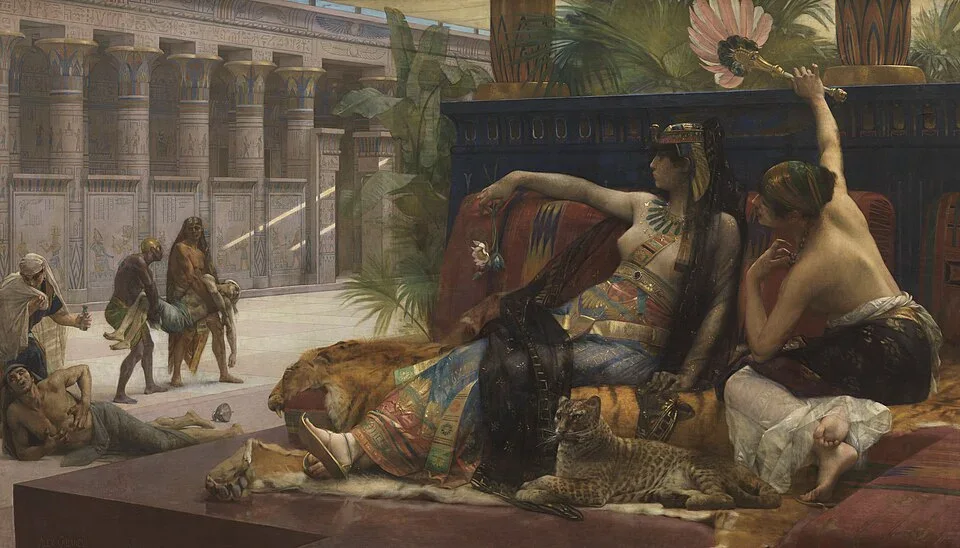
Cleopatra Testing Poisons on Condemned Prisoners
Why are luxury and death painted side by side? On the right, Cleopatra reclines on a low bench. She wears a crown shaped like a vulture, its head just above her forehead, its wings framing her face. She is shown in profile, as in ancient Egyptian paintings, and a servant fans her. On the left, a woman holds a bottle of poison above a man who clutches his stomach in pain. Behind them, two men carry away a body. These dying figures are painted less sharply and with less colour, while she keeps her distance, seemingly unmoved. Cleopatra tested poisons on condemned prisoners, looking for a quick and painless death for herself. The men were killed to improve her poisons. Cabanel painted the picture for a museum founded in Antwerp by the Royal Academy of Fine Arts. The Academy bought it from him in 1887 and lent it to the Royal Museum.
Listen in the appAlexandre Cabanel · CC0
07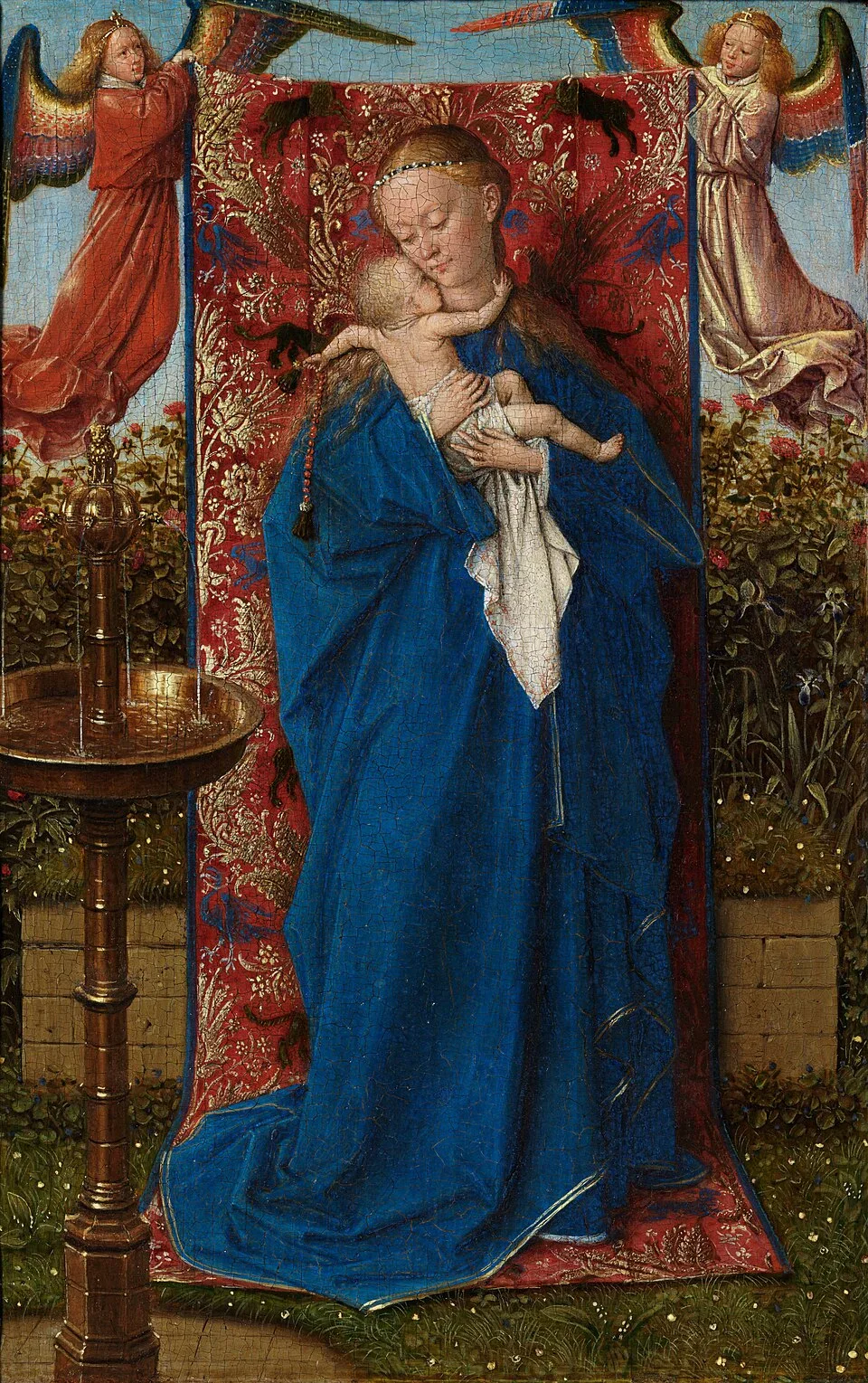
Madonna at the Fountain
Mary stands here, and that was rare in a picture of the Virgin at this time. Most were shown seated. The child's cheek rests against hers, one hand reaching out. That tenderness comes from Byzantine icons of a type called the Virgin of Tenderness. Van Eyck brought that type into this small picture, made for someone's private prayers. Images like it had been arriving in the North for more than a century and were widely copied. He probably saw them for himself on a visit to Italy. The Byzantine look may also have to do with his patron, Philip the Good, eager to reconcile with the Greek Orthodox Church. His own panel was copied in turn, again and again, through the fifteenth century.
Listen in the appJan van Eyck · Public domain
08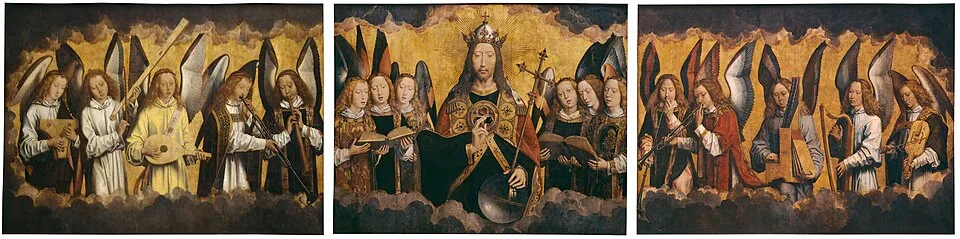
Christ with singing and music-making Angels
Some of the angels carry little letters on their clothing. They spell Mary and Jesus. Those letters may point to something missing here. Only these three panels survive of what was once a huge altarpiece. It was made for the abbey church of Santa María la Real, at Nájera in Spain. At its center stood the Assumption of the Virgin Mary. That scene, and every part around it, is lost. The central panel shows Christ against gold. Six angels sing from large songbooks, three on either side of him. Ten more fill the two wings, playing the instruments people used in the fifteenth century. Spanish merchants in Bruges asked Memling to make it all, to decorate the organ of that church. For four centuries it was abandoned, until a dealer bought it and the Belgian government brought it here. Restoring it took sixteen years, beginning in 2001. Restorers removed dirt and old varnish. They also cleared away a layer that had cast a gray veil over the colors. With it gone, the depth and detail came back. Where the idea came from, of Christ surrounded by all these singing and playing angels, no one really knows.
Listen in the appHans Memling · Public domain
09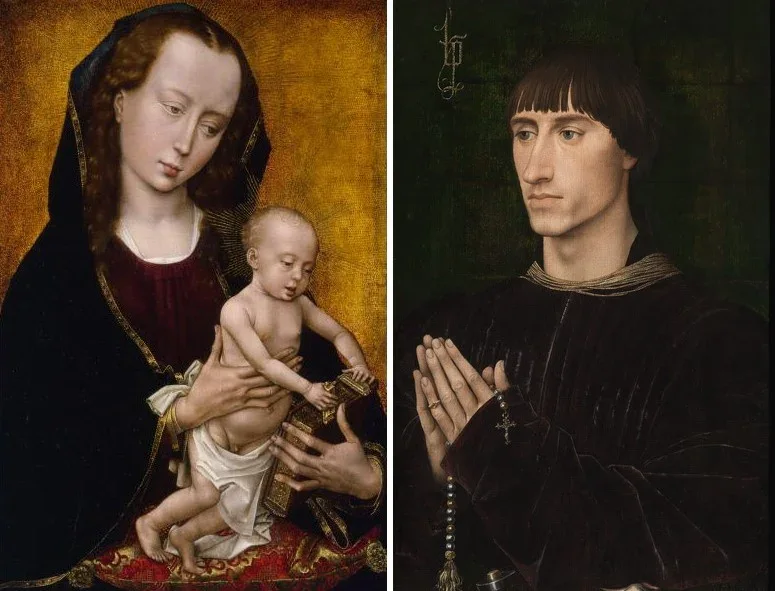
Diptych of Philip de Croÿ with The Virgin and Child
A young man's hands are folded, a pearled rosary caught between his thumbs and index fingers. He wanted to be shown praying before the Virgin and Child. In those years the Virgin was thought to plead for a soul before God. The devout could cut their time in purgatory through prayer, and a portrait like this was one way to do it. He was Philip, a soldier at the Burgundian court who collected manuscripts, about twenty five when this was painted. Rogier van der Weyden set him against pleated green cloth. On the other panel the Virgin and Child appear against gold, like a vision before him. The child turns toward him and reaches a hand almost past the edge of the panel, as if to make contact. The child's fingers play with the clasps of a prayer book, probably meant as a compliment to Philip's love of illuminated books. The two panels were probably made as one. At some unknown time they were broken apart, and now this one is in Antwerp while the other is in San Marino.
Listen in the appRogier van der Weyden · CC BY-SA 4.0
10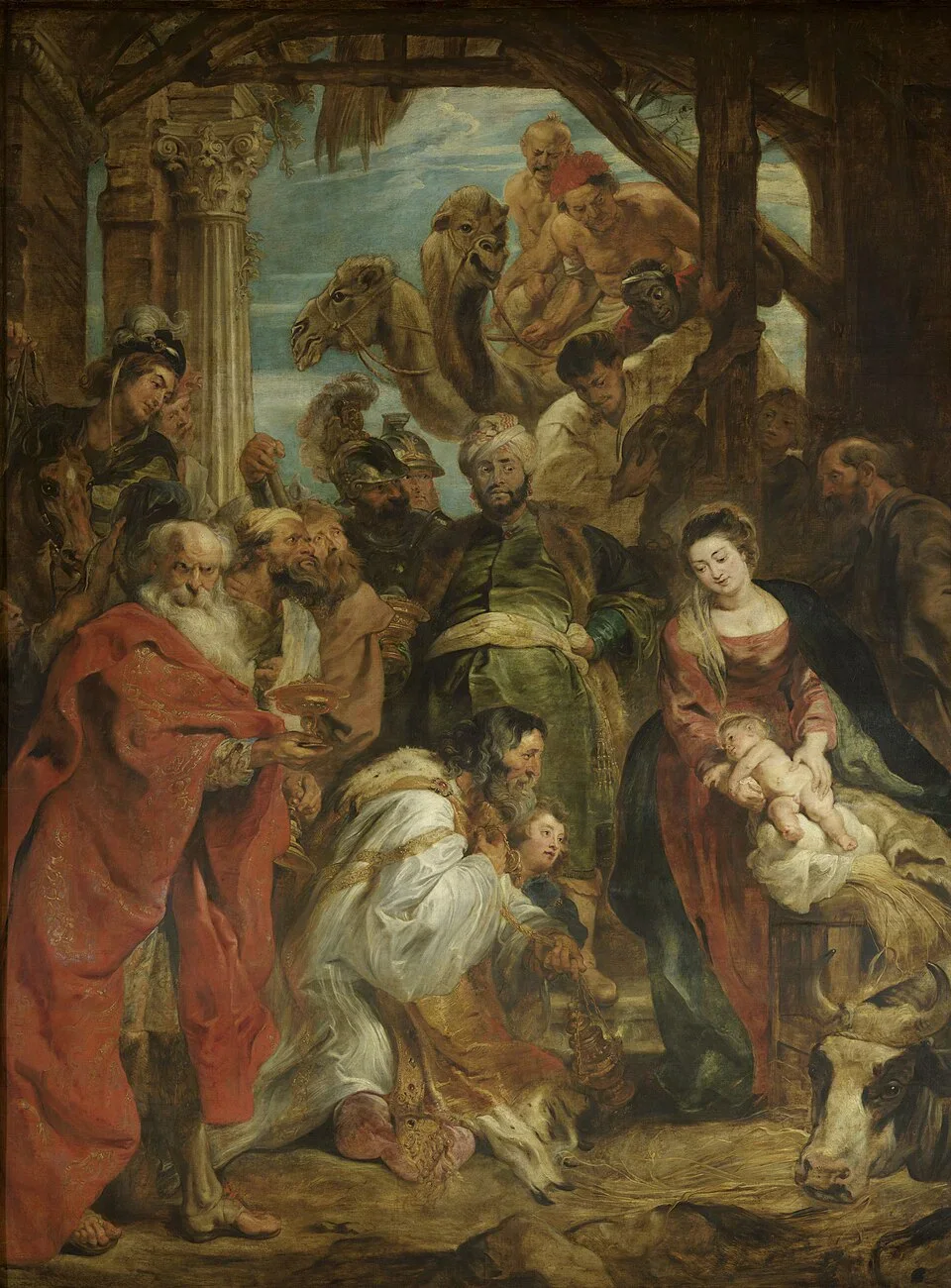
Adoration of the Magi
A crowd comes into a ruined building, and the whole company turns toward the right. There Mary shows the baby Jesus to three kings, who have come with gifts. The three gifts honour him as God, as king and as a man. The ruined building behind them is King David's palace, the family line the Messiah was expected to come from. High on the right, a spider sits in its web, a sign of the evil that Jesus will overcome. The king kneeling closest to the child is Gaspar, dressed in a surplice and a stole, the clothes a priest wears at the altar. In most pictures it is the eldest king, Melchior, who is nearest. But here Rubens puts Gaspar there, and that is how he ties the Bible story to the Mass. The abbot of Saint Michael's Abbey ordered it for the high altar in 1624, five hundred years after the abbey was founded.
Listen in the appPeter Paul Rubens · CC0
- 11
Venus Frigida
Peter Paul Rubens · 1614
- 12
Seated Nude
Amedeo Modigliani · 1917
- 13
Portrait of Eleazar Swalmius
Rembrandt · 1637
- 14
Self-portrait
Jean-Auguste-Dominique Ingres · 1864–1865
- 15
Man with a Roman coin
Hans Memling · 1474–1480
- 16
Rest on the Flight into Egypt
Gerard David · c. 1515
- 17
Christ on the Cross between the two criminals
Anthony van Dyck · 1619–1620
- 18
Calvary
Antonello da Messina · 1475
- 19
The Ironer
Rik Wouters · 1912
- 20
Caritas
Lucas Cranach the Elder · 1537–1540
- 21
Maria Sèthe
Théo van Rysselberghe · 1891
- 22
Peasant Woman Digging Up Potatoes
Vincent van Gogh · c. 1885
- 23
The Prodigal Son
Peter Paul Rubens · c. 1618
- 24
Orsini Polyptych
Simone Martini · 1333
- 25
The Intrigue (Ensor)
James Ensor · 1890
- 26
Pierre de Wiessant
Auguste Rodin · 1884–1886
- 27
The baptism of Christ
Peter Paul Rubens · 1604–1605
- 28
Landscape with the Flight into Egypt
Joachim Patinir · c. 1515
- 29
The Fall of the Rebel Angels
Frans Floris (I) · 1554
- 30
Stephanus Geeraerdts Alderman in Haarlem
Frans Hals · c. 1650–1652
- 31
The Lemon
Édouard Manet · c. 1880
- 32
Minerva Visits the Muses
Jan Brueghel the Elder, Joos de Momper the Younger, Hendrick van Balen the Elder · 1617
- 33
The Parisian Sphinx
Alfred Stevens · 1875–1877
- 34
Altarpiece of the Guild of the Joiners
Quinten Metsys · 1507–1511
- 35
The Judgement of Solomon
Frans Floris (I) · 1545–1550
- 36
As the Old Sing, So Pipe the Young
Jacob Jordaens · 1638–1640
- 37
Skeletons fighting over a Hanged Man
James Ensor · 1891
- 38
The Fisher Boy
Frans Hals · 1630–1632
- 39
Altarpiece of the Guild of the Old Arbalest
Maerten de Vos · c. 1590
- 40
The Rooftops of Ostend
James Ensor · 1884
- 41
Man of Sorrows
James Ensor · 1891
- 42
Joannes Gaspard Gevartius, (1593-1666)
Peter Paul Rubens · 1628–1631
- 43
Crucifixion
Antonello da Messina · 1475
- 44
The Oyster Eater
James Ensor · 1882
- 45
The Mad Maiden
Rik Wouters · 1912
- 46
The lamentation over the dead Christ
Anthony van Dyck · 1634–1640
- 47
The Man on the Chair
Henri de Braekeleer · 1875
- 48
Triptych of Antonius Tsgrooten
Goswin van der Weyden · 1507
- 49
Meleager and Atalanta
Jacob Jordaens · 1617–1618
- 50
A Collection
Frans Francken the Younger · 1619
- 51
Samson Mocked by the Philistines
Jan Steen · 1676
- 52
Festival of the Archers
Master of Frankfurt · c. 1493
- 53
The Daughters of Cecrops Finding the Child Erichthonius
Jacob Jordaens · 1617
- 54
As the Old Sing, So the Young Pipe
Jacob Jordaens · 1638–1640
- 55
The blind man
Gustave Van de Woestijne · 1910
- 56
Crucifixion
Jan van Amstel · 1525–1549
- 57
Adrienne
Gustave Van de Woestijne · 1919
- 58
Self-portrait with a Blue Sketchbook
Léon Spilliaert · 1907
- 59
The Lamentation over the Dead Christ
Quinten Metsys · 1507–1511
- 60
Portrait of Abraham Grapheus
Cornelis de Vos · 1620
- 61
Gaston and his Sister
Gustave Van de Woestijne · 1923
- 62
Flowers in a Vase
Jan Brueghel the Elder · 1650
- 63
Christ Mocked
Hieronymus Bosch · c. 1500
- 64
Virgin Mary Praying
Quinten Metsys · 1505
- 65
Portrait of a Man
Jan Cornelisz Vermeyen, Maarten van Heemskerck · 1530–1540
- 66
Albrecht Dürer's Visit to Antwerp in 1520
Jan August Hendrik Leys · 1855
- 67
Virgin and Child Surrounded by Angels
Jean Fouquet · 1450–1456
- 68
Two Girls as Saint Agnes and Saint Dorothea
Michaelina Wautier · c. 1650s
- 69
Still Life with Fish
Clara Peeters · 1600
- 70
Scaldis and Antverpia
Abraham Janssens I · 1609
- 71
The Lamentation over the Dead Christ
Anthony van Dyck · c. 1629
- 72
Summer
Emile Claus · 1893
- 73
Self-Portrait in a Black Eyepatch
Rik Wouters · c. 1915
- 74
Saint Jerome in His Study
Marinus van Reymerswaele · 1541
- 75
Emperor Charles V as a child
Jan van Beers · 1879
- 76
Winter Pleasures on the Ice
Jan Griffier I · c. 1710–1719
- 77
Preliminary sketch for the statue of Archbishop Andreas Cruesen from his tomb in St Rumbolds Cathedral, Mechelen
Lucas Faydherbe · 1617–1697
- 78
Calvary of Hendrik van Rijn
Unknown Artist · 1363
- 79
The Temptation of Antony Abbot of Egypt
After Hieronymus Bosch · 15th century
- 80
Portrait of Philippe de Croy
Rogier van der Weyden · c. 1460
- 81
Helmeted Minerva
Jan Frans Deckers · 1886
- 82
Self-portrait
John Michael Rysbrack · c. 1730
- 83
The Dance of the Bride
After Pieter Bruegel the Elder · 16th century
- 84
The Bourgeois Salon
James Ensor · 1881
- 85
Playing Cards
Adriaen Brouwer · 17th century
- 86
Fruit and Wine Glass
Willem van Aelst · 1659
- 87
Les Boëchelles. Two Walloon Peasant Children
Léon Frédéric · 1888
- 88
Embarkation at Calais
James Tissot · c. 1878–1882
- 89
Light
Jules Schmalzigaug · 1915–1916
- 90
Vespers
Constant Permeke · 1927
- 91
The Liqueur Drinkers
Gustave Van de Woestijne · 1922
- 92
Adoration of the Shepherds
Jacob Jordaens · c. 1616
- 93
The Ferry
Salomon van Ruysdael · 1657
- 94
Snow in Flanders
Valerius de Saedeleer · 1928
- 95
Spring
Jean Brusselmans · 1935
- 96
Cimon and Pero (Caritas Romana)
Jerôme Duquesnoy the Younger · 17th century
- 97
The Reliquary Bearer
George Minne · c. 1897
- 98
The Virgin seated, with her Child in her lap
Joannes Cardon · 1643
- 99
Portrait of Théophile Smekens
Jacques De Braekeleer · 1889
- 100
Preliminary sketch for the pillar picture of St. Joseph and the Christ Child on the globe, St. Rumbolds Cathedral, Mechelen
Lucas Faydherbe · 1617–1697
- 101
Apollo and Python
Artus Quellinus the Elder · 1609
- 102
Aaron
Jacques Bergé · 1696–1756
- 103
Melchisedech
Jacques Bergé · 1696–1756
- 104
Portrait of Florent Joseph ridder van Ertborn (1784-1840)
Joseph Geefs · 1849
- 105
The Annunciation
Simone Martini · 1333
- 106
Lady Godiva
Jozef Van Lerius · 1870
- 107
Two Springs
Gustave Van de Woestijne · 1910
- 108
Deep Fountain
Cristina Iglesias · 2006
- 109
Antwerp, Foster Mother of Painters
Theodoor Boeyermans · 1655
- 110
Le moulin à café en Scène d'hiver
Charles de Groux · 1857
- 111
Luis de Benavides Carillo, Marquis of Caracena, Governor of the Habsburg Netherlands
Artus Quellinus the Elder · 1664
- 112
Interior of an inn with an old man asleep and an amorous couple
Adriaen Brouwer · c. 1631–1638
- 113
A Ford
Johannes Siberechts · 1660s
- 114
Madonna with the Child on her lap
Walter Pompe · c. 1703
- 115
Head of a weeping child, with the right hand on the cheek
Jan Pieter van Baurscheit the Elder · c. 1683
- 116
David with the Head of Goliath, by Artemisia Gentileschi
Artemisia Gentileschi · 1610s
- 117
The Sleepers
Gustave Van de Woestijne · 1918
- 118
Statue of William the Silent and Philips of Marnix, Lord of Saint-Aldegonde
Jean-Paul Laenen · 2012
- 119
The education of Mary
Peter Paul Rubens · 1625–1626
- 120
Triumphal Chariot of Kallo
Peter Paul Rubens · 1638
- 121
Christ with Singing Angels
Hans Memling · 1480s
- 122
Music-making Angels
Hans Memling · 1480s
- 123
Music-making Angels
Hans Memling · 1480s
- 124
Madonna and Child
Dieric Bouts · 15th century
- 125
Croy family shield
Rogier van der Weyden · 1452–1461
- 126
The Annunciation
Rogier van der Weyden · 15th century
- 127
The Tax Collectors
Marinus van Reymerswaele · 1537
- 128
Descent from the Cross
Simone Martini · 1333
- 129
Last Judgement and the seven Acts of Mercy
Bernard van Orley · 1519–1525
- 130
The Painter Marten Pepijn
Anthony van Dyck · 1632
- 131
Judith
Jan Matsys · 1560–1565
- 132
The Holy Women and Saint John at Golgotha
Gerard David · 1480–1485
- 133
Huy, Seen from Ahin
Lucas van Valckenborch · 1580
- 134
The Dauphin François, Son of François I
Jean Clouet · 1520
- 135
Pierson la Hues, Drummer and Page of the Old Archers' Guild
Gillis Coignet · 1581
- 136
Christiaan de Hondt, abbot of Ter Duinen
Master of 1499 · 1499–1500
- 137
Virgin of the Annunciation
Simone Martini · 1333
- 138
Card Players
Theodoor Rombouts · 17th century
- 139
Portrait of a Girl as a Huntress
Caesar van Everdingen · c. 1665
- 140
Tavern Scene
David Teniers the Younger · 17th century
- 141
Portrait of a Family
Anthonie Palamedesz. · 1635
- 142
Landscape with Diana and Actaeon
Kerstiaen de Keuninck · 16th century
- 143
Landscape with dancing Shepherds
Jan Wildens · 1631
- 144
Vegetable Market
Joachim Beuckelaer · 1567
- 145
Banquet of the Gods
Frans Floris (I) · 1550
- 146
Inn Scene
Adriaen van Ostade · 17th century
Koninklijk Museum voor Schone Kunsten Antwerpen
Frequently asked questions
How much does the guide cost?
Free app download. Free until 1 January. Listed guide price: $1.99. Audio guide only. Venue admission is separate.
Can I listen without internet?
Yes. Download the guide’s audio, images, and maps in the app before your visit. Your downloaded content is then available offline.
Can I listen in my language?
In English for now. More languages soon.
Do I need to follow a schedule?
No. This is a self-guided experience. Choose your stops, pause whenever you like, and return to a story at your own pace.
Which artworks are in the Koninklijk Museum voor Schone Kunsten Antwerpen audio guide?
146 artworks, including Melun Diptych (Jean Fouquet), Jacopo Pesaro, Bishop of Paphos, being presented by Pope Alexander VI to Saint Peter (Titian), The Seven Sacraments (Rogier van der Weyden), Saint Barbara (Jan van Eyck), Rockox Triptych (Peter Paul Rubens), Cleopatra Testing Poisons on Condemned Prisoners (Alexandre Cabanel), Madonna at the Fountain (Jan van Eyck), and Christ with singing and music-making Angels (Hans Memling). The full list is on this page.
Is this the museum’s official audio guide?
No. Stanza is an independent audio guide app and is not affiliated with Koninklijk Museum voor Schone Kunsten Antwerpen. Museum admission is separate.
At your own pace
Explore Koninklijk Museum voor Schone Kunsten Antwerpen.
Download Stanza, then search for “Koninklijk Museum voor Schone Kunsten Antwerpen”.
Free app download · Guide price shown in the app
Keep exploring
Nearby audio guides
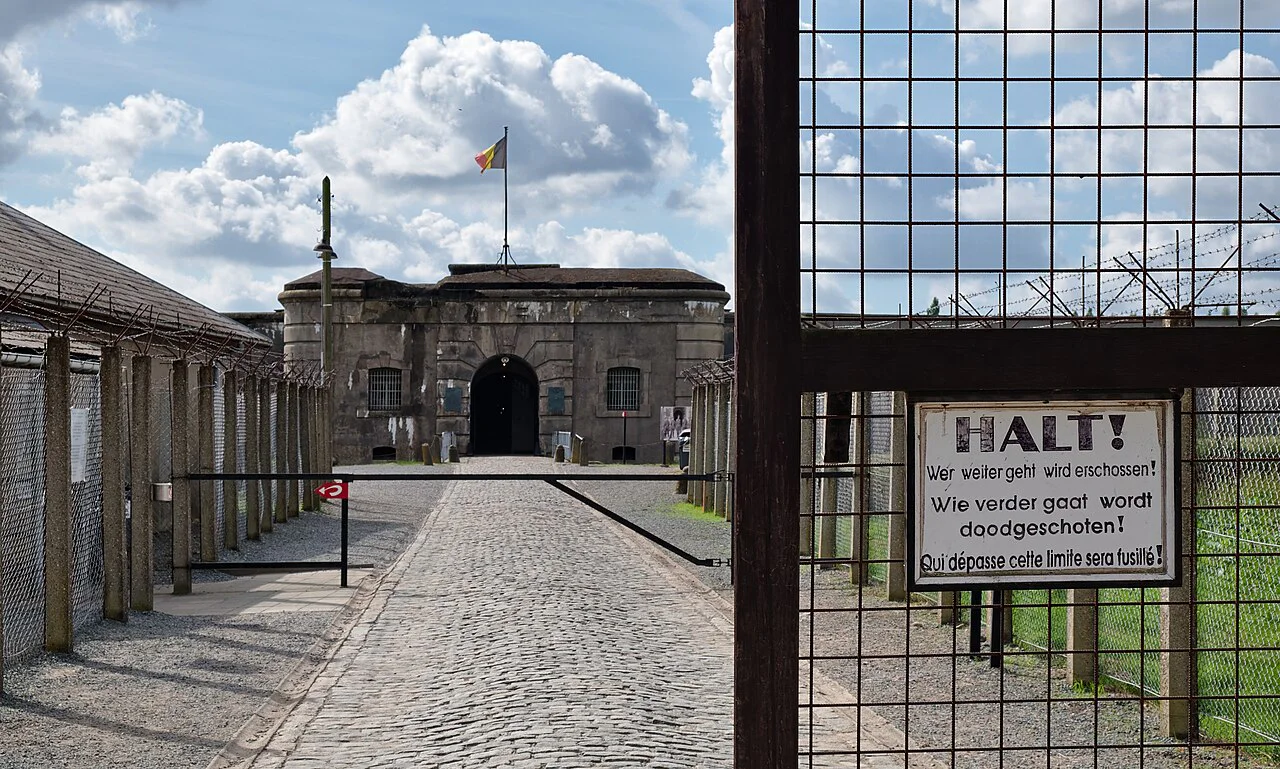
Willebroek · 17 km
Fort van Breendonk
Content & sources
Trougnouf (Benoit Brummer) · CC BY 4.0
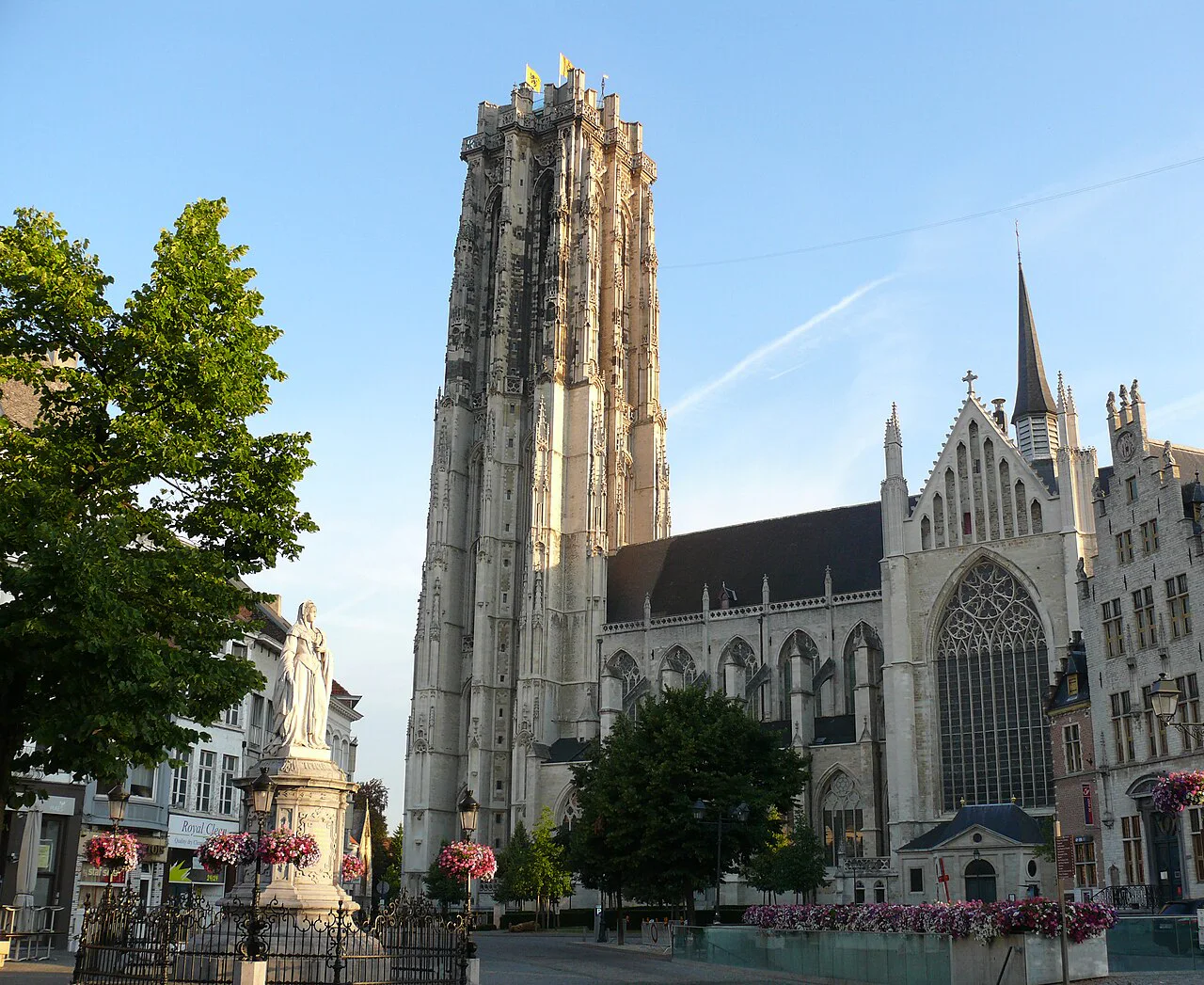
Mechelen · 21 km
Sint-Romboutskathedraal
Content & sources
Photo: Ad Meskens · CC BY-SA 3.0
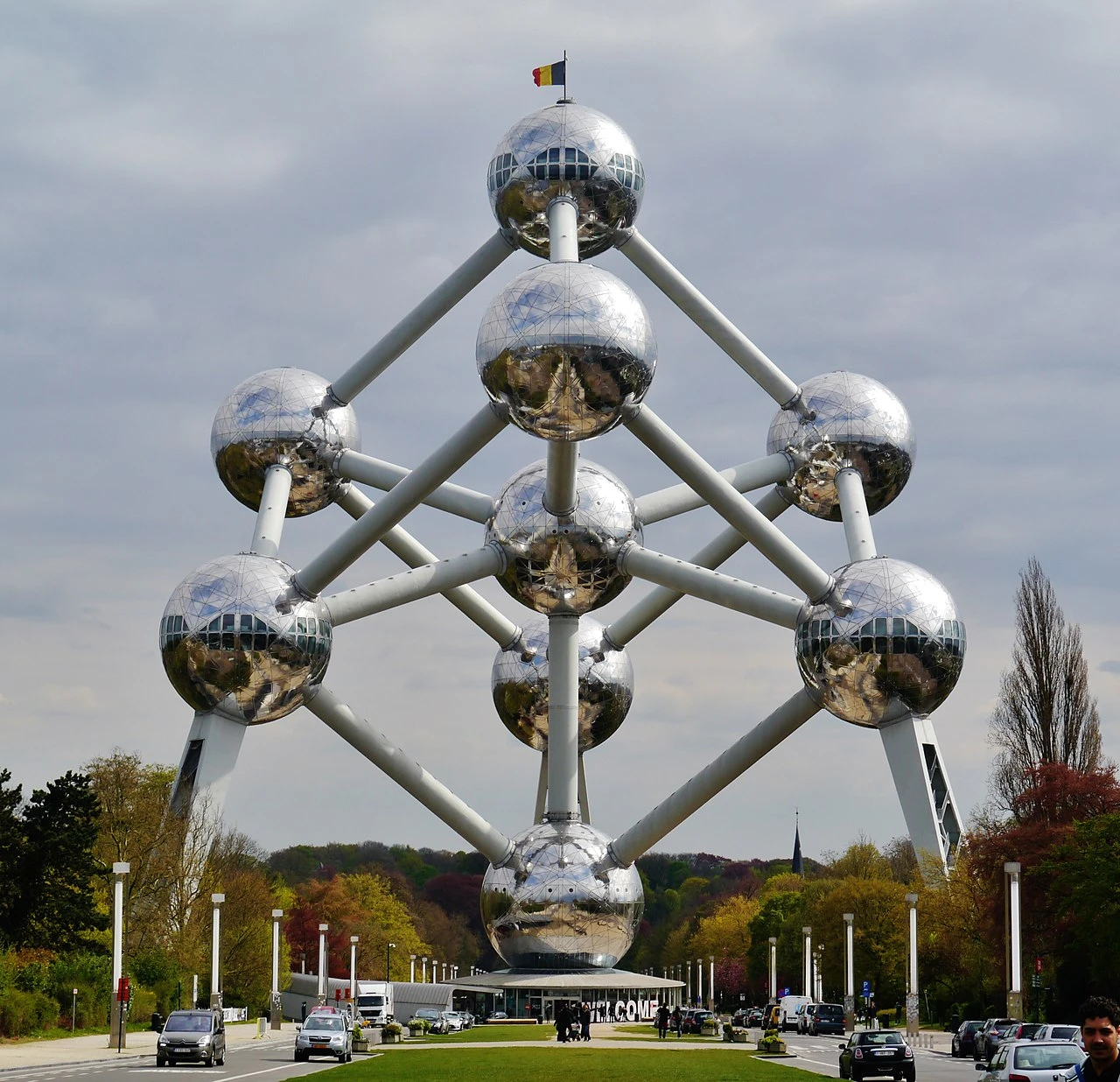
Brussels · 35 km
Atomium
Content & sources
Photo: Zairon · CC BY-SA 4.0
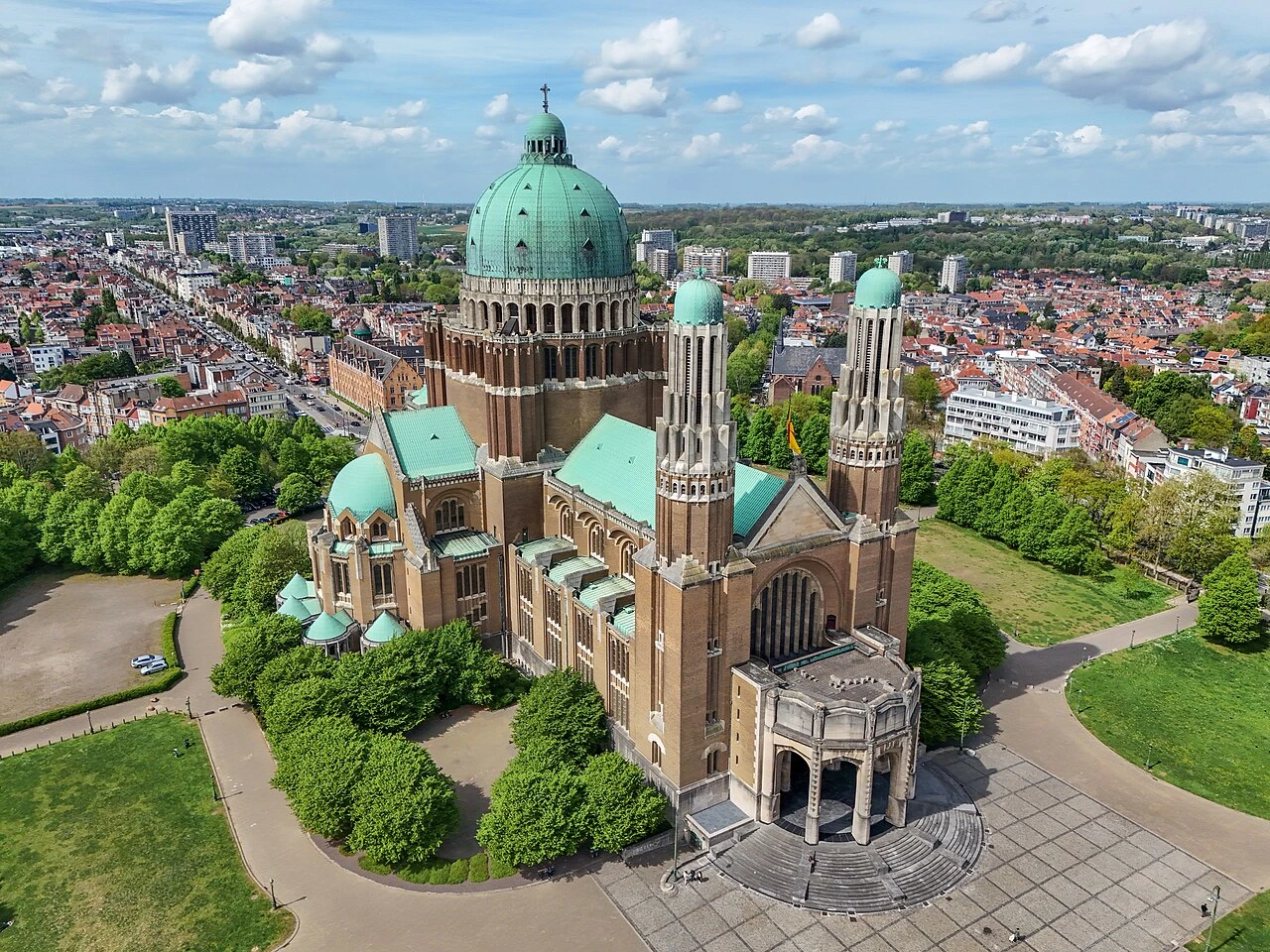
Koekelberg · 38 km
Basilica of the Sacred Heart, Brussels
Content & sources
Photo: Giles Laurent · CC BY-SA 4.0
Art museums
More art museum audio guides
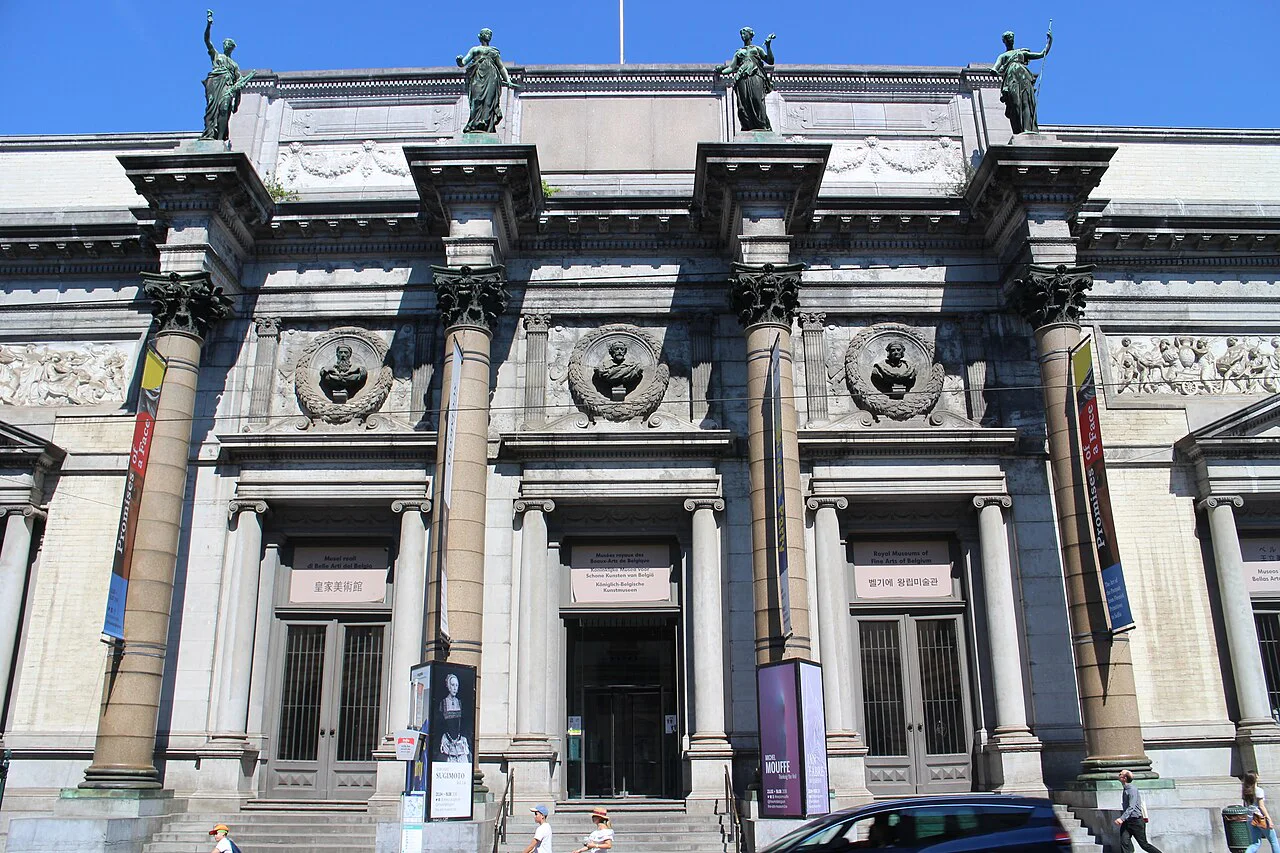
Brussels · 127 artworks
Royal Museums of Fine Arts of Belgium
Content & sources
Photo: Suicasmo · CC BY-SA 4.0
Lille · 96 artworks
Palais des Beaux-Arts de Lille
Content & sources
Photo: Velvet · CC BY-SA 3.0
Haarlem · 45 artworks
Frans Hals Museum
Content & sources
Mcke · CC BY-SA 3.0
Amsterdam · 73 artworks
Van Gogh Museum
Content & sources
Warrox · CC BY 2.5
Amsterdam · 387 artworks
Rijksmuseum
Content & sources
Marco Almbauer · CC BY-SA 3.0
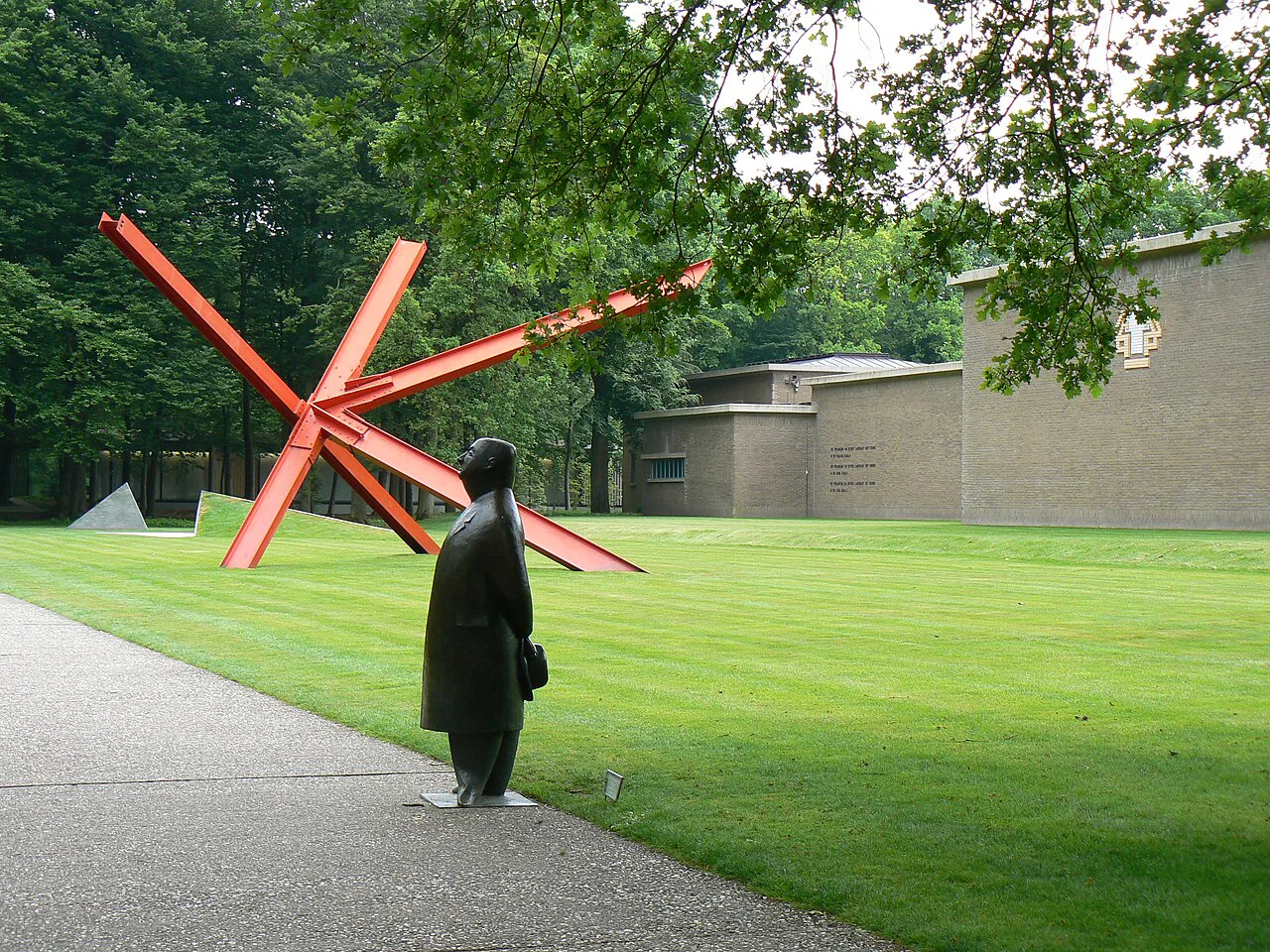
Otterlo · 60 artworks
Kröller-Müller Museum
Content & sources
Photo: Gerardus · Public domain