Stanza · Audio guide
Pinacoteca nazionale di Bologna Audio Guide
A place to remember. A story to take with you.
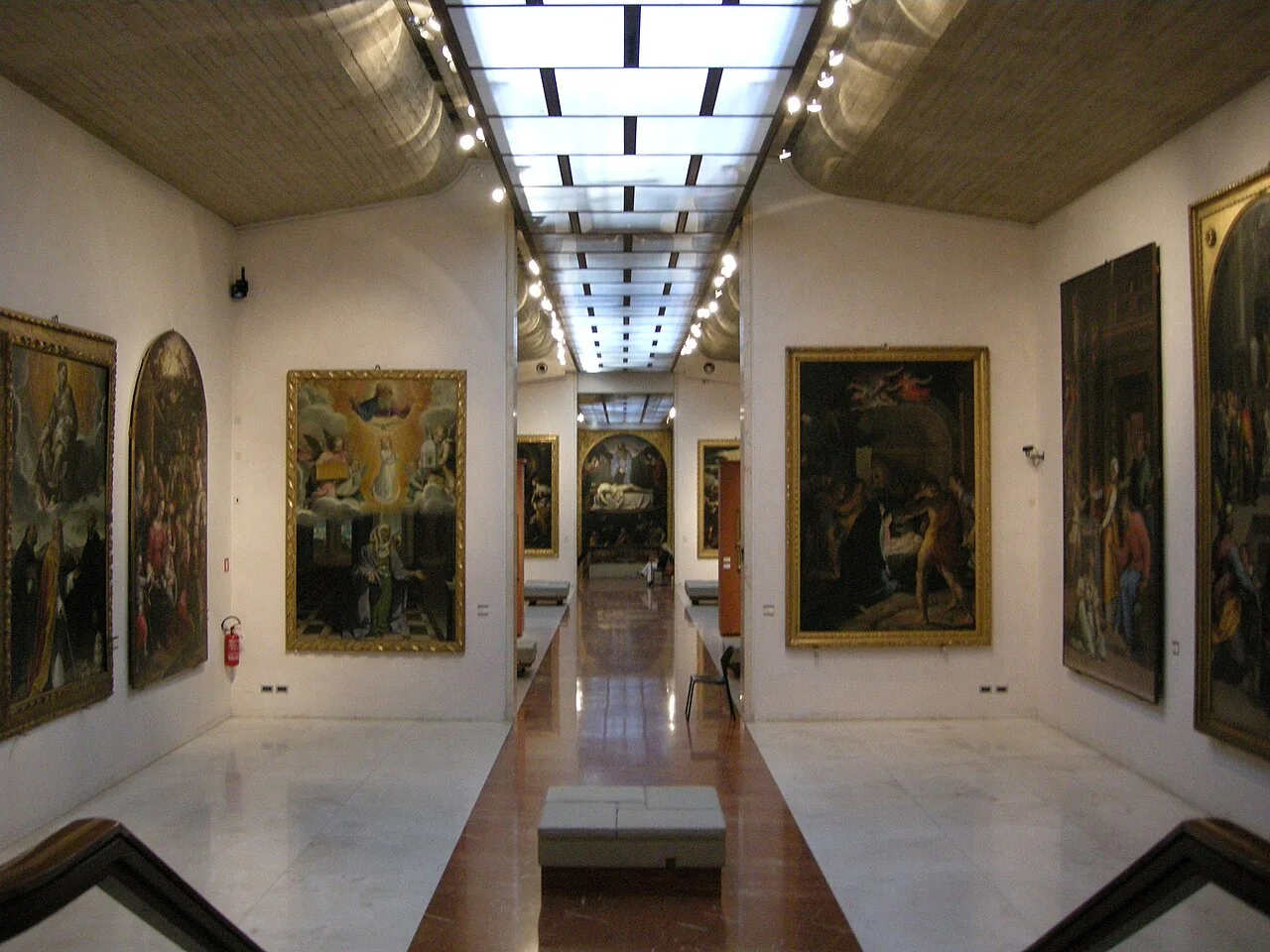
The National Art Gallery of Bologna is a museum in Bologna, Italy, located in the former Saint Ignatius Jesuit novitiate of the city's University district and inside the same building that houses the Academy…
Download Stanza, then search for “Pinacoteca nazionale di Bologna”.
About the tour
One guide. Your kind of visit.
The National Art Gallery of Bologna is a museum in Bologna, Italy, located in the former Saint Ignatius Jesuit novitiate of the city's University district and inside the same building that houses the Academy of Fine Arts. The museum offers a wide collection of Emilian paintings from the 13th to the 18th century and other fundamental works by artists who were in some way related to the city.
The Pinacoteca nazionale di Bologna guide tells the stories of 38 artworks, including The Ecstasy of Saint Cecilia (Raphael), The Last Supper (El Greco), Massacre of the Innocents (Guido Reni), Madonna in Glory with Saints (Pietro Perugino), Mocking of Christ (Annibale Carracci), Madonna and Child with Saints John the Baptist, John the Evangelist, and St. Catherine (Annibale Carracci), The Last Communion of St Jerome (Agostino Carracci), and Portrait of the Gozzadini Family (Lavinia Fontana). Every artwork is free to hear in the Stanza app until 1 January.
Ready when you are.
- 01Get the free Stanza app.
iOS & Android
- 02Find your guide.
“Pinacoteca nazionale di Bologna”
- 03Download before you go.
Works offline
Audio guide / 38 artworks
Inside the guide
Get to know a few of the stories before you go. Open a stop to read more.
01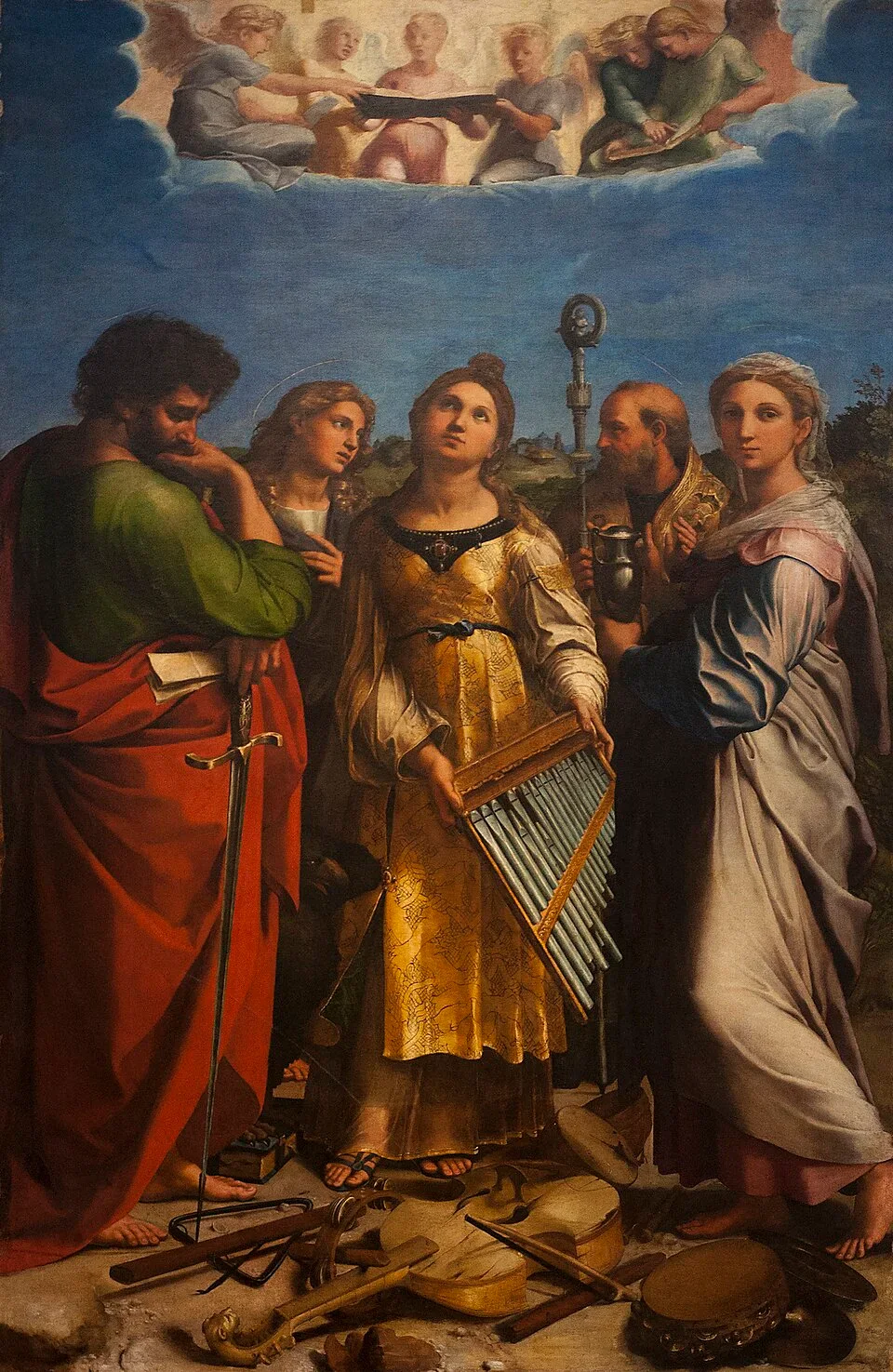
The Ecstasy of Saint Cecilia
At Cecilia's feet, the instruments are broken. A viola da gamba has no strings, the flutes are chipped, the tambourines have torn skins. A small organ is slipping from her hands. They are the music of the world she turned away from. Above her, the clouds open and a choir of angels appears, and she is the only one who raises her face to it. The picture was made for a woman who saw herself in Cecilia. Elena Duglioli dall'Olio was a noblewoman of Bologna, known for her visions and ecstasies, with music at their heart. She had a devotion to Saint Cecilia and had been given a relic of her, a knucklebone. Like Cecilia, she wanted to live chaste within her marriage, and she persuaded her husband not to consummate it. She wanted her saint on the altar of the chapel in the church of San Giovanni in Monte. In the old story, as musicians played at her wedding, Cecilia turned to God in her heart and asked him to keep her pure. Raphael painted that moment of worship, not a saint to be adored. No Christ appears in the sky above her, not even a cross or a dove. The divine is in Cecilia's heart, and the music she hears sounds only in her soul.
Listen in the appRaphael · Public domain
02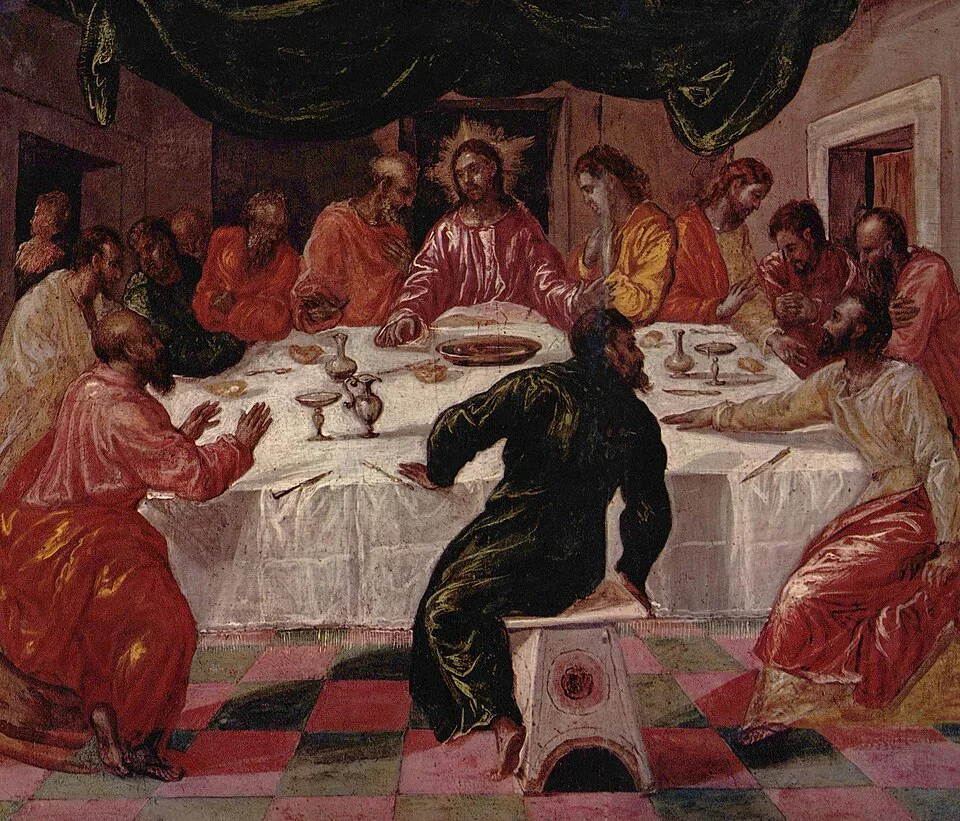
The Last Supper
Christ and his apostles are gathered around a long table with a cloth across it. The room has several doors and a floor of red and black checkered tiles. Christ stands out in a red robe that becomes the strongest light in the picture. He has just told the apostles that one of them will betray him, one of the most dramatic moments of Holy Thursday. The view drops steeply from above and straight on. The small room hangs in the air, and the figures tip toward you. They have almost no body to them, hovering over the table more than sitting at it. Around Christ, the apostles show all kinds of poses and eastern colours. Those quick strokes of the brush already point the way El Greco would paint for the rest of his career. What is still not known is whether this painting is really his, because it carries no signature.
Listen in the appEl Greco · Public domain
03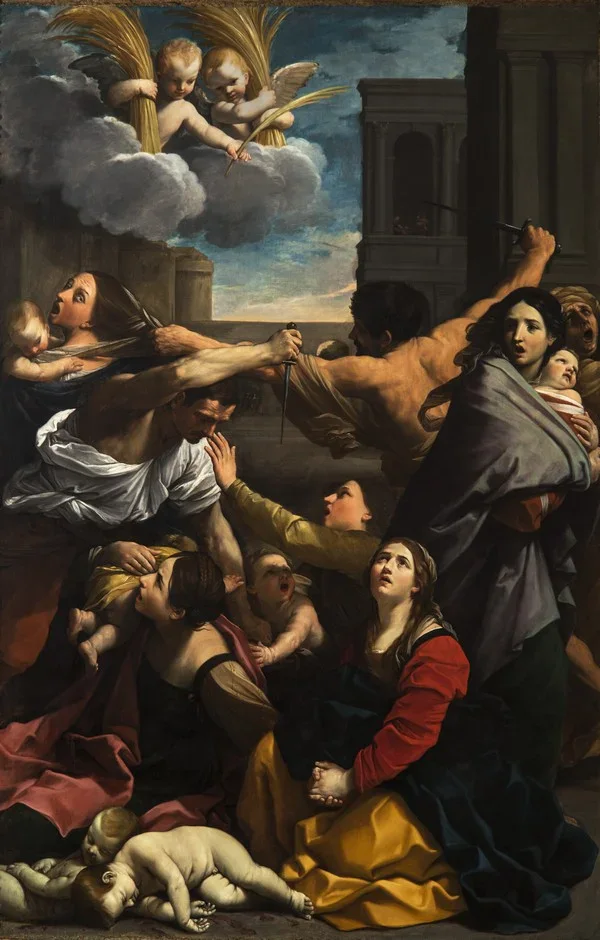
Massacre of the Innocents
French soldiers carried this painting out of its chapel in 1796 and took it to the Louvre. It was made in 1611 for the Berò chapel in the church of San Domenico and had hung there ever since. The Berò family sold it to the Ghisilieri family in 1734, and it was still in that chapel when the French came. It returned in 1815 and has been here since 1817. The picture they carried off shows two soldiers with knives in their right hands, ready to kill the children. One is seen from behind, rushing at a woman who screams as he grabs her hair. Reni leaves the killers' faces in shadow and puts the light on their arms and hands, to show how coldly they work. He gives the feeling only to the mothers and children, leaving the killers outside the grief. One mother runs to the right, embracing her child. Another kneels and prays over the children already dead, her face turned to the sky. This is the story from Matthew's Gospel, where Herod the Great orders every boy under two in Bethlehem killed. In the upper left, angels rest on clouds and hold out palm fronds. Those fronds are the palms of martyrdom, and the children are the martyrs.
Listen in the appGuido Reni · Public domain
04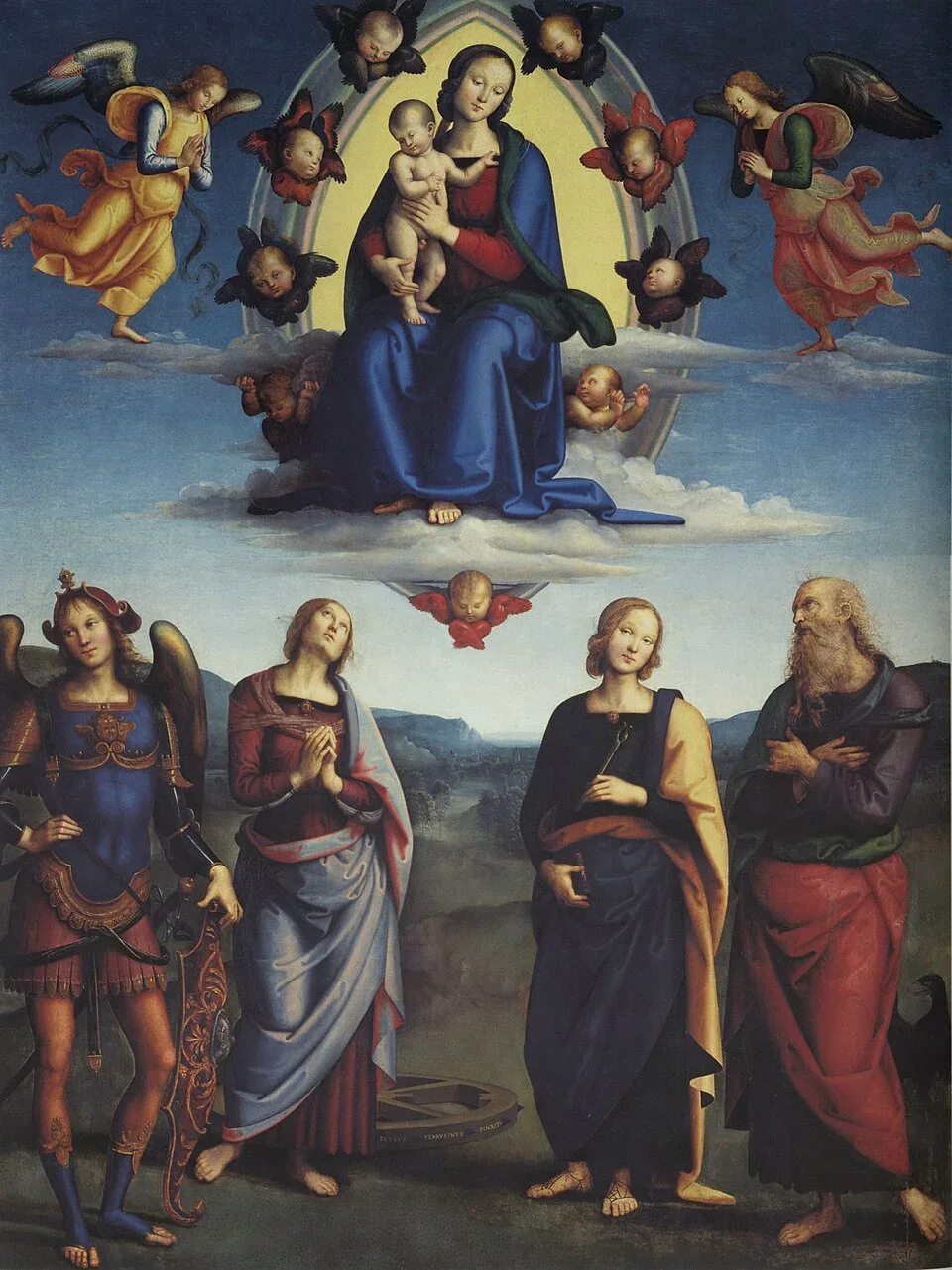
Madonna in Glory with Saints
One of the four saints here is Catherine of Alexandria, and a toothed wheel is beside her, the instrument of her torture. Right on that wheel, Perugino signed his name, saying he had painted the picture. It is an odd place for a signature. The wheel is in the lower half of the painting, where the four saints appear against a hilly landscape. Above them, Mary and the child are inside an almond shape, surrounded by angels. The two halves barely meet. This design goes back to an Assumption he painted for the Sistine Chapel, now lost, and he used it in other works too. The picture was made for the Scarani Chapel, in the church of San Giovanni in Monte.
Listen in the appPietro Perugino · Public domain
05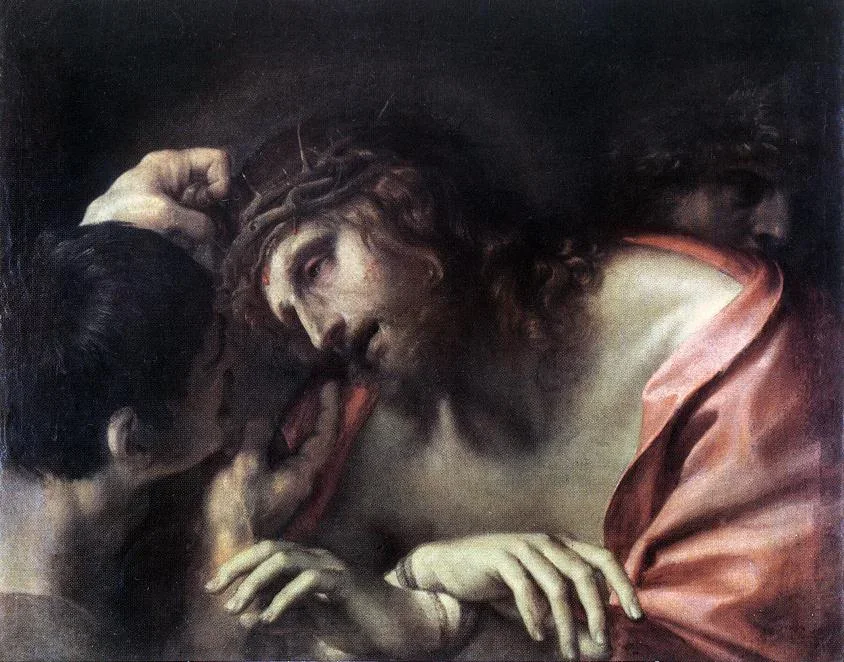
Mocking of Christ
Christ has been whipped, and one man pulls his hair. A crown of thorns is coming down onto his head, lowered by another man. Christ's hands are foreshortened, and they fill the small space between him and the man lowering it. They give the scene a sudden depth in a space this tight. This is probably the painting made to answer Cardinal Odoardo Farnese. He kept saying that painters of the past were better than painters alive now. So Annibale Carracci painted it in the manner of Sebastiano del Piombo and hung it on a wall of the Palazzo Farnese. The cardinal saw it and admired it. He took it for a work by Luciani and said that proved him right. Painters of that sort, he said, were dead and gone. The painter answered that he was, by the grace of God, still alive.
Listen in the appAnnibale Carracci · Public domain
06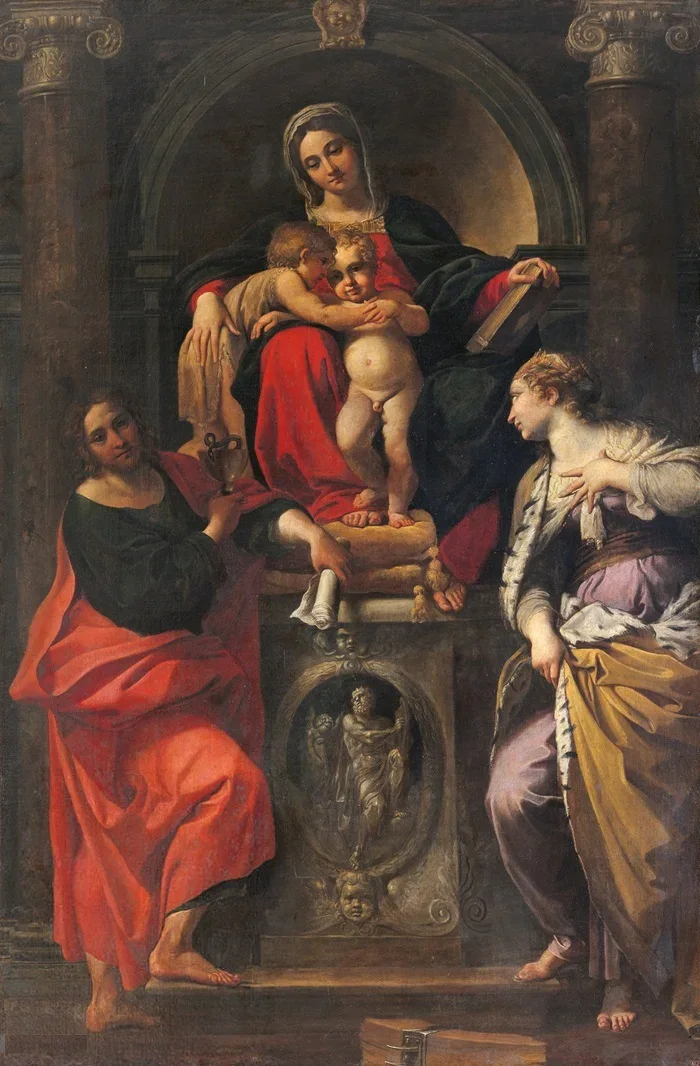
Madonna and Child with Saints John the Baptist, John the Evangelist, and St. Catherine
How many painters are at work in this one picture? Mary is enthroned at the centre, the children close around her, the whole scene balanced and still. Only a few years earlier, Annibale Carracci painted in the warm, rich style of Venice. You can still feel it in Saint Catherine, a figure drawn from that tradition. But the quiet symmetry, the Virgin in the middle, the settled pyramid of figures, belong to the calmer holy scenes of the Renaissance. He painted this for a chapel in Bologna, and in it he tried a new direction. On the throne, inside an oval niche, a carved relief shows King David playing the lyre, and Ionic columns frame the scene. Both come from Correggio, a master who had influenced him before the Venetian years. And the baby's foot rests on his mother's foot, taken directly from Raphael's Madonna del Cardellino. The group of Mary and the two children came from that painting too.
Listen in the appAnnibale Carracci · Public domain
07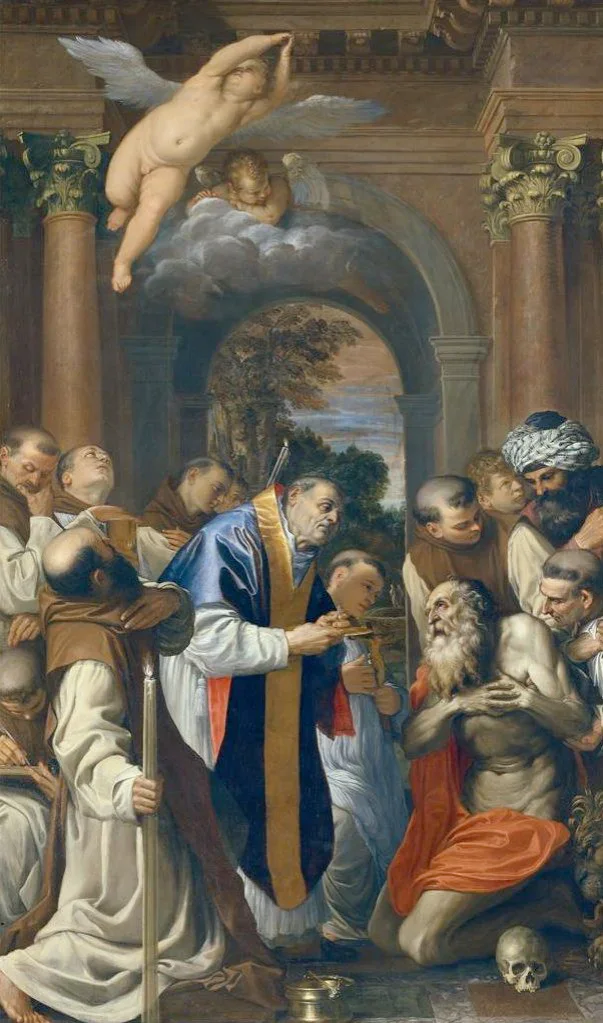
The Last Communion of St Jerome
This painting was nearly left unfinished. Agostino Carracci took the commission for a church in Bologna, then kept putting it aside. He worked in bursts and left it for long stretches. He even thought of giving back the advance money to escape the commission. It seems he finished only after Orazio Spinola, the pope's deputy in Bologna, urged him on. Spinola took that post in 1597, so if that is how it went, the work was finished just after, about five years after he began. The painting he finally handed over is crowded with figures in one closed space, every shape and volume worked out in fine detail. Jerome is an old man now. He kneels to receive his last communion, two brothers supporting him. At the centre the priest gives him the host, while monks with shaved crowns catch the light from the left. In the lower right corner you can just make out a lion, Jerome's faithful companion. Years later the picture was drawn into a quarrel. Domenichino painted the same subject for a church in Rome in 1614, and his version closely resembled this one. When the two were competing for important commissions, Lanfranco accused him of copying it. To prove the charge, he had a print made of it, since in Rome it was less well known than in Bologna.
Listen in the appAgostino Carracci · Public domain
08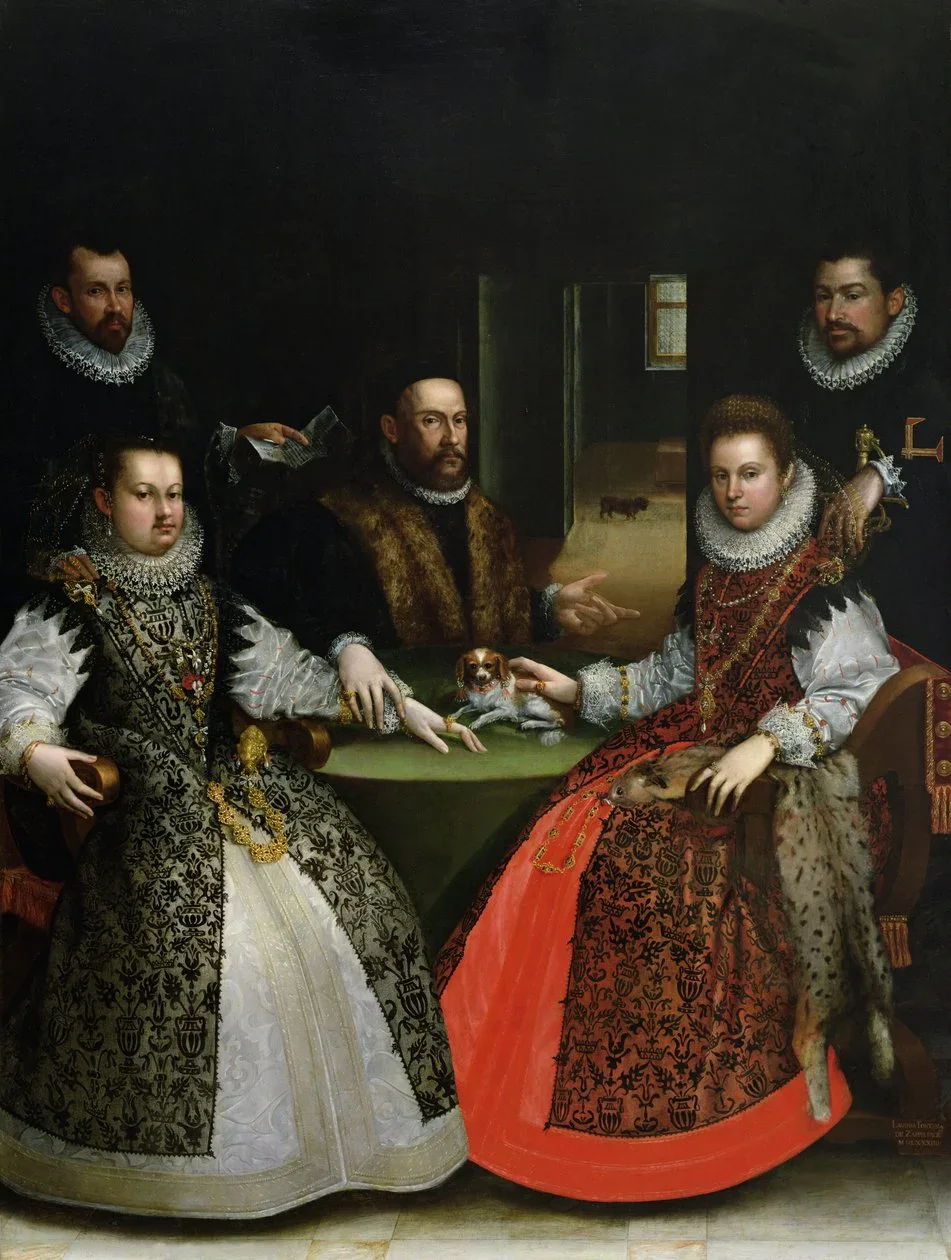
Portrait of the Gozzadini Family
This picture may have been Laudomia Gozzadini's way of proving what was hers. Her father had promised the family fortune to whichever daughter first produced a living heir. Her sister Ginevra won that contest, and was dead by the time this was painted. Annibale, executor of their father's will, owed Laudomia money. She took him to court, and won. She put herself at the front, in a bold red that sets her apart. She and Ginevra fill most of the space, faces lit, while the two husbands stand behind and fade into the dark. Their wedding jewels were bought by their father. Shown in full, they may be a reminder that the money each sister brought into her marriage was her own inheritance, not a husband's to withhold. The paper in Annibale's hand may hint at his hold over the sisters' money. Lavinia Fontana, close to Laudomia in age and friendship, made this her first recorded commission. She painted Ginevra accurately, though Ginevra was already dead and buried. In her will, Laudomia first asked that prayers be said for the souls of those in the picture. Then she asked only that they be remembered. In the end she removed both requests, and left the portrait to her two daughters, Placidia and Berenice.
Listen in the appLavinia Fontana · Public domain
09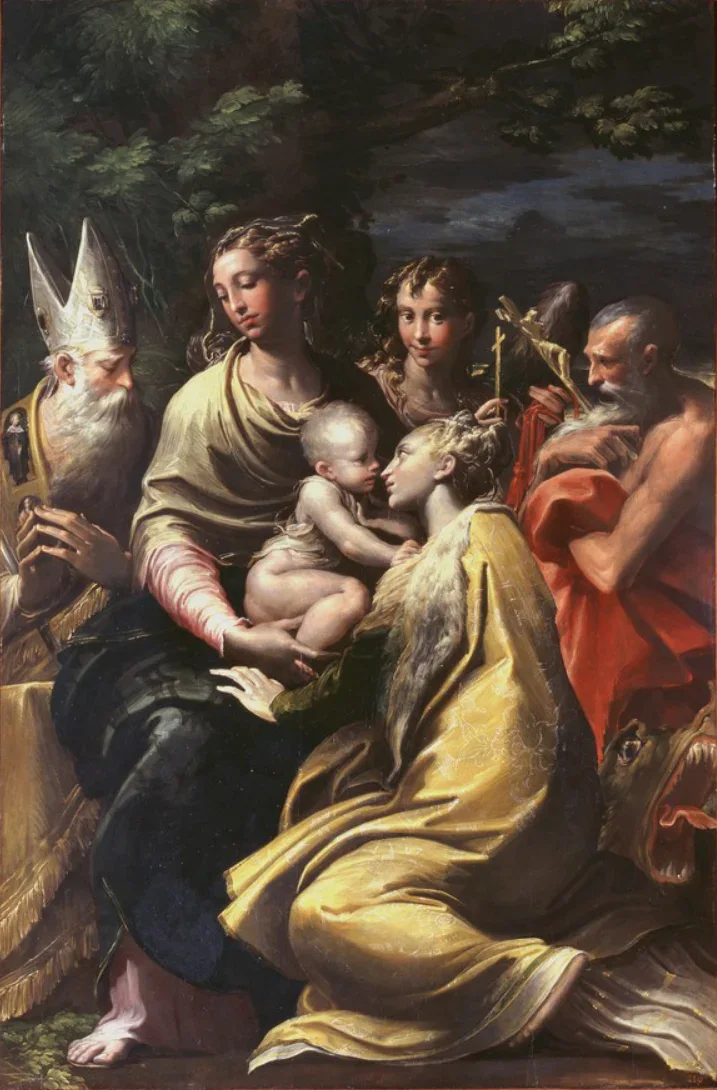
Madonna of Saint Margaret
A child is held out toward a young woman, his eyes fixed on her. The woman holding him has turned to a bishop at her side. In the lower right, half in shadow, a monster opens its jaws. No one pays the monster any mind. Its curled tongue and great teeth only tell you this is Saint Margaret. She has brought her face close to the child, tickling his chin. Her other hand rests easily on Mary's knee. His eyes stay on hers, and she looks back. Parmigianino painted this in Bologna between 1529 and 1530. It was never made for the nobleman whose chapel it ended up in. On the eighth of April, 1530, it passed to Giovanni Maria Giusti. A hundred and fifty thousand lire went with it, in exchange for a house beside the convent. He wanted it for his newly built chapel in the convent church. The nuns of Santa Margherita had ordered it for themselves.
Listen in the appParmigianino · Public domain
10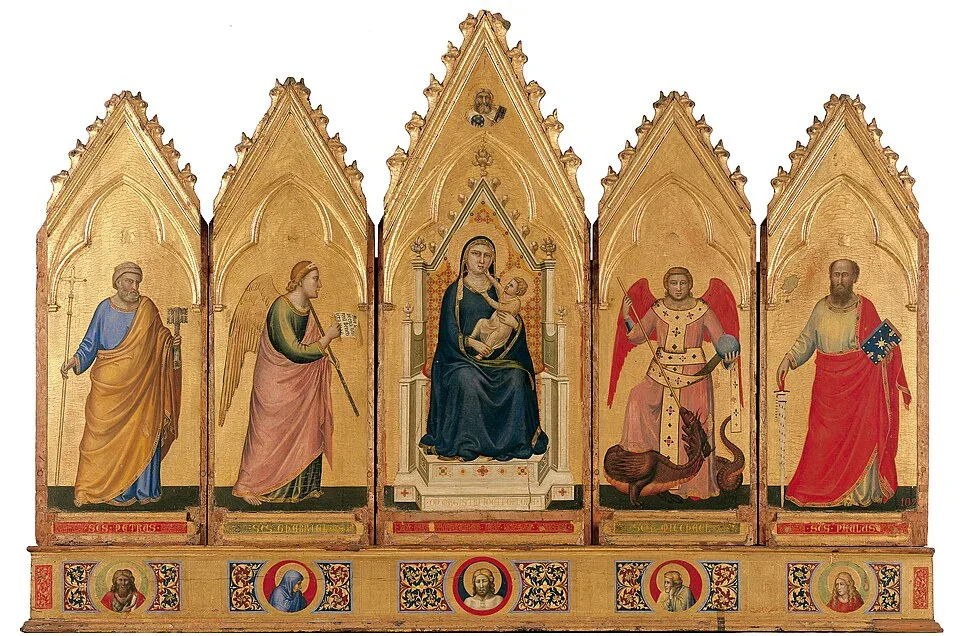
Bologna Polyptych
When Bologna tore down the castle, this painting was carried out of it. It had been made for the pope's private chapel in the fortress at Porta Galliera. The citizens had risen against the papal legate, and in 1334 the fortress was demolished. The panel was taken beyond the walls to a small church, Santa Maria degli Angeli. At the center the Virgin sits on a throne with the Child. On the step below her is a signature, the work of Master Giotto of Florence. Her face looks local rather than Florentine. It may follow a model supplied by whoever ordered the work. It became the model for painters in Bologna throughout the fourteenth century. In 1732 Giampietro Zanotti came across it in the sacristy of that church and read the signature on the step. He guessed that Gerra Pepoli had ordered it. There was no real evidence for that. In 2015 the patron was identified as the papal legate himself, Bertrand du Pouget. The man whose castle Bologna destroyed had commissioned the painting. The panels were taken apart in 1808 and put back in 1894, in a new frame that damaged their edges. They have hung here since. The year it was painted is still not known.
Listen in the appGiotto · Public domain
- 11
Madonna dei Bargellini
Ludovico Carracci · 1588
- 12
Transfiguration
Ludovico Carracci · 1595
- 13
Madonna degli Scalzi with Saints Francis and Jerome
Ludovico Carracci · c. 1590
- 14
Susanna and the Elders
Artemisia Gentileschi, Onofrio Palumbo · 1652
- 15
The Visitation
Jacopo Tintoretto · c. 1550
- 16
Pala della Peste
Guido Reni · 1631–1632
- 17
Madonna in Glory with Saints
Annibale Carracci · 1590–1592
- 18
Madonna and Child
Giovanni Battista Cima da Conegliano · c. 1495
- 19
Christ and the Good Thief
Titian · c. 1563
- 20
Saint Sebastian Tended by Saint Irene
Guercino · 1619
- 21
Ariadne
Guido Reni · 1638–1640
- 22
Sibyl with a Cartouche
Guercino · 1619–1620
- 23
Saint Peter of Verona
Guercino · 1647
- 24
Madonna enthroned with child and Saints Petronius and John the Evangelist
Francesco del Cossa · 1474
- 25
Newborn Baby in a Crib
Lavinia Fontana · c. 1583
- 26
Altar Bentivoglio
Francesco Francia · 1499
- 27
Saint Joseph
Guercino · c. 1648–1649
- 28
Madonna del Passero
Guercino · c. 1615–1616
- 29
Saint John the Baptist
Guercino · c. 1644
- 30
Flagellazione of Cristo
Guido Reni · 1640–1642
- 31
Archangel Michael
Ercole de' Roberti · c. 1470–1480
- 32
Philoctetes on the Island of Lemnos
James Barry · 1770–1771
- 33
Sibyl
Guido Reni · 1635–1636
- 34
Saint Ambrose
Giusto de' Menabuoi · 1363
- 35
The Investiture of Saint William of Aquitaine
Guercino · c. 1620
- 36
Saint George and the Dragon
Vitale da Bologna · c. 1350
- 37
The Penitent St Jerome
Marco Zoppo · 1465–1466
- 38
Toilet of Venus
Francesco Albani · 1605–1610
Pinacoteca nazionale di Bologna
Frequently asked questions
How much does the guide cost?
Free app download. Free until 1 January. Listed guide price: $0.99. Audio guide only. Venue admission is separate.
Can I listen without internet?
Yes. Download the guide’s audio, images, and maps in the app before your visit. Your downloaded content is then available offline.
Can I listen in my language?
In English for now. More languages soon.
Do I need to follow a schedule?
No. This is a self-guided experience. Choose your stops, pause whenever you like, and return to a story at your own pace.
Which artworks are in the Pinacoteca nazionale di Bologna audio guide?
38 artworks, including The Ecstasy of Saint Cecilia (Raphael), The Last Supper (El Greco), Massacre of the Innocents (Guido Reni), Madonna in Glory with Saints (Pietro Perugino), Mocking of Christ (Annibale Carracci), Madonna and Child with Saints John the Baptist, John the Evangelist, and St. Catherine (Annibale Carracci), The Last Communion of St Jerome (Agostino Carracci), and Portrait of the Gozzadini Family (Lavinia Fontana). The full list is on this page.
Is this the museum’s official audio guide?
No. Stanza is an independent audio guide app and is not affiliated with Pinacoteca nazionale di Bologna. Museum admission is separate.
At your own pace
Explore Pinacoteca nazionale di Bologna.
Download Stanza, then search for “Pinacoteca nazionale di Bologna”.
Free app download · Guide price shown in the app
Keep exploring
Nearby audio guides
Bologna · 1 km
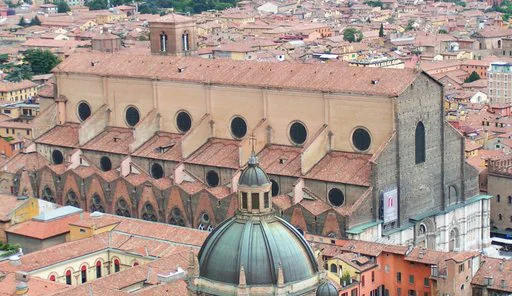
Basilica di San Petronio
Content & sources
No machine-readable author provided. Rnt20 assumed (based on copyright claims). · Public domain
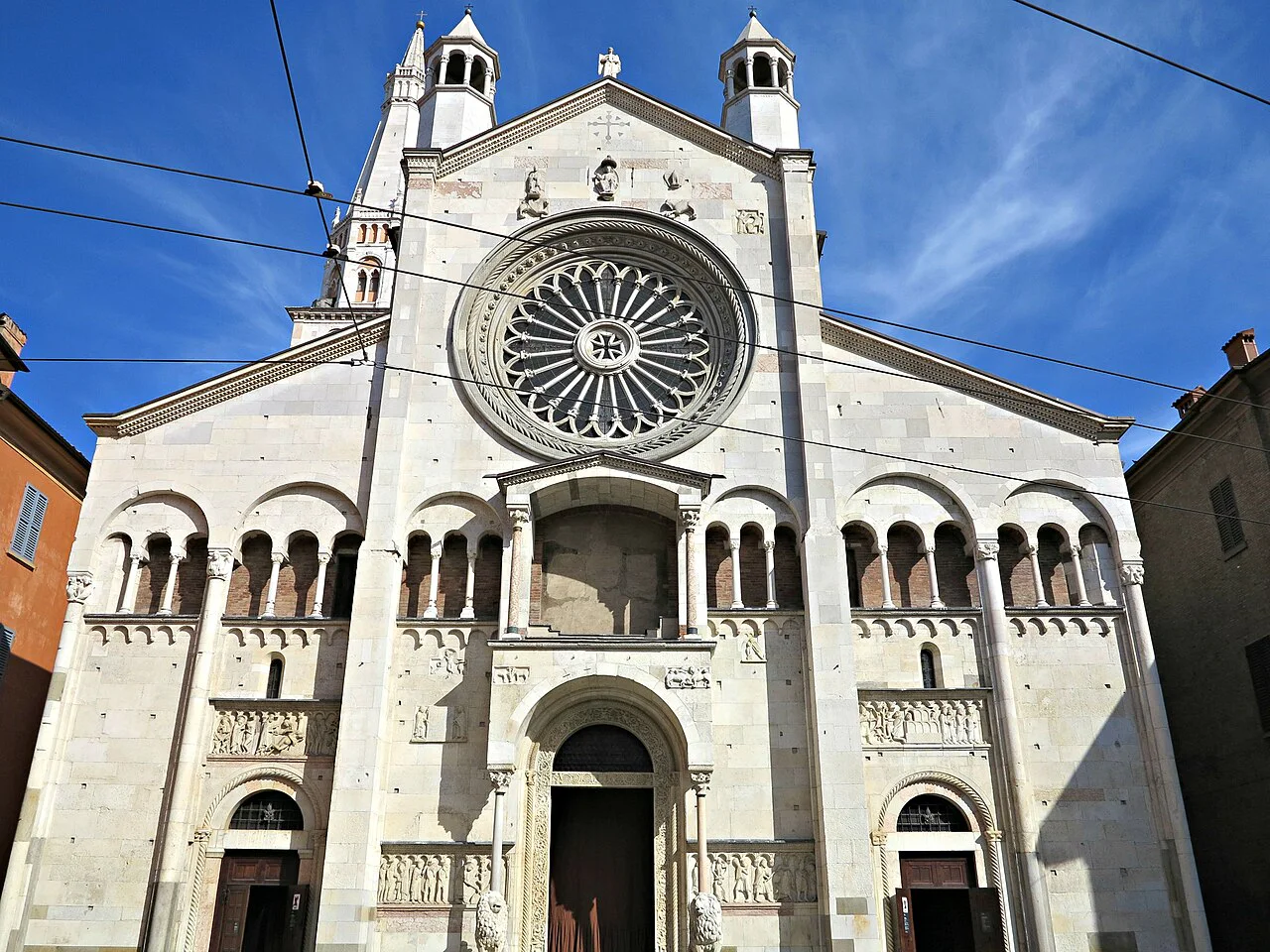
Modena · 38 km
Duomo di Modena
Content & sources
Photo: Mongolo1984 · CC BY-SA 4.0
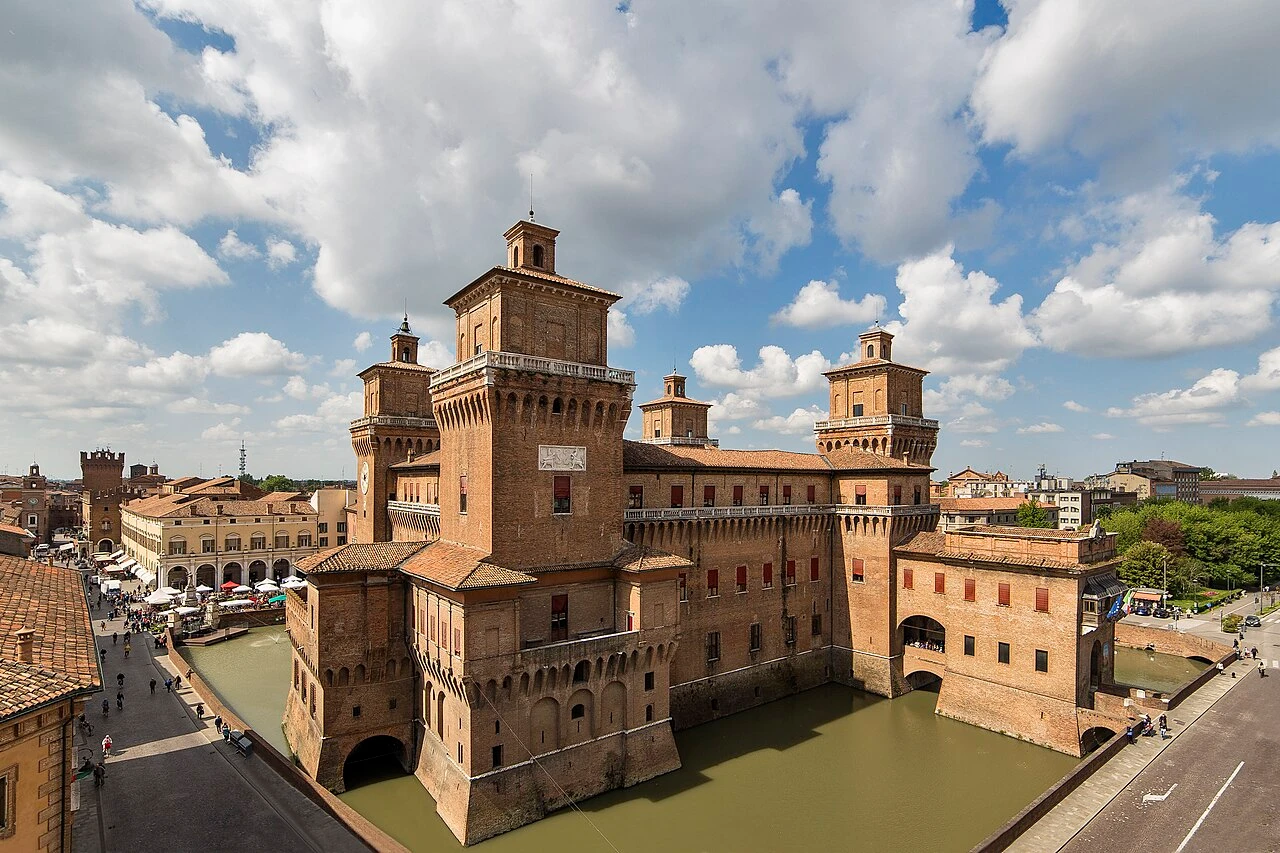
Ferrara · 43 km
Castello Estense
Content & sources
Photo: Nbisi · CC BY-SA 4.0
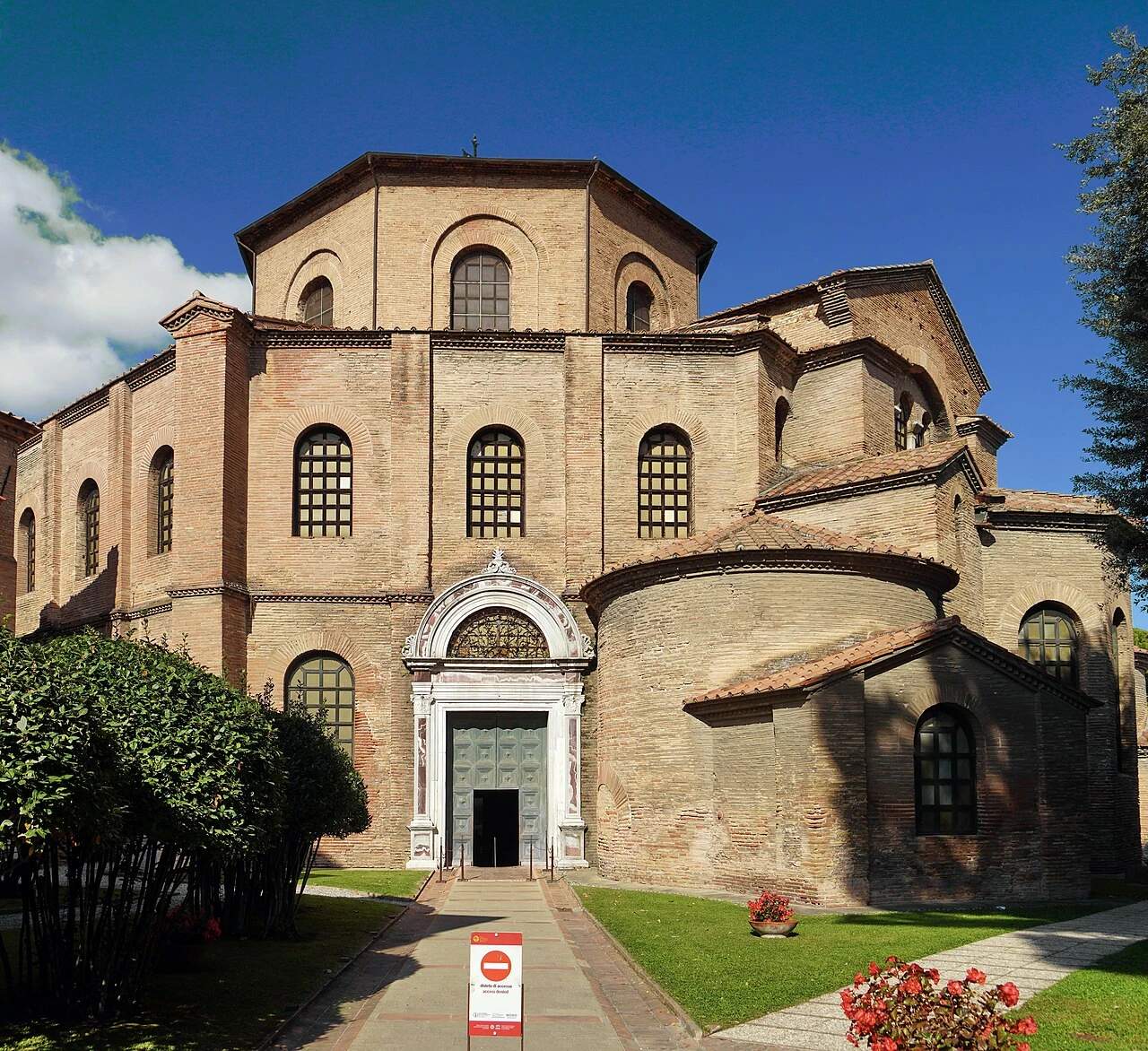
Ravenna · 67 km
Basilica of San Vitale
Content & sources
Commonists · CC BY-SA 4.0
Art museums
More art museum audio guides
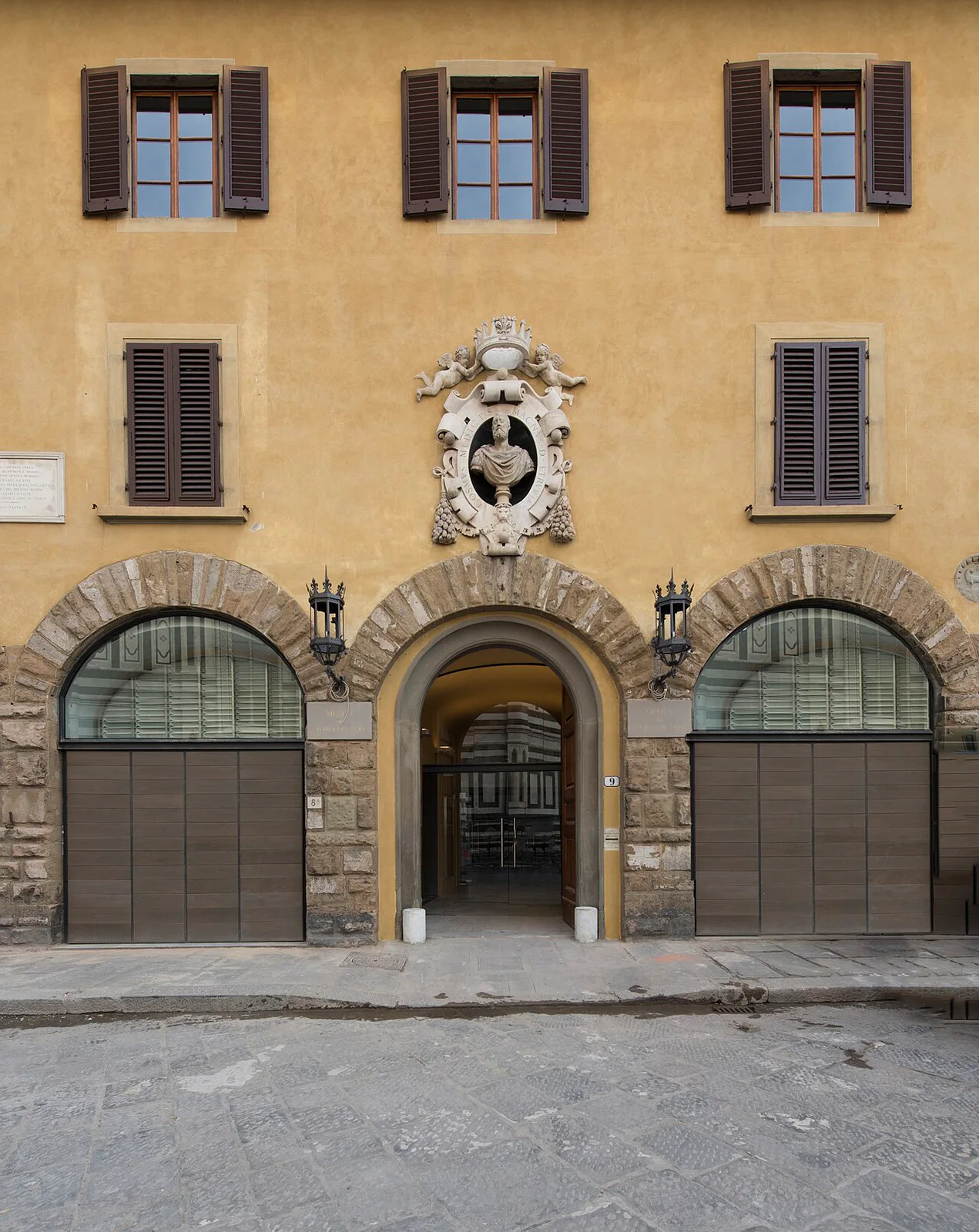
Florence · 27 artworks
Museo dell'Opera del Duomo
Content & sources
Photo: Giovanni Serafini · CC0
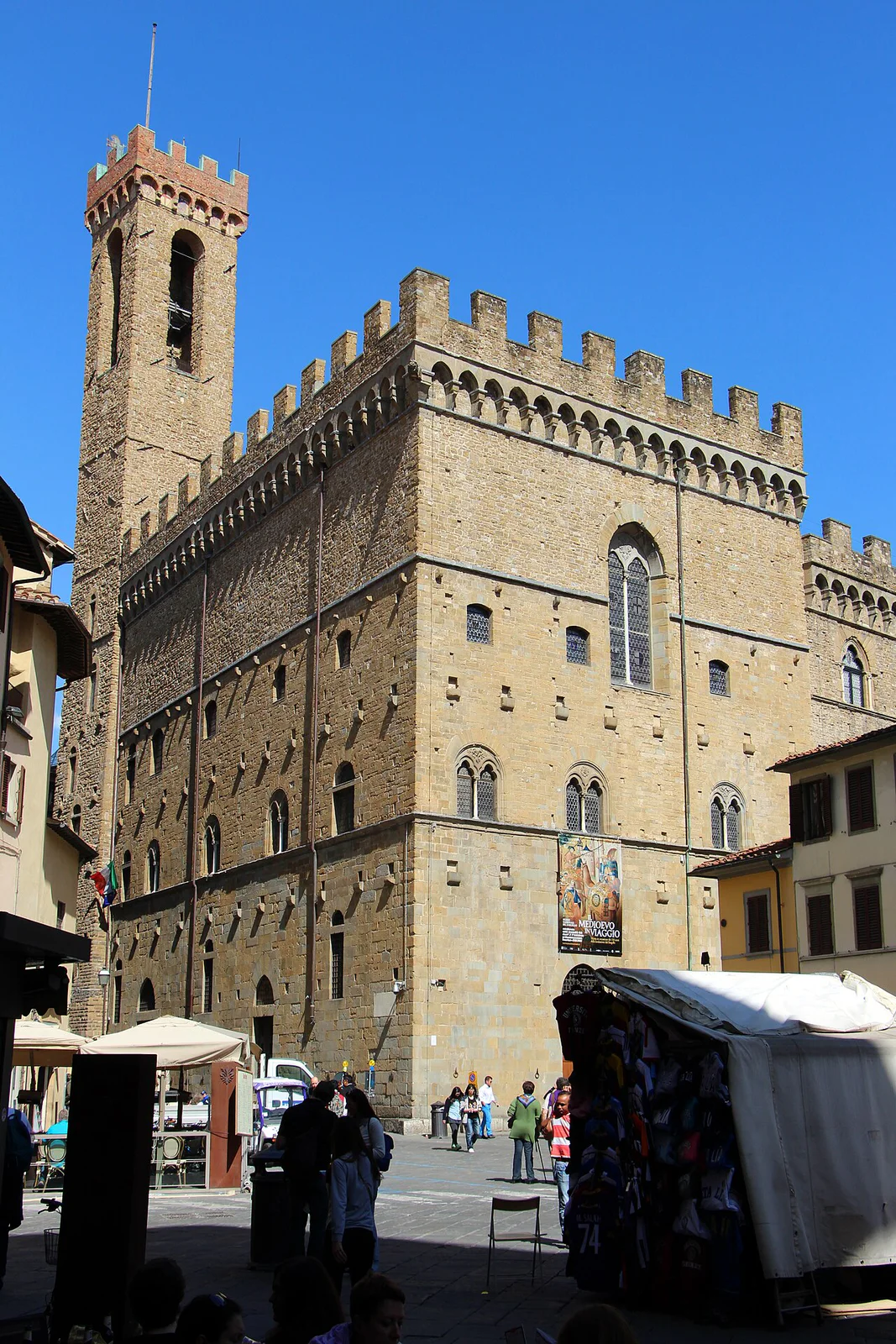
Florence · 37 artworks
Museo nazionale del Bargello
Content & sources
Photo: Sailko · CC BY 3.0
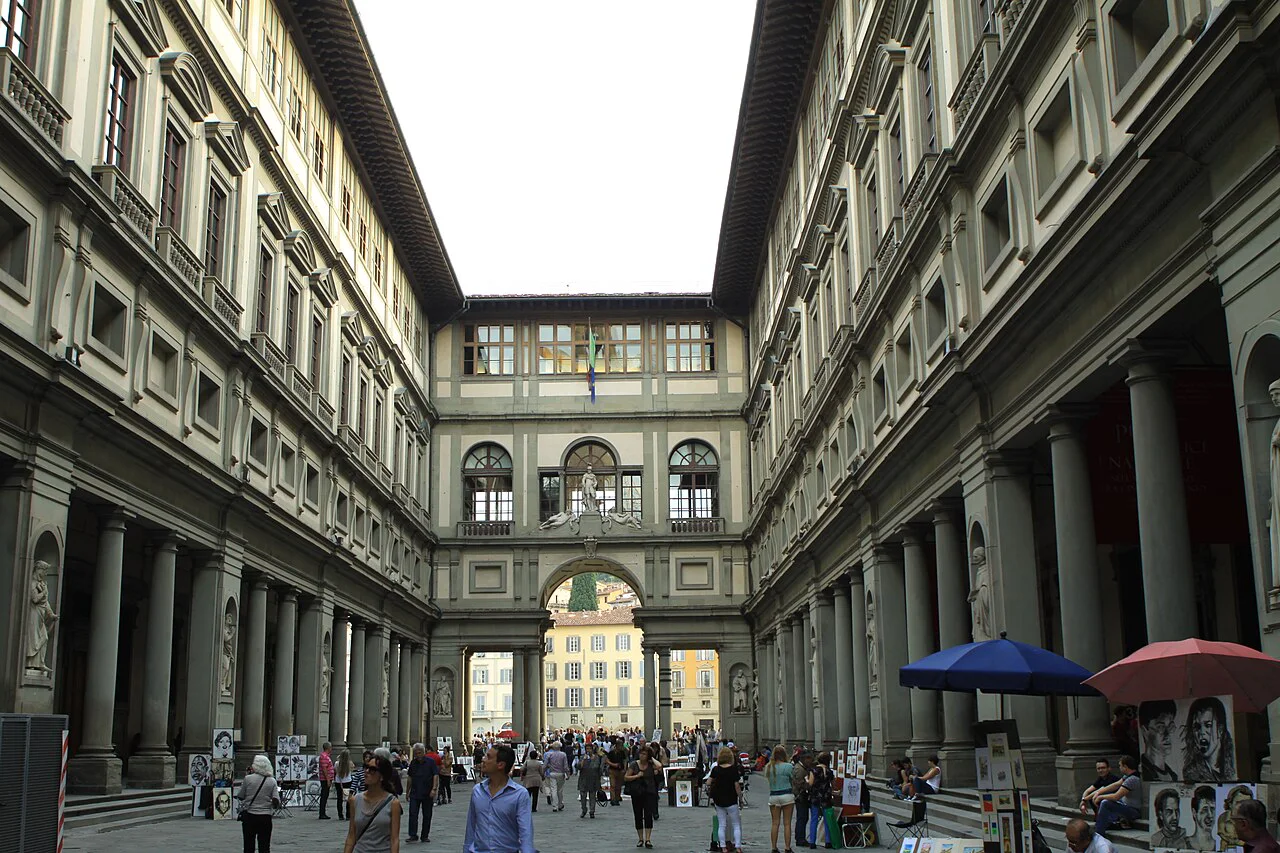
Florence · 70 artworks
Uffizi Gallery
Content & sources
Arek N. · CC BY-SA 3.0
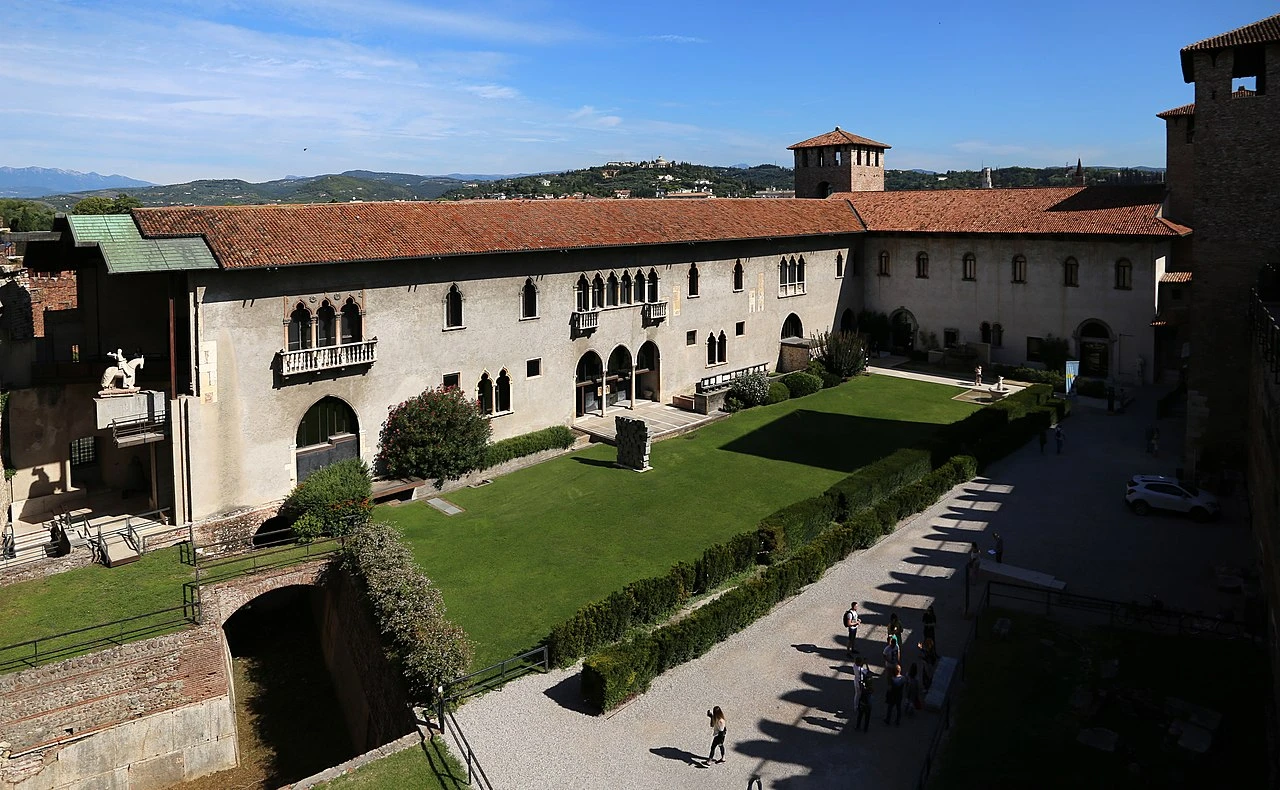
Verona · 65 artworks
Castelvecchio Museum
Content & sources
Photo: Sailko · CC BY-SA 4.0
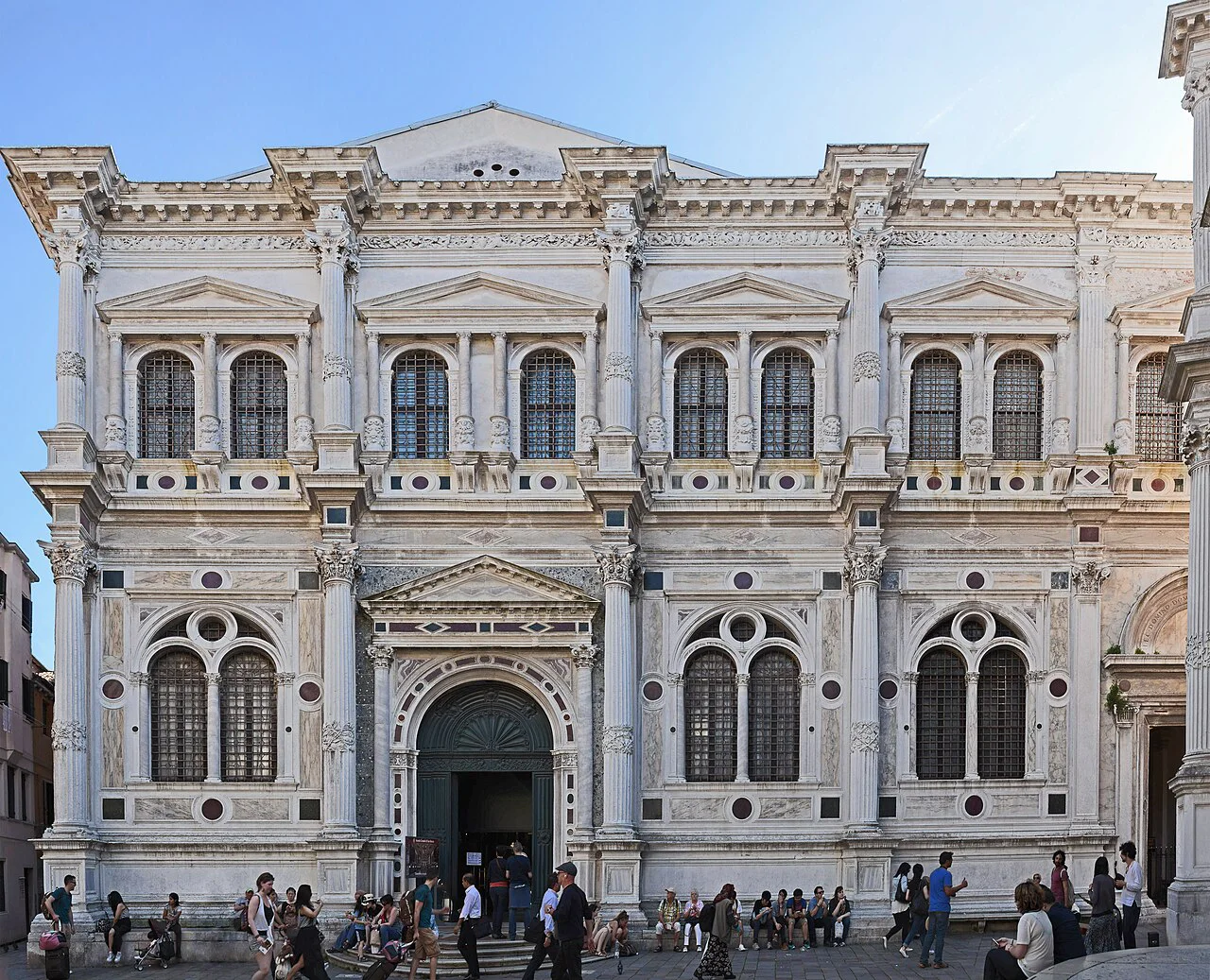
Venice · 23 artworks
Scuola Grande di San Rocco
Content & sources
Didier Descouens · CC BY-SA 4.0
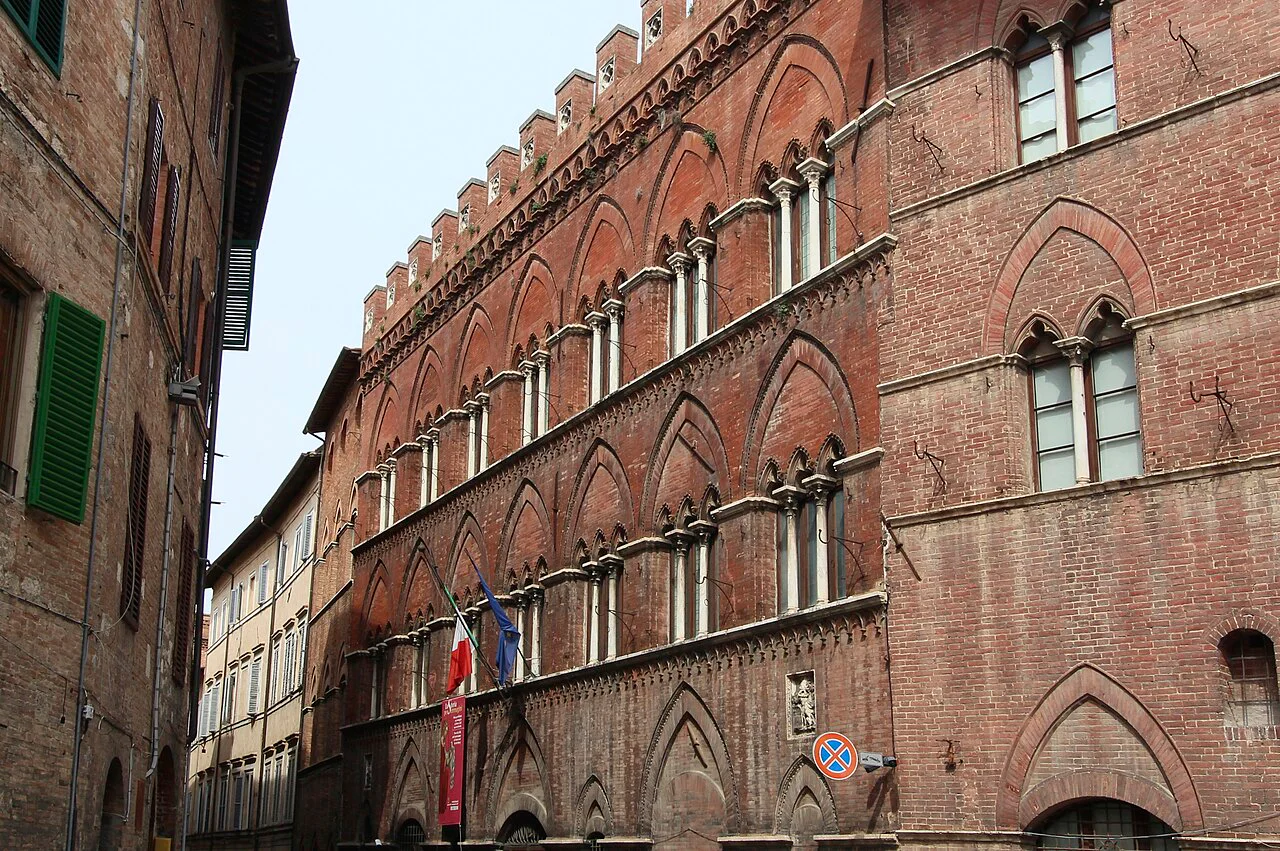
Siena · 37 artworks
Pinacoteca nazionale
Content & sources
Photo: LigaDue · CC BY-SA 4.0