
Stanza · Audio guide
Munch Museum Audio Guide
A place to remember. A story to take with you.
The Munch Museum is an art museum located in Bjørvika, Oslo. It is dedicated to the life and works of the Norwegian artist Edvard Munch.
Download Stanza, then search for “Munch Museum”.
About the tour
One guide. Your kind of visit.
The Munch Museum is an art museum located in Bjørvika, Oslo. It is dedicated to the life and works of the Norwegian artist Edvard Munch.
The Munch Museum guide tells the stories of 20 artworks, including Anxiety (Edvard Munch), The Kiss (Edvard Munch), Vampire (Edvard Munch), Christmas in the Brothel (Edvard Munch), Self-Portrait. Between the Clock and the Bed (Edvard Munch), Caricature Portrait of Tulla Larsen (Edvard Munch), The Death of Marat (Edvard Munch), and Separation (Edvard Munch). Every artwork is free to hear in the Stanza app until 1 January.
Ready when you are.
- 01Get the free Stanza app.
iOS & Android
- 02Find your guide.
“Munch Museum”
- 03Download before you go.
Works offline
Audio guide / 20 artworks
Inside the guide
Get to know a few of the stories before you go. Open a stop to read more.
01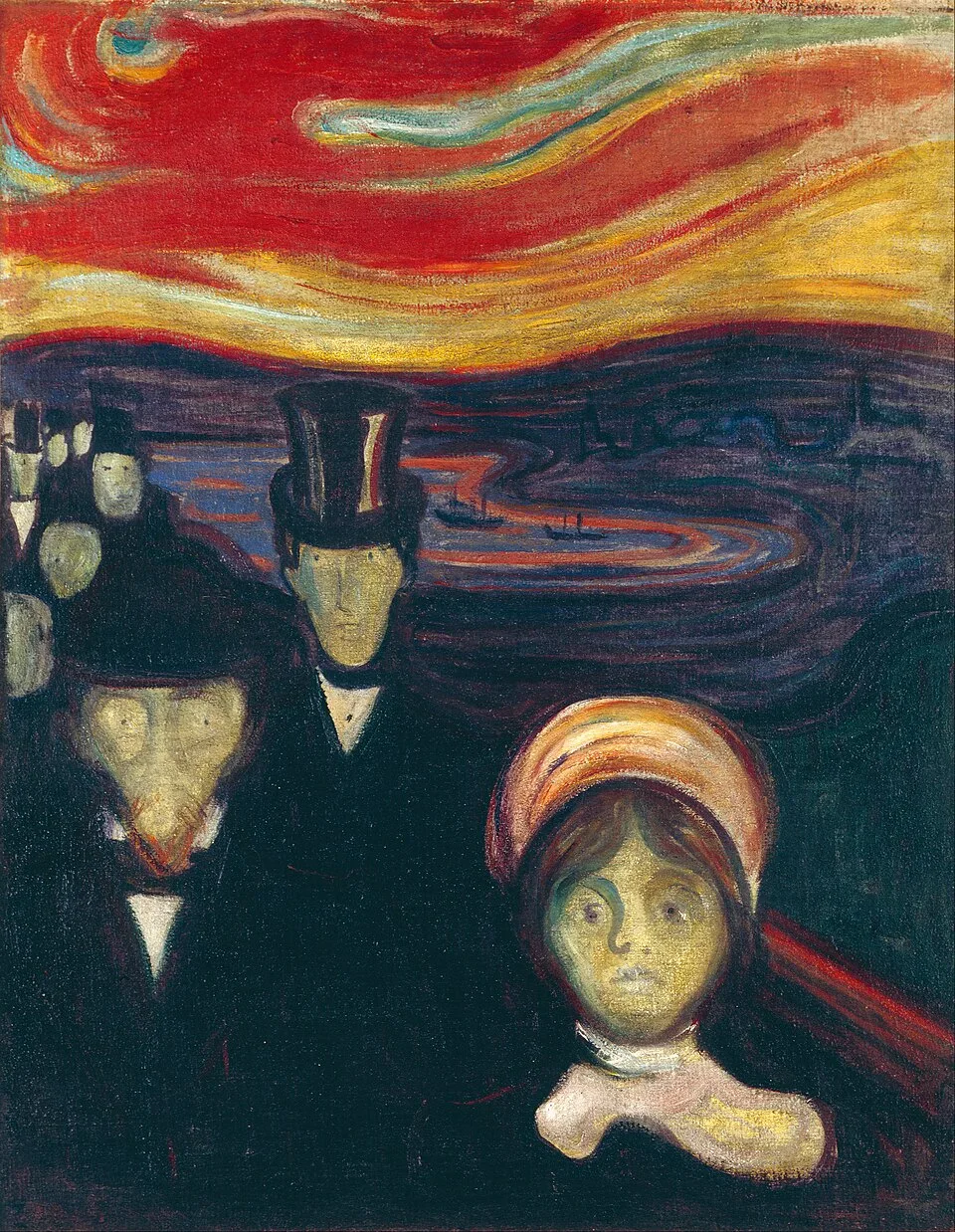
Anxiety
A crowd is coming straight at you across the bridge. Greenish, pale faces, eyes wide open, every one of them staring at you, and the sky above has turned the color of blood. In another moment they will be right in front of you, and there is no getting past. It started with a night when Munch was twenty two, walking late along Karl Johans gate, the main boulevard of Kristiania. That city is now called Oslo. He was looking for Milly Thaulow, the woman he loved. She was three years older than him and married to his own cousin. A crowd streamed toward him, his legs would not carry him, and he felt he was about to fall. Every face going by seemed to stare at him, pale in the evening light. The woman with the halo is the one he was looking for, and the man in the top hat is her husband. In his writings he called her Mrs Heiberg. Two years later he made prints of the scene, and there the woman with the bonnet appears three times. He said he saw Mrs Heiberg in every woman who passed him. Whether those two faces really are the woman he loved and her husband is still not known.
Listen in the appEdvard Munch · Public domain
02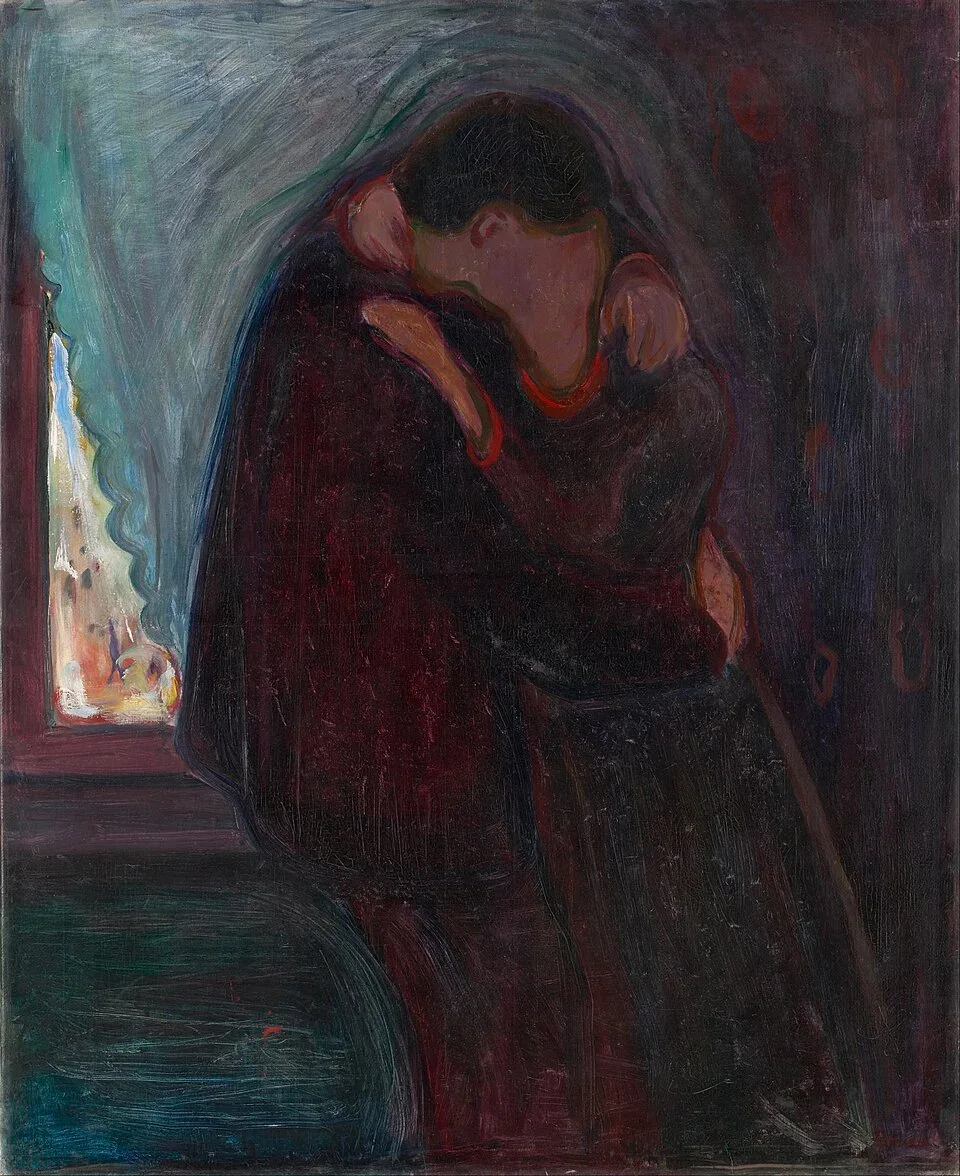
The Kiss
Edvard Munch wanted to catch the moment two people become one. He had kept returning to this image since 1888 and 1889, in paintings and in prints cut from wood. Here their faces meet, and where they meet there is just one shape, with no features. You cannot tell which face belongs to which person. To him the joining meant belonging, two people so close the line between them disappears. But the room around them is almost dark. Only a thin line of daylight gets past a curtain covering most of the window. Outside, the world is alive and moving. Inside, these two are held still. And in that stillness the closeness turns threatening. To merge this completely is also to lose yourself, and death is never far from that thought. He worked on this story for more than thirty years. He called it a fight between men and women, and love was his name for the fight. It follows a relationship all the way from first attraction to disappointment. This kiss belongs to it. In the versions he painted later, he did not stop at the faces. He let their bodies merge as well.
Listen in the appEdvard Munch · Public domain
03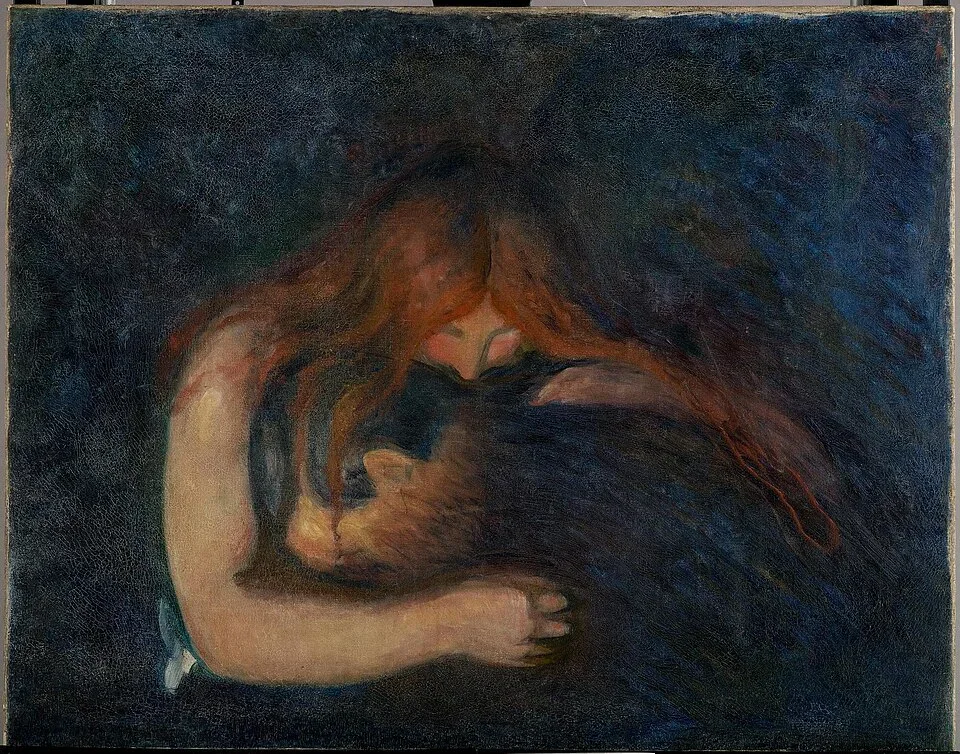
Vampire
A version of this painting was stolen from this museum in February 1988. It came back later the same year, after the thief contacted the police. Here a woman with long red hair bends over a man who leans toward her. Her face is pressed into his neck, and her hair falls in strands across him, partly hiding him. The two figures merge into one pyramid shape, and dark shadows rise behind them, framing their outlines. Munch always said the picture showed nothing more than a woman kissing a man on the neck. He called it Love and Pain. The name Vampire was not his. His friend, the critic Stanisław Przybyszewski, saw it on exhibition and read it another way. He described a man who had given in, with a biting vampire's face at his neck. He was the first to call it Vampire. Munch let the name stand. But years later he wrote that it gave the picture a literary character, when in reality it was only that kiss. He made it as part of a group of pictures he called the Frieze of Life, about life, love and death.
Listen in the appEdvard Munch · Public domain
04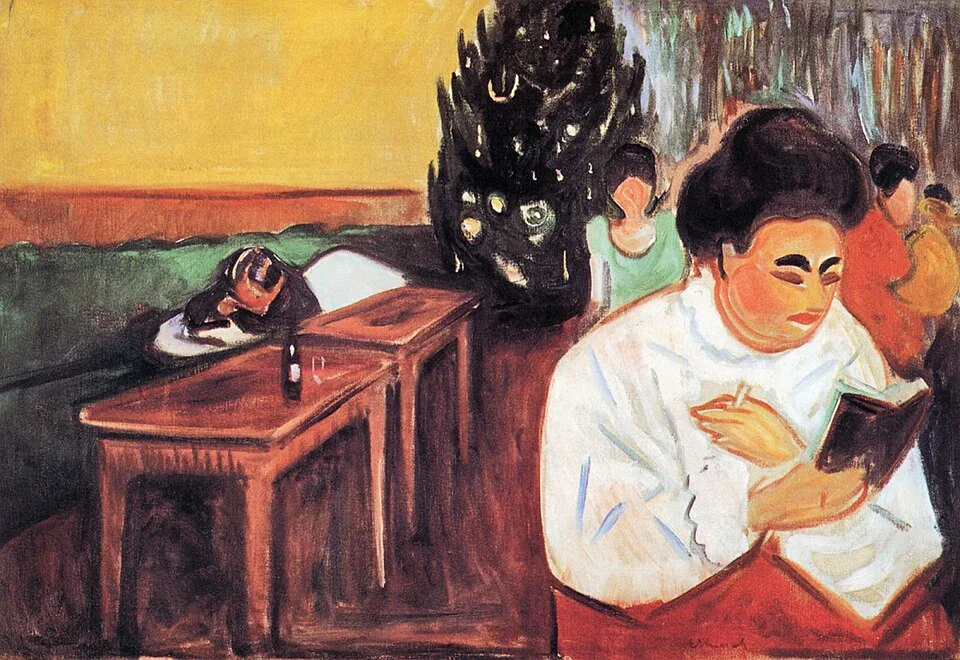
Christmas in the Brothel
Who would choose to spend Christmas in a brothel? The women who work here have just finished decorating a Christmas tree. One of them fills the foreground, reading and smoking a cigarette. Munch painted this around New Year, between 1903 and 1904. He was staying in Lübeck with his patron, the eye doctor Max Linde. Linde's father in law, a senator from Hamburg, had asked him to paint a portrait. It went well at first, but around Christmas they fell out. He grew anxious and drank heavily. It seems that on Christmas Eve he chose the brothel over the Linde family. The senator withdrew the commission, and this painting came out of that break. A brothel visit then did not always mean sex. A man could drink, play cards and be entertained. In the background sits a man alone with his bottle, perhaps Munch himself, trying to quiet his nerves.
Listen in the appEdvard Munch · Public domain
05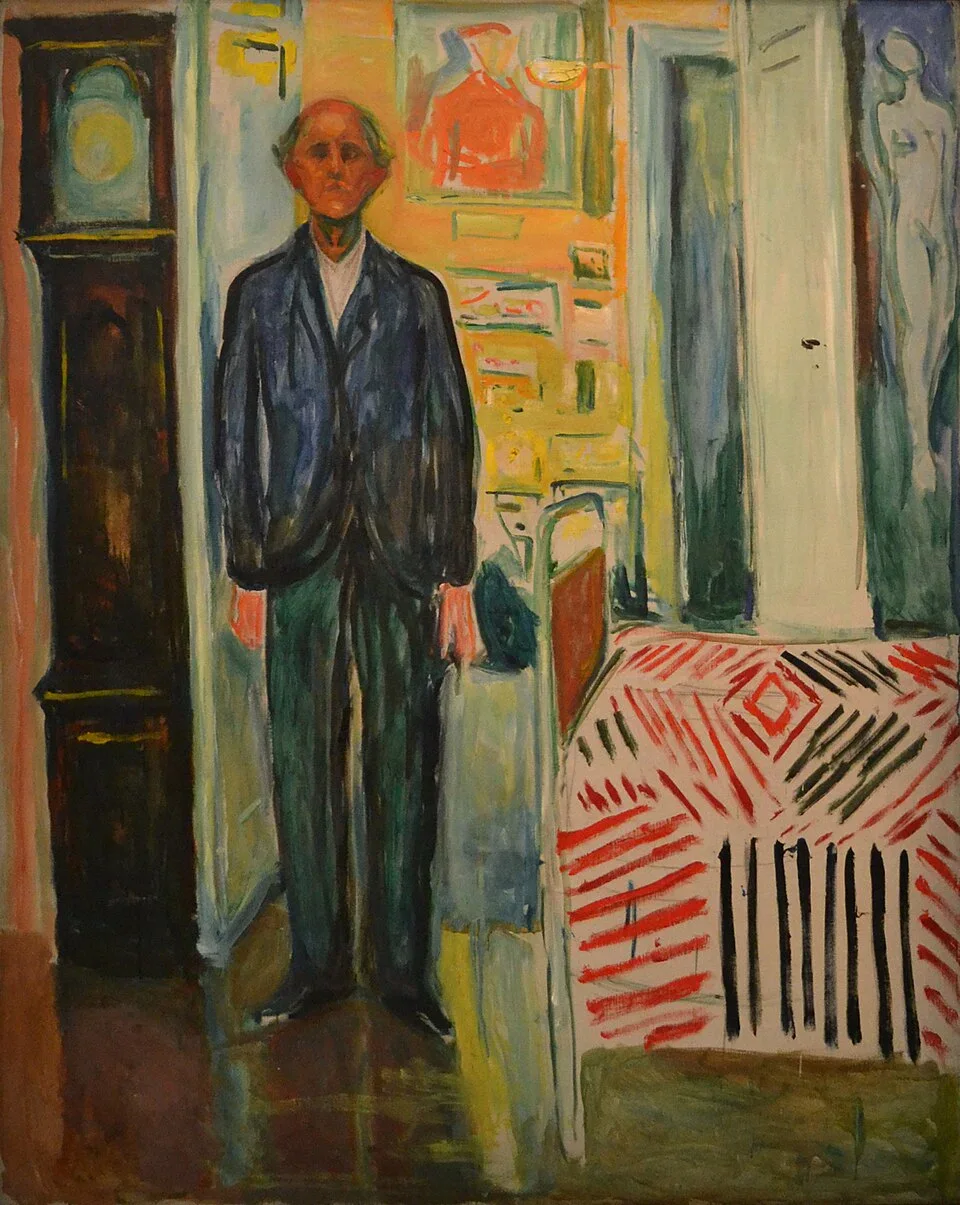
Self-Portrait. Between the Clock and the Bed
An old man stands facing you, right on a threshold. He is thin and stiff, his arms hanging, in a jacket that does not fit. Behind him, through an open door, a bright yellow room holds the paintings of his earlier life. The room he stands at the edge of is cool and grey, in shadow. Munch painted himself here, at the end of his life, between a grandfather clock and a bed. The clock is on the left. It has no hands, and where the face should be there is a patch the colour of the sun. It stands for the passing of time. On the right stands a lacquered iron bed. Its cover has red and black lines that meet in a diamond, like a sun and its rays. That is the bed where he will lie down for the last time. He died the next year, in 1944.
Listen in the appEdvard Munch · Public domain
06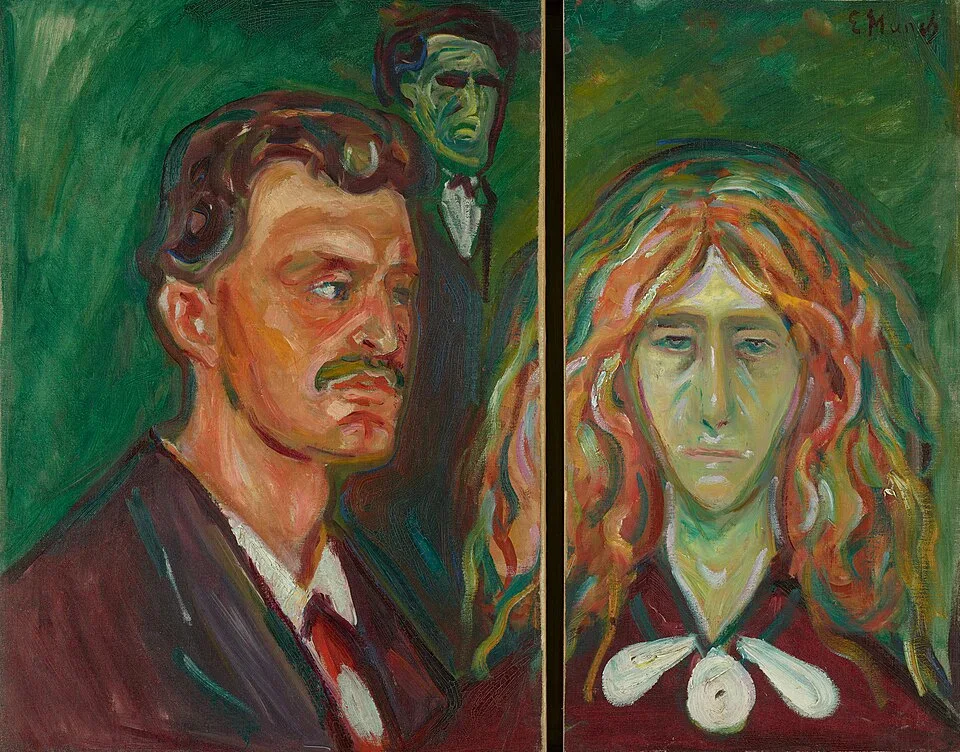
Caricature Portrait of Tulla Larsen
In the green background of the picture is a third man. He is Arne Kavli, also a painter, and Tulla married him in 1903. So this was painted after Munch and Tulla had separated. Munch put the two of them together in one image in 1905, three years after the relationship ended. They had met in 1898. Tulla was the daughter of a wealthy wine merchant, six years younger than Munch, and they spent parts of their summers together. He was drawn to her and felt trapped by her at the same time. Marriage was talked about, though Munch later said only Tulla wanted it. In 1902 a scuffle in a bedroom ended with a shot from a revolver. Munch lost the top joint of his left middle finger. No one knows whose hand held the gun. The pain stayed with him for life, and he later painted himself naked on an operating table, bleeding from that hand. Then he took this double portrait and sawed it in two. Tulla's face became one picture and his own face the other. Both stayed with the family, and both came to the Munch Museum. In 2019, more than a century later, the British Museum showed the two halves together as one picture again.
Listen in the appEdvard Munch · CC BY 4.0
07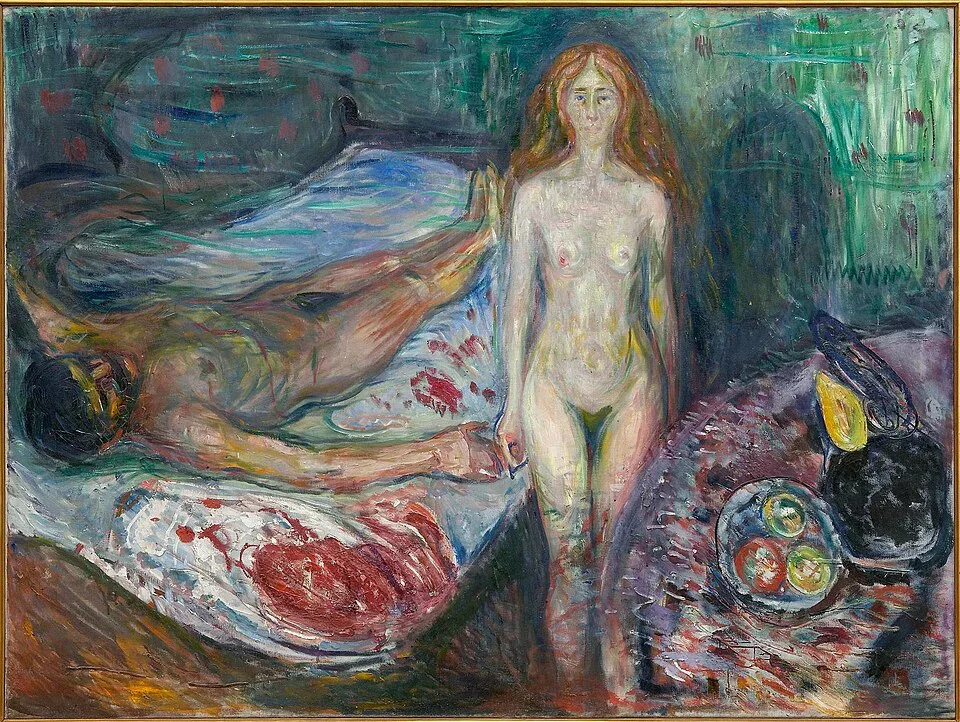
The Death of Marat
A man lies naked on a white sheet marked with blood. In the foreground a naked woman faces you, standing rigid. A round table holds a lady's hat and a basket of fruit. The title names Jean Paul Marat, the revolutionary stabbed to death in his bath in 1793. But Munch put himself in the dead man's place, and the woman has Tulla Larsen's face. In 1902, at his holiday home in Åsgårdstrand, a revolver went off between them and he lost the top of his left middle finger. The hat and the fruit on the table were part of that fight. For years after, he painted himself bleeding in bed at Åsgårdstrand, with her standing beside him. David had shown only the dying Marat, with no murderess in the room. Munch set her in the center, and the body was pushed aside like a discarded doll. In Berlin in 1907 he showed one as a still life. He said he had painted it like Cézanne, only with a murderess and her victim in the background. No one knows whose hand held the revolver.
Listen in the appEdvard Munch · Public domain
08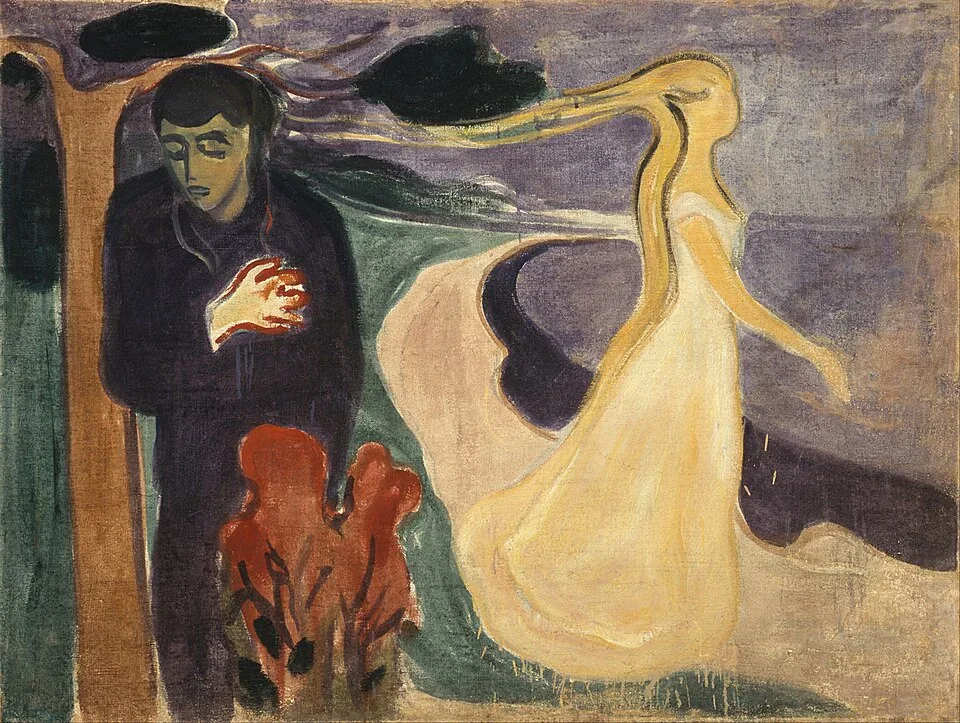
Separation
At the left, a man in black bends his head before a tree stump, eyes shut, his right hand pressed over his heart. The woman goes the other way, toward the sea in a long white dress, with no face at all. But her blonde hair stretches in long lines across the picture and winds around his head and chest. She is leaving, and still she holds him. A strip of shoreline divides the two, and only the man bleeds. The red edging his hand and the red plant at his feet give the sense that his heart is wounded. In his notes, Munch said he felt invisible threads of her hair winding around him. When she vanished over the water, his heart bled, because the threads could not be cut. He made that blood flower his image for art, born from the heart's blood.
Listen in the appEdvard Munch · Public domain
09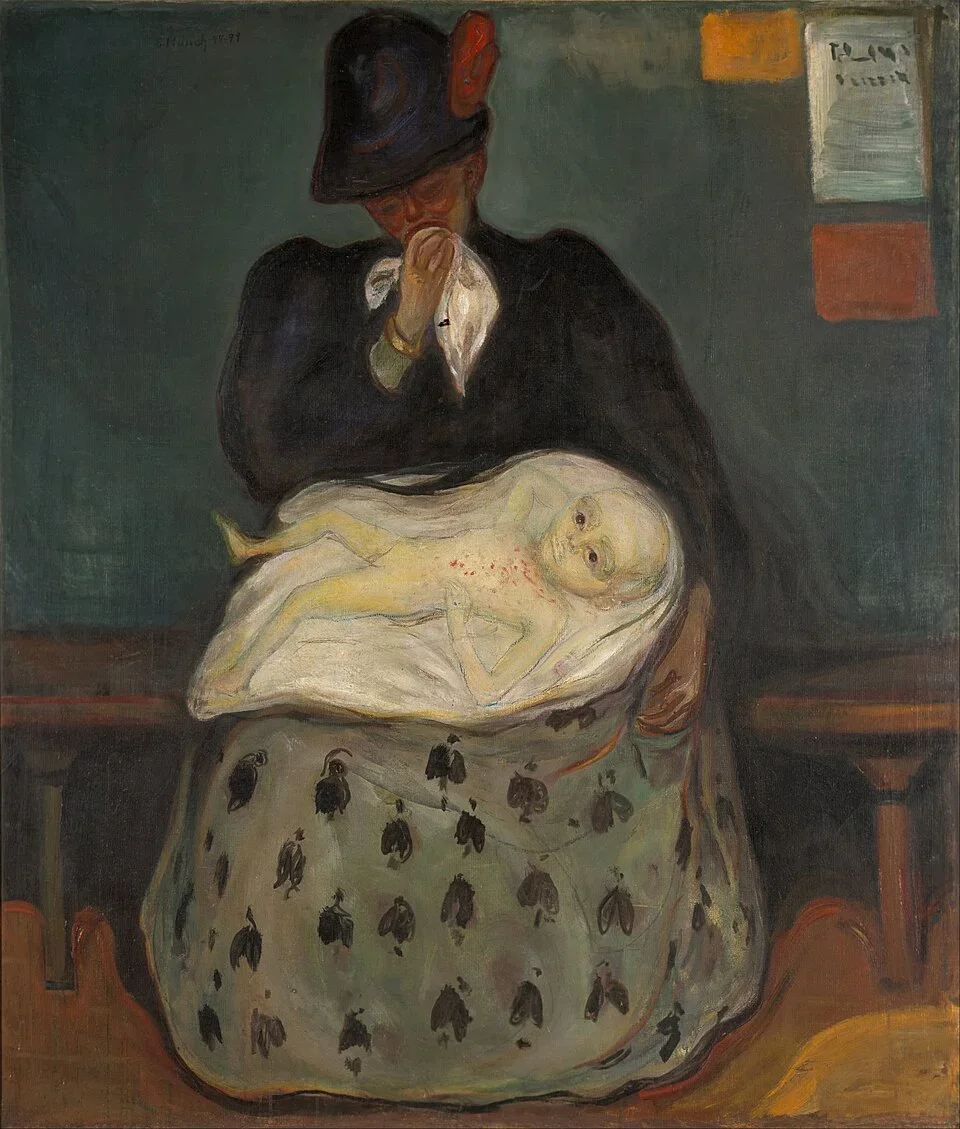
Inheritance
Nobody knows how the mother in this picture came by the sickness her baby was born with. Whether it passed from an unfaithful husband or from her own sex work, the picture does not say. The child lies in her lap, pale and spotted, eyes wide open, body parts out of proportion. She bends over her child and weeps until her face is scarlet. Her hands and patterned skirt stand out against the green behind them. The baby's face is as white as linen against her red one. Munch had seen a woman crying for her child with syphilis at the Hôpital Saint Louis in Paris. That hospital took in people with the disease. In that hospital's museum he had also seen a wax model of a baby born with the same disease. He first called the painting The Syphilitic Child. When it appeared, people were surprised. Speaking of such a sickness in public was not accepted then. He had turned the usual Madonna and Child inside out. He made it like a poster, with unnatural details that seem to belong to religious pictures. He wanted whoever saw it to feel the sorrow he had felt in that hospital.
Listen in the appEdvard Munch · Public domain
10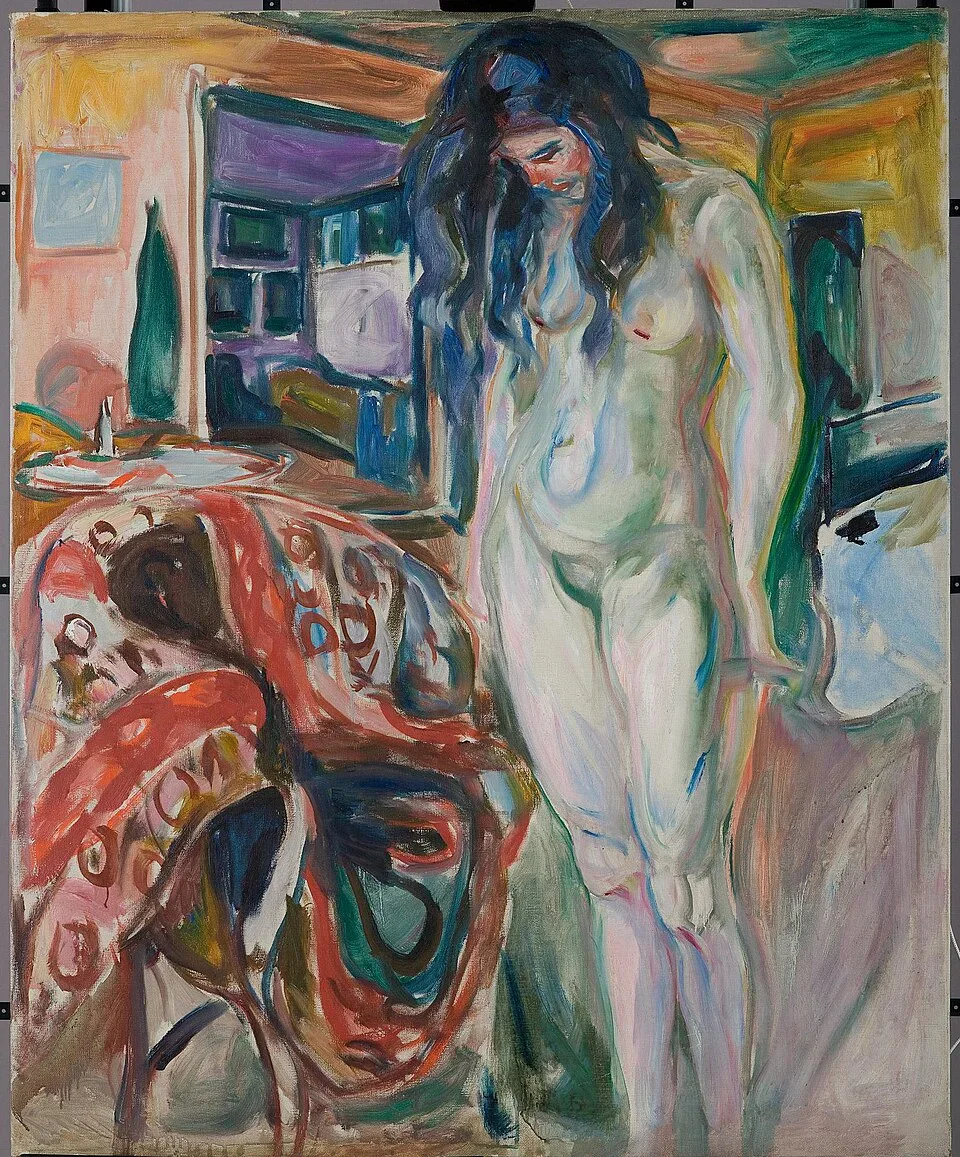
Model by the Wicker Chair
She looks at the cloth, not at you. The model stands naked beside a wicker chair, and a colorful fabric, mostly red, covers it. A model is used to being watched. Here she is the one watching. Edvard Munch painted this between 1919 and 1921. There is another painting of the same scene. A different version has been at the Metropolitan Museum of Art since 1944, given through a bequest from the Munch Museum itself. This one has traveled as well. It went to New York in 2006, to Madrid in 2015, and back to New York in 2016, to the Neue Galerie. There it was one of only nineteen of Munch's oil paintings chosen for the show.
Listen in the appEdvard Munch · Public domain
- 11
Self-Portrait With a Bottle of Wine
Edvard Munch · 1906
- 12
Woman. Sphinx
Edvard Munch · 1894
- 13
Death and the Child
Edvard Munch · 1897–1899
- 14
Red Virginia Creeper
Edvard Munch · 1898–1900
- 15
Despair
Edvard Munch · 1894
- 16
Eye in Eye
Edvard Munch · 1894
- 17
The Angel of Death
Edvard Munch · 1893
- 18
Metabolism
Edvard Munch · 1898
- 19
Golgotha
Edvard Munch · 1900
- 20
Death in the Sickroom
Edvard Munch · 1893
Munch Museum
Frequently asked questions
How much does the guide cost?
Free app download. Free until 1 January. Listed guide price: $1.99. Audio guide only. Venue admission is separate.
Can I listen without internet?
Yes. Download the guide’s audio, images, and maps in the app before your visit. Your downloaded content is then available offline.
Can I listen in my language?
In English for now. More languages soon.
Do I need to follow a schedule?
No. This is a self-guided experience. Choose your stops, pause whenever you like, and return to a story at your own pace.
Which artworks are in the Munch Museum audio guide?
20 artworks, including Anxiety (Edvard Munch), The Kiss (Edvard Munch), Vampire (Edvard Munch), Christmas in the Brothel (Edvard Munch), Self-Portrait. Between the Clock and the Bed (Edvard Munch), Caricature Portrait of Tulla Larsen (Edvard Munch), The Death of Marat (Edvard Munch), and Separation (Edvard Munch). The full list is on this page.
Is this the museum’s official audio guide?
No. Stanza is an independent audio guide app and is not affiliated with Munch Museum. Museum admission is separate.
At your own pace
Explore Munch Museum.
Download Stanza, then search for “Munch Museum”.
Free app download · Guide price shown in the app
Keep exploring
Audio guides — Norway
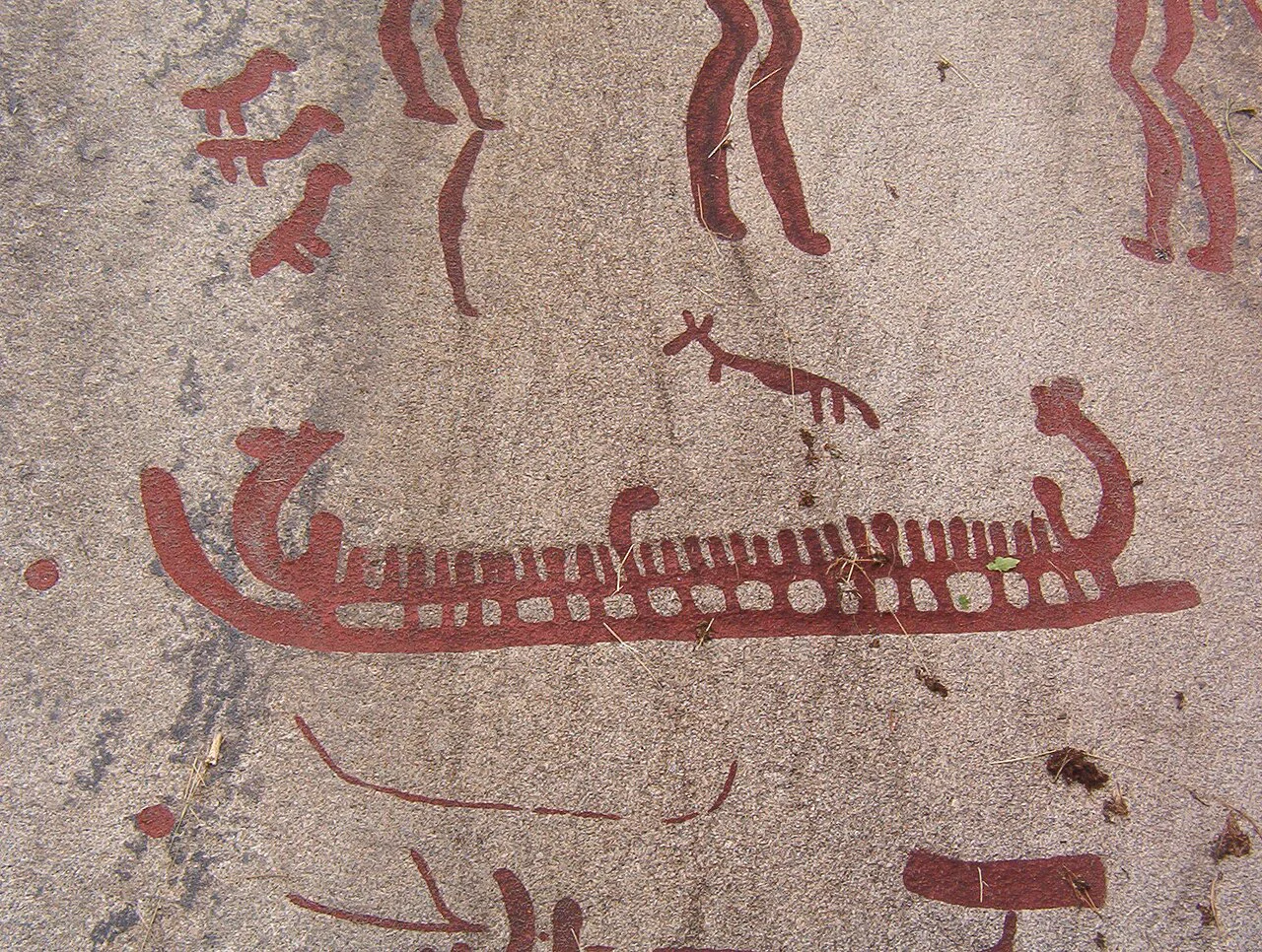
Tanumshede · 138 km
Rock Carvings in Tanum
Content & sources
Photo: Fred J · Public domain

Borgund
Borgund Stave Church
Content & sources
mendhak · CC BY-SA 2.0

Luster
Urnes Stave Church
Content & sources
Photo: Superbass · CC BY-SA 4.0
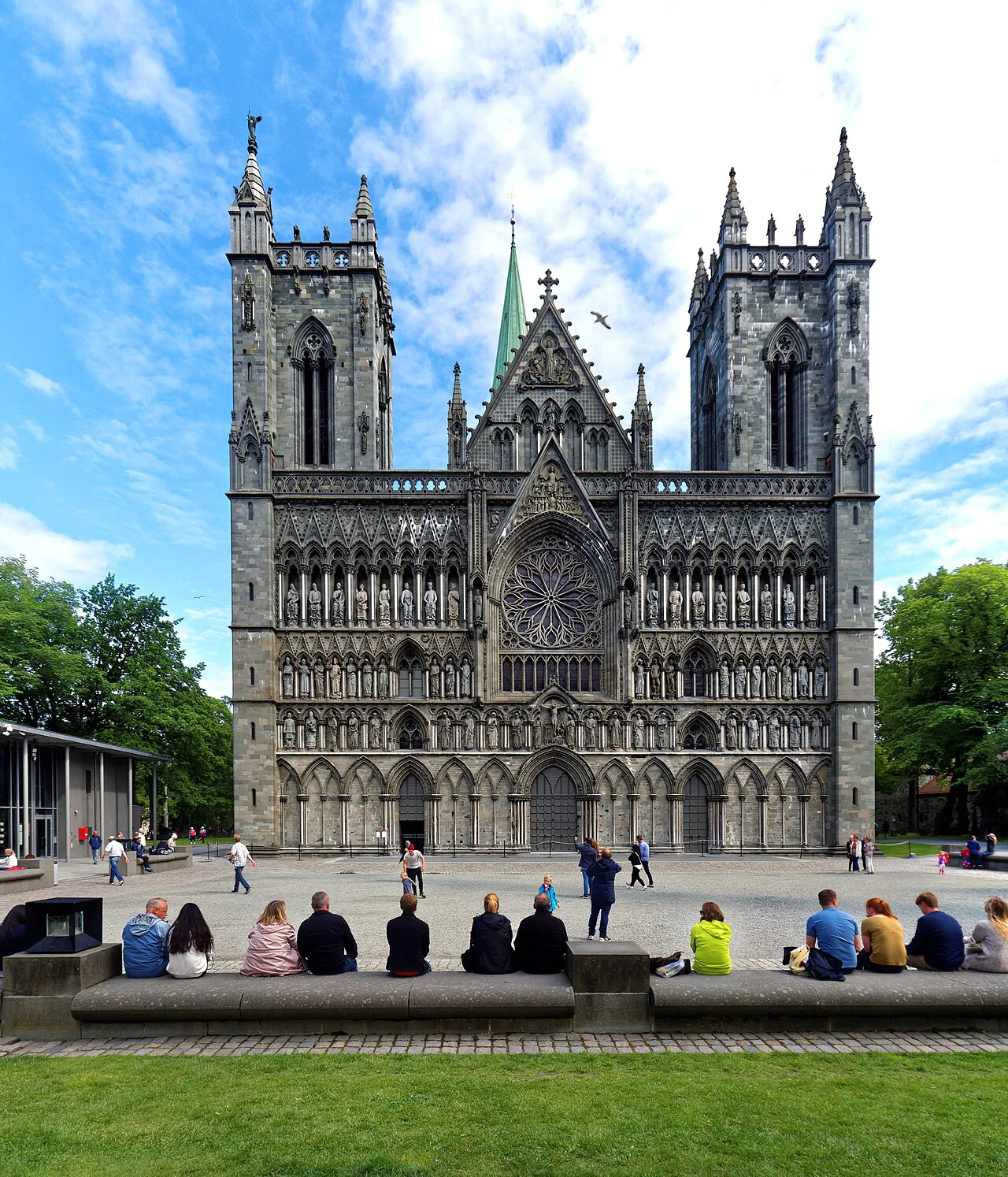
Trondheim
Nidaros Cathedral
Content & sources
Photo: Holger Uwe Schmitt · CC BY-SA 4.0
Art museums
More art museum audio guides

Berlin · 218 artworks
Gemäldegalerie, Berlin
Content & sources
Photo: Membeth · CC0
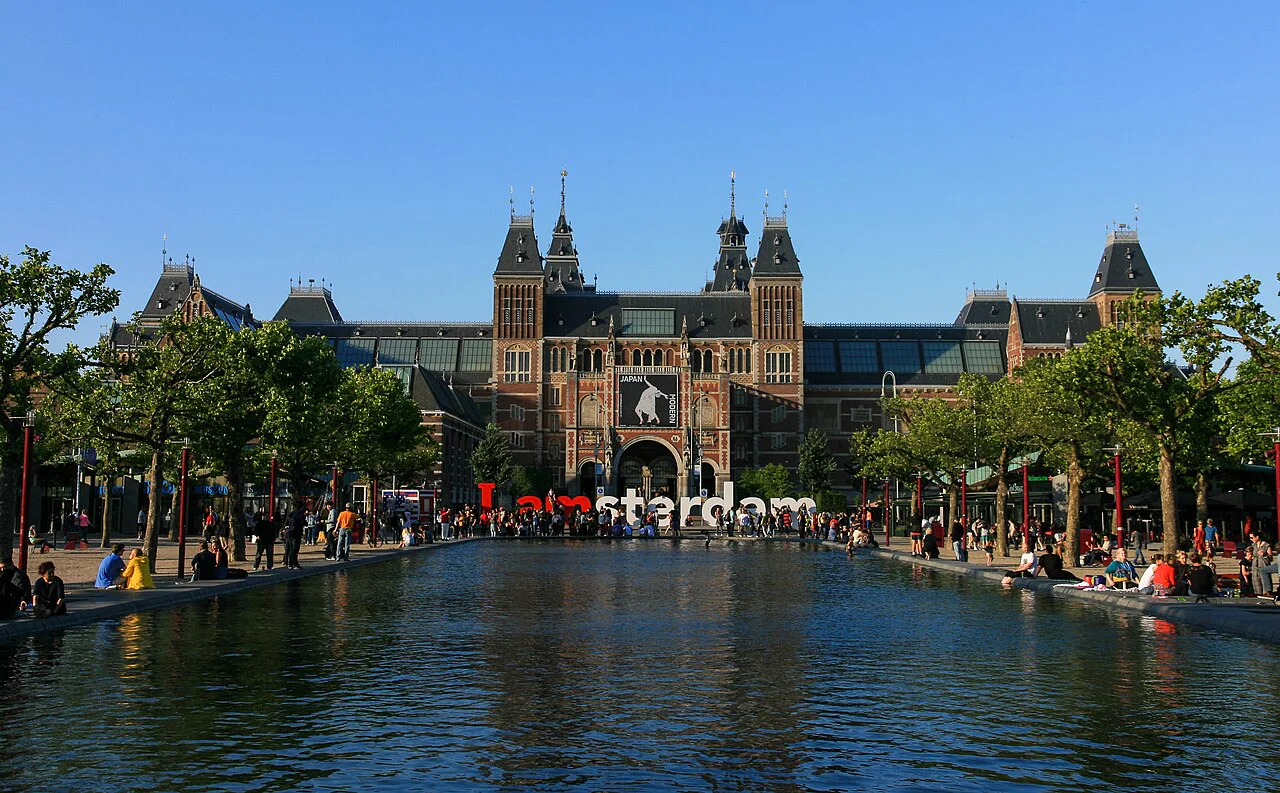
Amsterdam · 387 artworks
Rijksmuseum
Content & sources
Marco Almbauer · CC BY-SA 3.0
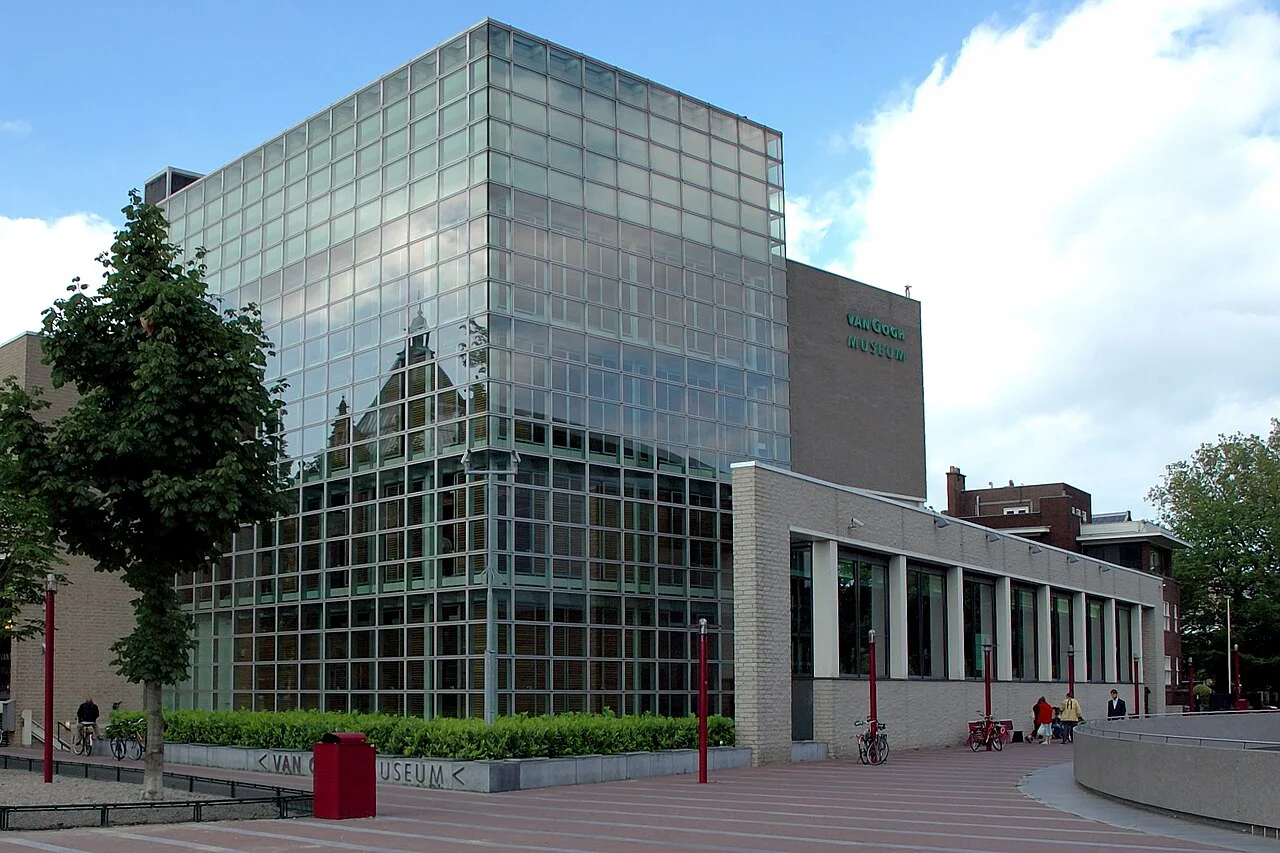
Amsterdam · 73 artworks
Van Gogh Museum
Content & sources
Warrox · CC BY 2.5
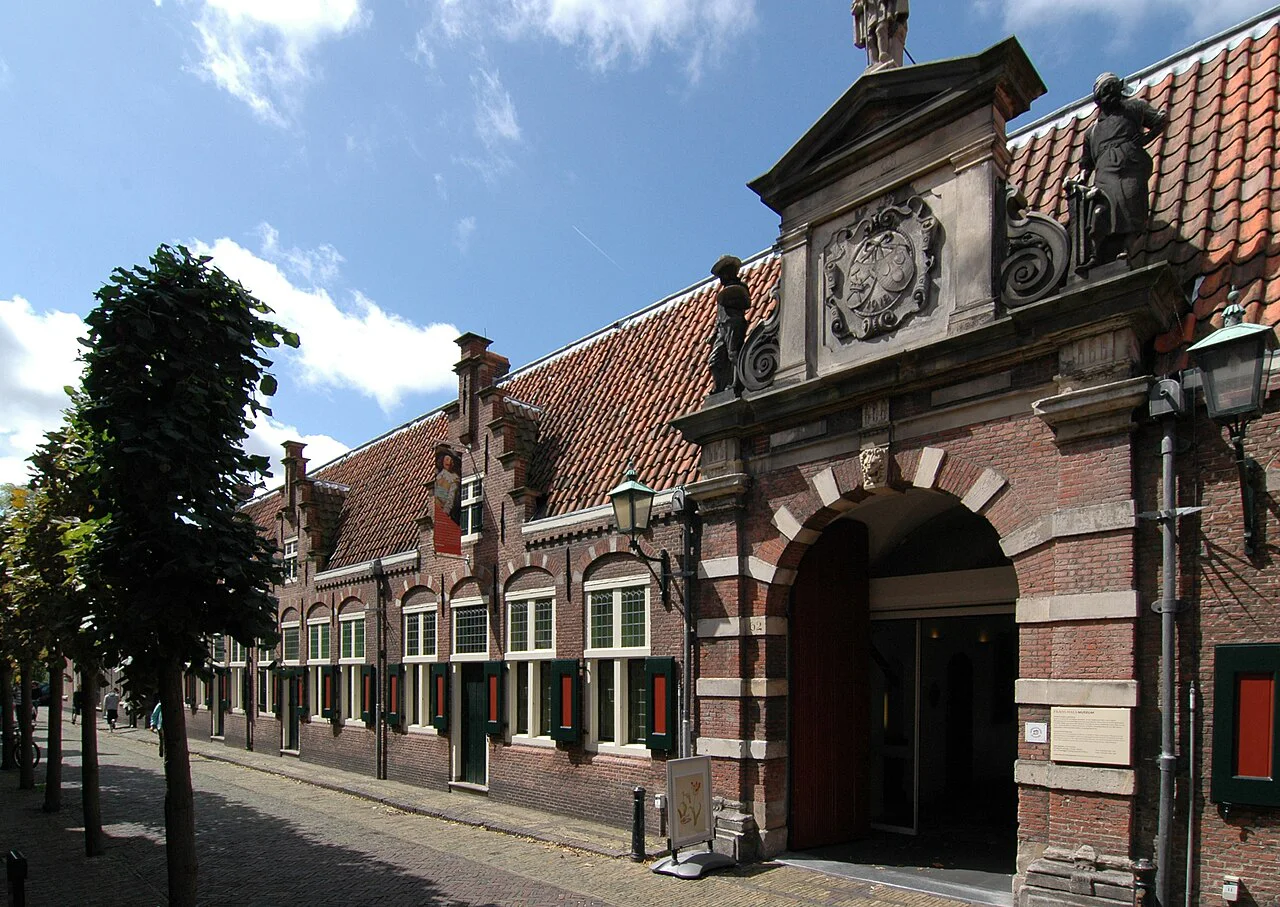
Haarlem · 45 artworks
Frans Hals Museum
Content & sources
Mcke · CC BY-SA 3.0
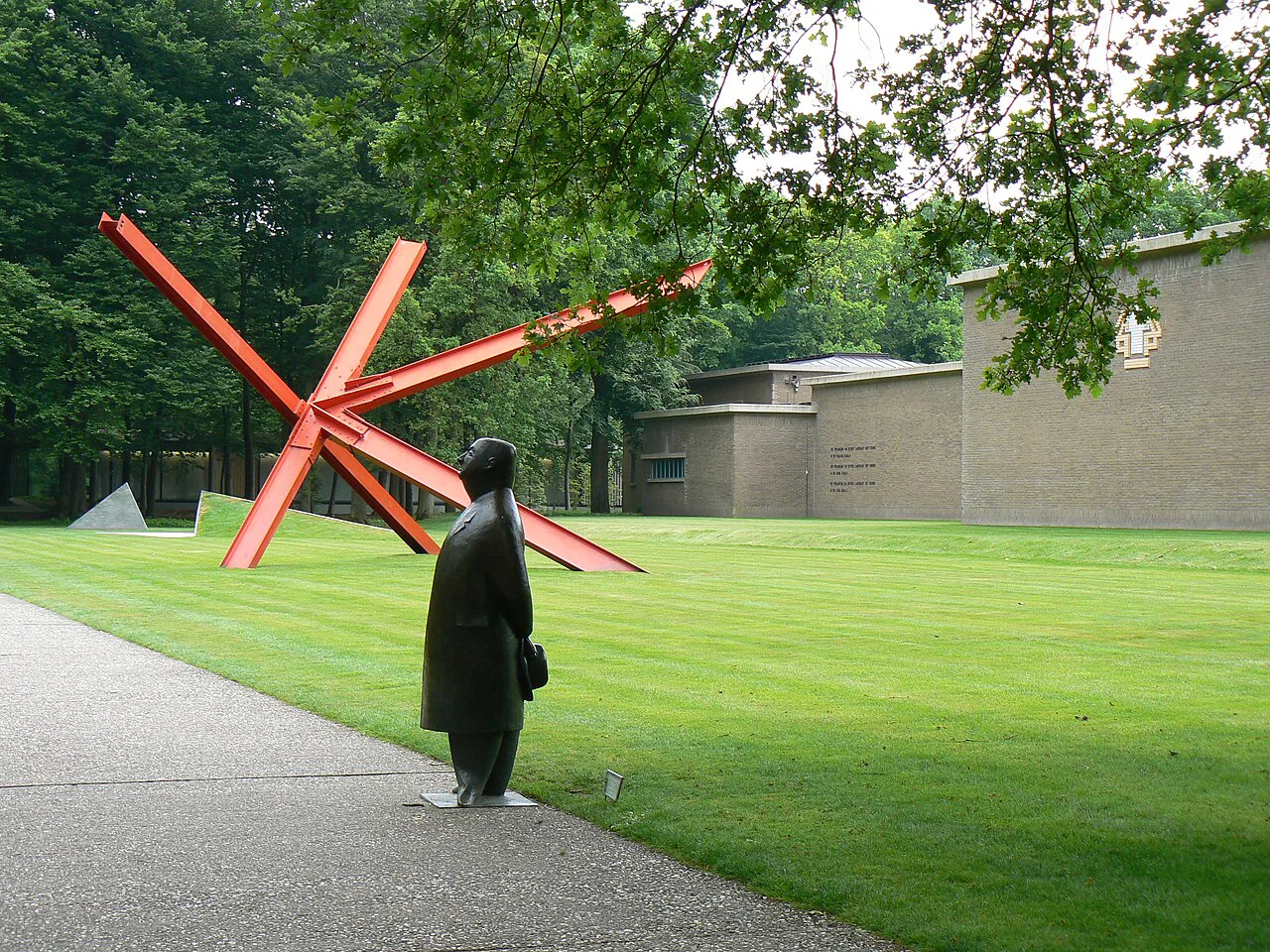
Otterlo · 60 artworks
Kröller-Müller Museum
Content & sources
Photo: Gerardus · Public domain

Wrocław · 44 artworks
Muzeum Narodowe we Wrocławiu
Content & sources
Photo: Jar.ciurus · CC BY-SA 3.0 pl