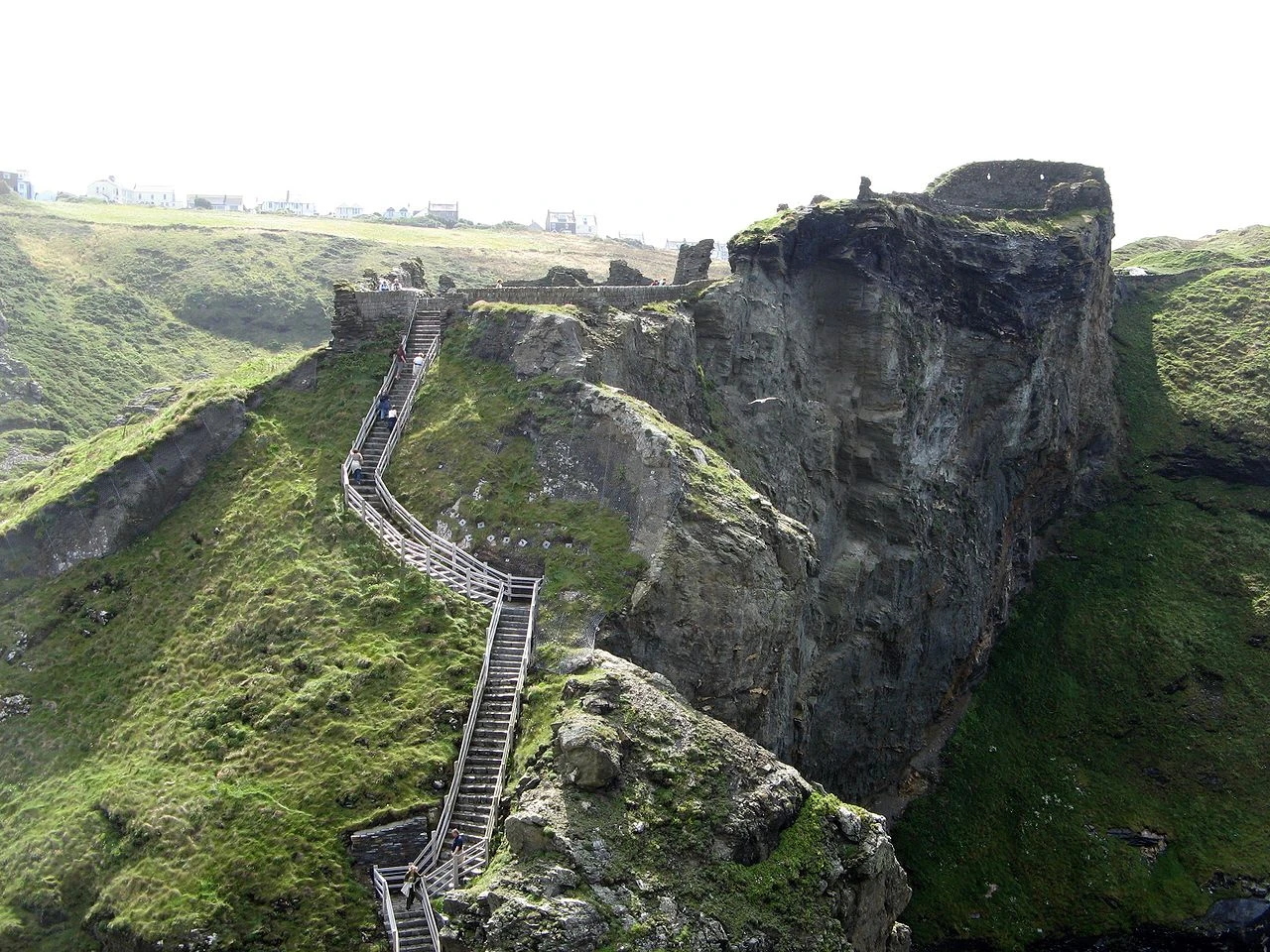
Stanza · Audio guide
Tintagel CastleAudio guide
A place to remember. A story to take with you.
Tintagel Castle is a medieval fortification located on the peninsula of Tintagel Island in Cornwall. It is famously associated with the legend of King Arthur and features extensive ruins overlooking the…
Download Stanza, then search for “Tintagel Castle”.
About the tour
One guide. Your kind of visit.
Tintagel Castle is a medieval fortification located on the peninsula of Tintagel Island in Cornwall. It is famously associated with the legend of King Arthur and features extensive ruins overlooking the Atlantic coast.
Ready when you are.
- 01Get the free Stanza app.
iOS & Android
- 02Find your guide.
“Tintagel Castle”
- 03Download before you go.
Works offline
Audio guide / 15 narrated stops
Inside the guide
Get to know a few of the stories before you go. Open a stop to read more.
01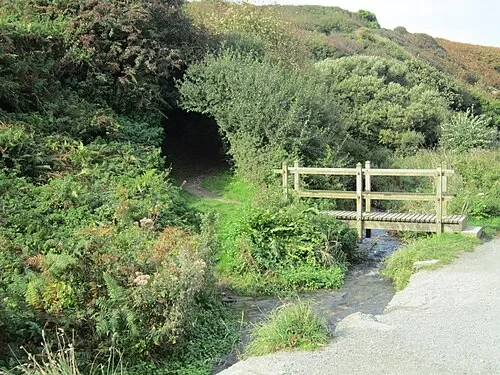 The Mainland ApproachThe Coastal Valley Path
Welcome to one of the most dramatic coastal landscapes in Britain, where your journey begins along this deep, green valley. As you follow the path leading down from the visitor centre, notice how the environment slowly shifts around you. The sheltered, grassy slopes of the inland valley gradually give way to more rugged terrain, filled with the salt-scented air and distant roar of the ocean. This walk prepares you for the physical adventure ahead. To reach the ruins of the castle, you will face steep climbs, narrow paths, and numerous stone steps carved into the hillsides. Wearing sturdy footwear is highly recommended as the path winds closer to the edge of the sheer cliffs. Take your time to enjoy the transition from this quiet, peaceful comb—as valleys are called locally—to the wild, exposed headlands where history and legend meet. The steep sides of the ravine frame your descent, building anticipation for the vast coastal vistas that will soon open up before you.
Robert Linsdell from St. Andrews, Canada · CC BY 2.0
02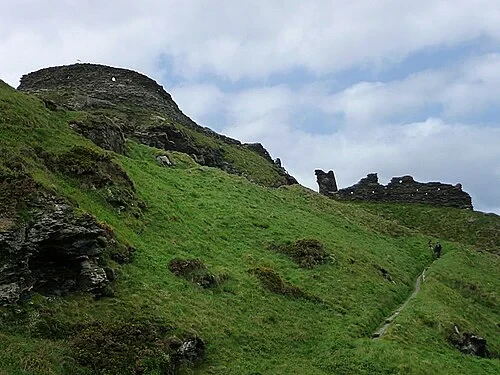 The Mainland ApproachThe Mainland Cliffside Ruins
Look toward the steep cliffs where fragmenting stone walls cling precariously to the edge of the land. These ruins represent the mainland portion of the medieval castle complex. Long before any stone structures were raised here, this dramatic headland captured the imagination of medieval writers. In the twelfth century, a cleric named Geoffrey of Monmouth wrote a highly influential historical text that forever tied this spot to legend. According to his writings, this wild cliff was where King Uther Pendragon, transformed by the sorcery of the wizard Merlin, disguised himself to gain entry to the stronghold and conceive King Arthur. This single, sensational story transformed an otherwise remote, windswept rock into one of the most famous legendary sites in the medieval world. While modern historians analyze the factual reality of the ruins, it was Geoffrey's literary tale that ignited centuries of fascination, turning these high, rugged cliffs into a place of pilgrimage for those seeking the origins of the Arthurian myth.
Chris Gunns · CC BY-SA 2.0
03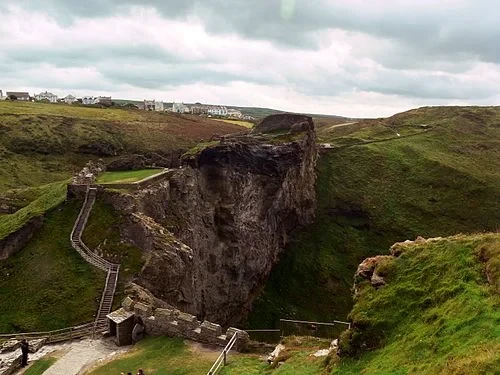 The Mainland CourtyardThe Upper Mainland Courtyard
In 1233, Richard, the wealthy first Earl of Cornwall and brother to King Henry the Third, acquired this dramatic headland to build a new castle. Curiously, the site possessed very little strategic military value. Instead of constructing a state-of-the-art thirteenth-century fortress, Richard instructed his builders to use a deliberately old-fashioned, rustic style. Using local dark slate and rubble, they raised walls that looked centuries older than they actually were. This architectural choice was a calculated political statement. By making his new castle appear ancient, Richard sought to visually connect himself to the legendary, mythic kings of Cornwall who were said to have ruled from this very headland. The calculated illusion allowed him to assert his local authority and prestige, drawing on popular Arthurian folklore to legitimize his status. Here in the upper courtyard, the surviving foundations show the layout of this carefully staged medieval power play, where style was used as a powerful tool of political propaganda.
Listen in the appKerry Garratt · CC BY-SA 2.0
04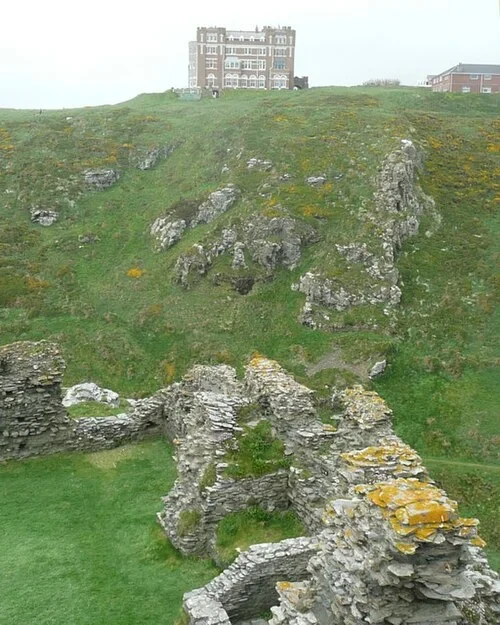 The Mainland CourtyardThe Outer Ward Walls
Scanning the perimeter of the mainland ruins reveals the layout of the castle's outer ward walls, built to secure the landward approach. Across the steep valley on the opposite high ground stands a massive, castle-like building. That is the Camelot Castle Hotel, constructed during the late nineteenth century. Its presence tells a crucial story about how this remote landscape was rediscovered. During the Victorian era, writers like Alfred, Lord Tennyson revived the legends of King Arthur through poetry, capturing the public's imagination. This literary movement sparked a massive wave of romantic tourism, with visitors eager to see the wild places associated with the legendary king. Tintagel went from being an isolated, neglected ruin to a highly popular destination. To accommodate the wealthy travelers arriving via the newly built railways, the imposing hotel was constructed directly on the cliffs. The visual link between the medieval slate walls and the grand Victorian hotel illustrates how myth and literature completely reshaped the geography and economy of this Cornish coast.
Listen in the appHumphrey Bolton · CC BY-SA 2.0
05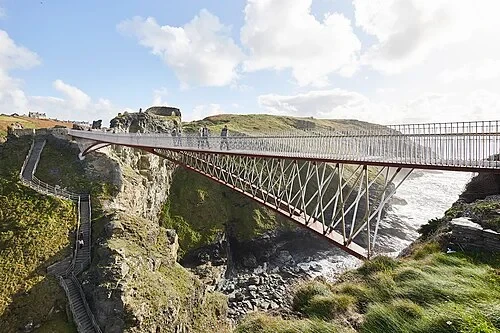 The Cantilevered FootbridgeThe Cantilevered Footbridge
Spanning the deep void between the mainland and the island is a striking modern footbridge completed in 2019. The bridge represents a significant engineering achievement, designed to respect both the archaeology and the dramatic natural setting. It consists of two independent steel cantilever arms that reach out from opposite sides of the cliff face. Uniquely, these two halves do not actually join; they meet in the middle with a deliberate forty-millimeter gap, allowing the structure to expand and contract naturally with changing temperatures. Walking across this slender pathway offers a thrilling sense of suspended space. Beneath your feet, the open decking allows you to look straight down through the bridge structure to the churning, white-foamed waves fifty-eight meters below. The combination of local slate tiling on the deck and the slender steel handrail makes the crossing feel secure yet deeply connected to the elements, providing an unparalleled perspective of the sheer rock walls that define this historic coastline.
Listen in the appHufton + Crow Photography · CC BY-SA 4.0
06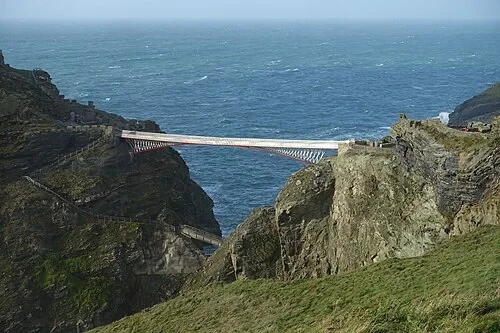 The Cantilevered FootbridgeThe Great Chasm Span
To understand the true layout of the medieval castle, it helps to understand how much the landscape has changed. In the thirteenth century, the island was not actually an island. It was connected to the mainland by a narrow, natural neck of land, or isthmus. Over successive centuries, the relentless power of the Atlantic waves caused severe coastal erosion, eventually causing this natural land bridge to collapse entirely. This catastrophic landslip cut the castle in two, leaving the mainland courtyard stranded from the high island headland. For centuries, visitors had to descend hundreds of steep steps to the valley floor and climb back up the other side to access the island. The modern footbridge physically and historically reunites these two halves, allowing you to walk the exact elevated route that medieval residents would have taken. Standing over the gap, you can observe how the sea has slowly carved out the chasm beneath, transforming the defensive geography of this once-unified coastal stronghold.
Listen in the appPhoto: Kmtextor · CC BY-SA 4.0
07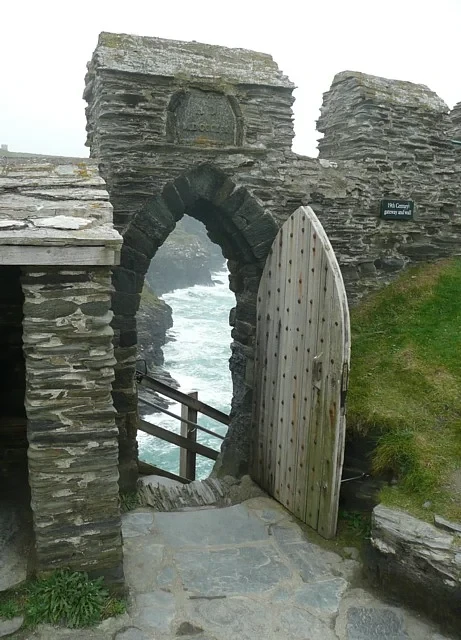 The Island Gatehouse and Great HallThe Island Gatehouse
Passing through the narrow, arched stone gateway brings you onto the island proper. This heavily fortified entrance served as the primary defense for the island portion of the castle, restricting access to a narrow, easily defensible path. Above the sturdy wooden door, look for a carved stone plaque dating from the Victorian era. It displays the Roman numerals MDCCCLII, representing the year 1852. This marks the early conservation and stabilization work carried out by local authorities to prevent the ruins from collapsing further into the sea, showing that preservation efforts here began over a century ago. The gateway also offers a spectacular visual treat. As you look through the rugged stone archway, the opening frames a breathtaking view of the turquoise waters of the Atlantic cove below. This contrast between the heavy, dark slate masonry of the defense works and the bright, shifting colors of the sea provides a memorable introduction to the island high ground.
Listen in the appHumphrey Bolton · CC BY-SA 2.0
08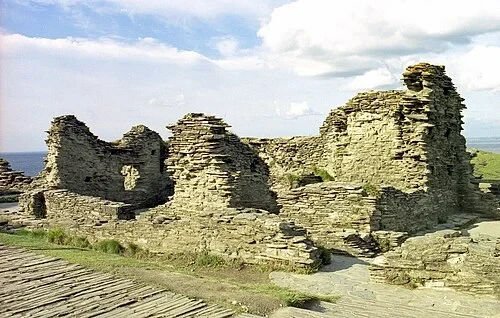 The Island Gatehouse and Great HallThe Great Hall Ruins
Scattered across the grassy terrace are the low-lying stone foundations of the Great Hall, once the heart of the island complex. Built by Richard, Earl of Cornwall, in the thirteenth century, this structure was never intended to withstand a siege. Instead, it was constructed as a grand symbolic space for feasting, entertaining, and hosting high-status guests. The layout reveals that the hall stood remarkably close to the cliff edge. This position was chosen deliberately to maximize the dramatic impact on anyone who entered. Guests dining inside would have looked out over the sheer drop to the ocean, experiencing a visual display of Richard's immense wealth, power, and his self-proclaimed connection to ancient Arthurian royalty. Though only the low stone outlines remain today, you can still trace the proportions of the medieval hall, which was divided into a main seating area and service rooms, positioned to make the absolute most of this wild, spectacular coastal setting.
Listen in the appAndrew Hackney · CC BY-SA 2.0
09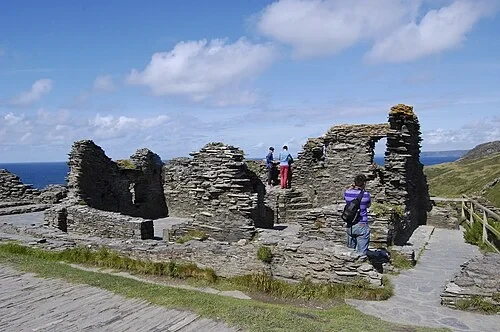 The Dark Age Palace FoundationsThe Island Courtyard
Following the death of Richard of Cornwall in 1272, the castle entered a rapid and permanent decline. Because the site held virtually no strategic military value, successive Earls of Cornwall rarely visited or maintained the structures. By the fourteenth century, the buildings were already falling into serious decay, and the site was briefly utilized as a remote state prison rather than a royal residence. The surviving walls around this quiet courtyard showcase the traditional drystone masonry technique used by medieval builders. Utilizing local flat slate, craftsmen carefully stacked the stones without mortar, relying on gravity and precise fitting to hold the walls together. This traditional method of construction has proven remarkably durable, allowing these exposed ruins to withstand centuries of fierce Atlantic gales, damp sea mists, and relentless coastal weather. Today, the courtyard serves as a peaceful spot to appreciate the sheer resilience of these simple stone walls, which have outlasted the grand ambitions of their original creator.
Listen in the appBill Harrison · CC BY-SA 2.0
10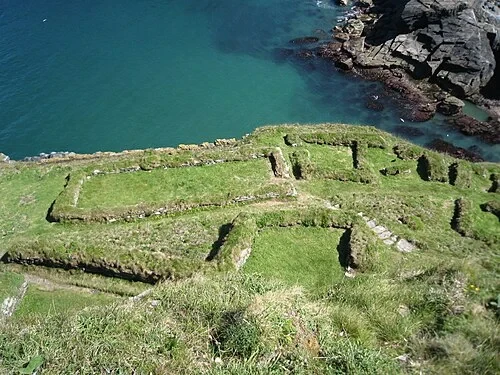 The Dark Age Palace FoundationsThe Early Medieval Palace
Looking down onto the lower terraces of the island reveals a series of grass-covered, rectangular stone foundations. While they may look simple, these ruins represent one of the most important archaeological discoveries in Britain. Excavations conducted in 2016 and 2017 revealed that these terraces were once occupied by a wealthy, high-status royal palace dating to the fifth and sixth centuries, long before the medieval castle was built. Archaeologists working at the site uncovered thousands of fragments of luxury goods, including high-quality glass and immense quantities of imported Mediterranean pottery. These vessels once carried wine and olive oil from as far away as modern-day Turkey, Tunisia, and Greece. The findings proved that during the supposedly dark ages following the collapse of Roman rule in Britain, this remote cliff was actually a bustling, global trading hub of immense wealth and power. It likely served as the seasonal seat of the rulers of Dumnonia, the ancient kingdom of Cornwall, cementing the site's true historical importance.
Listen in the appIDS.photos from Tiverton, UK · CC BY-SA 2.0
Tintagel Castle
Frequently asked questions
How much does the guide cost?
Free app download. Listed guide price: $3.99. Guide price shown in the app. Audio guide only. Venue admission is separate.
Can I listen without internet?
Yes. Download the guide’s audio, images, and maps in the app before your visit. Your downloaded content is then available offline.
Can I listen in my language?
Stanza supports 15 languages. Check the app for the languages available for this guide.
Do I need to follow a schedule?
No. This is a self-guided experience. Choose your stops, pause whenever you like, and return to a story at your own pace.
At your own pace
Explore Tintagel Castle.
Download Stanza, then search for “Tintagel Castle”.
Free app download · Guide price shown in the app
Keep exploring
Nearby audio guides
Alnwick
Alnwick Castle
Content & sources
Clementp.fr · CC BY-SA 4.0
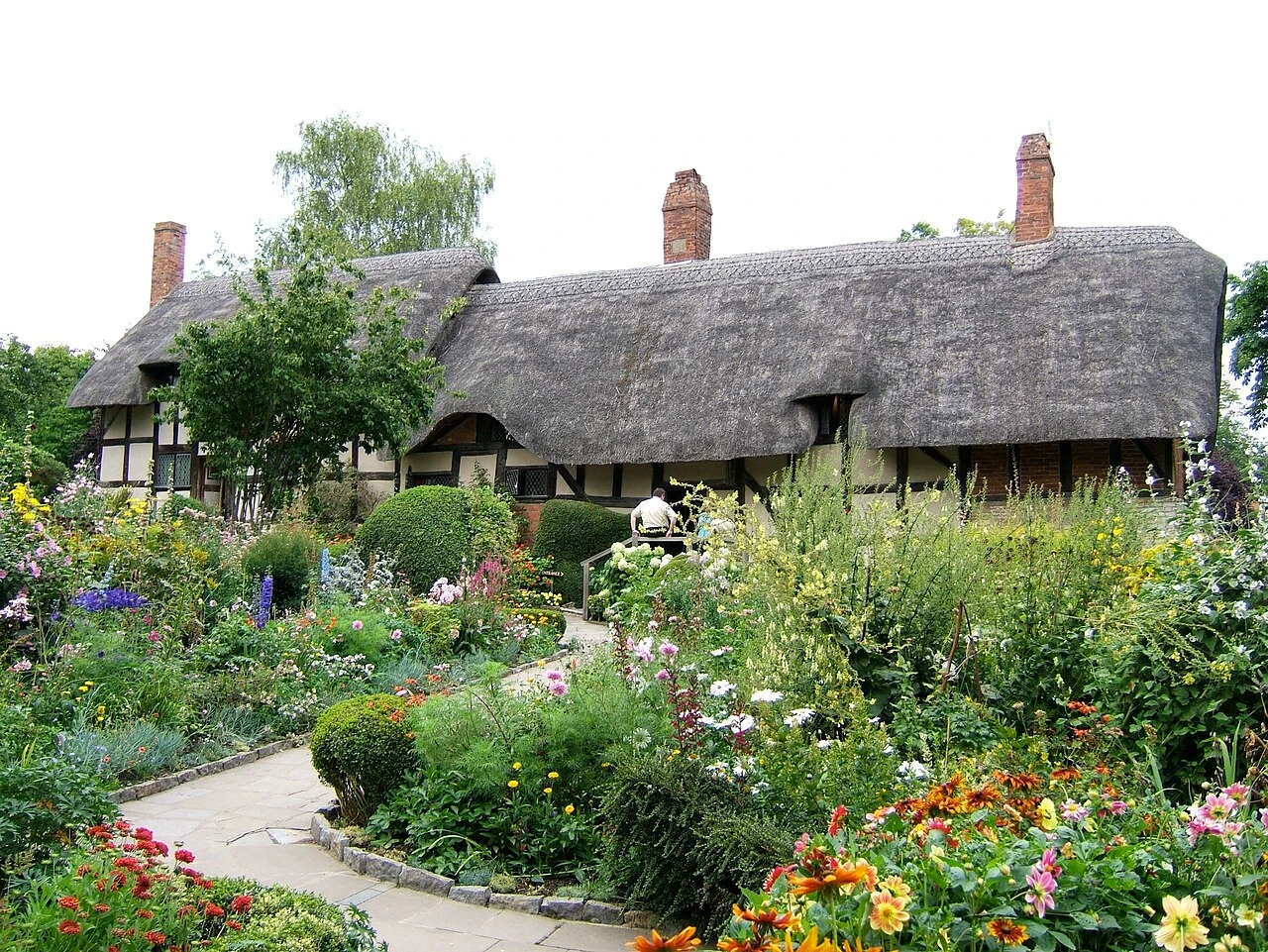
Stratford-on-Avon
Anne Hathaway's Cottage
Content & sources
Richard Peat · CC BY-SA 2.0
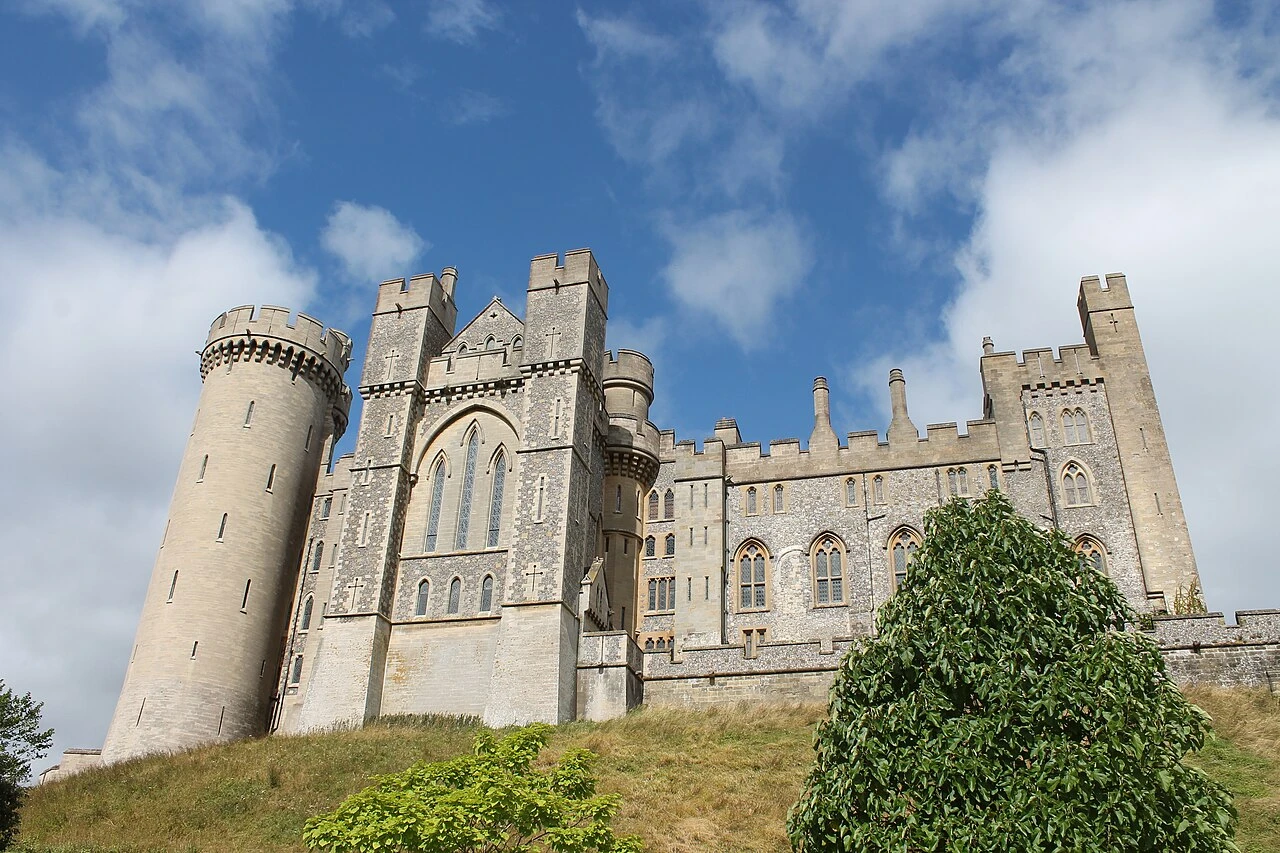
Arun
Arundel Castle
Content & sources
Photo: Egjoni98 · CC BY-SA 4.0
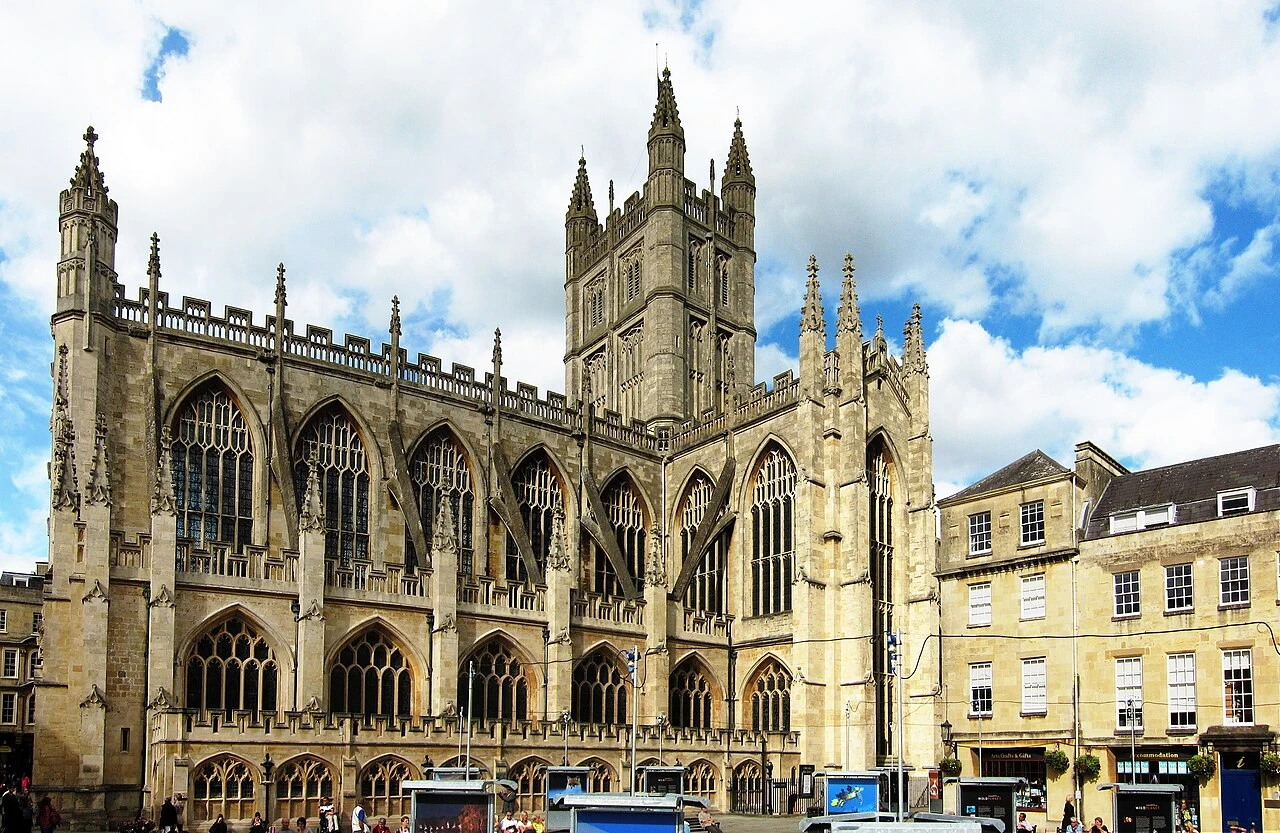
Bath
Bath Abbey
Content & sources
Photo: Velvet · CC BY-SA 3.0