Stanza · Audio guide
Notre-Dame Cathedral Basilica of Saigon Audio Guide
A place to remember. A story to take with you.
The Notre-Dame Cathedral Basilica of Saigon is a cathedral located in Ho Chi Minh City, Vietnam. It was constructed between 1877 and 1880 by French administrators and features two bell towers reaching a…
Download Stanza, then search for “Notre-Dame Cathedral Basilica of Saigon”.
About the tour
One guide. Your kind of visit.
The Notre-Dame Cathedral Basilica of Saigon is a cathedral located in Ho Chi Minh City, Vietnam. It was constructed between 1877 and 1880 by French administrators and features two bell towers reaching a height of 58 meters.
Ready when you are.
- 01Get the free Stanza app.
iOS & Android
- 02Find your guide.
“Notre-Dame Cathedral Basilica of Saigon”
- 03Download before you go.
Works offline
Audio guide / 10 narrated stops
Inside the guide
Get to know a few of the stories before you go. Open a stop to read more.
01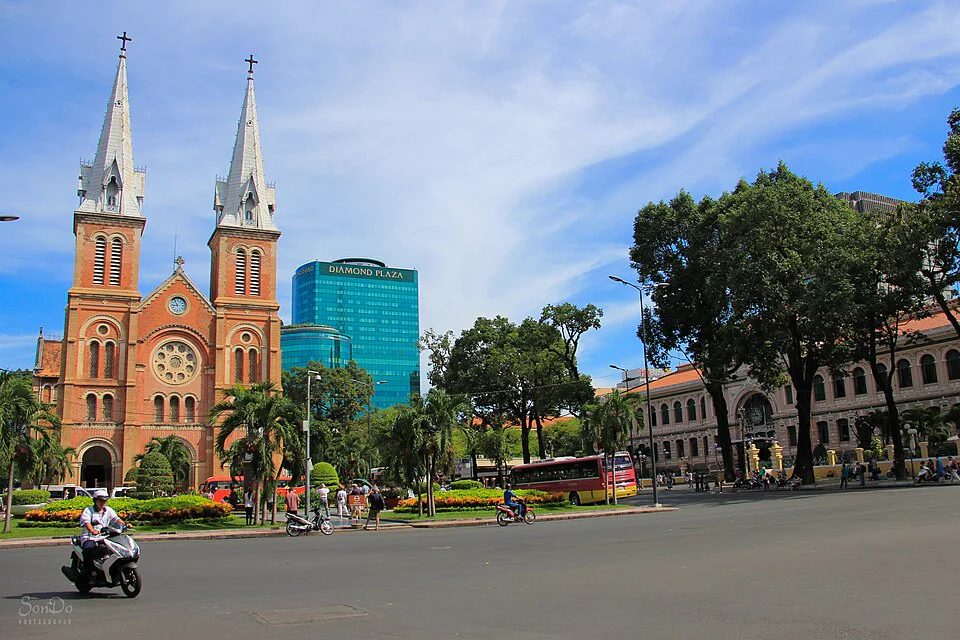 Paris Commune Square & Plaza
The Cathedral above Paris Commune Square
Welcome to the Notre-Dame Basilica of Saigon; over the next stops, one red-brick church will tell the story of a city. The cathedral was raised by the French colonial state, and its first name shows it: the State Cathedral. Bishop Isidore Colombert laid the first stone on the seventh of October, 1877, before the senior officials of the colony. Construction took three years. On Easter Sunday, the eleventh of April, 1880, the finished church was blessed in the presence of the Governor of Cochinchina, Charles Le Myre de Vilers. The colonial treasury paid for everything, the building and its interior decoration alike, at a cost reckoned in its day at about two and a half million French francs. Since the state owned what it had paid for, people simply called it the State Cathedral. It remains a working cathedral today, and the landmark of Paris Commune Square, with motorbikes sweeping past its open grounds all day long.
son do · CC BY 2.0
02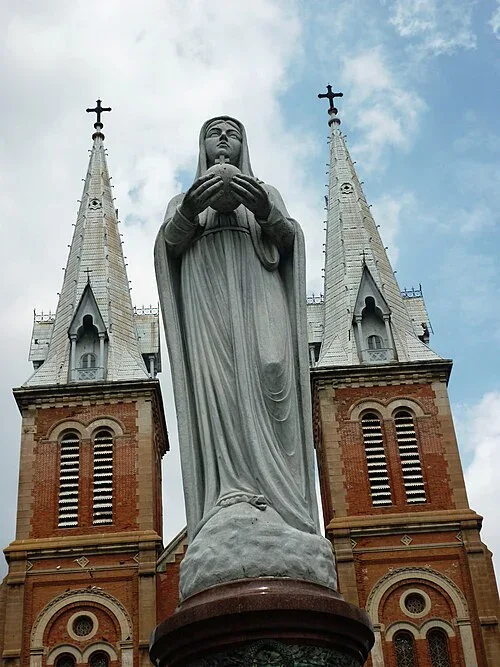 Statue of Our Lady of Peace
Our Lady of Peace
The statue in the forecourt is the reason the cathedral carries the name Notre-Dame at all. Through the mid-twentieth century the pedestal in front of the church stood empty; it had stood empty since 1945. Bishop Joseph Pham Van Thien, who shepherded the Saigon parish, ordered a statue of Our Lady of Peace for the Marian Congress of 1959. It was carved in white Carrara marble at Pietrasanta, the Tuscan town of stone-carvers, and shipped from the port of Genoa. It reached Saigon in February 1959 and was raised onto the long-empty base. At the ceremony the bishop read a prayer of his own: Notre-Dame bless the peace to Vietnam. The next day Cardinal Agagianian came from Rome to bless the statue before the assembled crowds. From then on the church was called Notre-Dame. In October 2005 crowds gathered here again, after reports that the statue had shed a tear down its right cheek. Thousands came, traffic around the square had to be stopped, and the Church's own clergy never confirmed it.
Photo: Ngô Trung · CC BY-SA 3.0
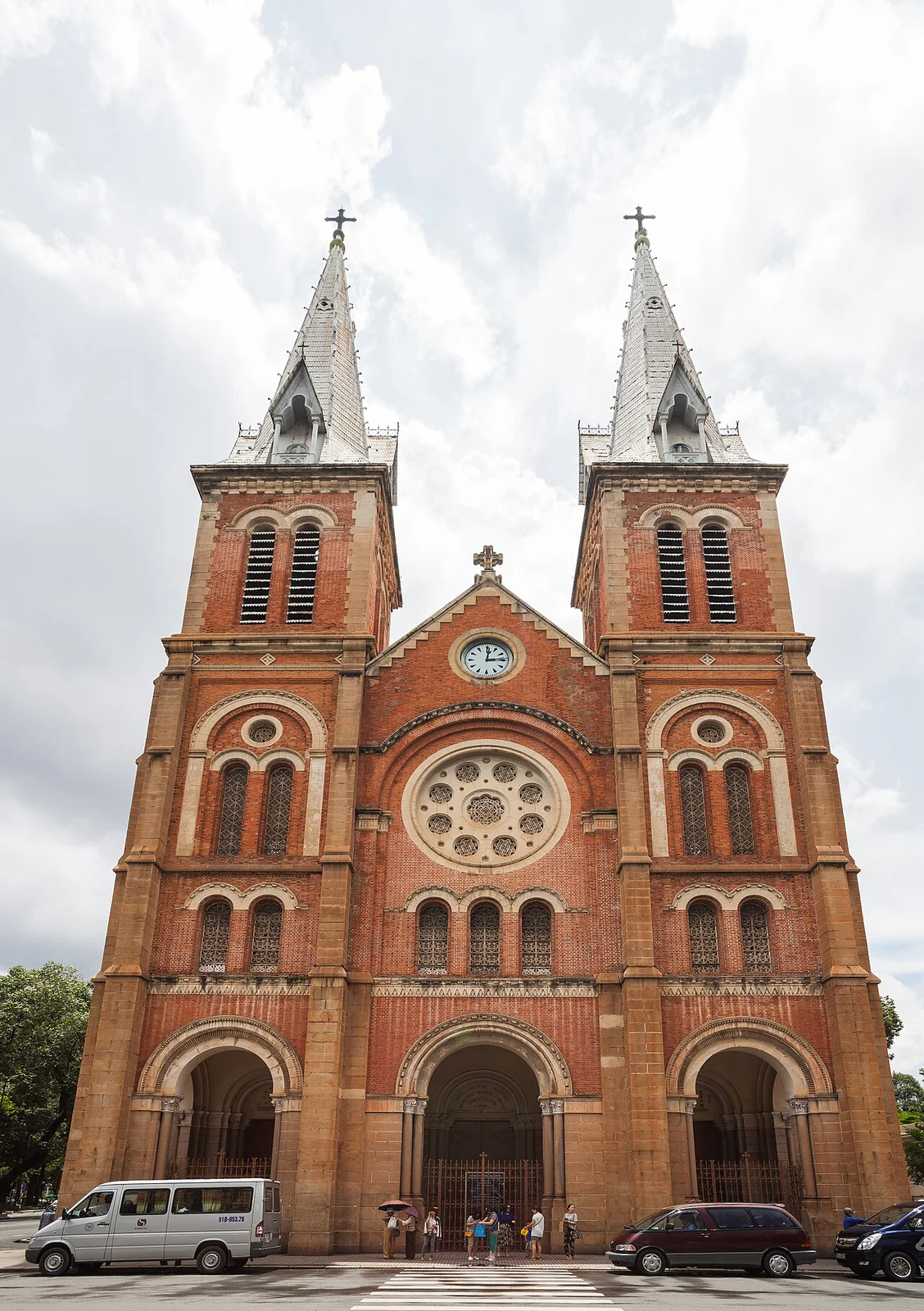
03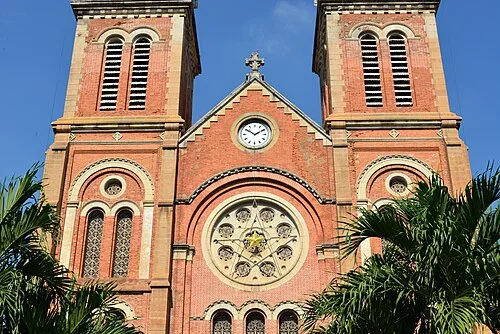 Front Façade & Twin Bell Spires
The Facade and Towers
Two slim spires give the cathedral its silhouette, and they were an afterthought. The church of 1880 had no towers; these were added in 1895, each rising nearly fifty-eight metres, with a cross on top bringing the whole to about sixty and a half. Inside are six bronze bells cast in France. They were shipped to Saigon in 1879, and together they weigh close to twenty-nine tons. Each bell is named after a note of the scale. The great bell called Sol hangs in the south tower, with the smallest bells beside it; the north tower holds La and Si. On ordinary weekdays the three small bells ring twice a day, at five in the morning and a quarter past four in the afternoon. The three largest sound only for great feasts, Christmas, the Lunar New Year and New Year's Eve. They are so heavy that the story goes they must be given a push by hand, a kick, before the electric motor can take over. Between the towers, some fifteen metres above the ground, sits a clock built in Switzerland in 1887, still kept true by a weekly winding with a crank.
Listen in the appАндрей Бобровский · CC BY 3.0
04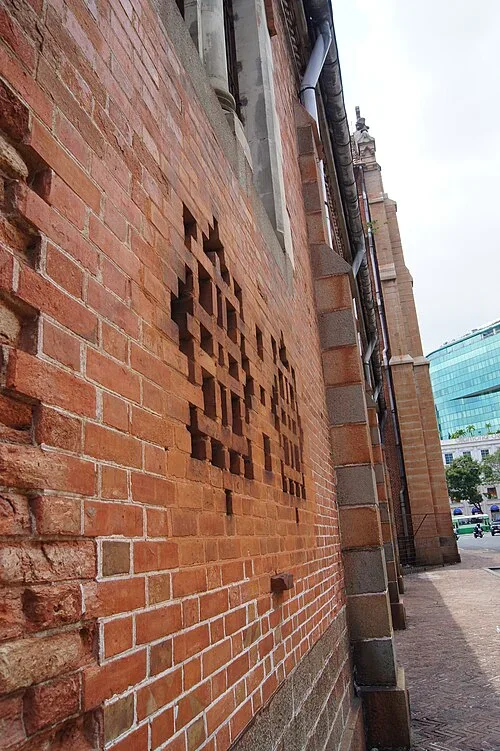 Front Façade & Twin Bell Spires
The Bare Brick Wall
Up close, the wall explains the cathedral's colour. The brick was ordered from Toulouse in France and shipped around the world to Saigon, and the builders left it bare, with no plaster and no coating of any kind. More than a century of tropical sun and rain later, it is still that bright, warm red. Everything else came the same way: the cement, the iron and steel, even the screws. The roof tiles carry their makers' names stamped into the clay, Guichard Carvin of Marseille St André. Broken tiles were later replaced with ones made in Saigon, stamped Wang-Tai, many of them after wartime damage. The skin of the building has needed care in this century too; a major restoration of the basilica began in 2017 and has continued since.
Listen in the appPhoto: Hoangvantoanajc · CC BY-SA 3.0
05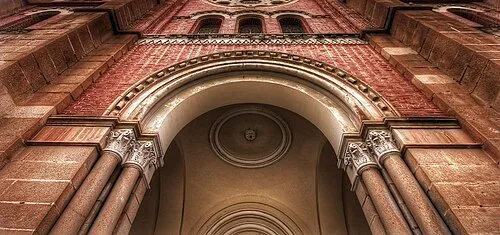 Main Entrance Portico
The Main Entrance
A granite plate set inside the main entrance records this building's own history: the day work began, the day it was finished, and the name of its designer. But it also marks the end of a longer search for a proper church. The first one stood on today's Ngo Duc Ke Street, built for the French community after the conquest, and it was soon too small. In 1863 a wooden church was begun on the bank of the Charner canal, with Bishop Lefevre laying its first stone that March. It took about two years to build and was called the Saigon Church. Termites then did what no one had planned for, eating into the timber until it was no longer sound. Services moved to the guest-chamber of the French Governor's Palace, which doubled as a seminary, and stayed there for years. Only when this cathedral was finished did the congregation finally have a permanent home, behind the great arched portal of the entrance.
Listen in the appJimmy McIntyre - Editor HDR One Magazine · CC BY-SA 2.0
06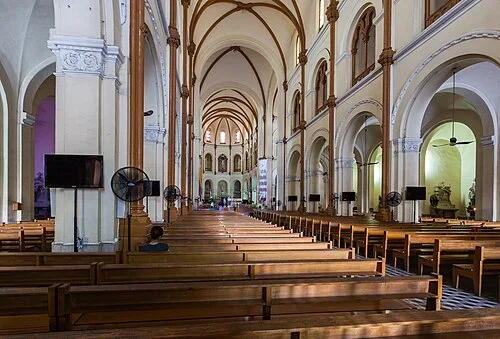 Central Nave & Apostle Columns
The Nave and the Twelve Columns
Inside, the cathedral is a hall built to be filled. Two rows of six pillars run down the nave, and tradition reads them as the twelve apostles, carrying the church on their shoulders the way the apostles carry the faith. From door to sanctuary the building runs ninety-three metres, and at its widest it spans thirty-five. The vault rises twenty-one metres overhead. Wooden pews fill the space in long ranks, with side aisles and chapels opening off the nave. When every bench is taken, the cathedral holds about twelve hundred worshippers. On a feast day it becomes exactly that, a full congregational church, with fans turning overhead against the Saigon heat.
Listen in the appDiego Delso · CC BY-SA 3.0
07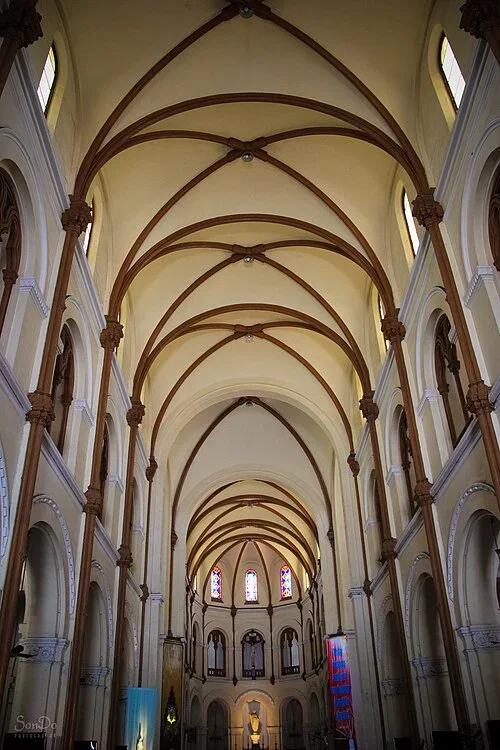 Central Nave & Apostle Columns
The Vaulted Nave
The design was chosen in a contest. In August 1876 the governor of the south, Duperré, invited architects to submit plans for a new church, and seventeen entries came in. The winner was J. Bourard, working in a Romanesque revival style with Gothic touches, and he went on to supervise the construction as well. The blend is easy to see overhead. The great arches crossing the nave are rounded, in the Romanesque manner, thick and calm. Between them the ribs climb to the pointed shapes of the Gothic, the older language of the French cathedrals. Its pale plaster and warm wooden ribs give the vault a lightness stone rarely achieves.
Listen in the appson do · CC BY 2.0
08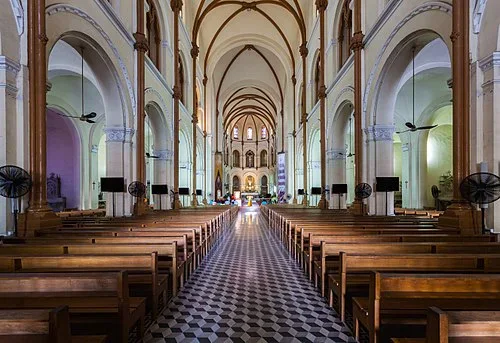 High Altar & Sanctuary
The Sanctuary
Down the aisle, past the pews, the view ends at the altar, and this is where the cathedral's later story sits. In 1960 Pope John the Twenty-third set up Vietnam's own Catholic hierarchy, with archbishops in Hanoi, Huế and Saigon. This church became the chief cathedral of Saigon, the seat of its archbishop. Two years later, in 1962, the same pope conferred on it the rank of basilica, and from then on it has been the Saigon Notre-Dame Cathedral Basilica. The title is no ornament; mass is still celebrated here, and the church remains the centre of the archdiocese. The connection to Rome continues in small ways too. At the end of 2022 a carillon of twenty-five bells was installed in the forecourt, its timber frame built in Germany. Four of its bells carry the names of the archbishops who have led the diocese since 1960.
Listen in the appDiego Delso · CC BY-SA 3.0
09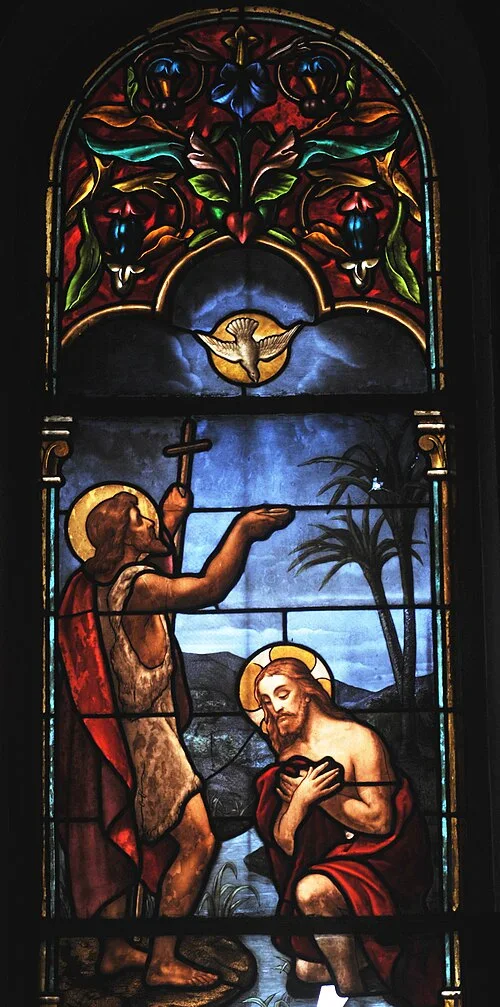 Stained Glass & Side Chapels Walk
The Stained Glass of Chartres
The stained glass came from Chartres, the French town whose medieval cathedral windows have been famous for eight hundred years. The Lorin firm there supplied fifty-six glass squares for Saigon, filling the church with scenes in deep blues and reds. One of them shows the baptism of Jesus, John the Baptist pouring water over him while a dove hovers above. The glazing also carries a story of loss: much of the original nineteenth-century glass was destroyed during the wartime years, and the windows in place today are largely later replacements. That makes any early glass still hanging here the more precious. The colours still do their work, casting patches of blue and ruby across the pale walls of the aisles.
Listen in the apppham xuan nghi · CC BY 2.0
10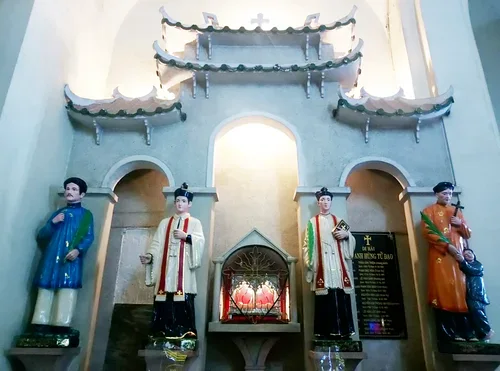 Stained Glass & Side Chapels Walk
Chapel of the Vietnamese Martyrs
Off the aisle, one chapel looks different from everything else in the building. The Chapel of the Vietnamese Martyrs is crowned with the sweeping, upturned roofs of Vietnamese architecture, and its figures of the saints stand in Vietnamese dress, in flowing robes and the caps of scholars and officials. They honour Catholics who died for their faith in Vietnam through the centuries of persecution, witnesses the Vietnamese Church counts as its own saints. The setting answers the rest of the building quietly. Every material in this cathedral was shipped from France, yet the devotion inside has taken wholly Vietnamese form. A church founded as a colonial state project now carries a Vietnamese name, Our Lady of Peace, in a Vietnamese city, with Vietnamese saints at its altars.
Listen in the appPhoto: Trần Thế Vinh · CC BY-SA 4.0
Notre-Dame Cathedral Basilica of Saigon
Frequently asked questions
How much does the guide cost?
Free app download. Listed guide price: $0.99. Guide price shown in the app. Audio guide only. Venue admission is separate.
Can I listen without internet?
Yes. Download the guide’s audio, images, and maps in the app before your visit. Your downloaded content is then available offline.
Can I listen in my language?
This audio guide is available in 15 languages, including English.
Do I need to follow a schedule?
No. This is a self-guided experience. Choose your stops, pause whenever you like, and return to a story at your own pace.
At your own pace
Explore Notre-Dame Cathedral Basilica of Saigon.
Download Stanza, then search for “Notre-Dame Cathedral Basilica of Saigon”.
Free app download · Guide price shown in the app
Keep exploring
Audio guides — Vietnam
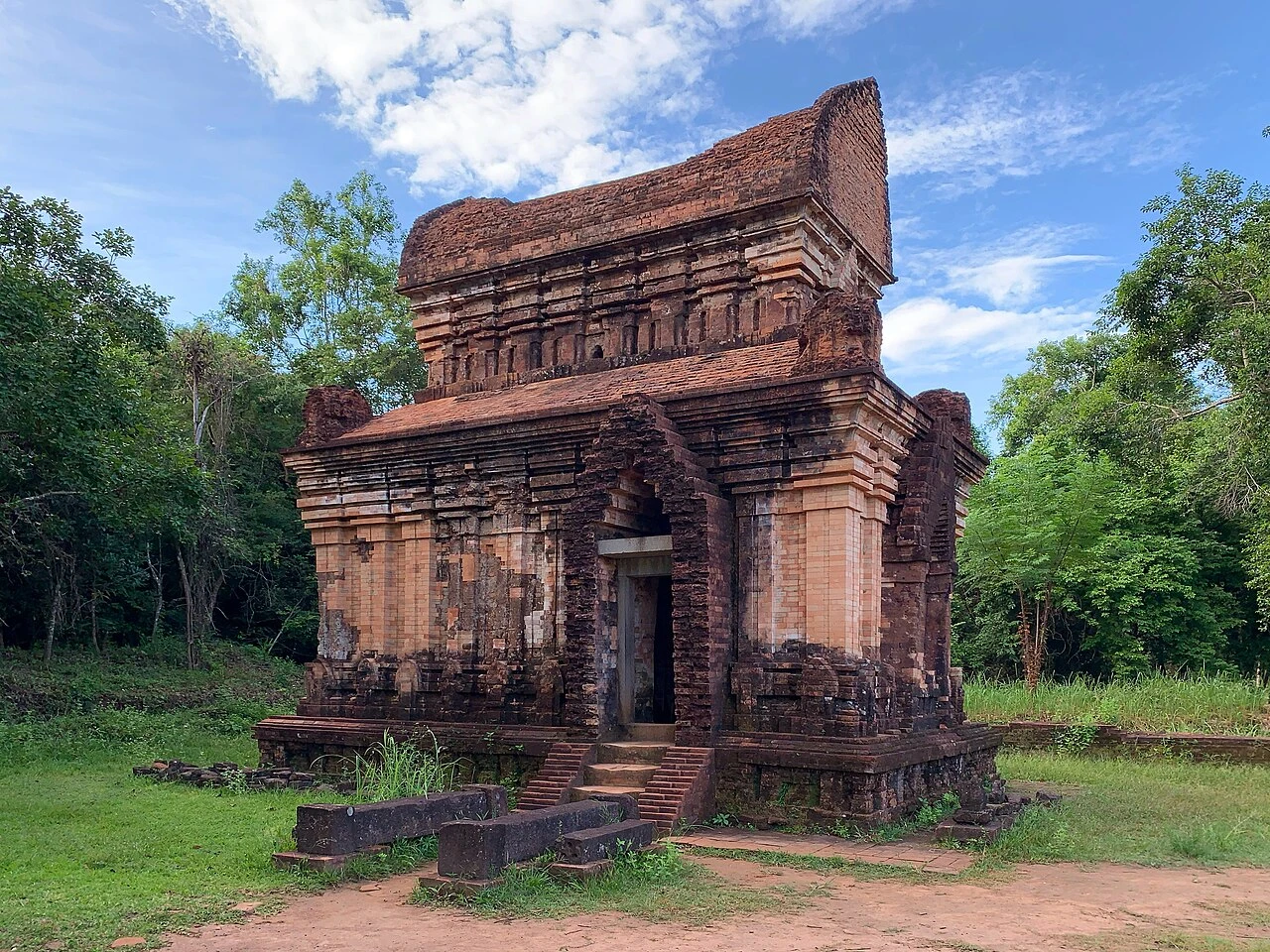
Da Nang
My Son Sanctuary
Content & sources
Photo: Chainwit. · CC BY 4.0
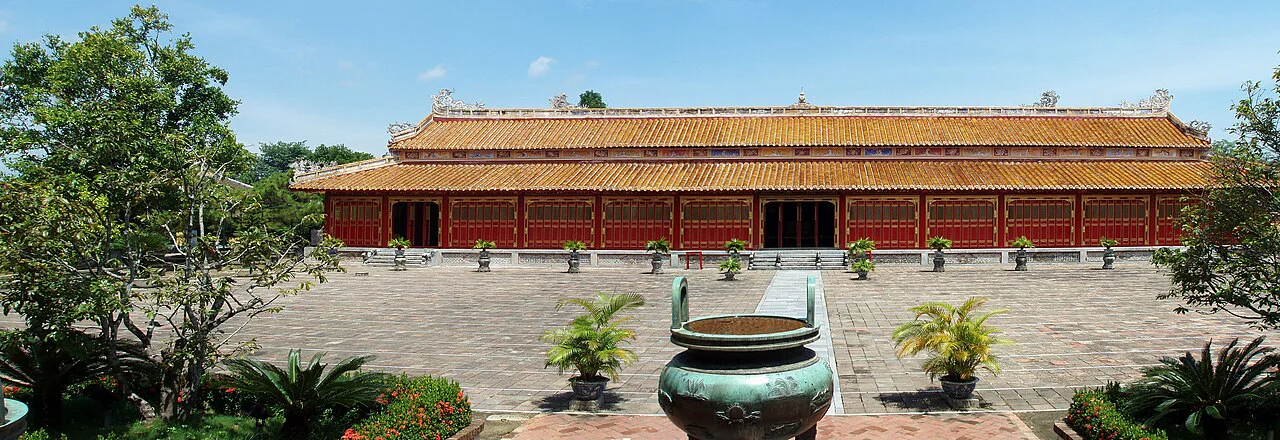
Huế
Imperial City of Huế
Content & sources
https://www.flickr.com/photos/sixty4coupe/ · CC BY-SA 2.0
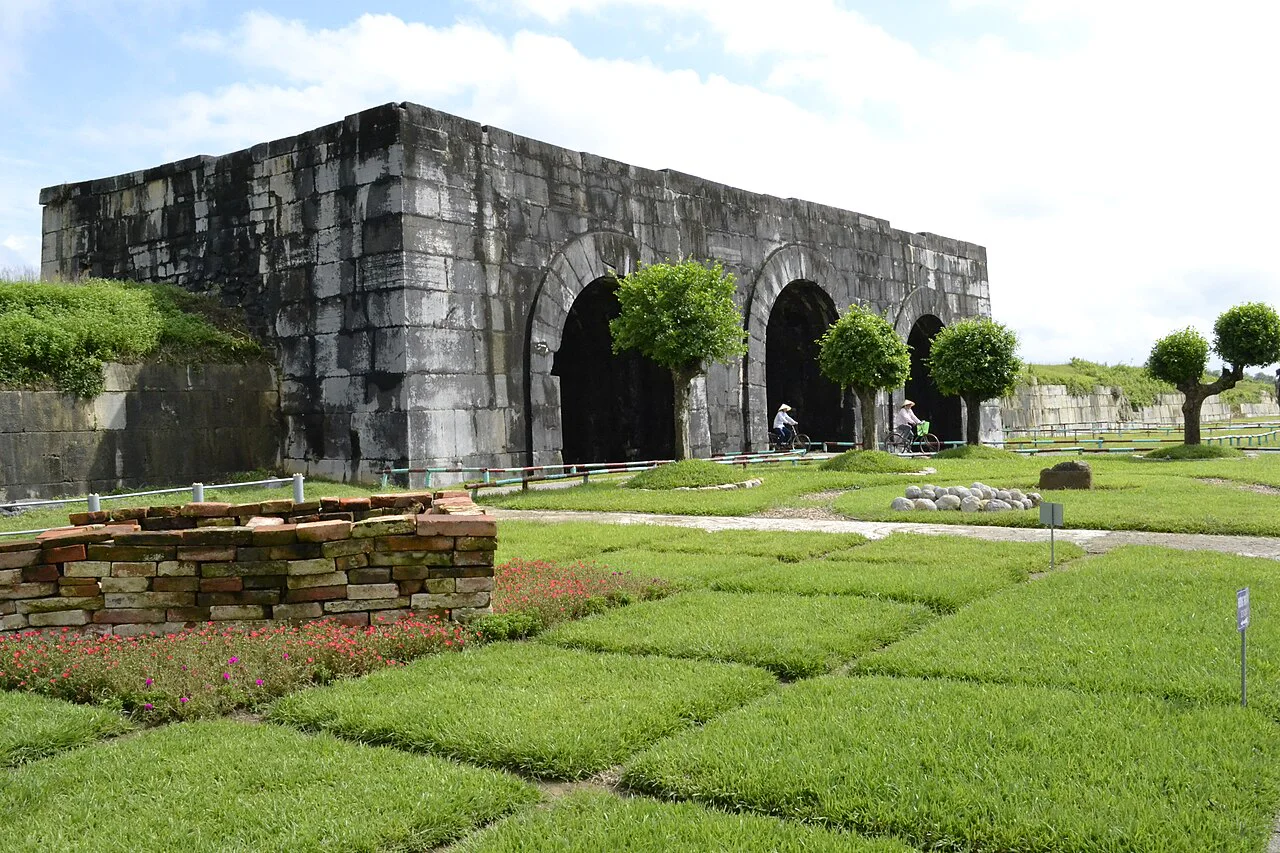
Tây Đô Commune
Citadel of the Hồ Dynasty
Content & sources
Loi Nguyen Duc · CC BY 2.0
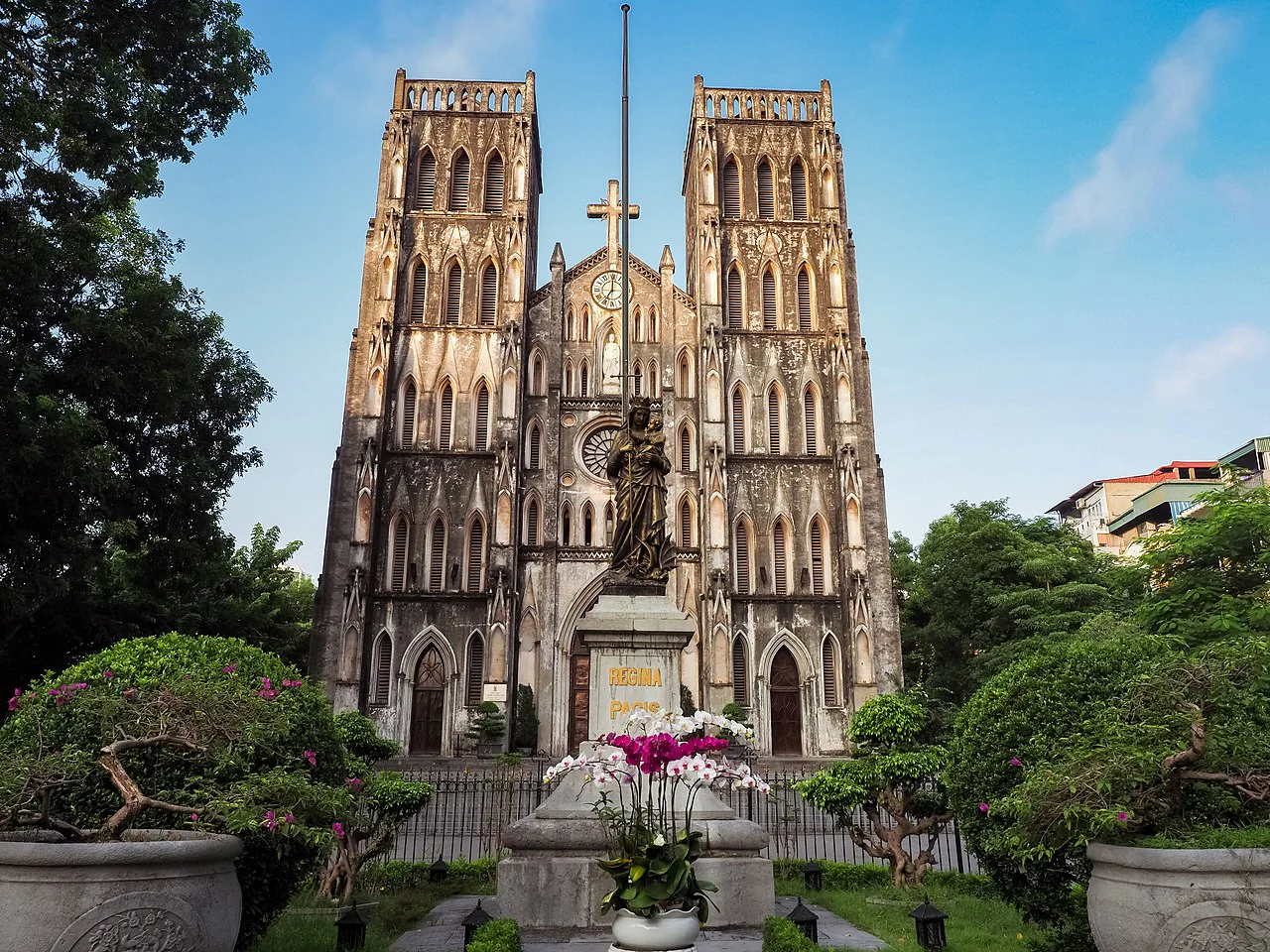
Hanoi
St. Joseph's Cathedral, Hanoi
Content & sources
John Ragai · CC BY 2.0
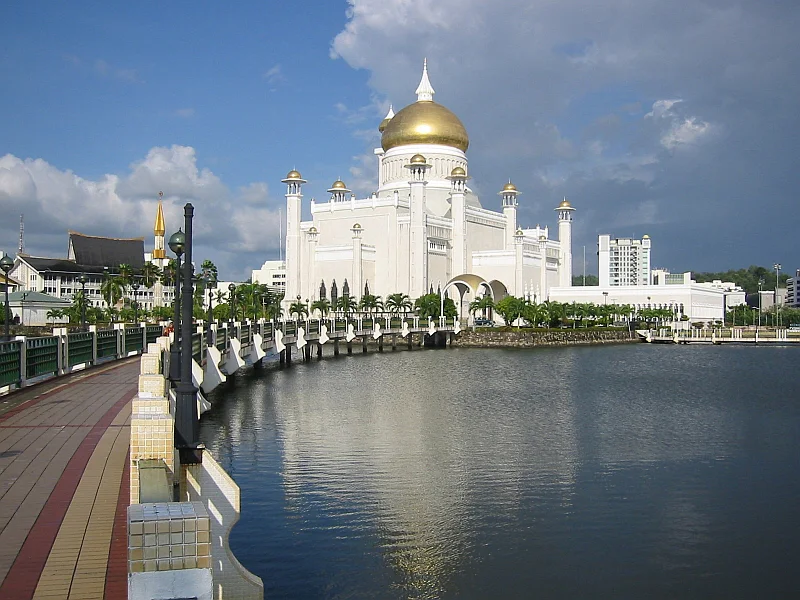
Bandar Seri Begawan
Omar Ali Saifuddien Mosque
Content & sources
Daniel Weiss · CC BY-SA 3.0
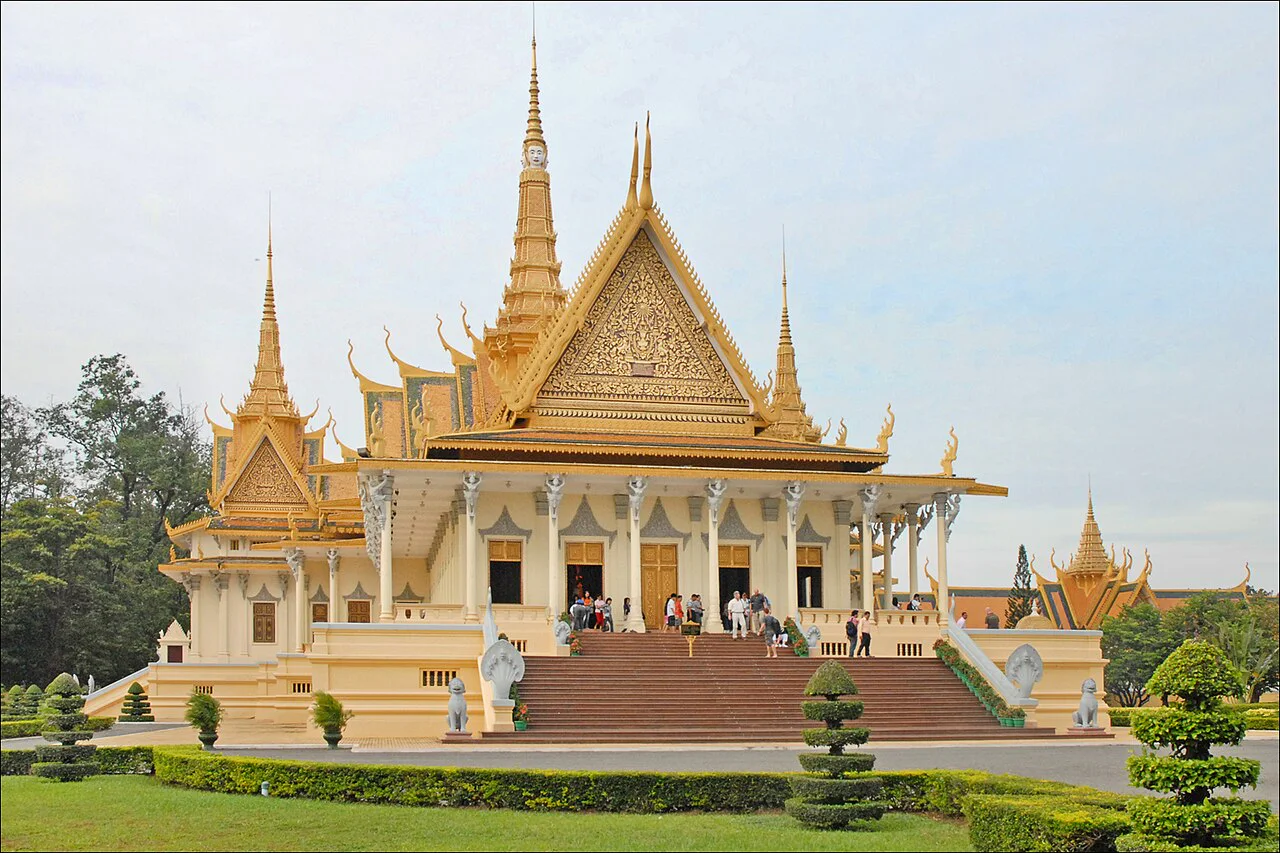
Phnom Penh
Royal Palace of Cambodia
Content & sources
Jean-Pierre Dalbéra from Paris, France · CC BY 2.0