Stanza · Audio guide
Musée des Beaux-Arts de Caen Audio Guide
A place to remember. A story to take with you.
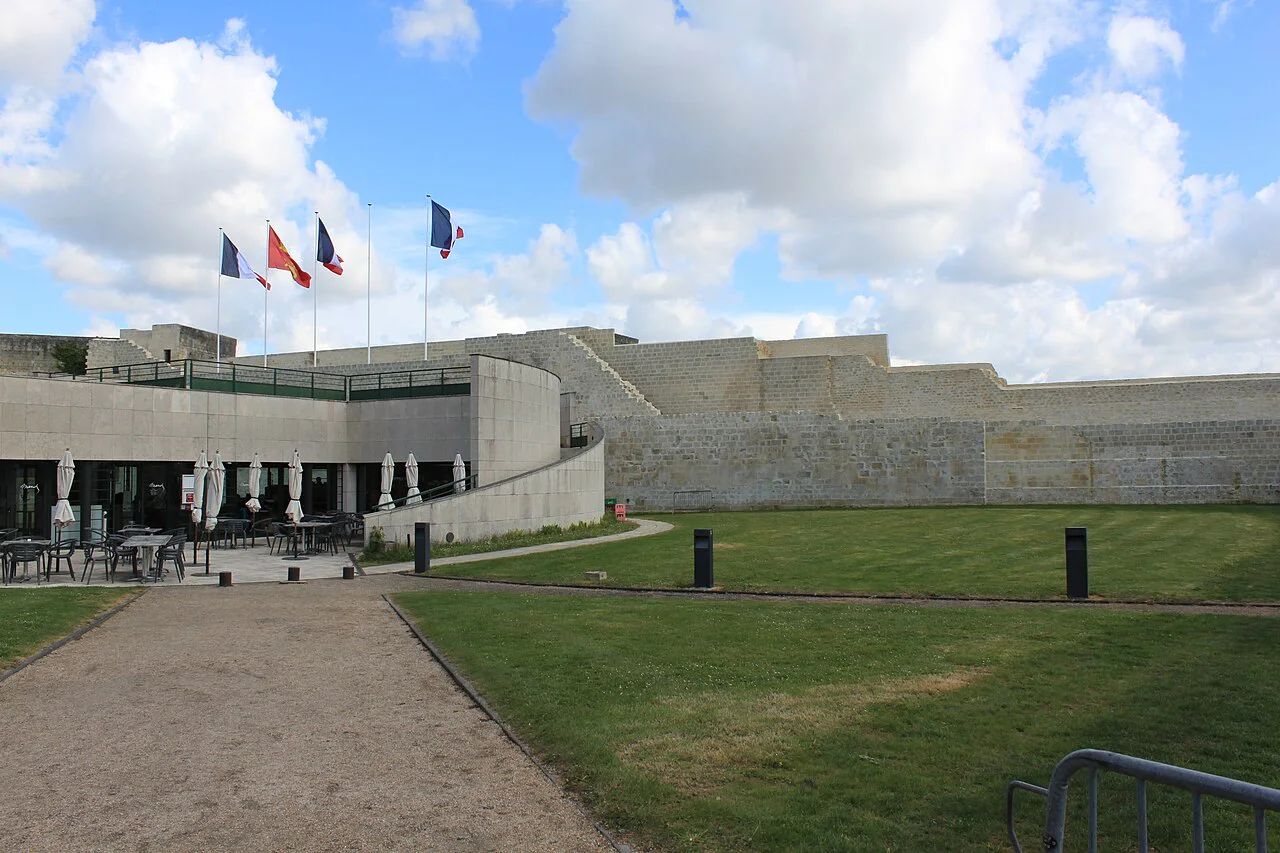
The Musée des Beaux-Arts de Caen is a fine arts museum in the French city of Caen. It was founded at the start of the 19th century and rebuilt in 1971 within the ducal château.
Download Stanza, then search for “Musée des Beaux-Arts de Caen”.
About the tour
One guide. Your kind of visit.
The Musée des Beaux-Arts de Caen is a fine arts museum in the French city of Caen. It was founded at the start of the 19th century and rebuilt in 1971 within the ducal château.
The Musée des Beaux-Arts de Caen guide tells the stories of 19 artworks, including Marriage of the Virgin (Pietro Perugino), The Meeting between Abraham and Melchizedek (Peter Paul Rubens), Venus Weeping for Adonis (Nicolas Poussin), Perugino, Saint Jerome in the Desert (Pietro Perugino), Damocles, by Thomas Couture (Thomas Couture), Froimont Diptych (Workshop of Rogier van der Weyden), The baptism of Christ (Lambert Sustris), and The Lady with Jewels (Gustave Courbet). Every artwork is free to hear in the Stanza app until 1 January.
Ready when you are.
- 01Get the free Stanza app.
iOS & Android
- 02Find your guide.
“Musée des Beaux-Arts de Caen”
- 03Download before you go.
Works offline
Audio guide / 19 artworks
Inside the guide
Get to know a few of the stories before you go. Open a stop to read more.
01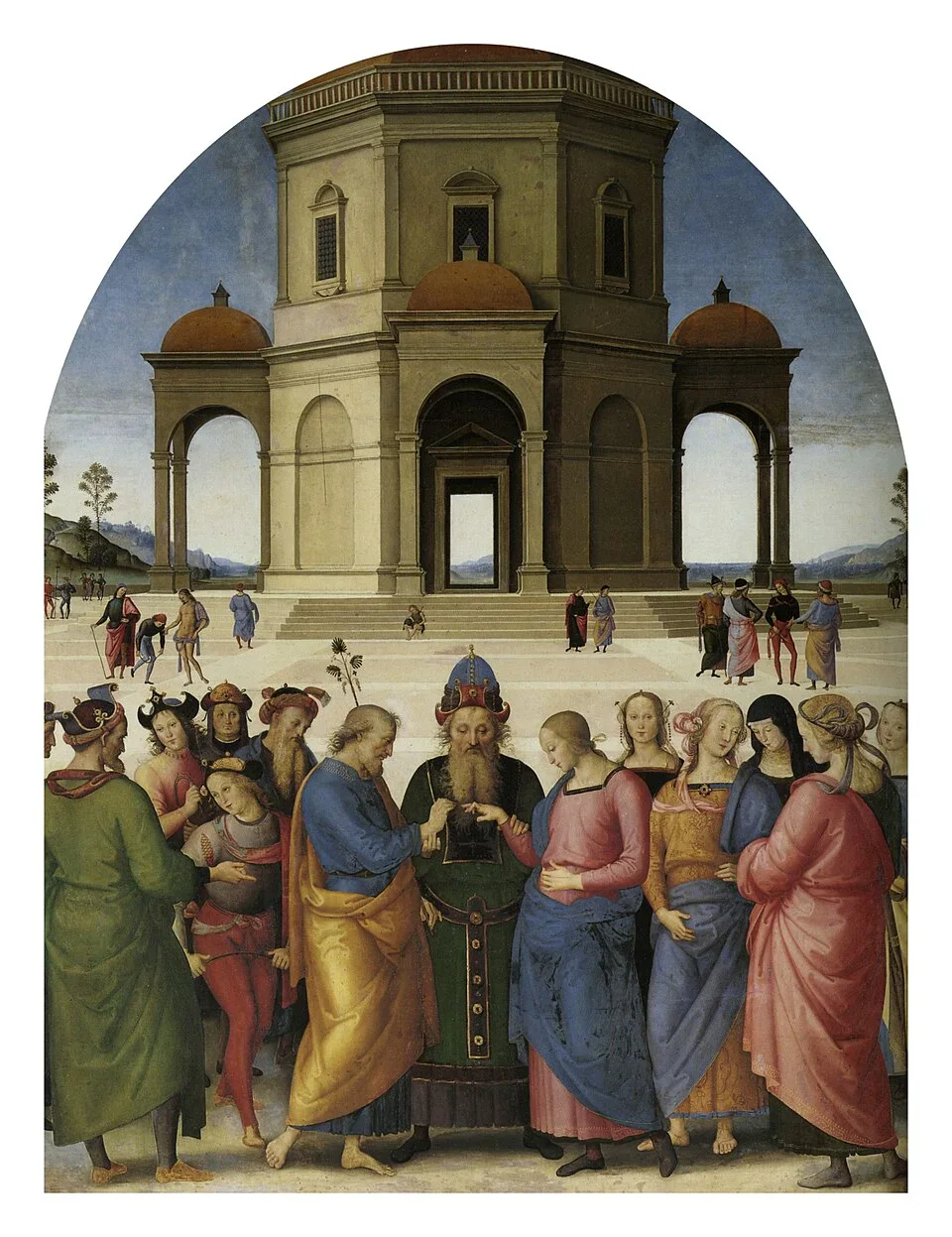
Marriage of the Virgin
This picture was stolen. In 1797 Napoleon's soldiers took it from the cathedral in Perugia and carried it off to France. The city asked again and again for its return, and Antonio Canova pleaded for it in person. It never came back. At the centre of the scene is a ring, and that ring is why the picture was painted. In Perugia, the cathedral kept the Virgin's engagement ring as a relic, in a chapel there. The ring had been stolen from a church in Chiusi and only just recovered. Joseph is placing it on Mary's finger, while the high priest stands between them and guides their hands. Behind them, at the far end of a paved square, rises the octagonal Temple of Jerusalem. Its open door lines up with the priest, and the rows of paving lead straight toward it. The commission finally went to Perugino, who worked on the picture over several years. The painting hung in that chapel for nearly three hundred years. A copy made in 1825 was sent back to Perugia to take its place, and it is still in that chapel.
Listen in the appPietro Perugino · Public domain
02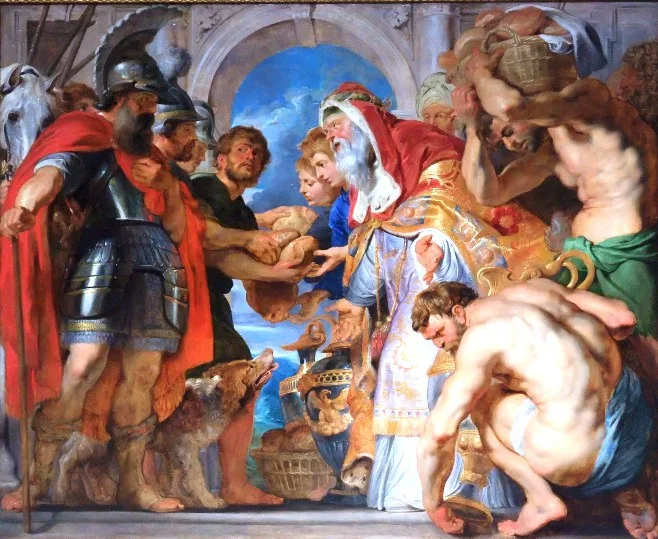
The Meeting between Abraham and Melchizedek
Two groups face each other across the painting. On the left stands a warrior in armor and a wide red cloak, a staff in his right hand. Just behind him is the head of a horse. He has only just arrived. On the right, a richly dressed man is surrounded by servants holding out baskets of bread and jars of wine. All of them lean toward the warriors. What has brought them together is a victory. The warrior is Abraham, back from defeating the king of Elam and his allies, who had sacked Sodom and taken his nephew Lot prisoner. He brought the captives and the goods back. The man facing him is Melchizedek, king of Salem and priest of God Most High. He offers the bread and wine and blesses Abraham, who gives him a tenth of the spoils. That bread and wine came to be read as a foreshadowing of the Eucharist, and Melchizedek's arrival as the announcement of Christ's coming. Rubens set Melchizedek's right hand at the centre of the painting, just beneath the loaves being passed, reaching onto Abraham's side. The young servants' faces press even further forward, right under the arch at the back. A spaniel stands at Abraham's feet. From it a diagonal climbs to the face of a standing slave, drawing the two sides of the scene together.
Listen in the appPeter Paul Rubens · Public domain
03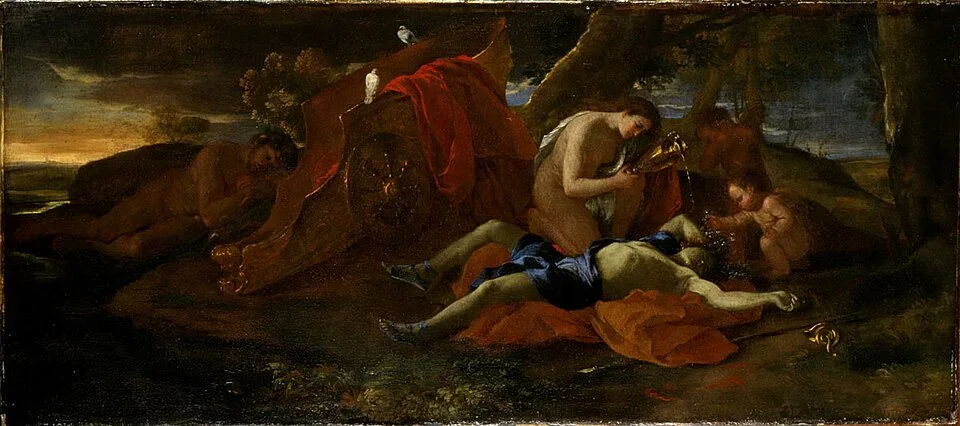
Venus Weeping for Adonis
At the water's edge, a small figure is picking flowers. They are scarlet anemones, grown from the blood of the man lying here, to keep his memory. He is Adonis, killed by a boar while hunting. Venus kneels by her chariot and pours nectar from a pitcher onto his wounds. The way he lies recalls the crucified Christ, and Venus tending him is like Saint Mary. In those years this was a popular subject, standing for death and rebirth and echoing the Christian belief that Christ rose again. That chariot beside her brings Pluto to mind, a symbol of death. Poussin painted this in Rome for a cardinal named Angelo Giori.
Listen in the appNicolas Poussin · Public domain
04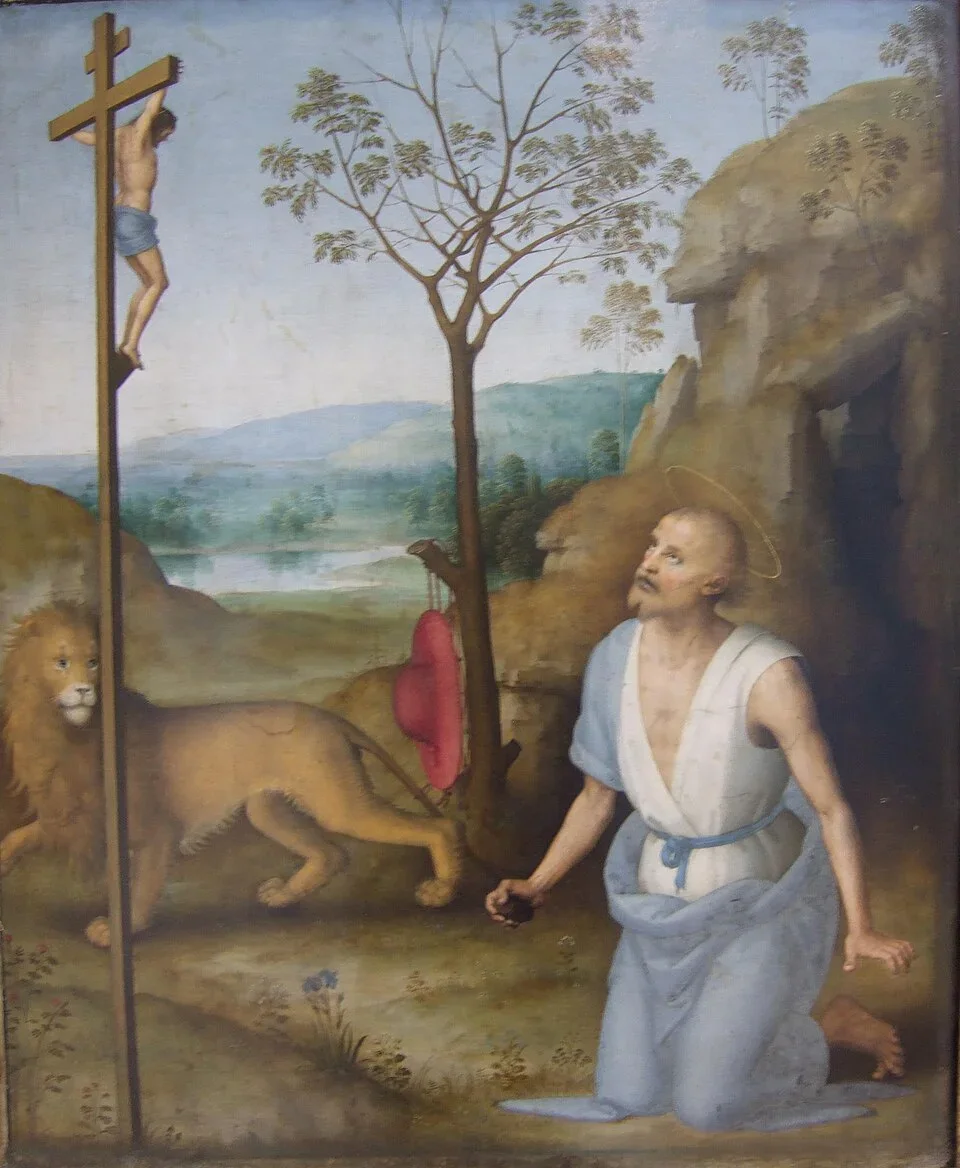
Perugino, Saint Jerome in the Desert
What is the kneeling man staring at? He is on the right of the picture, and his eyes are fixed on a crucifix set in the ground at the left. You might expect a hermit's cross to be rough, carved with simple tools. Instead, the figure on it looks like a real person in miniature, with natural skin and a body shaped like a living man's. Perugino has put a small green tree between the two, and from a broken branch of it hangs a red cardinal's hat. The kneeling man is Jerome, living as a hermit in the desert. There is no city and no one else in the landscape, only green slopes and mountains that fade toward the horizon. A stone is in his hand, and his chest is still unmarked. He has not yet used it.
Listen in the appPhoto: DamTESC · CC BY-SA 3.0
05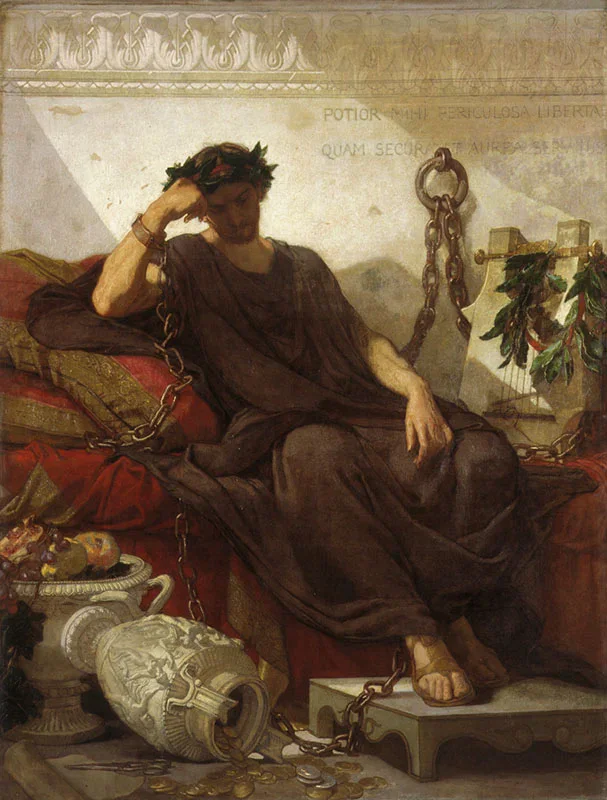
Damocles, by Thomas Couture
No sword hangs over this man. Cicero tells the old story of Damocles at a banquet, a threatening sword above him, the danger that comes with power. Couture took the sword away. He left the man in a melancholy pose, with objects around him that carry meaning. The chains say he is tied to power. The scissors say censorship. Under Napoleon the Third, Couture still received official commissions, yet he felt an artist's life there was a kind of servitude. So Damocles becomes the painter himself, bound and deeply disenchanted. When the picture reached the Salon of 1872, after its painter had been away for several years, it was praised for how it was painted. Few grasped what it meant. Up in the right corner, a Latin line says he would rather face the dangers of freedom than the safety of golden servitude. The space around him is largely empty, and it deepens the solitude of the man at its centre.
Listen in the appThomas Couture · Public domain
06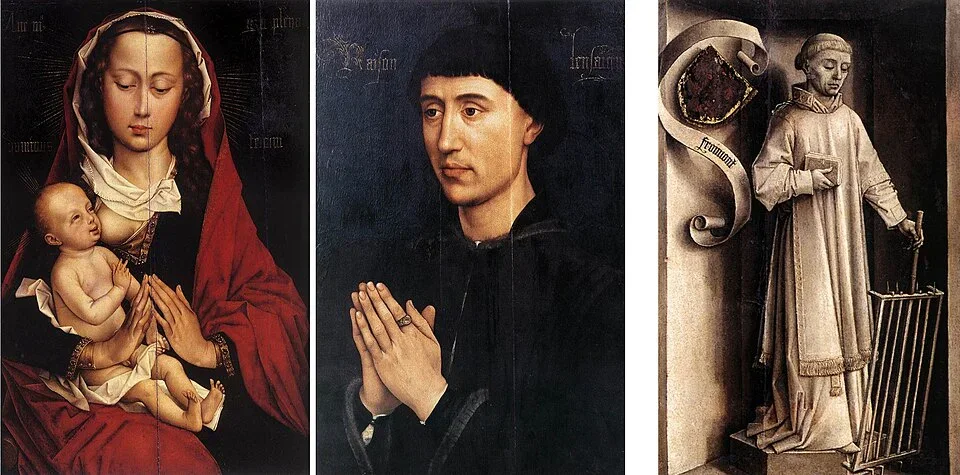
Froimont Diptych
Jean de Froimont wanted himself painted facing the Virgin and Child. There he is on the right wing, with a nursing Madonna on the left. The child pays no attention to his mother's uncovered breast and looks toward Jean instead. He blesses him the way Christ is pictured in old Byzantine icons. Behind Mary's head, tiny gold letters spell the opening of the Hail Mary. Behind Jean, barely visible against the dark, runs the motto Raison l'ensaigne. On the back of his portrait, Saint Lawrence holds the gridiron he was tortured on, with the name Froimont below. Pairs like this were what Rogier van der Weyden began making for the Burgundian elite in his last years. This one came from his workshop. Tests on the wood put it after 1469, five years after Weyden died. The painter may have been his cousin, Louis Le Due. Who actually painted it is still not known.
Listen in the appWorkshop of Rogier van der Weyden · Public domain
07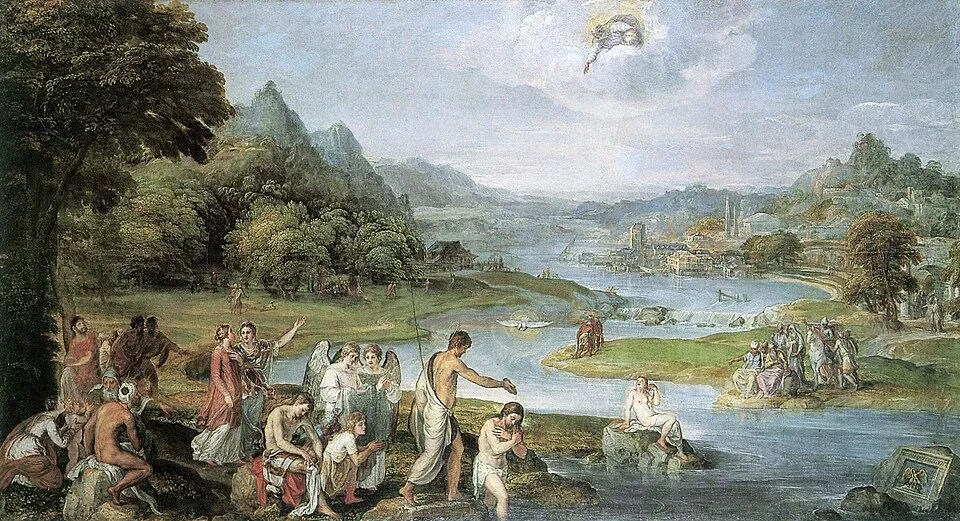
The baptism of Christ
Down in the lower right corner, set among rocks, there is a small carved relief. It shows a pelican feeding its young, with a Latin motto above it meaning as for those who love. That relief is a coat of arms, and it belongs to the man who ordered this painting. He was a cardinal, Othon Truchsess de Waldbourg. The scene he wanted was the baptism of Christ. The Jordan comes winding in from the horizon in broad bends, a wide river landscape stretching behind everything. At the very front stands Jesus, his back turned to John the Baptist, who pours the baptismal water over him. Around them are many witnesses. Two angels, and a young nude bather on a rock at the bank, her eyes lifted toward God the Father. High in the blue sky, from a cloud, God the Father gestures toward his son. He guides the dove of the Holy Spirit, which is already flying over Christ. The painter signed himself Lambertus de Amsterdam, after the city where he was born. The picture later came to France, and Louis the Fourteenth bought it from the Duke of Richelieu in 1665. It has been in Caen since 1802, and since 2007 the town has owned it.
Listen in the appLambert Sustris · Public domain
08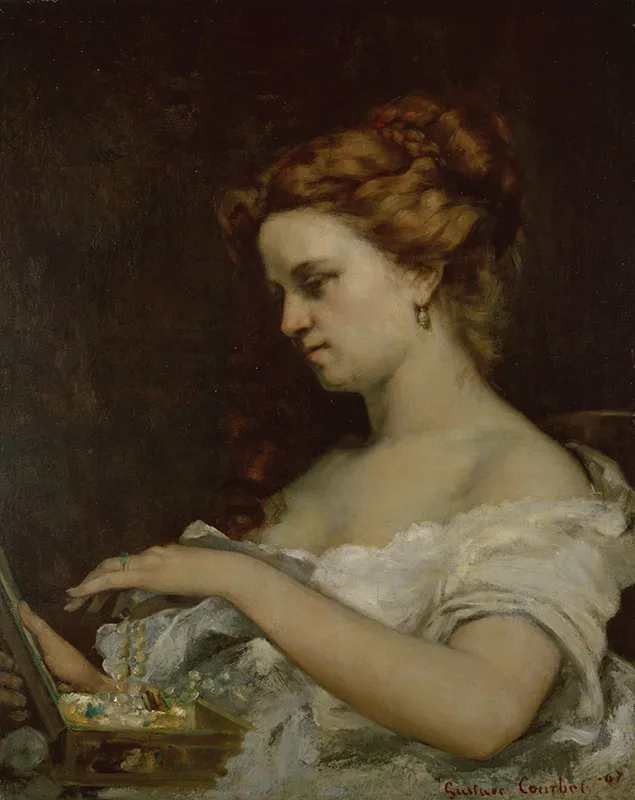
The Lady with Jewels
She is holding a jewel case. A string of pearls lies in one hand, the open box in the other. Her eyes turn to the inside of the lid, where there may be a small mirror. But her gaze seems lost and melancholy. Everything about her says she is examining her jewels. Except for that pout. That pout is what a satirical journal seized on. In June 1867 it printed a drawing making fun of her expression. The joke was that anyone seeing her face would take the pearls for false. Only the honesty of the painter who had given them to her, a man beyond suspicion, ruled that out. That painter was Courbet. The woman who sat for him was Blanche d'Antigny, one of the most famous courtesans in Paris.
Listen in the appGustave Courbet · Public domain
09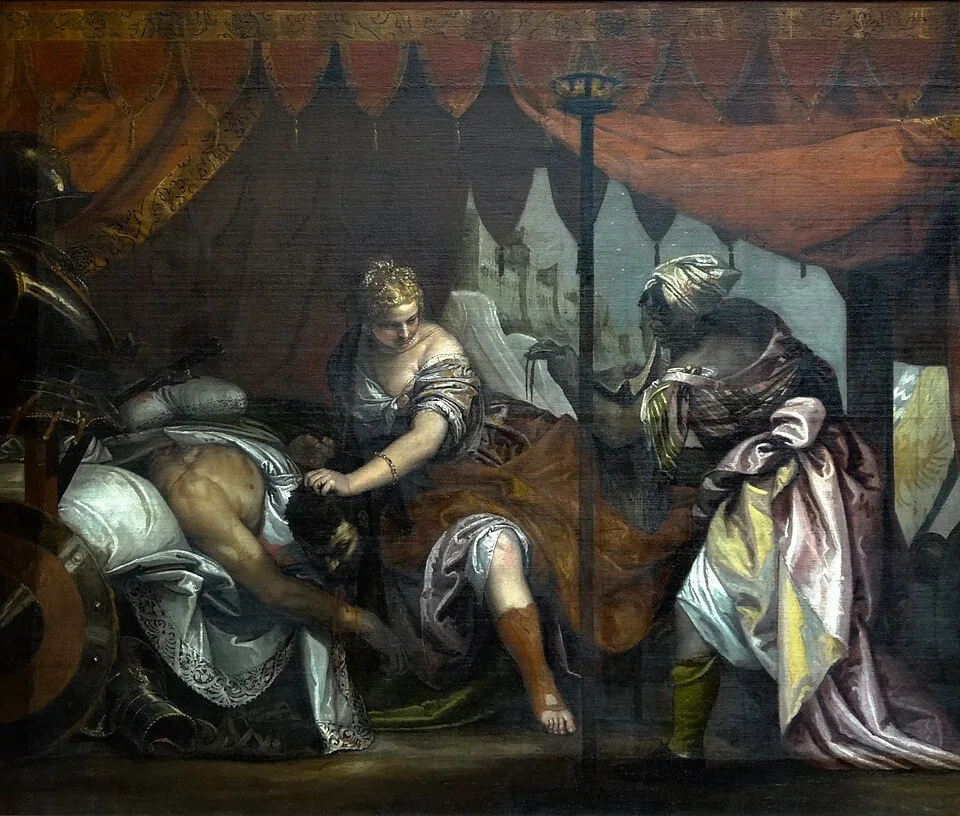
Judith and Holofernes
Judith sits on the bed's edge, Holofernes' severed head in her hand, her face turned from his body on the white sheets. At the right, a black servant stands with her back turned, holding a bag open, ready to flee with it to Bethulia. Veronese left out the killing itself and painted the moment after. Notice the lace edge of the white sheet, and the military standard at the right. Both carry the double headed eagle of the Habsburgs. That emblem identifies Holofernes and his army with the Spain of Philip the Second. Judith, at the center, stands for the Republic of Venice, set against Spain. Venetian expansion had brought the two into conflict. Veronese arranged the whole scene as a piece of theater. The heavy tent closes the space as a curtain would, and the flat starry sky and walls behind Judith form a theatrical backdrop. The poses and the staging come from the theater and carnival of Venice. The painting came to Caen on deposit in 1811, and only became the city's own in 2007.
Listen in the appPaolo Veronese · Public domain
10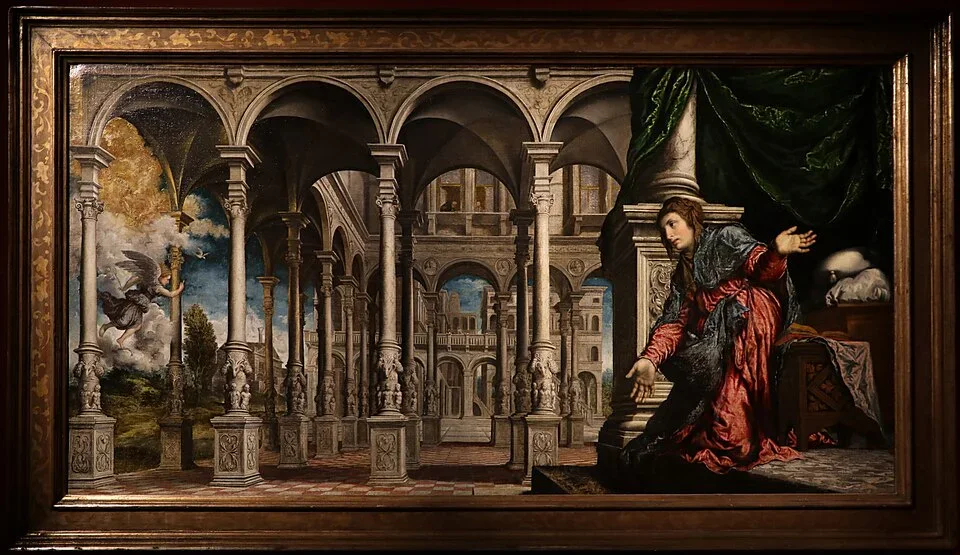
Annunciation
Almost the whole painting is a palace colonnade, row upon row of columns in a strict geometric grid. Paris Bordone built the whole scene on that grid. The moment is the Annunciation, when Gabriel tells Mary she will bear a son. Mary is on the right, near the front, dressed in red and black. She opens her arms at the sight of God's messenger. Gabriel is on the left, further back and in flight. But the columns are laid out so their eyes never meet. The angel turns toward the distance instead, where two pairs of figures stand on an upper floor. Above him, his finger points to the dove of the Holy Spirit, coming down from a golden Heaven.
Listen in the appFrancesco Bini · CC BY-SA 4.0
- 11
Portrait Diptych of Laurent Froimont (left wing)
Rogier van der Weyden · c. 1460
- 12
Temptation of St Anthony
Paolo Veronese · 1552–1553
- 13
Madonna and child between Saint George and Saint James
Giovanni Battista Cima da Conegliano · 1511
- 14
The Sea
Gustave Courbet · 1872
- 15
The Man with the Fig
Simon Vouet · c. 1615
- 16
Giordano, The Abduction of Helen, Caen
Luca Giordano · c. 1680–1683
- 17
The Marriage of the Virgin, by Paris Bordone
Paris Bordone · 1540
- 18
Quentin Durward and the Balafré
Eugène Delacroix · 1828
- 19
Joseph Sold by His Brothers. Sketch.
Théodore Chassériau · 19th century
Musée des Beaux-Arts de Caen
Frequently asked questions
How much does the guide cost?
Free app download. Free until 1 January. Listed guide price: $0.99. Audio guide only. Venue admission is separate.
Can I listen without internet?
Yes. Download the guide’s audio, images, and maps in the app before your visit. Your downloaded content is then available offline.
Can I listen in my language?
In English for now. More languages soon.
Do I need to follow a schedule?
No. This is a self-guided experience. Choose your stops, pause whenever you like, and return to a story at your own pace.
Which artworks are in the Musée des Beaux-Arts de Caen audio guide?
19 artworks, including Marriage of the Virgin (Pietro Perugino), The Meeting between Abraham and Melchizedek (Peter Paul Rubens), Venus Weeping for Adonis (Nicolas Poussin), Perugino, Saint Jerome in the Desert (Pietro Perugino), Damocles, by Thomas Couture (Thomas Couture), Froimont Diptych (Workshop of Rogier van der Weyden), The baptism of Christ (Lambert Sustris), and The Lady with Jewels (Gustave Courbet). The full list is on this page.
Is this the museum’s official audio guide?
No. Stanza is an independent audio guide app and is not affiliated with Musée des Beaux-Arts de Caen. Museum admission is separate.
At your own pace
Explore Musée des Beaux-Arts de Caen.
Download Stanza, then search for “Musée des Beaux-Arts de Caen”.
Free app download · Guide price shown in the app
Keep exploring
Nearby audio guides
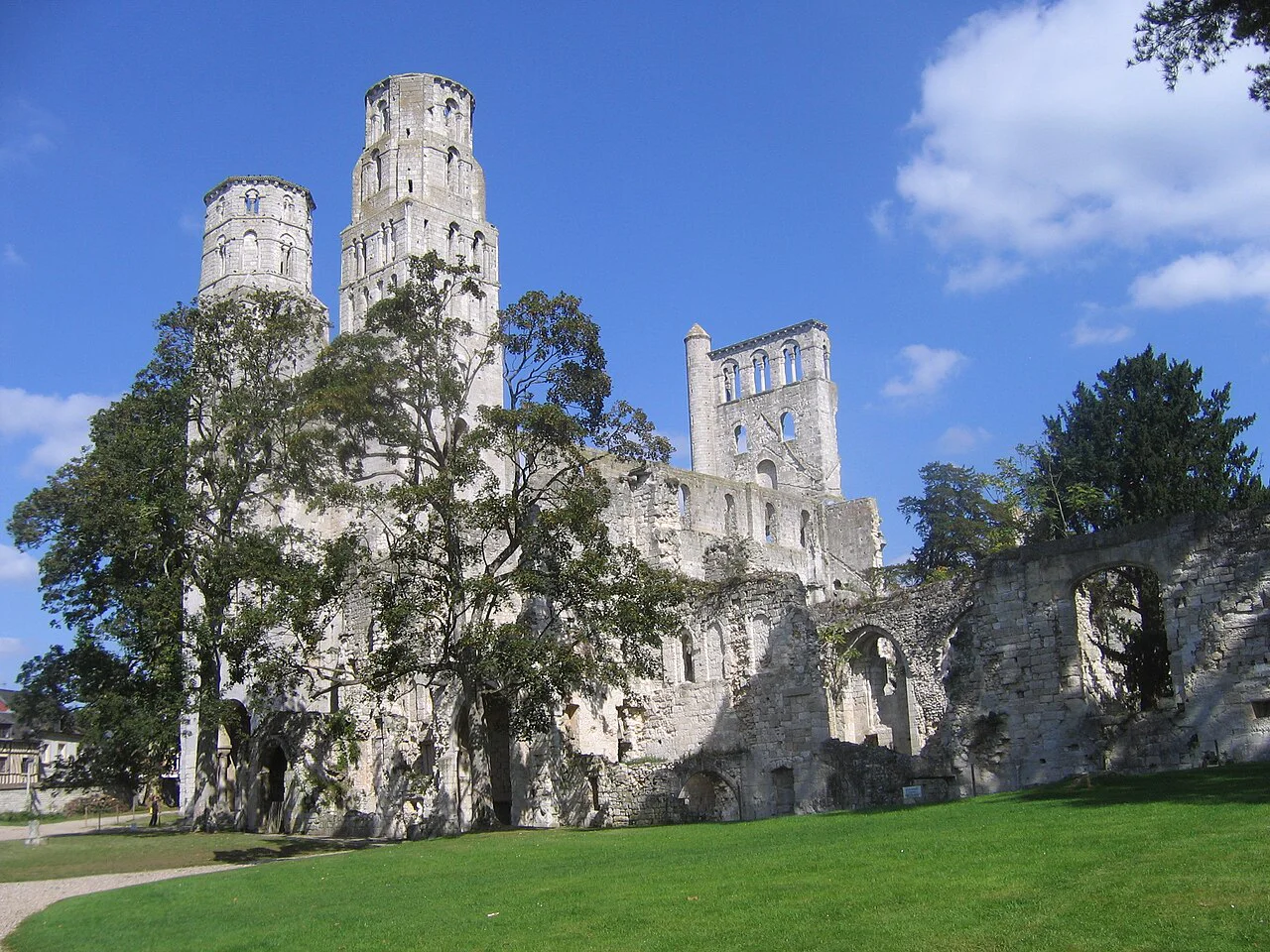
Jumièges · 90 km
Abbaye de Jumièges
Content & sources
Franz Golhen · Public domain
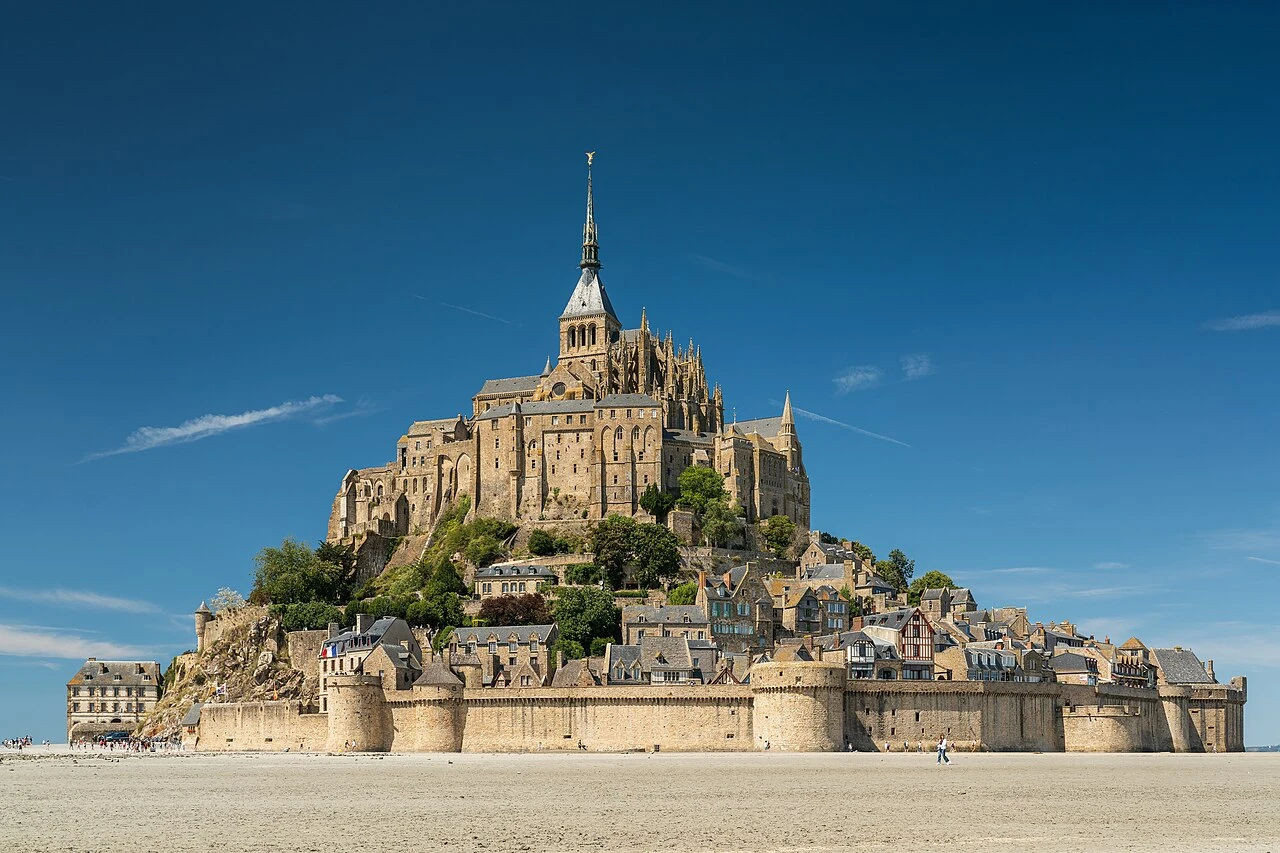
Le Mont-Saint-Michel · 104 km
Le Mont-Saint-Michel, Mont-Saint-Michel Abbey
Content & sources
Photo: Lynx1211 · CC BY-SA 4.0
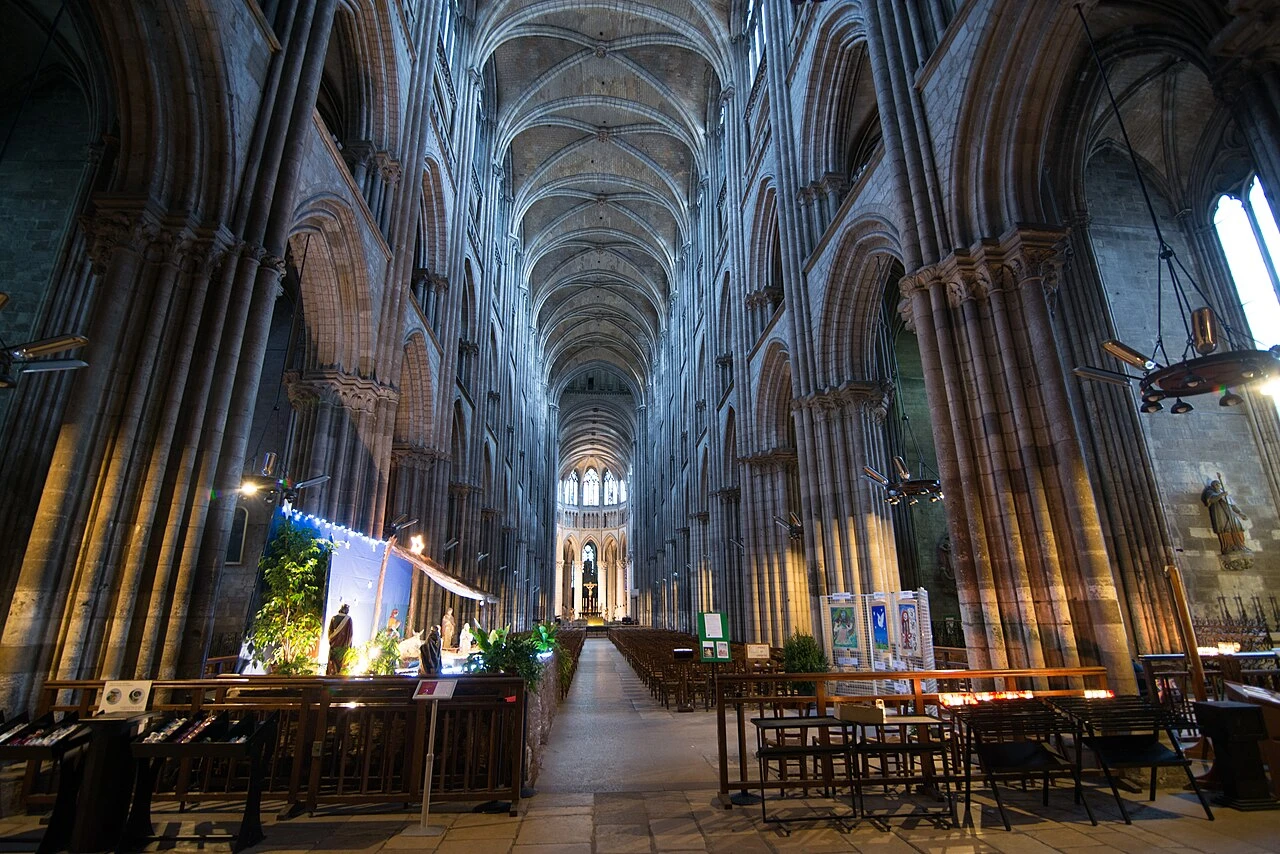
Rouen · 109 km
Rouen Cathedral
Content & sources
Jorge Láscar from Melbourne, Australia · CC BY 2.0
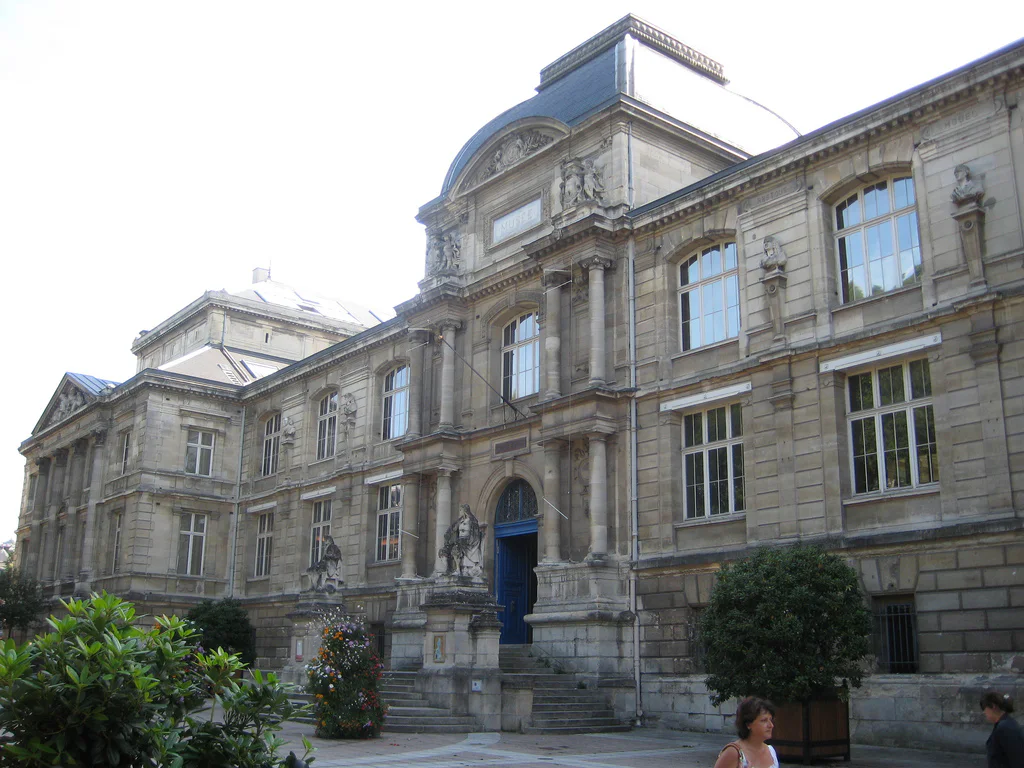
Rouen · 109 km
Musée des Beaux-Arts de Rouen
Content & sources
Allie_Caulfield · CC BY 2.0
Art museums
More art museum audio guides
Rouen · 45 artworks
Musée des Beaux-Arts de Rouen
Content & sources
Allie_Caulfield · CC BY 2.0
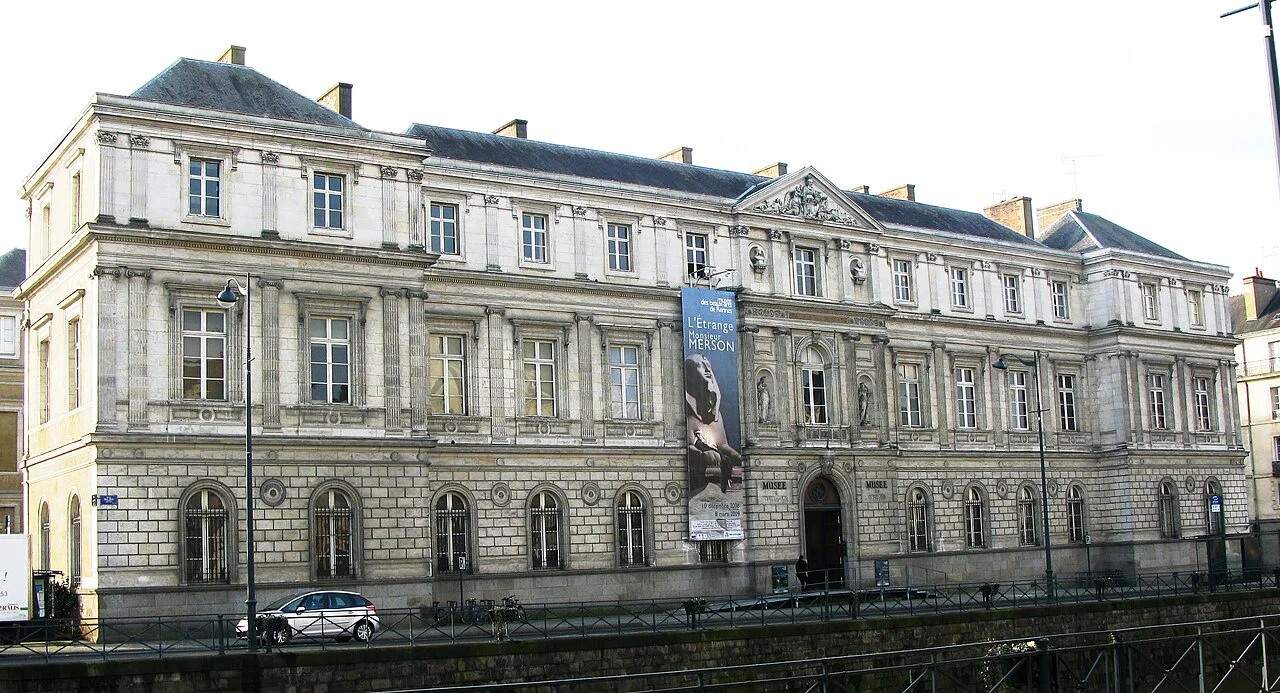
Rennes · 27 artworks
Musée des Beaux-Arts de Rennes
Content & sources
Photo: XIIIfromTOKYO · CC BY-SA 3.0
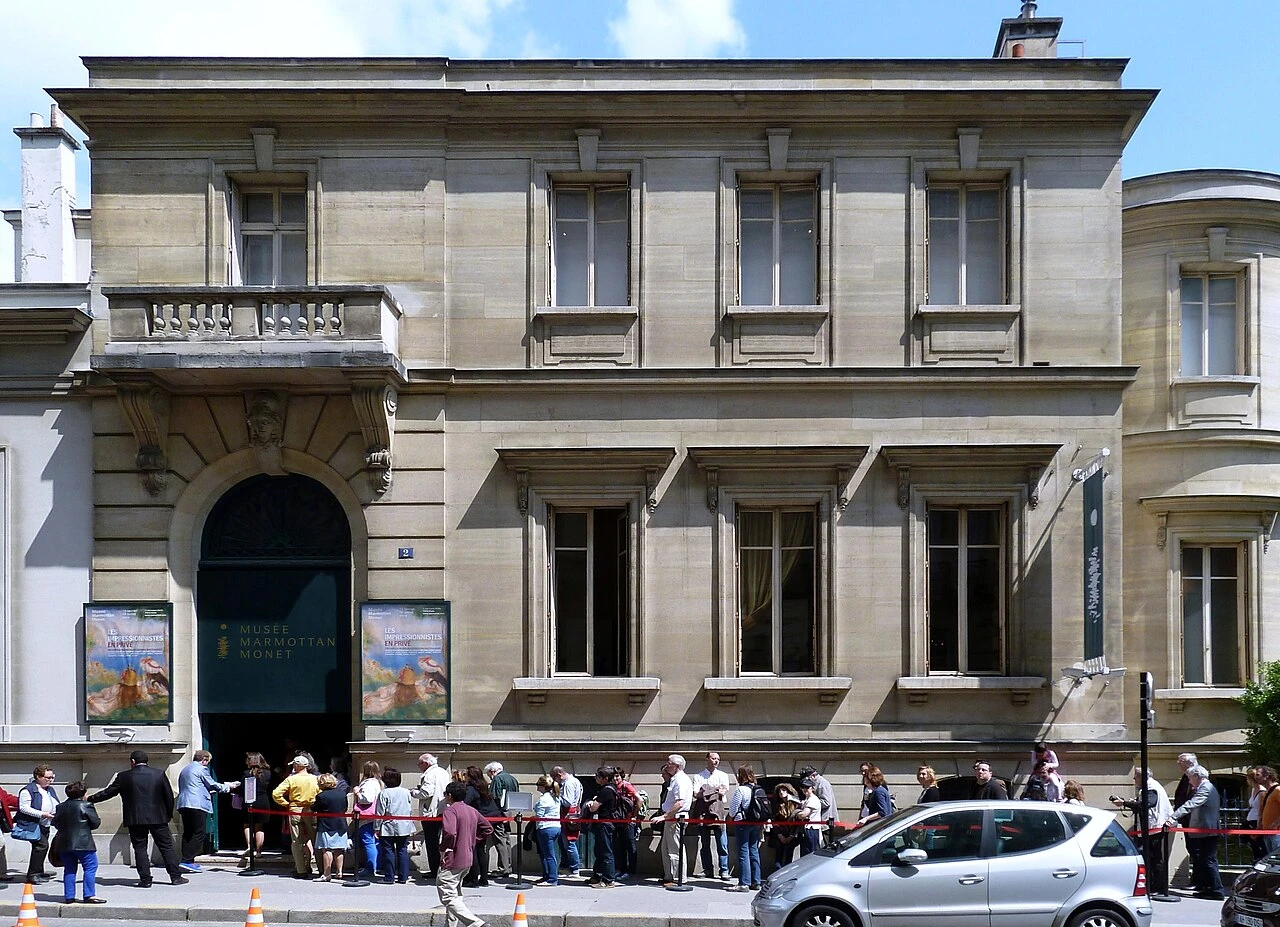
Paris · 25 artworks
Musée Marmottan Monet
Content & sources
PIERRE ANDRE LECLERCQ · CC BY-SA 4.0
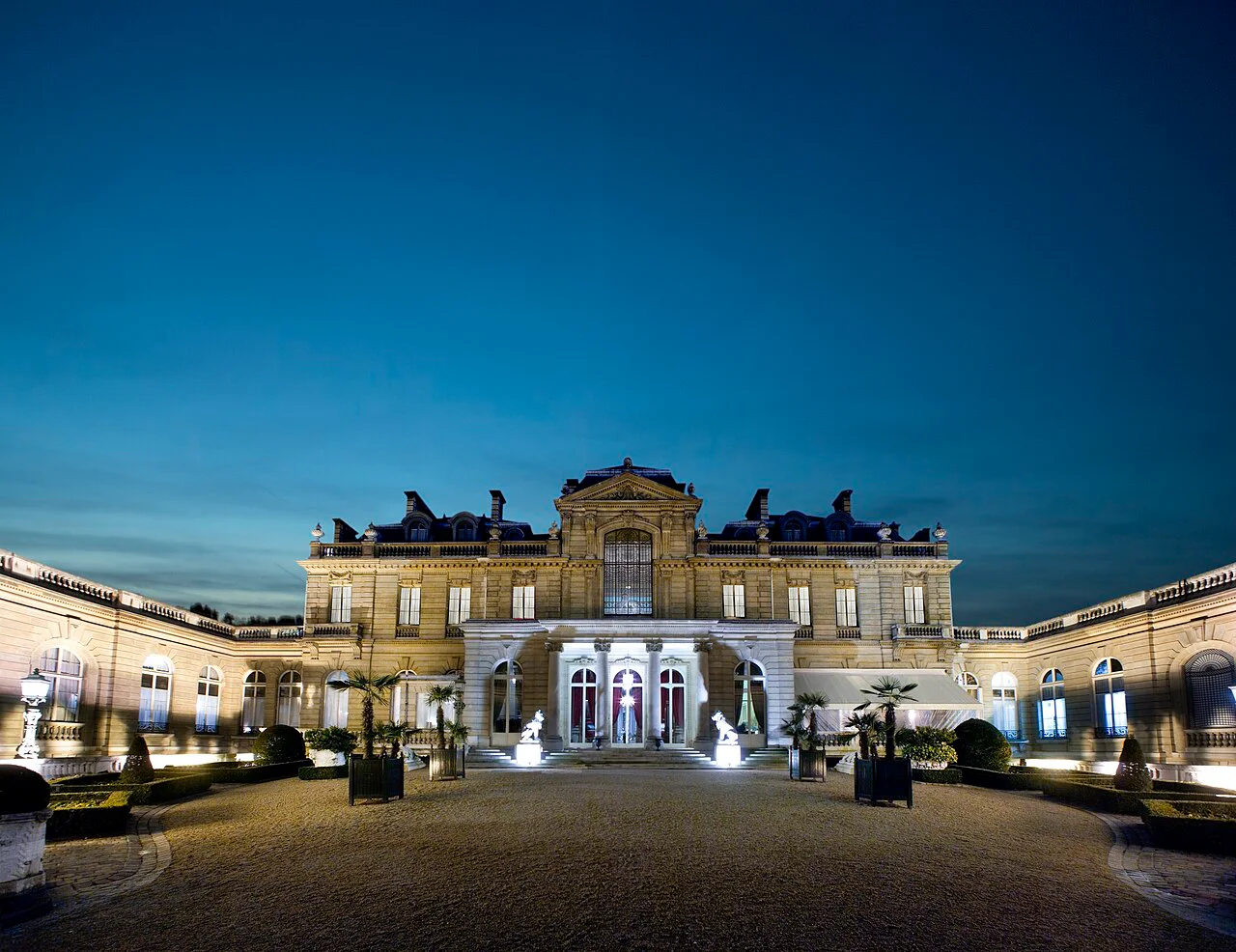
Paris · 24 artworks
Musée Jacquemart-André
Content & sources
Christophe Recoura · CC BY-SA 3.0
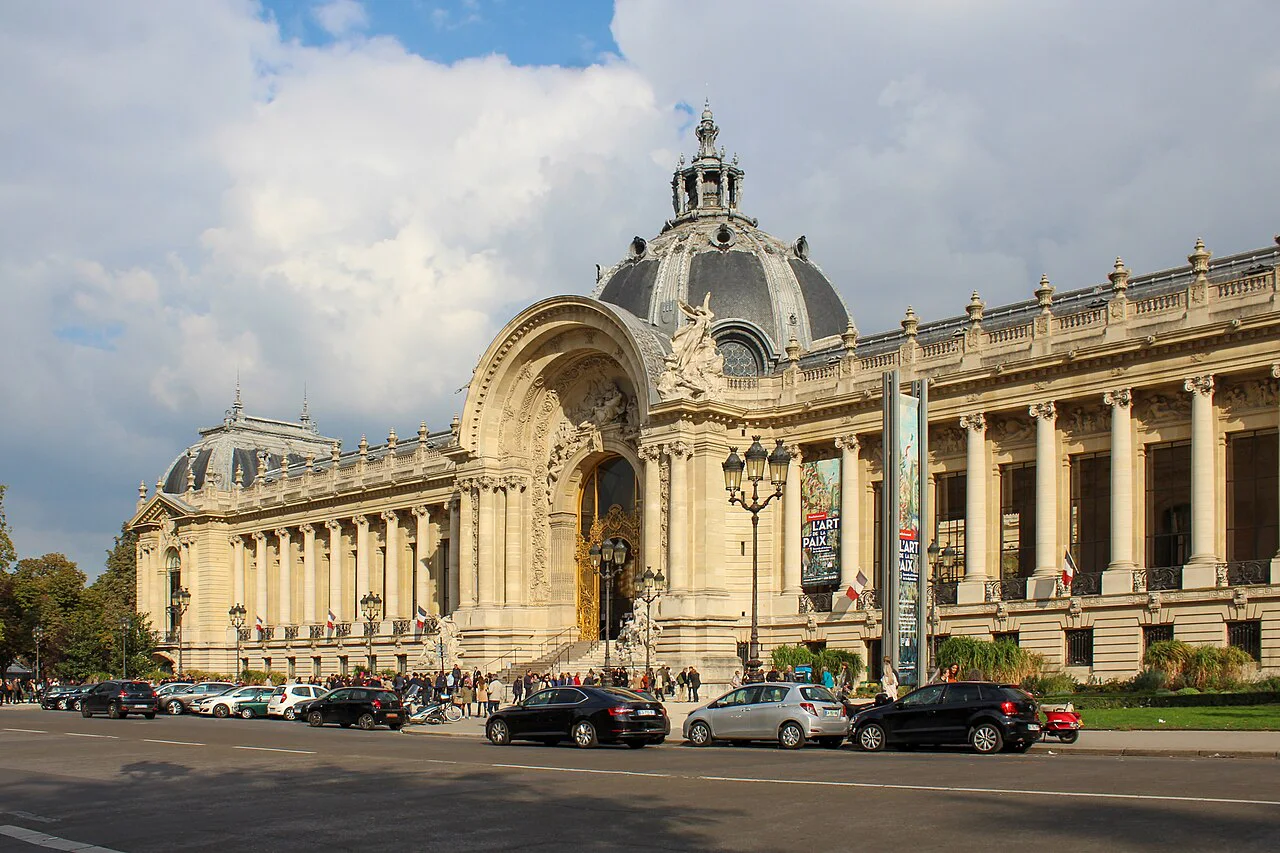
Paris · 77 artworks
Petit Palais
Content & sources
Chabe01 · CC BY-SA 4.0
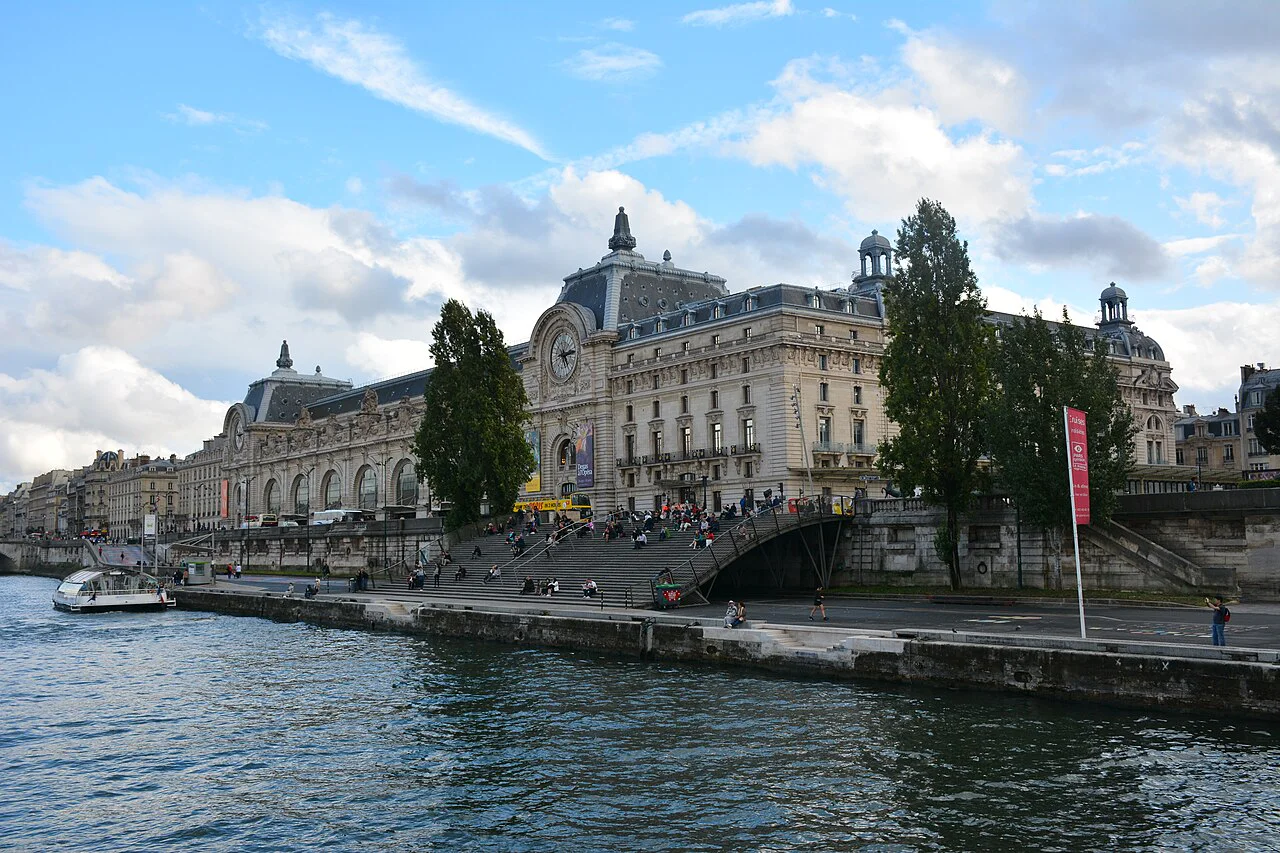
Paris · 462 artworks
Musée d'Orsay
Content & sources
Cheng-en Cheng from Taichung City, Taiwan · CC BY-SA 2.0