Stanza · Audio guide
Hungarian National Gallery Audio Guide
A place to remember. A story to take with you.
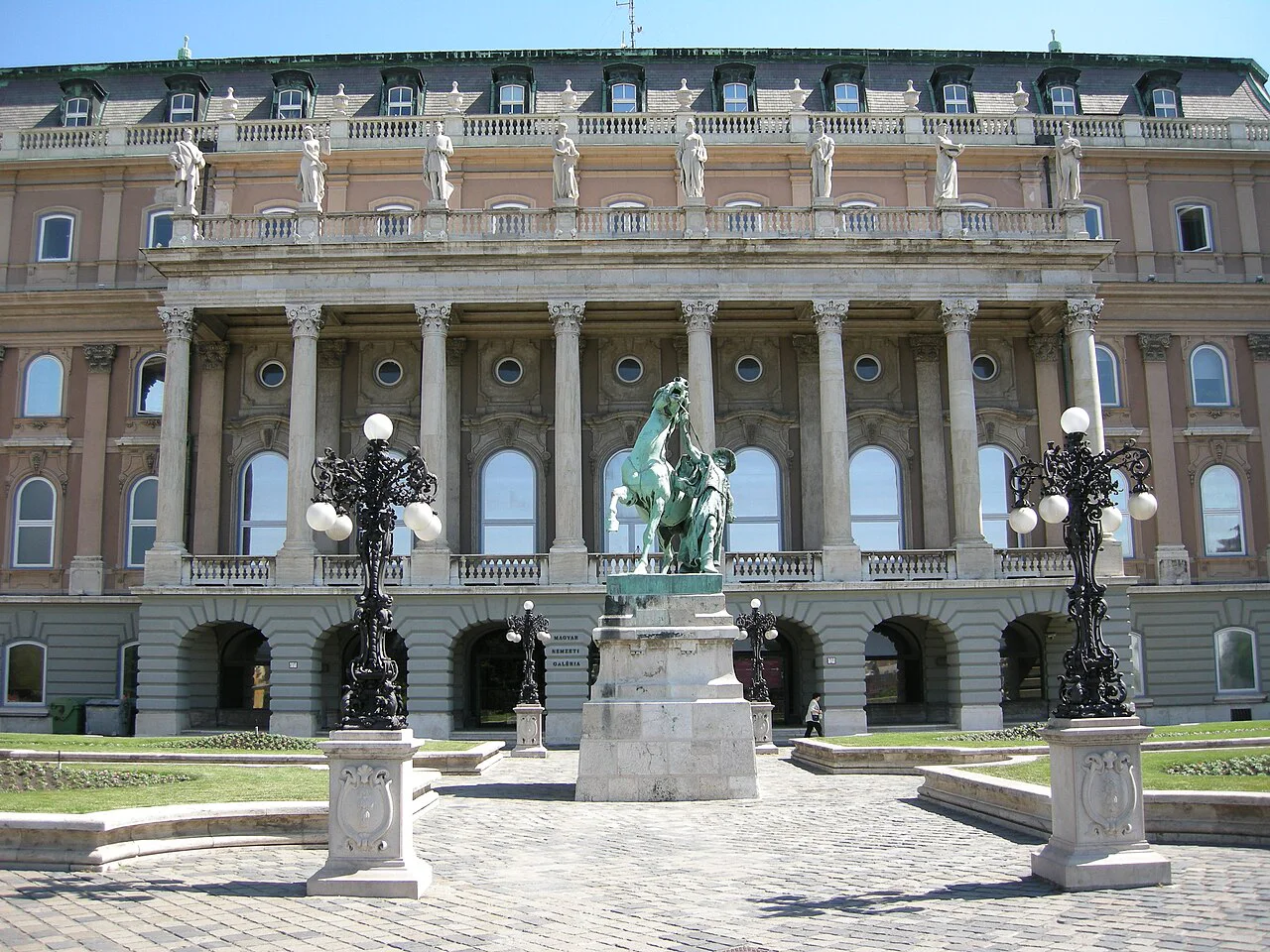
The Hungarian National Gallery is a national art museum established in 1957. It is located in Buda Castle and houses collections of Hungarian art across all genres.
Download Stanza, then search for “Hungarian National Gallery”.
About the tour
One guide. Your kind of visit.
The Hungarian National Gallery is a national art museum established in 1957. It is located in Buda Castle and houses collections of Hungarian art across all genres.
The Hungarian National Gallery guide tells the stories of 29 artworks, including The Balloon (Pál Szinyei Merse), Little Princess Statue (László Marton), The Wrestlers (Gustave Courbet), Virgin and Child with Saint Paul (Titian), Pilgrimage to the Cedars of Lebanon (Tivadar Csontváry Kosztka), The Condemned Cell I (Mihály Munkácsy), Garden under Snow (Paul Gauguin), and The Black Pigs (Paul Gauguin). Every artwork is free to hear in the Stanza app until 1 January.
Ready when you are.
- 01Get the free Stanza app.
iOS & Android
- 02Find your guide.
“Hungarian National Gallery”
- 03Download before you go.
Works offline
Audio guide / 29 artworks
Inside the guide
Get to know a few of the stories before you go. Open a stop to read more.
01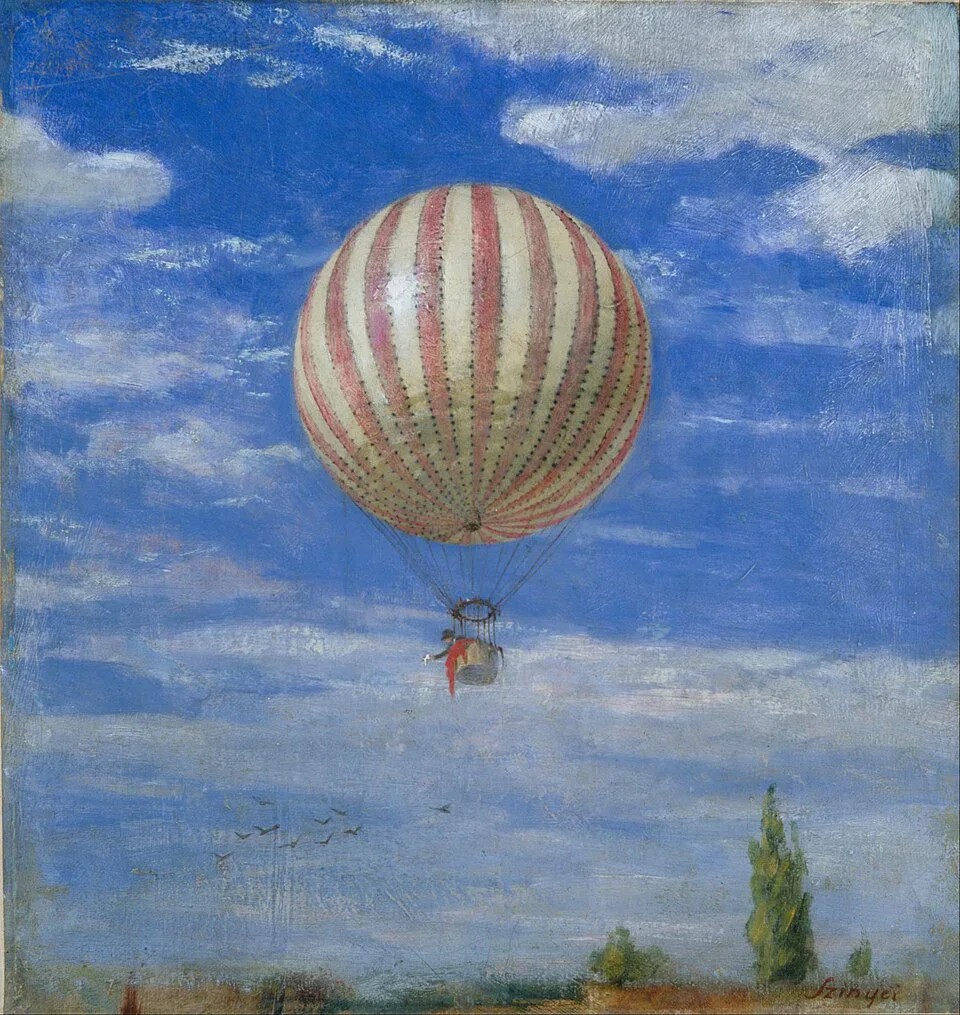
The Balloon
High in the air, a small figure leans out and waves a handkerchief at friends. That wave is a goodbye. The man is Béla Probstner. Szinyei was there when the balloon carrying his brother in law rose over northern Hungary. He saw it happen. In 1878 he turned that ascent into a picture about progress and the human dream of rising by one's own strength. The balloon climbs through an immense blue sky crossed by light clouds. The earth stays below, green and brown, a few treetops and roofs lost in the distance. Floating here means freedom from gravity, freedom of thought, and freedom to express oneself as an artist. But the earth and nature stay in sight. The birds fly lower than the man, and that is how high he has gone.
Listen in the appPál Szinyei Merse · Public domain
02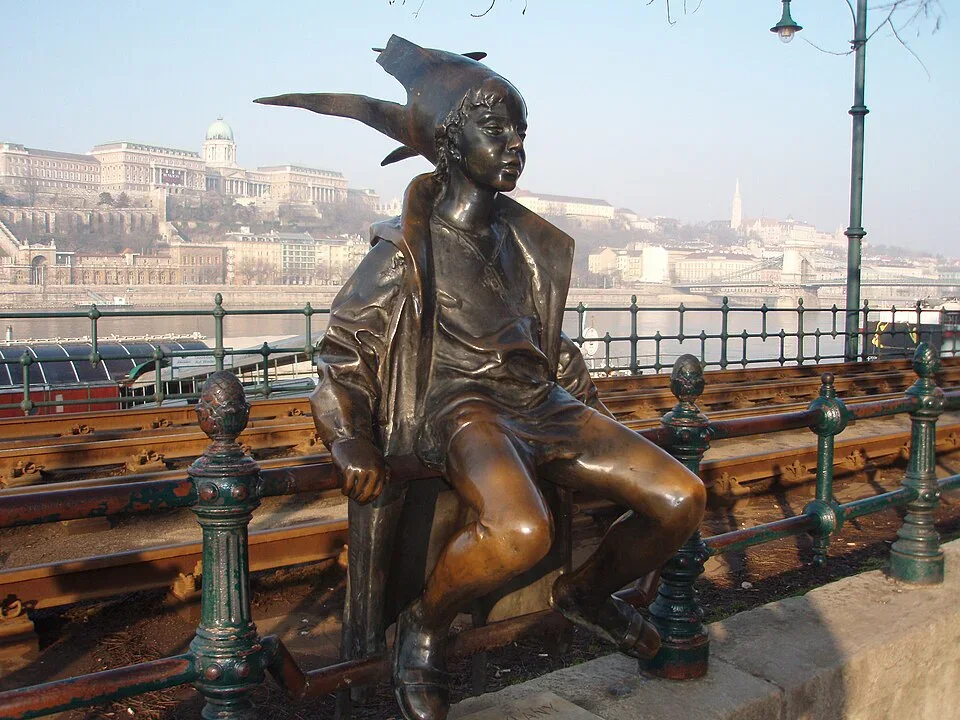
Little Princess Statue
A little girl plays at being a princess. Her name is Évi. A bathrobe lies over her shoulders like a mantle, and on her head is a crown her father made from newspaper. That father was the sculptor László Marton, and the moment he saw her playing this way, he knew he had found his subject. That moment became the little statuette here, made in 1972. Years later the city asked him for a statue, and he offered this same little princess. A version at full size went up on the Danube Promenade in 1990, a small girl sitting on the railings. It became a symbol of Budapest. Copies stand in his home town of Tapolca and, as his own gift, outside the concert hall of the Tokyo Metropolitan Art Space. Of his more than forty works in Budapest, he was proudest of this one and his statue of the poet Attila József. Even her father was not sure how old she was that day. He said five once, and another time about six.
Listen in the appMister No · CC BY 3.0
03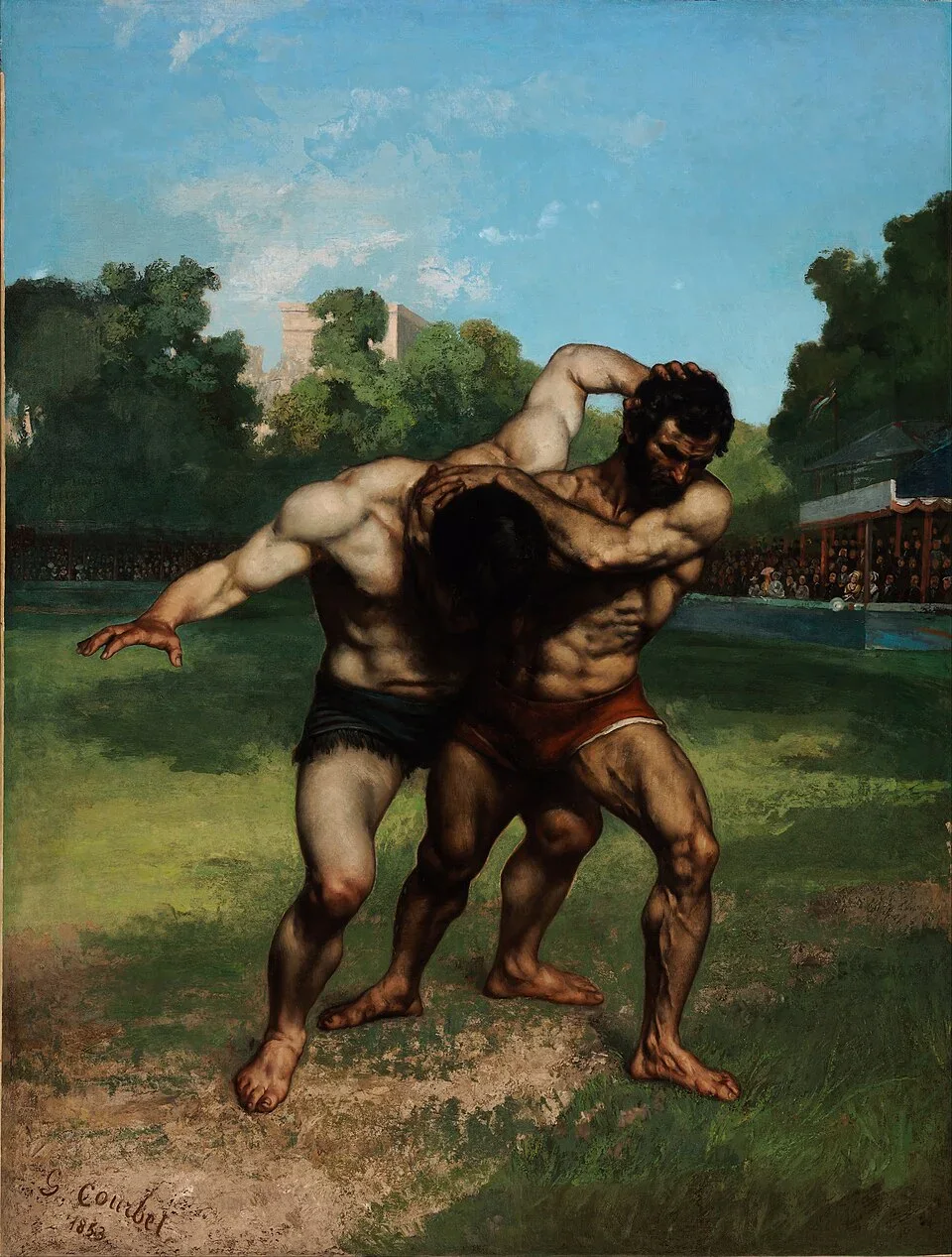
The Wrestlers
These wrestlers cover another painting. Short of money, Courbet took a canvas he had used in 1841 and painted over it. That earlier painting was his Saint Walpurgis' Night, inspired by the legend of Faust. What he put there is a wrestling match at the old racecourse in Paris. Two men are locked in French wrestling, a style based on the wrestling of ancient Greece and Rome. They strain against each other, yet the figures are almost still. The bodies are painted with great care, muscles drawn tight, veins standing out. Behind them the stands are filled with elegant spectators, their faces barely made out. The sharp bodies and the blurred faces behind them may be social criticism, pointing to the suffering people rather than the comfortable crowd. The contest is played for you, far more than for the audience in the stands behind them.
Listen in the appGustave Courbet · Public domain
04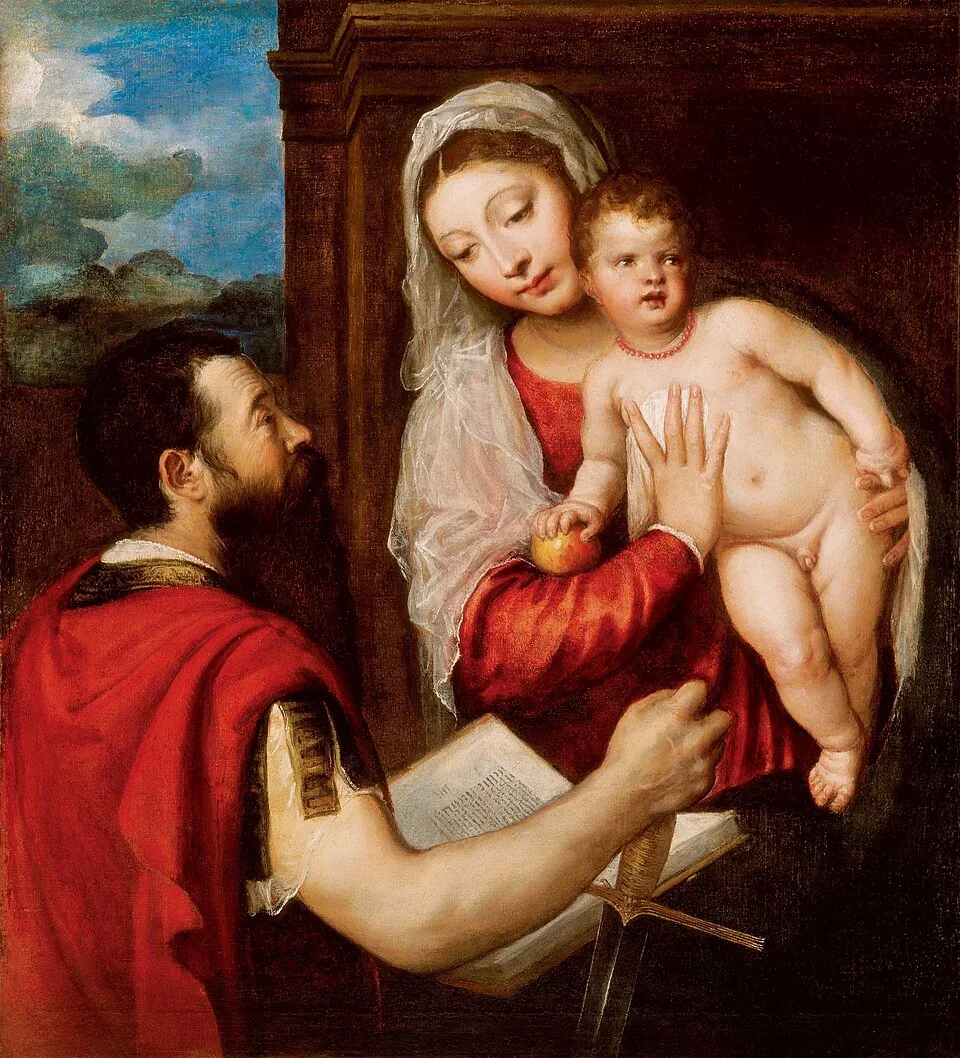
Virgin and Child with Saint Paul
A sword and a book, and a man in a soldier's clothes. Those are the marks of Saint Paul, though here he is shown still as Saul. Titian probably painted real people. He likely used his own family for Mary and the child, and the man who commissioned the picture for this soldier. For years no one knew whose work it was. It was with a family in Pécs, taken for the work of some unknown Italian master. Then in 2005 it came up at an auction and sold for a hundred and forty million forints. Vilmos Tátrai suspected it might be an unknown Titian, and the examinations soon proved him right. It was the most important painting found in Hungary in more than half a century. In July 2015, Hungary's national bank bought the picture nobody could name for four and a half billion forints.
Listen in the appTitian · Public domain
05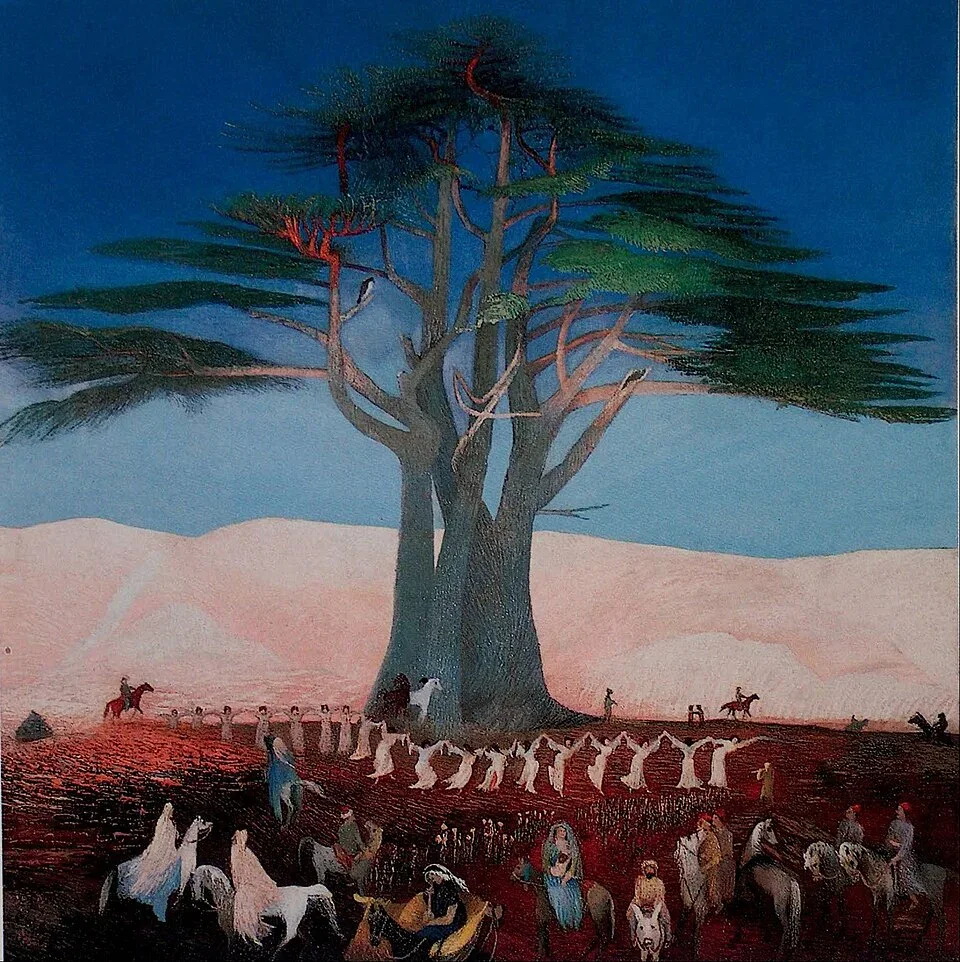
Pilgrimage to the Cedars of Lebanon
These trees were painted far from home, in Lebanon, while Csontváry was on a pilgrimage to the cedars. At forty he gave up pharmaceuticals and took up painting. Then he travelled thousands of miles in search of inspiration, and these cedars became a key part of his work. But they are not here simply as trees. His religious feeling runs right through the work, and he brought many different meanings together in this one picture. The cedar mattered in the old Hungarian beliefs long before he ever painted it. It stood for fertility. It was taken for the tree of life, and for the tree of knowledge.
Listen in the appTivadar Csontváry Kosztka · Public domain
06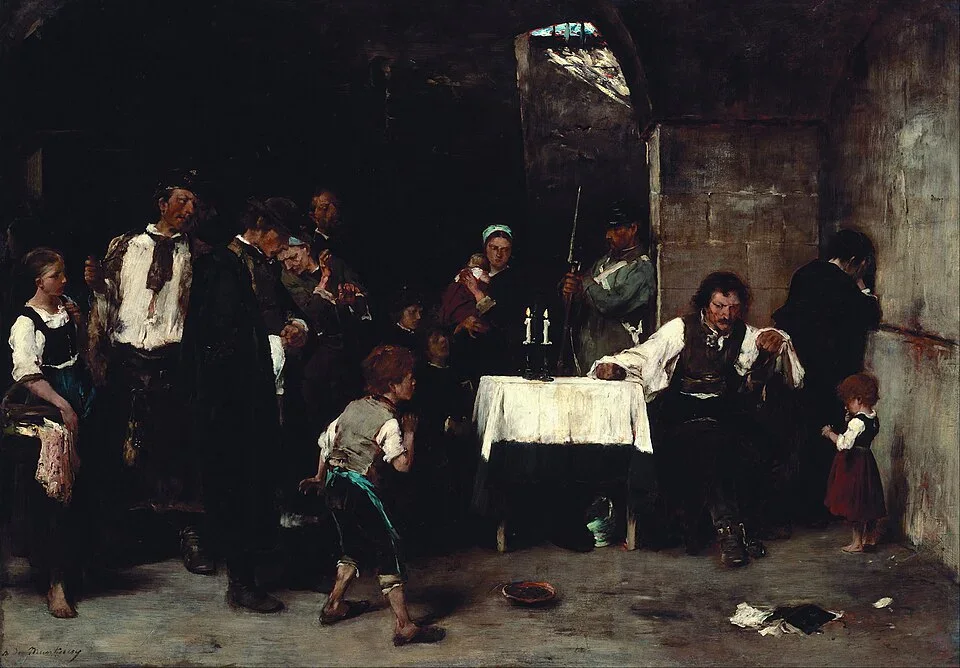
The Condemned Cell I
What did this man do? The cell will not tell you. The deed he is accused of stays in the dark, left to your imagination. He sits at a table covered with a white cloth, with a crucifix and candles, and he looks at the floor. His right hand is clenched into a fist. A heavy chain is fixed to his boots. He has been condemned to die, and his family has come to visit, a visit that was part of Hungarian customary law. They range from a baby to an old woman. One woman, perhaps his wife or mother, stands in the dark corner with her back to you, turning her tearful face away in shame. The children near the table are curious, though one little girl pauses, seeming to feel sympathy. The adults grieve, but they keep their distance too, with a kind of moral disapproval. Munkácsy painted what he had known as a child. His father was jailed for taking part in the Hungarian Revolution, and the boy, only four, went to live with his uncle. On the dirty floor stands the last meal he rejected, and beside it an open Bible with damaged pages coming loose. Together they show a man cut off from society and from any hope of a life after death.
Listen in the appMunkácsy, Mihály (1844 - 1900) – Painter (Hungarian) Born in Munkács. Died in Endenich. Details on Google Art Project · Public domain
07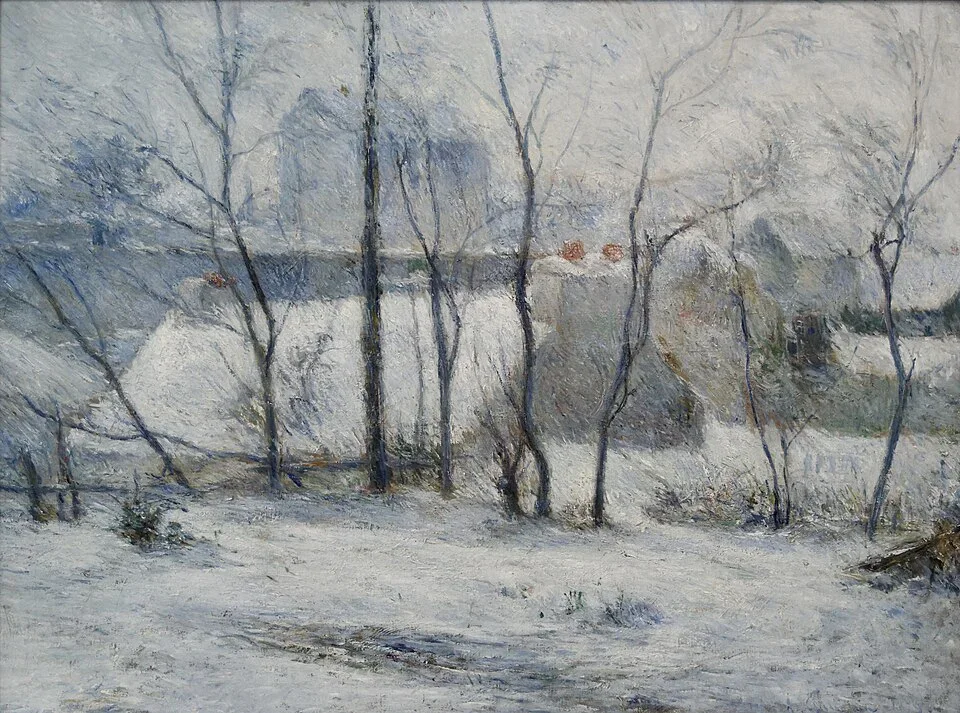
Garden under Snow
The landscape hardly shows itself here. You catch it only in glimpses, between the trees. That way of hiding the view was not the young painter's idea. It came from Pissarro, who had taken him under his wing in 1874, and the brushwork shows his influence too. Gauguin painted this garden in 1879, in Vaugirard in Paris, in his first years as a painter. The scene is quiet and calm. But already, in this snowy garden, there is a turning away from modern city life. It is the same wish that would later take him to the French countryside, and from there to Tahiti. He was still working as a stockbroker when he painted it.
Listen in the appPaul Gauguin · Public domain
08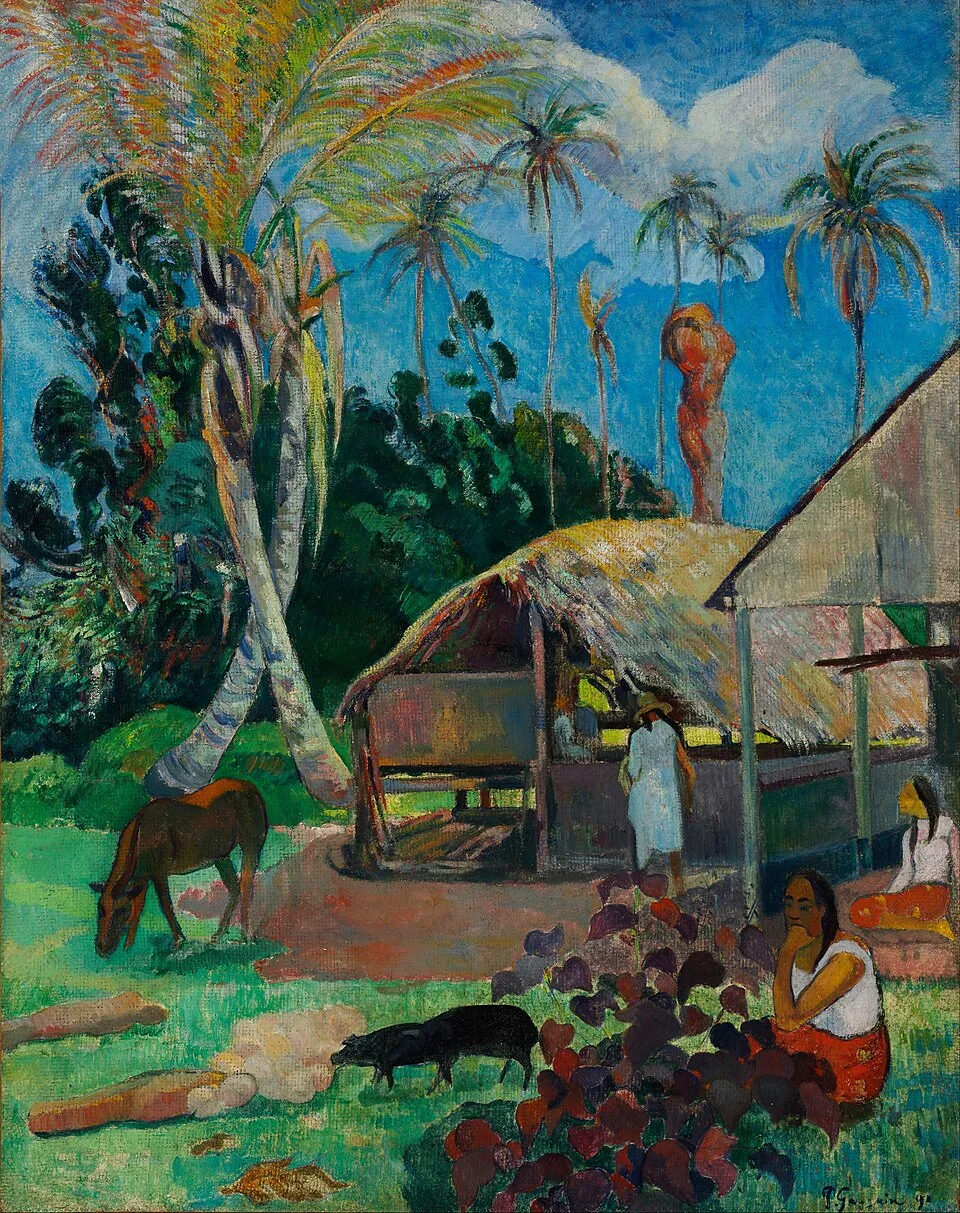
The Black Pigs
On his first trip to Tahiti, in 1891, Gauguin was changing how he painted. He was turning away from Impressionism toward simpler, more solid shapes. This picture catches him right in the middle of that change. The old way is still there. The leaves of the trees and the thatched roof of the hut are made of fine strokes laid side by side that shimmer. But across the rest of the picture, those strokes give way to more even areas of colour. Strong blue lines close the shapes in. The pigs are pared down to compact forms. And the women are shown in a calm that belongs to a much older time. Their forms are simplified too. The space between the hut, the pigs and the women is settled by the shapes themselves, each one fitted against the next.
Listen in the appPaul Gauguin · Public domain
09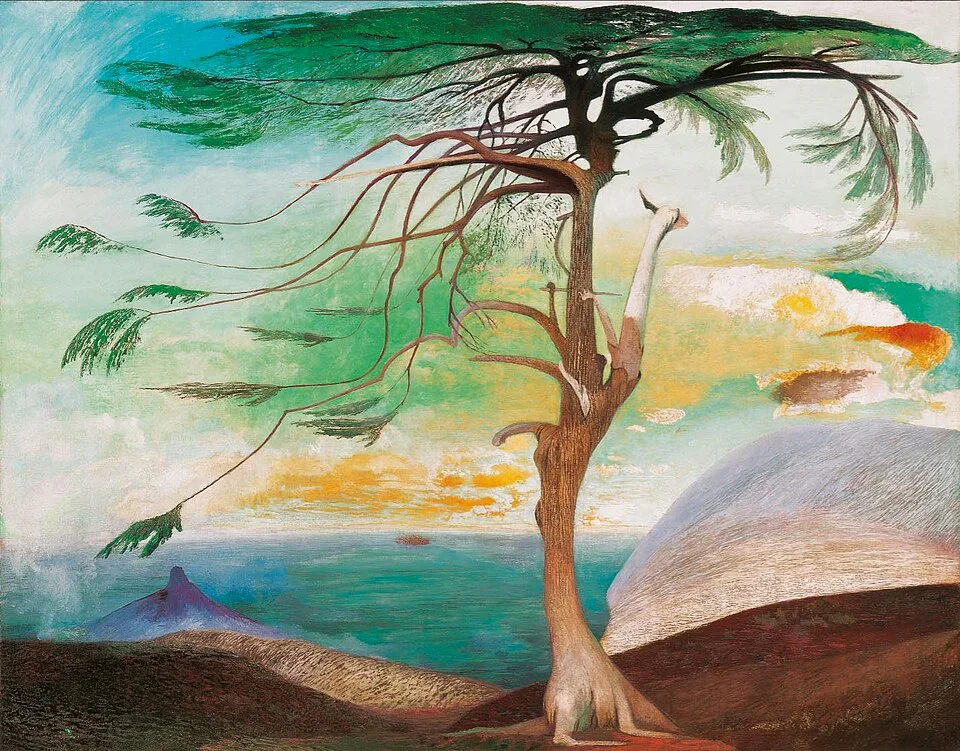
The Lonely Cedar
For years people believed this tree was invented. Its painter worked from pictures kept in his studio. As far as anyone knew, he had never been to Lebanon. Then Gábor Rieder found the tree in a collection of stereo photographs from Jerusalem. There, on a bare plateau above Tripoli, stood a small grove. One tree in it was damaged, lopsided and partly dried out, much like this one. A camping couple had been photographed in front of it. Csontváry painted this in 1907, and a year later showed it in Budapest as a cedar tree from Lebanon. He took that wounded tree out of its grove and set it alone on barren land. The trunk is stretched, the crown flattened, the top pushed right up to the top of the canvas. The branches on the left bend and almost float, and the roots at the ground crouch like an animal. On the right, the broken stump is slightly smaller but still lifelike, kept so the tree stays recognisable and keeps its biblical meaning. Sky and land are left rough, while every detail of the tree is worked out. No sketch of the tree has survived, so no one knows whether he ever drew one.
Listen in the appTivadar Csontváry Kosztka · Public domain
10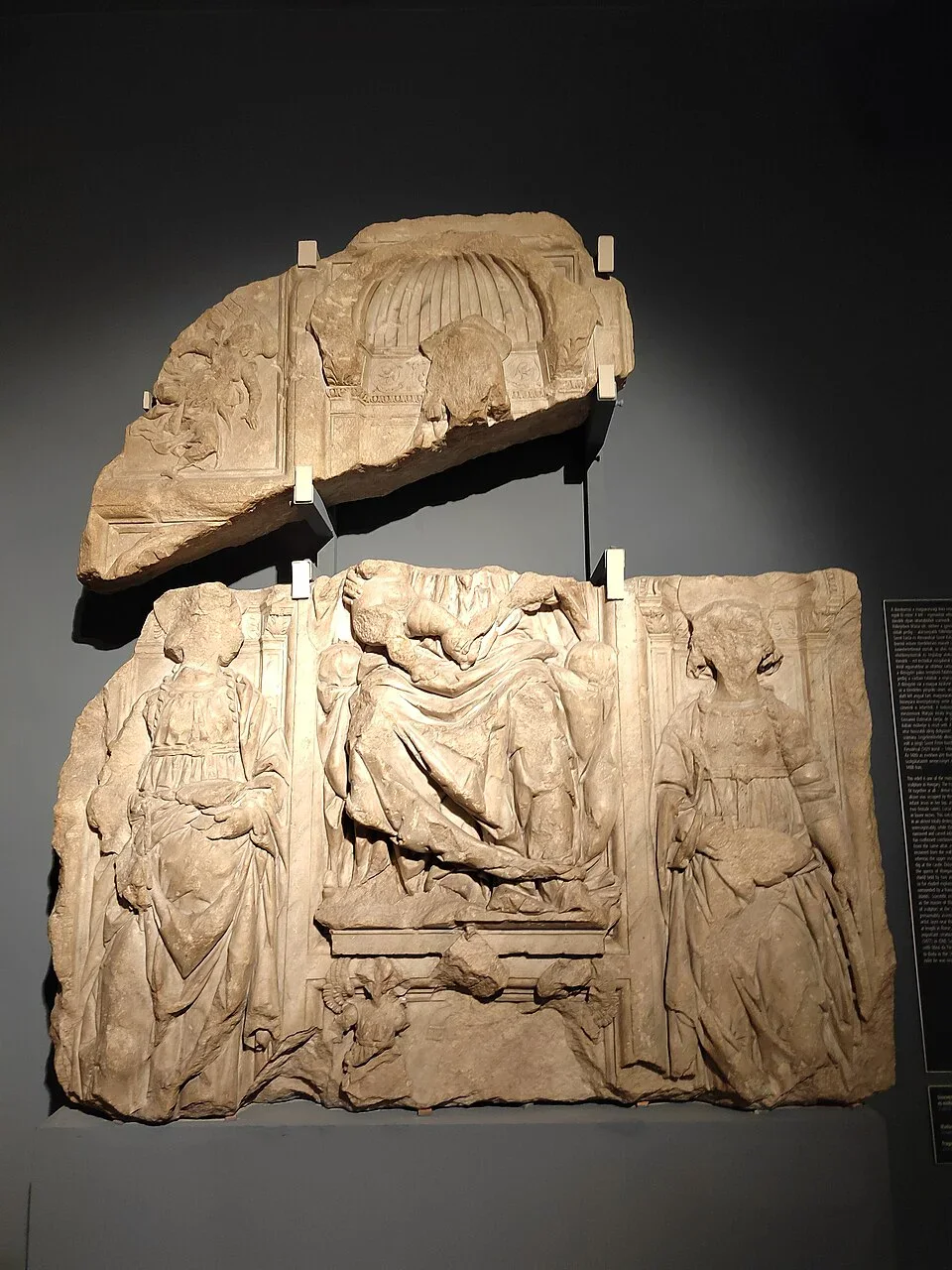
Diósgyőr Madonna
Mary has the child on her lap, and he looks restless. She holds his left leg, probably to stop him falling. His upper body is gone, but the movement is still there. Her clothing pulls tight across her shin, then folds between her knees to make a seat for him. Giovanni Dalmata carved this, King Matthias's sculptor, and it is the first work we can be sure is his. Then came Diósgyőr's rough centuries. The faces were probably smashed by Turkish raiders who burned the town, in the sixteenth or seventeenth century. Mary's face was crushed by a heavy object when the piece went into the ground. The lower half was used again as building stone, built into the fence wall of a Pauline monastery. An Eger priest took it out in 1892 and kept it at home, where it helped turn his rooms into a little museum. The upper half came to light in 1959, during digging at the castle. It lay with a gold coin of Sultan Selim the Second and a silver ring engraved with the year 1600. The pieces do not fit together, and for a long time no one could say whether they came from one work or two.
Listen in the appPhoto: Alensha · CC0
- 11
The Pont-Neuf, Sunlight (Second Series)
Camille Pissarro · 1902
- 12
Narcissus
Gyula Benczúr · 1881
- 13
Nudes
Erzsébet Korb · c. 1921
- 14
Woman Churning Butter
Mihály Munkácsy · 1873
- 15
Báthory Madonna
Unknown Artist · 1526
- 16
The Spring of léri in Chassagne
Gustave Courbet · 1863
- 17
The Battle of Varna
Jan Matejko · 1879
- 18
Visegrád
Károly Markó · 1826–1830
- 19
Portrait of Countess Nákó
Friedrich von Amerling · 1855
- 20
Self-Portrait
Károly Brocky · 1850
- 21
Self-portrait
Ádám Mányoki · 1711
- 22
Pigeon Post
Miklós Barabás · 1843
- 23
Romanian Family Heading for the Fair
Miklós Barabás · 1843–1844
- 24
Lifeboat
Mihály Zichy · 1847
- 25
Diana at the Hunt (Hunting Nymphs)
Károly Markó · 1833
- 26
View of the Great Hungarian Plain with Draw Well
Károly Markó · 1853
- 27
Woman Playing the Lute
János Donát · 1811
- 28
Virgin and Child with Saint Anne
Unknown Artist · c. 1520
- 29
Flagellation
Unknown Artist · 1514
Hungarian National Gallery
Frequently asked questions
How much does the guide cost?
Free app download. Free until 1 January. Listed guide price: $0.99. Audio guide only. Venue admission is separate.
Can I listen without internet?
Yes. Download the guide’s audio, images, and maps in the app before your visit. Your downloaded content is then available offline.
Can I listen in my language?
In English for now. More languages soon.
Do I need to follow a schedule?
No. This is a self-guided experience. Choose your stops, pause whenever you like, and return to a story at your own pace.
Which artworks are in the Hungarian National Gallery audio guide?
29 artworks, including The Balloon (Pál Szinyei Merse), Little Princess Statue (László Marton), The Wrestlers (Gustave Courbet), Virgin and Child with Saint Paul (Titian), Pilgrimage to the Cedars of Lebanon (Tivadar Csontváry Kosztka), The Condemned Cell I (Mihály Munkácsy), Garden under Snow (Paul Gauguin), and The Black Pigs (Paul Gauguin). The full list is on this page.
Is this the museum’s official audio guide?
No. Stanza is an independent audio guide app and is not affiliated with Hungarian National Gallery. Museum admission is separate.
At your own pace
Explore Hungarian National Gallery.
Download Stanza, then search for “Hungarian National Gallery”.
Free app download · Guide price shown in the app
Keep exploring
Nearby audio guides

Budapest · 1 km
Buda Castle
Content & sources
Jakub Hałun · CC BY-SA 4.0
Budapest · 1 km
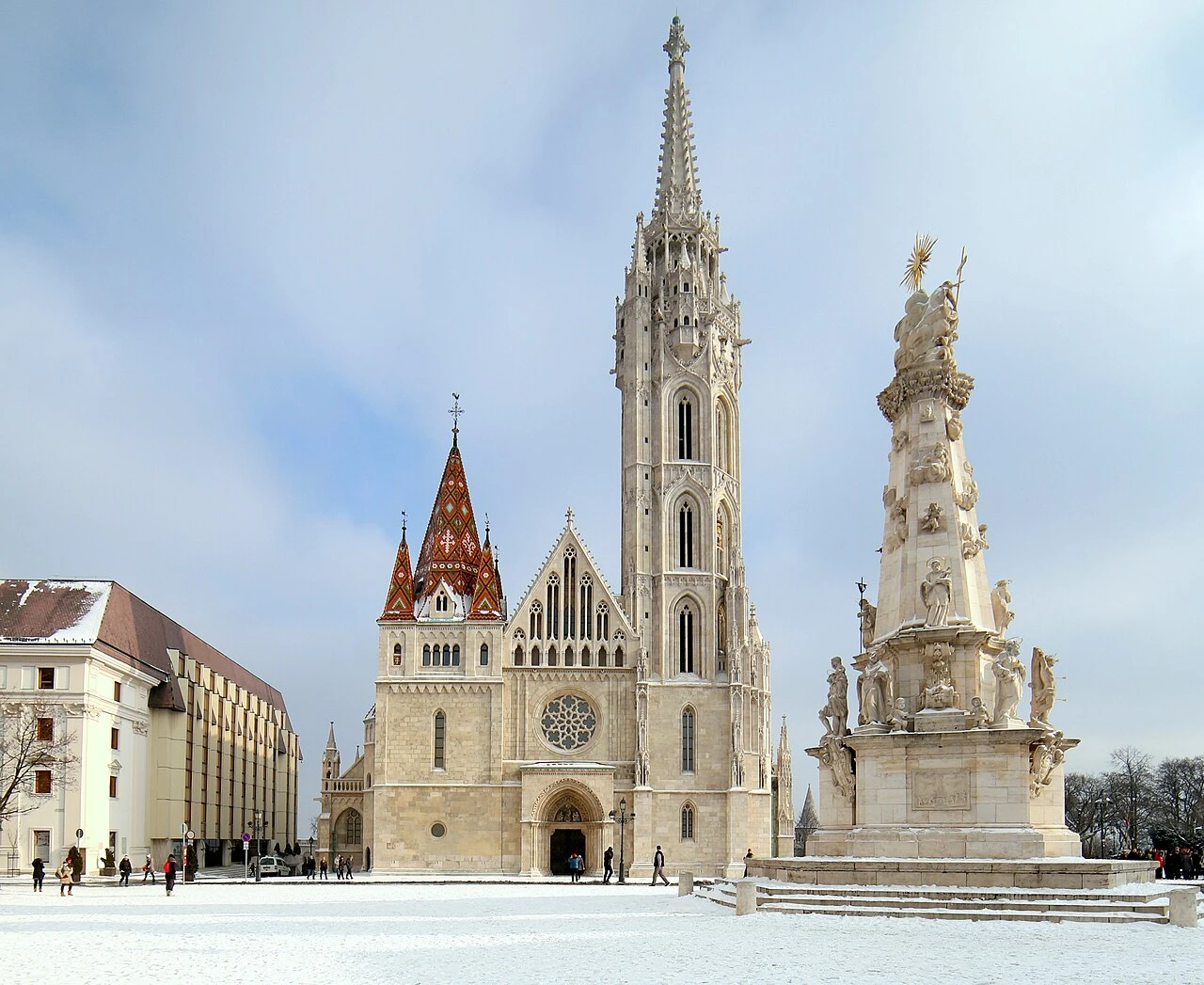
Matthias Church
Content & sources
Photo: Thaler Tamas · CC BY-SA 4.0
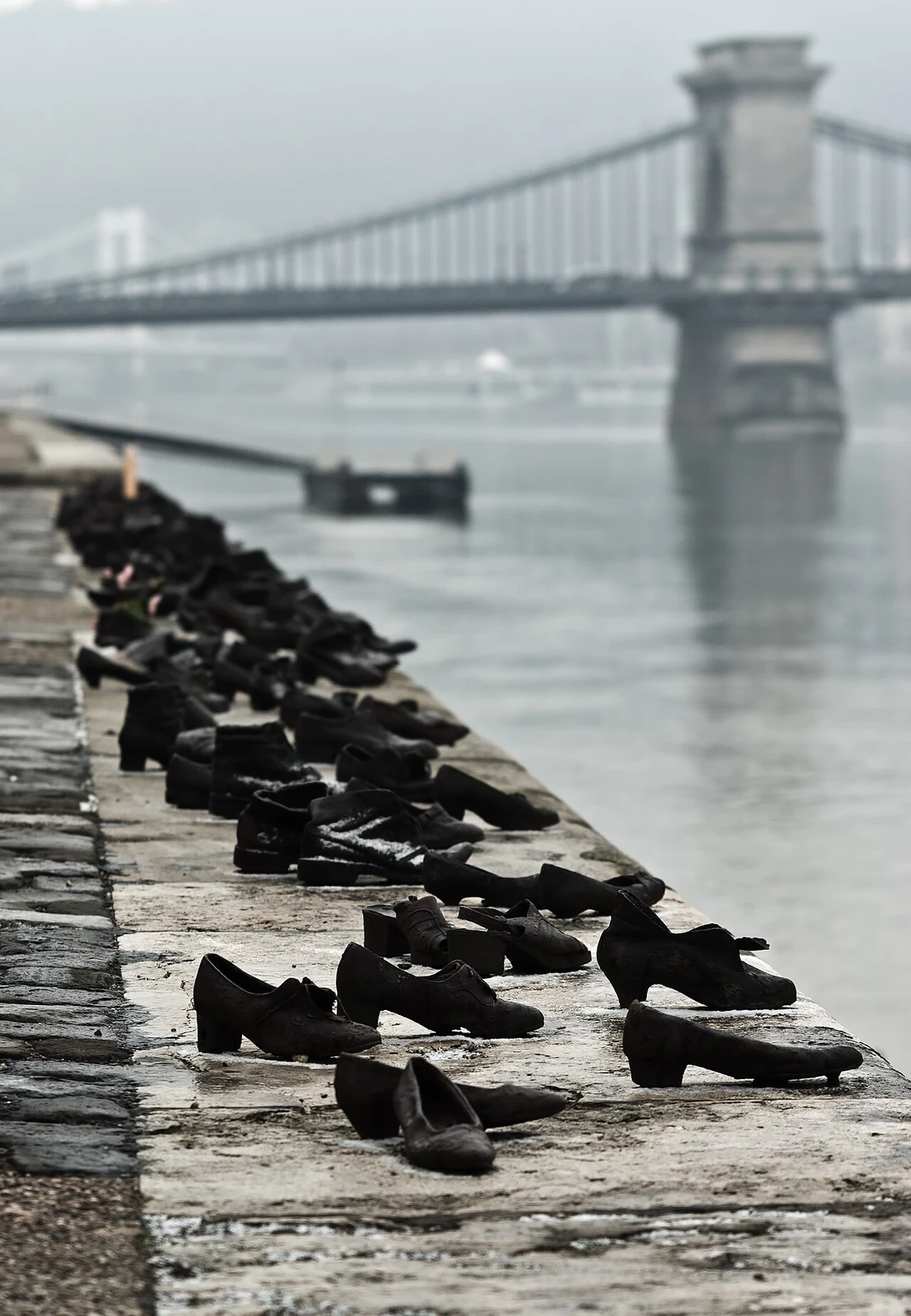
Budapest · 1 km
Shoes on the Danube Bank
Content & sources
Photo: Nikodem Nijaki · CC BY-SA 3.0
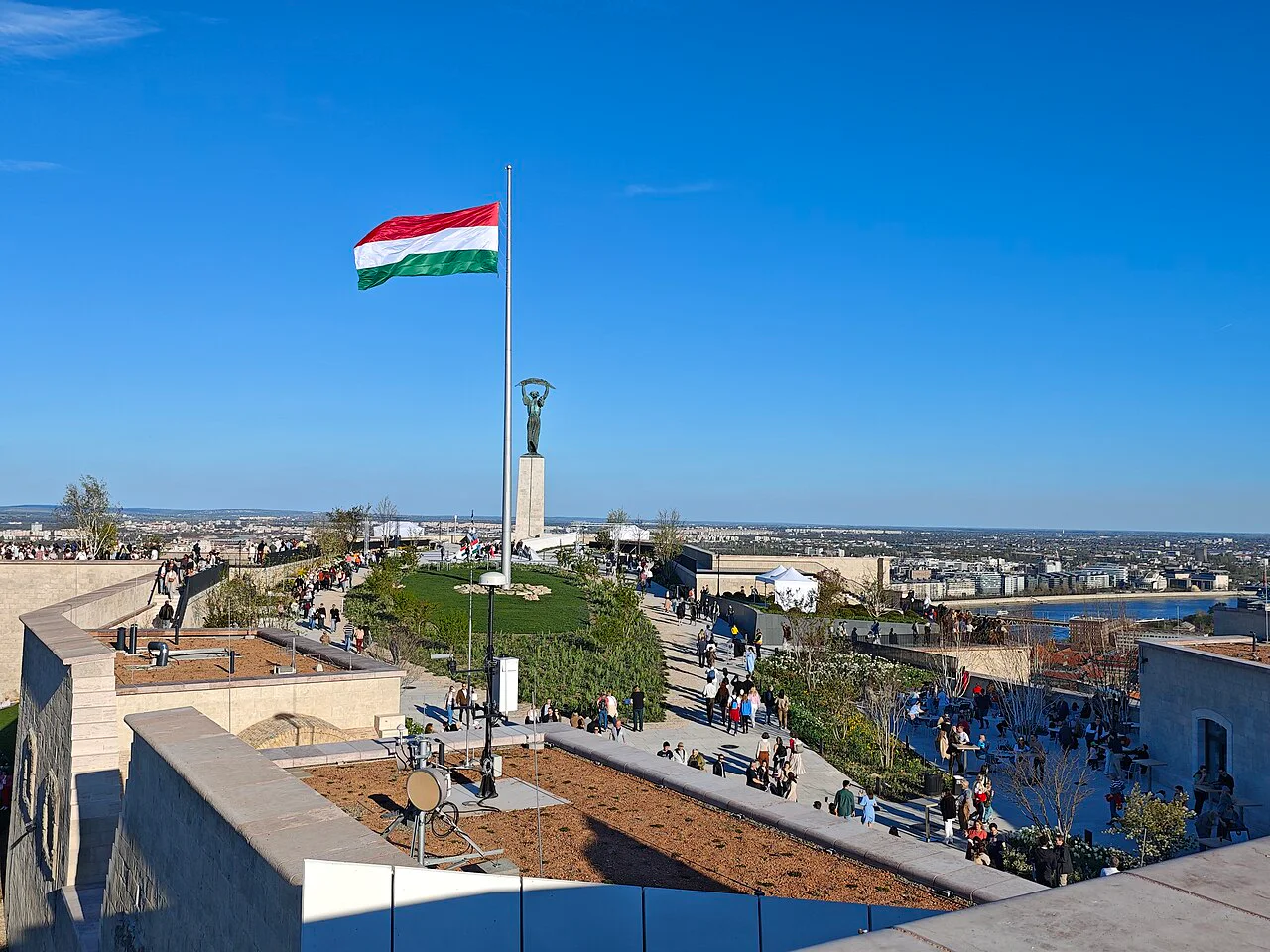
Budapest · 1 km
Citadella
Content & sources
Photo: Elekes Andor · CC BY 4.0
Art museums
More art museum audio guides
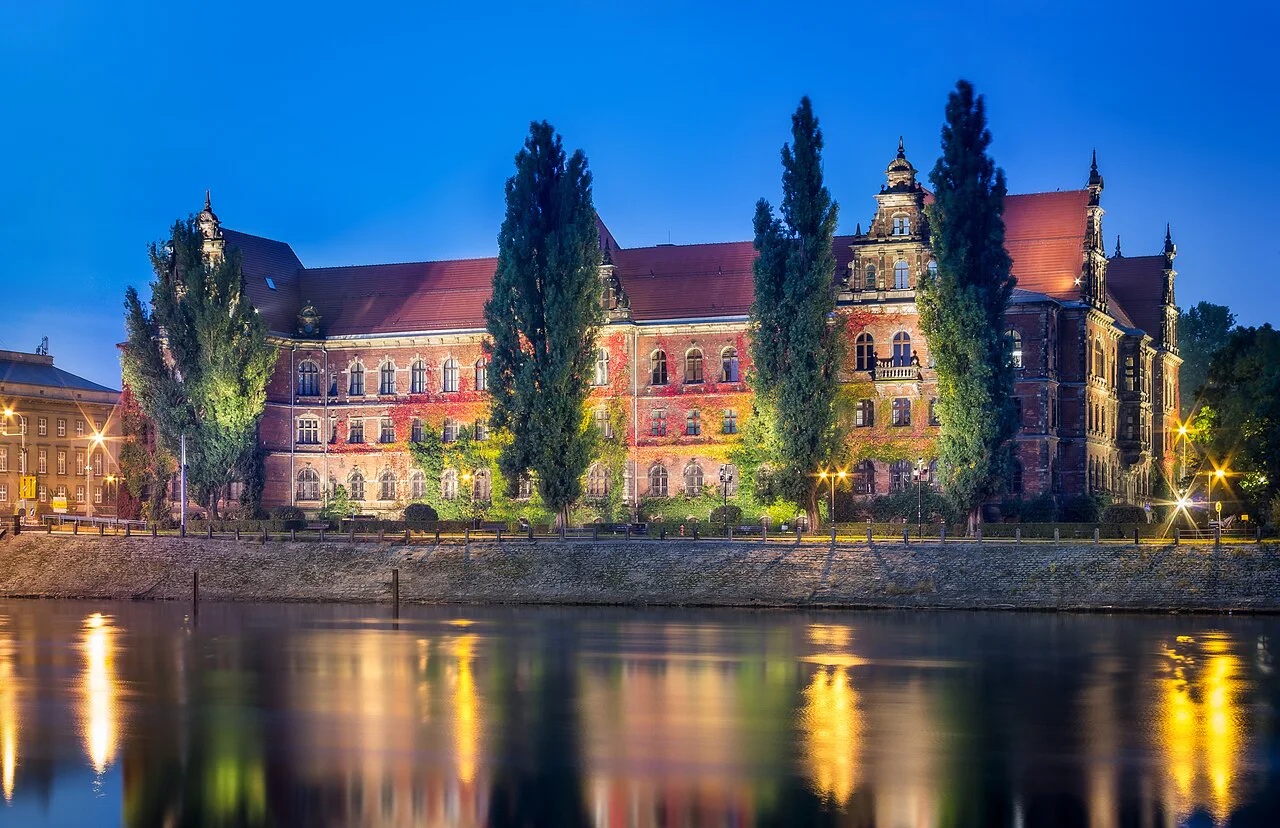
Wrocław · 44 artworks
Muzeum Narodowe we Wrocławiu
Content & sources
Photo: Jar.ciurus · CC BY-SA 3.0 pl
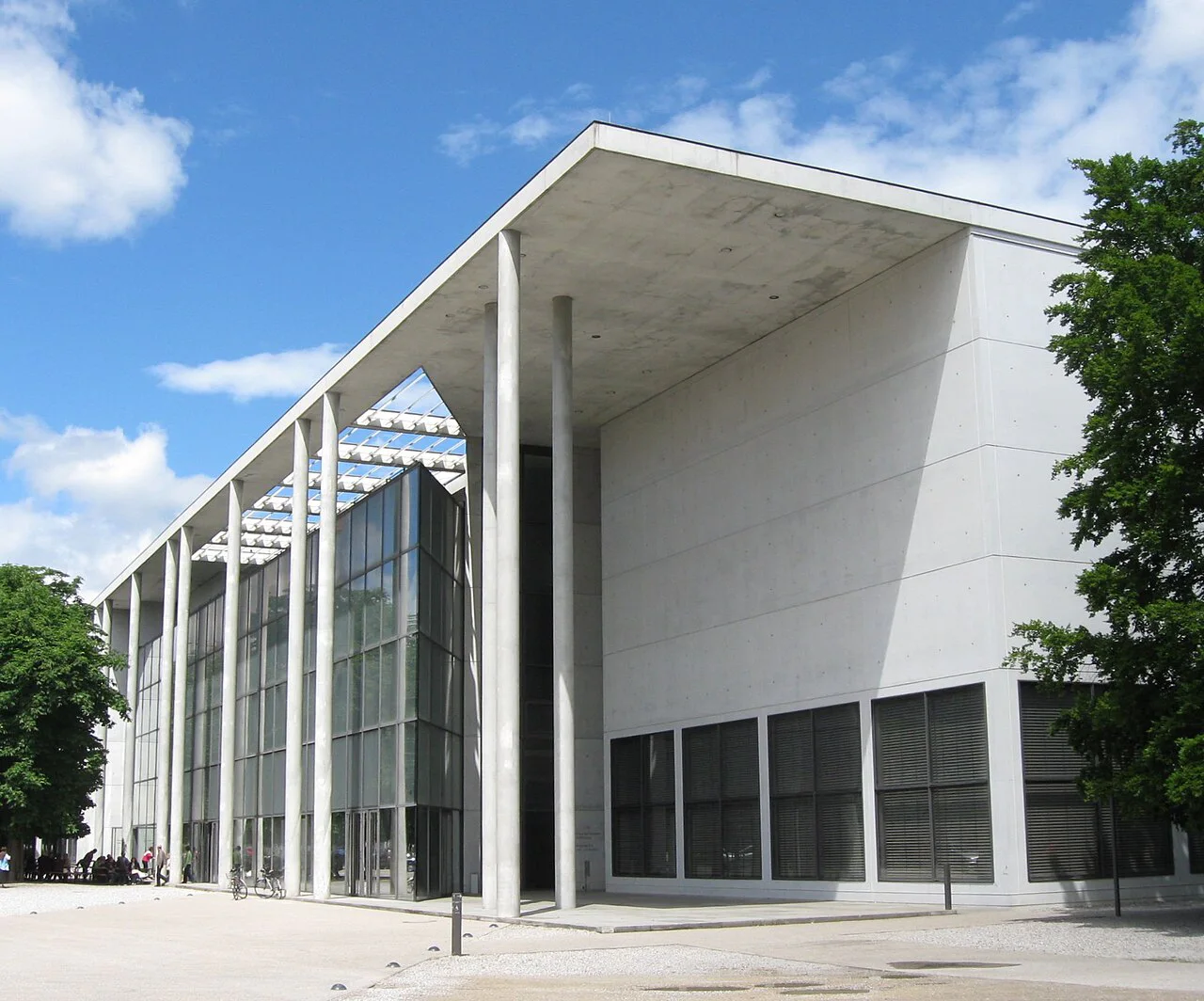
Munich · 6 artworks
Pinakothek der Moderne
Content & sources
Photo: Rufus46 · CC BY-SA 3.0
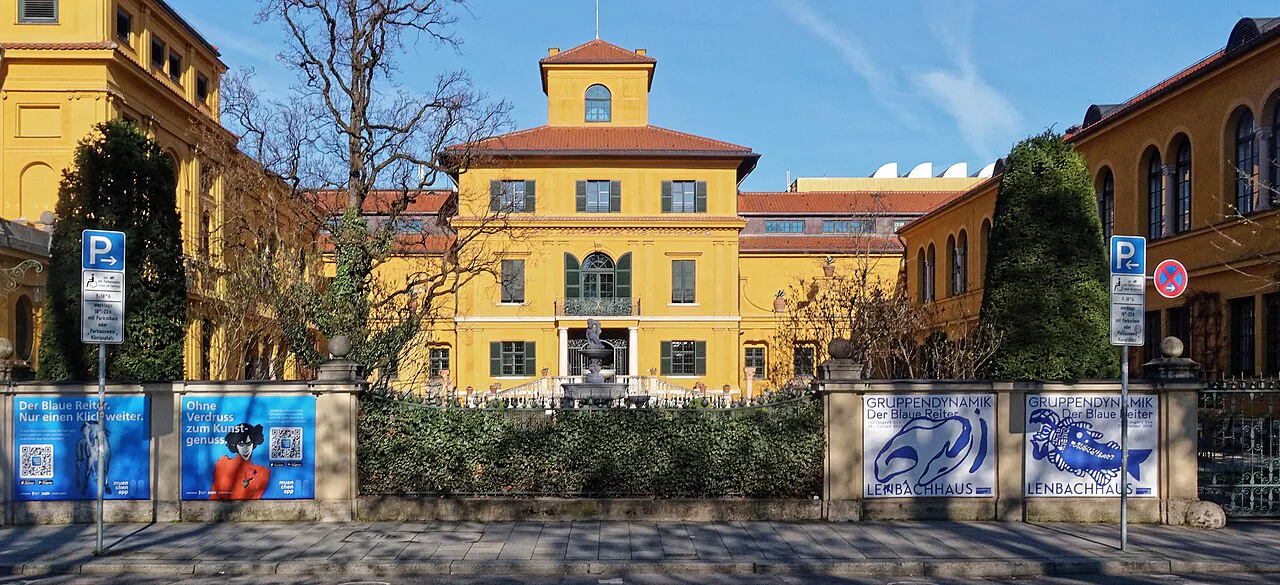
Munich · 33 artworks
Städtische Galerie im Lenbachhaus
Content & sources
Burkhard Mücke · CC BY-SA 4.0
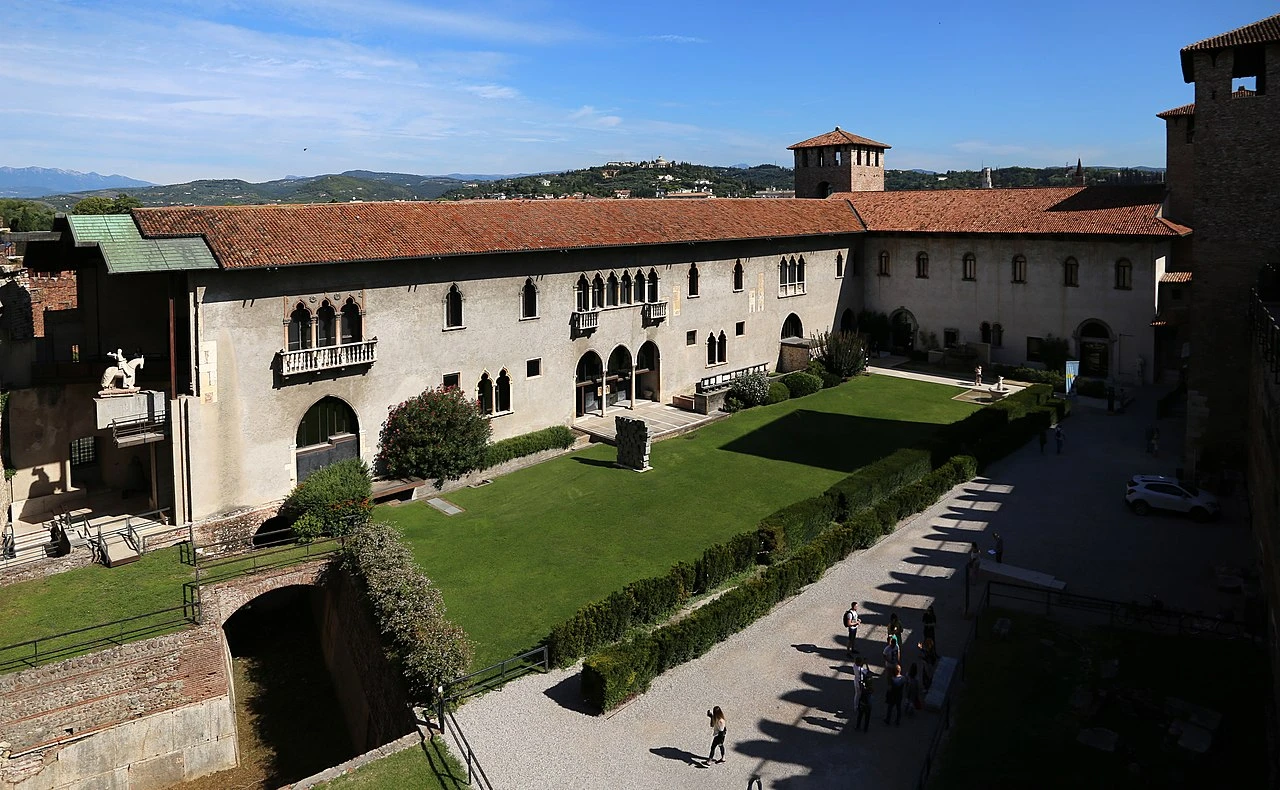
Verona · 65 artworks
Castelvecchio Museum
Content & sources
Photo: Sailko · CC BY-SA 4.0
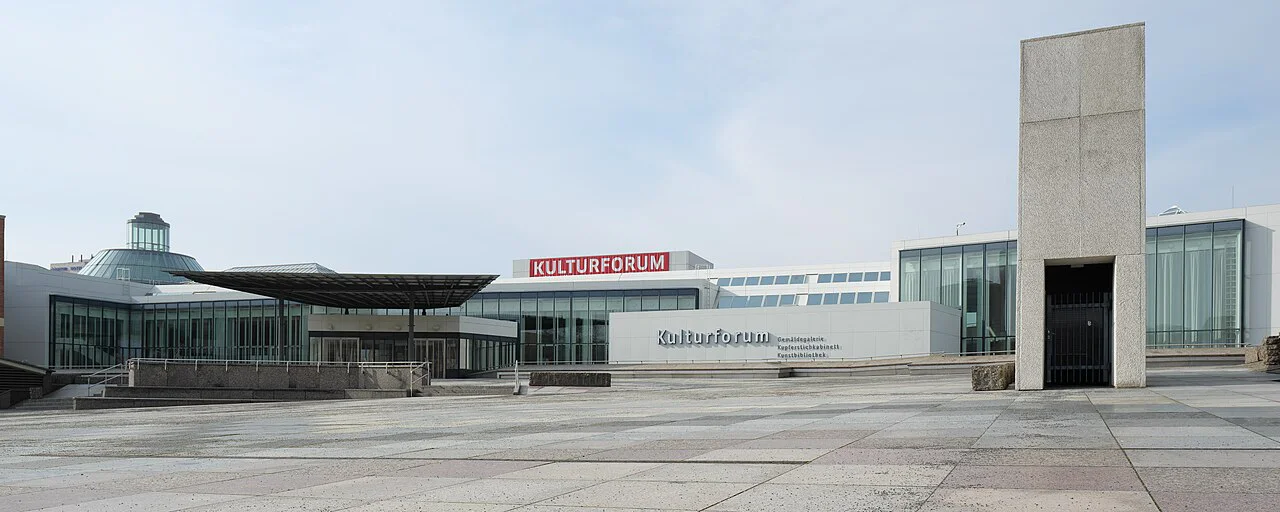
Berlin · 218 artworks
Gemäldegalerie, Berlin
Content & sources
Photo: Membeth · CC0
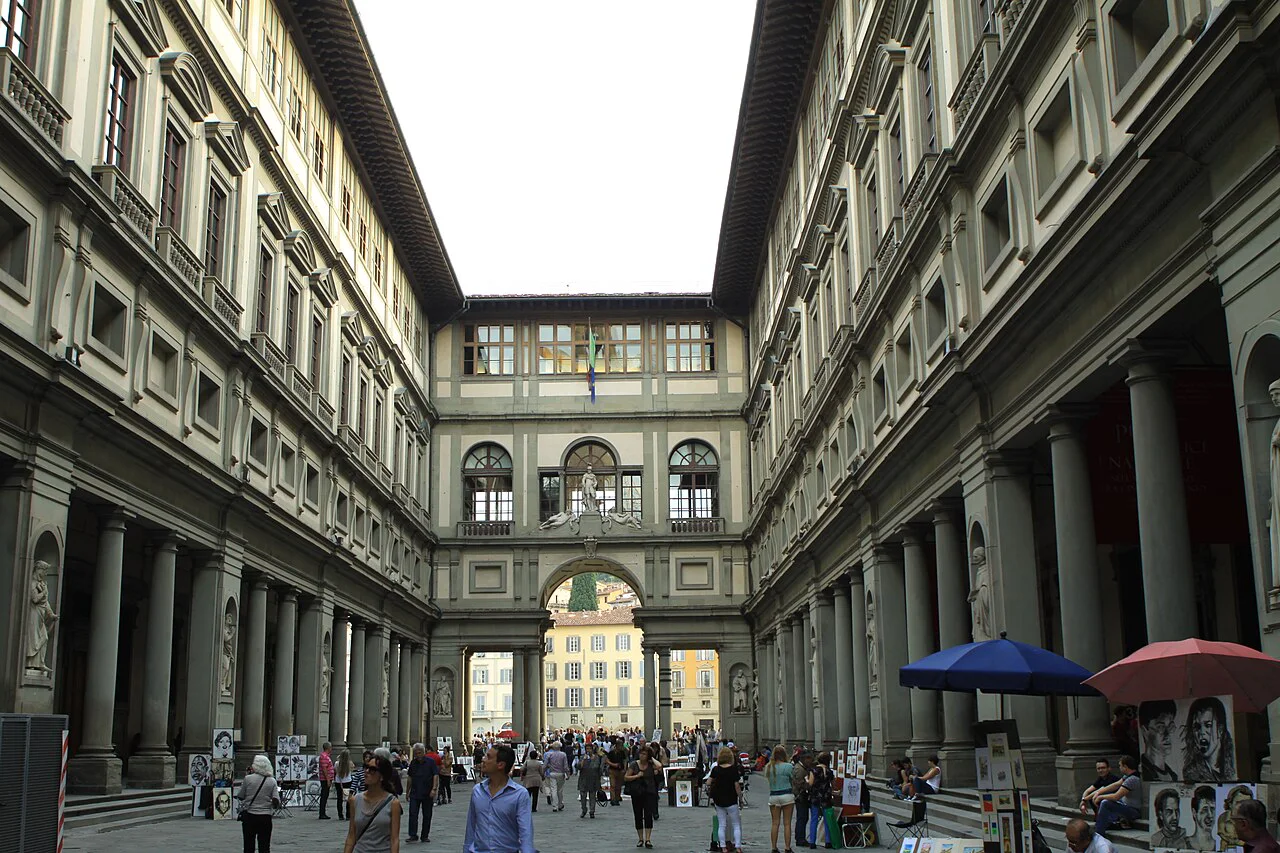
Florence · 70 artworks
Uffizi Gallery
Content & sources
Arek N. · CC BY-SA 3.0