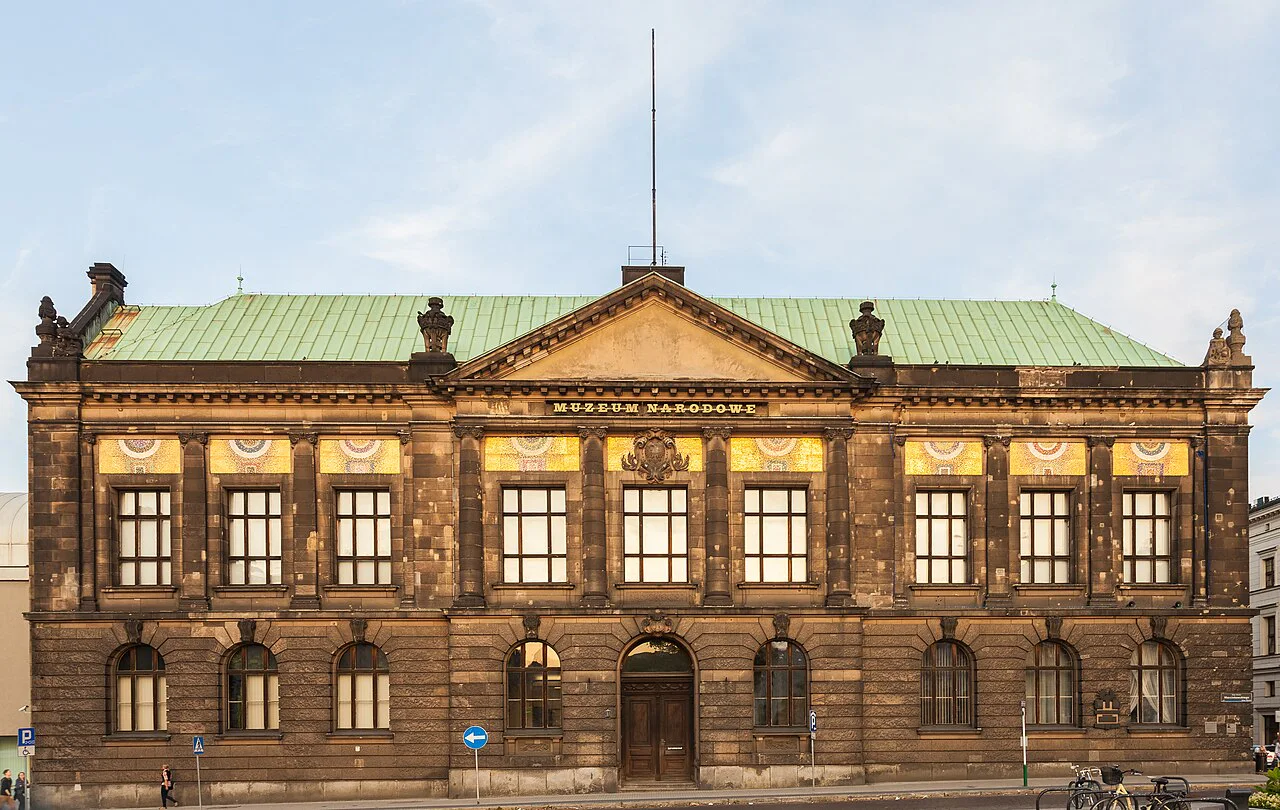
Stanza · Audio guide
Muzeum Narodowe w Poznaniu Audio Guide
A place to remember. A story to take with you.
The National Museum in Poznań is a state-owned cultural institution and one of the largest museums in Poland. It houses a rich collection of Polish painting from the 16th century on, as well as foreign…
Download Stanza, then search for “Muzeum Narodowe w Poznaniu”.
About the tour
One guide. Your kind of visit.
The National Museum in Poznań is a state-owned cultural institution and one of the largest museums in Poland. It houses a rich collection of Polish painting from the 16th century on, as well as foreign painting, numismatic collections, and a gallery of applied arts.
The Muzeum Narodowe w Poznaniu guide tells the stories of 28 artworks, including Beach in Pourville (Claude Monet), Portrait of the Artist's Sisters Playing Chess (Sofonisba Anguissola), Niewidoma (Diego Velázquez), Summer Evening (Józef Marian Chełmoński), Vicious circle (Jacek Malczewski), In the dust cloud (Jacek Malczewski), The Virgin of the Rosary venerated by Carthusians (Francisco de Zurbarán), and Battle of the Pyramids (Wojciech Kossak, Czesław Tański, Zygmunt Rozwadowski, Michał Gorstkin-Wywiórski, Władysław Jasieński, Kazimierz Pułaski). Every artwork is free to hear in the Stanza app until 1 January.
Ready when you are.
- 01Get the free Stanza app.
iOS & Android
- 02Find your guide.
“Muzeum Narodowe w Poznaniu”
- 03Download before you go.
Works offline
Audio guide / 28 artworks
Inside the guide
Get to know a few of the stories before you go. Open a stop to read more.
01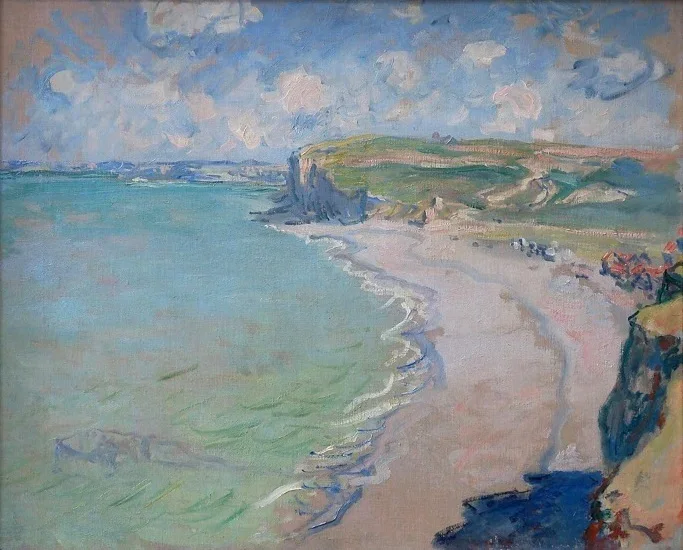
Beach in Pourville
Monet painted this outdoors, on a rocky cliff at Varengeville, and grains of sand are still caught in the paint. The view looks down from high above. Below lie the beach and the Amont rock, the fishing village of Pourville on the right, the Bay of Dieppe on the left. This was the only Monet on public display in Poland, and it had hung in Poznań since 1906. In September 2000 someone cut it from its frame and left a copy painted on cardboard in its place. The man who took it said he loved Monet's work and never meant to sell it. He hid the canvas behind a wardrobe in his parents' apartment. The case was closed in 2001, but the painting mattered to Polish culture, so the search continued. In January 2010 the canvas came back. In the lower right corner, Monet's signature is damaged. It was cut as the canvas came out of its frame, and that damage halved the painting's value.
Listen in the appClaude Monet · Public domain
02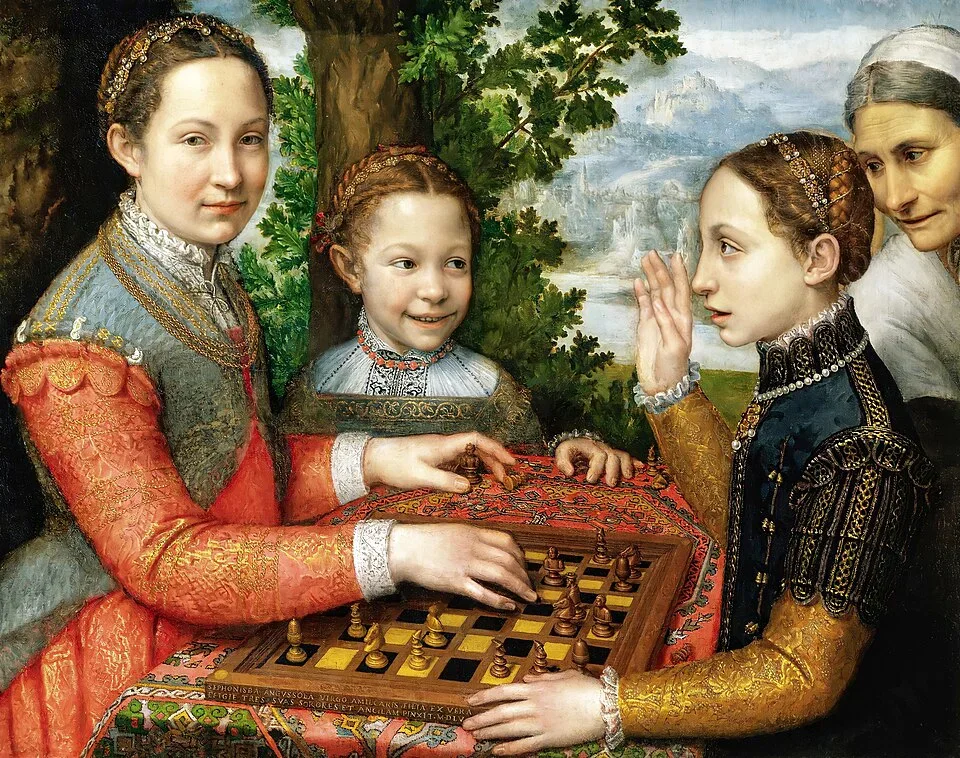
Portrait of the Artist's Sisters Playing Chess
In the middle of this picture there was once another face. Sofonisba Anguissola painted it out and moved it to the far right. That is the old servant, part of her cut off by the edge. Around the chessboard are three young women, the artist's own sisters. This game never took place. The sisters wear pearls and costly dresses, and jewels that belonged to their mother, far too fine for a match outdoors. Chess was a man's pursuit then, a show of martial skill. Girls were trained in embroidery and weaving. So Anguissola, only twenty-three, handed the board to her sisters and left her brother out. One sister on the left moves a piece and looks straight at you. Across the table another raises her hand as if to protest. Between them the youngest laughs, while the servant watches from the right. Along the edge of the board Anguissola wrote that she had painted three sisters and their maid from life, in 1555.
Listen in the appSofonisba Anguissola · Public domain
03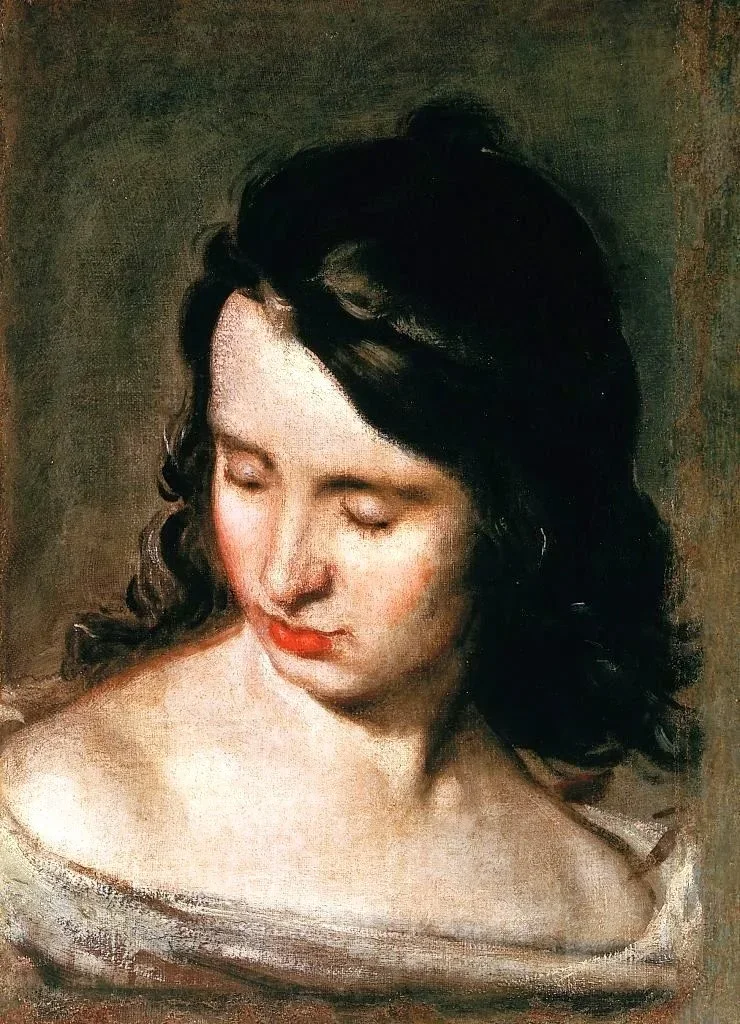
Niewidoma
Atanazy Raczyński wanted a Velázquez for his collection. He had spent years building one of the most important private collections of European painting. As the Prussian envoy in Madrid, he set about finding one. He wrote to middlemen and to the director of the Prado. He offered to buy a picture, or to swap some of the works he already had. At first, nothing came of it. Then, in 1854, Francis, the husband of Queen Isabella the Second, gave him two small paintings he believed were by the Spanish painter. This face is one of them. They were his way of saying thank you, and a keepsake of Raczyński's time at the Spanish court. A young woman fills almost the whole canvas. Her neck and shoulders are bare above a wide neckline, against a plain grayish brown ground with nothing to say where she is. Her eyes are almost shut, and that gave the picture its name, the Blind Woman. Velázquez painted this face without flattering her. Light picks out her forehead, nose, cheeks and chin. Dark hair frames the lit skin. It is a close study of one face. What this face was originally painted for is not known.
Listen in the appDiego Velázquez · Public domain
04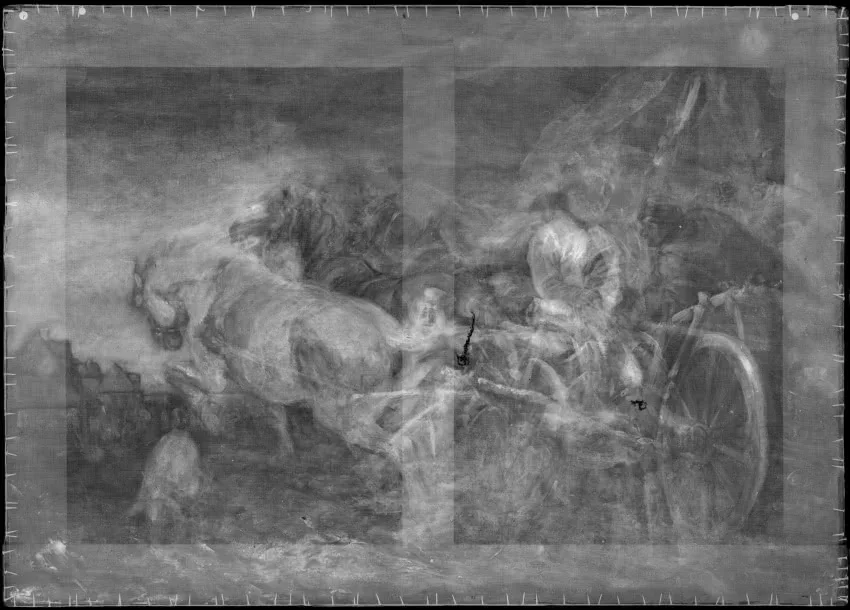
Summer Evening
A black dog sits in the gap between the two rooms. It looks like it guards the woman leaning at the window. She is turned sideways in a white dress, her hands behind her back, holding the strings of a straw hat. Her pose may suggest waiting, or weariness. In the darker room beyond, a man smokes a long pipe, with a servant almost invisible beside him. A white dog is visible outside the window, and the curtain blows in the wind. The whole scene feels like a dream. Chełmoński first showed it in Warsaw in February 1875. The reviews were mostly bad. He changed parts of the painting to answer them, but it made no difference. Recognition came only in Paris. There, in 1889, he received a grand prize. In 1890 it disappeared from a show of his paintings in Warsaw, and was gone for more than a century. It spent the war in an attic in Komorów, kept by one family and handed down. Restoration in 2023 confirmed he had painted it. That June it sold for more than four million zlotys, the most ever paid for one of his paintings. But X rays found a different painting beneath the surface. Four horses and a carriage, drawn by Antoni Adam Piotrowski, were there first. Chełmoński painted over them, and the two likely shared canvases to save money.
Listen in the appAntoni Adam Piotrowski · Public domain
05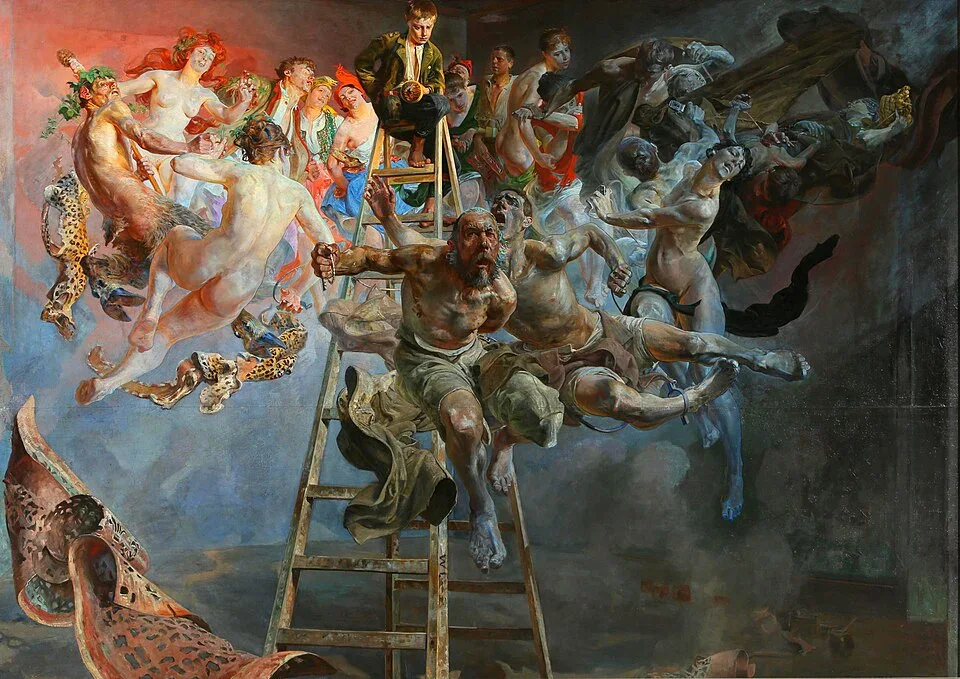
Vicious circle
What is an artist, and what is art for? The painting asks that question. Above a circle of bodies spinning in the air, a boy sits on a stepladder, deep in thought, a brush in his hand. The boy is the painter himself, Jacek Malczewski. He put himself up there, perched above the circle he imagined. Around him, naked Bacchantes and men young and old whirl in a magical ring. They are the feelings and the imagination of a young artist. They look solid and real, painted so convincingly, and yet the space they fill is no place you could ever stand. The left side is better lit, and it stands for sensual pleasure. The right side is darker, and it holds the artist's fears and anxieties. Between those two halves, the painting carries the vitality of human instincts and the tragedy of human fate. It shows a tortured artist hunting for inspiration. Art can let an artist see the human soul, setting ordinary thinking aside and working in direct contact with the universe.
Listen in the appJacek Malczewski · Public domain
06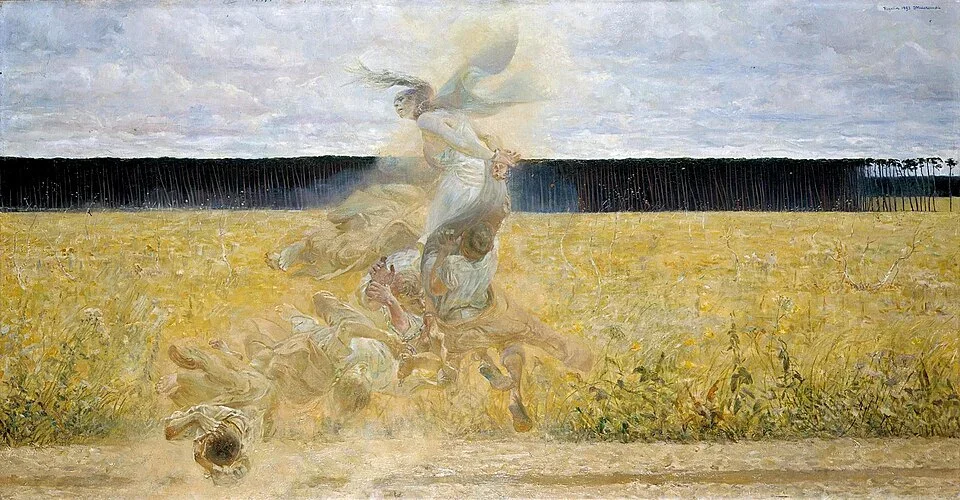
In the dust cloud
Who are these figures, and why do they hang in the air? They hover and swirl, more like apparitions than people. Jacek Malczewski came to Rogalin, invited by its owner, Edward Aleksander Raczyński, and painted this between 1893 and 1894. A cholera epidemic was raging at the time, and it may have given him the idea for the picture. The figures may be the people the disease took, and the fear it left behind. And the ground beneath them is real. It is the fallow land and pine forest of Greater Poland, where he was staying when the epidemic came.
Listen in the appJacek Malczewski · Public domain
07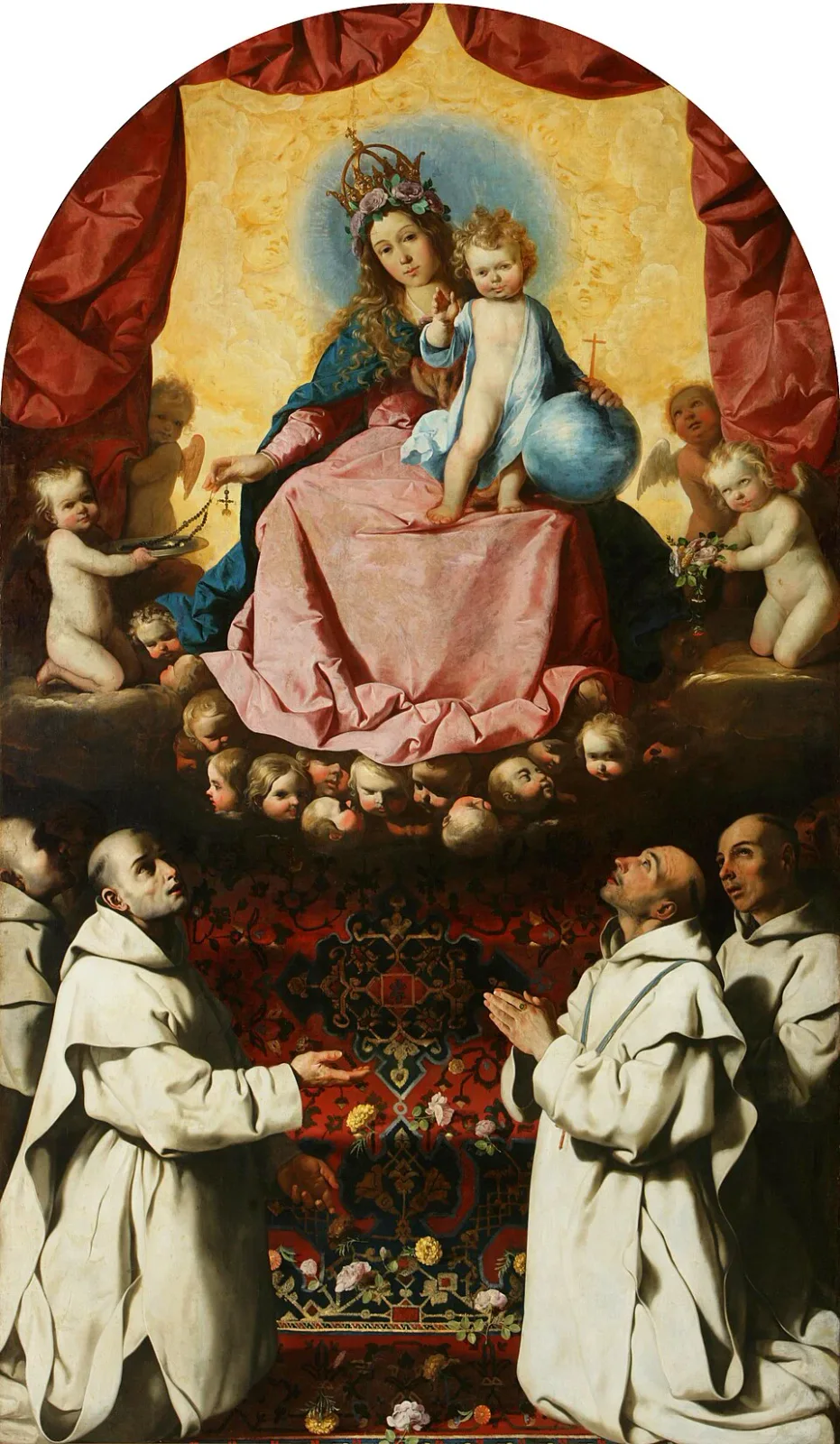
The Virgin of the Rosary venerated by Carthusians
On the left, a small angel holds out a rosary on a metal plate. Just below, a monk in a white habit kneels with one hand held out. He is Dominic Helion, one of the Carthusians painted here. His order believed it had been praying the rosary before the Dominicans did. They credited one of their own monks, Dominic of Prussia, with being the first to propose it. Below the rosary kneel the men who said their order began this prayer. Zurbarán painted this for the charterhouse at Jerez de la Frontera between 1638 and 1639. It was the centre panel of the lower altarpiece, one of twenty two canvases for that house. Above the kneeling monks, Mary wears an imperial crown, and the child stands on her knees and blesses. Steps covered with a patterned carpet and strewn with roses lead up between them, joining the praying monks to the heavenly vision. The picture left the charterhouse, passed through the Louvre and a London sale, and came to Poznań with Count Raczyński's collection.
Listen in the appFrancisco de Zurbarán · Public domain
08
Battle of the Pyramids
Wojciech Kossak wanted to paint the charge at Somosierra. The governor of Warsaw refused him. The subject was judged too patriotic, and could stir national feeling among Poles. So Kossak chose a battle far from home, fought in Egypt in 1798, when Napoleon's troops faced the Mamluk army. Here that choice becomes the Mamluk charge led by Murad Pasha. Horses gallop in clouds of desert dust. To get the details right, one painter went to Paris to study the uniforms and weapons. Kossak and Michał Wywiórski studied the ground around the village of Imbaba, using a battle plan. The panorama was a hundred and fifteen metres wide and fifteen metres high. It was painted in a rented rotunda in Warsaw, and opened in April 1901. By September 1902 it was rolled up and put into storage. It later travelled to Moscow, Odessa and Kharkiv. After 1908 Kossak cut it into smaller pieces so they could be sold. This charging cavalry is one of them.
Listen in the appWojciech Kossak · Public domain
09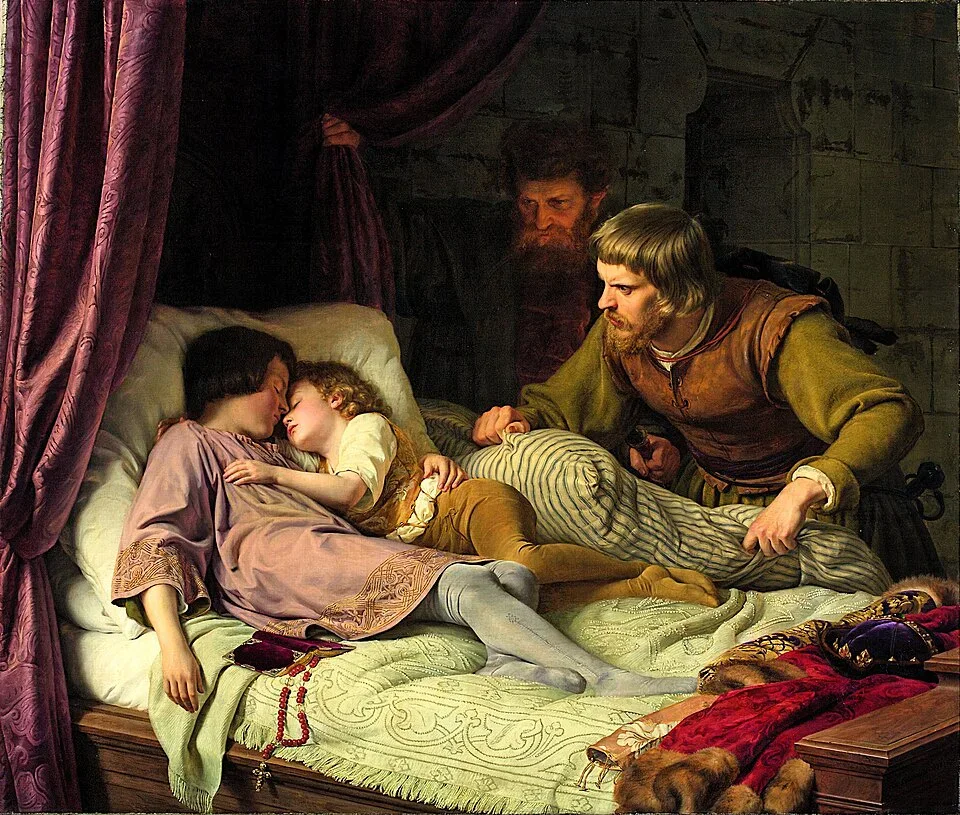
L'Assassinat des enfants d'Edouard by Theodor Hildebrandt
Nobody walking past would guess what that cushion is for. A man holds it clenched in both fists above a bed where two boys are asleep, the younger with his arm around the elder. A book and a rosary lie on the bed. The boys fell asleep after praying. The man is James Tyrell, a follower of the Lord Protector, Richard of York. He was ordered to smother them so that his employer could take the English crown. They are Edward the Fifth and his brother Richard, the Princes in the Tower, in a scene from Shakespeare's Richard the Third. In 1831 Paul Delaroche showed his own picture of the sons of Edward in Paris. It set artists arguing, and Hildebrandt went to study it. But for the arrangement of the figures he used an engraving after a painting by James Northcote. He had his own student, Paul Joseph Kiederich, sit for the villain. In the larger version in Düsseldorf a door opens at the back on the left. Here the door sits in the middle of the back wall, as it did in an oil sketch of 1834. The Berlin collector Atanazy Raczyński ordered this smaller painting, because he saw a new Rembrandt in Hildebrandt.
Listen in the appTheodor Hildebrandt (1804 - 1874) Born in Stettin. Died in Düsseldorf. Details on Google Art Project · Public domain
10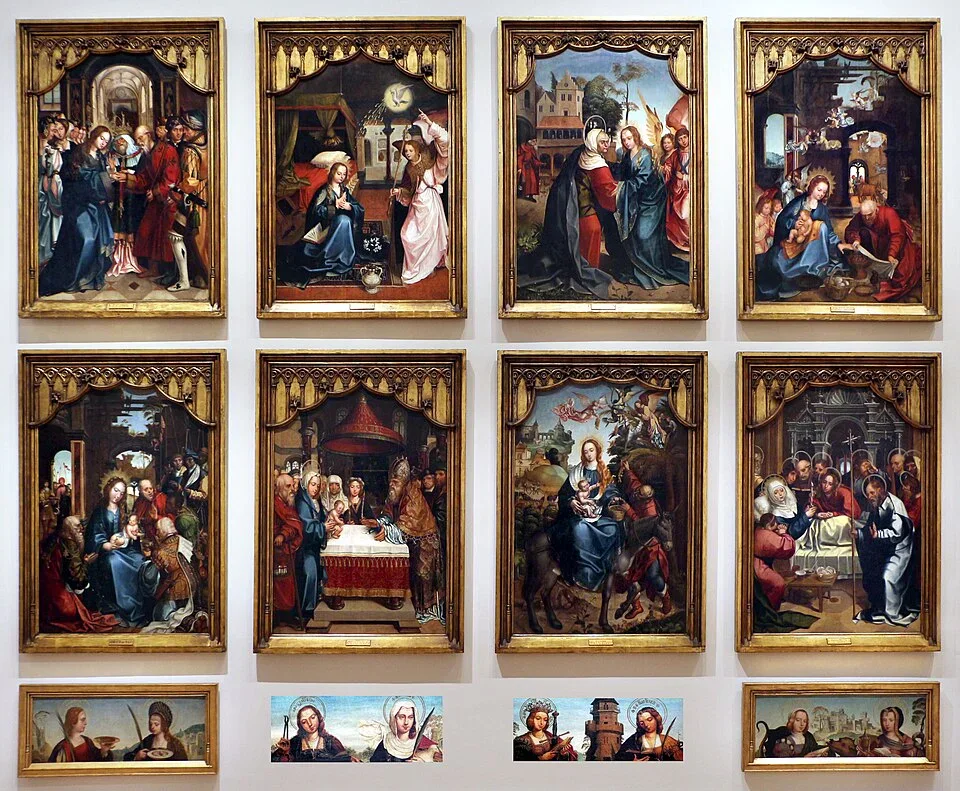
Polyptych of the Paradise Convent
Mary kneels with an open book beside her. Before her stands the Archangel Gabriel, holding a golden staff and pointing toward a dove. At her feet, in the foreground, a jar holds white lilies. The lilies speak of her purity. The book has fallen open across her cloak, and the blue of her dress shows through its thin pages. That fall tells of her surprise at the angel's coming. But the jar carries an inscription, Abram Prim, Abraham First. It points back to Abraham and Sarah, both grown old, visited by three angels who promised them a son. That son was Isaac, whose birth and circumcision foreshadowed those of Christ. Light falls from the right, along the line from the dove to Mary, marking where the sacred appears. The composition divides in two, with Gabriel from heaven and Mary from earth. This altarpiece, made for the high altar of a convent in Lisbon, was probably a team effort with Gregório Lopes in a prominent part. What is still not known is how much of it he painted himself.
Listen in the appSailko · CC BY 3.0
- 11
Autumn
Józef Marian Chełmoński · 1897
- 12
Ploughing
Józef Marian Chełmoński · 1896
- 13
The Maid of Orléans
Jan Matejko · 1886
- 14
Seducer.
Nasreddine Dinet · 1906
- 15
Fine Weather. The Hawk
Józef Marian Chełmoński · 1899
- 16
Second Peace of Thorn
Marian Jaroczyński · 1870–1873
- 17
Portrait of Michał Jerzy Poniatowski (1736-1794)
Marcello Bacciarelli · 1701
- 18
Founding of the Lubrański Academy in Poznań.
Jan Matejko · 1886
- 19
A Convention of Hunters
Józef Marian Chełmoński · 1874
- 20
Seated soldier
Aleksander Orłowski · 1809
- 21
Flower market in front of the Madeleine church in Paris
Józef Pankiewicz · 1890
- 22
The Abduction of Europa
Bernardo Strozzi · 1644
- 23
Madonna and Child with Donor
Giovanni Bellini · 1505
- 24
Self-portrait in a Yakut hat
Jacek Malczewski · 1907
- 25
Death on the stage.
Jacek Malczewski · 1891
- 26
Departure of Henry the Pious from Legnica
Jan Matejko · 1865
- 27
Rest on the flight into Egypt - drawing by Rubens
Peter Paul Rubens · c. 1633–1635
- 28
Gryfina of Halich and Leszek II the Black
Jan Matejko · 1879
Muzeum Narodowe w Poznaniu
Frequently asked questions
How much does the guide cost?
Free app download. Free until 1 January. Listed guide price: $0.99. Audio guide only. Venue admission is separate.
Can I listen without internet?
Yes. Download the guide’s audio, images, and maps in the app before your visit. Your downloaded content is then available offline.
Can I listen in my language?
In English for now. More languages soon.
Do I need to follow a schedule?
No. This is a self-guided experience. Choose your stops, pause whenever you like, and return to a story at your own pace.
Which artworks are in the Muzeum Narodowe w Poznaniu audio guide?
28 artworks, including Beach in Pourville (Claude Monet), Portrait of the Artist's Sisters Playing Chess (Sofonisba Anguissola), Niewidoma (Diego Velázquez), Summer Evening (Józef Marian Chełmoński), Vicious circle (Jacek Malczewski), In the dust cloud (Jacek Malczewski), The Virgin of the Rosary venerated by Carthusians (Francisco de Zurbarán), and Battle of the Pyramids (Wojciech Kossak, Czesław Tański, Zygmunt Rozwadowski, Michał Gorstkin-Wywiórski, Władysław Jasieński, Kazimierz Pułaski). The full list is on this page.
Is this the museum’s official audio guide?
No. Stanza is an independent audio guide app and is not affiliated with Muzeum Narodowe w Poznaniu. Museum admission is separate.
At your own pace
Explore Muzeum Narodowe w Poznaniu.
Download Stanza, then search for “Muzeum Narodowe w Poznaniu”.
Free app download · Guide price shown in the app
Keep exploring
Audio guides — Poland
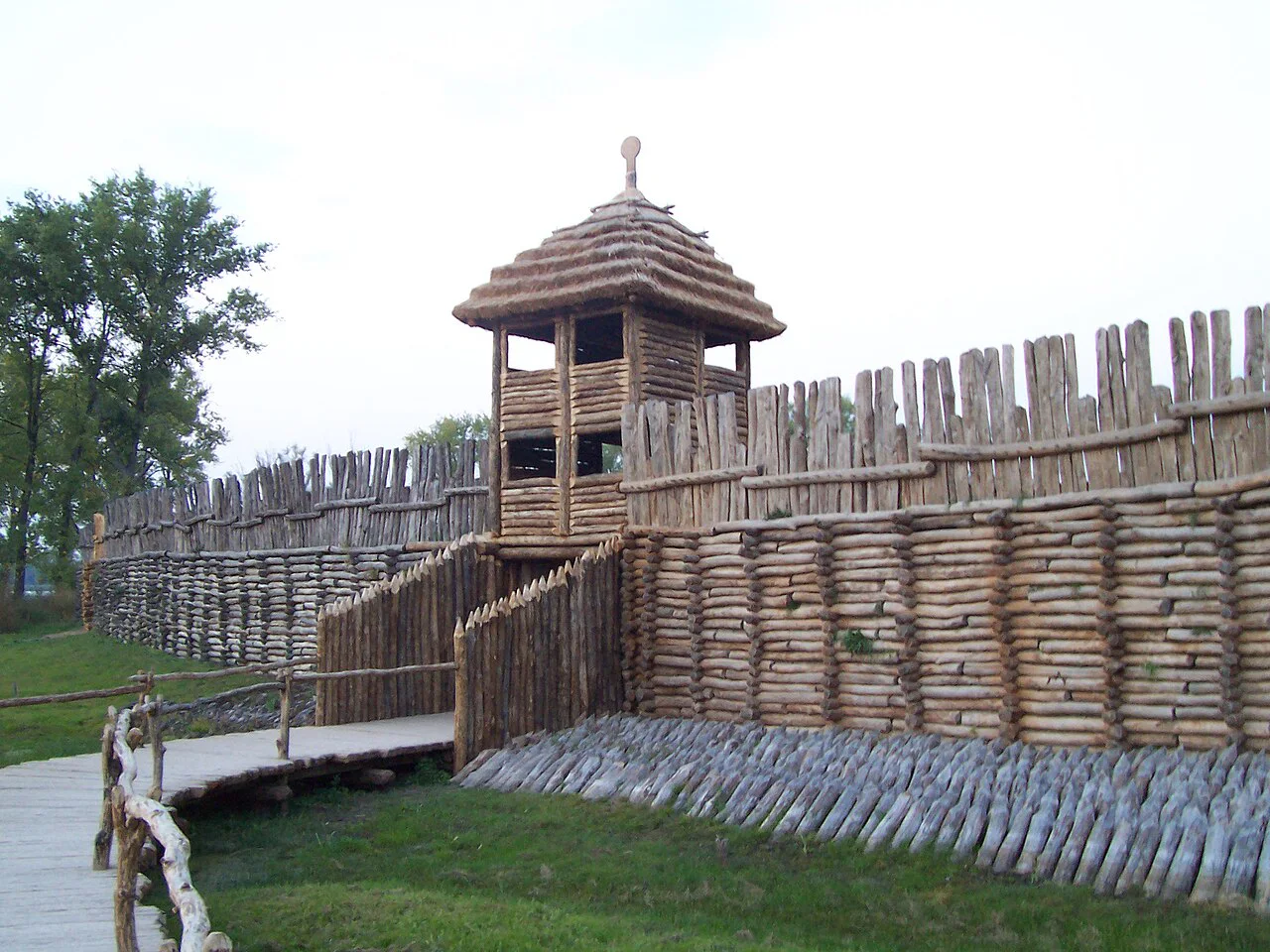
Biskupin · 69 km
Biskupin
Content & sources
User:Fazer · CC BY-SA 2.5
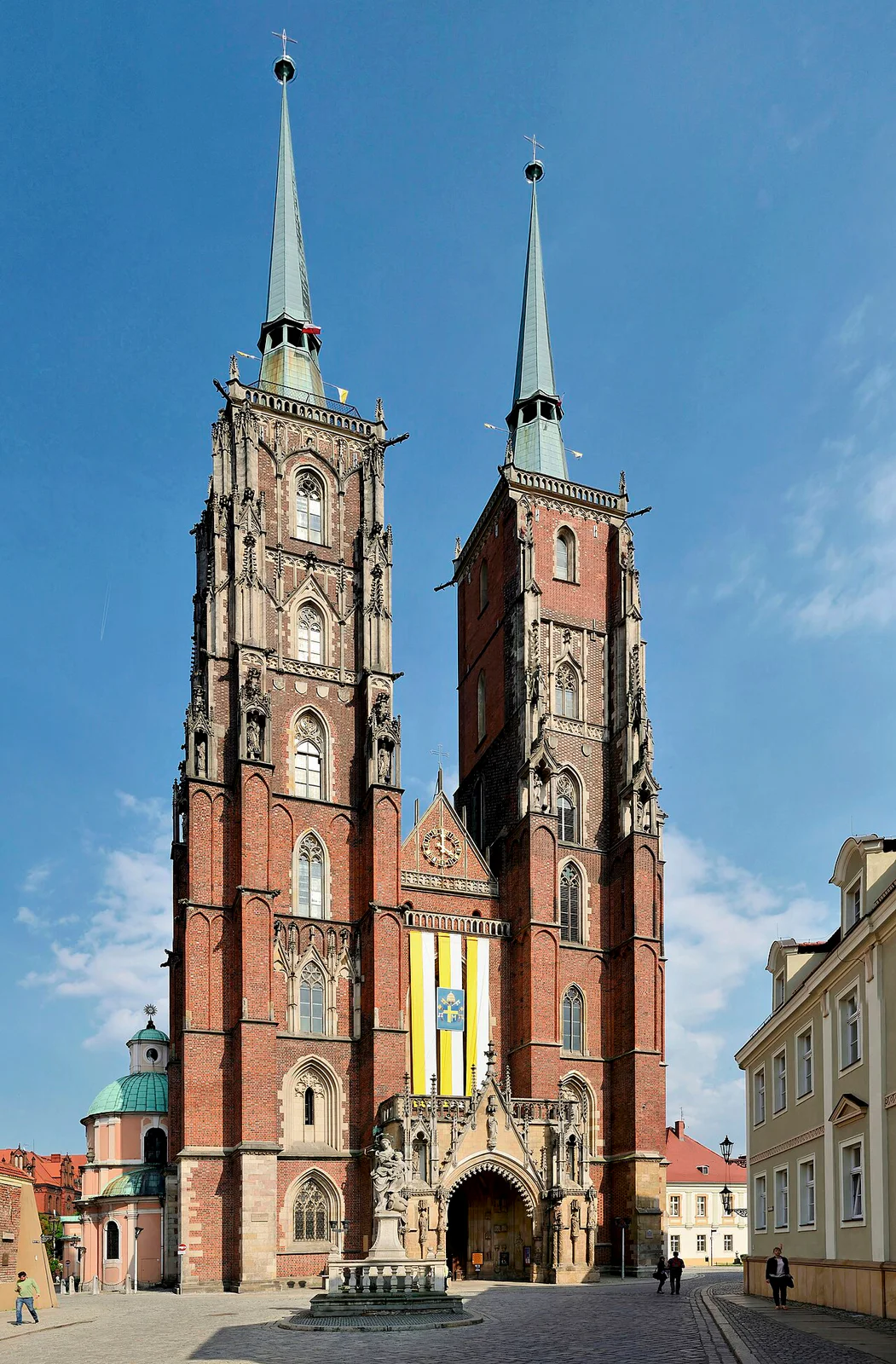
Wrocław · 144 km
Archikatedra św. Jana Chrzciciela we Wrocławiu
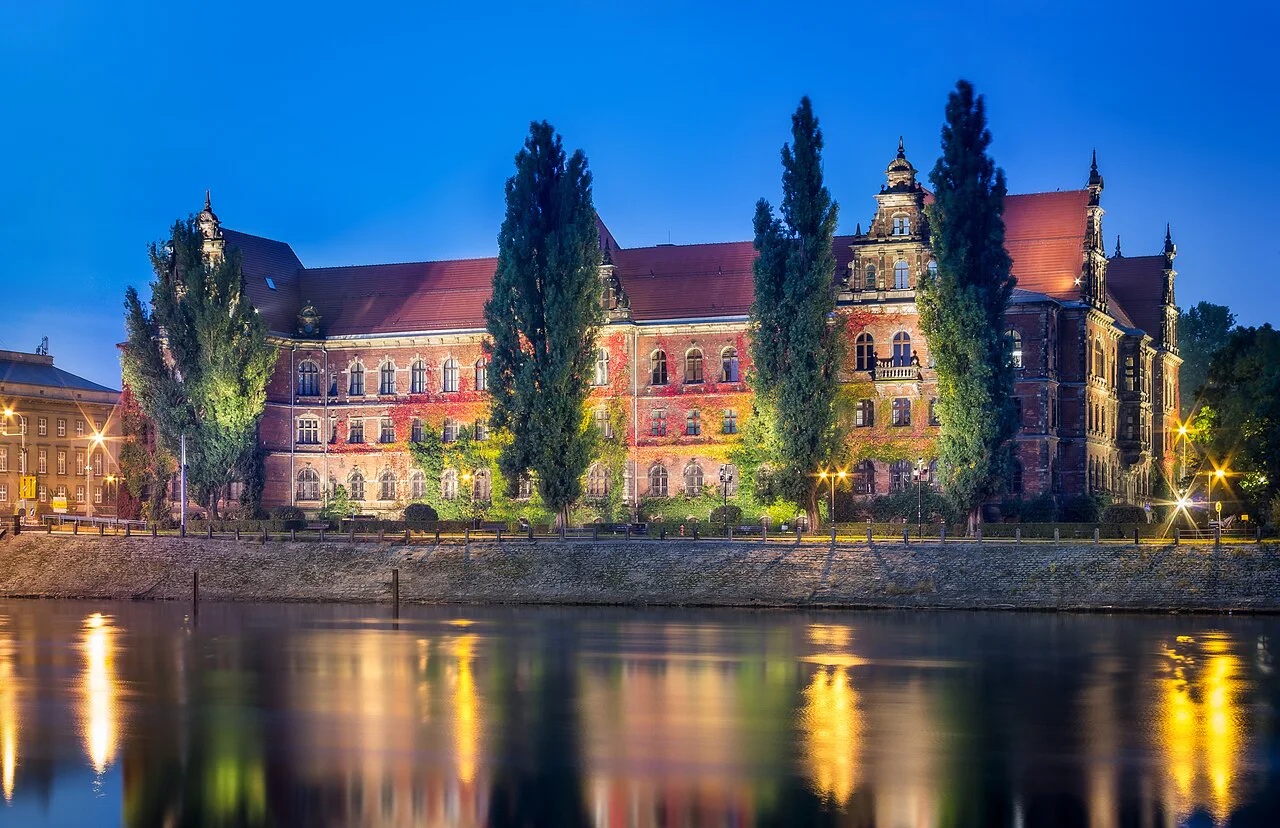
Wrocław · 145 km
Muzeum Narodowe we Wrocławiu
Content & sources
Photo: Jar.ciurus · CC BY-SA 3.0 pl
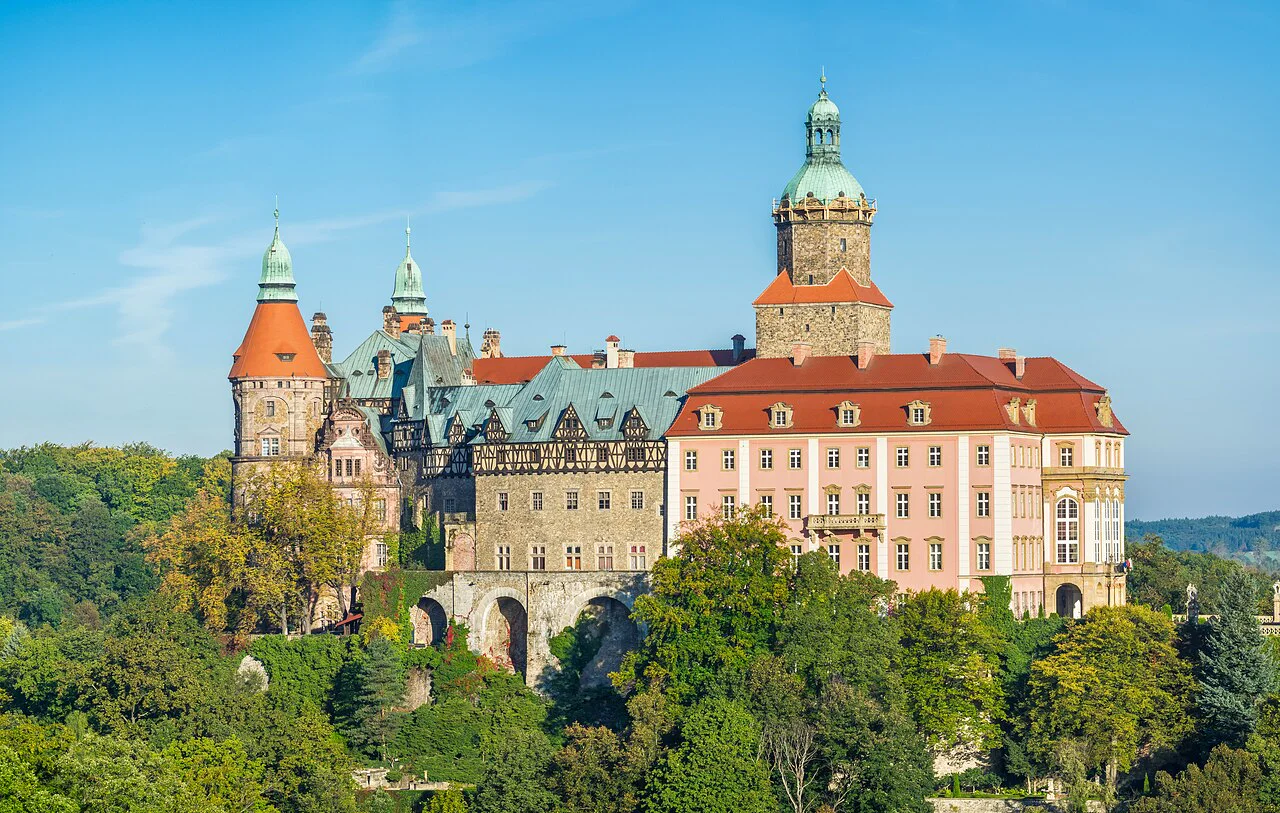
Wałbrzych
Zamek Książ
Content & sources
Photo: Jar.ciurus · CC BY-SA 3.0 pl
Art museums
More art museum audio guides
Wrocław · 44 artworks
Muzeum Narodowe we Wrocławiu
Content & sources
Photo: Jar.ciurus · CC BY-SA 3.0 pl
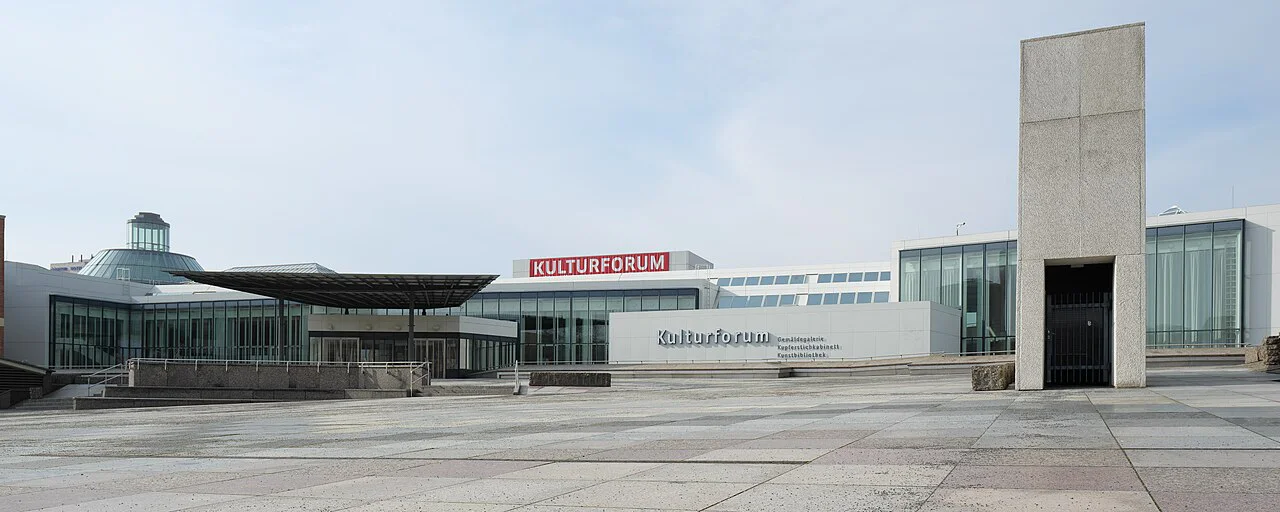
Berlin · 218 artworks
Gemäldegalerie, Berlin
Content & sources
Photo: Membeth · CC0
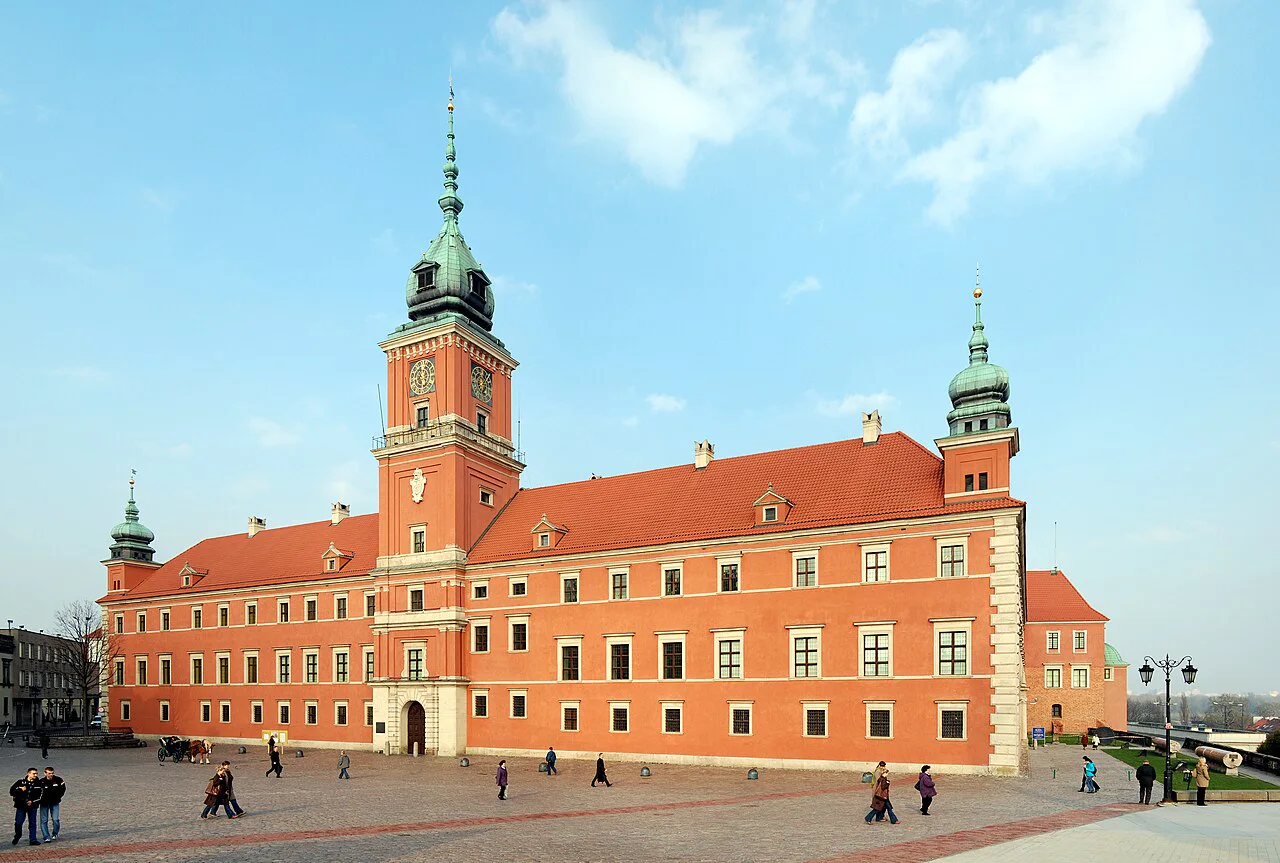
Warsaw · 17 artworks
Zamek Królewski w Warszawie
Content & sources
Marcin Białek · CC BY-SA 3.0
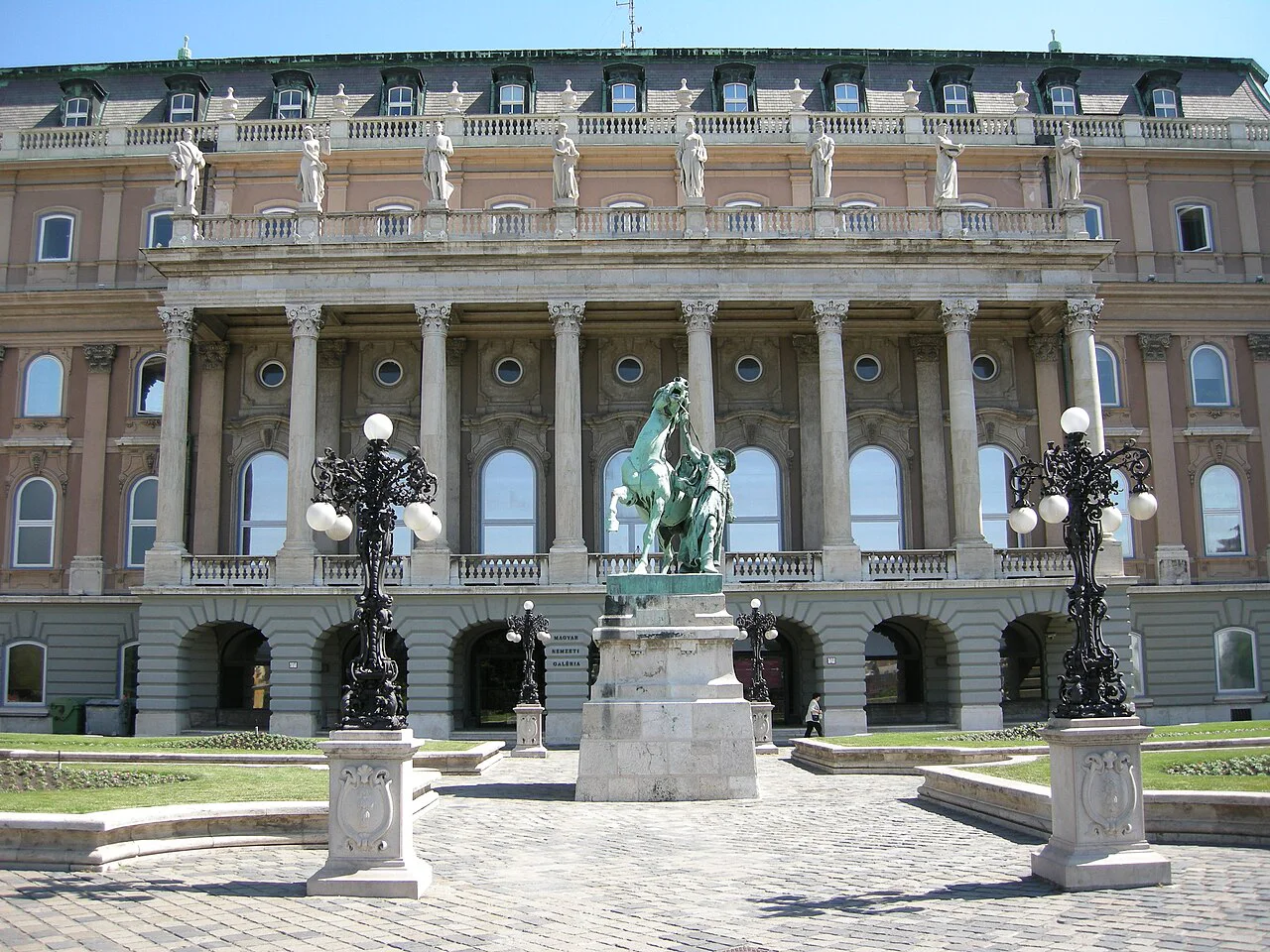
Budapest · 29 artworks
Hungarian National Gallery
Content & sources
Yoav Dothan · Public domain
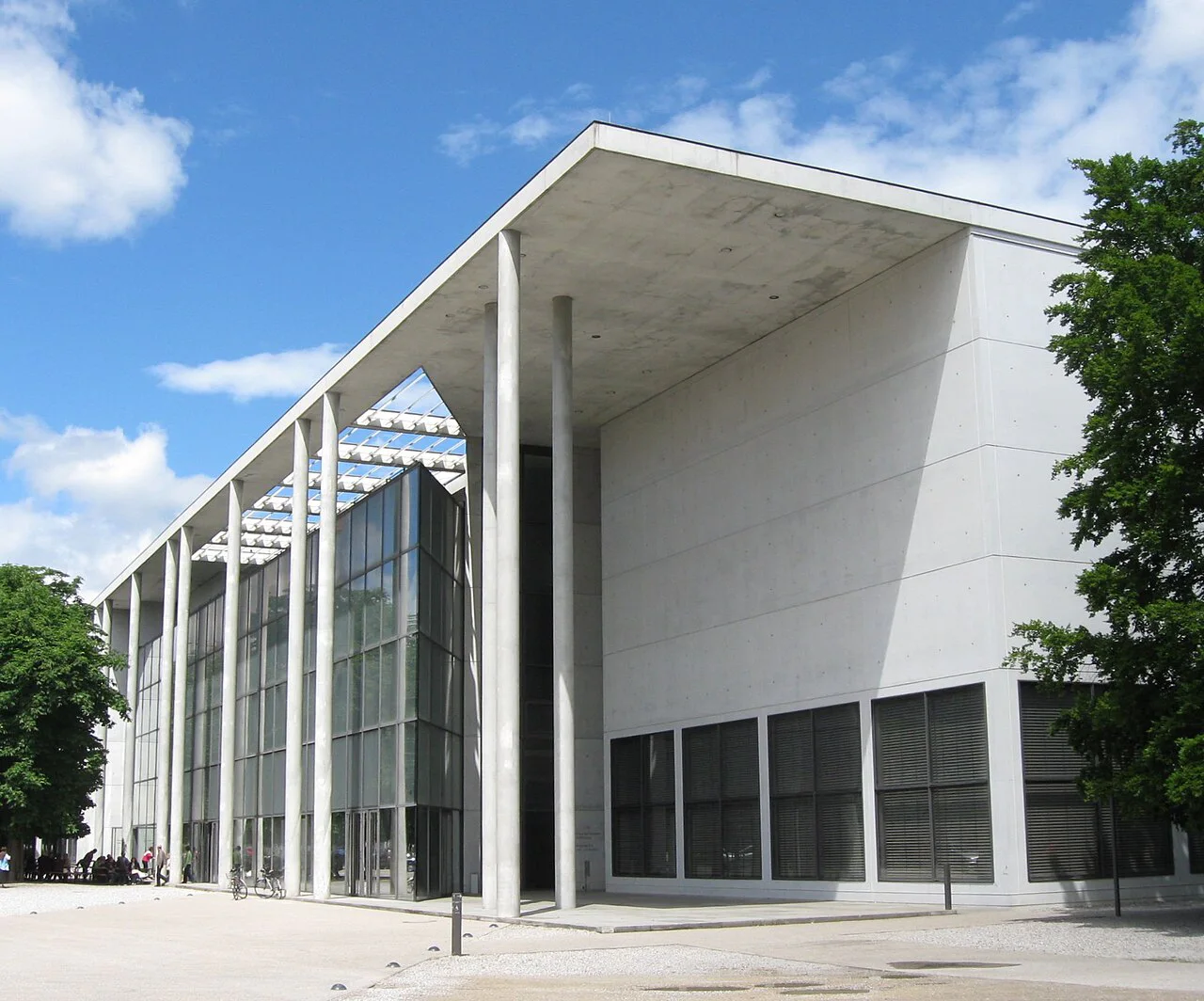
Munich · 6 artworks
Pinakothek der Moderne
Content & sources
Photo: Rufus46 · CC BY-SA 3.0
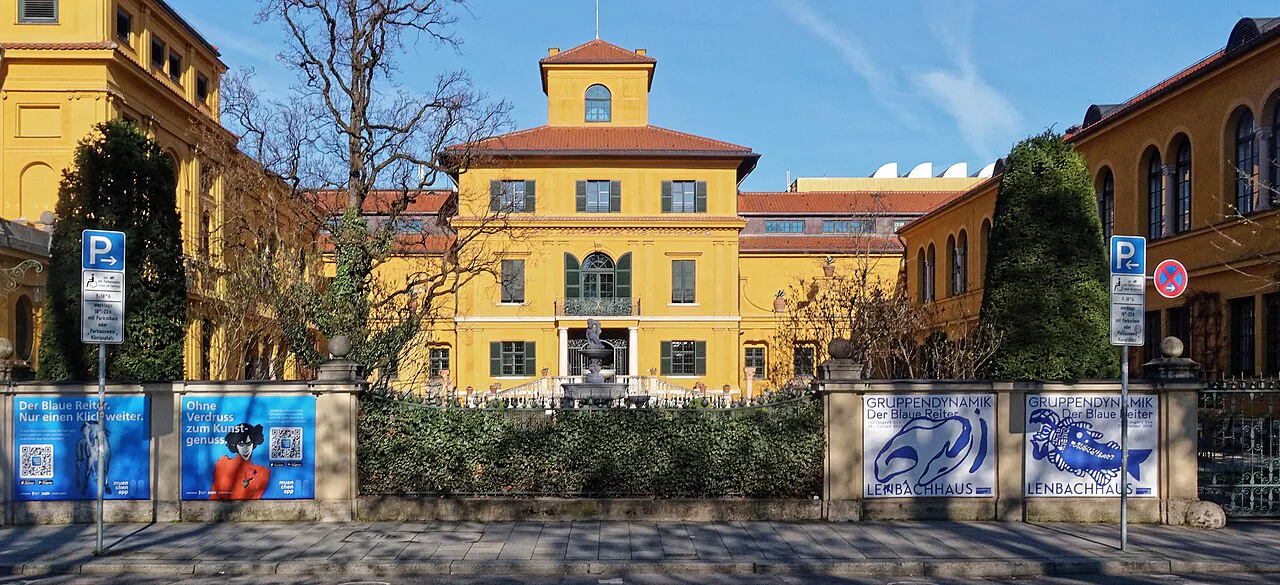
Munich · 33 artworks
Städtische Galerie im Lenbachhaus
Content & sources
Burkhard Mücke · CC BY-SA 4.0