Languages
15Palace of Westminster Audio Guide
Palace of Westminster is a landmark in City of Westminster, United Kingdom. Explore it with Stanza's GPS-triggered offline audio guide — available in 15 languages.
Quick Facts
24
Stops
15
Languages
100%
Offline
📍 City of Westminster, United Kingdom · 51.4994°N, -0.1242°E
About Palace of Westminster
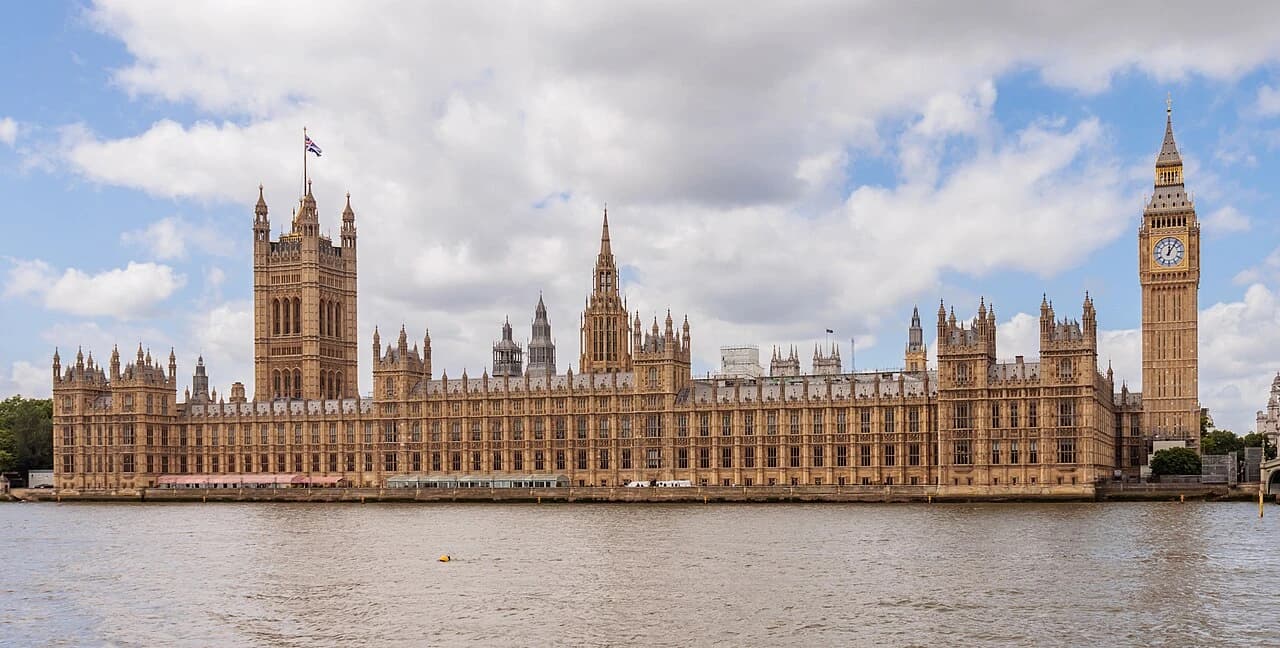
The Palace of Westminster is the meeting place of the Parliament of the United Kingdom. It is located in London, England.
Palace of Westminster is also known as Houses of Parliament, Westminster Palace, St. Stephen's.
This self-guided audio tour features 24 narrated stops organized across 6 sections, including The Victoria Tower and Sovereign's Entrance, Westminster Hall: The Medieval Heart, St Stephen's Hall, The Royal Gallery, The House of Lords Chamber, Members' Lobby and Political Icons. As a government building, Palace of Westminster offers a unique cultural experience in the heart of City of Westminster, United Kingdom.
The Stanza audio guide is available in 15 languages and works entirely offline — download the complete tour including audio narration, maps, and images before your visit. As you walk through Palace of Westminster, GPS-triggered narration plays automatically at each point of interest.
Last updated:
What you will hear
The Victoria Tower and Sovereign's Entrance
The starting point of the tour, focusing on the exterior majesty and the monarch's entrance. Includes the Victoria Tower POI and the Sovereign's Entrance POI.
The Sovereign's Entrance
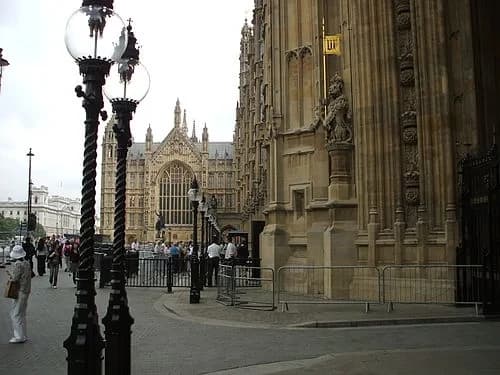
The large archway at the base of the Victoria Tower is known as the Sovereign's Entrance. It was designed with specific proportions to accommodate the massive royal carriage used during the State Opening of Parliament. This annual event is one of the few times each year when the three elements of Parliament—the Monarch, the House of Lords, and the House of Commons—come together in one place. The ritual is highly choreographed; the monarch travels from Buckingham Palace to this very spot to enter the building. From this high-status entrance, the monarch ascends the Sovereign's Staircase to reach the Norman Porch and the Royal Gallery. The interior of the palace is vast, containing roughly three miles of passageways that connect the hundreds of rooms and offices. Starting from grand areas like this, the hierarchy of the building is reflected in its decor, with the most lavish ornamentation reserved for the areas frequented by the Sovereign and the House of Lords. While much of the palace is accessible to the public and officials, this entrance remains a symbol of the constitutional link between the Crown and the legislative body that meets within these walls.
Westminster Hall: The Medieval Heart
Explores the oldest surviving part of the palace, covering its unique architecture and historical trials. Includes the Westminster Hall POI and Trial of Charles I POI.
Trial of Charles I, King of England, Scotland and Ireland
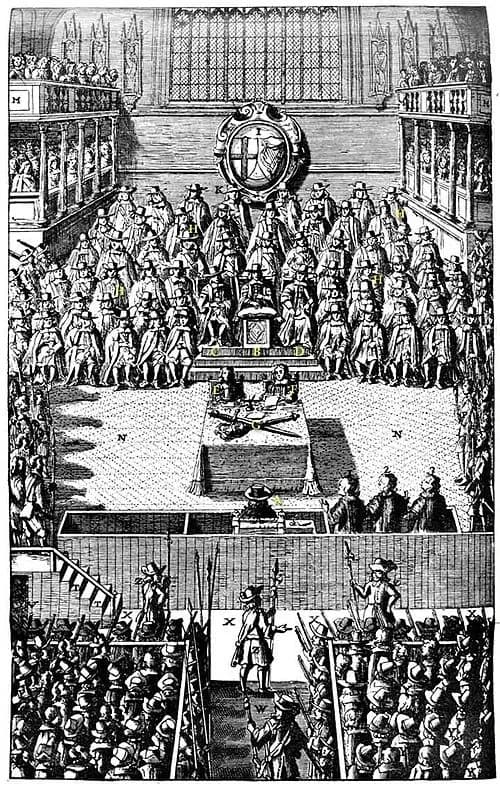
For centuries, Westminster Hall functioned as the primary seat of the English legal system. One of the most significant events to ever occur within these walls was the trial of King Charles I in January 1649. Following the English Civil War, the King was brought here to face a specially convened High Court of Justice. He was charged with high treason against the people of England. The trial was a radical departure from tradition, as it challenged the long-held belief in the Divine Right of Kings, asserting that even a monarch was subject to the law of the land. Charles I was ultimately found guilty and sentenced to death, leading to his execution shortly thereafter outside the Banqueting House in Whitehall. This was not the only famous trial held on this floor; other figures of immense historical importance were also judged here, including the Scottish knight William Wallace and Guy Fawkes, the most famous of the Gunpowder Plot conspirators. These trials transformed the hall from a royal feasting space into a site of profound constitutional and legal reckoning. Today, brass plaques set into the floor mark the exact spots where these figures stood during their trials, serving as a quiet reminder of the hall's long and often turbulent history as a place of judgment.
St Stephen's Hall
The public entrance hall built on the site of the original Commons chamber. Features the New Dawn artwork.
St Stephen's Hall
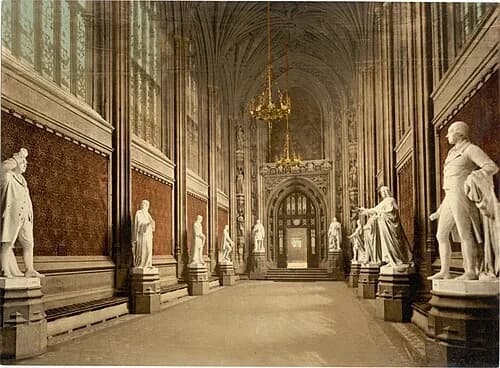
St Stephen's Hall is a space steeped in political history, standing directly on the site of the original St Stephen’s Chapel. From the mid-sixteenth century until the fire of 1834, this chapel served as the debating chamber for the House of Commons. For three hundred years, this was the room where the fundamental principles of British parliamentary democracy were forged. When the palace was rebuilt in the Victorian era, the architects chose to recreate the dimensions of the old chapel here to honor that heritage. The hall is lined with statues of famous British statesmen who once debated on this very spot, including influential figures like William Pitt the Younger and Charles James Fox. These figures are depicted in poses of oration, as if they are still engaged in the spirited arguments of their day. Today, St Stephen's Hall serves as the primary entrance for members of the public visiting Parliament. As visitors queue to enter the Central Lobby, they pass between these silent guardians of the past. The murals on the walls further illustrate scenes from British history, ensuring that even as a thoroughfare, the hall continues to educate visitors about the long evolution of the United Kingdom’s political system.
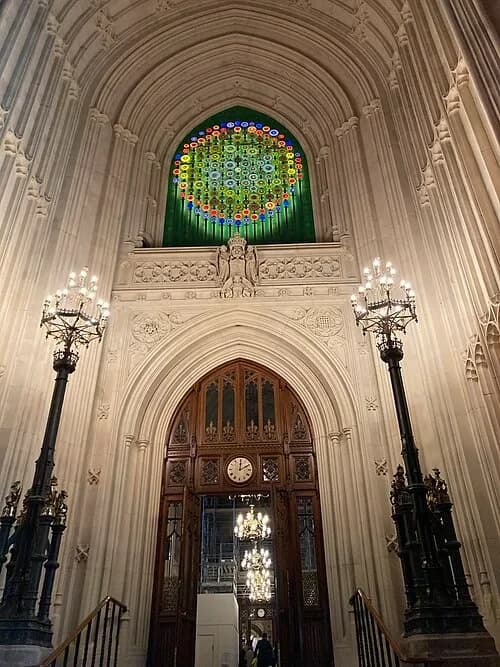
New Dawn
Located above the entrance to St Stephen's Hall is 'New Dawn,' a contemporary glass installation by artist Mary Branson. Unveiled in 2016, this work commemorates the long and difficult struggle for women's suffrage in the United Kingdom. It is composed of 168 hand-blown glass disks, arranged in a circular pattern that mimics the form of the portcullis, a long-standing symbol of Parliament. The colors of the glass—green, pink, and white—reflect the different factions of the suffrage movement, including the Suffragists and the Suffragettes. The most unique feature of the installation is its connection to the environment. The lights behind the glass disks are linked to the tide of the nearby River Thames. As the water rises, the installation glows more brightly, reaching its full illumination at high tide. This serves as a metaphor for the 'rising tide' of the women's movement, which grew in strength and momentum until the vote was finally won. By placing such a modern piece in a building dominated by Victorian and medieval history, the palace acknowledges that the story of democracy is still being written. It stands as a vibrant tribute to the thousands of women who campaigned for political equality, ensuring their legacy is visible to everyone who enters the building.
The Royal Gallery
A grand processional space dominated by massive military murals. Includes the Waterloo and Nelson POIs.
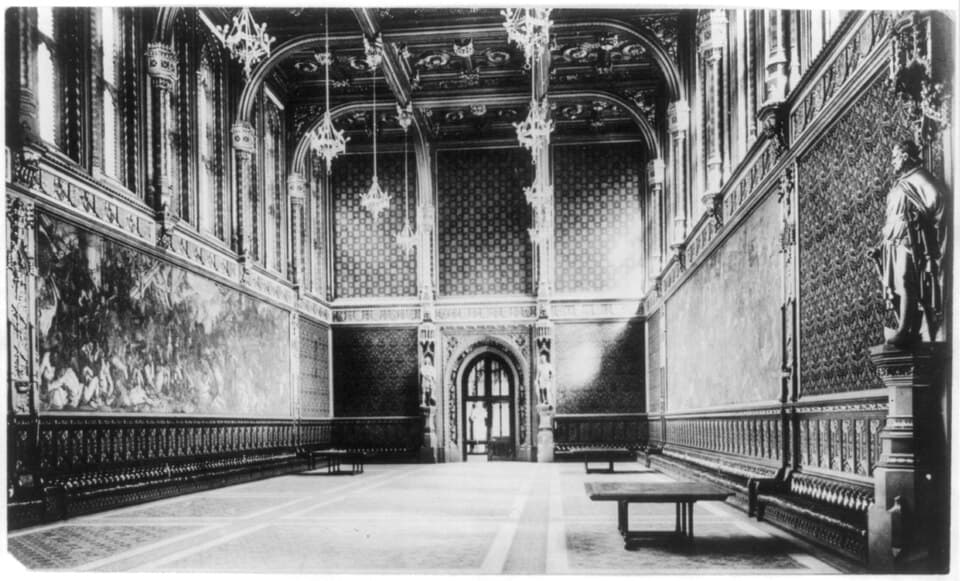
The Royal Gallery
The Royal Gallery is one of the largest and most impressive rooms in the palace, designed specifically to host royal processions and major state ceremonies. During the State Opening of Parliament, the monarch leads a grand procession through this space from the Robing Room to the House of Lords Chamber. The walls are decorated with two enormous murals, each forty-five feet long, which depict significant moments in British military history. The scale of the room, combined with its high gilded ceiling and elaborate floor, was intended to project the power and prestige of the British Empire at its height. Beyond its role in royal ritual, the Royal Gallery has served as a venue for significant diplomatic events. It is one of the few spaces in the building large enough to host joint meetings of both the House of Commons and the House of Lords. Because of this, it has been used for addresses by visiting foreign dignitaries, including French and United States presidents. These occasions underscore the palace's role not just as a domestic legislature, but as a site of international political significance. The statues of monarchs and the portraits of past leaders that line the walls provide a historic backdrop for these modern diplomatic encounters, bridging centuries of statecraft.
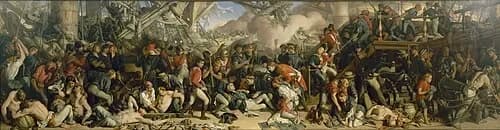
The Death of Nelson
Daniel Maclise · 1859 · canvas, oil paint
Facing the Waterloo mural in the Royal Gallery is its companion piece, 'The Death of Nelson,' also painted by Daniel Maclise. It depicts the mortal wounding of Vice-Admiral Horatio Nelson on the deck of his flagship, HMS Victory, during the Battle of Trafalgar in 1805. Unlike many heroized depictions of the era, Maclise chose to focus on the human chaos and medical reality of the naval battle. Nelson is shown surrounded by his officers and crew in the heat of the engagement, capturing the vulnerability of the commander even in his moment of greatest victory. This mural was revolutionary for state-commissioned art at the time because of its refusal to shy away from the grittier aspects of warfare. You can see the crowded, claustrophobic nature of life on a warship, with sailors of various backgrounds working together while their leader lies dying. The attention to historical detail, from the uniforms to the rigging of the ship, is exceptional. Like its companion across the room, it was painted using the water-glass technique. Together, these two massive works flank the space where royal processions pass, reminding those in power of the sacrifices made at sea and on land to secure the nation's interests, blending national myth-making with a stark, documentary-style approach to history.

The Meeting of Wellington and Blücher after the Battle of Waterloo
Daniel Maclise · 1861 · waterglass
Dominating one side of the Royal Gallery is Daniel Maclise’s monumental mural, 'The Meeting of Wellington and Blücher after the Battle of Waterloo.' Painted between 1858 and 1861, this work is forty-five feet long and captures the pivotal moment on the evening of June 18, 1815. The Duke of Wellington and the Prussian Marshal Gebhard Leberecht von Blücher meet amidst the devastation of the battlefield to celebrate their decisive victory over Napoleon Bonaparte. The scene is filled with a sense of grim reality, showing the exhausted soldiers and the wounded scattered across the ground. To create a work of this scale that would last, Maclise used a technique known as 'water-glass' or mineral painting. This involved applying pigments in a silicate solution, which was intended to fuse the paint with the wall itself. This method was chosen specifically to prevent the colors from fading or peeling in the notoriously damp and polluted air of nineteenth-century London. While the technique proved challenging to master, it allowed Maclise to achieve a remarkable level of detail and color depth. The mural remains one of the most significant pieces of nineteenth-century history painting in Britain, serving as a permanent memorial to a victory that shaped the course of European history for a century.
The House of Lords Chamber
The most lavishly decorated room in the palace, focusing on the Throne and red benches. POI House of Lords.
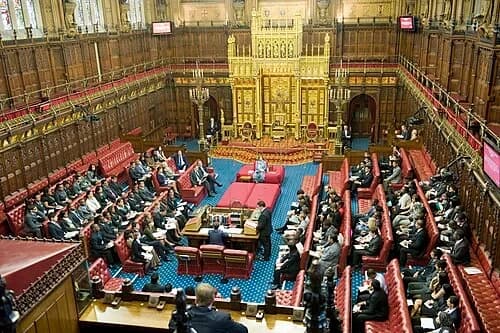
The House of Lords Chamber
The House of Lords Chamber is the most lavishly decorated room in the entire palace, a stark contrast to the more functional and austere design of the House of Commons. The space is dominated by a rich red-and-gold color scheme, which has traditionally signaled its status as the 'Upper House.' The walls are lined with ornate wood carvings and frescoes, while the ceiling is a masterwork of gilded detail. Lining the floor are the famous red leather benches where the members of the House sit. These include the Lords Temporal, who are appointed peers, and the Lords Spiritual, who are bishops of the Church of England. This chamber is the site of many of the UK's most significant constitutional rituals, most notably the State Opening of Parliament. The sheer scale and opulence of the decoration were intended to reflect the historical weight and authority of the House of Lords. Every element, from the stained glass windows depicting monarchs to the brass work on the gallery railings, was designed by Augustus Pugin to create a sense of medieval grandeur. While the House of Commons is the primary site of legislative debate today, the Lords Chamber remains a vital space for the scrutiny of laws and serves as a powerful visual reminder of the ancient traditions that still underpin the British parliamentary system.
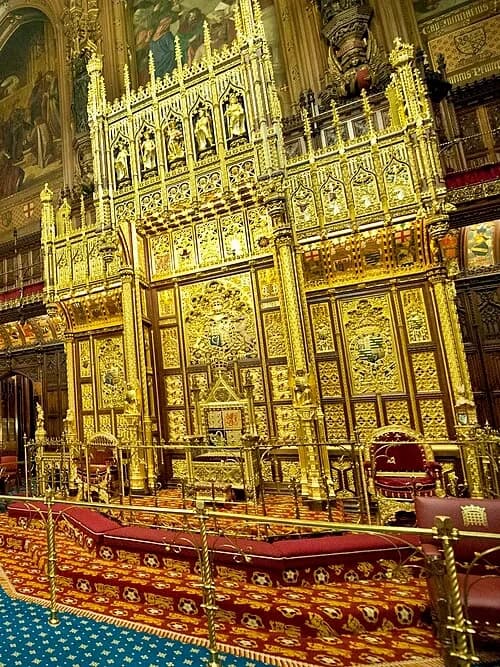
The Sovereign's Throne
At the far end of the House of Lords Chamber stands the Sovereign's Throne, perhaps the most iconic and intricately decorated object in the entire palace. Designed by Augustus Pugin, the throne is situated beneath a massive gilded canopy that is a masterpiece of Victorian craftsmanship. The throne itself is actually a Chair of State, used by the monarch during the annual State Opening of Parliament. It is from this seat that the 'Speech from the Throne' is delivered, outlining the government's legislative agenda for the upcoming session. The level of detail on the throne is extraordinary, featuring complex wood carvings, gold leaf, and high-quality upholstery. The design incorporates many heraldic symbols, including the royal coat of arms, lions, and unicorns, which represent the authority of the Crown. Pugin’s design was meant to evoke the majesty of a medieval king, even within the context of a nineteenth-century constitutional monarchy. Although it is the focal point of the chamber, the throne is only used once a year, remaining empty during the regular debates of the Lords. It stands as a silent symbol of the monarch's role in the parliamentary process, and its incredible ornamentation makes it one of the most photographed and recognized pieces of furniture in the world.
Members' Lobby and Political Icons
The hub for Members of Parliament, featuring statues of Winston Churchill and Margaret Thatcher. Includes POIs for the Lobby and statues.
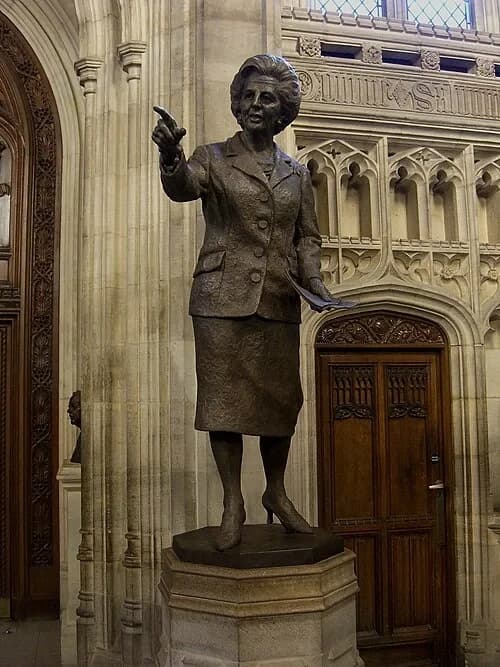
Statue of Margaret Thatcher
Antony Dufort · 2007
Directly opposite the figure of Winston Churchill stands the first statue of a female Prime Minister to be erected in the House of Commons. Unveiled in 2007, this likeness of Margaret Thatcher captures her in a characteristic pose, with one hand raised and her head tilted slightly as if she is in the middle of a sharp parliamentary exchange. Thatcher served as Prime Minister from 1979 to 1990, a period of significant social and economic change in Britain. Placing her here creates a balanced pair of 20th-century leaders at the threshold of the chamber. Unlike Churchill’s statue, which is often touched by MPs, Thatcher's statue stands on a slightly higher plinth, reflecting her formidable and often polarizing presence in British politics. The sculptor aimed to capture her 'Iron Lady' persona, focusing on the sharp tailoring of her suit and the determined expression she often wore during Prime Minister's Questions. Her presence in the lobby serves as a reminder of the barrier she broke as the first woman to lead a major British political party and the nation. The statue is positioned so that her gaze seems to meet Churchill’s across the busy floor of the Members' Lobby.
Want to hear the rest?
Download the Stanza app to unlock all 24 stops and full GPS-guided navigation.
Frequently Asked Questions
How long does the Palace of Westminster audio tour take?
The Palace of Westminster audio guide includes 24 narrated stops. Most visitors spend 45 minutes to 1.5 hours exploring the complete tour, though you can listen at your own pace and skip or revisit any stop.
Is the Palace of Westminster audio guide available in my language?
Stanza supports 15 languages: English, Spanish, French, German, Italian, Portuguese, Russian, Japanese, Chinese, Korean, Arabic, Hindi, Polish, Dutch, Hebrew. Check the guide in the app to confirm the languages currently available for this tour.
Can I use the audio guide offline at Palace of Westminster?
Yes! Download the complete Palace of Westminster tour — including all audio, maps, and images — before your visit. The Stanza app works completely offline, so you don't need WiFi or mobile data at the venue.
How much does the Palace of Westminster audio guide cost?
The Stanza app is free to download. The current listed price for the Palace of Westminster audio guide is $2.99; app-store region and currency may affect the final price.
How do I use the Stanza audio guide at Palace of Westminster?
Download the free Stanza app, search for "Palace of Westminster", and download the tour. When you arrive at the venue, the app uses GPS to detect your location and automatically plays the relevant narration as you move between points of interest — completely hands-free.
What makes the Stanza audio guide different from other Palace of Westminster tours?
Stanza offers GPS-triggered narration that plays automatically as you walk through Palace of Westminster — no need to manually select stops. The tour is available in 15 languages, works fully offline, and includes 24 expertly narrated stops with images and historical context.
What other audio guides are available near Palace of Westminster?
Stanza offers multiple audio guides in City of Westminster, United Kingdom and nearby areas. After downloading the app, browse the map to discover all available tours near Palace of Westminster. Each guide can be downloaded for offline use.
Nearby Audio Guides
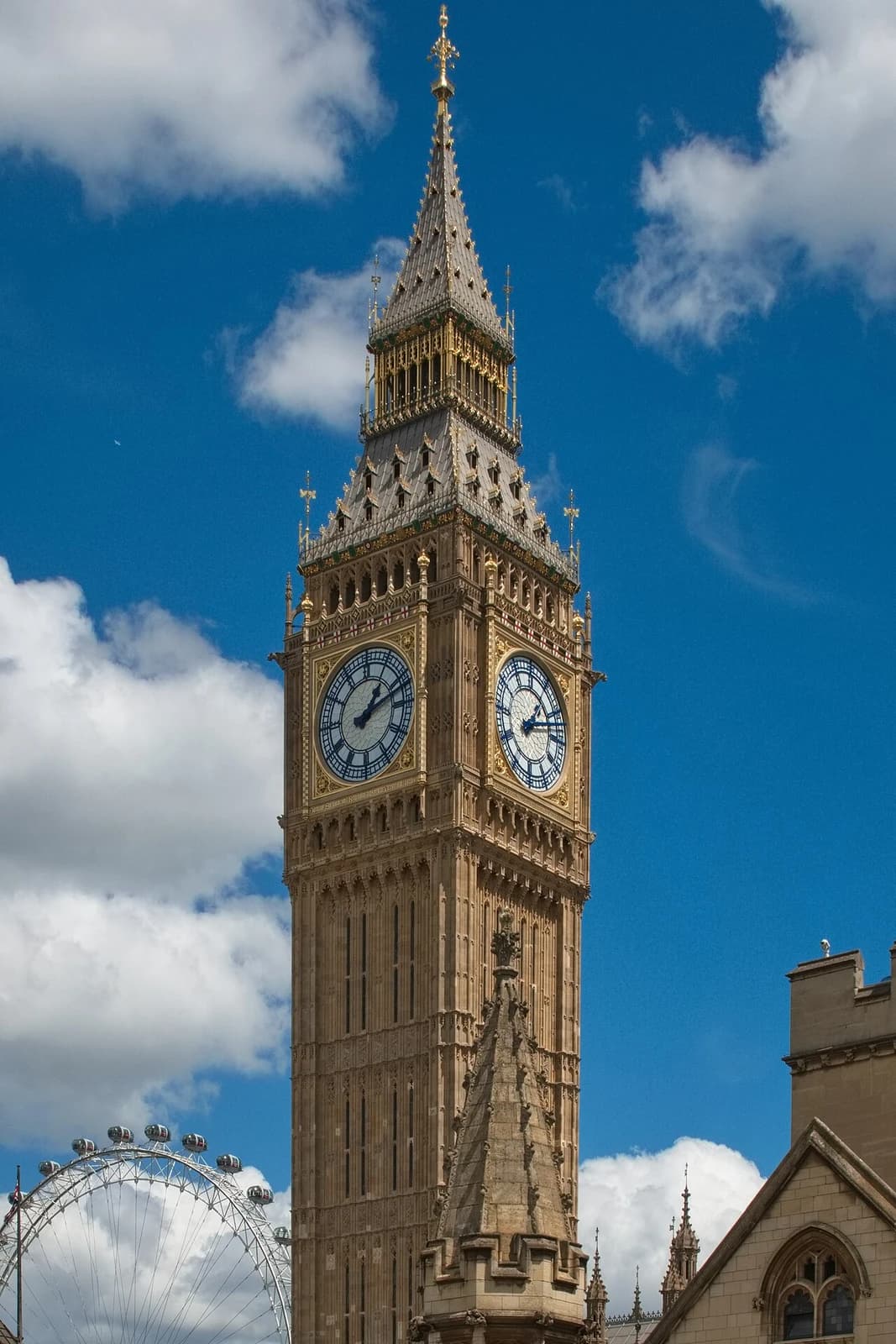
Big Ben
City of Westminster, United Kingdom
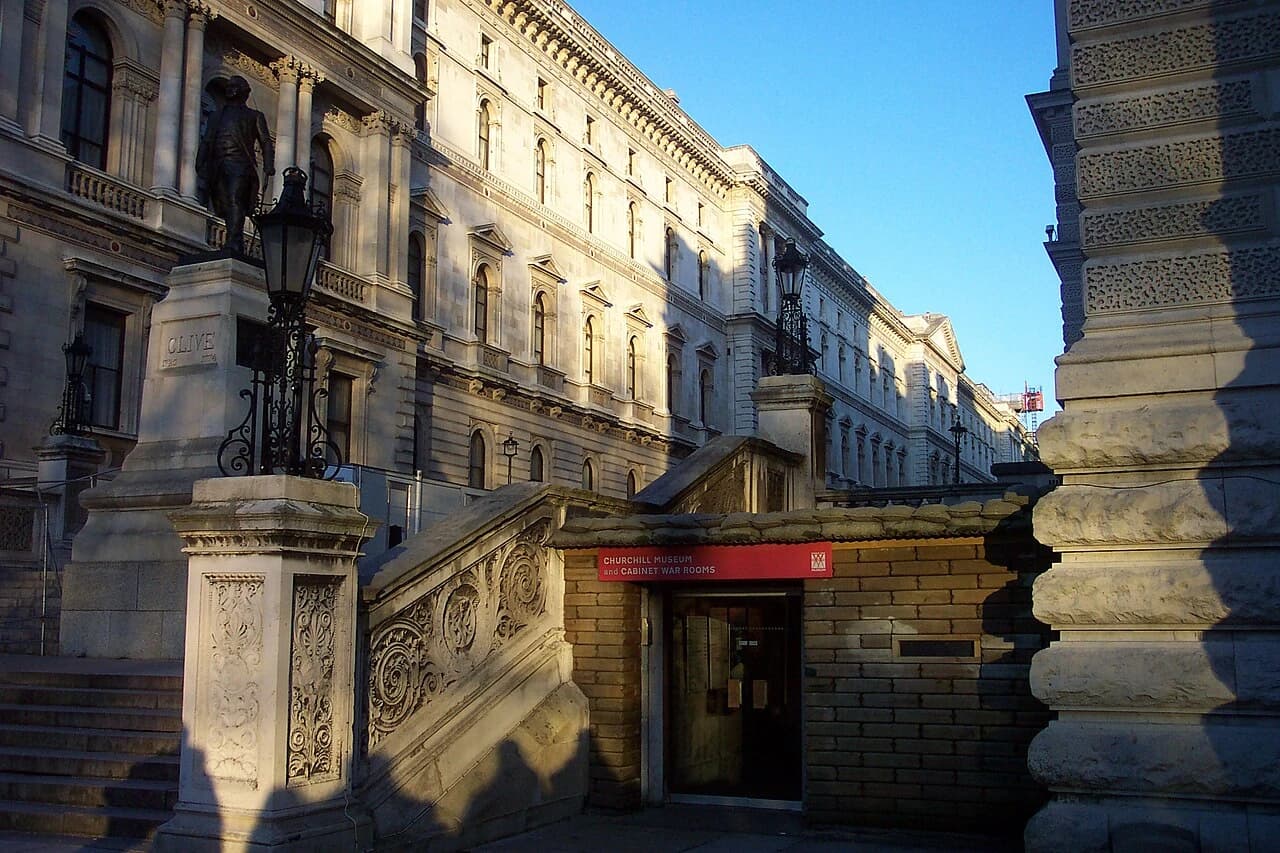
Churchill War Rooms
City of Westminster, United Kingdom
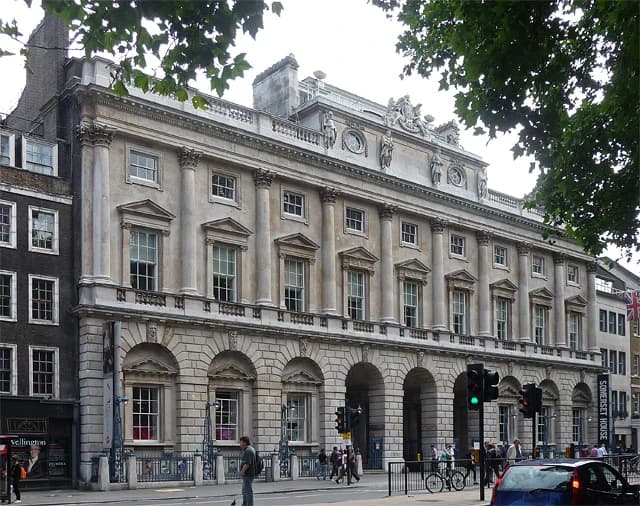
Courtauld Institute of Art
City of Westminster, United Kingdom
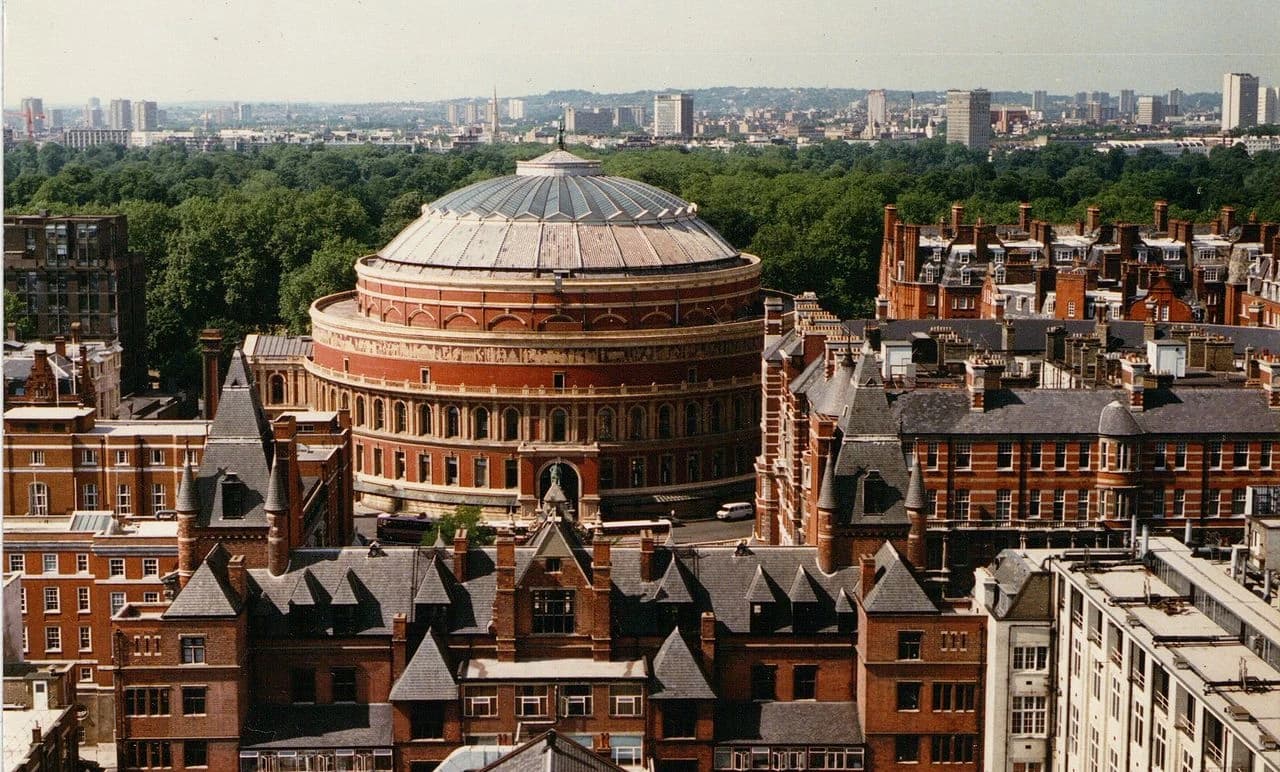
Royal Albert Hall
City of Westminster, United Kingdom
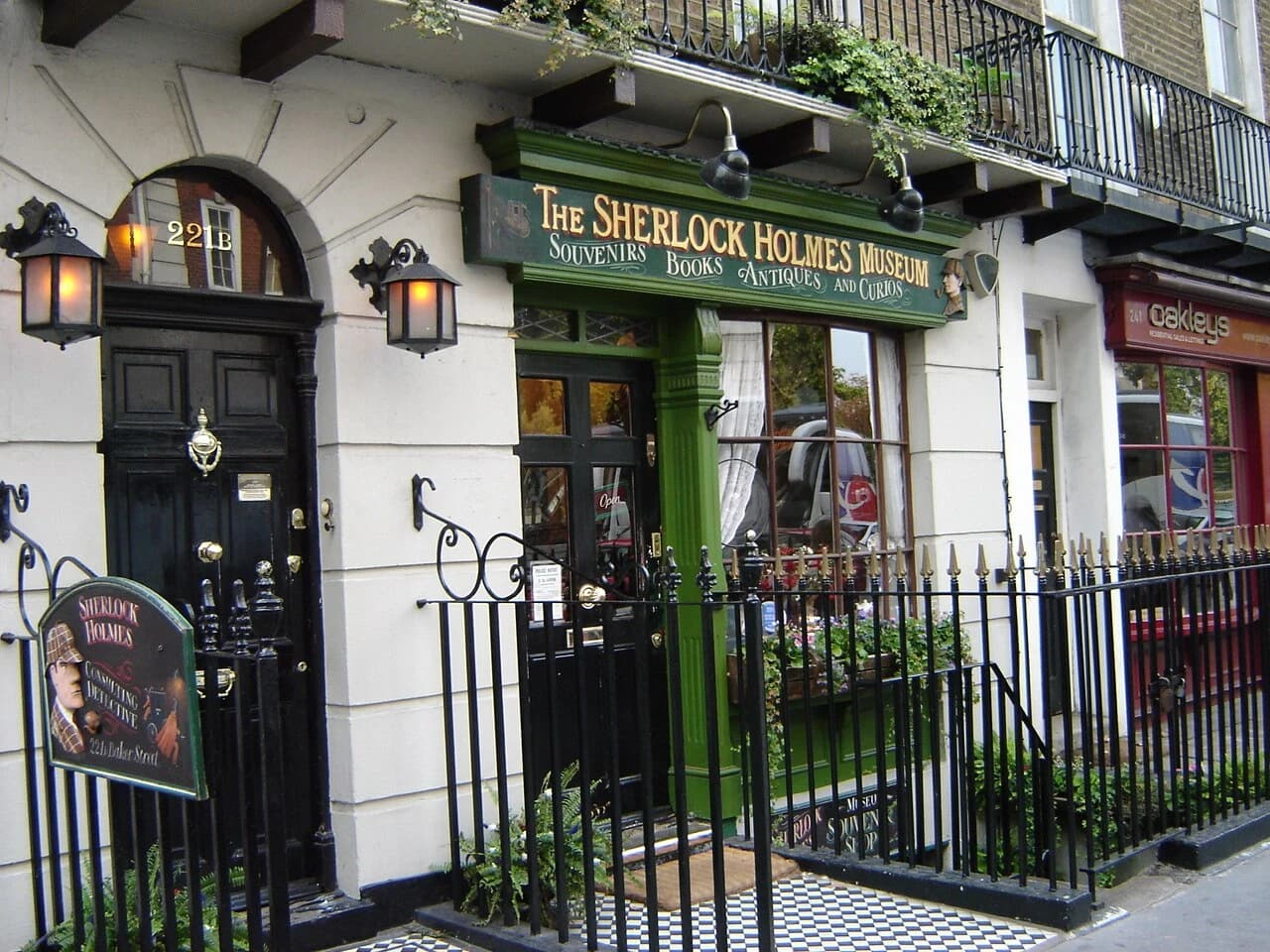
Sherlock Holmes Museum
City of Westminster, United Kingdom
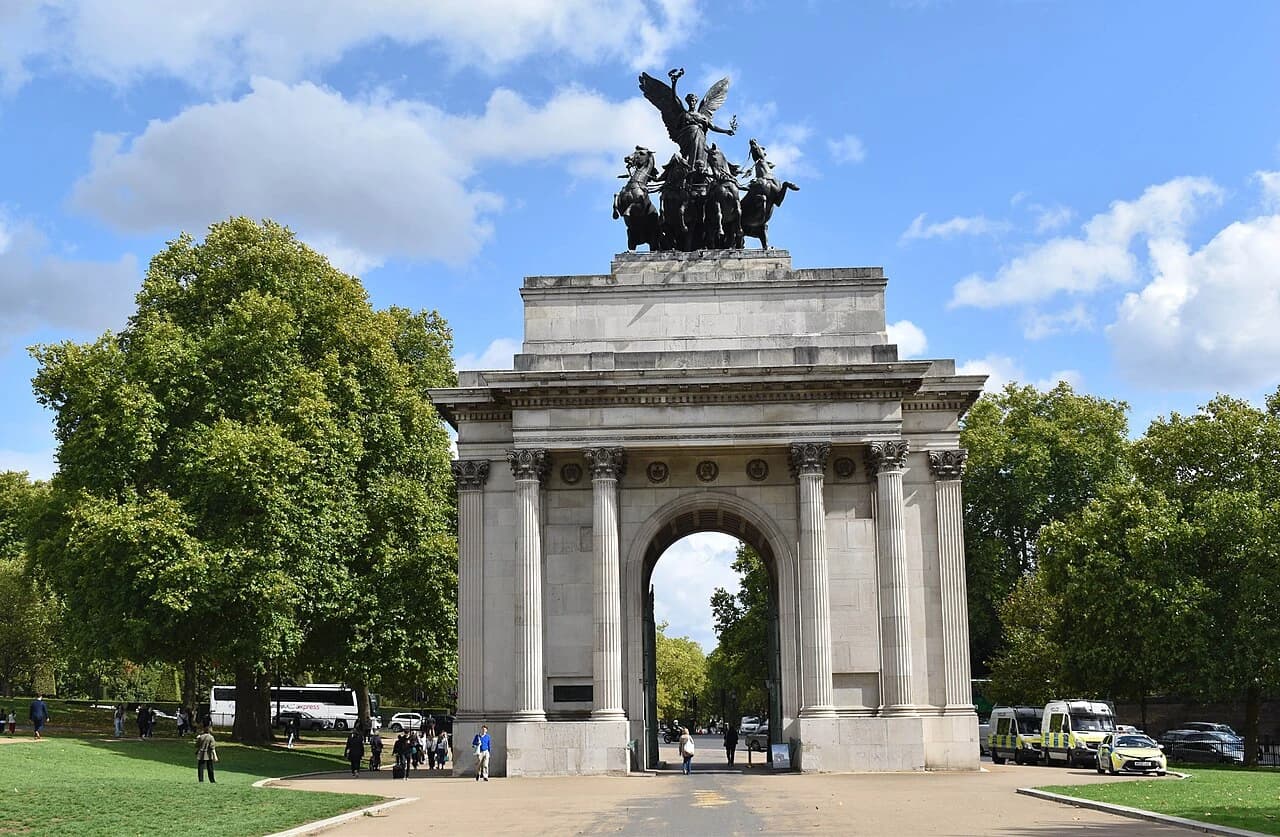
Wellington Arch
City of Westminster, United Kingdom