Stanza · Audio guide
Palazzo della Pilotta Audio Guide
A place to remember. A story to take with you.
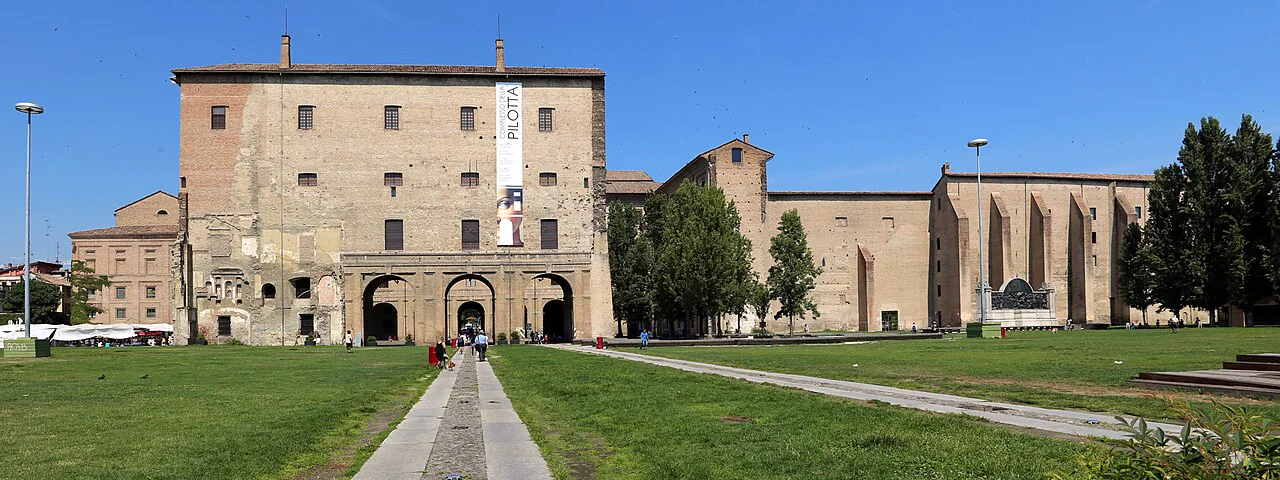
The Palazzo della Pilotta is a complex of edifices located between Piazzale della Pace and the Lungoparma in the historical centre of Parma, in the region of Emilia-Romagna, Italy. Its name derives from the…
Download Stanza, then search for “Palazzo della Pilotta”.
About the tour
One guide. Your kind of visit.
The Palazzo della Pilotta is a complex of edifices located between Piazzale della Pace and the Lungoparma in the historical centre of Parma, in the region of Emilia-Romagna, Italy. Its name derives from the game of pilota played at one time by Spanish soldiers stationed in Parma.
The Palazzo della Pilotta guide tells the stories of 62 artworks, including Head of a Woman (Leonardo da Vinci), Healing of the Man Born Blind (El Greco), Biblioteca Palatina di Parma (G. Gabelli), Madonna della Scodella (Antonio da Correggio), Turkish Slave (Parmigianino), Lamentation over the Dead Christ (Antonio da Correggio), Madonna of St. Jerome (Antonio da Correggio), and Madonna and Child with Saints Michael the Archangel and Andrew (Giovanni Battista Cima da Conegliano). Every artwork is free to hear in the Stanza app until 1 January.
Ready when you are.
- 01Get the free Stanza app.
iOS & Android
- 02Find your guide.
“Palazzo della Pilotta”
- 03Download before you go.
Works offline
Audio guide / 62 artworks
Inside the guide
Get to know a few of the stories before you go. Open a stop to read more.
01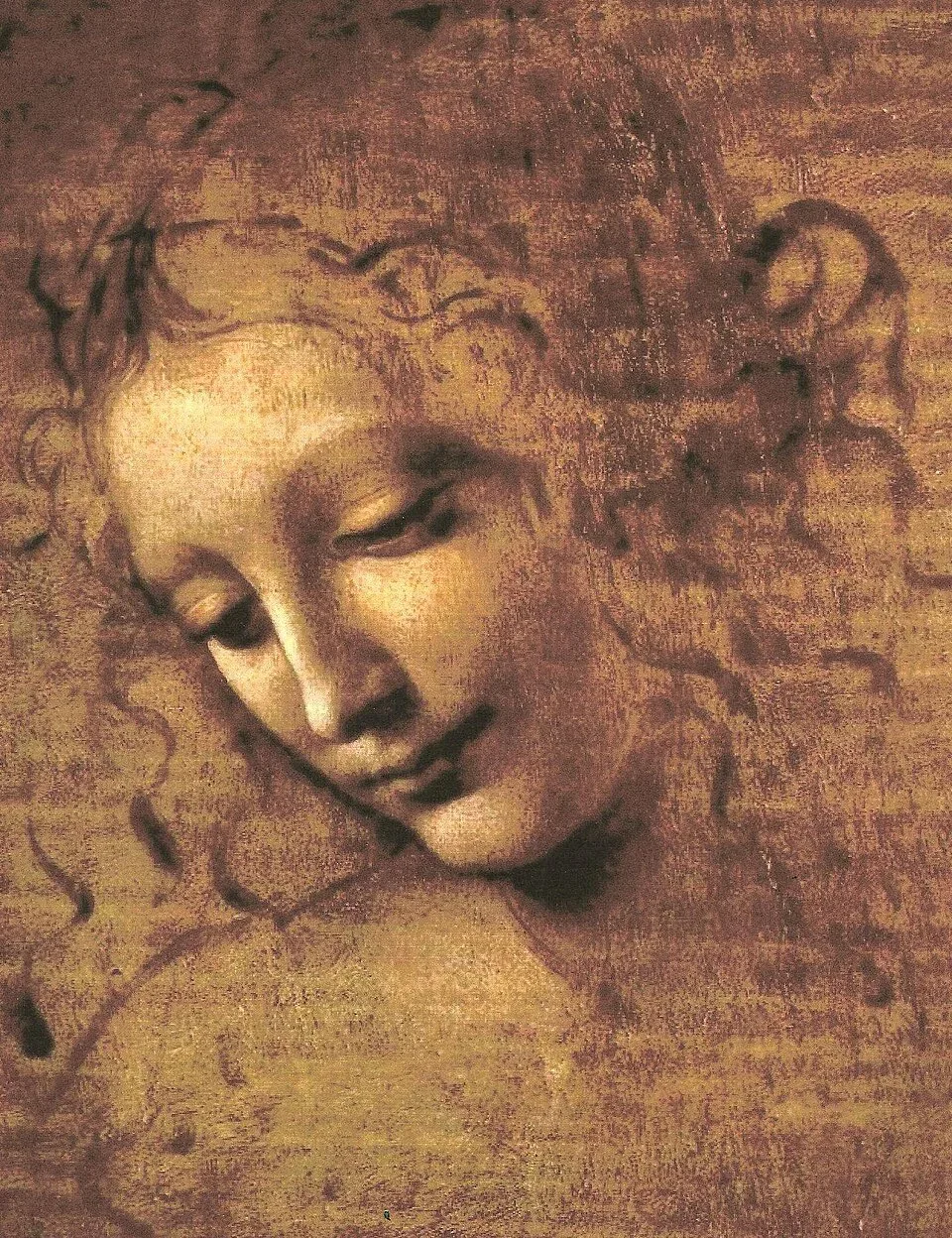
Head of a Woman
Only the face was finished. It takes up nearly the whole panel, and everything around it is barely sketched, the background still bare. She looks down, her head bowed and her eyes half closed, while her loose hair waves behind her. The shadows on her face are softened so gently that no brushstroke shows, along the left side of her jaw. Perhaps it was meant to be left this way. Such a private image may have been made for a single patron. Isabella d'Este was a leading woman of the Italian Renaissance at the Gonzaga court in Mantua. In 1501 she asked Leonardo for a Madonna for her private studio, and this could be that picture. She probably passed it to her son when he married. By 1627 an inventory calls it the head of a dishevelled woman by Leonardo. It disappears from view, possibly stolen when Mantua was sacked in 1630, and does not resurface until 1826, in a private collection in Parma.
Listen in the appLeonardo da Vinci · Public domain
02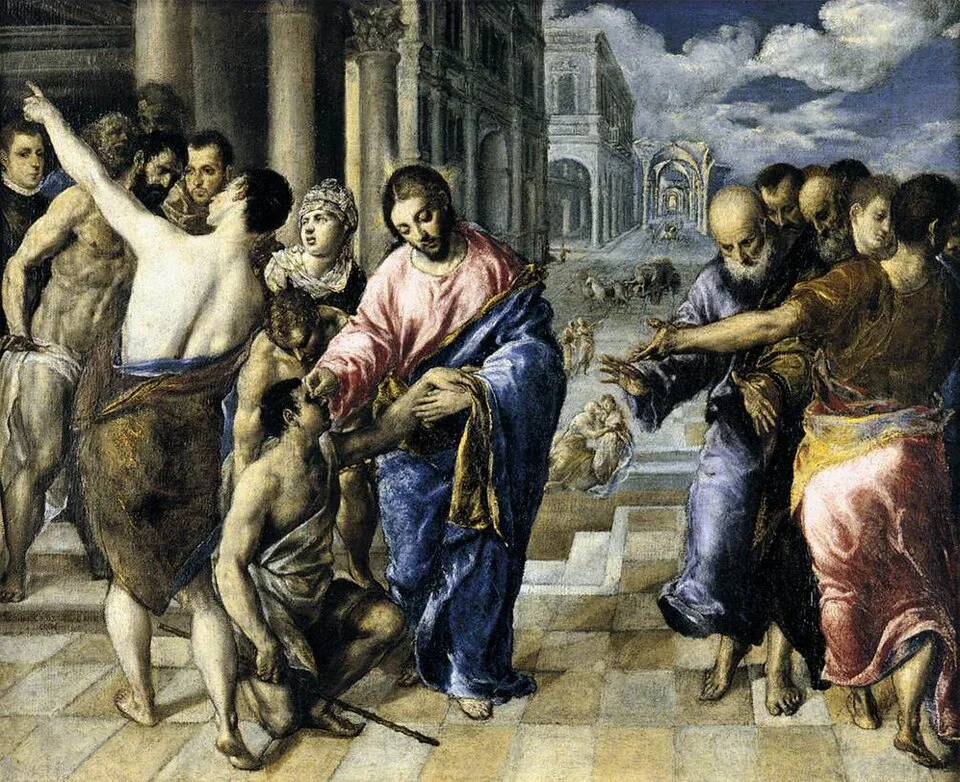
Healing of the Man Born Blind
Nobody can say for certain who stands in this crowd. In the group on the left, one face may be the young Alexander Farnese, Duke of Parma. In the middle of the line is Cardinal Ranuccio Farnese, painted after his death. Neither face appears in the other two paintings of this miracle. The picture was most likely ordered by Cardinal Alessandro Farnese himself, which would explain why his own relatives stand among the onlookers. Giulio Clovio, who made miniatures for the Farnese, had recommended the painter, and the cardinal's librarian, Fulvio Orsini, admired him. In the foreground, Christ opens the eyes of a man born blind. Christian Europe was split between Catholics and Protestants. In that crisis, the picture can be read as saying that the Church of Rome, like Christ, alone can open people's eyes to the true faith. At the far left, a young man looks straight out at you. That may be El Greco himself, and he looks nearer twenty than thirty.
Listen in the appEl Greco · Public domain
03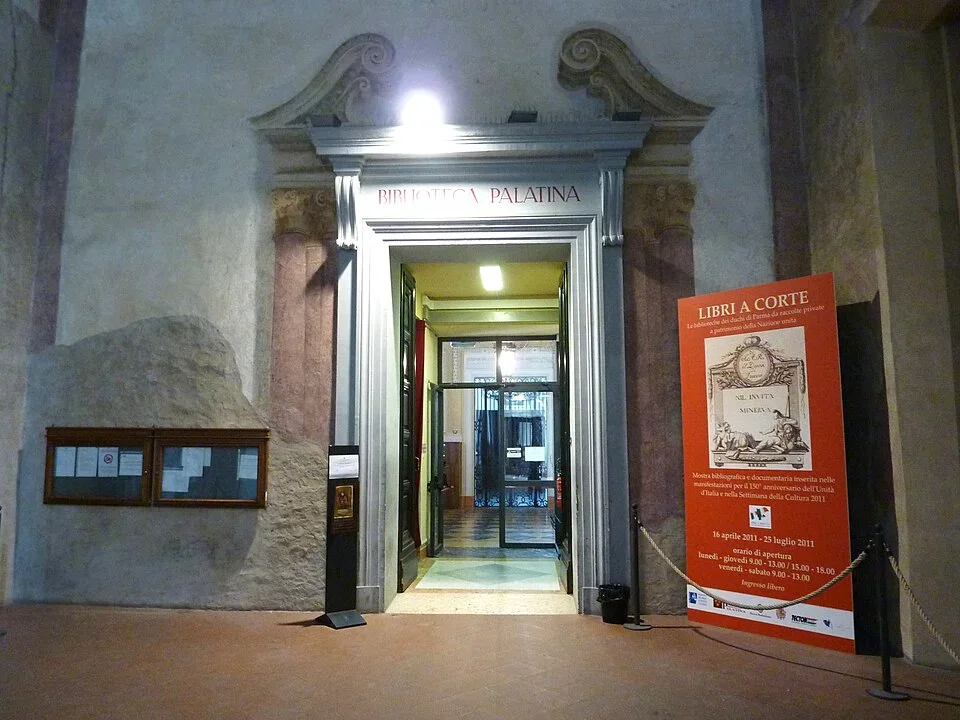
Biblioteca Palatina di Parma
The marble bust in the reading room shows Maria Luigia. She was the duchess who gave this library its Hebrew manuscripts, and they changed what it holds. The library was founded in 1761 by Duke Filippo as a public library for Parma. But filling the shelves proved hard. The Farnese collection, once kept here, had been carried to Naples by Filippo's own brother. The first librarian, Paolo Maria Paciaudi, failed to buy two collections he had hoped for. He ended up shopping for books on the open market. Then Maria Luigia, through her librarian Angelo Pezzana, bought the collection of Giovanni Bernardo De Rossi. He was a scholar of Hebrew, and most of the collection was ancient Hebrew volumes. She gave it to the library. Today the Hebrew holdings run to about sixteen hundred manuscripts. They date from the Middle Ages to the nineteenth century, and most were once De Rossi's. There is a room named for him, the Biblioteca Derossiana. This is why the library holds the largest collection of Hebrew manuscripts in Italy. Whether it is also the largest in the world is not certain.
Listen in the appG. Gabelli · CC BY-SA 3.0
04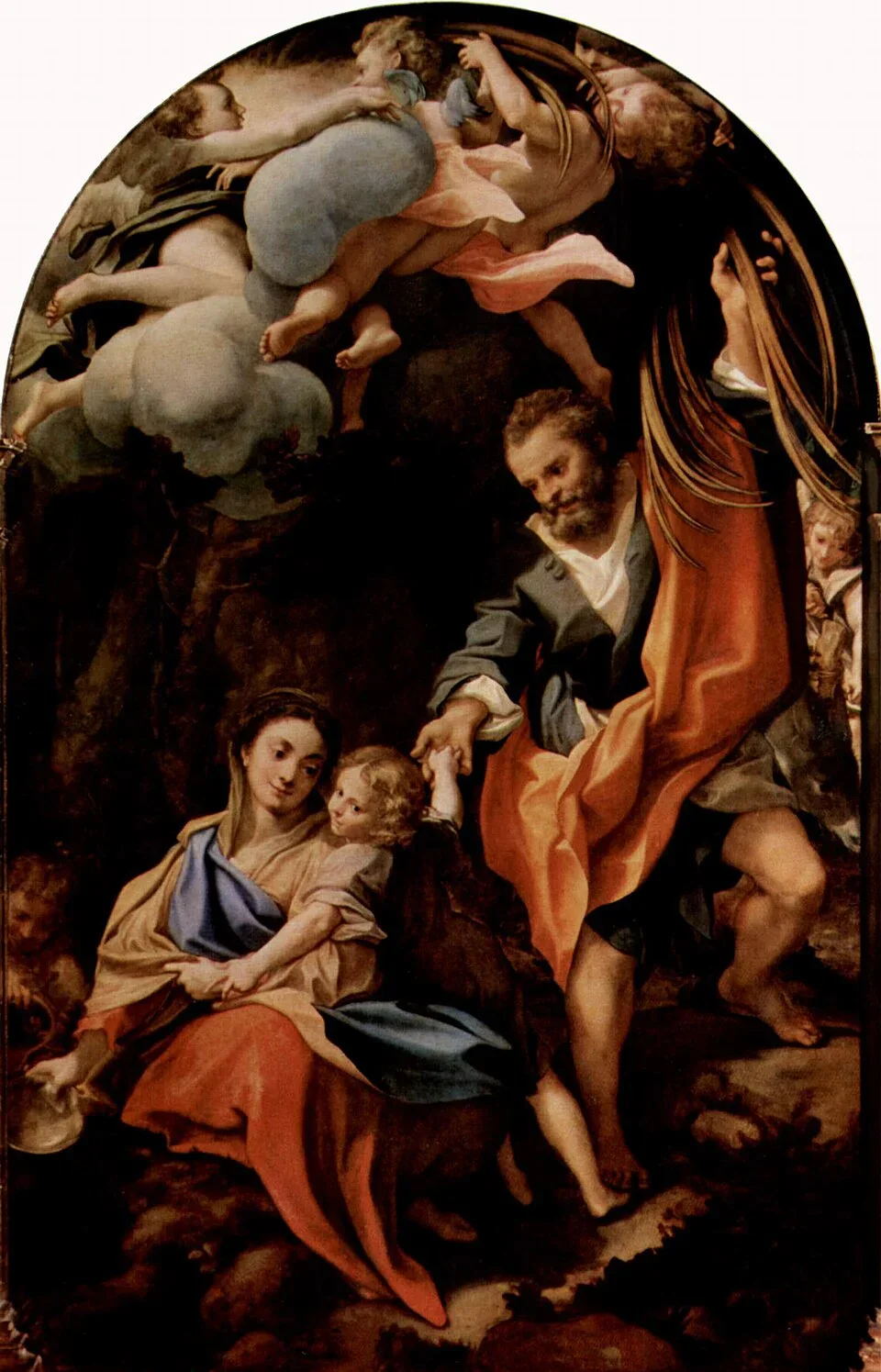
Madonna della Scodella
A silver bowl sits at the left edge, and from it a line runs through the joined hands of three figures. Mary, Jesus and Joseph have stopped under a date palm, with angels spiraling above them. The scene is a miracle told in the Gospel of Pseudo-Matthew. On the road back from Egypt, the family rested in the palm's shade, and the tree bent down to offer its fruit. Water appeared in the bowl to quench Jesus' thirst. That is why the painting carries the bowl's name. Mary gathers the fruit the palm holds out, and the angels above recall the Assumption fresco in the dome of Parma Cathedral. Yet the figure this whole altarpiece was built around is Joseph. His hand is part of that line. He has the leading role because the fraternity who commissioned the painting wanted him there, for an altar of Saint Joseph. Correggio gave the plain bowl the same importance he gave the basket in his Madonna of the Basket. The painting was probably commissioned in 1524, when a dying man, Cristoforo Bondini, left fifteen lire for a painting on that altar.
Listen in the appAntonio da Correggio · Public domain
05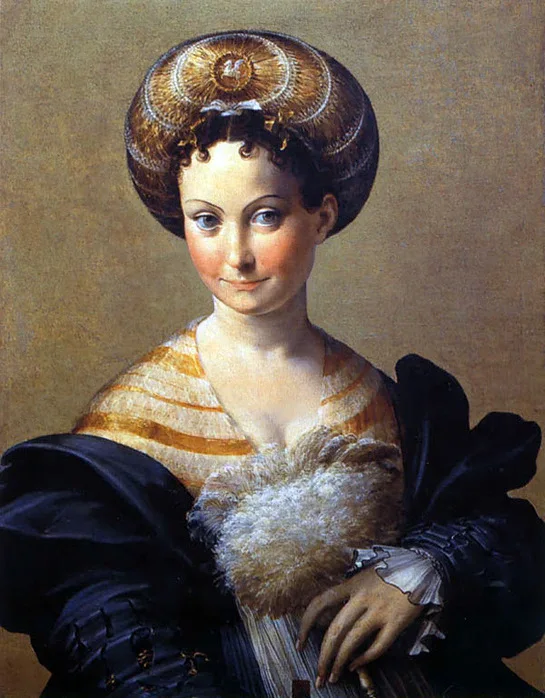
Turkish Slave
For a long time this woman has been called a Turkish slave, and it began with her hat. Someone took the gold cap on her head for a turban, and the name stuck. But that cap is a balzo, a doughnut-shaped headdress woven with gold thread and worn by the noblewomen of her time. It was probably invented for Isabella d'Este. Her indigo satin dress sits low on her shoulders, with large puffed sleeves. Look closely and you will see, at the center of the cap, a small medallion showing Pegasus, perhaps a metaphor of love. In her hand she holds a feather fan, and Parmigianino painted the feathers with tiny, careful strokes. She looks straight at you with a sly, hard-to-read smile. And on one slender finger she wears a small gold ring. Perhaps it marks a recent marriage, which would make this woman a young bride after all.
Listen in the appParmigianino · Public domain
06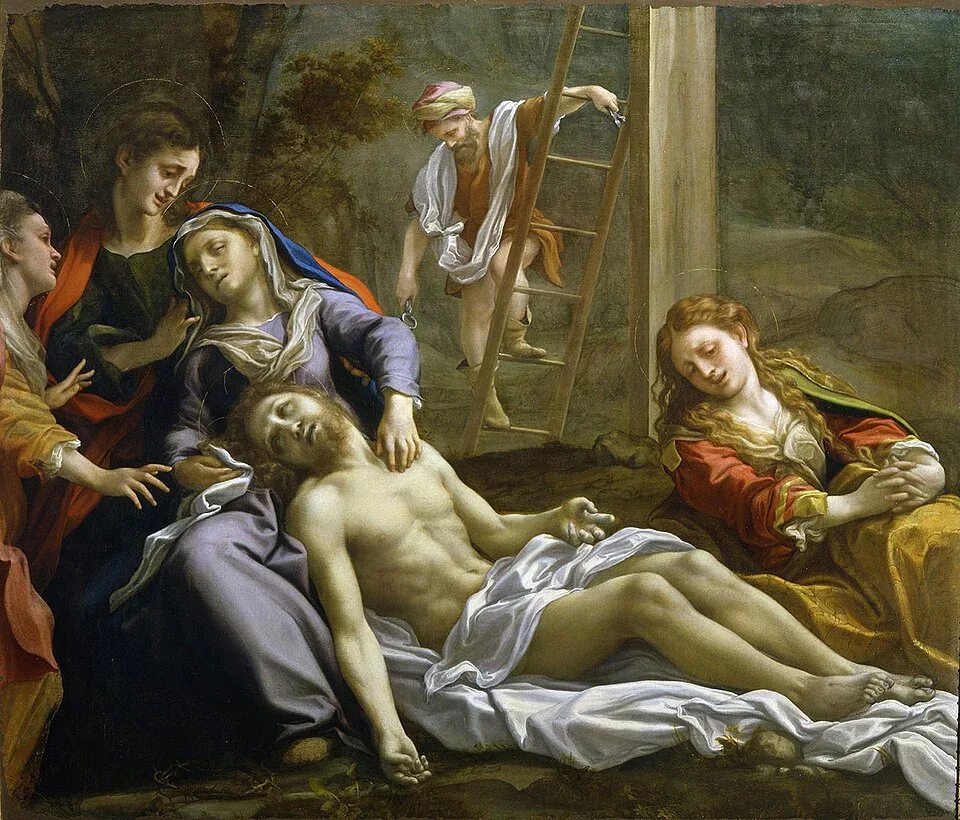
Lamentation over the Dead Christ
Christ has only just been lowered from the cross. His mother has fainted, and Saint John and another Mary are holding her up. At his feet Mary Magdalene has rushed forward, her hands clasped, her hair loose, her face twisted with grief. Behind them Nicodemus is climbing down the ladder, still holding the pincer that pulled out the nails. Of the cross, almost nothing remains but its base. This is the instant Correggio chose. Other painters of this subject showed the body coming down, or prayers later over the anointed body. He wanted the first rush of grief, the moment those closest to him gathered around the body. He laid Christ across his mother's lap, her face close above his, and set the whole group along a diagonal. Placido Del Bono wanted the painting for his chapel in the church of San Giovanni Evangelista in Parma. Correggio had just finished the fresco on the dome there, and the commission probably came from that success. The canvas went on the right wall, facing a painting of four saints being martyred on the left. It was made for people coming through the chapel door, who viewed it from the side. That is why the scene leans. The figures are cut off at the edges, probably because of the chapel's size.
Listen in the appAntonio da Correggio · Public domain
07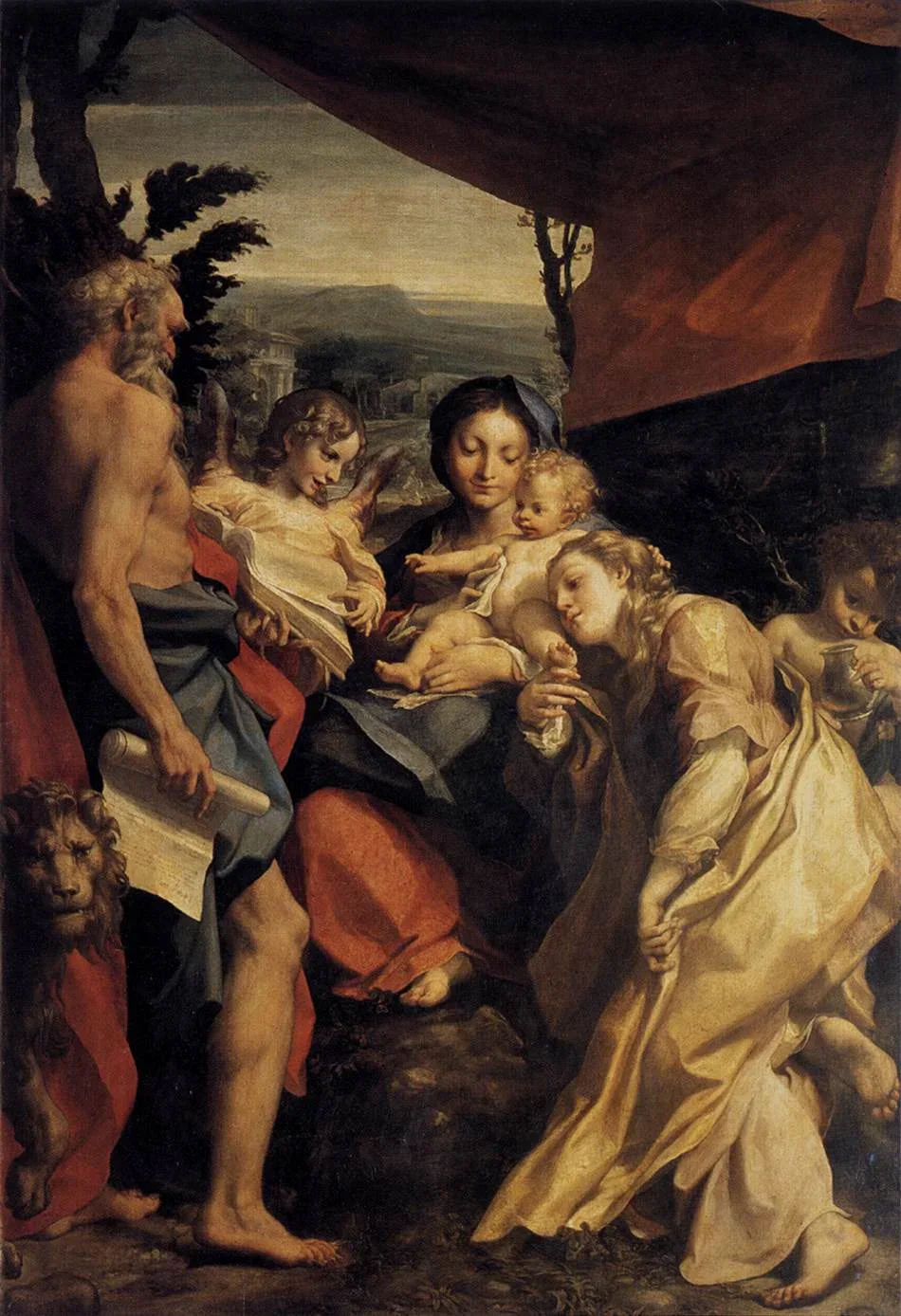
Madonna of St. Jerome
Why is a Bible being held out to a child? An angel offers the book to the Madonna and Child, almost asking their approval. What he holds is Saint Jerome's translation of the Bible, made from Hebrew into the everyday Latin that ordinary people spoke. An old story tells how Jerome made it in a cave at Bethlehem, with only a lion for company, at Pope Damasus's request. That lion is here beside him. In his own hand Jerome still holds the scroll, the older text he worked from. He fills almost the whole height of the picture, even more than the Madonna and Child. His thick, muscular right leg is long compared with his upper body and rather small head. Briseide Colla asked Correggio to paint it in 1523, for a chapel in the church of Sant'Antonio Abate in Parma. Its fame spread far beyond the city. Kings of Poland and France and the emperor offered to buy it. But when the church needed costly repairs, it was moved to the Cathedral in 1749 for safety. Napoleon's troops carried it off to Paris in 1796, and it came back to Parma after 1815.
Listen in the appAntonio da Correggio · Public domain
08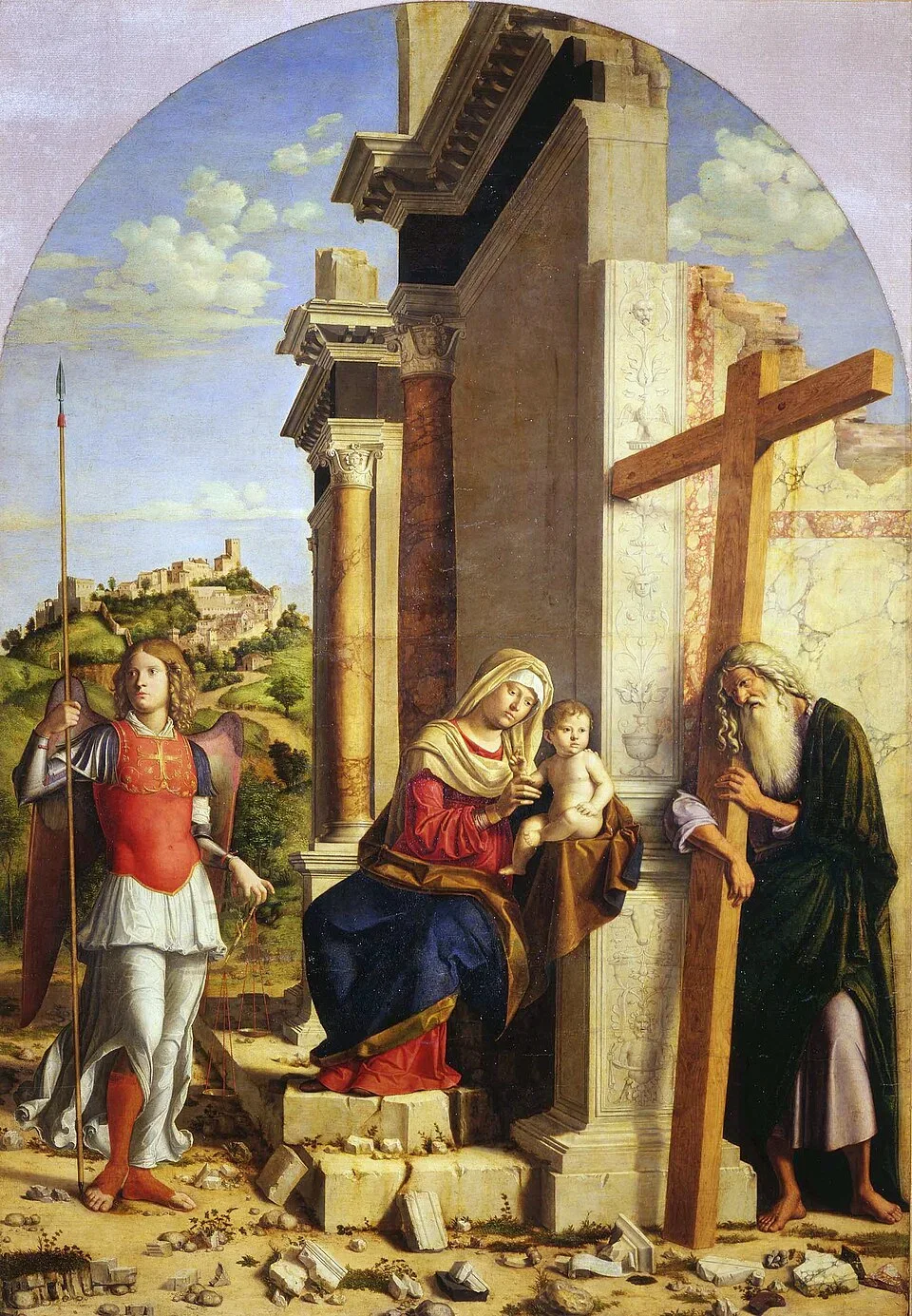
Madonna and Child with Saints Michael the Archangel and Andrew
Most pictures of the Virgin and Child face straight out at you. Cima set this mother and child at an angle instead, and that gives the whole scene a sense of movement. The Virgin sits on the remains of an ancient temple, with the child on a wall. Behind them, the ruined stonework is carved with classical patterns. At the bottom, among broken pieces of the temple scattered on the ground, lies a small panel with writing on it. That writing is false. Because of that one mark, the whole painting was taken for a work by Leonardo da Vinci. In 1706 it entered the Sanvitale collection under Leonardo's name. In 1834 it was sold to the gallery in Parma, and only then was it credited to its real painter.
Listen in the appGiovanni Battista Cima da Conegliano · Public domain
09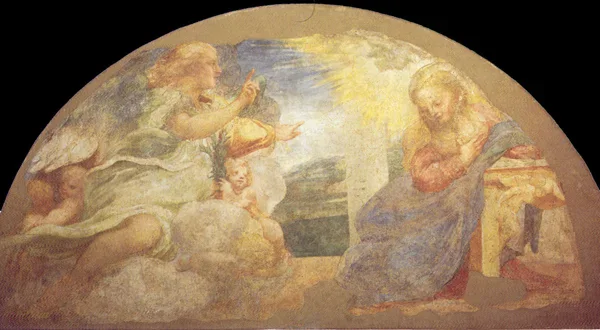
Annunciation
There is a small angel half hidden behind Gabriel. He belongs to the company of angels who came with the message, and he links this fresco to the domes Correggio was working on at the time. He had just finished one in Parma and was about to begin another. Gabriel kneels on a cloud, his robe blown by the wind, with more angels to his left and behind him. One of them carries a white lily, though Gabriel is the one who speaks. Mary, who had been praying, shrinks back at the sight of him and bows her head to listen. At the same moment a dove appears in golden light, the sign of the Holy Spirit and of Mary's virgin conception. The fresco was made for a Franciscan church in Parma, San Francesco, around 1525. In 1546 Duke Pier Luigi Farnese ordered the buildings outside the city walls torn down for defence. San Francesco stood outside them. The monks would not lose the painting. They braced the wall with timber and iron, cut it free a little at a time, and carried it away. Taking such trouble so soon after the painter's death shows how much he was already prized. It was moved again to the Annunziata church at Capo di Ponte, and in 1875 it was brought here.
Listen in the appAntonio da Correggio · Public domain
10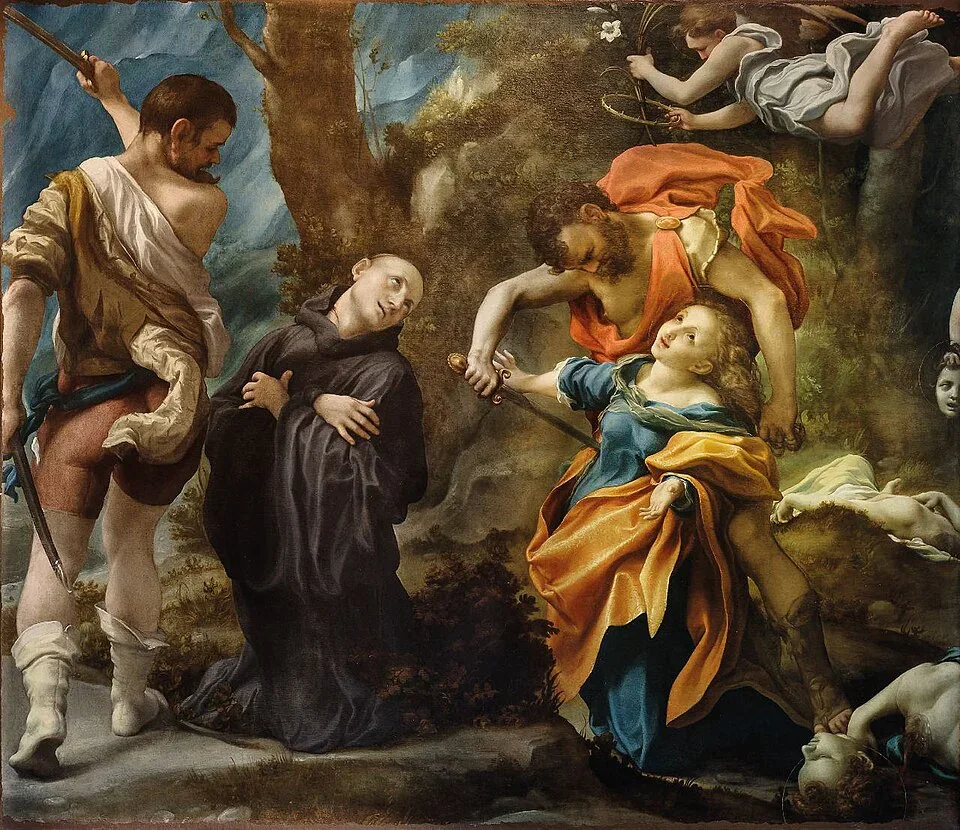
Martyrdom of Four Saints
Something is above the victims that the men with swords do not see. At the left edge, one executioner has his back turned. He is striking at the neck of a young man with his arms crossed on his chest. The man's body is beginning to give way, yet his eyes go up, toward that unseen thing. A second sword goes into his sister. She opens her arms and turns her face to the same place. Above them, an angel flies with the palm that marks a martyr. Only the two who are dying see it. It is the happiness they know at the moment of death, and the men with swords never look up to find it. The subject was so rare that there was no older picture to follow, and that freed Correggio to arrange the scene as he wished. The nobleman who paid for it was Placido del Bono, and he chose these four martyrs because one of them carried his own name. In an early drawing, the four saints stood in strict symmetry, with a small angel on a cloud at the center. Then Correggio thought about the angle from which visitors would see the painting in the chapel. He built the whole scene along a diagonal instead.
Listen in the appAntonio da Correggio · Public domain
- 11
Deposition, with Saints Claire, Francis, Magdalene and John
Annibale Carracci · 1585
- 12
Portrait of a Man in a Red Beret
Parmigianino · c. 1540
- 13
Madonna with child
Antonio da Correggio · 1522–1523
- 14
Madonna and Child with Saints
Agostino Carracci · 1585–1586
- 15
Capriccio with the Capitol
Bernardo Bellotto · 1742–1744
- 16
Madonna and Child Enthroned with Saints
Agnolo Gaddi · 1375
- 17
Portrait of Ferdinand I, duke of Parma
Johann Zoffany · 1778–1779
- 18
Self-Portrait
Annibale Carracci · 1593
- 19
Deesis with Saint Paul and Saint Catherine
Giulio Romano · c. 1520
- 20
Pope Paul III with a Nephew
Sebastiano del Piombo · 1534
- 21
Mystic Marriage of Saint Catherine
Parmigianino · c. 1524
- 22
The Funeral of the Virgin Mary
Ludovico Carracci · c. 1605–1609
- 23
Madonna and Child
Anthony van Dyck · 1621–1627
- 24
Portrait of Marie-Louise, Duchess of Parma and Piacenza
Giovanni Battista Borghesi · 1837–1839
- 25
Montini Altarpiece
Giovanni Battista Cima da Conegliano · c. 1506–1507
- 26
Susanna and the Elders
Guercino · 1650
- 27
The Betrayal of Christ, with a soldier in pursuit of Mark the Evangelist
Antonio da Correggio · c. 1522
- 28
Capriccio: a Palladian Design for the Rialto Bridge, with Buildings at Vicenza
Giovanni Antonio Canal · 1750
- 29
Virgin of the Assumption and St. Michael the Archangel
Dosso Dossi, Battista Dossi · c. 1533–1534
- 30
Coronation of Mary
Antonio da Correggio · c. 1522
- 31
Sant'Agata in carcere by Giovanni Lanfranco
Giovanni Lanfranco · 1611–1614
- 32
Bodoni Museum
Unknown Artist · 1963
- 33
Family of Don Philip of Bourbon
Giuseppe Baldrighi · c. 1757
- 34
Sleeping Endymion
Giovanni Battista Cima da Conegliano · c. 1505–1510
- 35
The Marys at the Sepulcher
Bartolomeo Schedoni · 1613–1614
- 36
Venere di Vicofertile
Unknown Artist · 5000–4300 BC
- 37
Ritratto di Maria Luigia d'Asburgo in veste di Concordia
Antonio Canova · c. 1811–1814
- 38
Portrait of Alexander Farnese
Antonis Mor · 1557
- 39
The Artist and his Wife
Giuseppe Baldrighi · c. 1757
- 40
Saint Fidelis of Sigmarigen and Saint Joseph of Leonessa
Giovanni Battista Tiepolo · 1752–1758
- 41
The Scartocciata
Johann Zoffany · 1778
- 42
Portrait of Bartolomeo Prati
Girolamo Mazzola Bedoli · 1542–1550
- 43
Giambattista Bodoni
Andrea Appiani · 1799
- 44
Coastal view at sunset and Wooded valley with shepherds
Pieter Mulier · c. 1687
- 45
Portrait of Princess Maria Carolina of Bourbon with Diadem
Anton Graff · 1792
- 46
Guercino - Madonna and Child in glory with Saints Francis and Clare, 1641, GN 165
Guercino · 1639–1641
- 47
Tabula alimentaria Veleia
Unknown Artist · 101–102
- 48
Parma embraces Alessandro Farnese
Girolamo Mazzola Bedoli · c. 1555
- 49
Judgment of Midas
Giovanni Battista Cima da Conegliano · 1505–1510
- 50
The adoration of the magi
Girolamo Mazzola Bedoli · 1547
- 51
Immaculate Conception of the Virgin
Girolamo Mazzola Bedoli · 1533–1536
- 52
Deposition
Bartolomeo Schedoni · 1613–1614
- 53
Coronation of Mary
Gherardo Starnina · c. 1404
- 54
Madonna and Child with Saints Aloysius Gonzaga and Stanislaus Kostka
Giuseppe Maria Crespi · c. 1726–1740
- 55
Marriage of the Virgin
Giulio Cesare Procaccini · 1617
- 56
Pantry with vegetables, mushrooms, game, calf's head and an owl
Felice Boselli · 1690s
- 57
Pantry with game, a piece of cheese, lemons, a cat, a dove and a guinea pig
Felice Boselli · c. 1690
- 58
Immaculate Conception and Angels
Giovanni Battista Piazzetta · 1744–1745
- 59
Thetis entrusts Achilles to the centaur Chiron
Pompeo Batoni · 1761
- 60
Parma Psalter
Unknown Artist · c. 1280
- 61
Capriccio with the Colosseum
Bernardo Bellotto · 1743–1744
- 62
Portrait of Julie Le Brun
Élisabeth Louise Vigée Le Brun · 1792
Palazzo della Pilotta
Frequently asked questions
How much does the guide cost?
Free app download. Free until 1 January. Listed guide price: $0.99. Audio guide only. Venue admission is separate.
Can I listen without internet?
Yes. Download the guide’s audio, images, and maps in the app before your visit. Your downloaded content is then available offline.
Can I listen in my language?
In English for now. More languages soon.
Do I need to follow a schedule?
No. This is a self-guided experience. Choose your stops, pause whenever you like, and return to a story at your own pace.
Which artworks are in the Palazzo della Pilotta audio guide?
62 artworks, including Head of a Woman (Leonardo da Vinci), Healing of the Man Born Blind (El Greco), Biblioteca Palatina di Parma (G. Gabelli), Madonna della Scodella (Antonio da Correggio), Turkish Slave (Parmigianino), Lamentation over the Dead Christ (Antonio da Correggio), Madonna of St. Jerome (Antonio da Correggio), and Madonna and Child with Saints Michael the Archangel and Andrew (Giovanni Battista Cima da Conegliano). The full list is on this page.
Is this the museum’s official audio guide?
No. Stanza is an independent audio guide app and is not affiliated with Palazzo della Pilotta. Museum admission is separate.
At your own pace
Explore Palazzo della Pilotta.
Download Stanza, then search for “Palazzo della Pilotta”.
Free app download · Guide price shown in the app
Keep exploring
Nearby audio guides
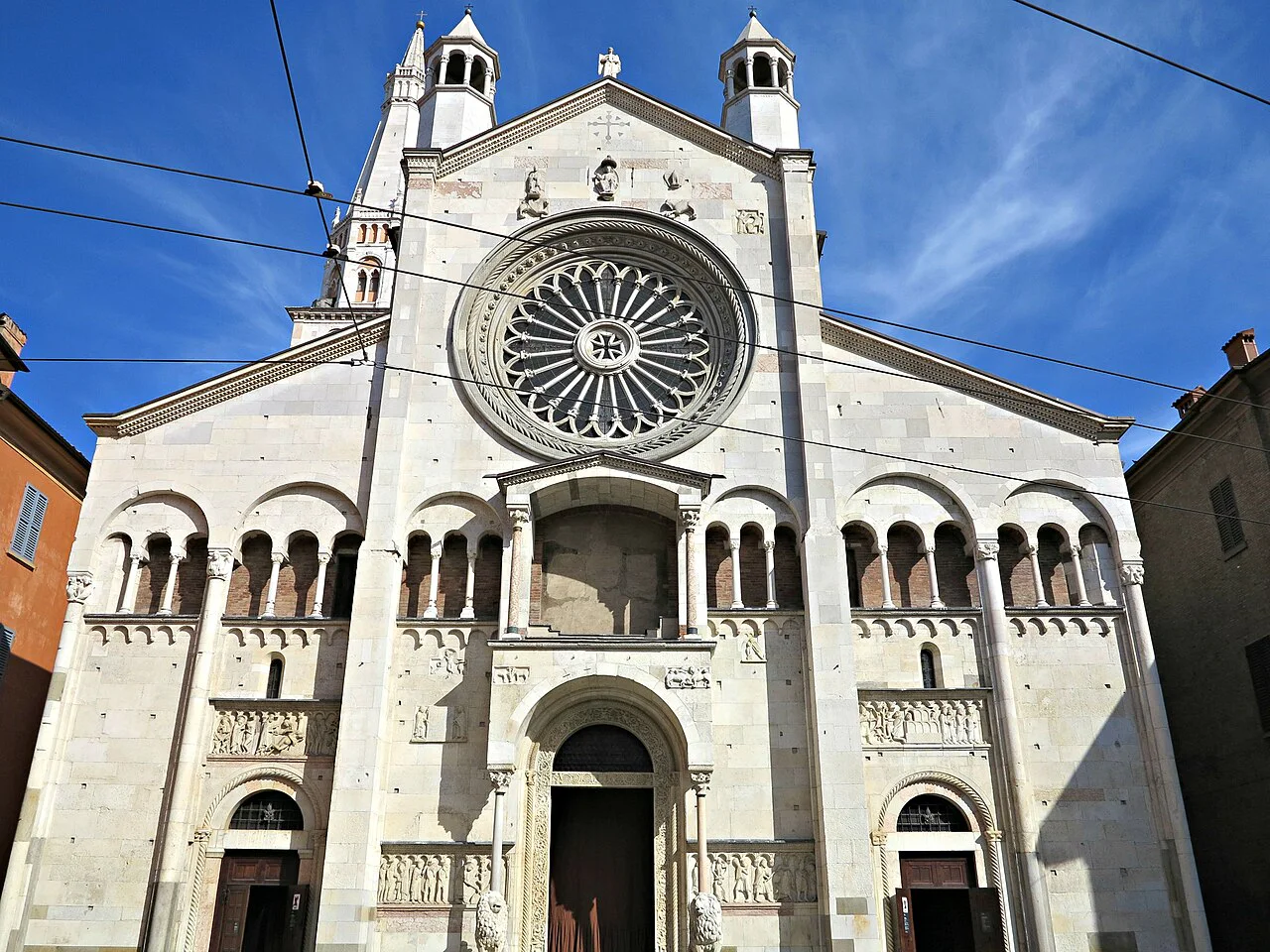
Modena · 51 km
Duomo di Modena
Content & sources
Photo: Mongolo1984 · CC BY-SA 4.0
Mantua · 53 km
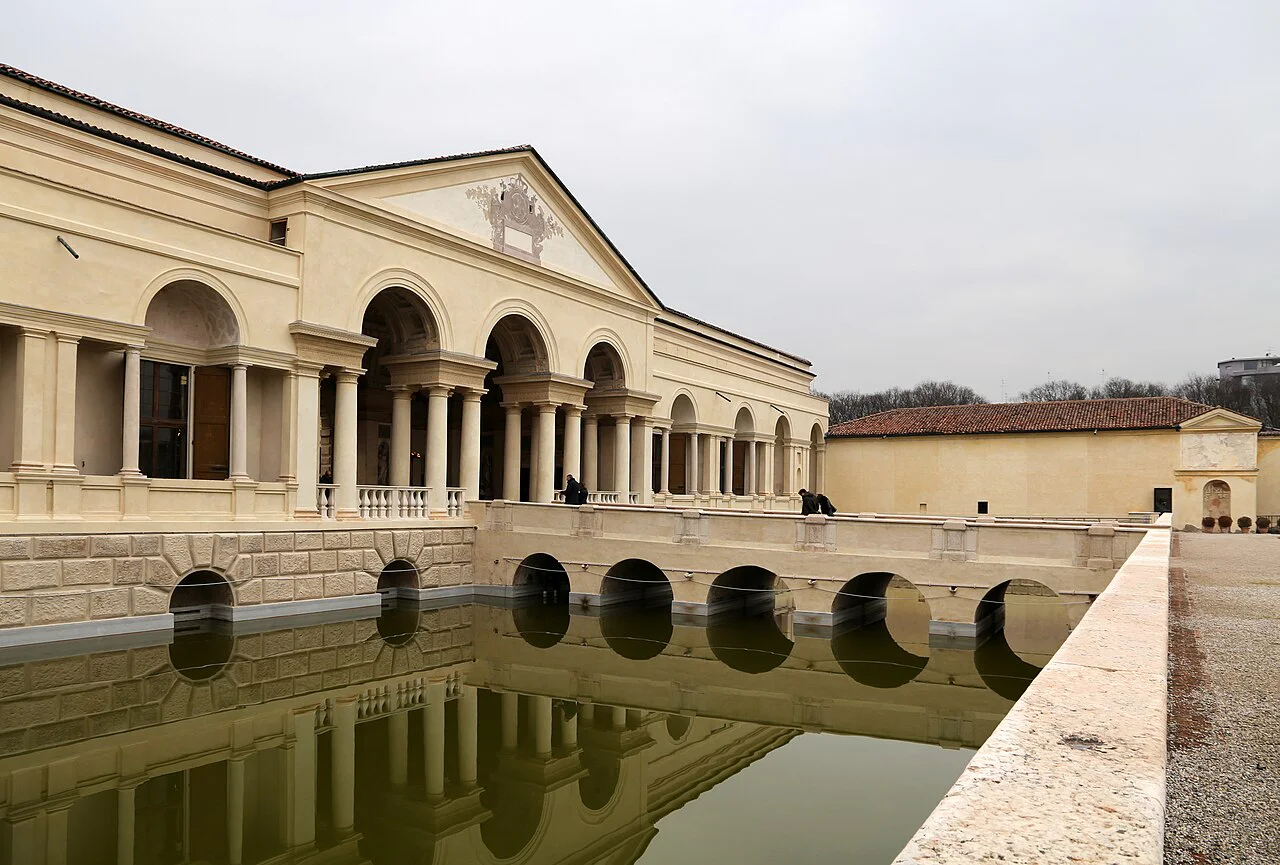
Palazzo Te
Content & sources
Photo: Sailko · CC BY 3.0
Mantua · 54 km
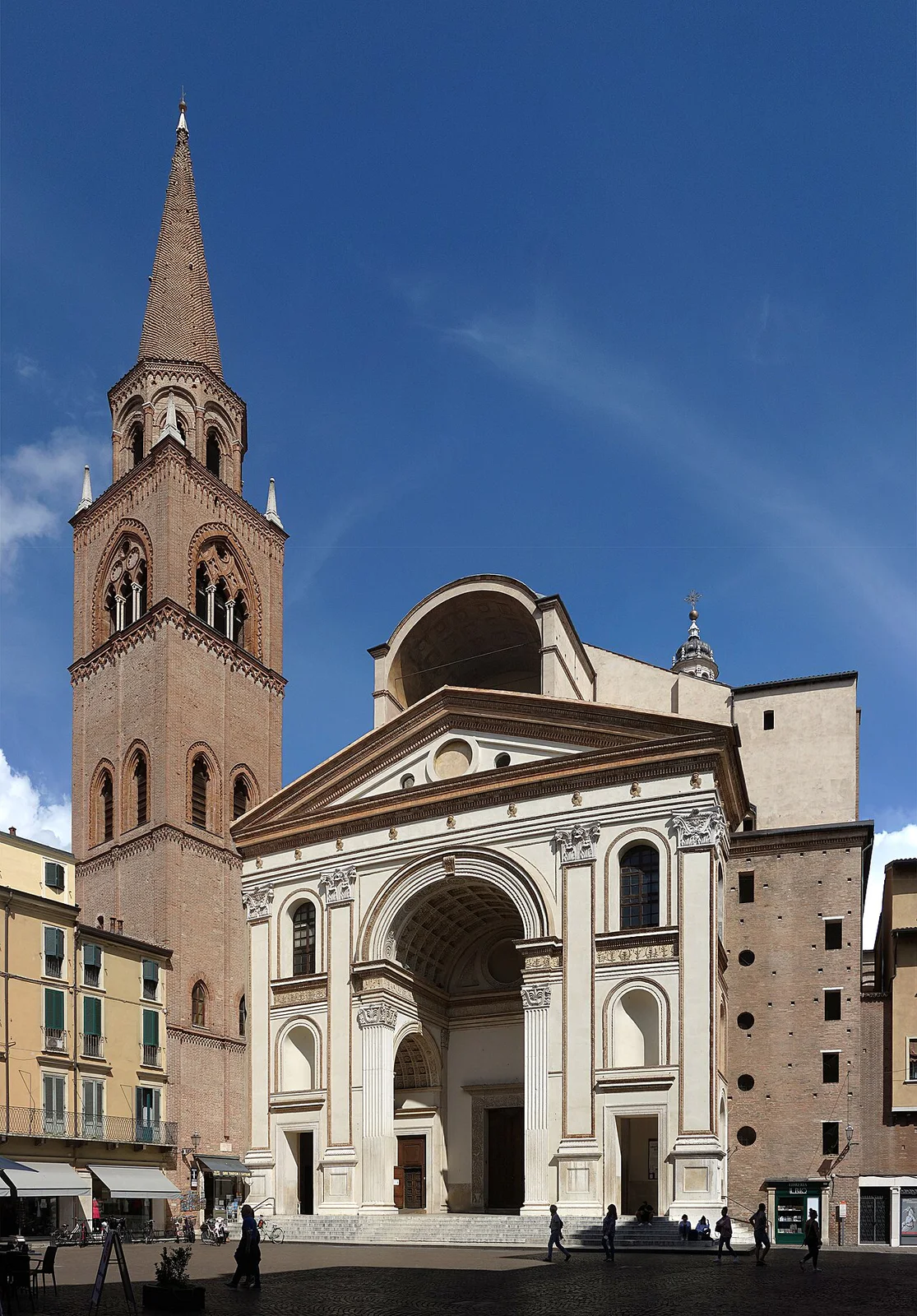
Basilica di Sant'Andrea
Content & sources
Photo: Velvet · CC BY-SA 4.0
Mantua · 54 km
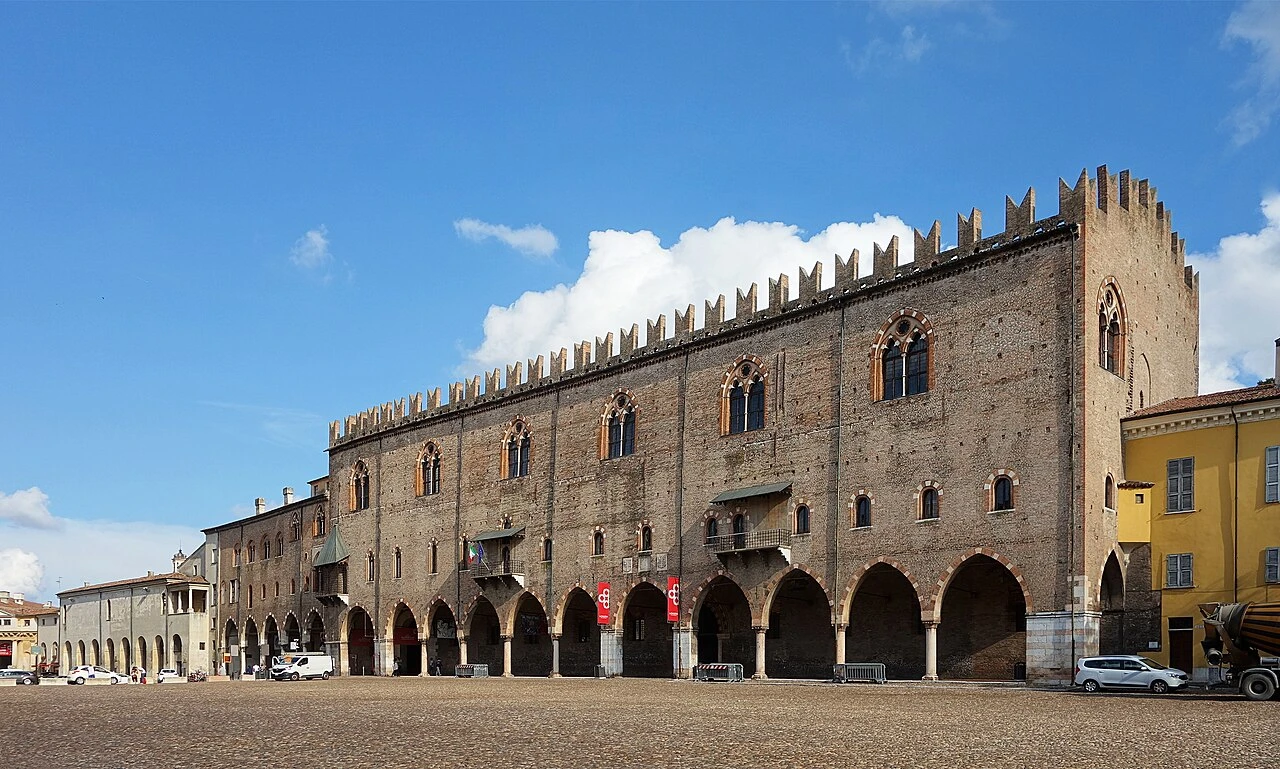
Palazzo Ducale di Mantova
Content & sources
Photo: Velvet · CC BY-SA 4.0
Art museums
More art museum audio guides
Verona · 65 artworks
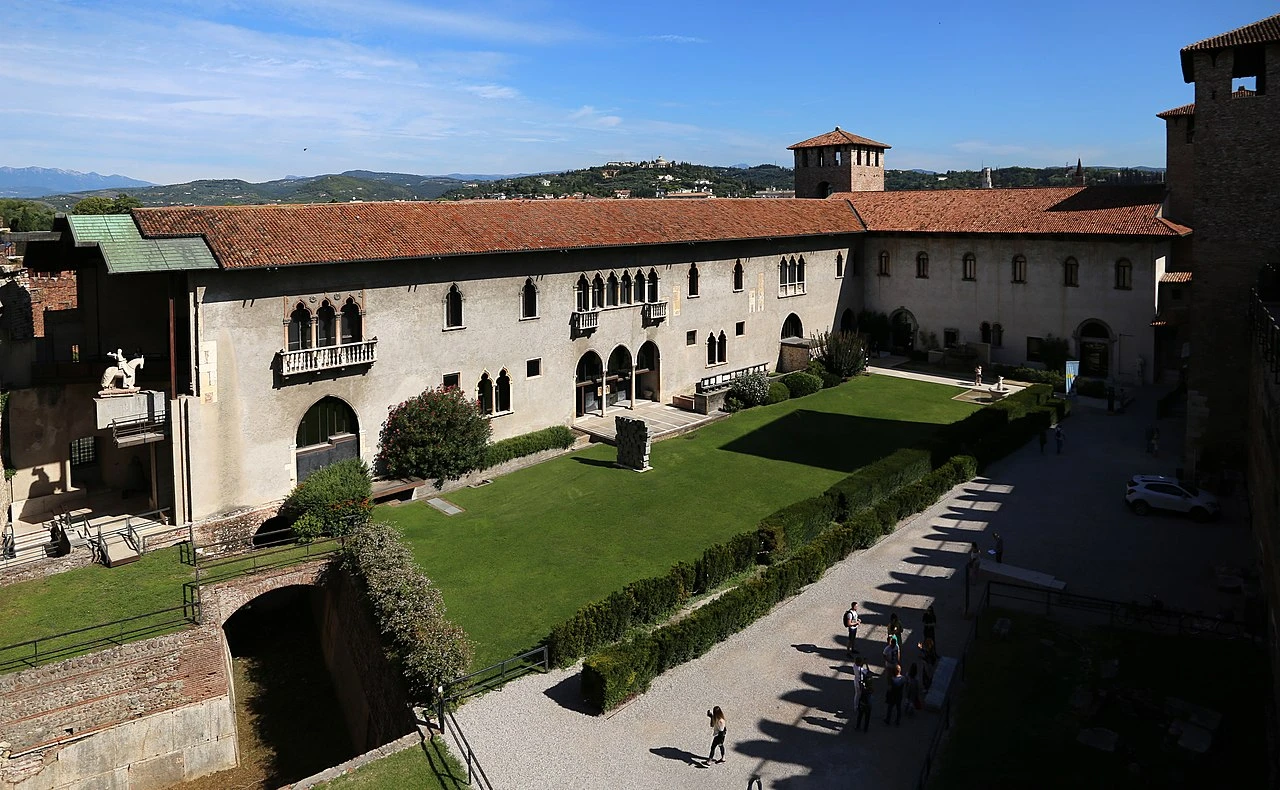
Castelvecchio Museum
Content & sources
Photo: Sailko · CC BY-SA 4.0
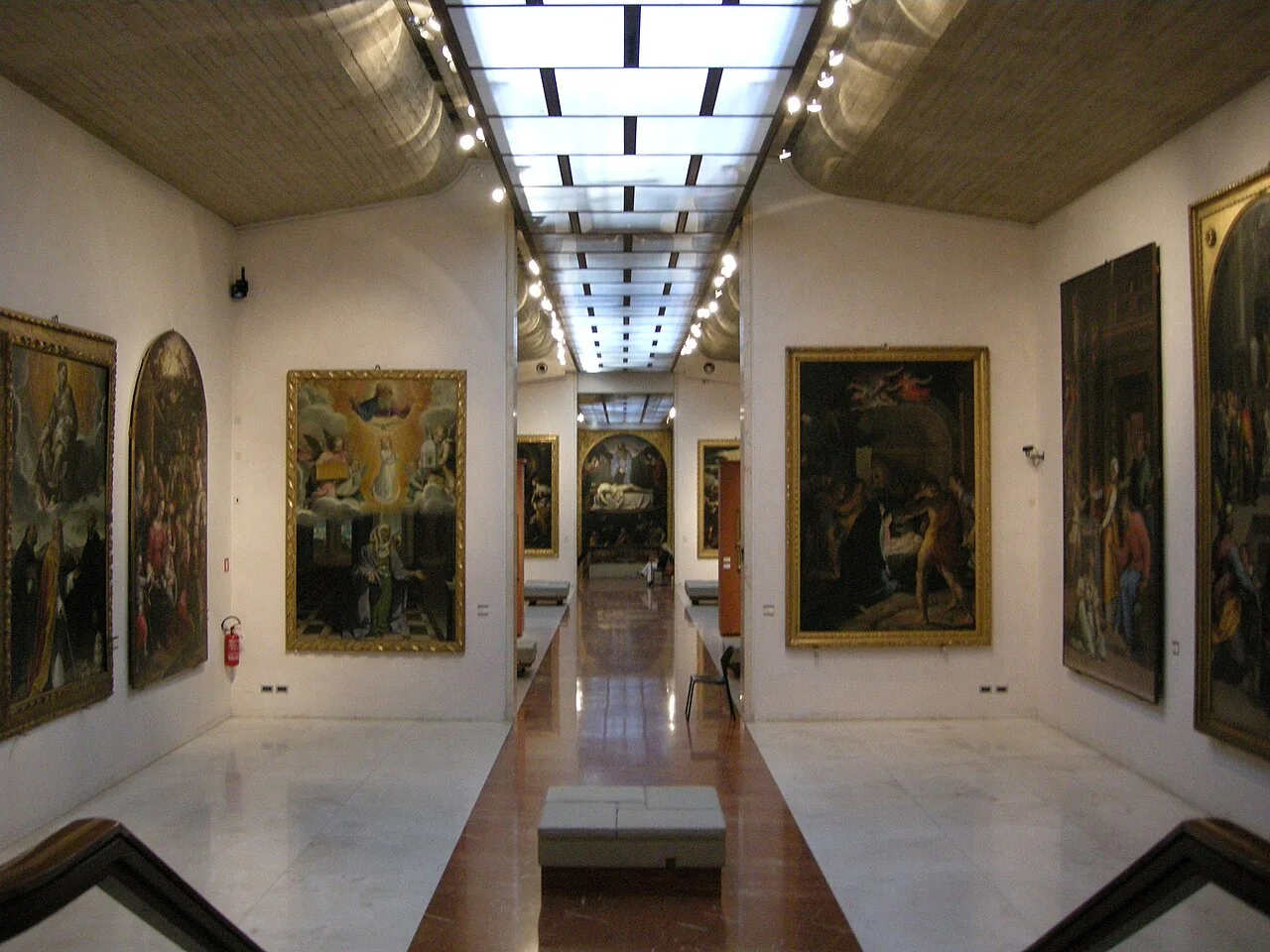
Bologna · 38 artworks
Pinacoteca nazionale di Bologna
Content & sources
Photo: Sailko · CC BY-SA 3.0
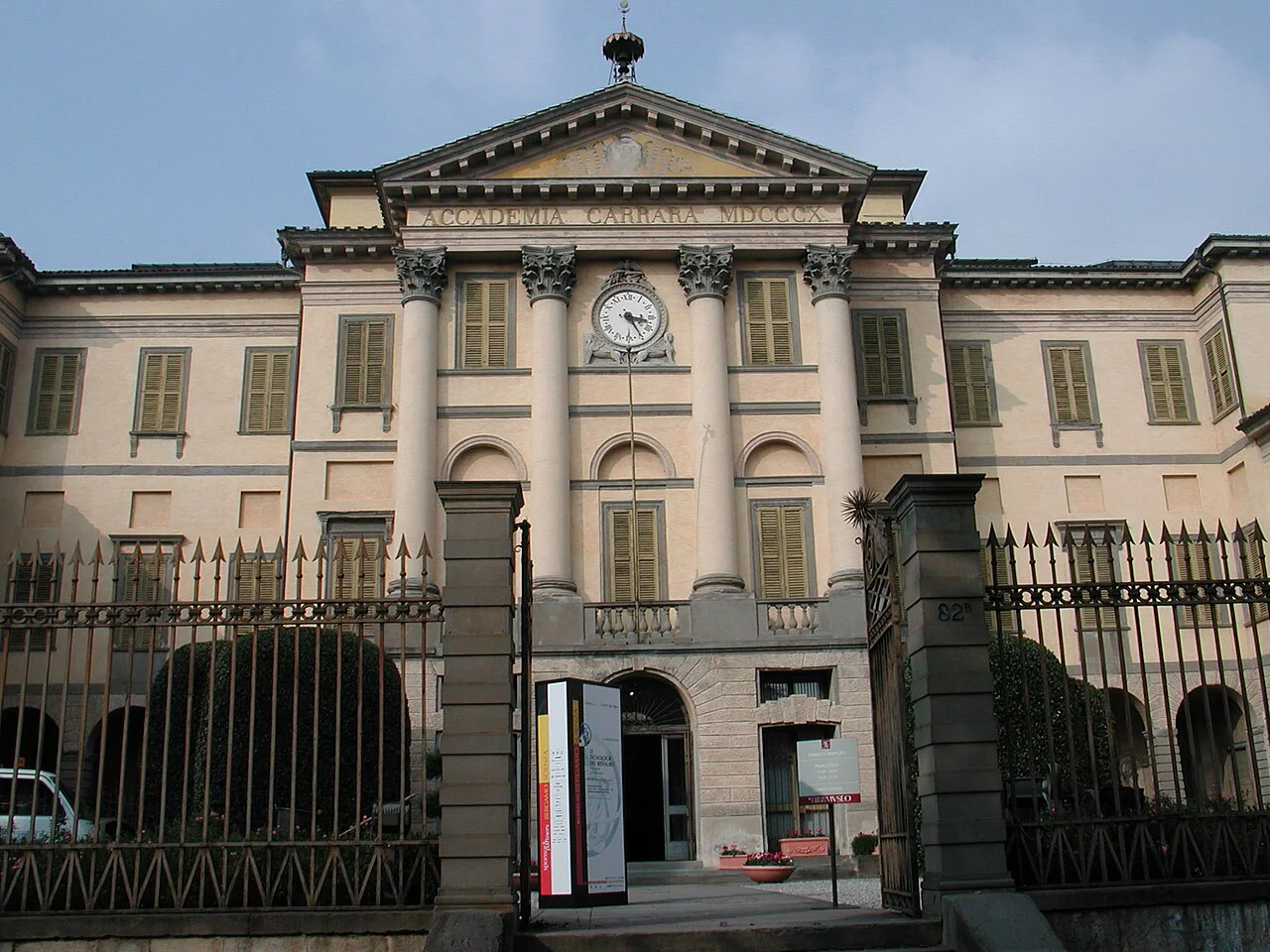
Bergamo · 66 artworks
Accademia Carrara
Content & sources
No machine-readable author provided. Paolo da Reggio~commonswiki assumed (based on copyright claims). · CC BY-SA 3.0
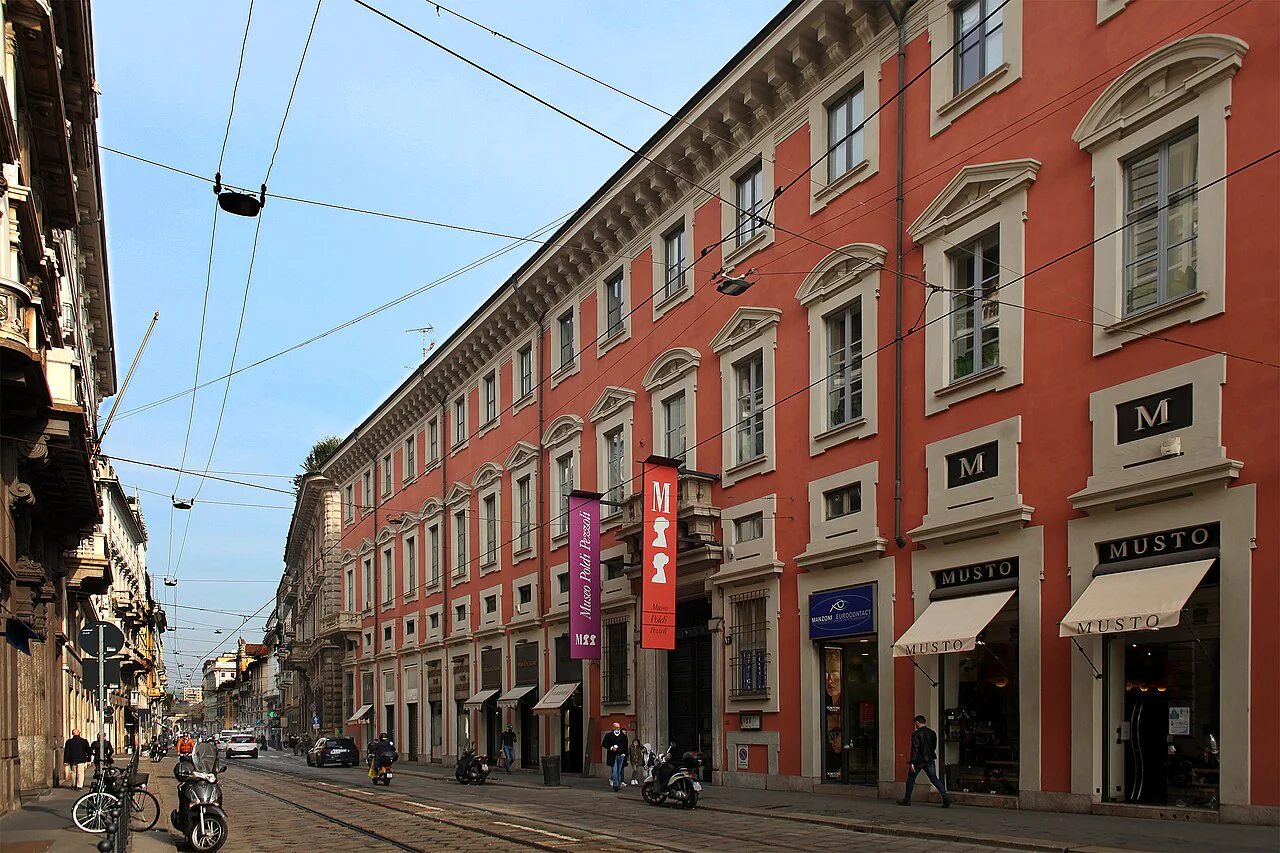
Milan · 30 artworks
Museo Poldi Pezzoli
Content & sources
Photo: Paolobon140 · CC BY-SA 4.0
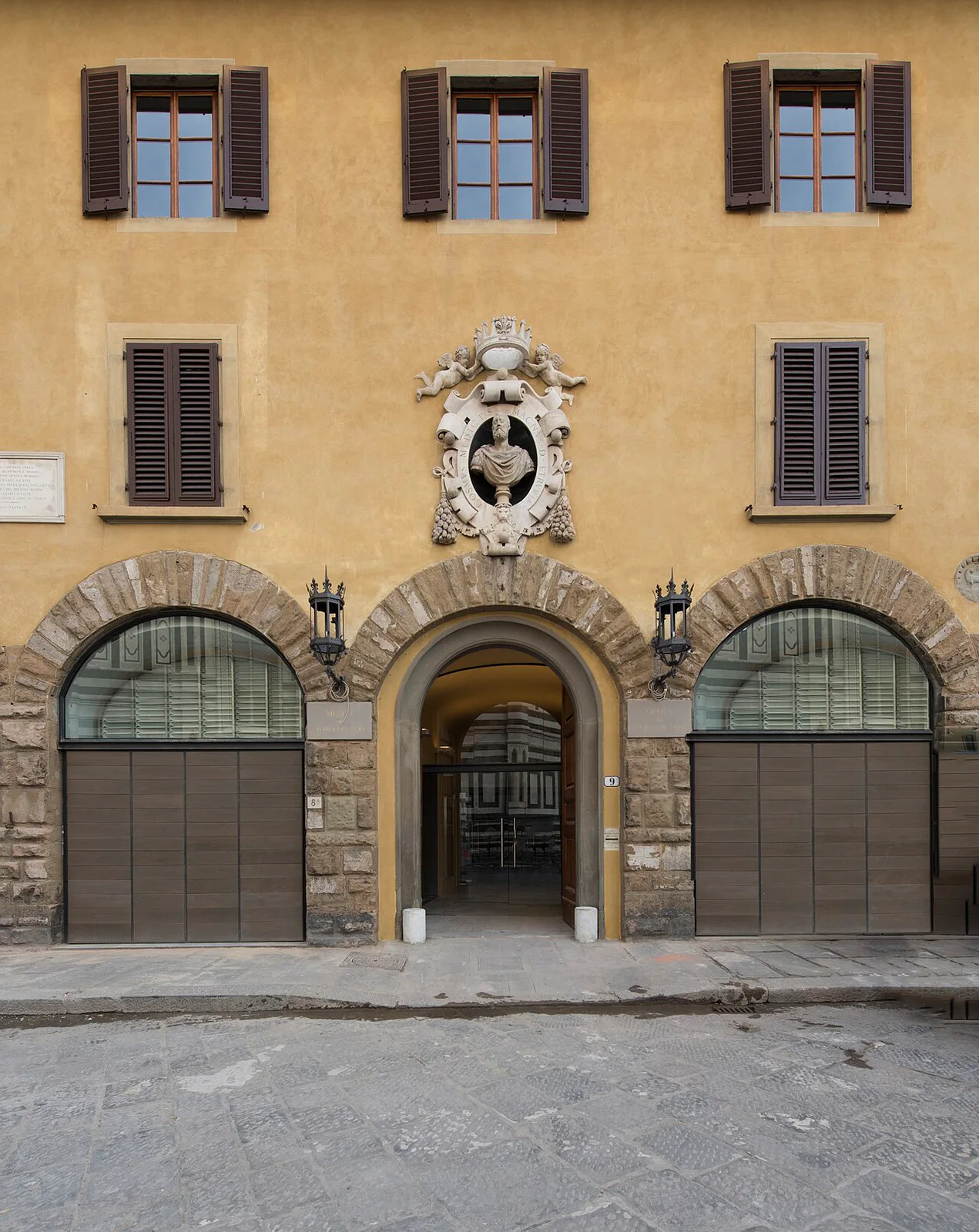
Florence · 27 artworks
Museo dell'Opera del Duomo
Content & sources
Photo: Giovanni Serafini · CC0
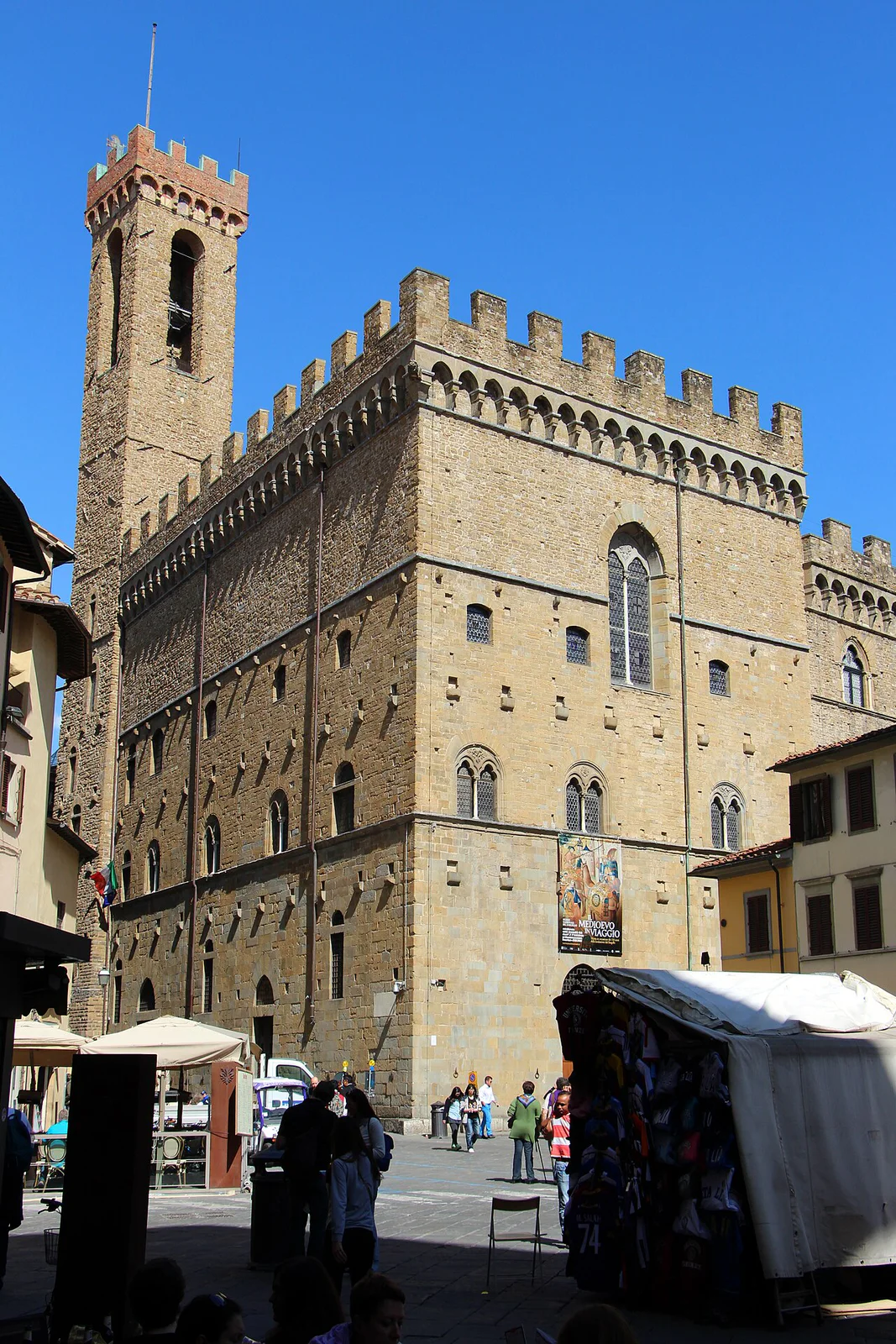
Florence · 37 artworks
Museo nazionale del Bargello
Content & sources
Photo: Sailko · CC BY 3.0