Stanza · Audio guide
National Museum of Norway Audio Guide
A place to remember. A story to take with you.
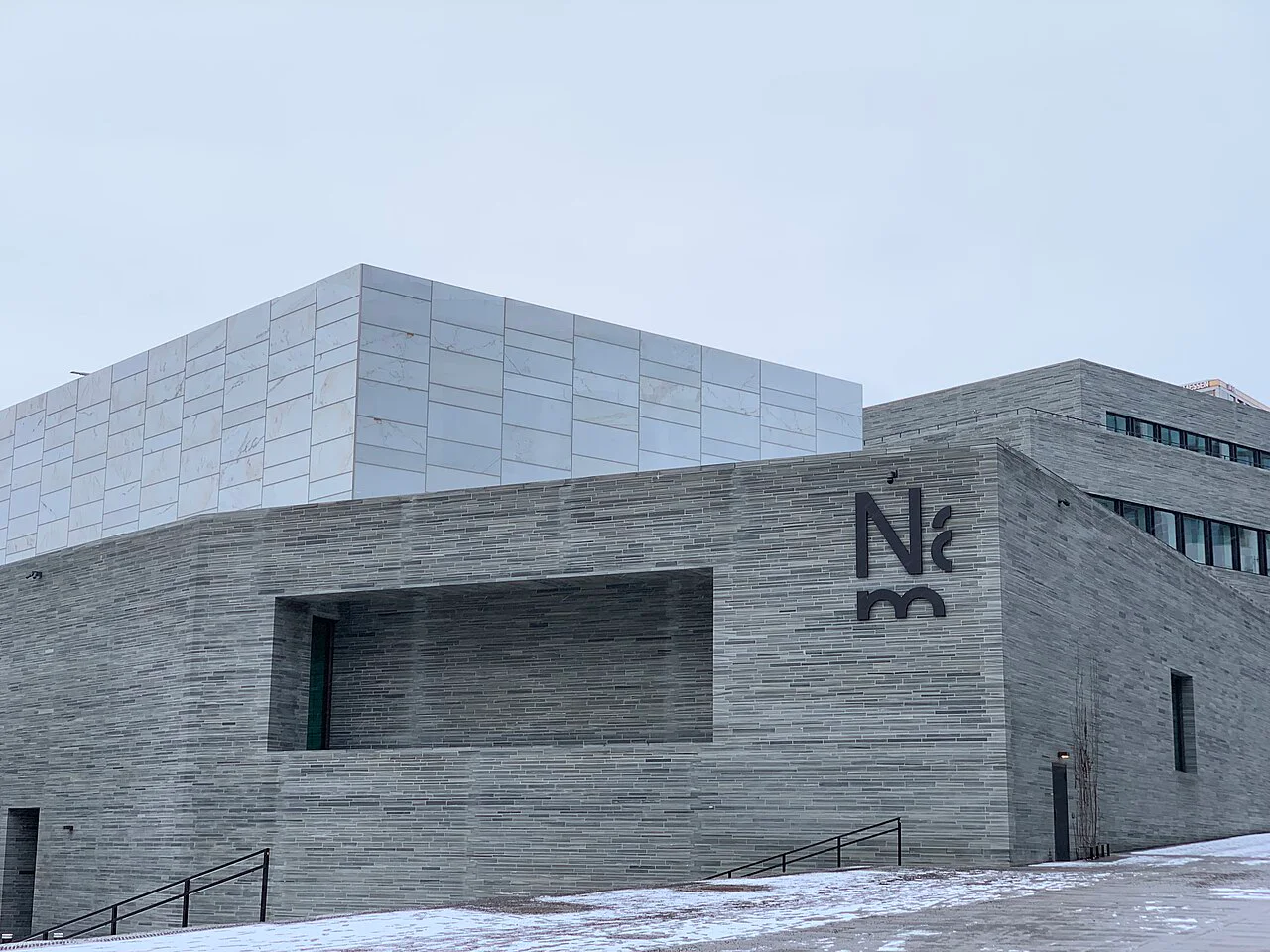
The National Museum is a museum in Oslo, Norway which holds the Norwegian state's public collection of art, architecture, and design objects. The collection totals over 400,000 works, including the first copy…
Download Stanza, then search for “National Museum of Norway”.
About the tour
One guide. Your kind of visit.
The National Museum is a museum in Oslo, Norway which holds the Norwegian state's public collection of art, architecture, and design objects. The collection totals over 400,000 works, including the first copy of Edvard Munch's The Scream from 1893.
The National Museum of Norway guide tells the stories of 60 artworks, including The Scream (Edvard Munch), Puberty (Edvard Munch), Dance of Life (Edvard Munch), Bridal Procession on the Hardangerfjord (Adolph Tidemand, Hans Gude), Melancholy (Edvard Munch), Winter at the Sognefjord (Johan Christian Dahl), Ashes (Edvard Munch), and Self-Portrait with Cigarette (Edvard Munch). Every artwork is free to hear in the Stanza app until 1 January.
Ready when you are.
- 01Get the free Stanza app.
iOS & Android
- 02Find your guide.
“National Museum of Norway”
- 03Download before you go.
Works offline
Audio guide / 60 artworks
Inside the guide
Get to know a few of the stories before you go. Open a stop to read more.
01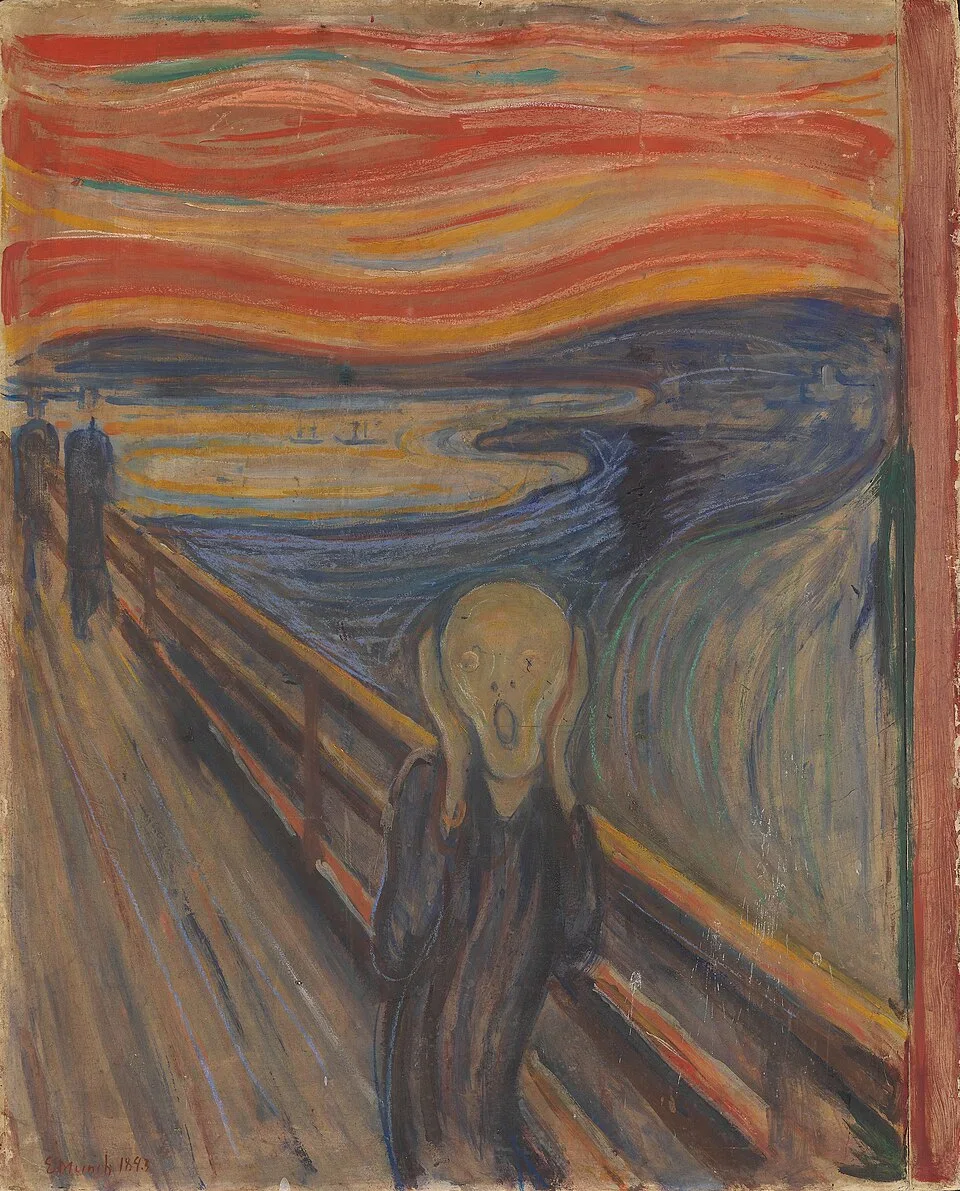
The Scream
In the top left corner is a sentence written in pencil, so small you have to be close to read it. In Norwegian it says that only a madman could have painted this. For years people took it for a remark left by a visitor or a critic. Then the painting was photographed with infrared light, and the handwriting gave it away. Munch had written it himself. One figure faces you straight on, hands pressed to its ears, mouth and eyes wide open. The sky is blood red. Two other figures at the left edge are quite calm, and a railing cuts diagonally across the view. The inscription was perhaps his answer to the unkind things said when the painting was first shown in Norway, in October 1895. They hurt him deeply. Mental illness ran in his family, and he was afraid it might come to him. His sister Laura Catherine was a patient at the asylum at the foot of Ekeberg, the hill overlooking Oslo.
Listen in the appEdvard Munch · Public domain
02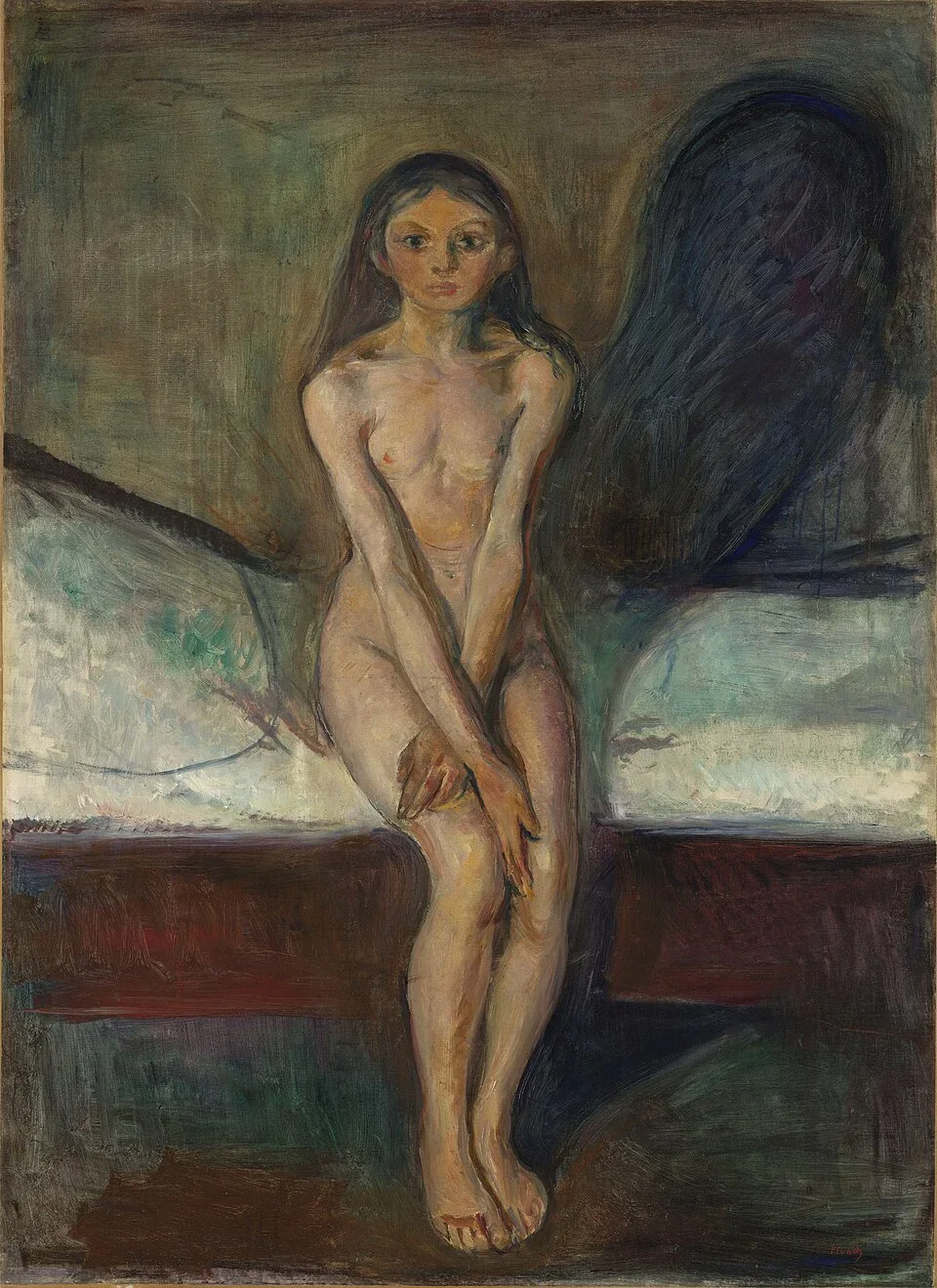
Puberty
Munch made this picture out of his own fear. He had lost his virginity to his cousin's wife, and the fear of sex that followed went straight into the painting. A young girl sits naked on the edge of a bed. Her legs are pressed together. One hand lies between her knees, the other rests on her right thigh. She stares straight ahead, her eyes wide open, her mouth closed, her long hair hanging down over and behind her shoulders. The fear was his, but the image would not settle into a single meaning. He called it The Young Model at first, and she was a model sitting for an artist. Later came Puberty, and she was a girl crossing into adulthood. Later still, At Night, and she belonged to the sensual pleasure and terror of the dark. Light enters from the left. Behind her a dark, ominous shadow grows.
Listen in the appEdvard Munch · Public domain
03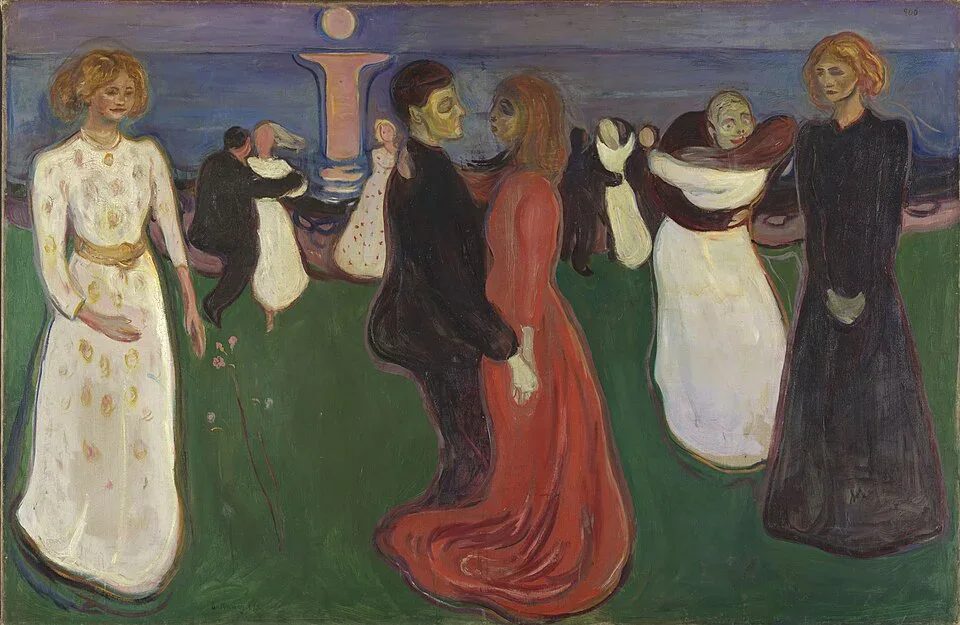
Dance of Life
On the left, a woman in a long white dress patterned with yellow flowers stands beside the couple in the middle. Her arm is slightly bent and points at them. It may mean she wants to take the dancer's place. She is one of three women around one man, and each stands for something he felt about women. At the center, the woman in red dances with him. Her red dress flows around him like a wave, pulling the ground from under his feet. She has her arm around him, perhaps possessively. On the right, a woman in black stands with her hands folded in front of her, looking down at the couple. That downward look is disappointment. In 1898, Edvard Munch met Tulla Larsen, the daughter of a rich wine merchant, six years younger than him. He was drawn to her, yet he felt crowded and robbed of his freedom. The two women at the edges of the picture are both her. He painted the green lawn first, leaving the figures out, then drew their outlines back in with repeated strokes.
Listen in the appEdvard Munch · Public domain
04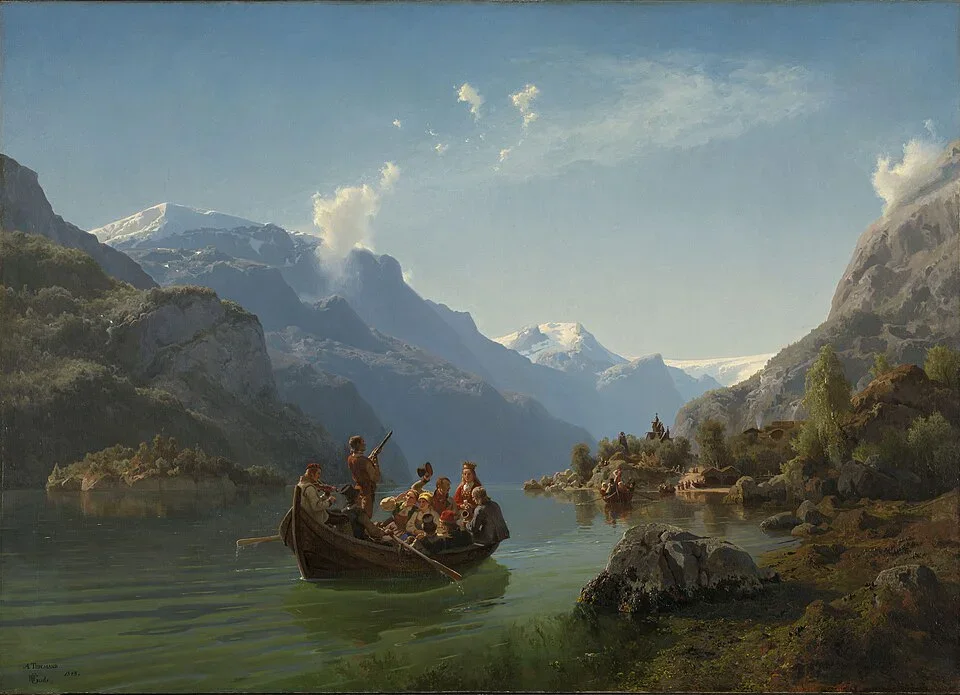
Bridal Procession on the Hardangerfjord
A wedding party crosses a fjord in several rowing boats. In the first boat the bride sits at the back, wearing a bridal crown and holding the paper that records her marriage. Just ahead of her, the groom tips his hat to the people left on the shore. A stave church stands in the background under a blue summer sky, with snow on the mountains. But this fjord is no real place. Gude, who painted the landscape, said so himself. He was twenty-three, working in Düsseldorf, far from Norway, and he built the mountains and the glacier from separate things he had seen. Tidemand, ten years older, painted the wedding party and dressed them in the costumes of Hardanger. The whole picture was made for the stage. In March 1849 it served as scenery at the Christiania Theatre, while a group in traditional costume performed a song aboard a boat. The crowned bride with her marriage paper can stand for Norway herself, and the wedding guests for her people. Whether Tidemand painted memories of his own wedding into this scene is something we cannot know.
Listen in the appAdolph Tidemand / Hans Gude · Public domain
05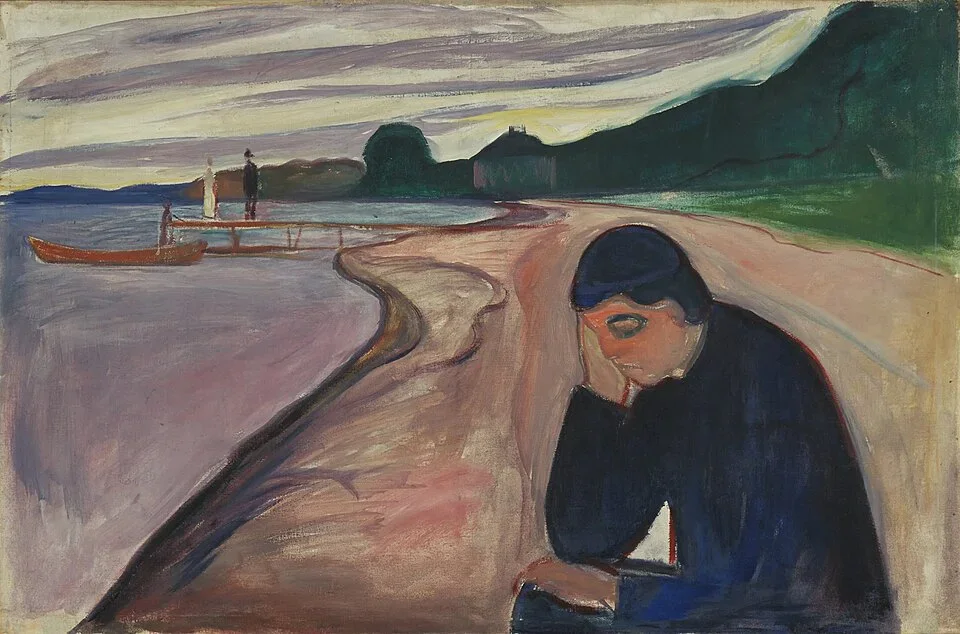
Melancholy
At the front edge of the picture a man has sunk down on the rocky beach, his head in his hand. Up on the jetty, three figures are heading toward a yellow boat, a couple and an oarsman, and soon they will set off. He stays where he is. The man is Jappe Nilssen. In the summer of 1891 he and Munch were at Åsgårdstrand, a small coastal town. Munch watched as Jappe, only twenty-one, fell in love with Oda Krohg, a married woman ten years older. It stirred Munch's own memories. He too had been twenty-one when he loved Milly Thaulow, his cousin's wife. It was a love he could not have, and when it ended he said he had given up all hope of ever loving again. So the man on the beach is Jappe, and he is Munch as well. The beach is black, and so is the man, and so are the figures up on the jetty. Black is the color of grief here, and it links him to that couple. The boat is yellow, the color of jealousy. In a note, Munch called it jealousy, a long and empty shore.
Listen in the appEdvard Munch · Public domain
06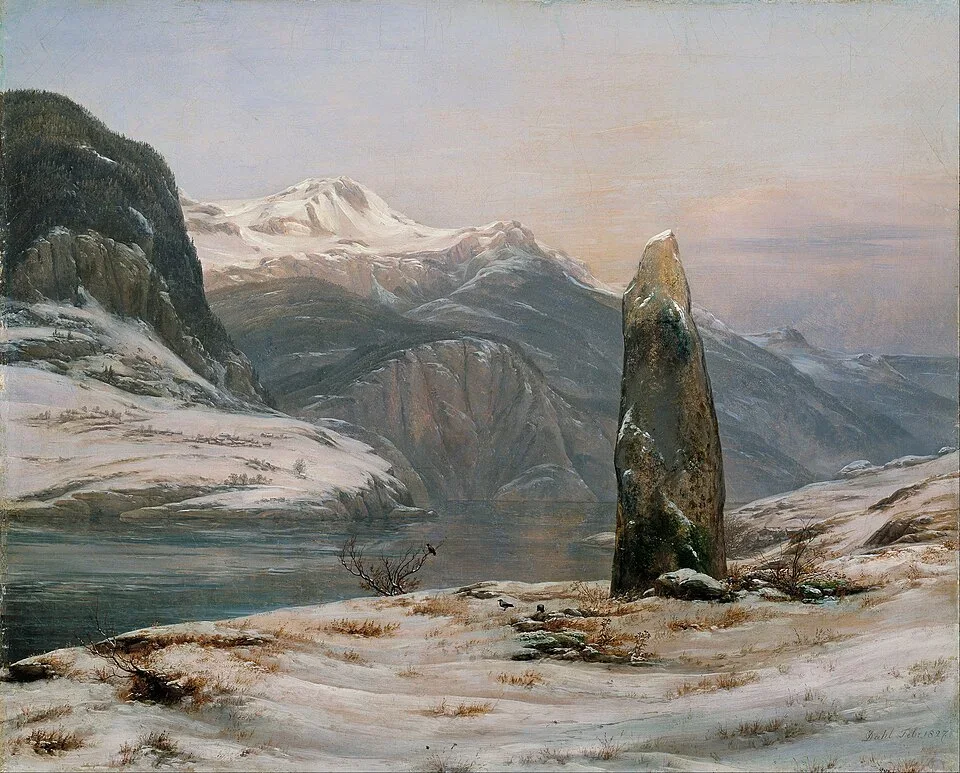
Winter at the Sognefjord
A tall stone stands at the front of this winter scene, and nothing here tells you it was put there on purpose. It never actually stood at this spot. And yet there it is, one upright stone against a landscape that is otherwise almost flat. Dahl painted this years after settling in Dresden. In 1826 he came back through Norway, sketched the view across the Sognefjord, and turned it into a winter scene in his studio. He added the stone himself, probably to recall the Battle of Fimreite. That battle, in 1184, was fought over the Norwegian crown, and Sverre Sigurdsson beat his rival Magnus Erlingsson. Fimreite is the farm you can just make out on the far side of the water. At the time, Norwegians were in the grip of a national awakening, and this battle site stirred strong feelings. The stone stands for a grand, ancient past. Sunlight falls on the top of the stone, which could mean hope for a new golden age. In front of the stone are a few crows. Crows can mean misfortune and death, and that suits a place remembered for a battle.
Listen in the appJohan Christian Dahl · Public domain
07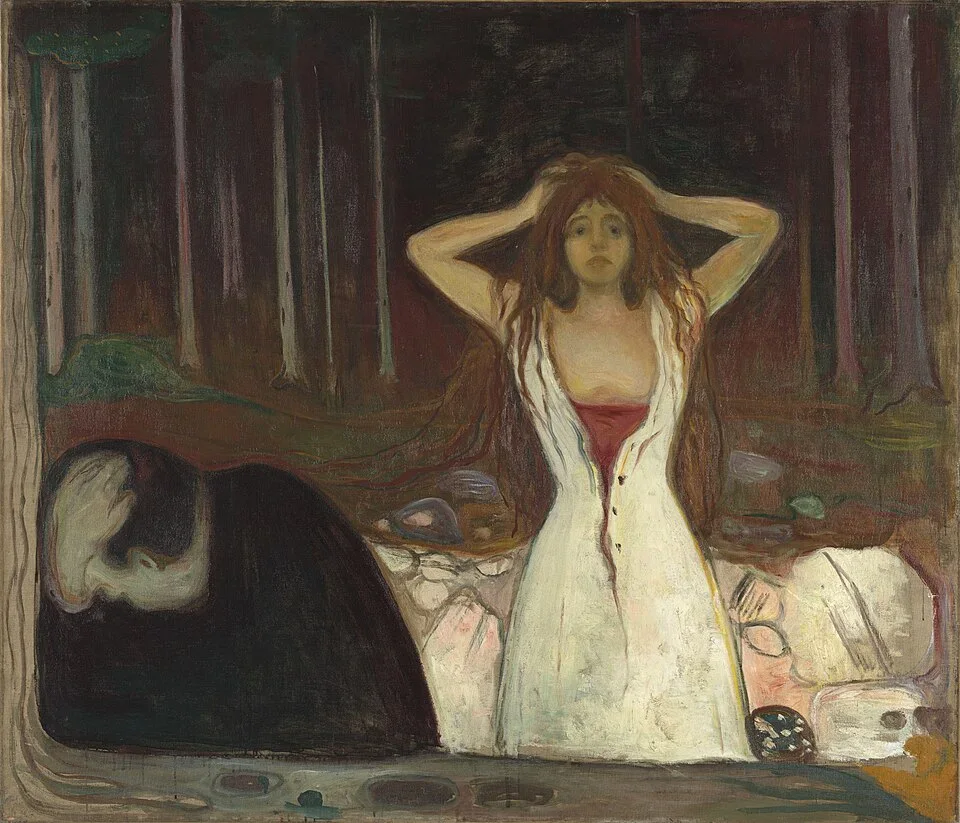
Ashes
Edvard Munch met Millie Thaulow in the woods, in secret. She was the wife of a cousin, and the affair was brief. It was probably no accident that he chose this scene. What he wanted was the instant the heat between them gave out. In the lower left a man crouches, turned away, his face hidden in his arm, grey as ash. He seems ashamed. The woman stands upright, a little right of centre, facing straight out. Her hands grip her head, her eyes wide and fixed. Her white dress is unbuttoned, showing a bright red undergarment. Her reddish brown hair falls past her shoulders toward the man's neck. Slender pine trunks rise behind them. At the front a fallen tree lies smouldering, turning to ash, with a column of smoke rising on the left. The crouched man almost merges with that trunk, as if staring into what is left of the fire. Afterwards he wrote that he felt their love lying on the ground like a heap of ash.
Listen in the appEdvard Munch · Public domain
08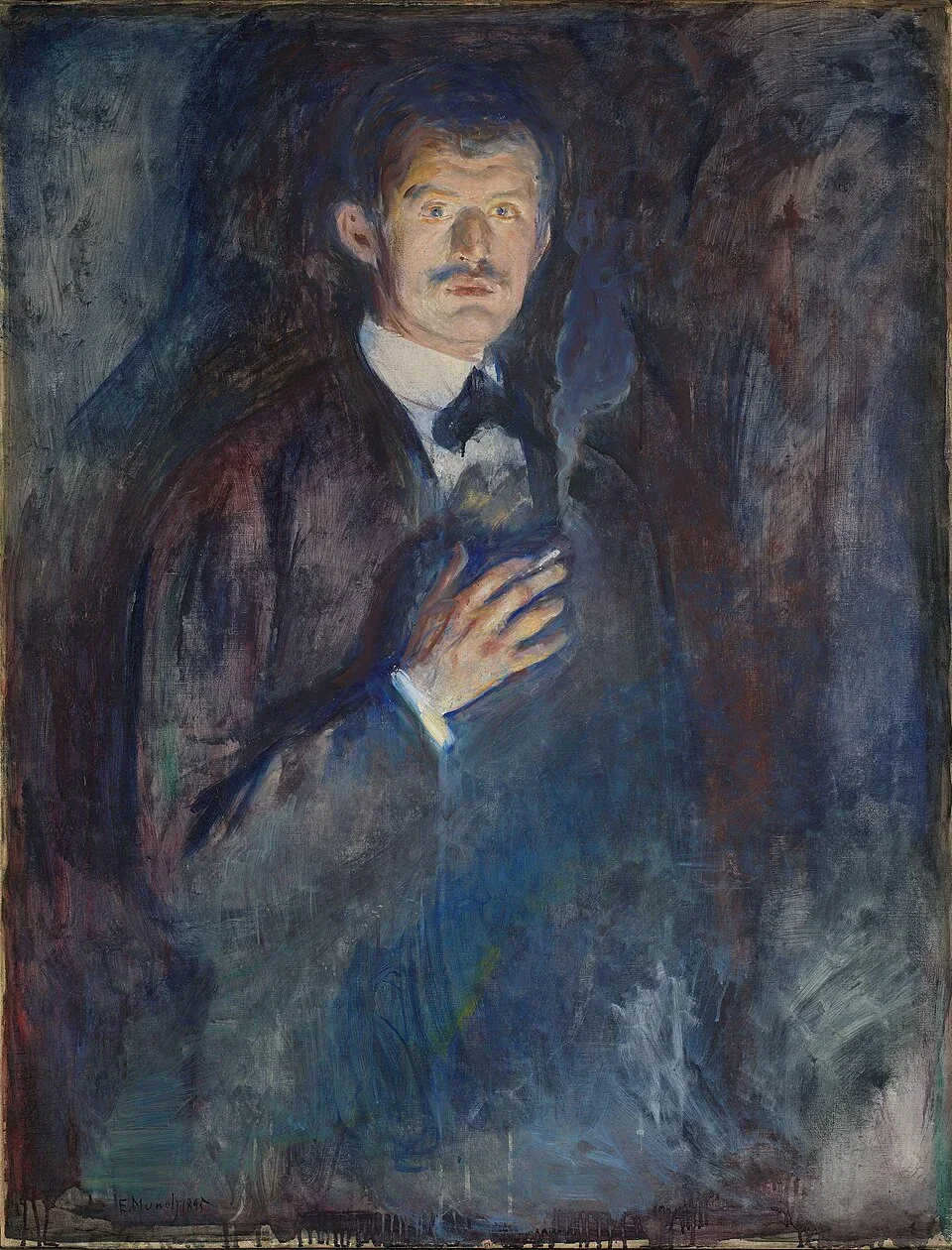
Self-Portrait with Cigarette
In Norway in 1895, smoking was still uncommon, and a cigarette in a portrait was a daring thing. It stood for decadence, for stepping outside respectable life. And there it is, right at the centre of this picture. The hand holds a burning cigarette and rests on his chest, level with his heart, nervous and trembling. His face is calm by contrast, and confident. Smoke gathers around him, and the light comes from below, the way a figure is lit on a stage. Only his face and that hand seem to glow out of the blue haze, as though he is stepping forward out of the smoke. Munch painted this in Paris, at thirty-one, just as success and recognition were beginning to come his way. He meant it to hang beside a portrait of a woman he admired, Dagny Juel, as a pair of wedding portraits. But before the exhibition opened in Oslo that autumn, her father asked him to take her picture down, and he did. So this one stood alone, near The Scream, Madonna and Vampire. The conservative press attacked it sharply. A medical student went further and publicly questioned Munch's state of mind, calling him a sick and corrupting influence on Norwegian youth. Whether Dagny Juel was really his lover is still not known.
Listen in the appEdvard Munch · Public domain
09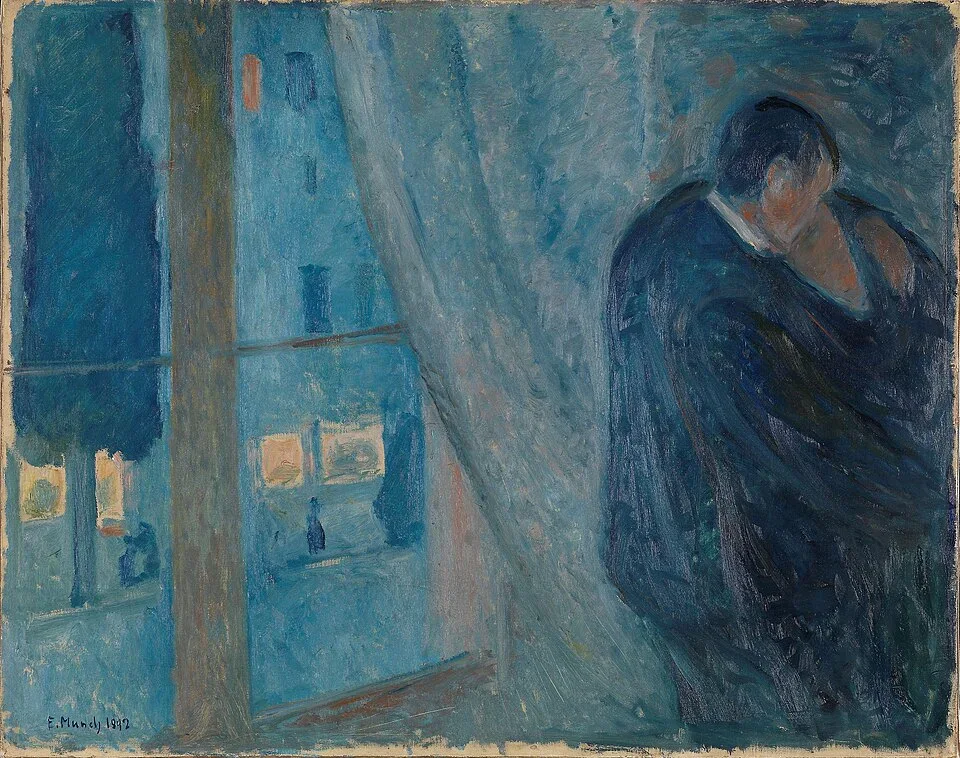
Kiss by the Window
A man and a woman kiss beside a window. She turns her whole upper body toward him, and his right arm reaches out around her. Both faces are lost in the shadow of that embrace. His right ear shows, and a little of his face. Hers cannot be made out at all. They are so tangled they stop being two people, each lost in the other. It looks more like a struggle than a loving hold, the wanting and the fear of love at once. They have been pushed to the far right of the picture, and the room around them is bare. The window beside them has a curtain gathered at the lower right. Beyond it is a street with lit shop windows and a few people passing. It makes the meeting feel secret, as if it happened by chance. Munch painted his own loneliness into these two figures. He had been urged to paint his own feelings. He made this as part of a larger series about life, death and love.
Listen in the appEdvard Munch · Public domain
10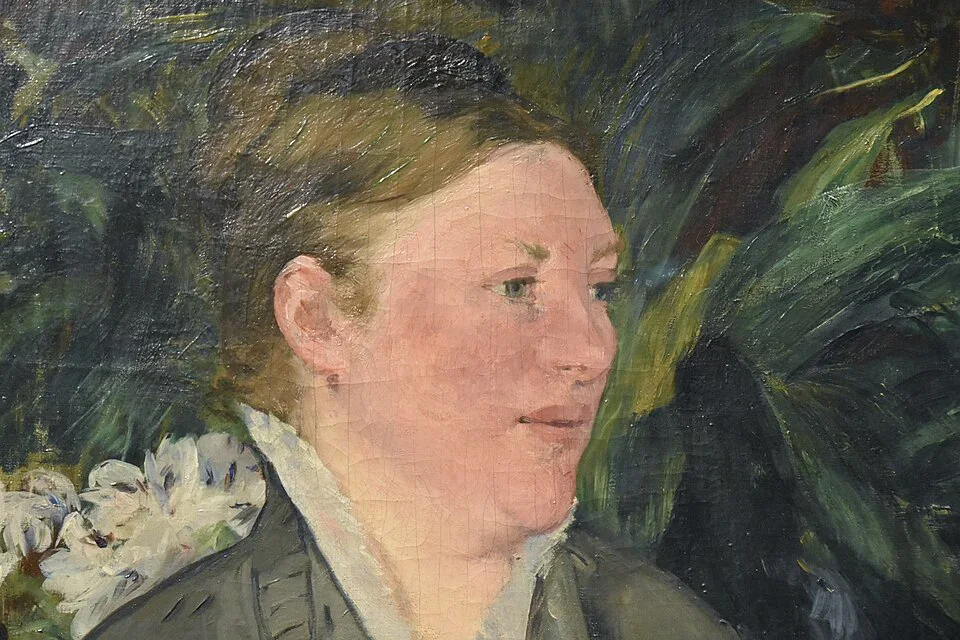
Madame Manet in the Conservatory
A woman is in a conservatory. That is Suzanne, the painter's own wife. She came here often to help with the sittings for another of his paintings, In the Conservatory. The couple who modelled for that one were the Guillemets, a fashionable Paris pair. The wife was famous for her beauty and elegance. Manet painted that couple and their surroundings with every refinement. Then he put Suzanne in that very same spot and painted her without any of it, simply. She thought the portrait a great success. After he died, she hung it on her bedroom wall. But in August 1895 she was short of money, and she let it go with great reluctance, for six thousand francs. It was bought by the collector Maurice Joyant, who later sold it to Georges Bernheim. In 1918 the Friends of the National Gallery in Oslo acquired it. Before she sold it, a copy was made. For years afterwards that copy travelled through Germany taken for the real Manet.
Listen in the appRichard Mortel from Riyadh, Saudi Arabia · Public domain
- 11
View from Stalheim
Johan Christian Dahl · 1836–1842
- 12
The wild Hunt of Odin
Peter Nicolai Arbo · 1872
- 13
Leiv Eirikson discovering America
Christian Krohg · 1891–1893
- 14
Stetind in Fog
Peder Balke · 1864
- 15
Night in Saint-Cloud
Edvard Munch · 1890
- 16
Iris, Messenger of the Gods
Auguste Rodin · 1891–1894
- 17
Christening in Tanum Church
Harriet Backer · 1892
- 18
Armour
Ragnhild Keyser · c. 1926
- 19
Albertine i politilægens venteværelse
Christian Krohg · 1887
- 20
Baldishol Tapestry
Unknown Artist · http://www.wikidata.org/.well-known/genid/90b5ef71fc77c7e17aad03eec73e9c83
- 21
At the Window
Hans Heyerdahl · 1881
- 22
Self-portrait
Vincent van Gogh · 1889
- 23
The Tears of Saint Peter
El Greco · c. 1590
- 24
View of the 1867 Exposition Universelle
Édouard Manet · 1867
- 25
Self-Portrait with the Spanish Flu
Edvard Munch · 1918–1919
- 26
Spring
Edvard Munch · 1887–1889
- 27
Rue Lafayette
Edvard Munch · 1891
- 28
Shipwreck on the Coast of Norway
Johan Christian Dahl · 1832
- 29
Stugunøset at Filefjell
Johan Christian Dahl · 1851
- 30
Christian II signing the Death Warrant of Torben Oxe
Eilif Peterssen · 1875–1876
- 31
The Blue Kitchen
Ludvig Karsten · 1913
- 32
Bronze Figure
Henri Matisse · 1908
- 33
The Scream
Edvard Munch · 1893
- 34
Judith and her Maidservant with the Head of Holofernes
Artemisia Gentileschi · 1639–1640
- 35
Bonfire celebrating Midsummer Night
Nikolai Astrup · 2000
- 36
Paus Trajan
Unknown Artist · 200
- 37
German Emigrants at the Churchyard
Karl Hübner · 1846
- 38
The Dream of the Doctor
Albrecht Durer · c. 1498
- 39
Portrait of Karel van Mallery
Anthony van Dyck · 1631
- 40
Larvik by Moonlight
Johan Christian Dahl · 1839
- 41
Low Church Devotion
Adolph Tidemand · 1848–1852
- 42
Peasant Burial
Erik Werenskiold · 1883–1885
- 43
Greifswald in moonlight
Caspar David Friedrich · 1816–1817
- 44
A game shop
Frans Snyders · 1625–1630
- 45
Braiding her Hair
Christian Krohg · c. 1888
- 46
Portrait of the Painter J.C. Dahl
Johann Carl Roessler · 1819–1820
- 47
Portrait of a young man
Adolph Tidemand · 1841
- 48
Duke Christian Albert of Holstein Gottorp and his wife Princess Frederica Amalia of Denmark and Norway
Jürgen Ovens · 1660s
- 49
Lighthouse on the Norwegian Coast
Peder Balke · 1855
- 50
Struggle for Survival
Christian Krohg · 1888–1889
- 51
Grindelwald glacier
Thomas Fearnley · 1838
- 52
Weary
Jules Bastien-Lepage · 1881
- 53
Autumn Work
Othon Friesz · 1908
- 54
View from Bastei
Johan Christian Dahl · 1819
- 55
Blue Interior
Harriet Backer · 1883
- 56
Judith and her maidservant with the head of Holofernes
Artemisia Gentileschi, Orazio Gentileschi · c. 1608–1612
- 57
St. Sebastian
Workshop of Lucas Cranach the Elder · 1543
- 58
Evening of Summer
Halfdan Egedius · 1893
- 59
From Vaterfjord
Gunnar Berg · 1886–1893
- 60
A Japanese Lantern
Oda Krohg · 1886
National Museum of Norway
Frequently asked questions
How much does the guide cost?
Free app download. Free until 1 January. Listed guide price: $1.99. Audio guide only. Venue admission is separate.
Can I listen without internet?
Yes. Download the guide’s audio, images, and maps in the app before your visit. Your downloaded content is then available offline.
Can I listen in my language?
In English for now. More languages soon.
Do I need to follow a schedule?
No. This is a self-guided experience. Choose your stops, pause whenever you like, and return to a story at your own pace.
Which artworks are in the National Museum of Norway audio guide?
60 artworks, including The Scream (Edvard Munch), Puberty (Edvard Munch), Dance of Life (Edvard Munch), Bridal Procession on the Hardangerfjord (Adolph Tidemand, Hans Gude), Melancholy (Edvard Munch), Winter at the Sognefjord (Johan Christian Dahl), Ashes (Edvard Munch), and Self-Portrait with Cigarette (Edvard Munch). The full list is on this page.
Is this the museum’s official audio guide?
No. Stanza is an independent audio guide app and is not affiliated with National Museum of Norway. Museum admission is separate.
At your own pace
Explore National Museum of Norway.
Download Stanza, then search for “National Museum of Norway”.
Free app download · Guide price shown in the app
Keep exploring
Audio guides — Norway

Oslo · 2 km
Munch Museum
Content & sources
Photo: Premeditated · CC BY-SA 4.0
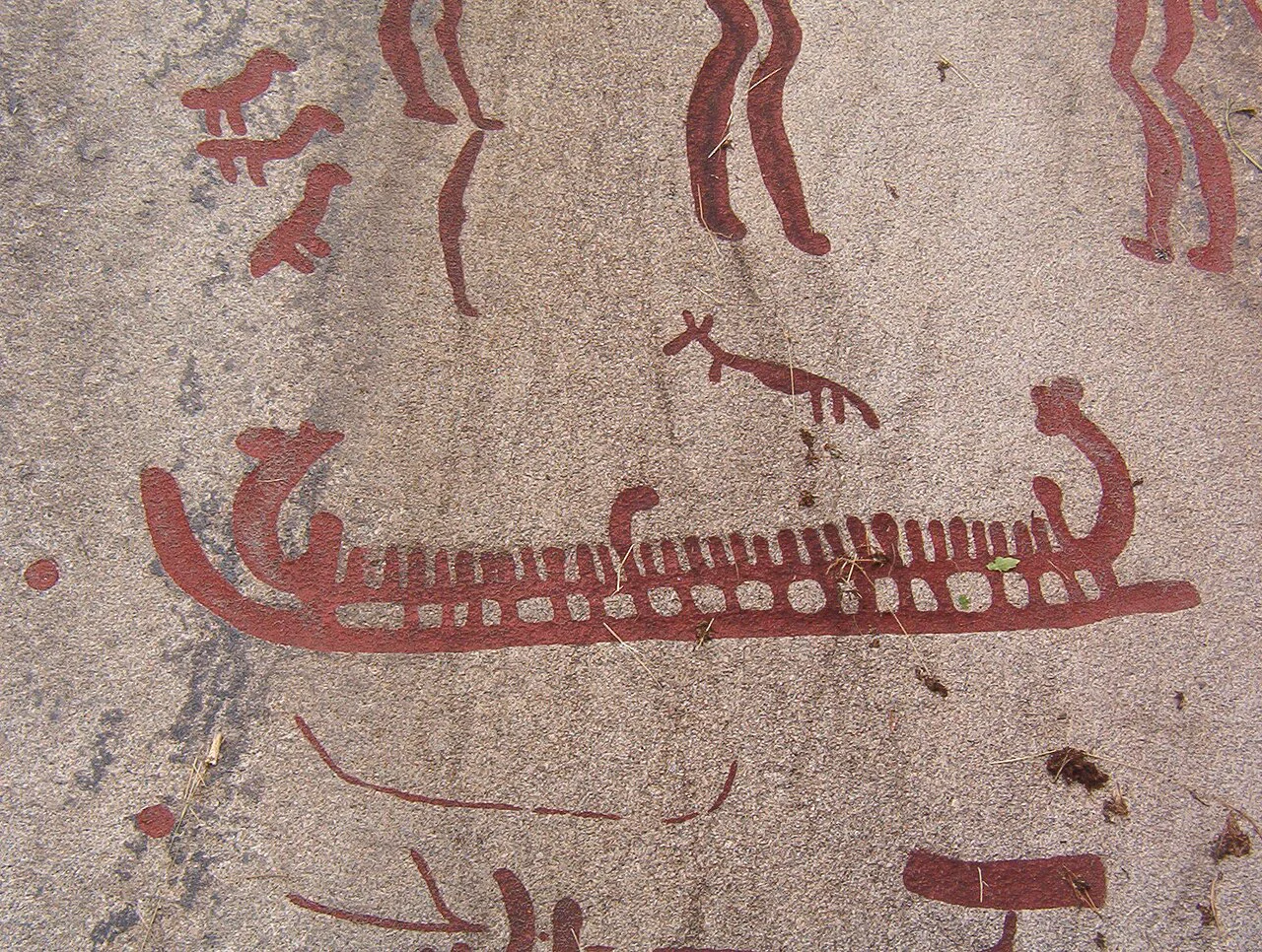
Tanumshede · 139 km
Rock Carvings in Tanum
Content & sources
Photo: Fred J · Public domain
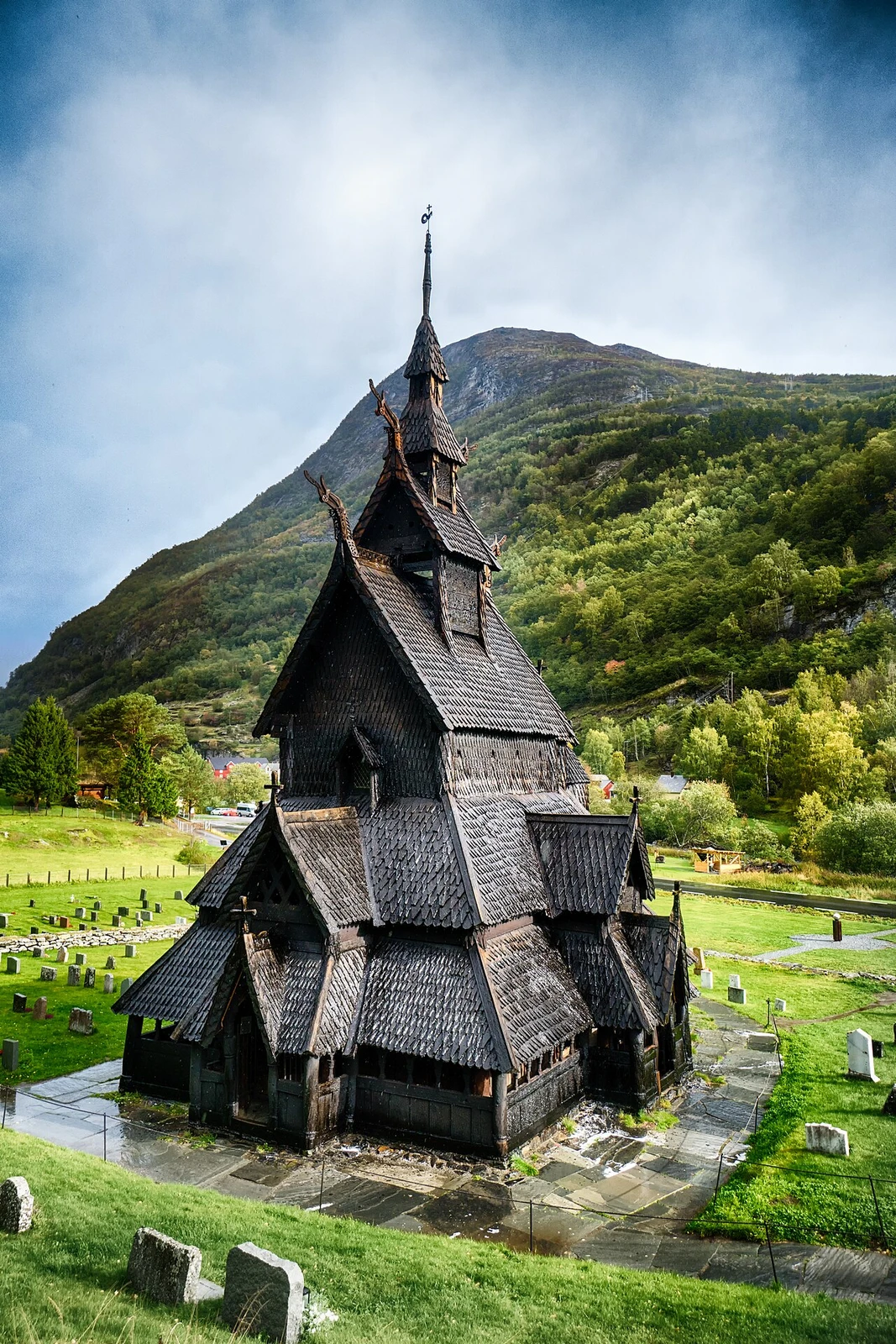
Borgund
Borgund Stave Church
Content & sources
mendhak · CC BY-SA 2.0
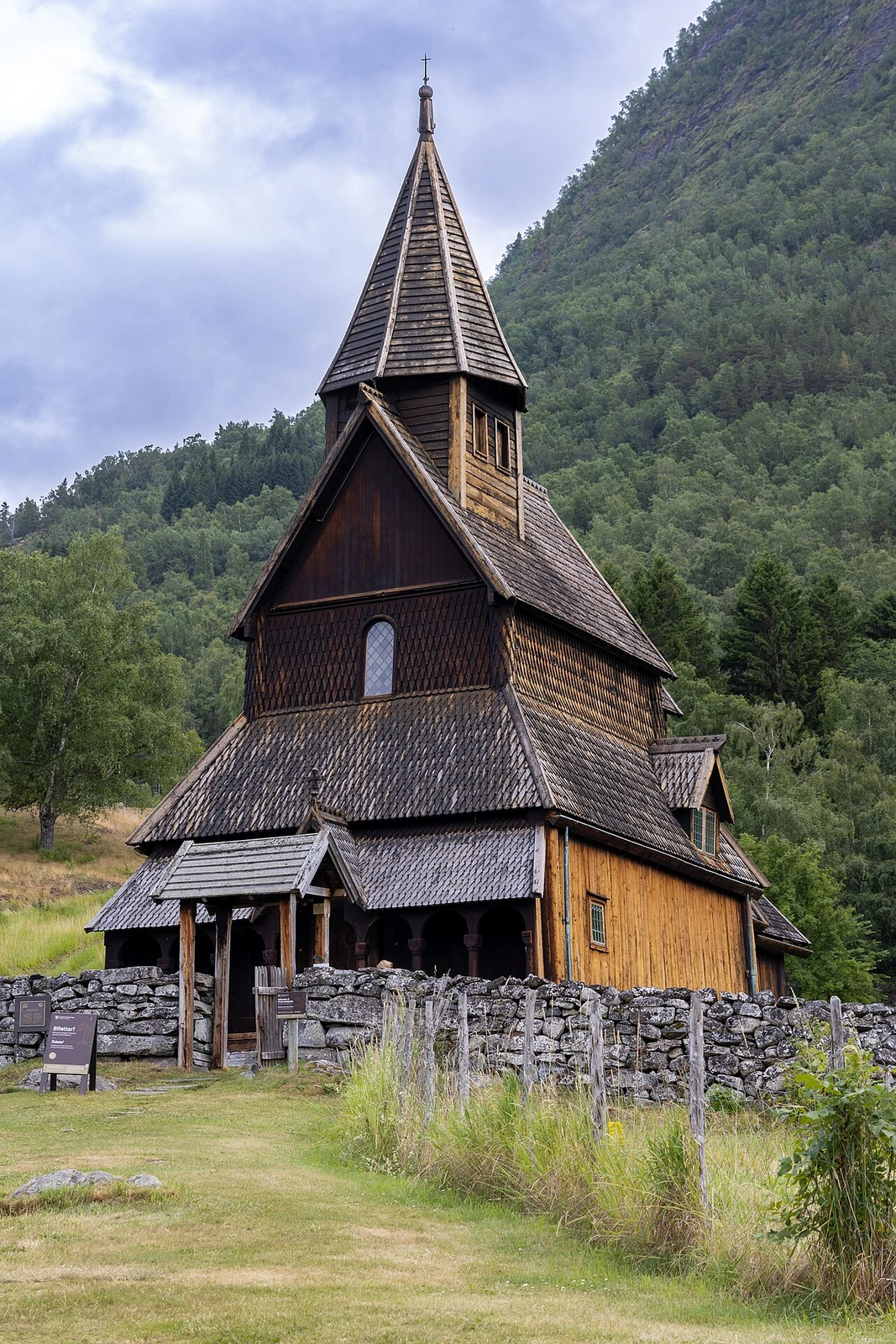
Luster
Urnes Stave Church
Content & sources
Photo: Superbass · CC BY-SA 4.0
Art museums
More art museum audio guides
Oslo · 20 artworks
Munch Museum
Content & sources
Photo: Premeditated · CC BY-SA 4.0
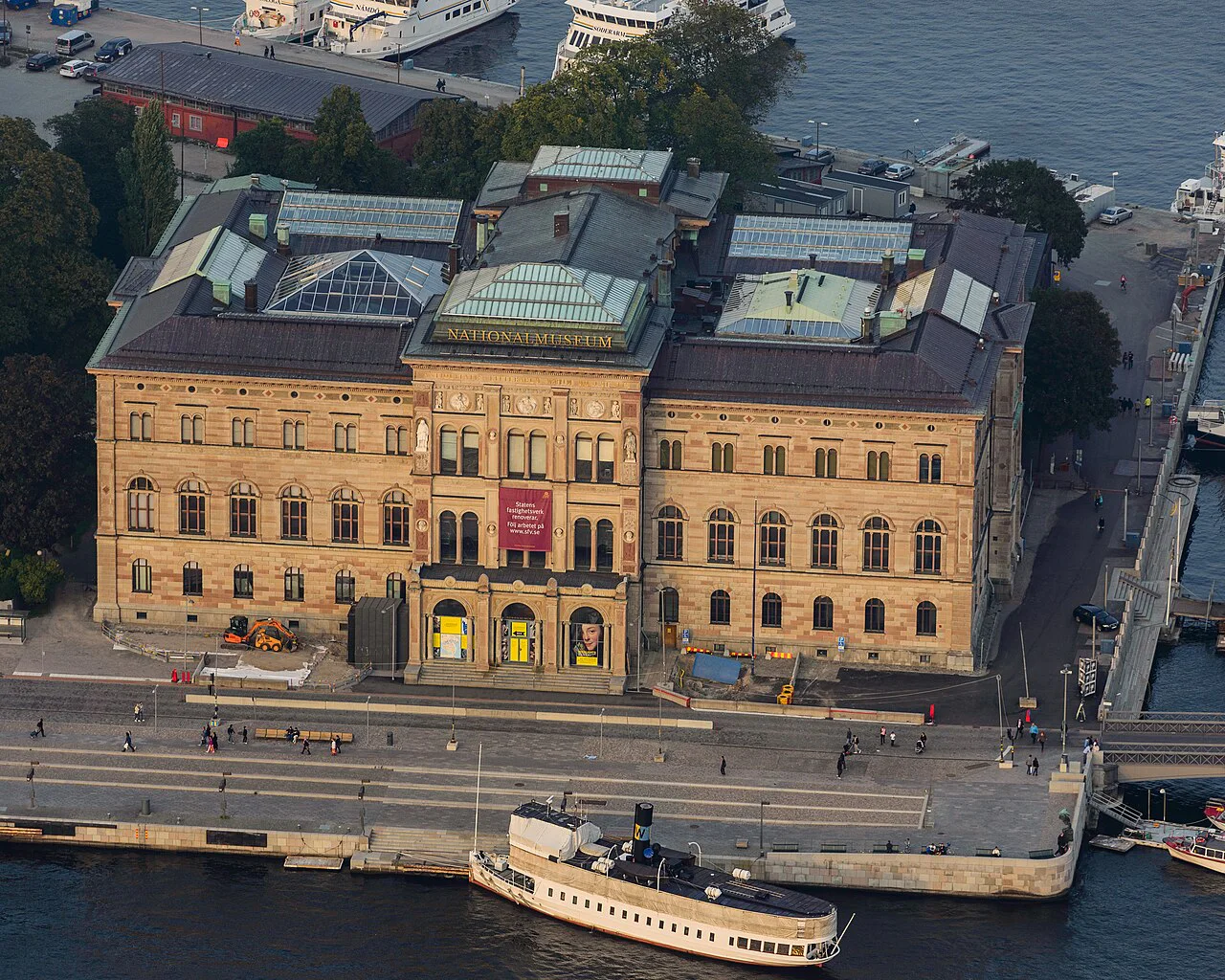
Stockholm · 164 artworks
Nationalmuseum
Content & sources
Arild Vågen · CC BY-SA 4.0
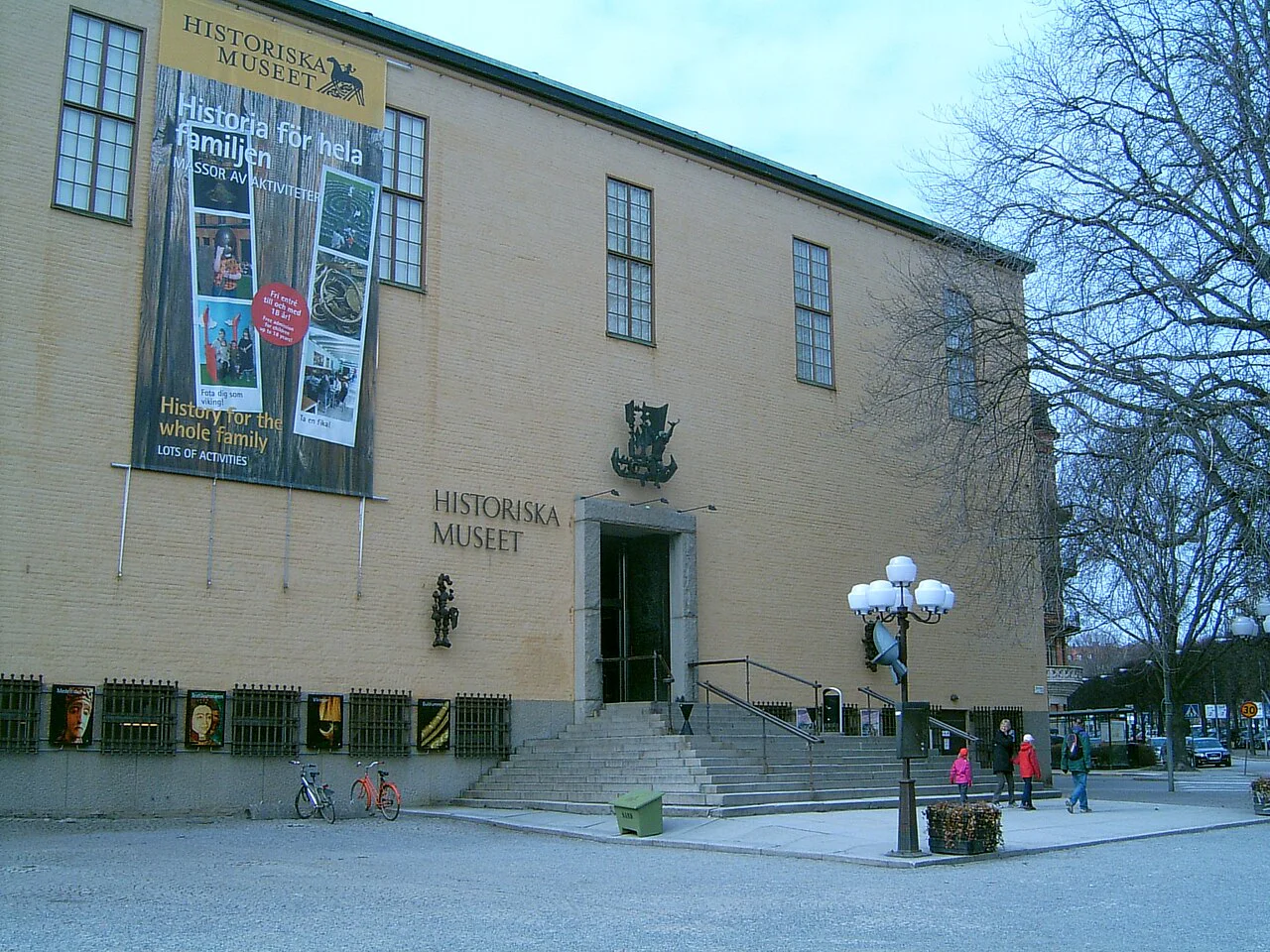
Stockholm · 55 artworks
Swedish History Museum
Content & sources
Mr Bullitt · CC BY-SA 3.0
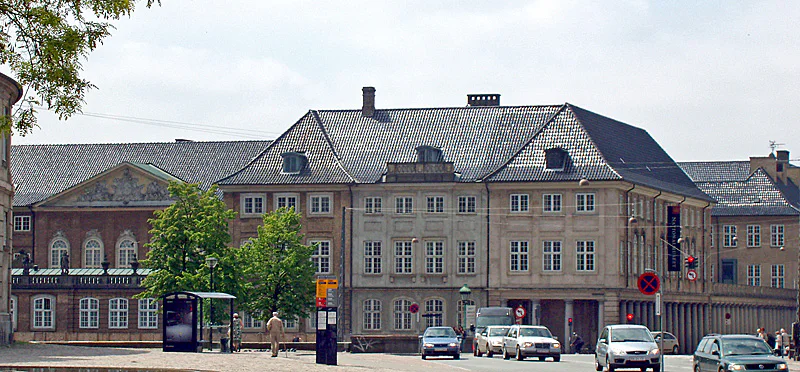
Copenhagen · 62 artworks
National Museum of Denmark
Content & sources
No machine-readable author provided. Nico-dk assumed (based on copyright claims). · CC BY-SA 3.0
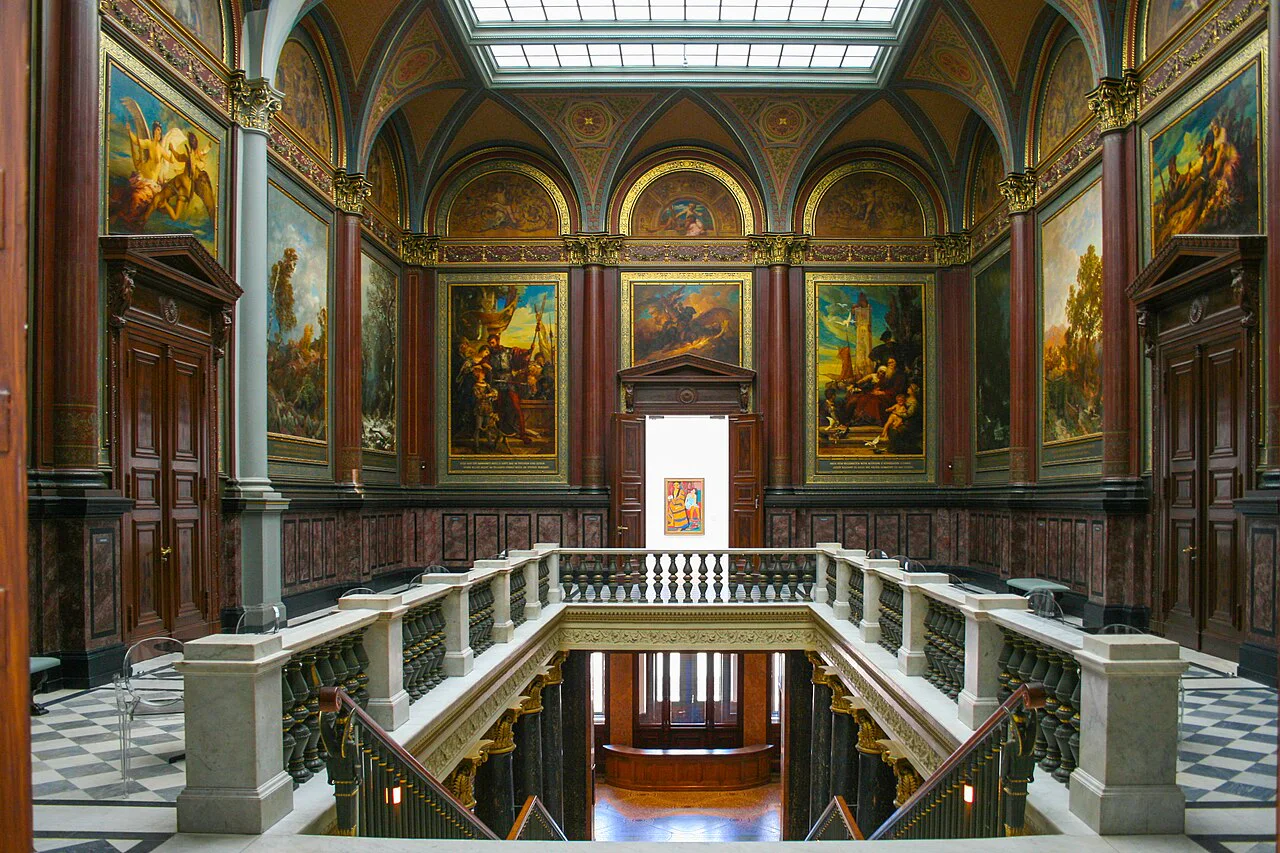
Hamburg · 64 artworks
Hamburger Kunsthalle
Content & sources
Photo: Daniela Kloth · GFDL 1.2
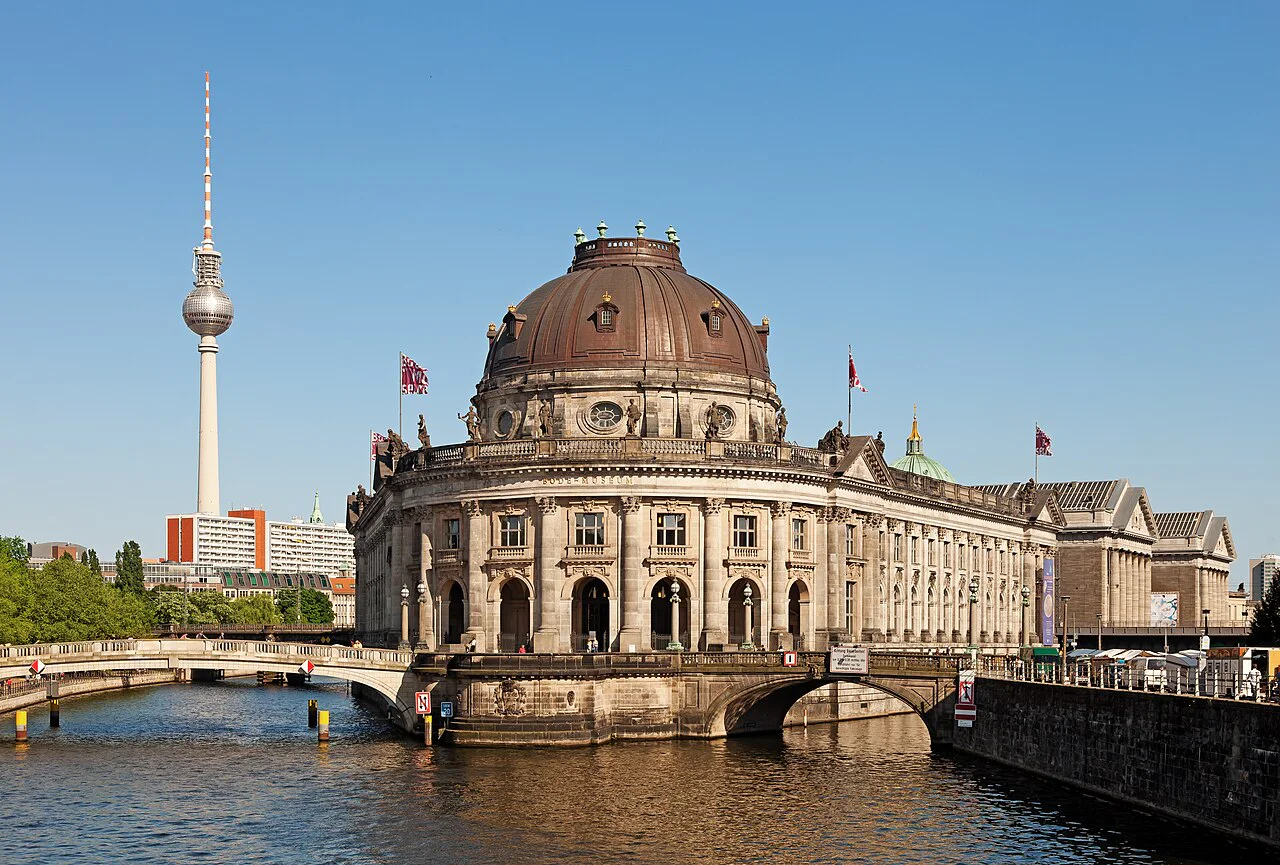
Berlin · 38 artworks
Bode-Museum
Content & sources
Thomas Wolf, www.foto-tw.de · CC BY-SA 3.0