Stanza · Audio guide
Nationalmuseum Audio Guide
A place to remember. A story to take with you.
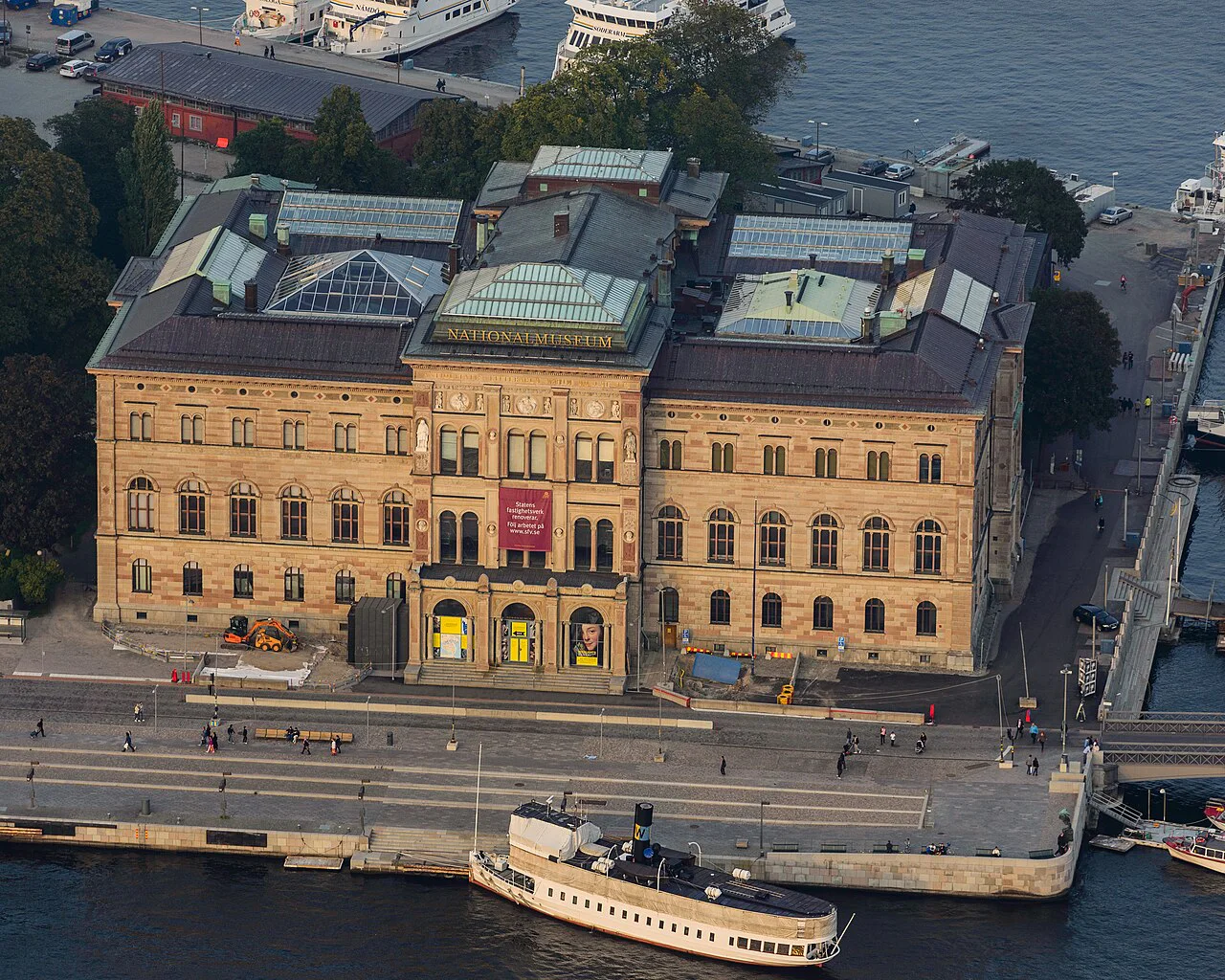
Nationalmuseum is the national gallery of fine arts of Sweden. It is located on the peninsula Blasieholmen in central Stockholm.
Download Stanza, then search for “Nationalmuseum”.
About the tour
One guide. Your kind of visit.
Nationalmuseum is the national gallery of fine arts of Sweden. It is located on the peninsula Blasieholmen in central Stockholm.
The Nationalmuseum guide tells the stories of 164 artworks, including Melencolia I (Albrecht Durer), The Conspiracy of Claudius Civilis (Rembrandt), Truth, Time and History (Francisco Goya), The Town (August Strindberg), La Grenouillère (Pierre-Auguste Renoir), Portrait of a violinist (Anne Vallayer-Coster), The Jurist (Giuseppe Arcimboldo), and The Kitchen Maid (Rembrandt). Every artwork is free to hear in the Stanza app until 1 January.
Ready when you are.
- 01Get the free Stanza app.
iOS & Android
- 02Find your guide.
“Nationalmuseum”
- 03Download before you go.
Works offline
Audio guide / 164 artworks
Inside the guide
Get to know a few of the stories before you go. Open a stop to read more.
01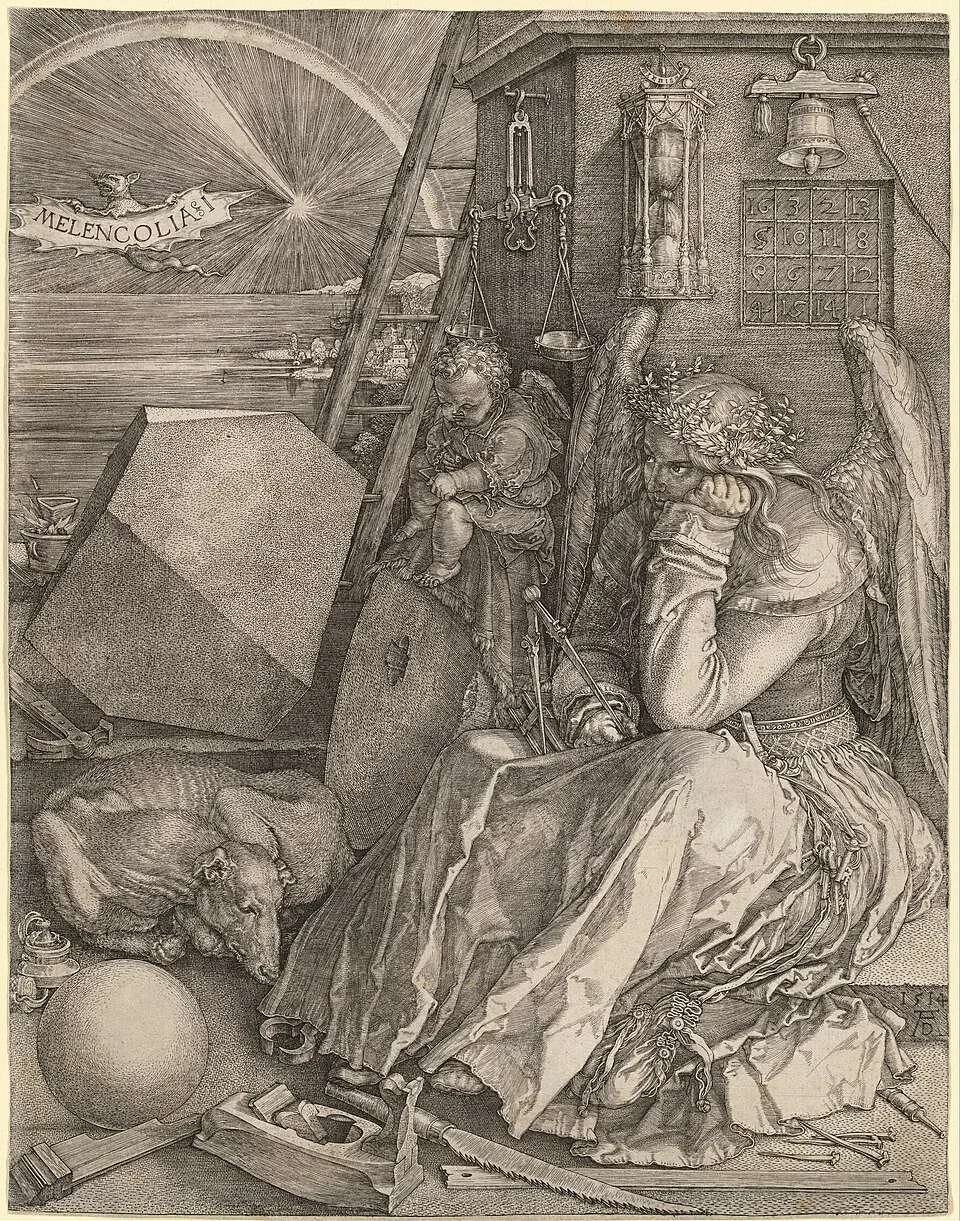
Melencolia I
Every line here was cut with a burin, a tool for cutting lines. Light falls one way through a transparent hourglass, another across a bursting comet, another along a rainbow, and another onto a geometric stone. Dürer made this after several friends had died, and after his mother died in 1514. In a book for young artists he warned that too much effort may leave a person overcome by melancholy. At the centre a winged woman rests her head on her hand and holds a compass loosely. The tools for measuring and building lie scattered around her, unused. This sadness went with thoughtful, creative minds. It could take away the will to make, yet it often marked the creative person. Behind her, on the wall, is a grid of sixteen numbers, the first magic square printed in Europe. Every row, column and diagonal adds to thirty four, and the two middle squares along the bottom give the year 1514. All that exact order sits behind a figure who cannot use a single one of her tools. A small figure sits on an upturned millstone and scribbles on a tablet. He is the one thing here at work. Together with the creature like a bat that carries the words across the sky, he shows two sides of this mood. One side holds her still. The other still makes things.
Listen in the appAlbrecht Dürer · Public domain
02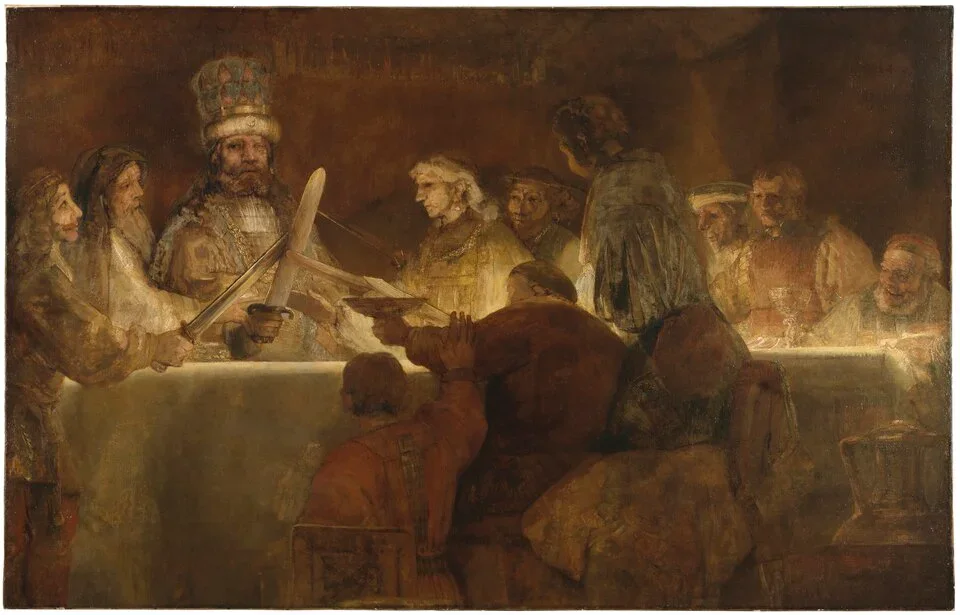
The Conspiracy of Claudius Civilis
No one knows why Amsterdam's city council took this painting down. It had hung in the new city hall for only a short time. The leader wears a crown and dominates the whole scene, hardly fitting a consultative, republican outlook. One eye is gone, the disfigurement he shared with Hannibal. Much of the canvas is left dark and empty. Any of it could have troubled them. It was made as a vast half circle, about five metres across, the largest work its painter had ever made. The subject was the Batavian revolt against Rome, which the Dutch saw as an earlier version of their own recent war with Spain. The new building was meant to have a series of paintings on the revolt. When the painter originally chosen for the series died, the council asked Rembrandt to paint this scene from Tacitus. After it was delivered, it went back to him, and he may never have been paid. In financial trouble, he cut it down to a quarter of its size and repainted parts so it would sell. In the next few months he had to sell the grave of his wife, Saskia. In Tacitus, the chiefs are gathered for a banquet and bound to the revolt with strange rites. The oath on swords was his own invention.
Listen in the appRembrandt · Public domain
03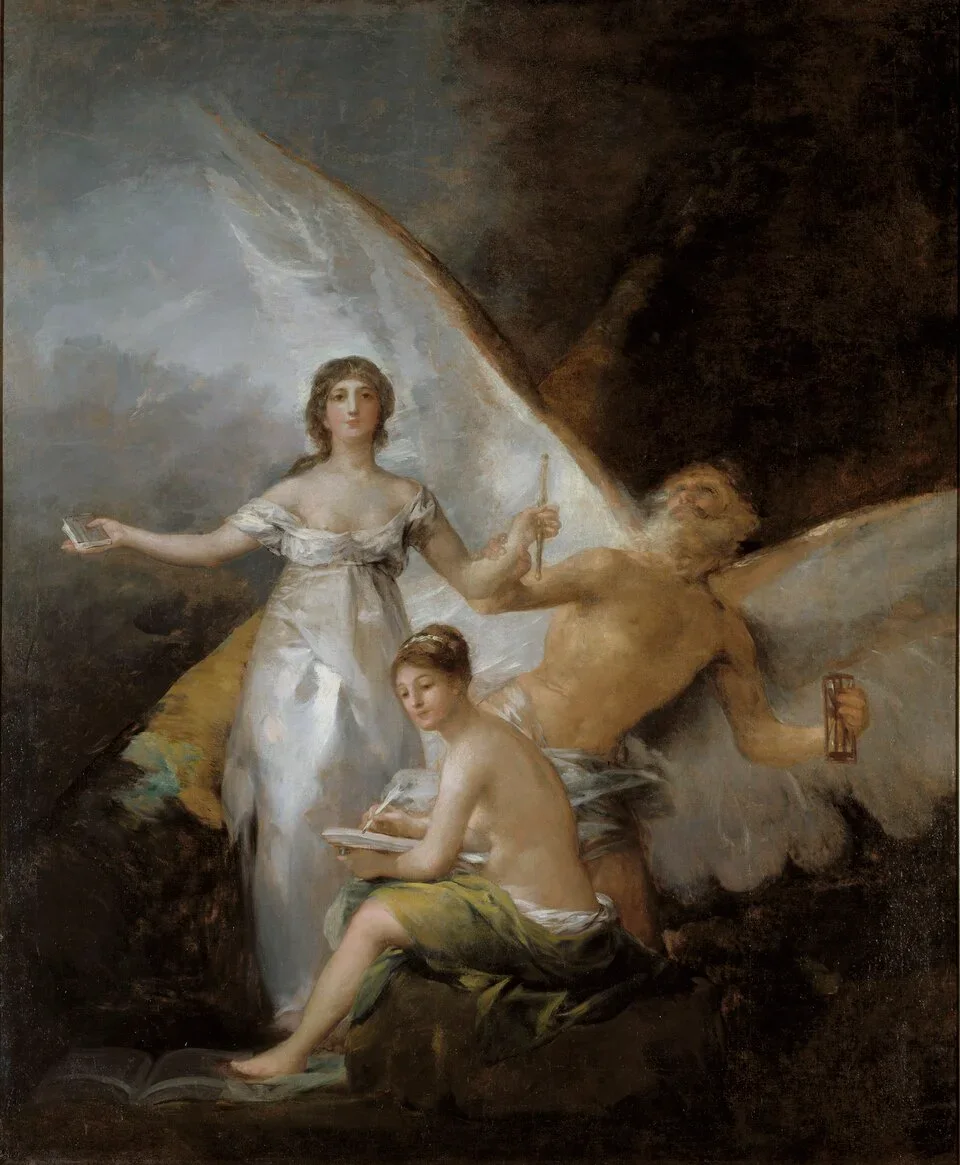
Truth, Time and History
On the left, a woman in white faces you with a scepter in one hand and a book in the other. An old man with great white wings grips her arm and holds an hourglass, his face turned so high you can barely see it. A third woman writes in a book open on her lap. The one writing is History, keeping the record that lets people last beyond their lives. The winged man is Time. Goya worked this out first in a rough sketch. There, Time led a nude Truth by the hand while bats and owls threatened from above. Here the threats are gone, and History has joined the pair. The book in the woman's hand may be the constitution Spain adopted in 1812, during the fighting that drove Napoleon out. The scepter stands for the realm. Read this way, she is both Truth and Spain, and Time's hourglass, newly turned, marks a new era. Who she is meant to be is still not settled.
Listen in the appFrancisco Goya · Public domain
04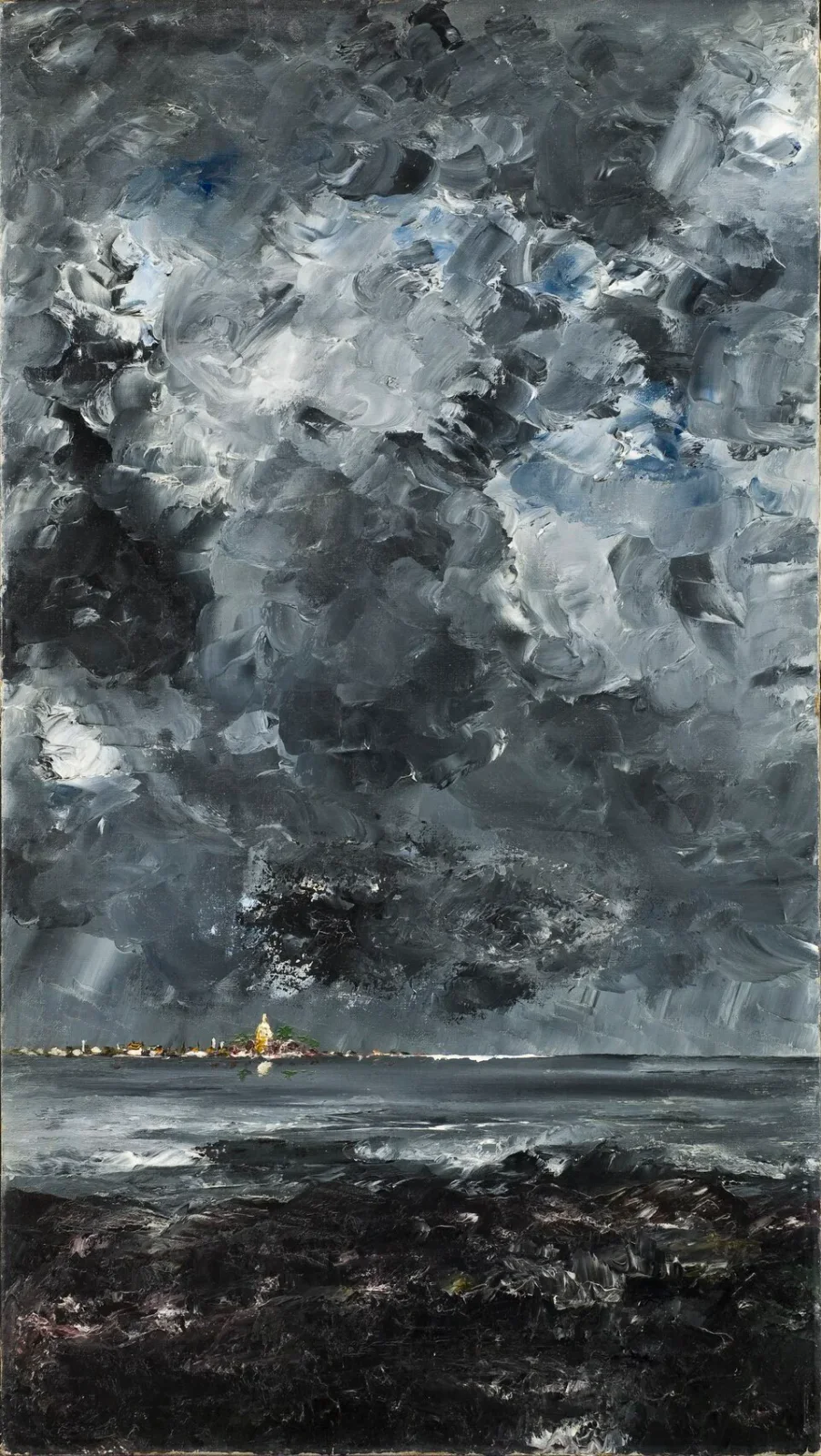
The Town
Almost everything here is white and black and gray. One small patch is green, the trees of a town far off on the horizon, lit against the dark around it. That town is Stockholm, the city where he was born, caught between a wild dark sea and a stormy sky. Strindberg painted this in 1903, when he could barely write but painted again and again. His marriage to the actress Harriet Bosse was under great strain and his mental health was poor. Painting storms was how he coped with what he felt inside. He worked quickly, finishing pictures like this in a day, sometimes a few hours, using his fingers and a palette knife more than brushes. For him the little town stood for civilization holding out against the untamable forces of nature. It meant the peace he wanted could only be found inside himself. The tallest building in that town is mirrored in the water, and the whole place seems to float like a mirage. It is a small light that keeps its distance from the storm.
Listen in the appAugust Strindberg · Public domain
05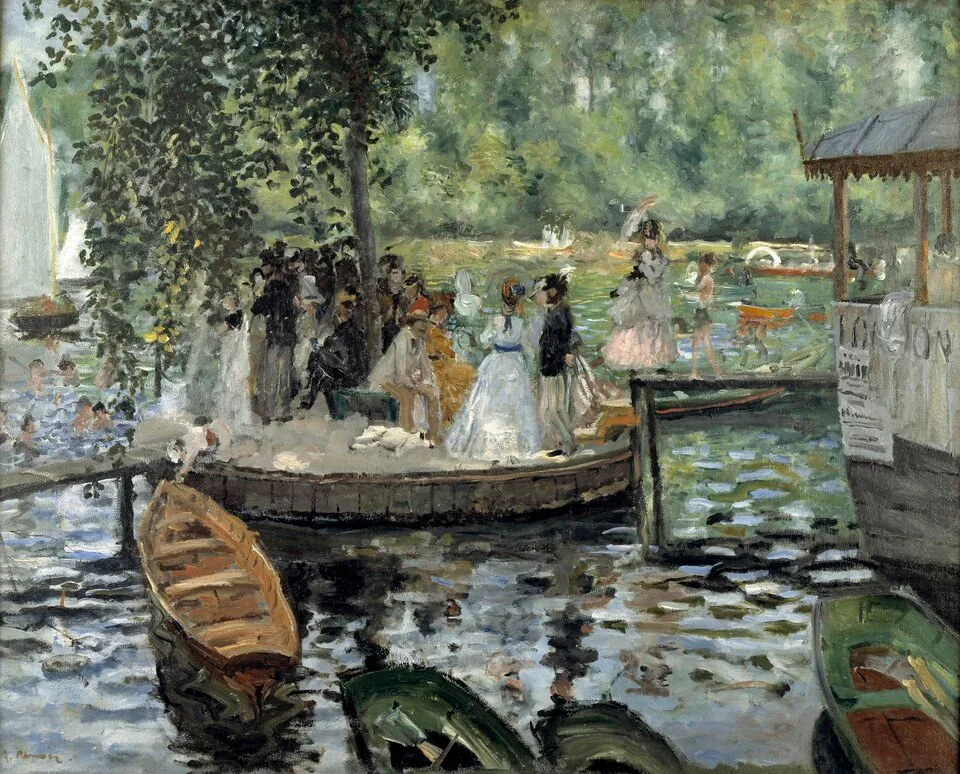
La Grenouillère
In September of 1869, two young friends short of money set up their easels side by side along the Seine. One of them was Renoir. What they were after was the quick impression a place makes on the eye, before the moment passed. That place was La Grenouillère, a floating restaurant and swimming spot outside Paris, where people came on Sundays for light and fresh air. In the middle of the picture sits a small island with one tree, joined by gangplanks. The restaurant reaches out over the river on the right, and boats for hire wait in the foreground. What interested him most here was the people and how they mix, the lively feel of a crowd. He draws the figures more carefully than his friend did in his own painting of the same view. He worked outdoors in short, quick strokes of pure, unmixed colour. He came back to this view again and again, shifting his position a little each time. The way of painting the two friends arrived at that summer was new. Five years later it was given the name Impressionism.
Listen in the appPierre-Auguste Renoir · Public domain
06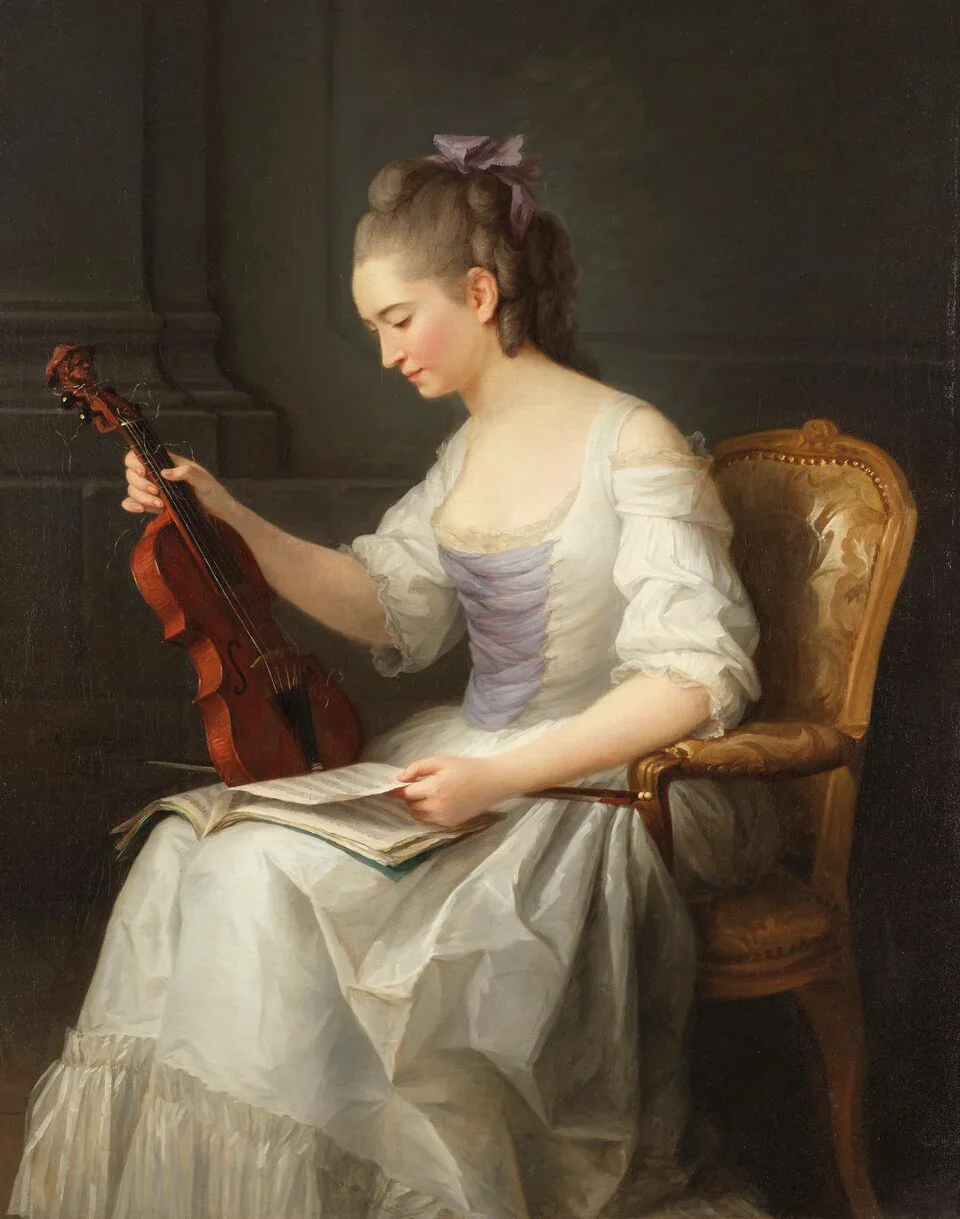
Portrait of a violinist
She sits bent over a music book, reading the notes, and yet the strings of her instrument are broken. The title calls her a violinist. But her instrument has six strings, and frets, those small bars under the strings. Those belong more to the viol family. It is closer to a viola da braccio than a violin. So the title does not quite fit. Anne Vallayer-Coster had painted a similar instrument before, in a still life of musical instruments. It was still lifes like that which earned her a place at the French academy in 1770. Portraits were rare for her, and the few she made were of people close to her. She did not marry until 1781, so was probably still working among her family. Perhaps this is one of her sisters, Madeleine, Elisabeth or Simone. Who the woman is, we do not know.
Listen in the appAnne Vallayer-Coster · Public domain
07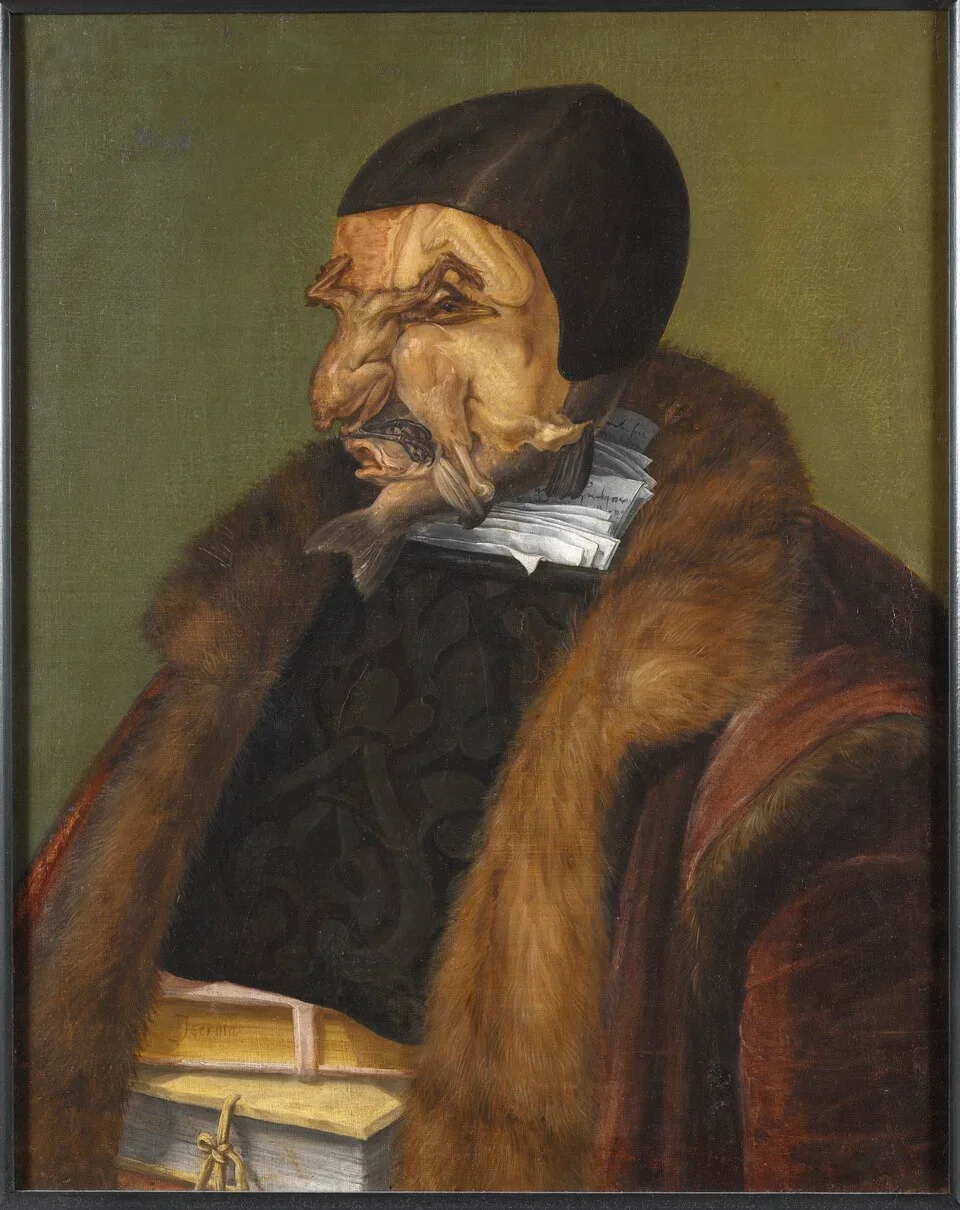
The Jurist
Here is a jurist in a black cap and a fur trimmed coat. But the cap sits over a head of dead fish and birds, and the coat clothes a pile of legal documents in place of a body. A fish forms the sneering mouth. The whole thing may be a joke about lawyers. Giuseppe Arcimboldo built figures like this out of ordinary things. He was court painter to Maximilian the Second, and this portrait was made partly to amuse the court.
Listen in the appGiuseppe Arcimboldo · Public domain
08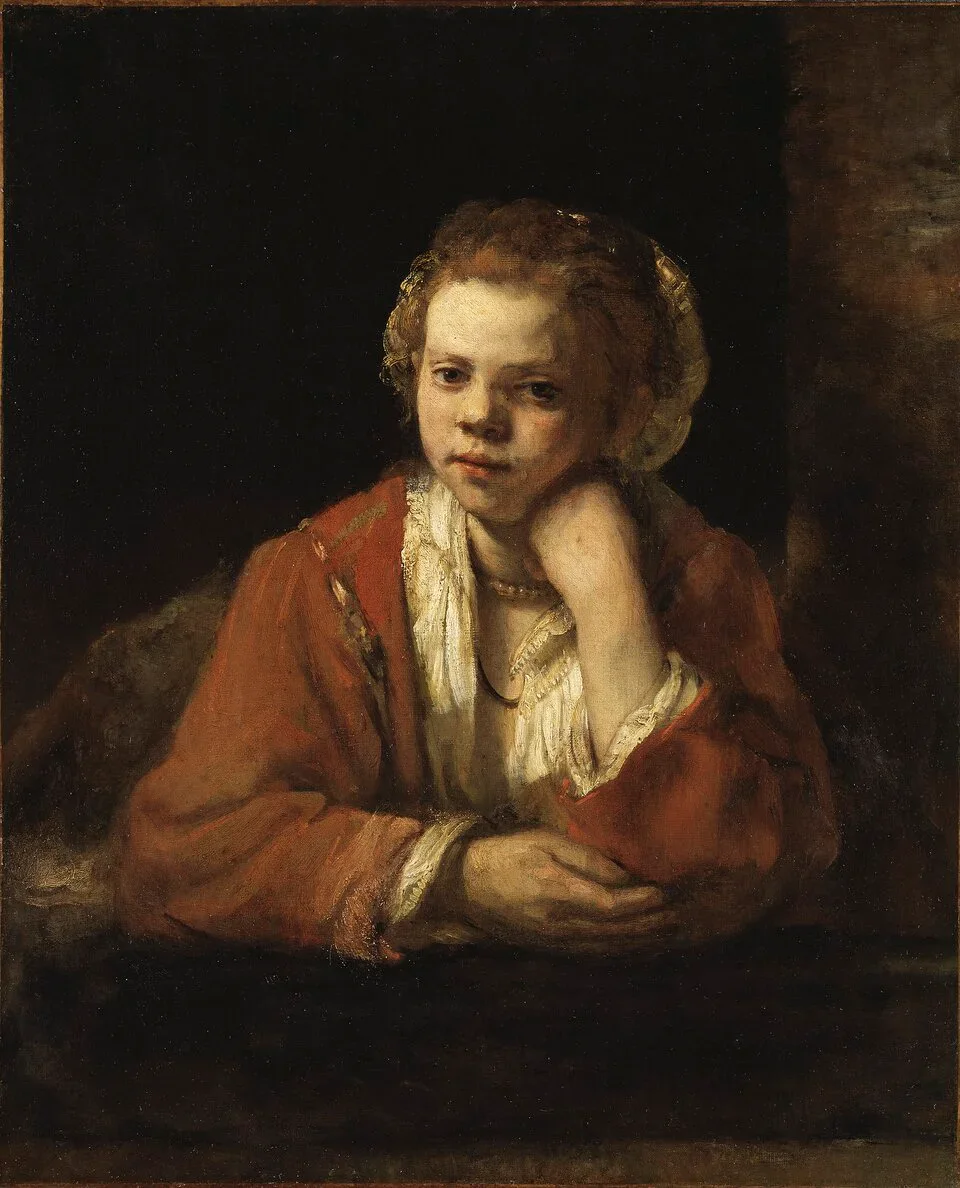
The Kitchen Maid
Rembrandt is thought to have used someone from his own household as the model. And there she is. She leans at a window, her right arm on the sill, her head resting in her left hand. She wears a dull red jacket, and her dark hair is combed back into a small golden cap. Her loose blouse is open a little at the throat, and a string of pearls shows there. That person was once taken to be Hendrickje Stoffels, the woman he lived with. That identification has since been set aside. The name wandered too. It came to Sweden in the late seventeenth century. There it was called a study of a boy resting his head on his hand. King Gustav the Third bought it at auction in 1779, together with several other paintings. Only in 1861 was it named a portrait of a young woman in a red jacket, Rembrandt's kitchen maid.
Listen in the appRembrandt · Public domain
09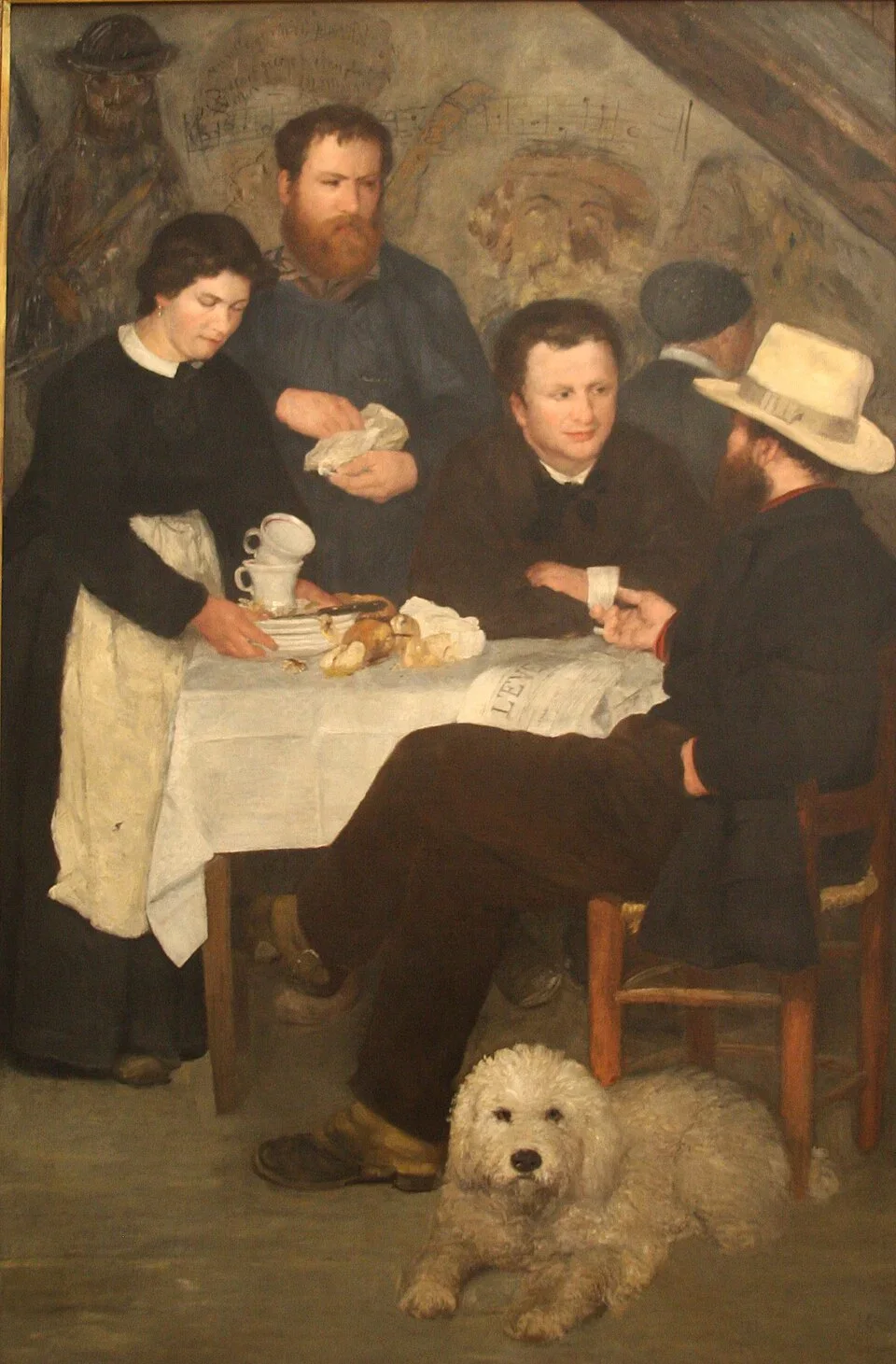
Mother Anthony's Tavern
On the table lies a copy of the newspaper L'événement. It carried some of Émile Zola's art reviews, and it tells you the sort of company that gathered here. This is a tavern in Bourron-Marlotte, on the edge of the Fontainebleau forest, south of Paris. Artists working nearby came here, the Barbizon painters among them. Renoir painted the room in 1866, when he was twenty five, one of his first major works. The faces are thought to be people from his own circle. On the right, in a yellow straw hat, sits the painter Alfred Sisley. Like Renoir, he would join the Impressionists a few years later. At the far right, seen from behind in a headscarf, is Madame Anthony, who kept the inn. Behind her, on the wall, hangs a picture of Henry Murger. He was a French novelist and poet, an icon of Bohemianism, the free and unconventional life of an artist.
Listen in the appPierre-Auguste Renoir · CC BY-SA 3.0
10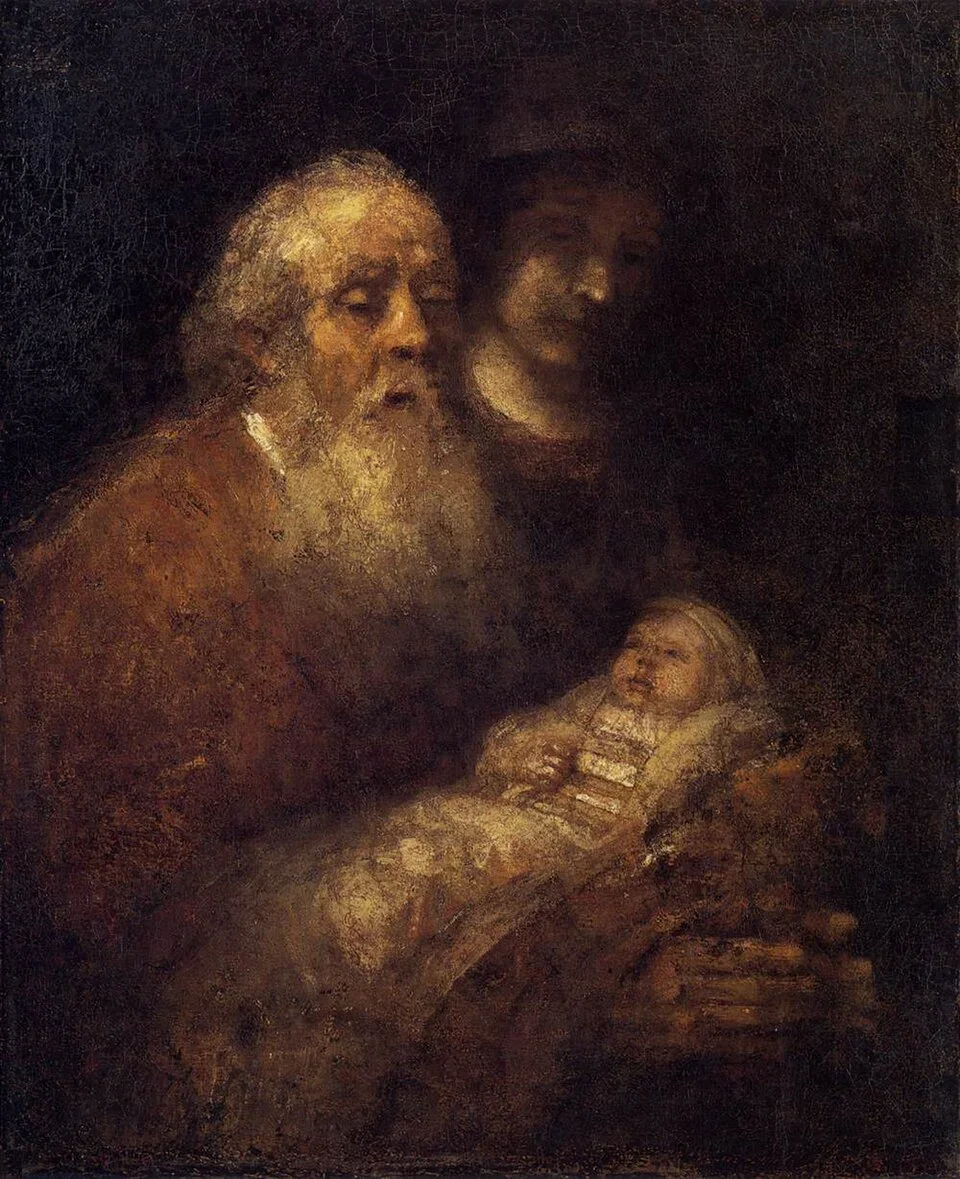
Simeon in the Temple
No one can say for certain who the woman in the background is. Mary, or Anna the Prophetess. An old man holds the child in his arms, his eyes half closed. He is fragile. Only a few figures are here, surrounded by darkness, and the woman stays in the background. The old man is Simeon. In the Gospel of Luke, God promised him he would not die before he had seen the Messiah. When the child was brought into the temple in Jerusalem, Simeon understood the Savior had come. He praised God in a song that carries his name. This was Rembrandt's last painting, and he left it unfinished when he died. After his death, the woman in the background was probably painted by someone in his workshop whose name we do not know.
Listen in the appRembrandt · Public domain
- 11
The Lady with a Fan, The Artist's Wife
Alexander Roslin · 1768
- 12
Landscape from Bretagne
Paul Gauguin · 1889
- 13
Bringing Home the Body of King Karl XII of Sweden
Gustaf Cederström · 1884
- 14
Midwinter's Sacrifice
Carl Larsson · 1915
- 15
Dancing Fairies
August Malmström · 1866
- 16
The Triumph of Venus
François Boucher · 1740
- 17
Mrs. Hugh Hammersley
John Singer Sargent · 1892
- 18
Saint Sebastian
Pietro Perugino · 1490
- 19
King Candaules of Lydia Showing his Wife to Gyges
Jacob Jordaens · c. 1646
- 20
Landscape with the Fall of Icarus
Joos de Momper the Younger · c. 1620s
- 21
Thor's Fight with the Giants
Mårten Eskil Winge · 1872
- 22
Valdemar Atterdag holding Visby to ransom
Carl Gustaf Hellqvist · 1882
- 23
The Rope Dancer
Henri de Toulouse-Lautrec · 1899
- 24
Young Boy Peeling a Pear
Édouard Manet · 1868
- 25
Omnibus
Anders Zorn · 1891
- 26
The Cook
Giuseppe Arcimboldo · c. 1570
- 27
Virgin and Child with Saints
Master of the Drapery Studies · 1435
- 28
Gustav Vasas intåg i Stockholm 1523
Carl Larsson · 1891–1908
- 29
En premiär
Anders Zorn · 1888
- 30
Wonderland
August Strindberg · 1894
- 31
King Gustav III of Sweden and his Brothers
Alexander Roslin · 1771
- 32
Breakfast Time
Hanna Hirsch-Pauli · 1887
- 33
The Child's Brain
Giorgio de Chirico · 1914
- 34
Midsummer Dance
Anders Zorn · 1897
- 35
Kneeling Nun
Martin van Meytens · 1731
- 36
Maria, Lady Eardley (1743-1794)
Thomas Gainsborough · 1766–1770
- 37
Saint Catherine of Alexandria
Artemisia Gentileschi · c. 1627–1635
- 38
The Danish portrait painter Bertha Wegmann at work
Jeanna Bauck · 1870
- 39
Interior with a Mother close to a Cradle
Pieter de Hooch · c. 1655–1670
- 40
View of Egmond aan Zee
Jacob van Ruisdael · c. 1650s
- 41
The Architect Ventura Rodriguez
Francisco Goya · 1784
- 42
Apostle Peter
Rembrandt · 1632
- 43
Portrait of a young woman in profile
Rembrandt · 1632
- 44
Stormy Sea. Broom Buoy
August Strindberg · 1892
- 45
St Peter and St Paul
El Greco · 1605–1608
- 46
The Sandvik Fiord
Hans Gude · 1879
- 47
Poetry and Poets
Francisco Goya · 1804–1808
- 48
Erminia and the Shepherds
Eugène Delacroix · 1859
- 49
Burial of the Count of Orgaz
El Greco
- 50
Kelp Chair
Unknown Artist · 2021
- 51
Moonlight Landscape
Guercino · c. 1616
- 52
Still Life with Statuette
Paul Cézanne · 1894–1895
- 53
A Parisian Lady
Édouard Manet · 1883
- 54
Waterfall in Småland
Marcus Larson · 1856
- 55
John Jennings Esq., his Brother and Sister-in-Law
Alexander Roslin · 1769
- 56
The Ill-Matched Couple
Lucas Cranach the Elder · 1532
- 57
Arthur James Balfour, 1st Earl of Balfour
John Singer Sargent · 1908
- 58
Christ and the Woman Taken in Adultery
Workshop of Lucas Cranach the Elder · 16th century
- 59
Interior of a Studio in Paris
Eva Bonnier · 1886
- 60
Venus Cythereia
Jan Matsys · 1561
- 61
At Breakfast
Laurits Andersen Ring · 1898
- 62
The Water Sprite
Ernst Josephson · 1882
- 63
Port of Hamburg
Anders Zorn · 1891
- 64
The Milliner
François Boucher · 1746
- 65
Aretino in the Studio of Tintoretto
Pierre-Nolasque Bergeret · c. 1822
- 66
The Veil of Saint Veronica, The Holy Face
Francisco de Zurbarán · c. 1631
- 67
Dolce Far Niente
John Singer Sargent · c. 1907
- 68
Leda and the Swan
François Boucher · 1742
- 69
Category:Venus, Rising from the Waves by Johan Tobias Sergel (Nationalmuseum Stockholm)
Johan Tobias Sergel · 1785
- 70
Fable of the Fox and the Heron
Frans Snyders · 17th century
- 71
Loggia, Procida
Martinus Rørbye · 1835
- 72
Culmin's Ghost Appears to his Mother
Nicolai Abildgaard · c. 1794
- 73
Portrait of an Old Man
Domenico Ghirlandaio · 1488
- 74
Zoie Ghika, Moldavian Princess
Alexander Roslin · 1777
- 75
Coronation of Gustav III.
Carl Gustaf Pilo · 1782–1793
- 76
Frederick II's canopy
Hans Knieper · 1586–1589
- 77
A Poacher
Bruno Liljefors · 1894
- 78
Isabella de Medici (1542-1576)
Bronzino · c. 1552–1553
- 79
The Fire at the Royal Palace, Stockholm, May 7th, 1697
Johan Fredrik Höckert · 1866
- 80
Bacchus-Apollo
Nicolas Poussin · c. 1620–1625
- 81
The Love Lesson
Jean-Antoine Watteau · c. 1716–1717
- 82
Landscape with Rebecka taking leave of her father
Claude Lorrain · c. 1640
- 83
Self-portrait
Eugène Jansson · 1910
- 84
Sunday Evening in a Farmhouse in Dalarna
Amalia Lindegren · 1860
- 85
Friends
Hanna Hirsch-Pauli · 1900–1910
- 86
Portrait of Maria Bastiaens van Hout
Frans Hals · 1643
- 87
Our Daily Bread
Anders Zorn · 1886
- 88
Valkyrie
Peter Nicolai Arbo · 1864–1865
- 89
Boy playing the Flute
Judith Leyster · 1630–1635
- 90
The Tree and the River III (The Seine at Bois-le-Roi)
Carl Fredrik Hill · 1877
- 91
Unknown Lady, called Baroness de Neubourg-Cromière
Alexander Roslin · 1756
- 92
Spanish Smiths
Ernst Josephson · 1881
- 93
Mrs Veronica Heiss
Anders Zorn · 1891
- 94
Miss Anna Bagge, née Heyman
Ernst Josephson · 1880
- 95
Dionysos (Bacchus) and Ariadne
Jonas Åkerström
- 96
Portrait of the painter Jeanna Bauck
Bertha Wegmann · 1881
- 97
Selfportrait
Ivar Arosenius · 1906
- 98
Getting Ready for a Game
Carl Larsson · 1901
- 99
Triumphant Cupid among Emplems of Art and War
Thomas Willeboirts Bosschaert, Paul de Vos · 17th century
- 100
Hornsgatan by Night
Eugène Jansson · 1902
- 101
Boy with Parrots and Monkeys
David Klöcker Ehrenstrahl · 1670
- 102
Hoga Valley, Tjörn
Karl Nordström · 1897
- 103
Hinric Hasenberger, the Court Jester
David Klöcker Ehrenstrahl · 1652
- 104
Two Small Dogs
David Klöcker Ehrenstrahl · 1673
- 105
Mr Frans R. Heiss
Anders Zorn · 1891
- 106
Woman reading a letter and a man at a window
Pieter de Hooch · 1668–1670
- 107
Black Cocks at Ground
David Klöcker Ehrenstrahl · 1675
- 108
King Gustav III of Sweden & a Soldier.Episode from the Russian War 1789
Pehr Hilleström · c. 1790
- 109
Apostle Paul
Jan Lievens · 1627–1629
- 110
Memento mori
Roelant Savery · 1600–1609
- 111
Mucius Scaevola before King Porsenna
Abraham Schöpfer · 1533
- 112
Young Student Drawing
Jean-Baptiste-Siméon Chardin · 1733–1735
- 113
Venus with the Beautiful Buttocks, c. 1780 CE, by Johan Tobias Sergel, Nationalmuseum, Sweden
Johan Tobias Sergel · c. 1780
- 114
Sami Collecting Reindeer which have Been Shot
Johan Tirén · 1892
- 115
The Princess and the Trolls
John Bauer · 1913
- 116
The Water-Sprite and Ägir's Daughters
Nils Blommér · 1850
- 117
The Council of the Society of Artists
Richard Bergh · 1903
- 118
The Sphinx
Georg von Rosen · 1887–1907
- 119
Fairies of the Meadow
Nils Blommér · 1850
- 120
In the Bois de Boulogne
Berthe Morisot · c. 1879
- 121
Feast of Sea Gods
Workshop of Frans Floris (I) · c. 1550
- 122
The Severed Heads
Théodore Géricault · c. 1818
- 123
Death of King Gustav II Adolf of Sweden at the Battle of Lützen
Carl Wahlbom · 1855
- 124
Selfportrait with Allegories
David Klöcker Ehrenstrahl · 1691
- 125
Venus Mourning Adonis
Paolo Veronese · 1573
- 126
The Artist and his Wife Marie Suzanne Giroust painting the Portrait of Henrik Wilhelm Peill
Alexander Roslin · 1767
- 127
Christ crowned with Thorns
Giovanni Bellini · 1507
- 128
Adolf Erik Nordenskiöld
Georg von Rosen · 1886
- 129
The artist Eva Bonnier
Richard Bergh · 1889
- 130
Autumn
Helmer Osslund · 1907
- 131
The Toilet of Venus
François Boucher · 1746
- 132
Yngling med sköldpadda
John Börjeson · 1879
- 133
King Gustav III of Sweden
Alexander Roslin · 1775
- 134
The Artist's Mother
Akseli Gallen-Kallela · 1896
- 135
Church-Goers in a Boat
Carl Wilhelmson · 1909
- 136
A Boy Playing the Lute ("Hearing", One of a Series of the Five Senses)
Hendrick ter Brugghen · 1620
- 137
The Artist, Julia Beck
Richard Bergh · c. 1882
- 138
The Neighbouring Farm Houses
Karl Nordström · 1894
- 139
A Cat with a Young Bird in its Mouth. Five studies in one frame NM 2223-2227
Bruno Liljefors · 1885
- 140
The Dowager Queen Lovisa Ulrika of Sweden
Lorens Pasch the Younger · 1775
- 141
Summer Landscape
Johan Edvard Bergh · 1873
- 142
A Couple and a Shepherdess in a Landscape
Hendrick van der Burgh · 1661
- 143
Vision. Scene from Visby
Richard Bergh · 1894
- 144
Portrait of a Man, possibly Mr Robert Pigott of Chetwynd
Joshua Reynolds · 18th century
- 145
Boy from Concarneau
Richard Bergh · 1882
- 146
Turkish Boatman in the Constantinople Harbour
Anders Zorn · 1886
- 147
In Mourning
Anders Zorn · 1880
- 148
The Last Human Beings
Carl Fredrik Hill
- 149
Decommissioned Omnibus Horses on Boulevard d’Enfer, Paris
Nils Kreuger · 1885
- 150
Unicorn in the forest by Märta Måås-Fjetterström
Märta Måås-Fjetterström · c. 1915
- 151
The Death of Sten Sture the Younger on the Ice of Lake Mälaren
Carl Gustaf Hellqvist · 1880
- 152
Fosterbröderna
Theodor Lundberg · 1887–1888
- 153
Kraka
Mårten Eskil Winge · 1862
- 154
The Christmas Fair
Georg von Rosen · 1872
- 155
The Lineman
Laurits Andersen Ring · 1883–1884
- 156
Loke and Sigyn
Mårten Eskil Winge · 1863
- 157
Hypnotic Séance
Richard Bergh · 1887
- 158
The Cellist (Self-portrait)
Gustave Courbet · 1847
- 159
Art and Handiwork
Theodor Lundberg · 1896–1897
- 160
Passionate lovers
Johan Tobias Sergel · 1770
- 161
In sorrow
Theodor Lundberg · 1900
- 162
Jupiter and Callisto
Caesar van Everdingen · 1655
- 163
Achilles Discovered Amongst the Daughters of Lycomedes
Gerard de Lairesse · c. 1685
- 164
The Penitent St Jerome
Georges de La Tour · 1620s
Nationalmuseum
Frequently asked questions
How much does the guide cost?
Free app download. Free until 1 January. Listed guide price: $1.99. Audio guide only. Venue admission is separate.
Can I listen without internet?
Yes. Download the guide’s audio, images, and maps in the app before your visit. Your downloaded content is then available offline.
Can I listen in my language?
In English for now. More languages soon.
Do I need to follow a schedule?
No. This is a self-guided experience. Choose your stops, pause whenever you like, and return to a story at your own pace.
Which artworks are in the Nationalmuseum audio guide?
164 artworks, including Melencolia I (Albrecht Durer), The Conspiracy of Claudius Civilis (Rembrandt), Truth, Time and History (Francisco Goya), The Town (August Strindberg), La Grenouillère (Pierre-Auguste Renoir), Portrait of a violinist (Anne Vallayer-Coster), The Jurist (Giuseppe Arcimboldo), and The Kitchen Maid (Rembrandt). The full list is on this page.
Is this the museum’s official audio guide?
No. Stanza is an independent audio guide app and is not affiliated with Nationalmuseum. Museum admission is separate.
At your own pace
Explore Nationalmuseum.
Download Stanza, then search for “Nationalmuseum”.
Free app download · Guide price shown in the app
Keep exploring
Nearby audio guides
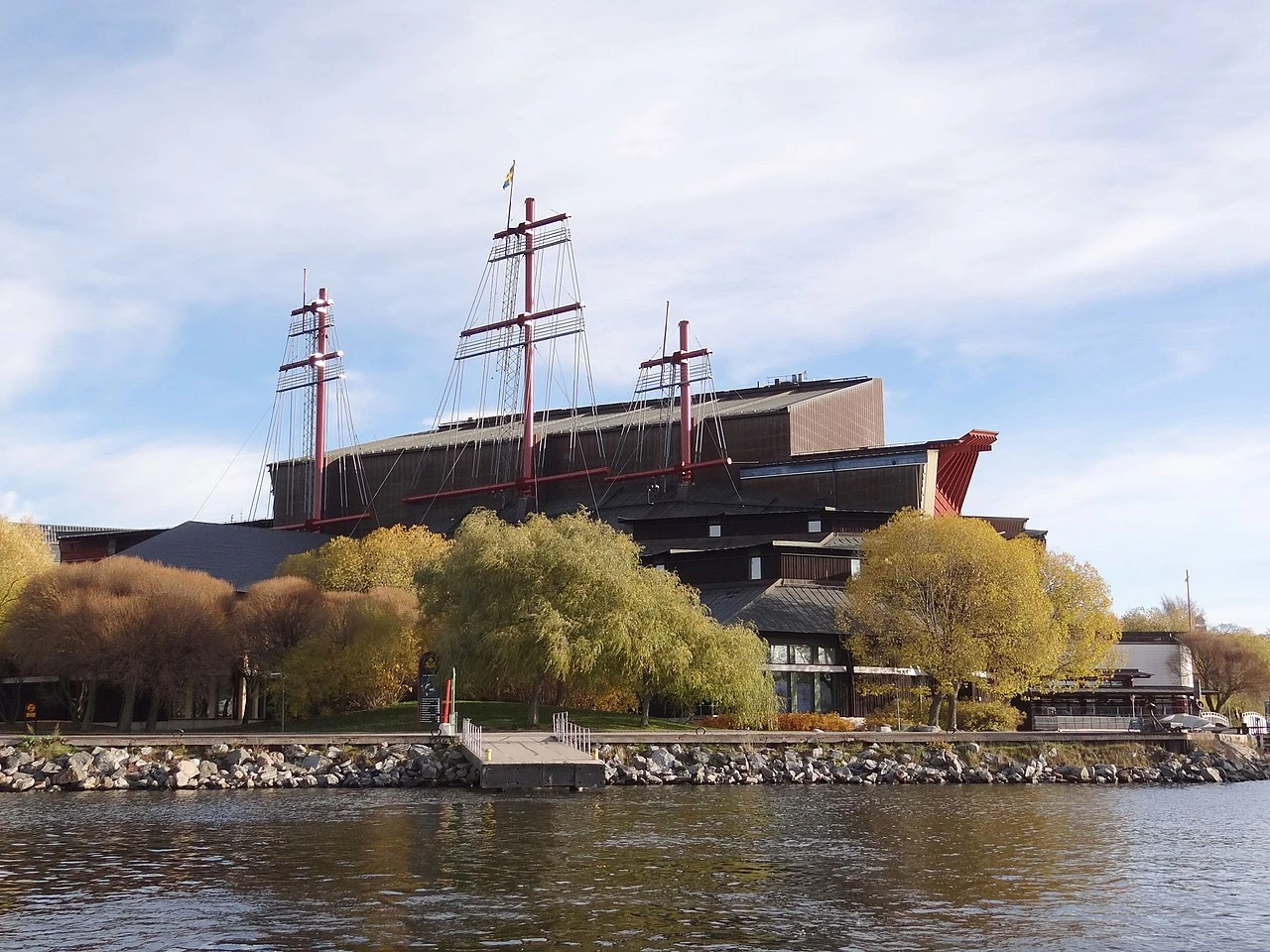
Stockholm · 1 km
Vasa Museum
Content & sources
Photo: Hanay · CC BY-SA 3.0
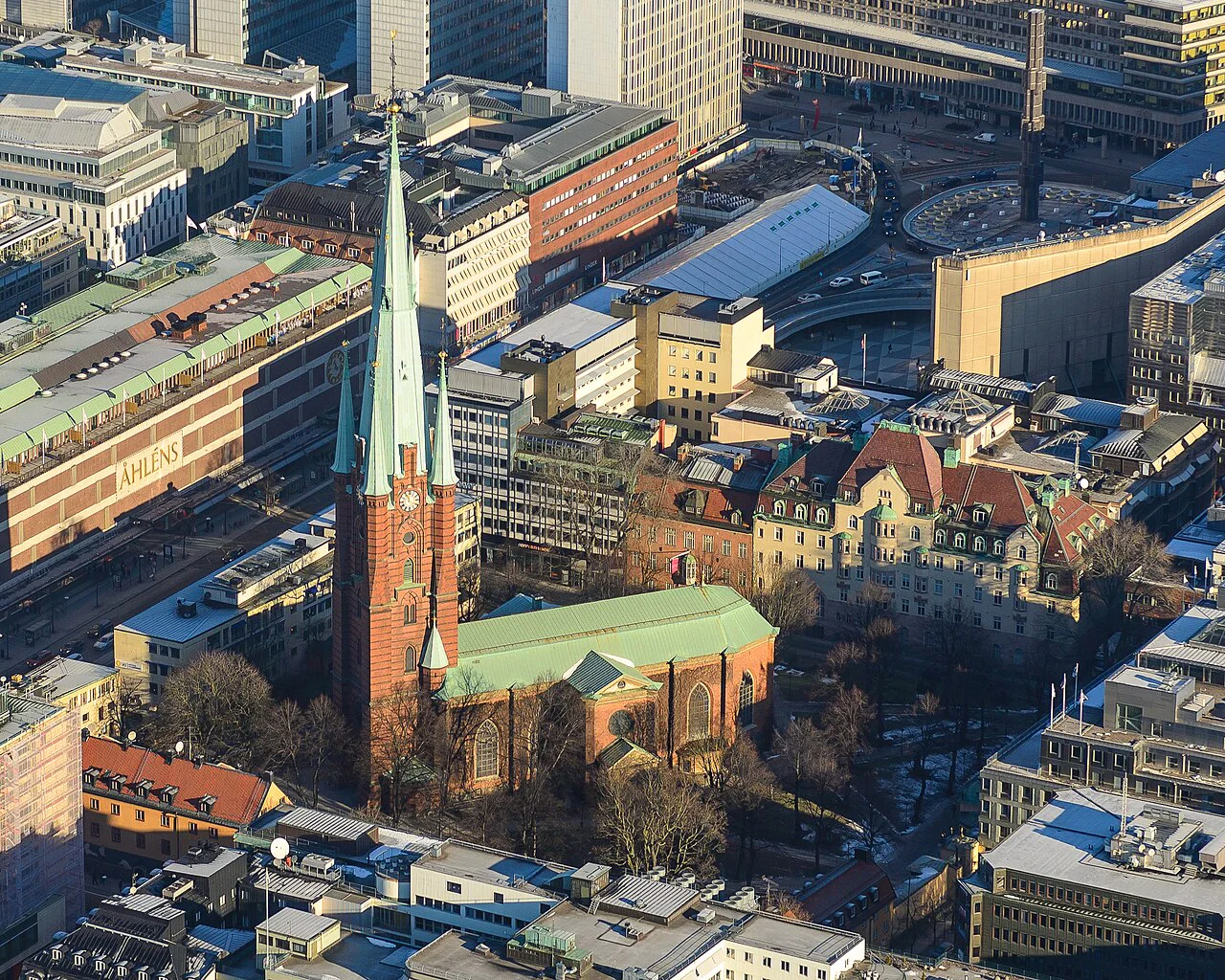
Stockholm · 1 km
Klara Church
Content & sources
Arild Vågen · CC BY-SA 3.0
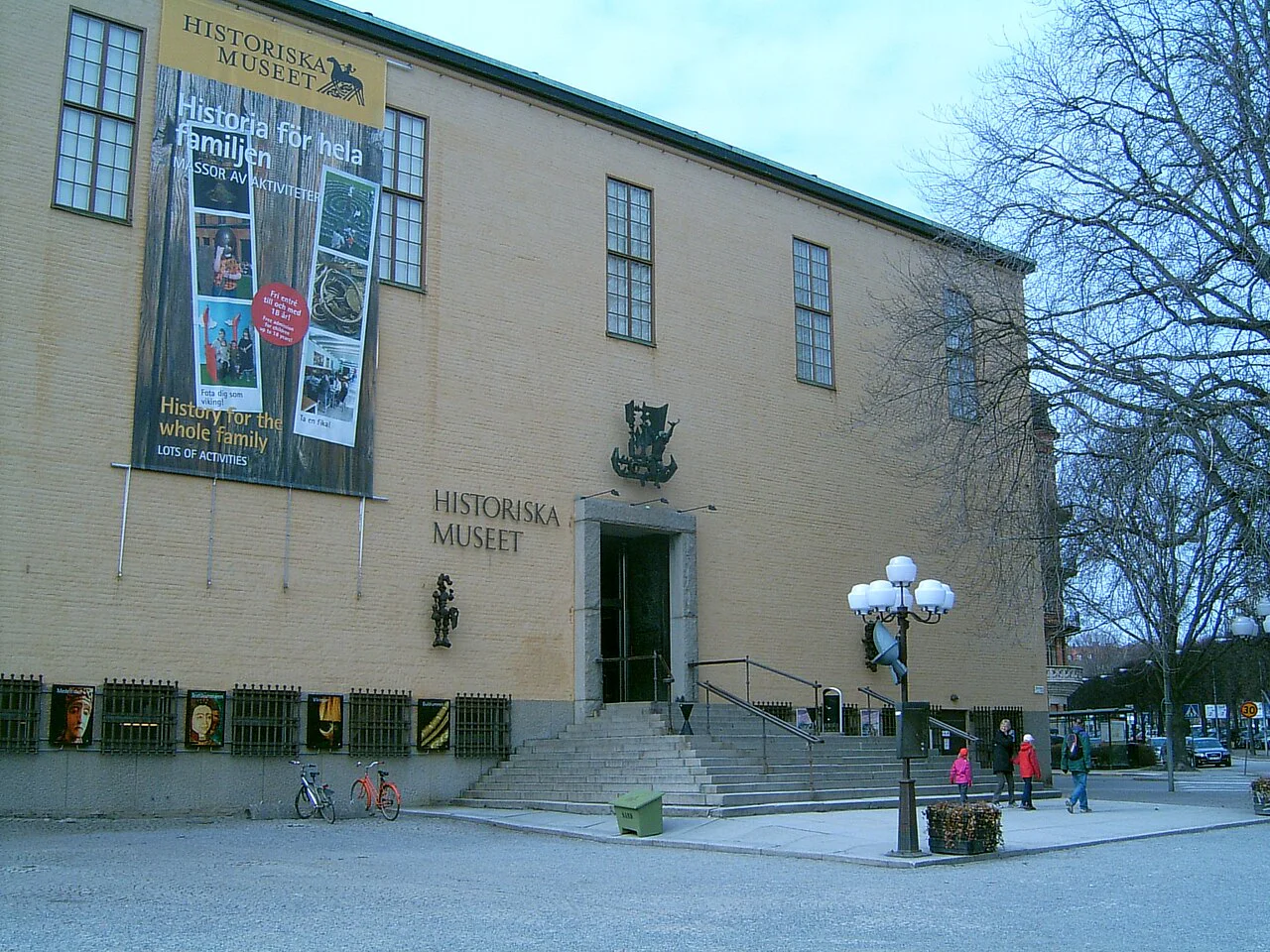
Stockholm · 1 km
Swedish History Museum
Content & sources
Mr Bullitt · CC BY-SA 3.0
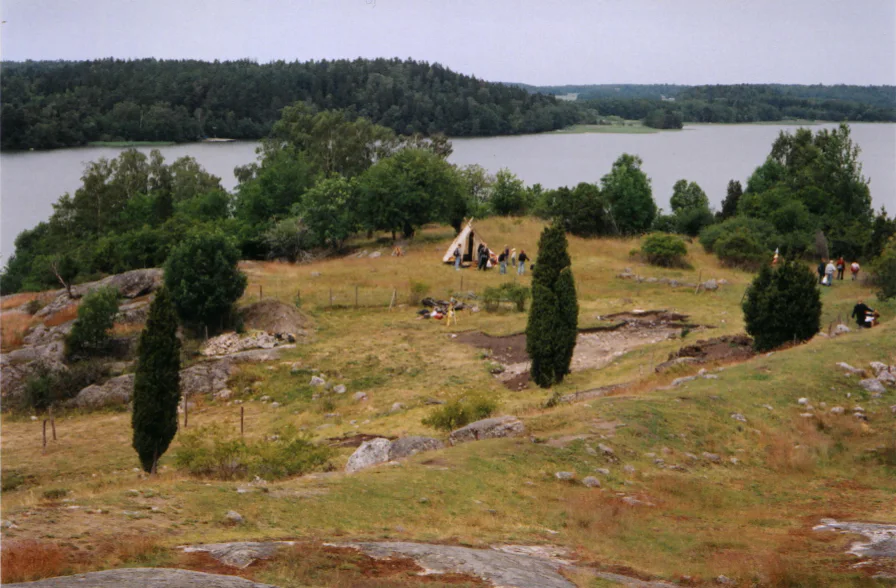
Ekerö kommun · 30 km
Birka
Content & sources
Alex Peterson · CC BY-SA 3.0
Art museums
More art museum audio guides
Stockholm · 55 artworks
Swedish History Museum
Content & sources
Mr Bullitt · CC BY-SA 3.0

Oslo · 20 artworks
Munch Museum
Content & sources
Photo: Premeditated · CC BY-SA 4.0
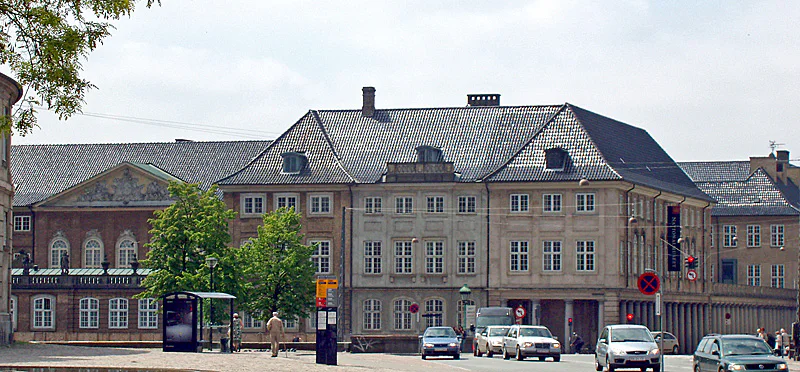
Copenhagen · 62 artworks
National Museum of Denmark
Content & sources
No machine-readable author provided. Nico-dk assumed (based on copyright claims). · CC BY-SA 3.0
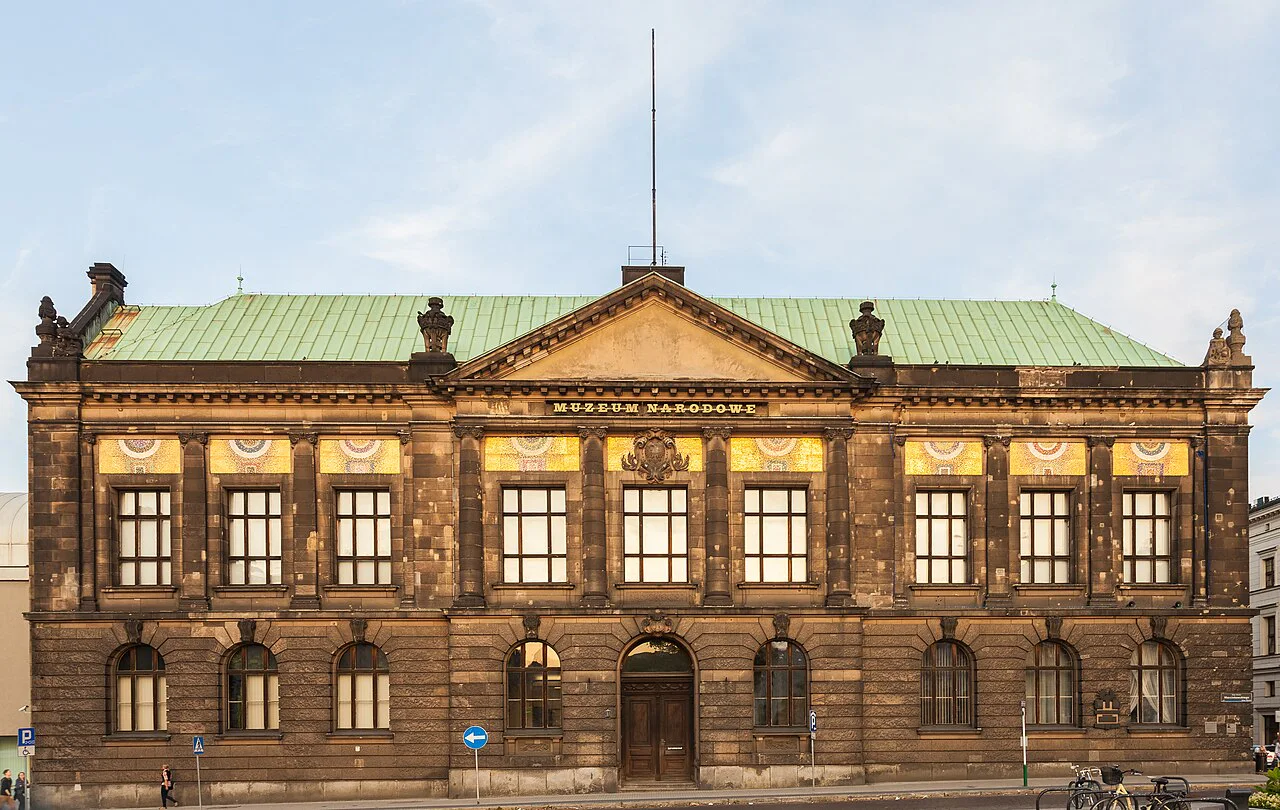
Poznań · 28 artworks
Muzeum Narodowe w Poznaniu
Content & sources
Diego Delso · CC BY-SA 4.0
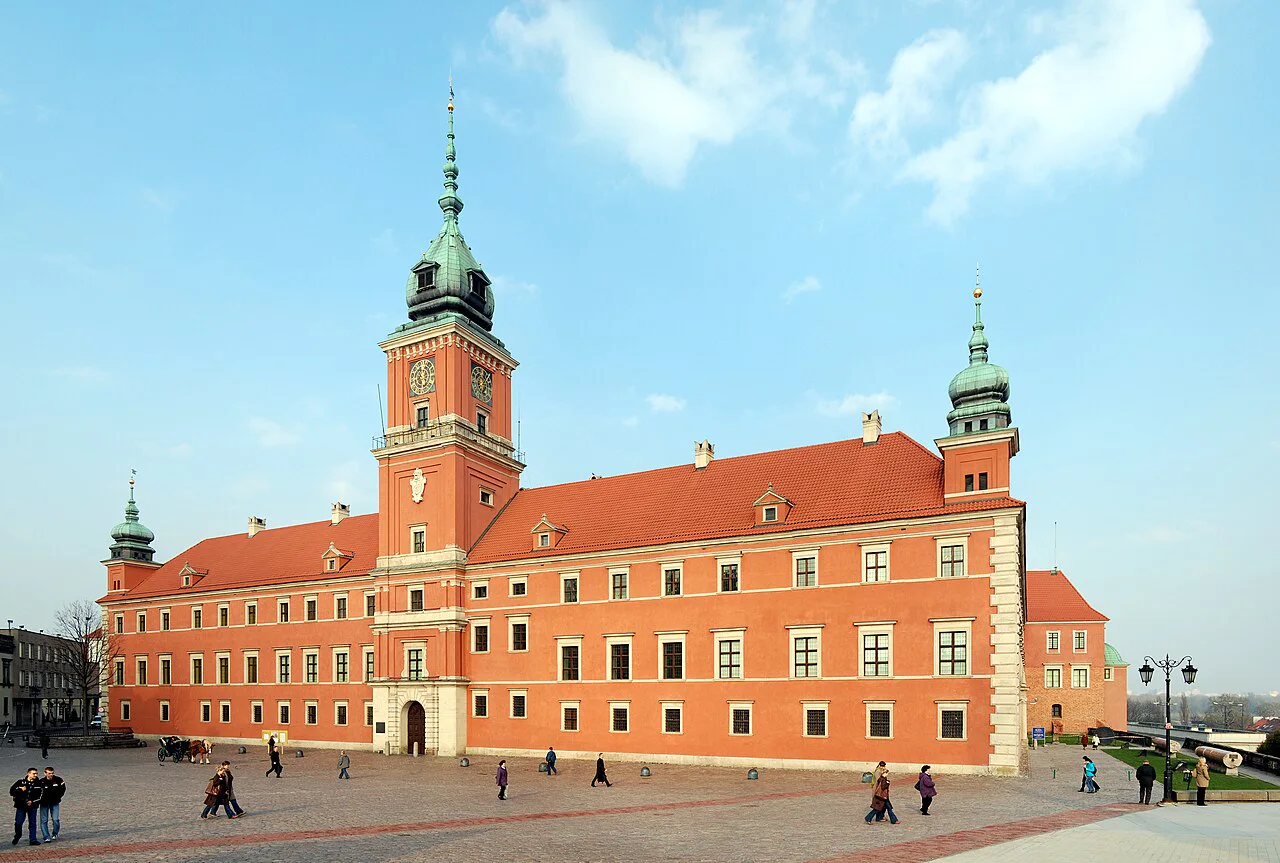
Warsaw · 17 artworks
Zamek Królewski w Warszawie
Content & sources
Marcin Białek · CC BY-SA 3.0
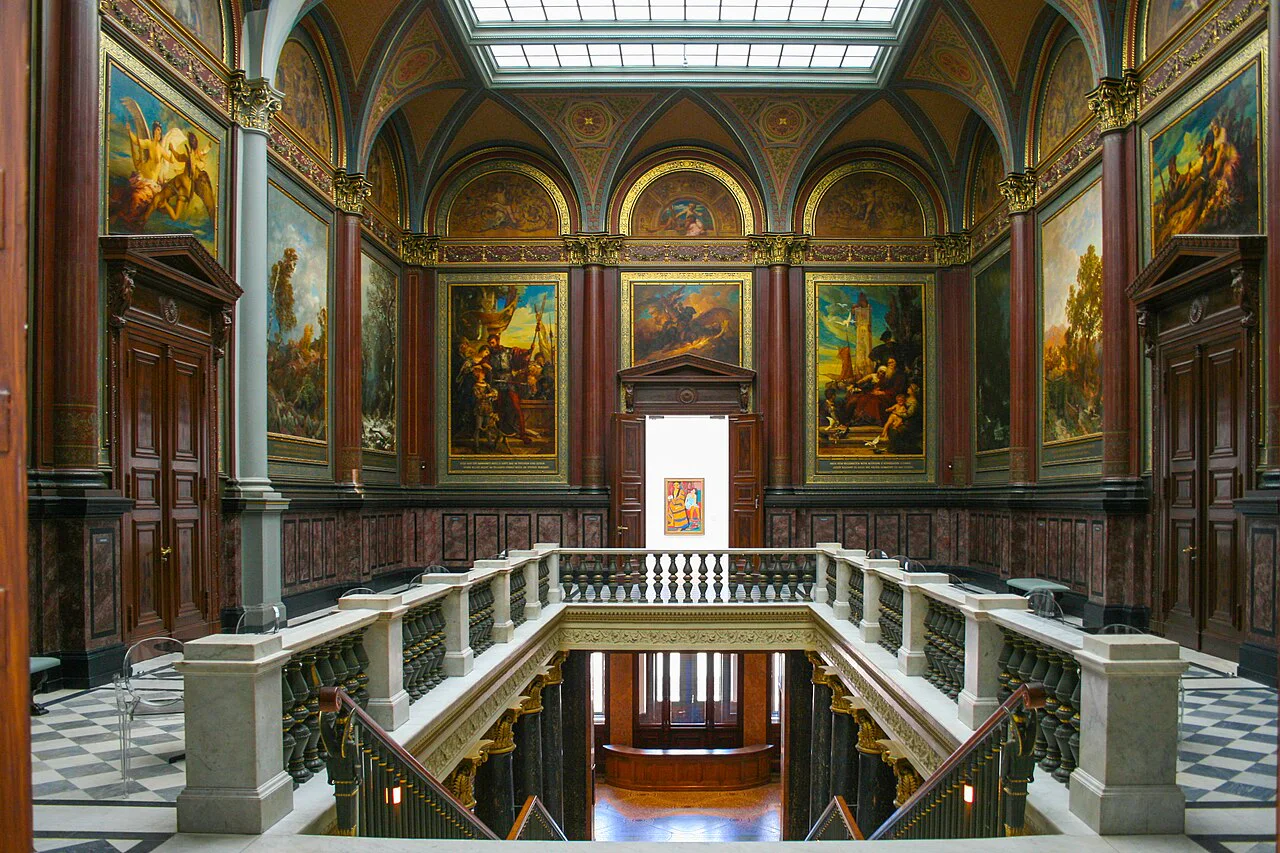
Hamburg · 64 artworks
Hamburger Kunsthalle
Content & sources
Photo: Daniela Kloth · GFDL 1.2