Languages
15창덕궁 Audio Guide
창덕궁 is a landmark in Seoul, South Korea. Explore it with Stanza's GPS-triggered offline audio guide — available in 15 languages.
Quick Facts
16
Stops
15
Languages
100%
Offline
📍 Seoul, South Korea · 37.5794°N, 126.9917°E
About 창덕궁
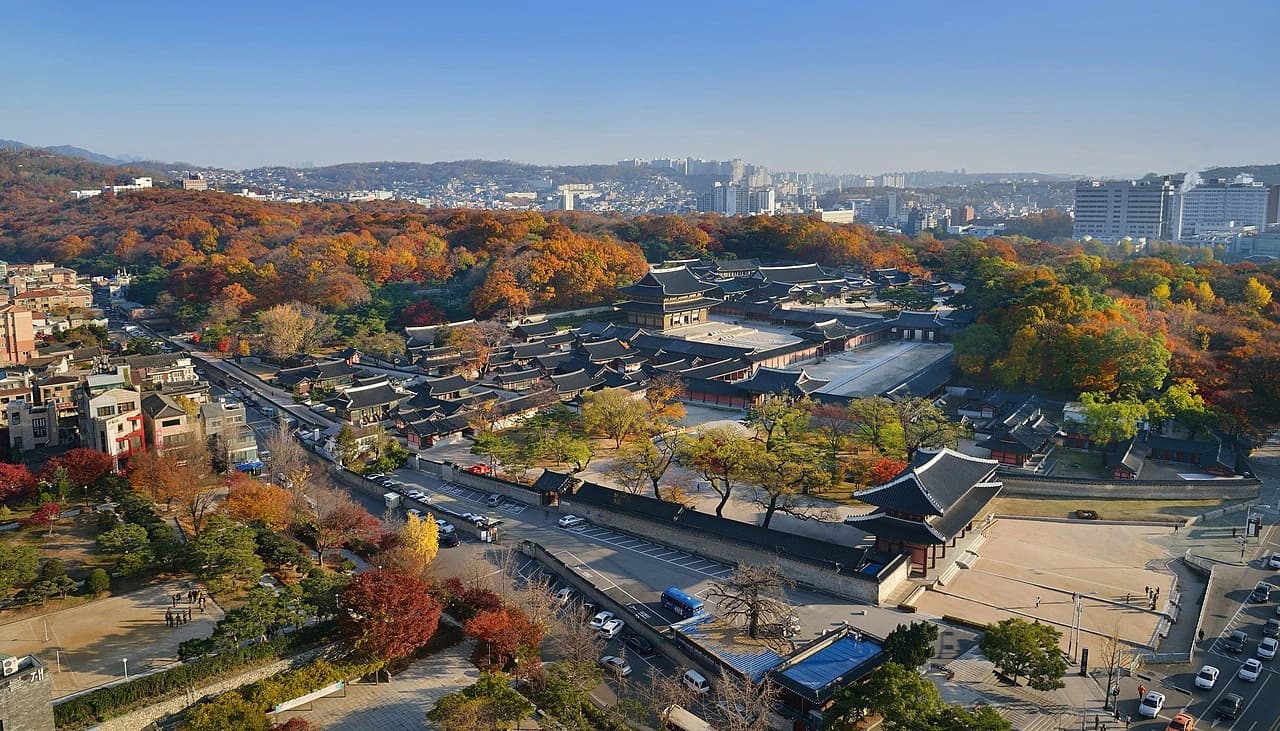
Changdeokgung is a UNESCO World Heritage site and the most well-preserved of the Joseon Dynasty's five royal palaces. It is renowned for its harmonious integration of grand architecture into the natural topography of its surrounding gardens.
창덕궁 is also known as Changdeok Palace, Changdeokgung Palace, Ch'angdŏkkung, Changdok-kung Palace, and 1 other names in various languages.
This self-guided audio tour features 16 narrated stops organized across 6 sections, including Geumcheongyo Bridge, Injeongjeon Throne Hall, Seonjeongjeon Hall, Huijeongdang Hall, Buyongji Pond and Pavilions, Yeongyeongdang Residence. As a palace, 창덕궁 offers a unique cultural experience in the heart of Seoul, South Korea.
The Stanza audio guide is available in 15 languages and works entirely offline — download the complete tour including audio narration, maps, and images before your visit. As you walk through 창덕궁, GPS-triggered narration plays automatically at each point of interest.
Last updated:
What you will hear
Geumcheongyo Bridge
Focus on the oldest stone bridge in the palace, showing its architectural structure followed by the detailed carvings of protective mythological beasts.
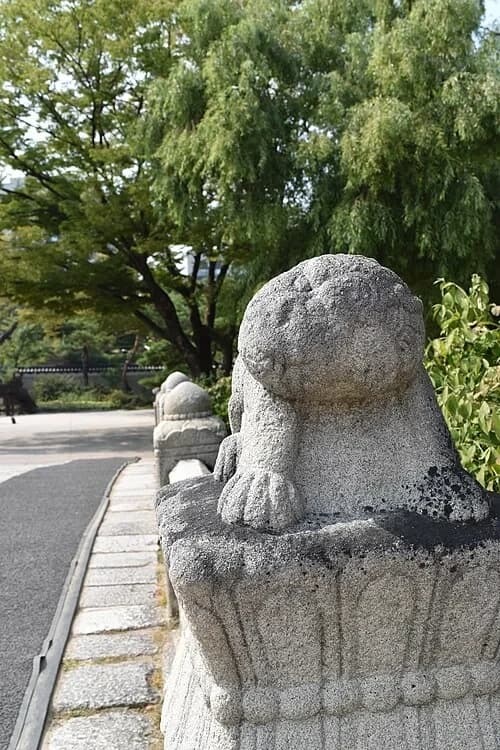
Guardian Beast of Geumcheongyo Bridge
Intricate stone carvings along the balustrade of the bridge reveal the protective spiritual layer of the palace layout. Weathered mythical creatures, sculpted into the pillars and arches, served as silent guardians against unseen threats. Among these figures, you can identify the Haetae, also known as Haechi, a legendary unicorn-lion hybrid believed to possess the power to protect against fire and natural disasters. On the central arch directly facing the stream bed below sits a Seosu, a mythical water beast. Positioning these guardians directly over the flowing water was a deliberate choice meant to block evil spirits from floating down the current and infiltrating the royal court. The whimsical, expressive features of these carvings reflect the artistic sensibilities of the early Joseon period, combining spiritual utility with a distinctively playful aesthetic.
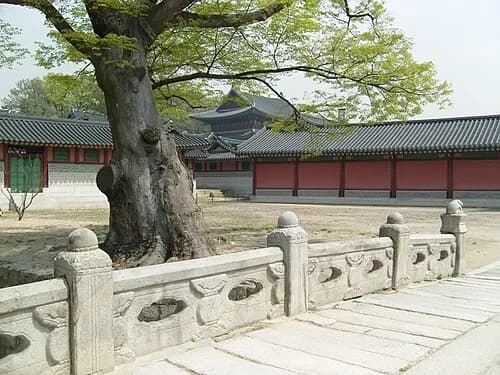
Geumcheongyo Bridge
Stepping onto the flat pathway of this historic structure reveals the strategic planning that defined Joseon royal architecture. Built in 1411, the bridge served to cross a purifying stream, dividing the secular outside world from the sacred palace grounds. Two solid arches support the stone roadbed, which has carried centuries of royal entourages and officials. Growing directly alongside the masonry is a massive, ancient zelkova tree. The way its sprawling branches reach over the stream and stone pathway perfectly illustrates the design philosophy of the palace, where man-made structures were built to accommodate and blend with the pre-existing natural environment rather than dominate it. This bridge was not merely a functional crossing but a psychological threshold, reminding all who crossed to leave behind their worldly concerns and enter the royal presence with quiet respect.
Injeongjeon Throne Hall
Establish the political heart of the palace by guiding visitors through the entry gate, into the main courtyard, and finally inside the majestic throne room.
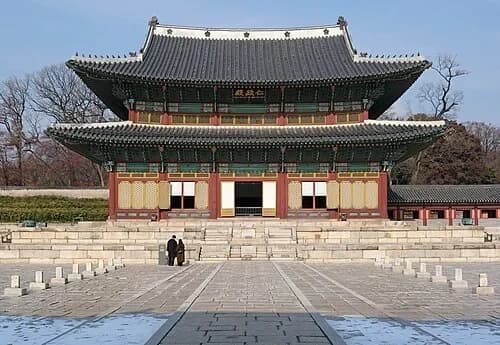
Injeongjeon Throne Hall
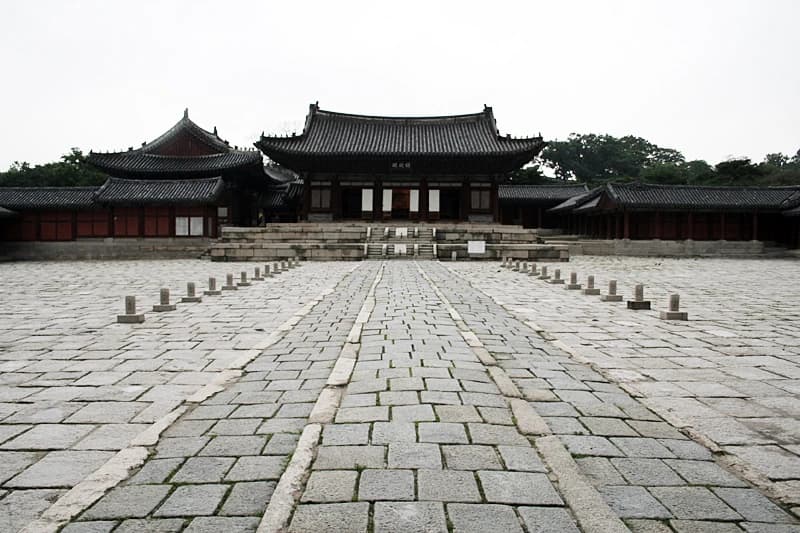
Rebuilt in 1804 after a devastating fire, the primary state hall serves as the grand centerpiece of official palace life. The monumental structure sits elevated on a double-tiered stone terrace known as a Woldae, which lent the building an air of supreme authority during major state events. In the wide courtyard below, rows of small stone pillars line the central path leading toward the hall. These markers, known as Pumgyeseok, designated the exact standing positions for civil and military officials during formal assemblies. Each stone is inscribed with a specific bureaucratic rank, ranging from the highest grades down to the lowest. Officials were required to stand strictly behind their assigned marker, with the highest-ranking ministers positioned closest to the king at the top of the steps and the junior officials relegated to the back of the courtyard.
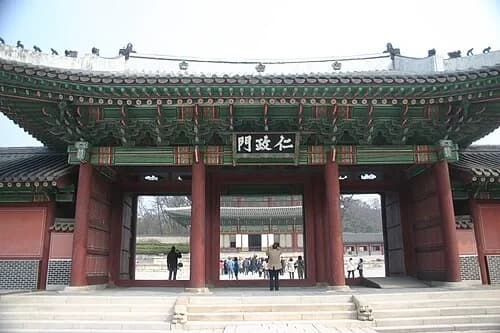
Injeongmun Gate
Acting as the primary threshold to the sovereign’s official realm, the gate witnessed some of the most critical transitions of power in Joseon history. Major royal ceremonies, including coronation events for several kings, commenced right here before the monarchs proceeded to the grand throne hall. Underneath the sloping roof, the bracket system is painted in the traditional Dancheong style, featuring intricate patterns rendered in five primary colors. These bright pigments served the dual purpose of protecting the timber from weathering and projecting royal prestige. Leading up to the entryway are wide, shallow stone steps. Their deliberate, low-rise design was intentional, forcing visitors to slow down their stride and proceed with a measured, dignified pace suitable for entering the presence of the king.
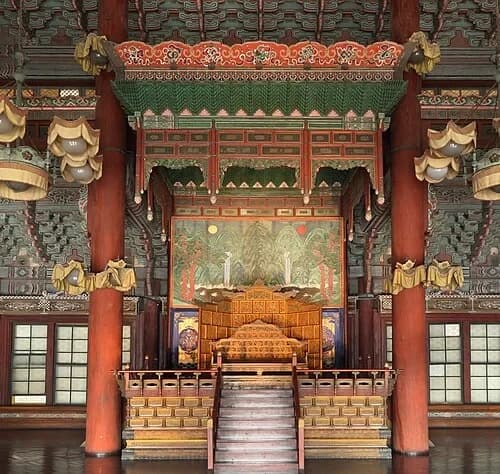
Interior of Injeongjeon Hall
Peer inside the main hall to witness an intriguing blend of traditional Joseon dynasty symbolism and imported Western technology. At the center of the hall stands the yellow imperial throne, positioned on a raised dais. Behind the seat of power is the iconic folding screen depicting the Sun, Moon, and Five Peaks, an artistic representation of the king's role in maintaining the cosmic order. However, the surrounding space reveals a dramatic transformation that took place in 1908 as Western influence swept through the peninsula. Traditional paper screens were replaced with glass windowpanes, and heavy yellow curtains were hung from the high ceilings. Rather than the traditional earth or clay flooring, the interior features polished wooden floorboards, lit from above by electric chandeliers that must have seemed incredibly futuristic to the court officials of the time.
Seonjeongjeon Hall
Highlight the king's official office, renowned as the only surviving palace building featuring luxurious blue-glazed roof tiles.
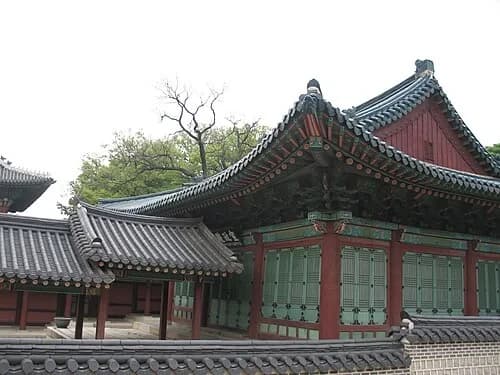
Seonjeongjeon Hall
Distinctive blue-glazed clay tiles immediately set this building apart from the other structures in the complex. Known as Cheongwa, these rare tiles represent the only surviving blue-tiled roof from the Joseon dynasty palaces. In the past, creating these glazed tiles required expensive raw materials imported from China, making them an incredible luxury reserved exclusively for the most prestigious state offices. The building functioned as the king's daily executive office, where he conducted the routine business of ruling the country. In contrast to the massive, highly formal throne hall, this more compact space allowed the king to hold morning briefings with ministers, oversee state examinations, and engage in detailed cabinet discussions in a far more practical and focused setting. The distinctive blue roof remains a striking reminder of the high status this office held within the royal administration.
Huijeongdang Hall
Introduce the king's private residence, showing the exterior transition to modern architecture, followed by the Westernized interior features.
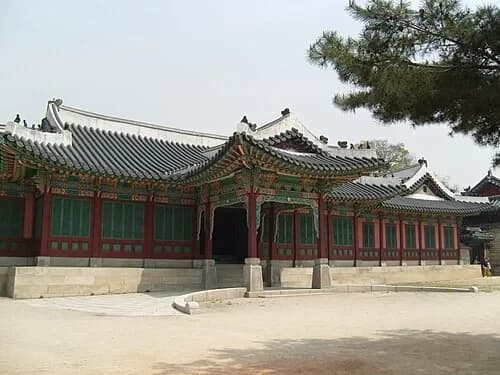
Huijeongdang Hall
Rebuilt in 1920 following a destructive fire, this building initially served as the king's private study and bedchamber. The exterior architecture showcases a fascinating hybrid design that documents the royal family’s transition into the modern era. Projecting forward from the main entrance is a prominent wooden and brick carriage porch, also known as a porte-cochère. Rather than being constructed to accommodate traditional wooden palanquins carried by servants, this driveway was specifically engineered to allow modern motorcars to pull directly up to the door under the shelter of the roof. This unusual architectural feature highlights how the Joseon court rapidly adapted its traditional palace layouts to incorporate Western technologies and vehicular transport during the early twentieth century, leaving behind a tangible record of physical modernization amid historic surroundings.
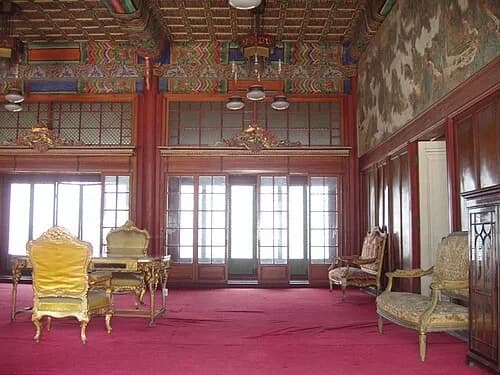
Westernized Interior of Huijeongdang Hall
Glancing through the windows of the former private study reveals an interior that looks more like a European salon than a traditional East Asian royal residence. Rich red carpeting covers the floor, illuminated from above by ornate European-style chandeliers hanging from high, decorated ceilings. The space is furnished with gilded Victorian-style chairs, patterned wallpaper, and tall glass doors that divide the rooms. Despite these heavy Western design choices, the space retains a unique Korean identity. Large-scale landscape paintings by modern Korean artists decorate the walls, demonstrating a creative blend of traditional brushwork and ink techniques with Western-influenced rules of perspective. This striking juxtaposition illustrates the rapid modernization of the royal family’s daily life as the dynasty drew to a close.
Buyongji Pond and Pavilions
Enter the Secret Garden (Huwon) at its most iconic location, featuring the cross-shaped Buyongjeong Pavilion and the two-story Juhamnu Library across the water.
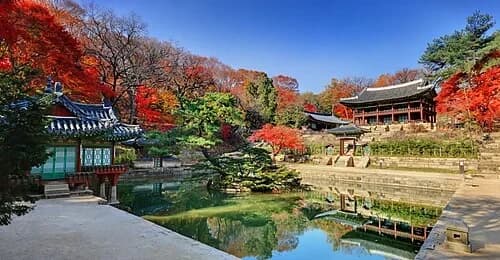
Buyongji Pond and Juhamnu Library
The central landscape of the Secret Garden showcases a profound cosmological philosophy embedded directly into the earth. The rectangular pond features a small, perfectly round island at its center. In traditional East Asian cosmology, this arrangement represents the universe: the square shape of the pond represents the earth, while the round island represents heaven. Looking past the water to the hillside beyond, the eye is drawn to the impressive two-story Juhamnu Library. Established by King Jeongjo in 1776, this building was far more than just a repository for royal books. It functioned as a highly influential research institute where reform-minded scholars gathered to debate philosophy, discuss statecraft, and develop innovative political ideas under the king’s close patronage.
Yeongyeongdang Residence
Examine the civilian-style residence built inside the royal garden to experience the lives of the gentry, showcasing its simple wooden architecture.
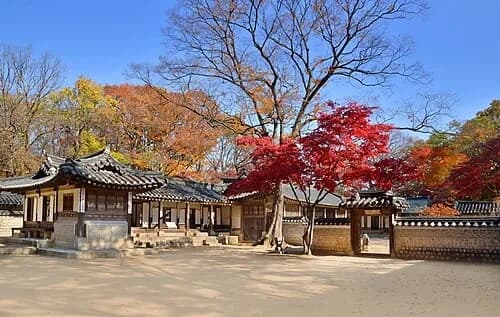
Yeongyeongdang Residence
Built in 1828 by Crown Prince Hyomyeong within the secluded Secret Garden, this complex was designed to look like the home of a wealthy civilian nobleman rather than a grand royal residence. Constructed entirely from unpainted pine timber, the buildings feature separate living quarters for men and women, adhering strictly to the domestic layouts of the Joseon upper class. Rather than serving as a permanent home, the royal family used this unique space to escape the rigid formalities of court life. Here, they hosted intimate banquets for senior officials, staged classical court dances, and experienced a simulated version of the simplified, elegant lifestyle of the provincial gentry. The unpainted wood has weathered naturally over the decades, helping the residence blend seamlessly into its forest surroundings.
Want to hear the rest?
Download the Stanza app to unlock all 16 stops and full GPS-guided navigation.
Frequently Asked Questions
How long does the 창덕궁 audio tour take?
The 창덕궁 audio guide includes 16 narrated stops. Most visitors spend 45 minutes to 1.5 hours exploring the complete tour, though you can listen at your own pace and skip or revisit any stop.
Is the 창덕궁 audio guide available in my language?
Stanza supports 15 languages: English, Spanish, French, German, Italian, Portuguese, Russian, Japanese, Chinese, Korean, Arabic, Hindi, Polish, Dutch, Hebrew. Check the guide in the app to confirm the languages currently available for this tour.
Can I use the audio guide offline at 창덕궁?
Yes! Download the complete 창덕궁 tour — including all audio, maps, and images — before your visit. The Stanza app works completely offline, so you don't need WiFi or mobile data at the venue.
How much does the 창덕궁 audio guide cost?
The Stanza app is free to download. Free and paid audio guides are available; current prices are shown in the app.
How do I use the Stanza audio guide at 창덕궁?
Download the free Stanza app, search for "창덕궁", and download the tour. When you arrive at the venue, the app uses GPS to detect your location and automatically plays the relevant narration as you move between points of interest — completely hands-free.
What makes the Stanza audio guide different from other 창덕궁 tours?
Stanza offers GPS-triggered narration that plays automatically as you walk through 창덕궁 — no need to manually select stops. The tour is available in 15 languages, works fully offline, and includes 16 expertly narrated stops with images and historical context.
What other audio guides are available near 창덕궁?
Stanza offers multiple audio guides in Seoul, South Korea and nearby areas. After downloading the app, browse the map to discover all available tours near 창덕궁. Each guide can be downloaded for offline use.