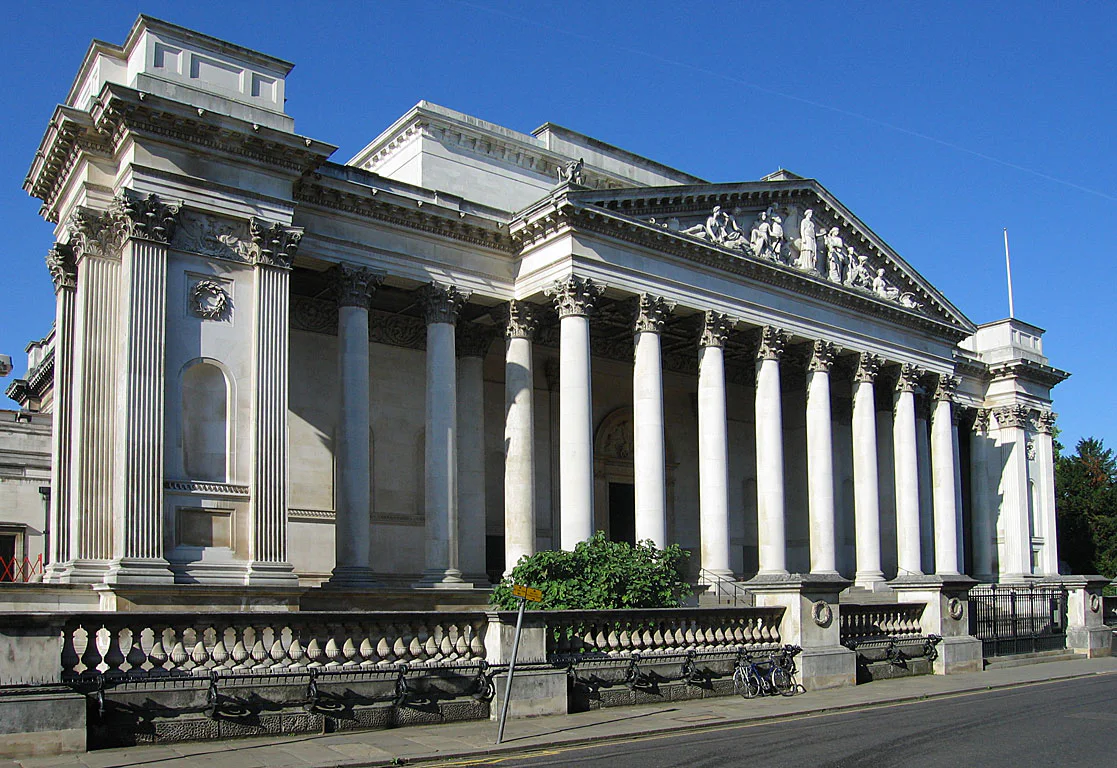
 Stanza / Audio guide
Content & sources
Stanza · Audio guide
Fitzwilliam Museum Audio Guide
A place to remember. A story to take with you.
The Fitzwilliam Museum is the art and antiquities museum of the University of Cambridge. It houses one of the best collections of antiquities and modern art in western Europe, featuring over half a million…
Download Stanza, then search for “Fitzwilliam Museum”.
About the tour
One guide. Your kind of visit.
The Fitzwilliam Museum is the art and antiquities museum of the University of Cambridge. It houses one of the best collections of antiquities and modern art in western Europe, featuring over half a million objects.
The Fitzwilliam Museum guide tells the stories of 51 artworks, including Tarquin and Lucretia (Titian), The Ancient of Days (William Blake), The Gust of Wind (Pierre-Auguste Renoir), Self-portrait with the Colosseum (Maarten van Heemskerck), Teresa of Avilà's Vision of the Dove (Peter Paul Rubens), Hours of Isabella Stuart (Rohan Master), The Bridesmaid (John Everett Millais), and Studio under the Eaves (Henri Matisse). Every artwork is free to hear in the Stanza app until 1 January.
Ready when you are.
- 01Get the free Stanza app.
iOS & Android
- 02Find your guide.
“Fitzwilliam Museum”
- 03Download before you go.
Works offline
Audio guide / 51 artworks
Inside the guide
Get to know a few of the stories before you go. Open a stop to read more.
01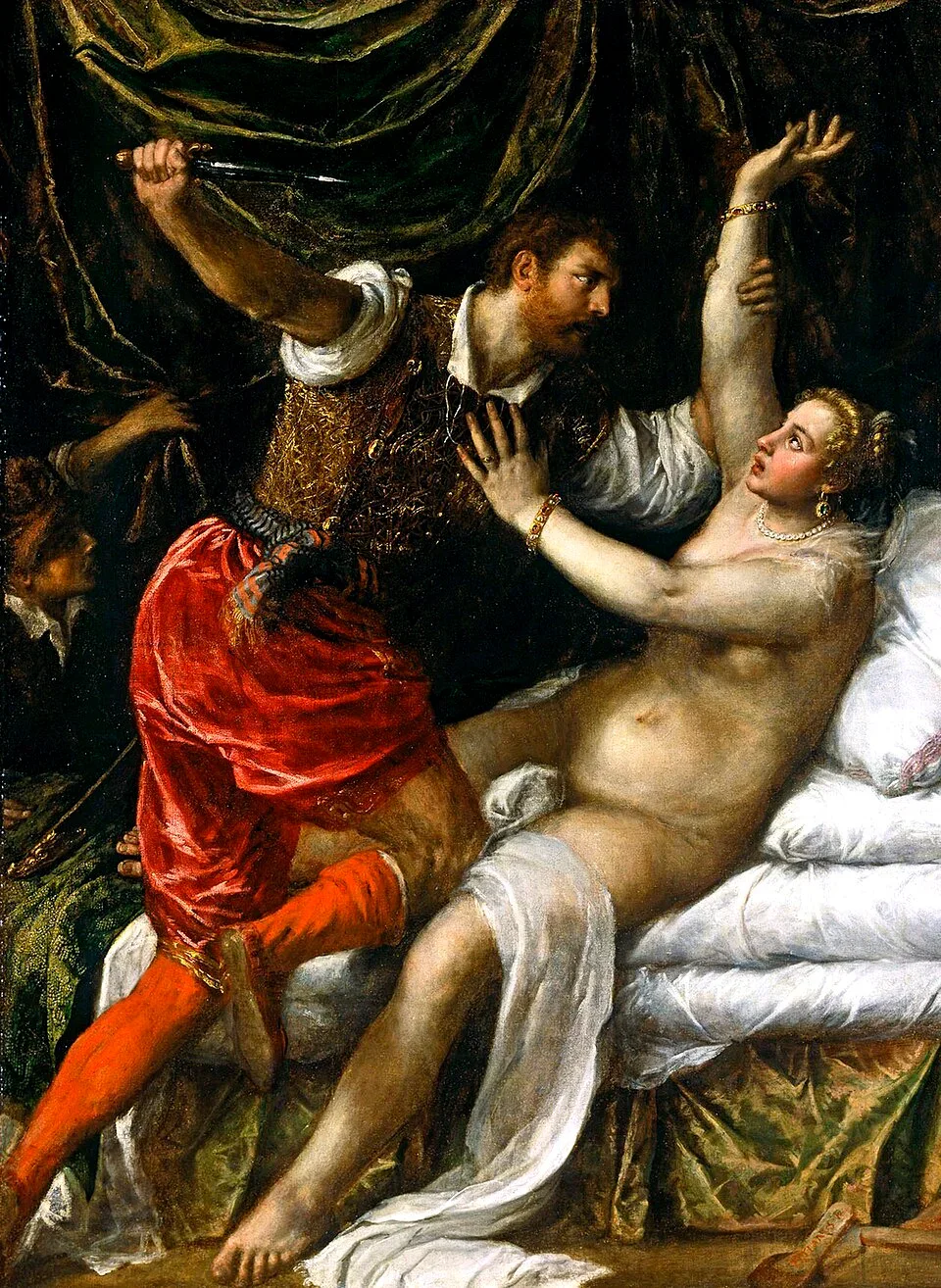
Tarquin and Lucretia
At the left edge of the painting, a man's head and hand enter the scene. He is a slave, and easy to miss. But he is the reason Lucretia gives in. Tarquin has threatened to kill them both if she refuses, and then claim he caught them together in adultery. To spare her husband and family that shame, she yields. Small touches of pure white sharpen the drama, at the tip of the dagger and in the eyes of Tarquin and Lucretia. This is the picture Philip the Second of Spain asked Titian for. He was in his eighties. He wrote that he had put more labour and skill into this one than into many of his late works. The next day Lucretia told her husband what had happened, and killed herself. Her death drove the Romans to revolt. They threw out Tarquin's father, the last king of Rome, and set up the Republic.
Listen in the appTitian · Public domain
02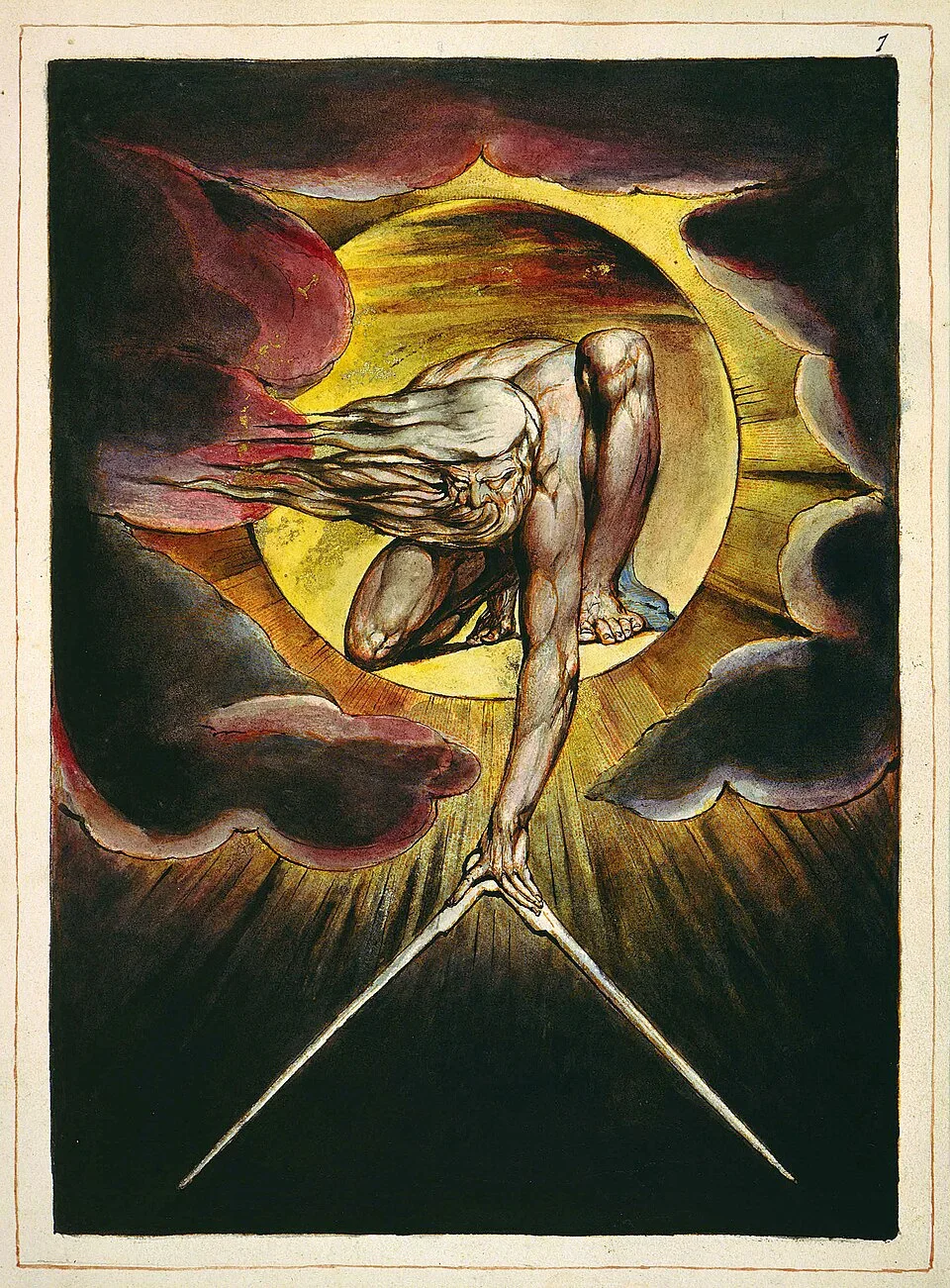
The Ancient of Days
Near the end of his life, William Blake lay propped up in bed, colouring one more copy of a picture he had often made. It was the one he loved best. Inside a circle, a figure crouches, leaning forward, one arm reaching down into the dark. Between his extended fingers is a compass, and it shines so brightly that rays seem to stream from his own fingertips. A hard wind drives his long hair and beard to one side. The figure is Urizen, an image of reason and law. The compass marks out the dark, the way an architect measures ground. He first published it in 1794 as the front picture of a book of prophecy. He returned to it again and again, colouring each print by hand, so that no two are quite alike. The copy in his bed had been ordered by a disciple, Frederick Tatham. He paid more for it than anyone had ever paid for any of his work. When it was finished, Blake threw it from him. That would do, he said. He could mend it no further. One of the surviving copies may not be his own work.
Listen in the appWilliam Blake · Public domain
03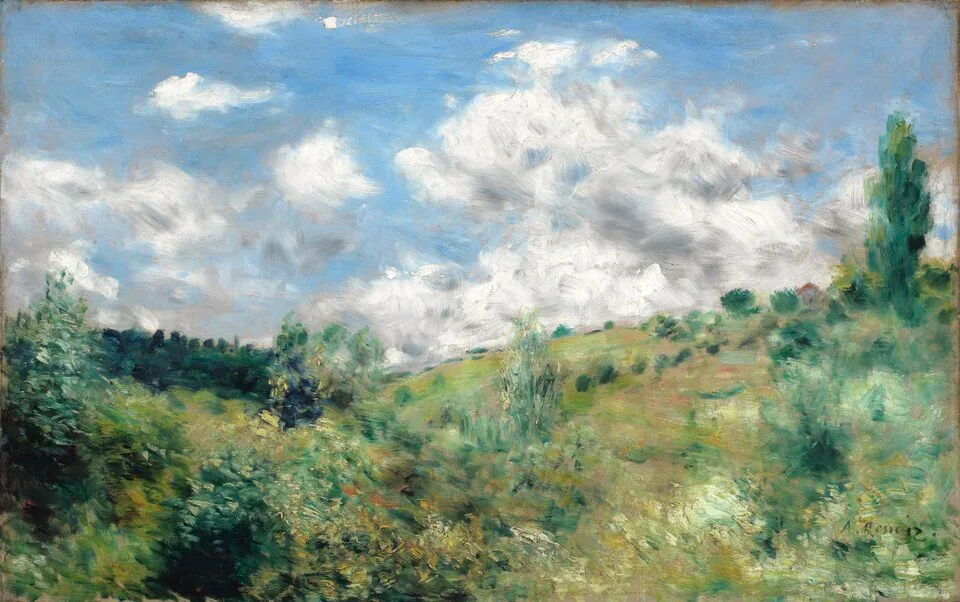
The Gust of Wind
Wind sweeps through the grass and trees under a blue sky with white clouds. Above the hillside, a single house is visible on the distant horizon. The hillside is there for the wind. Renoir wanted the air itself, an invisible force. His loose brushstrokes make the air something you can feel. The foreground is indistinct, the way land blurs when you watch it from a moving train. He painted outdoors, and in those years he worked closely with Monet, chasing the sensation a landscape gives. He finished it just before the First Impressionist Exhibition in 1874. In 1875, he and other Impressionists held an auction in Paris. This painting was one of twenty works he offered, called Grand Vent. The public met the sale with anger, and his paintings went cheaply. This one sold for fifty five francs. Beneath the house, in the lower right, the pale first layer of paint shows through.
Listen in the appPierre-Auguste Renoir · Public domain
04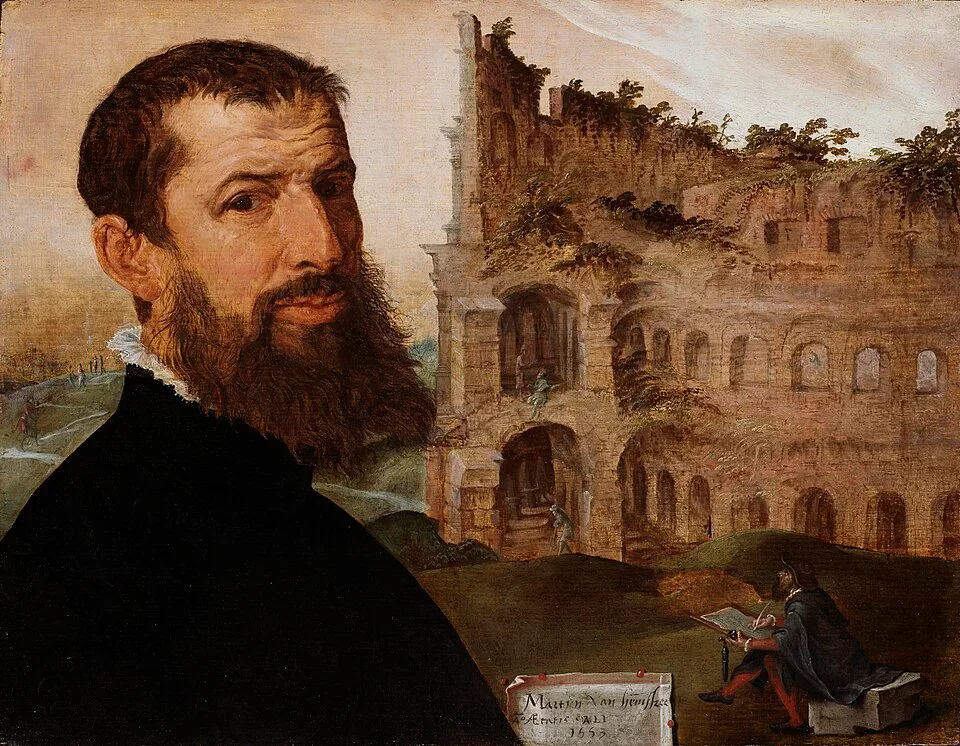
Self-portrait with the Colosseum
A young man sits drawing the ruined Colosseum, those enormous remains behind him. He came to Rome to study its ancient art, and he will carry these ruins home on paper. At the front of the picture, the same man meets your gaze, about twenty years older and dressed in black. He looks as if he is showing you what he found in Rome. Heemskerck signed it at the bottom, giving his age as fifty-five. But this scene was never painted in front of the ruins. He put it together at home, years later, from the drawings he had made on that first trip. The ruined arena seems to stand for the old age still to come. That age is the man now facing you. Those same drawings went on living, engraved and sent across Europe, and other artists used them as models. A cardinal, probably Granvelle, supported his work on the Roman ruins.
Listen in the appMaarten van Heemskerck · Public domain
05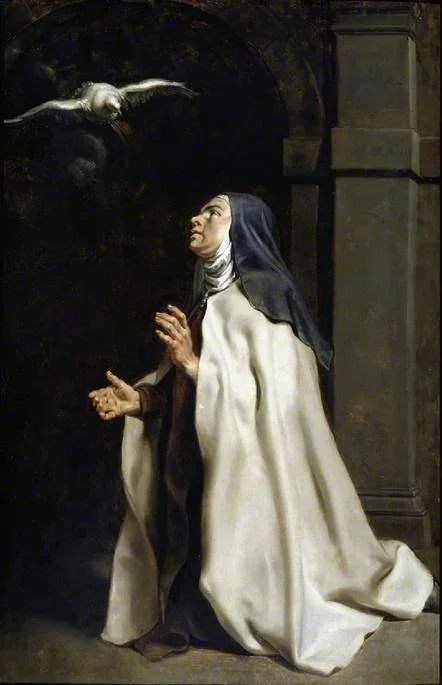
Teresa of Avilà's Vision of the Dove
A dove appears to Teresa of Ávila. The dove is the Holy Spirit. Teresa was a Spanish Carmelite nun and mystic who reformed the Carmelite orders. Rubens painted this subject three times, about 1614, and this is one of them. Around 1650, it appears in the background of David Teniers the Younger's painting of a painter's studio. Pierre van Schuppen made a print of it around the same time. It later belonged to the Prince de Ligne, whose collection was sold in Paris in 1843. Two more auctions followed in the nineteenth century. Then it vanished. As of 1973, no one knew where it was. In 1999 it was accepted in place of inheritance tax and allocated to the Fitzwilliam Museum in Cambridge.
Listen in the appPeter Paul Rubens · Public domain
06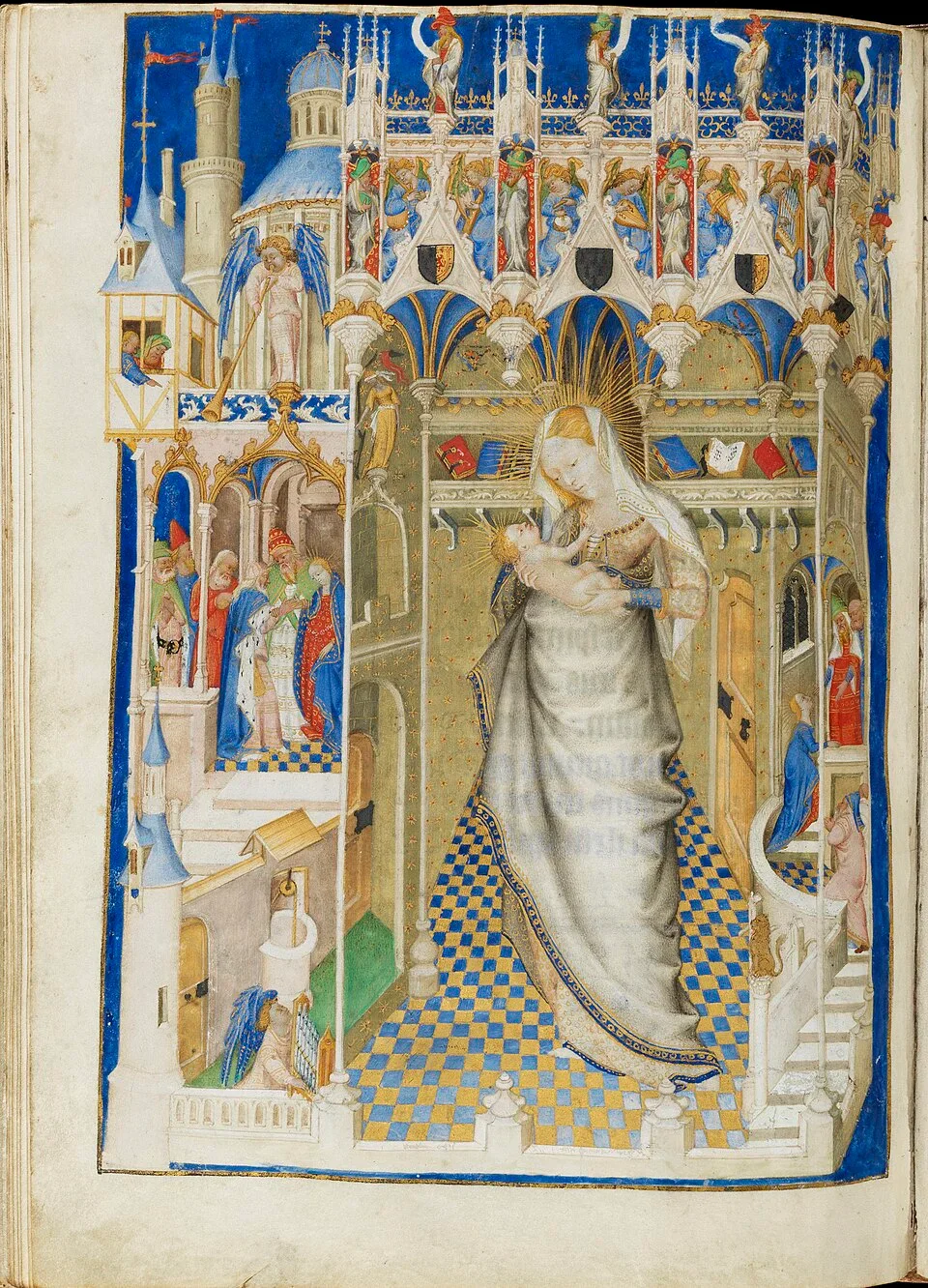
Hours of Isabella Stuart
No one is quite sure who this book was first made for. It is a book of hours, a book of prayers, painted in the Rohan Master's workshop at Angers. In the margins a woman prays, dressed in black, a widow. In the prayer Creator celi the Latin has feminine endings, as though a woman is speaking. That points to Yolande of Aragon, widowed when her husband died in 1417. But the owner's portrait was scraped away, and what is underneath shows she was not a widow. So the book was probably made for Yolande of Aragon's daughter, also called Yolande. The widows were there to remind her of her mother. The younger Yolande married Francis, Duke of Brittany. After she died, Francis married Isabella Stuart, a daughter of James the First of Scotland, and gave her the book. Isabella had her arms put all through it, and the old portrait painted over with one of herself beside Saint Catherine. It seems to have happened in two stages. First the figure and Catherine, then a ducal coronet replaced her headdress. It was before her marriage to Francis, on the twenty-ninth of October, 1442. In the new pictures she wears the ermine of Brittany and the lion of Scotland. In time Isabella gave the book to her daughter Margaret, who had herself painted in too, praying before the Madonna and Child.
Listen in the appMadonna Master · Public domain
07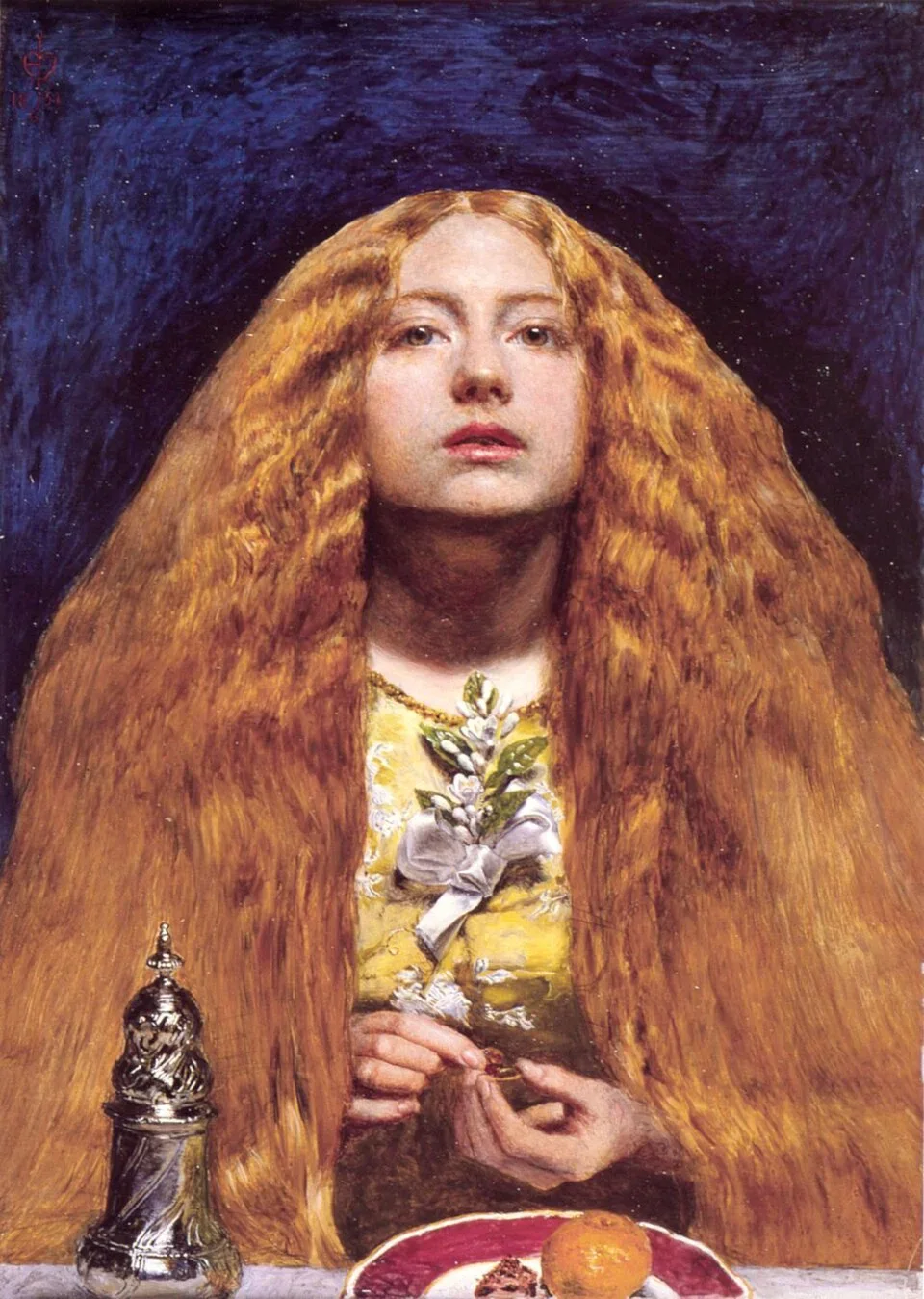
The Bridesmaid
In the lower left corner sits a sugar pot. Its shape may be a man's, standing for the husband this girl is trying to picture. It is the one detail that breaks the strict symmetry, and with it the balance of her young life. She had been a bridesmaid, and she is passing a piece of wedding cake through a ring nine times. In the England of her day, people believed a girl could see her future husband that way. She seems caught between fear and fascination at the marriage ahead. She breathes in the strong scent of the orange blossom on her dress. The blossom stands for purity and innocence. On the plate before her lie the cake and an orange, another sign of her virginity. Under the paint a rough sketch shows through, a sign that Millais worked from a living model. She was Miss McDowell, a professional model and his muse at the time. She is painted close to the edge, facing us almost like an icon, with bright colours in large, evenly ordered planes. That only deepens the sense that she is in a trance.
Listen in the appJohn Everett Millais · Public domain
08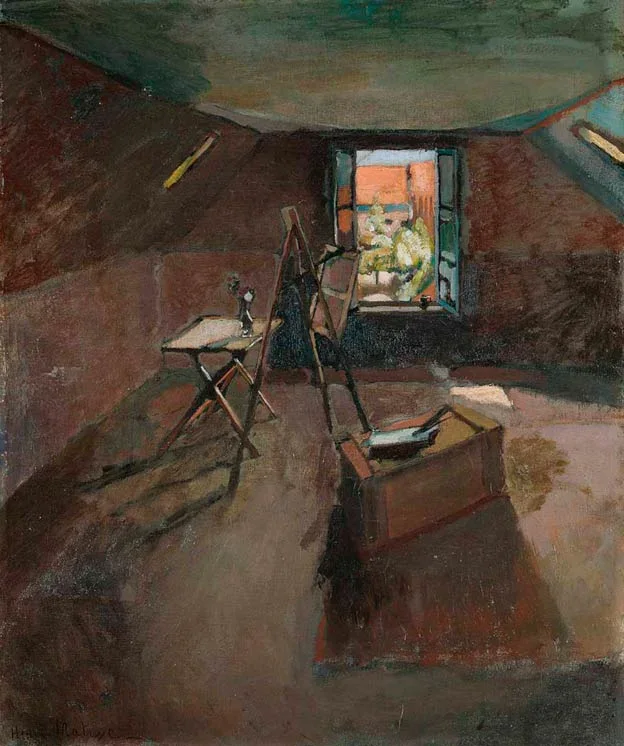
Studio under the Eaves
Matisse came up to this attic in 1903, exhausted by a year of family trouble. This is the studio he made for himself here, a small place to paint. There is very little here. An easel holds a canvas, beside a plain folding table with a small vase of two dahlias. A chest near the easel has his palette lying on it, and the roof slopes in from the sides and above. Browns and dark greens fill the room. They matched how low he was feeling. He needed to get away. His wife's parents were tied to a woman who committed financial fraud, and when it came out in 1902 they were held responsible. The police searched his flat and his studio, and his wife's father was arrested. He was supporting his wife Amélie, three children, and her parents too. Doctors had told him to rest. In March 1903 he shut his Paris studio and returned to Bohain, then moved again to escape the tension at his parents' home. This is the room he set up there. The room itself is gloomy. At the back, an open window shows green trees and pale pink and blue buildings, almost a separate, brighter world. That July he wrote to his friend the painter Simon Bussy that life's troubles had almost made him give up painting altogether.
Listen in the appFitzwilliam Museum · Public domain
09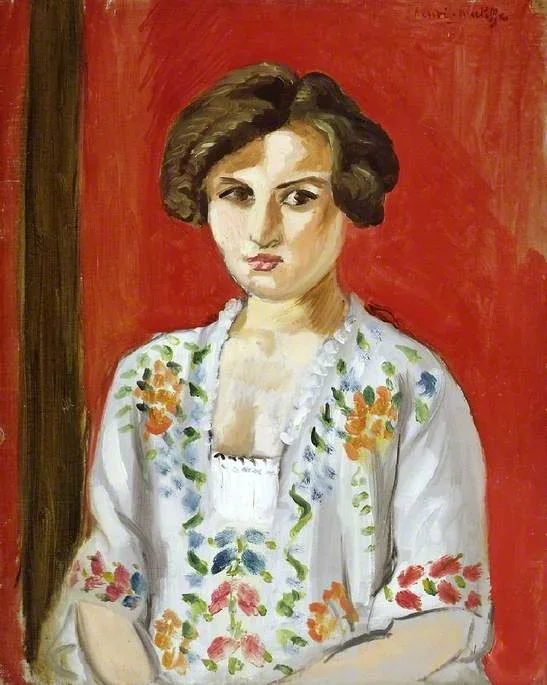
The Bulgarian blouse
A woman wears a blouse covered in patterns of many colours, and behind her the red is intense. Those patterns are not just a detail of a portrait. Their colours set up a rhythm, and that rhythm gives shape to the space around her. The red background and the embroidery work together to build the expression and the balance of the whole picture. Colour here is not simply copying what is real. It is doing its own work. The woman stays recognizable, but her blouse and her surroundings have been shaped to serve colour, form and pattern. Matisse painted it in 1920, probably in Nice, where he had been working since the end of 1917. These were the years he kept returning to women, patterned cloth and decorated interiors. Who she was is not known.
Listen in the appFitzwilliam Museum · Public domain
10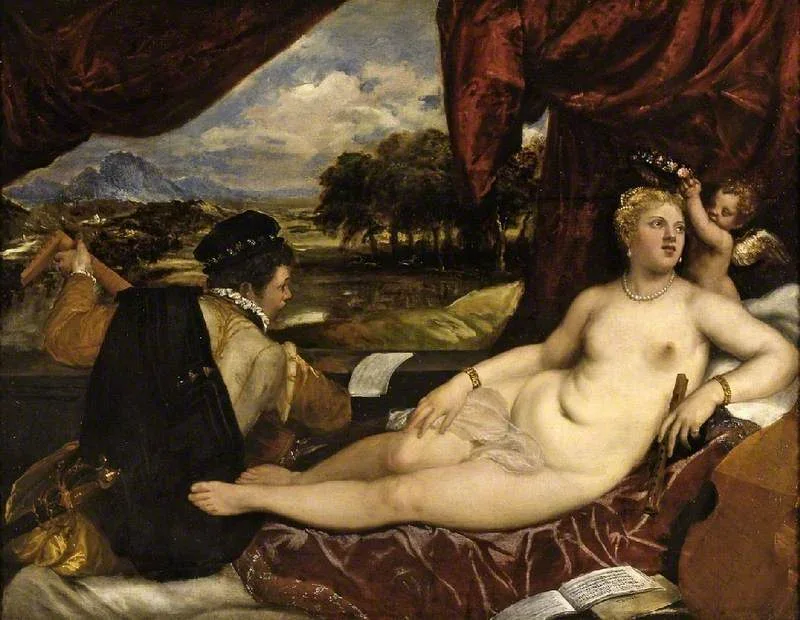
Venus and Cupid with a lute-player
Venus has only just stopped playing the recorder, and it is still in her hand. Cupid is offering her a crown while she looks into the distant sky. On the left, a courtier in the dress of the sixteenth century sings a madrigal to his lute. His eyes are on Venus's head, and his gaze leads the scene from left to right. Titian built the picture around this serenade as a whole experience of the senses. The picture gathers up a code of courtship. Beauty was what a lover praised, and poetry and music were how he praised it. The music also carries the time. Venus's recorder is the moment just past. The courtier's song is now. Venus's naked body faces the front, for the pleasure of the person standing here. At the lower right, a viola da gamba leans, waiting beyond the frame for its player.
Listen in the appTitian · Public domain
- 11
Extreme Unction
Nicolas Poussin · 1638–1640
- 12
Hours of Philip the Bold
Willem Vrelant, Master of Girart de Roussillon, Jean Le Tavernier, Master of the Boqueteaux, Master of the Livre du Sacre, Master of Wauquelin's Alexander · 1370
- 13
La Place Clichy
Pierre-Auguste Renoir · c. 1880
- 14
The Bench
William Hogarth · 1758
- 15
Joan of Arc
Dante Gabriel Rossetti · 1882
- 16
View on the Amstel Looking towards Amsterdam
Jacob van Ruisdael · 1671–1681
- 17
Death of Hippolytus
Peter Paul Rubens · c. 1611–1613
- 18
L'Enlèvement (The Abduction)
Paul Cézanne · 1867
- 19
David and Goliath
Edgar Degas · 1859
- 20
Mrs Coventry Patmore
John Everett Millais · 1851
- 21
Rothschild Bronzes
Unknown Artist
- 22
Macclesfield Psalter
Unknown Artist · c. 1320–1330
- 23
L'Umana Fragilità
Salvator Rosa · c. 1655–1656
- 24
Triptych of the Madonna of Humility with Saints
Filippo Lippi · c. 1430
- 25
The Vision of Fray Lauterio
Bartolomé Esteban Murillo · c. 1640
- 26
The 7th Earl of Northampton
Pompeo Batoni · 1758
- 27
The Braddyll Family
Joshua Reynolds · 1789
- 28
Portrait of Claude-Armand Gérôme, brother of the artist
Jean-Léon Gérôme · 1848
- 29
Primer of Claude of France
Guido Mazzoni · c. 1505
- 30
The Twins, Kate and Grace Hoare
John Everett Millais · 1876
- 31
Ben Lomond Mountains, Scotland: The Traveller - Vide Ossian's War of Caros
J. M. W. Turner · c. 1802
- 32
Hampstead Heath
John Constable · 1820
- 33
On the Brink (1865)
Alfred Elmore · 1864–1865
- 34
The River Wye at Tintern Abbey
Philip James de Loutherbourg · 1805
- 35
The Betrayal of Christ
Guercino · 1621
- 36
Grey-FitzPayn Hours
anonymus · 1400
- 37
The Flood at Port Marly
Alfred Sisley · 1876
- 38
Algernon Charles Swinburne
Dante Gabriel Rossetti · 1861–1862
- 39
A Beech Wood with Gypsies seated in the Distance
J. M. W. Turner · c. 1799–1801
- 40
A Beech Wood with Gypsies round a Campfire
J. M. W. Turner · c. 1799–1801
- 41
Hermes, Herse and Aglauros
Paolo Veronese · 1576–1584
- 42
Venus and Cupid
Palma Vecchio · c. 1523–1524
- 43
Cambridge altar retable. Scene: three saints with angels, from left: S. Geminianus, S. Michael, S. Augustinus
Simone Martini · 1319–1325
- 44
St. Sebastian succoured by two angels
Guercino · 1617
- 45
Rachel de Ruvigny, Countess of Southampton, as Fortune
Anthony van Dyck · c. 1640
- 46
The Nativity
Domenico Ghirlandaio · 1492
- 47
The Annunciation
Domenico Veneziano · c. 1445
- 48
Lansdowne Antinous
Unknown Artist
- 49
Bruna Brunelleschi
Dante Gabriel Rossetti · 1878
- 50
Golden Water
Dante Gabriel Rossetti · c. 1858
- 51
Mary Magdalene in a landscape
Annibale Carracci · c. 1598
Fitzwilliam Museum
Frequently asked questions
How much does the guide cost?
Free app download. Free until 1 January. Listed guide price: $1.99. Audio guide only. Venue admission is separate.
Can I listen without internet?
Yes. Download the guide’s audio, images, and maps in the app before your visit. Your downloaded content is then available offline.
Can I listen in my language?
In English for now. More languages soon.
Do I need to follow a schedule?
No. This is a self-guided experience. Choose your stops, pause whenever you like, and return to a story at your own pace.
Which artworks are in the Fitzwilliam Museum audio guide?
51 artworks, including Tarquin and Lucretia (Titian), The Ancient of Days (William Blake), The Gust of Wind (Pierre-Auguste Renoir), Self-portrait with the Colosseum (Maarten van Heemskerck), Teresa of Avilà's Vision of the Dove (Peter Paul Rubens), Hours of Isabella Stuart (Rohan Master), The Bridesmaid (John Everett Millais), and Studio under the Eaves (Henri Matisse). The full list is on this page.
Is this the museum’s official audio guide?
No. Stanza is an independent audio guide app and is not affiliated with Fitzwilliam Museum. Museum admission is separate.
At your own pace
Explore Fitzwilliam Museum.
Download Stanza, then search for “Fitzwilliam Museum”.
Free app download · Guide price shown in the app
Keep exploring
Nearby audio guides
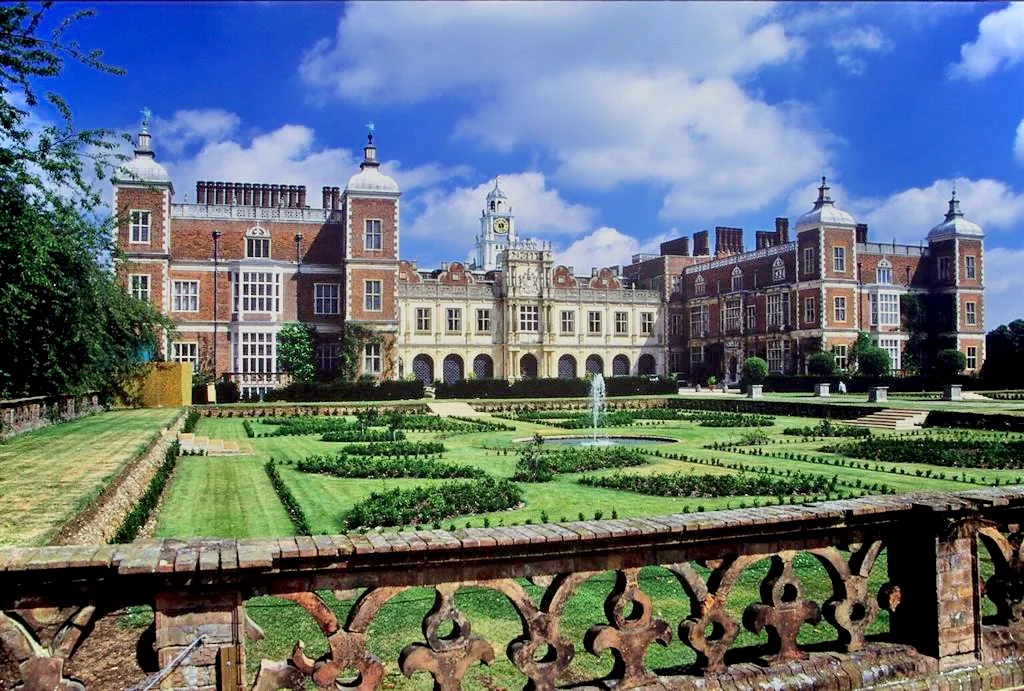
Hatfield · 54 km
Hatfield House
Content & sources
Allan Engelhardt · CC BY-SA 2.0
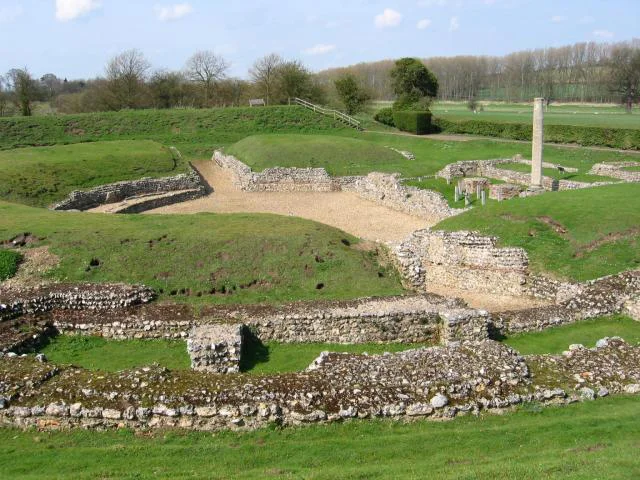
St Albans · 60 km
Verulamium
Content & sources
Rob Hinkley · CC BY-SA 2.0
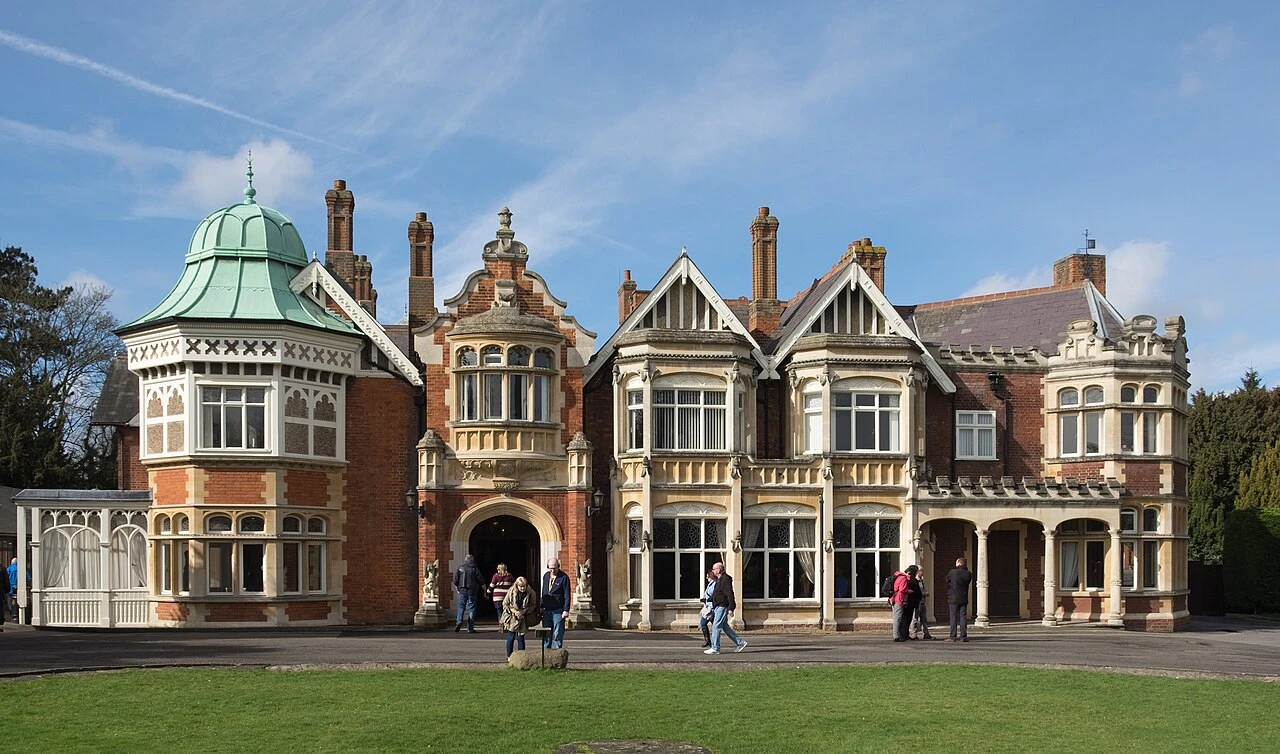
Milton Keynes · 63 km
Bletchley Park
Content & sources
Photo: DeFacto · CC BY-SA 4.0
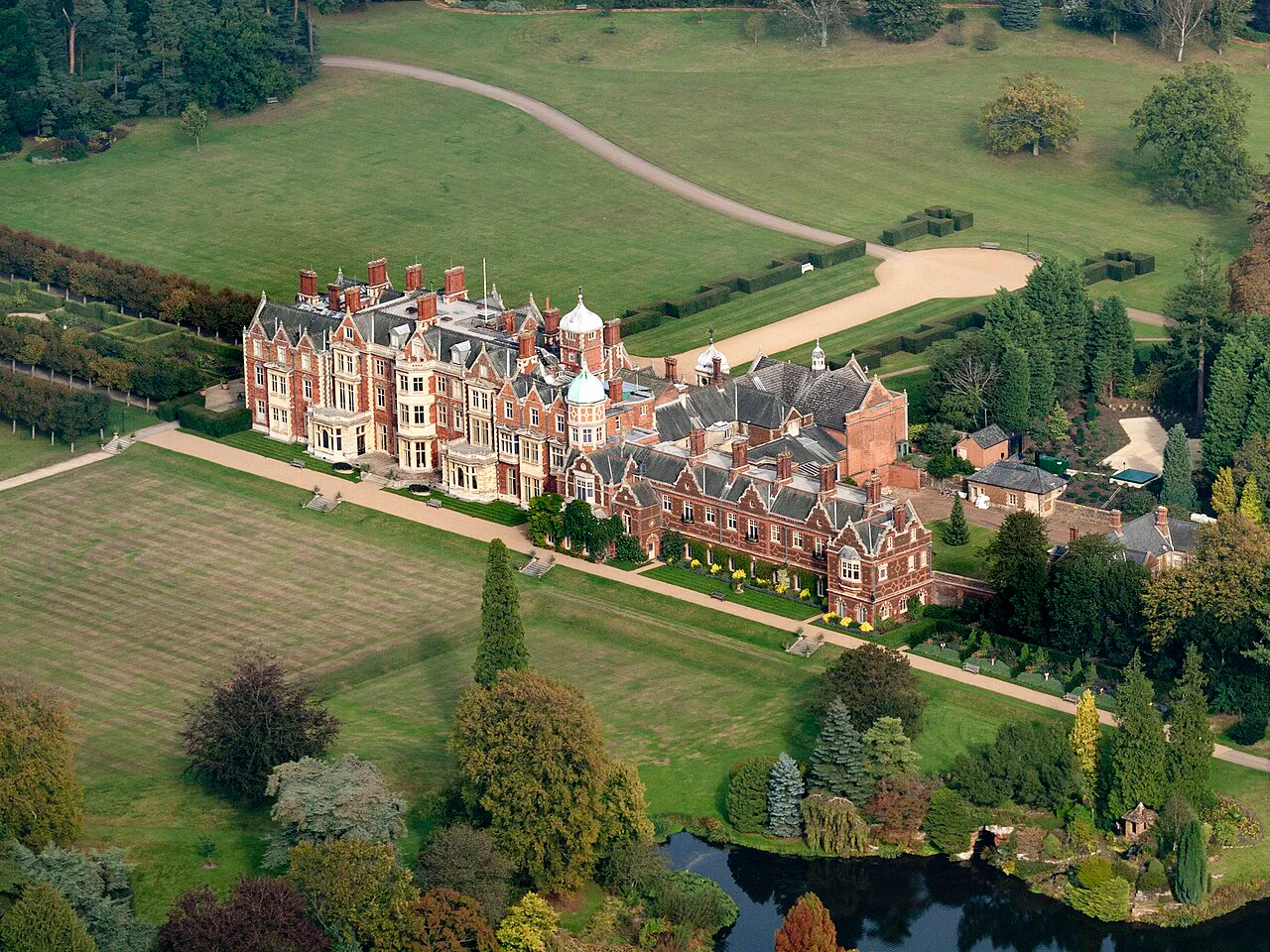
Sandringham · 75 km
Sandringham House
Content & sources
John Fielding from Norwich, UK · CC BY 2.0
Art museums
More art museum audio guides
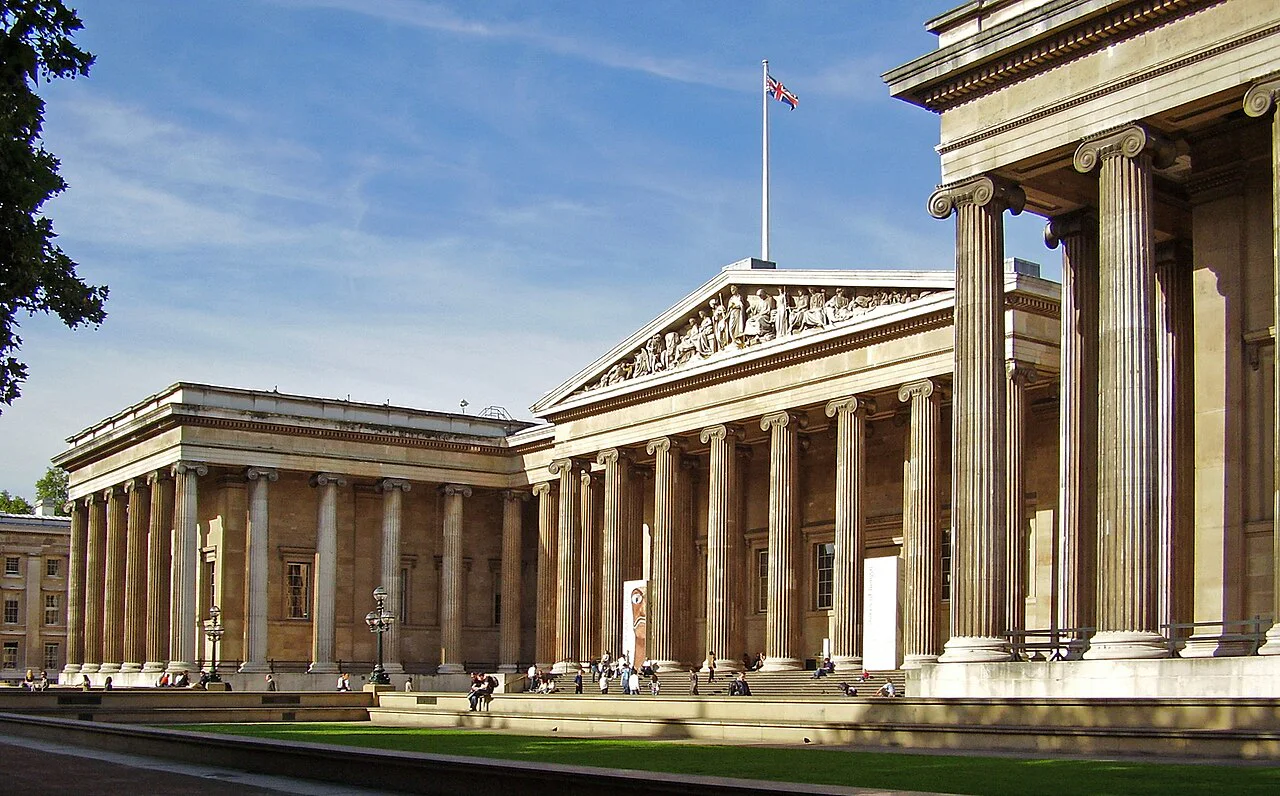
London · 68 artworks
British Museum
Content & sources
Ham · CC BY-SA 3.0
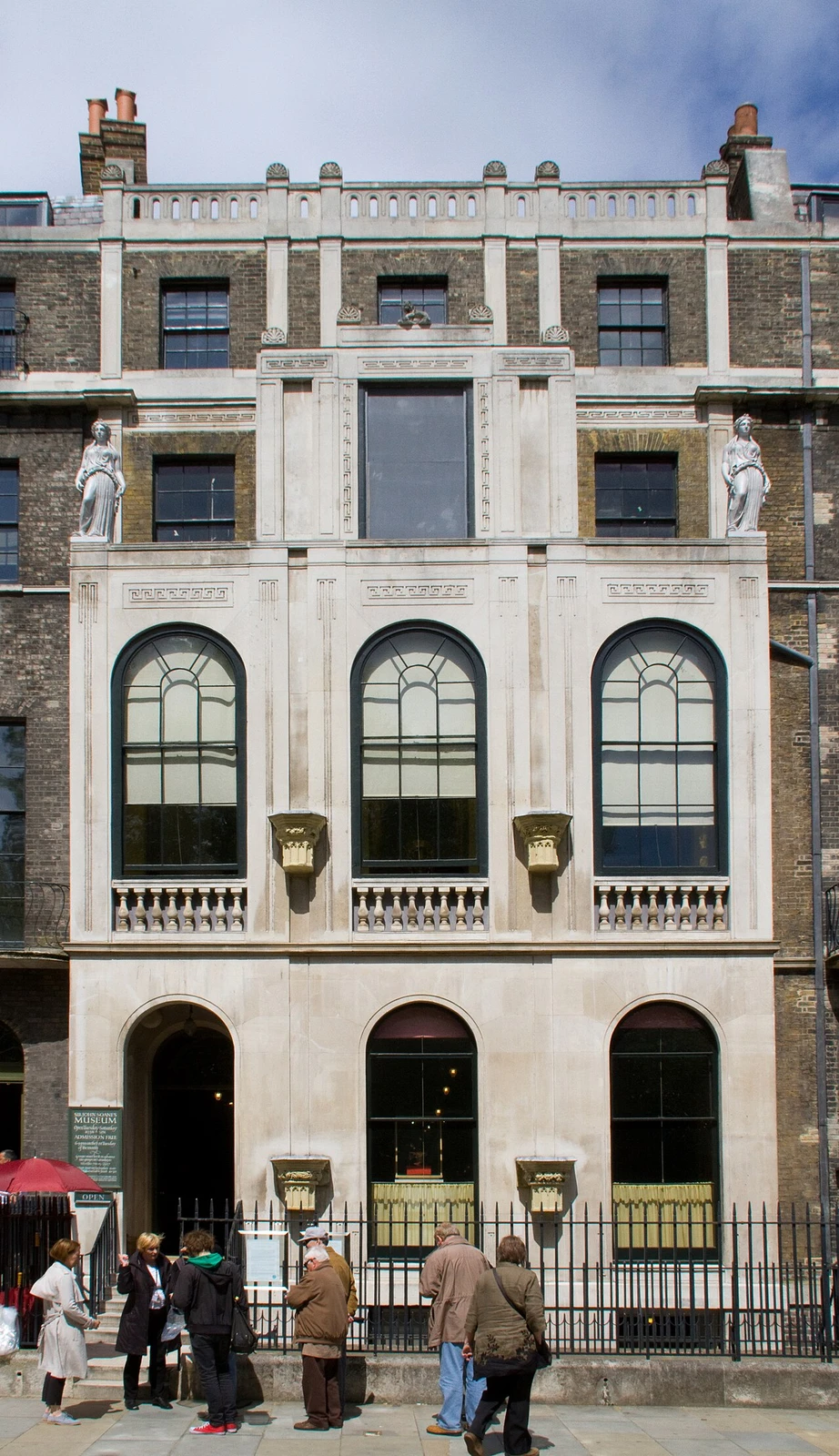
London · 8 artworks
Sir John Soane's Museum
Content & sources
Tony Hisgett from Birmingham, UK · CC BY 2.0
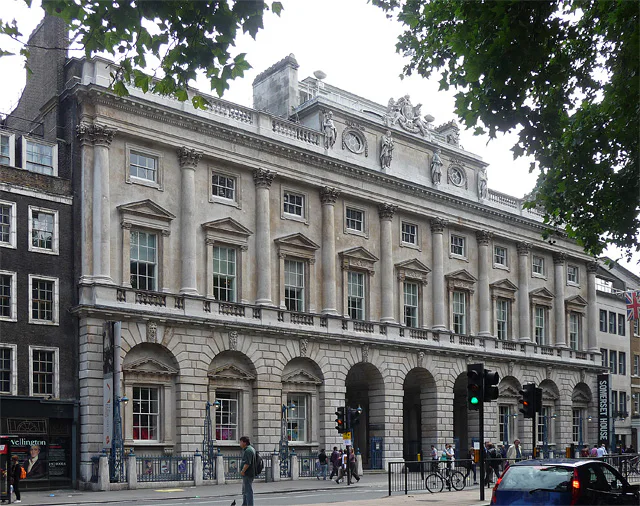
London · 33 artworks
Courtauld Gallery
Content & sources
Stephen Richards · CC BY-SA 2.0
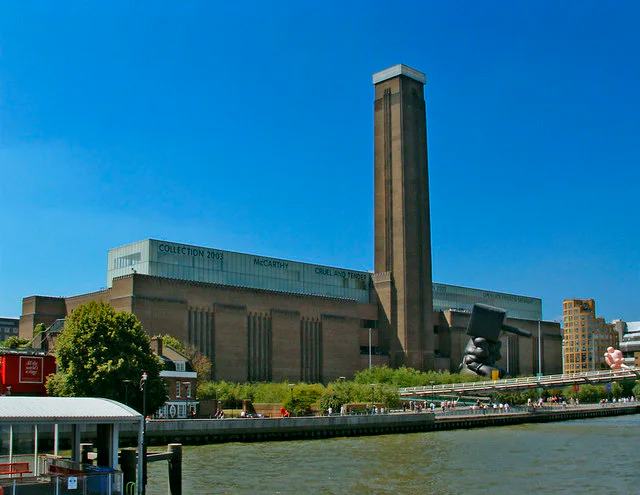
London Borough of Southwark · 15 artworks
Tate Modern
Content & sources
Christine Matthews · CC BY-SA 2.0
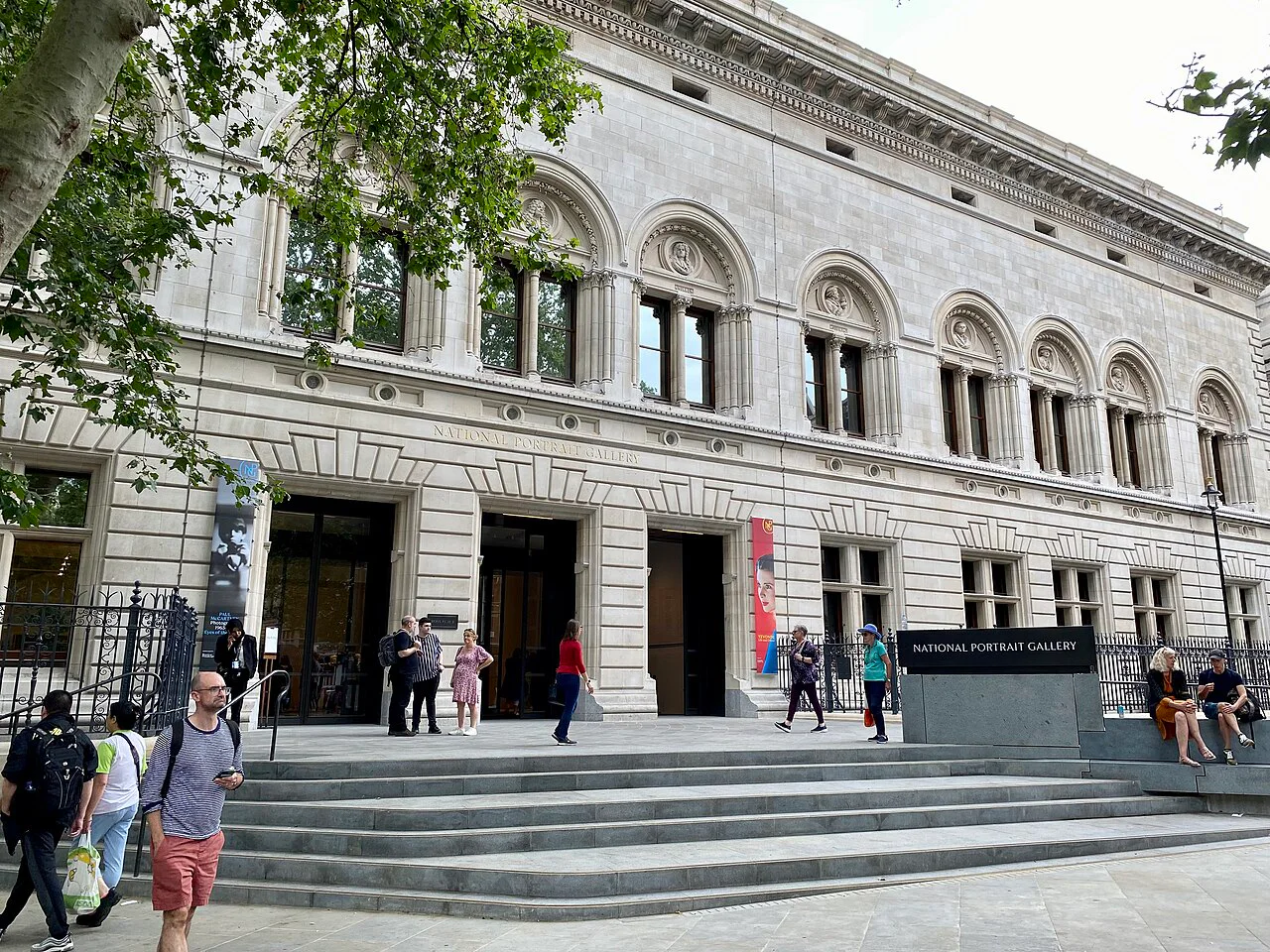
London · 164 artworks
National Portrait Gallery, London
Content & sources
Photo: No Swan So Fine · CC BY-SA 4.0
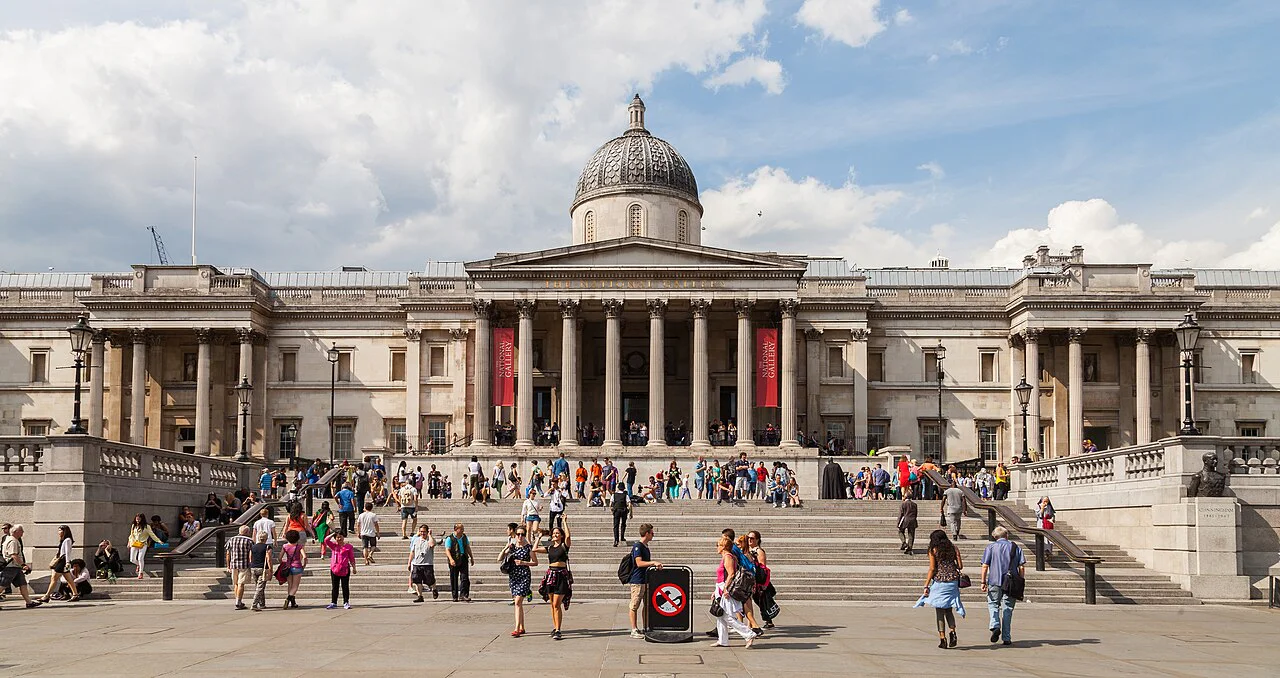
London · 171 artworks
National Gallery, London
Content & sources
Diego Delso · CC BY-SA 4.0