 Stanza / Audio guide
Content & sources
Stanza · Audio guide
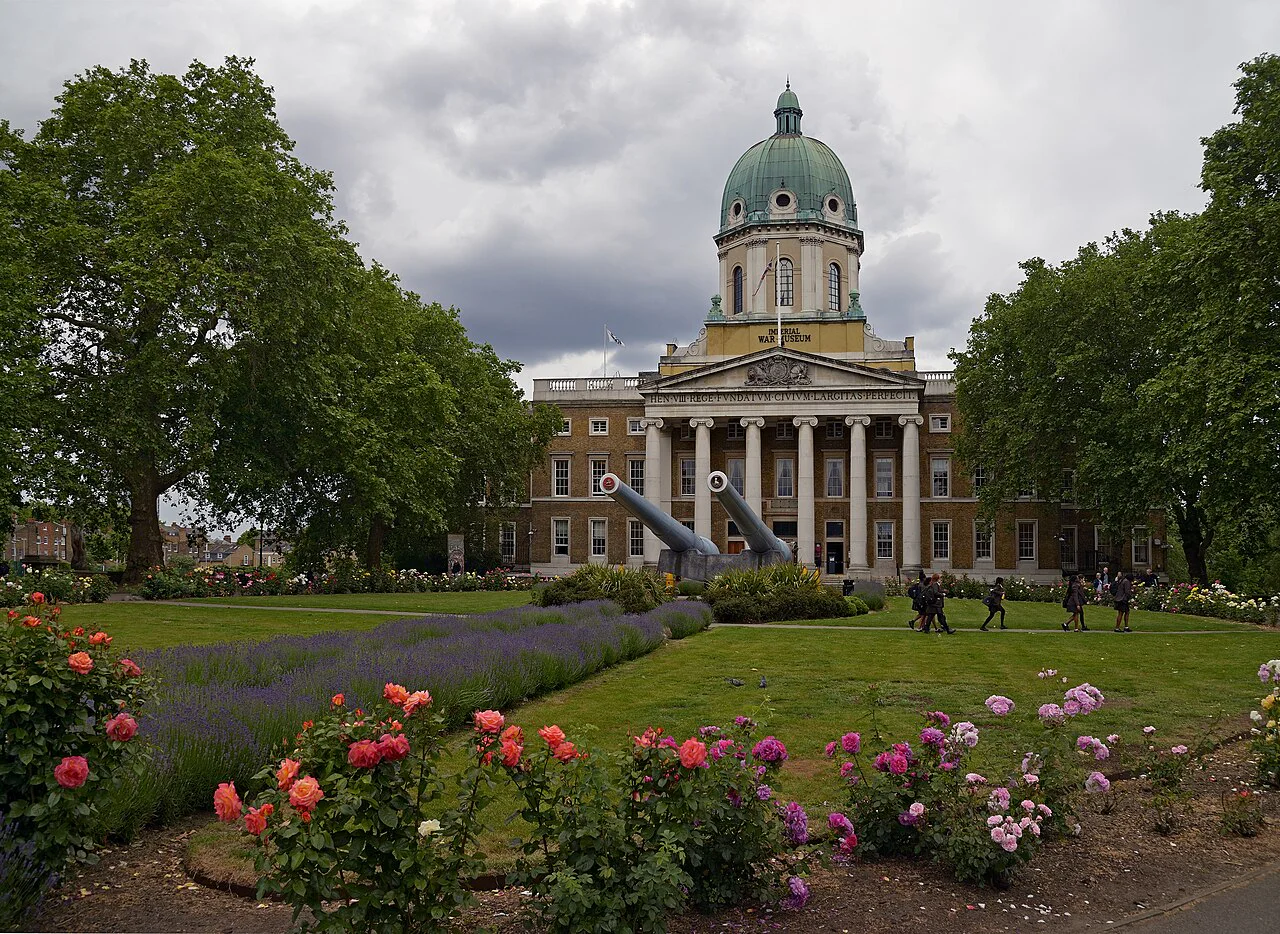
Imperial War Museum Audio Guide
A place to remember. A story to take with you.
The Imperial War Museum is a British national museum headquartered in London with five branches in England. Founded in 1917 to record the civil and military war effort and sacrifice of the United Kingdom and…
Download Stanza, then search for “Imperial War Museum”.
About the tour
One guide. Your kind of visit.
The Imperial War Museum is a British national museum headquartered in London with five branches in England. Founded in 1917 to record the civil and military war effort and sacrifice of the United Kingdom and its Empire during the First World War, its remit has since expanded to include all conflicts in which British or Commonwealth forces have been involved since 1914.
The Imperial War Museum guide tells the stories of 32 artworks, including Gassed (John Singer Sargent), Ruby Loftus Screwing a Breech Ring (Laura Knight), The Signing of Peace in the Hall of Mirrors, Versailles, 28 June 1919 (William Orpen), Daddy, What Did You Do in the Great War? (Savile Lumley, Johnson, Riddle & Co. Ltd.), Paths of Glory (C. R. W. Nevinson), The Menin Road (Paul Nash), Lieut A. P. F. Rhys Davids, DSO, MC (1897–1917) (William Orpen), and The Kensingtons at Laventie (Eric Kennington). Every artwork is free to hear in the Stanza app until 1 January.
Ready when you are.
- 01Get the free Stanza app.
iOS & Android
- 02Find your guide.
“Imperial War Museum”
- 03Download before you go.
Works offline
Audio guide / 32 artworks
Inside the guide
Get to know a few of the stories before you go. Open a stop to read more.
01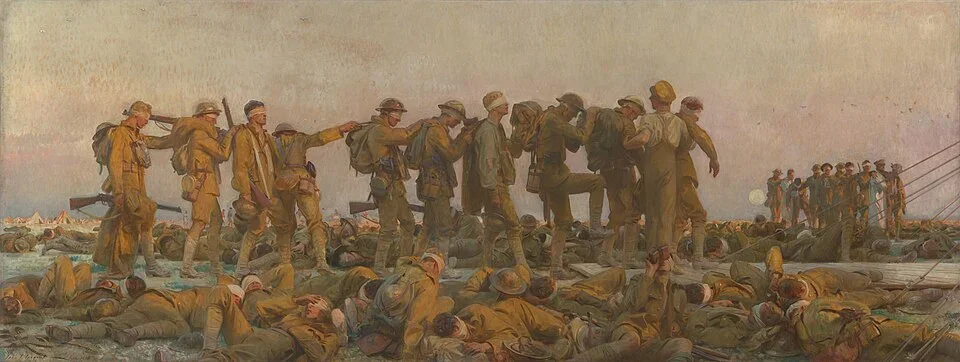
Gassed
A line of blindfolded men moves along a duckboard, each with a hand on the shoulder of the man ahead. An orderly guides them toward a dressing station. Wounded soldiers lie around them. In the background, uninjured men play football in blue and red shirts, and the sun goes down in a pink haze. That game and that rosy light were hidden from people for decades. A layer of yellowed varnish from the 1970s had turned the whole picture green and sickly. For years people took that for the mood of the gas attack itself. When the varnish came off in 2023, the pinks and mauves the painter had used came back, along with the sunset and the football. Perhaps he meant the game to say that life went on after the killing. Sargent saw it himself. Blinded men kept arriving at a dressing station on the Doullens Road in August 1918, and he made notes there. The British War Memorials Committee had asked him for a picture of British and American troops acting together. He could not find that scene, and painted this instead.
Listen in the appJohn Singer Sargent · Public domain
02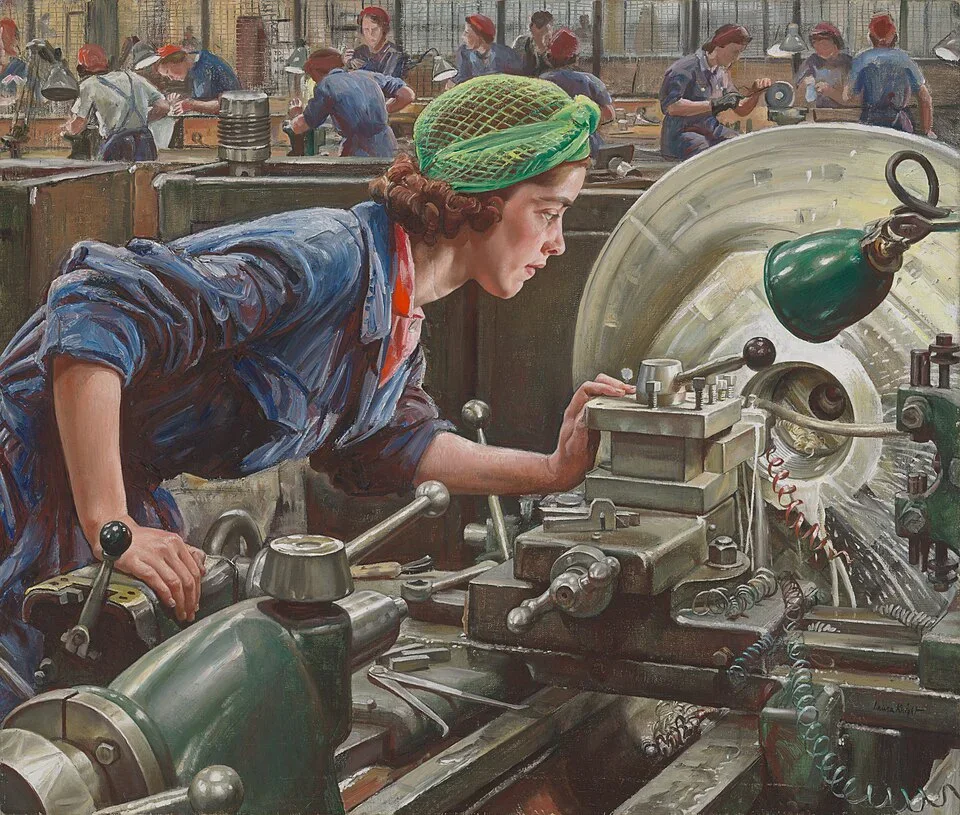
Ruby Loftus Screwing a Breech Ring
Visitors to the Royal Academy voted this the best picture on show in 1943. It was printed as a large poster and put up in factories across the country. The woman at the lathe is Ruby Loftus, twenty one. She is cutting the screw threads of a Bofors gun's breech ring, the most skilled job at her factory in Newport. A slip could destroy the gun when it was fired. That work normally went to someone with up to nine years' experience. Loftus had learned it in seven months, and only two other women were trusted with it. With so many men away fighting, Britain needed women in the factories. The government committee for war artists wanted a picture that would draw them in. Laura Knight was commissioned to paint Loftus. Knight wanted to work in her own studio, but Loftus was too valuable to be released. So Knight went to the factory in Newport and painted her there over three weeks. Loftus is bent over the lathe, her fingers resting on the machine as sparks come off the metal. Her face sits in the horizontal centre, and a metal disk faces her along the diagonal. Her green headscarf hardly holds her brown curls, and her overalls are spattered with paint. The light on her face comes from the wet metal. She is lit by the very thing she is making.
Listen in the appLaura Knight · Public domain
03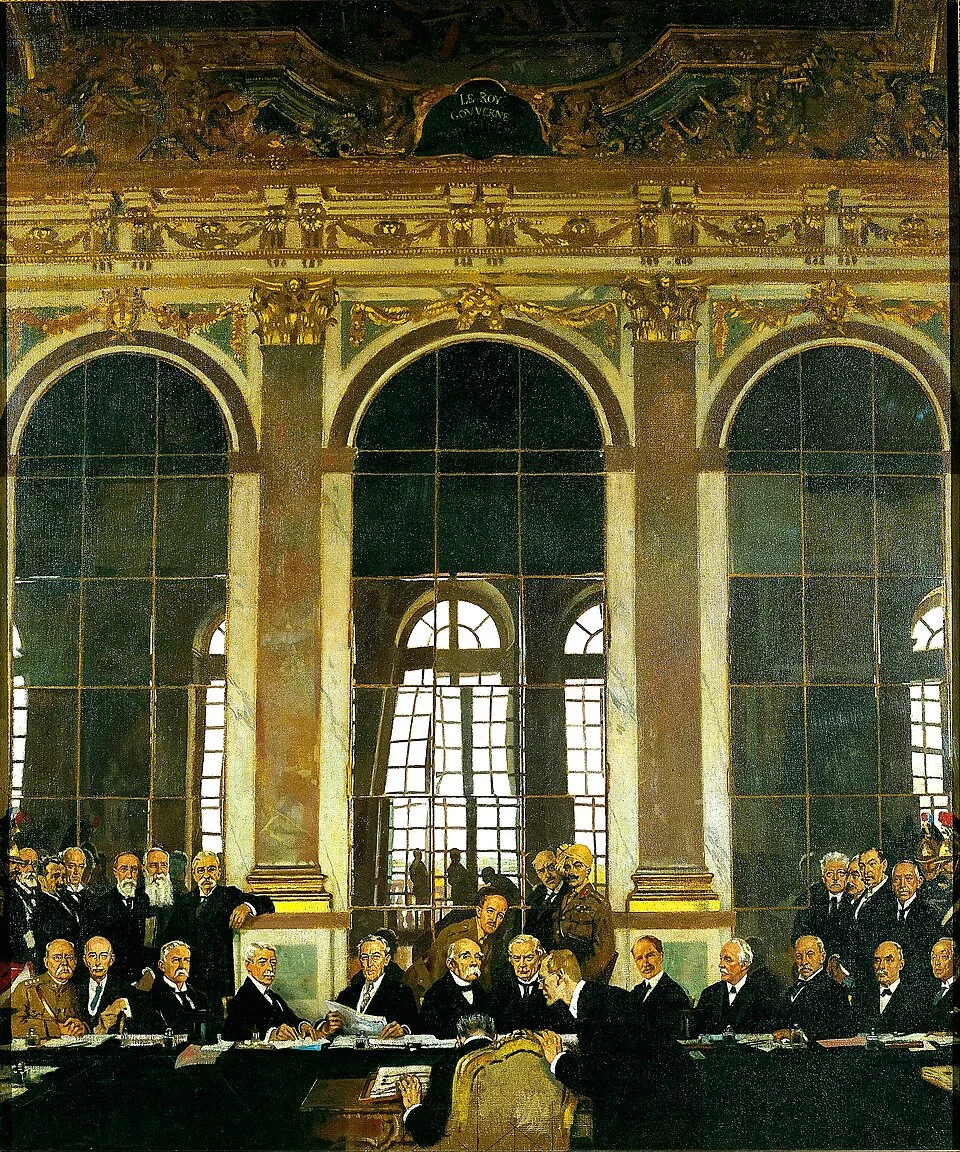
The Signing of Peace in the Hall of Mirrors, Versailles, 28 June 1919
William Orpen was asked to paint the men who signed the peace treaty that ended a war. He was the official painter at the peace conference, and this was the scene he had to record. But the longer he watched the politicians, the less he liked them. He thought them vain and greedy. So he painted the room instead. Up front, the two German delegates turn their backs to us. One sits in a chair and signs. The other stands beside him, leaning over. They use a small bare table, set well apart from the long one covered in green cloth where the victors sit. The walls and ceiling of the Hall of Mirrors rise over the gathering and leave the politicians small. High above, the words read The King governs alone. That line hangs over a conference that could not agree on its own peace terms. This is the same hall where, in 1871, the Prussian king was proclaimed German Emperor.
Listen in the appWilliam Orpen · Public domain
04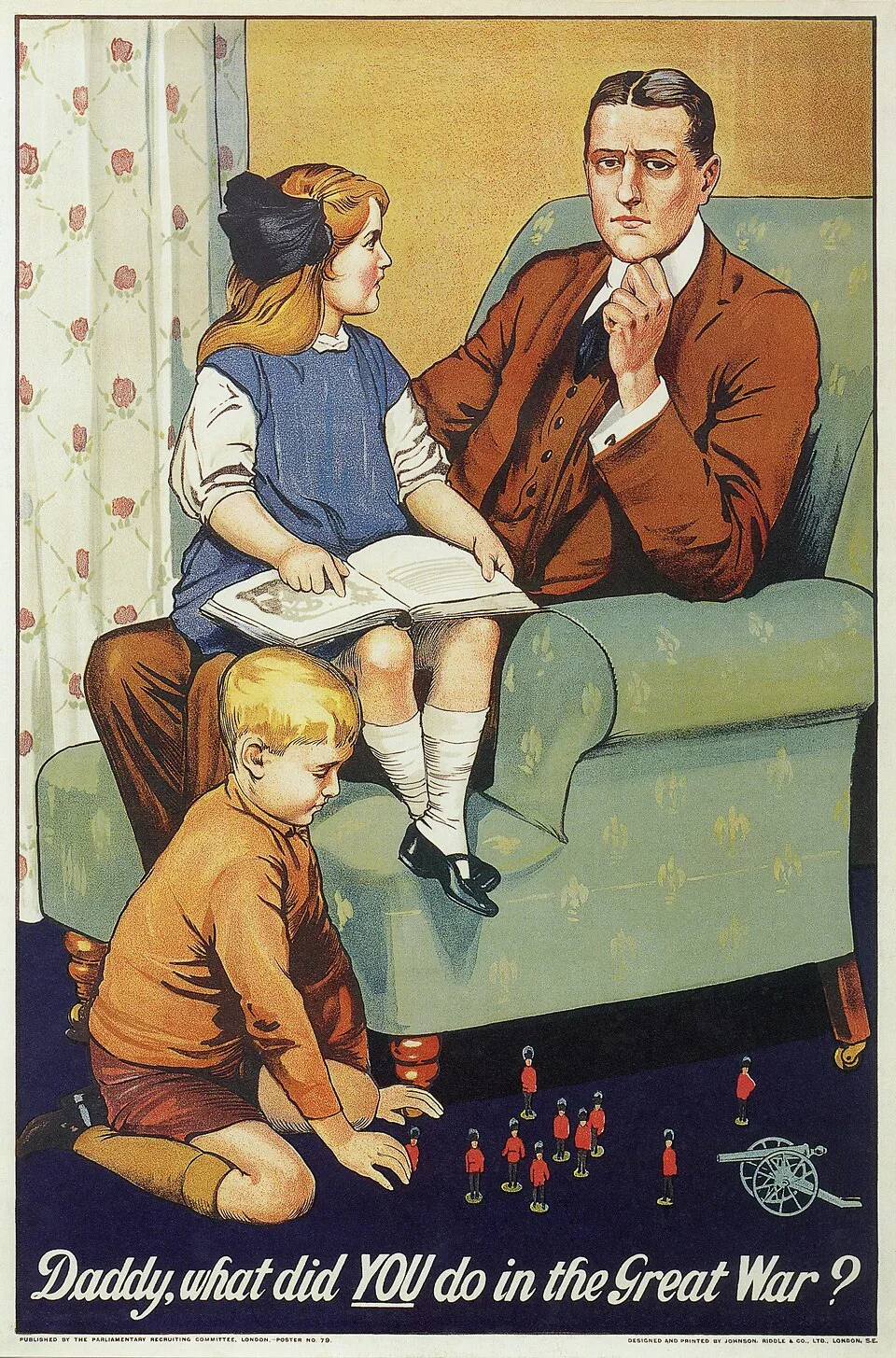
Daddy, What Did You Do in the Great War?
A man sits in an armchair, looking out at you with a distant expression. His daughter sits on his lap with a book. Near the chair, a boy plays with toy soldiers. For the people who saw it in 1915, this was a future. The question below asks what he did in the Great War. Britain had no conscription, and volunteers were falling. The campaign had turned to guilt and patriotism to bring men forward. That girl will grow into the child who wants an answer. The toy soldiers on the floor belong to the home the poster says men must fight to keep. A father who stayed home would have to face his children. The idea came from Arthur Gunn, a publisher who had not enlisted and felt that guilt himself. He asked John Savile Lumley to set the question inside a family scene. Seeing the sketch, Gunn signed up for the Westminster Volunteer Cavalry. He took the poster to the Parliamentary Recruitment Committee, which approved it for official publication. It was not one of the committee's most printed posters. Some soldiers hung it in the trenches and wrote mocking answers to the girl's question. The artist later renounced it because of the criticism. The question grew from a January 1915 poster asking men what they would answer when their children asked why they had not been soldiers.
Listen in the appSavile Lumley / Johnson, Riddle & Co. Ltd. / Adam Cuerden · Public domain
05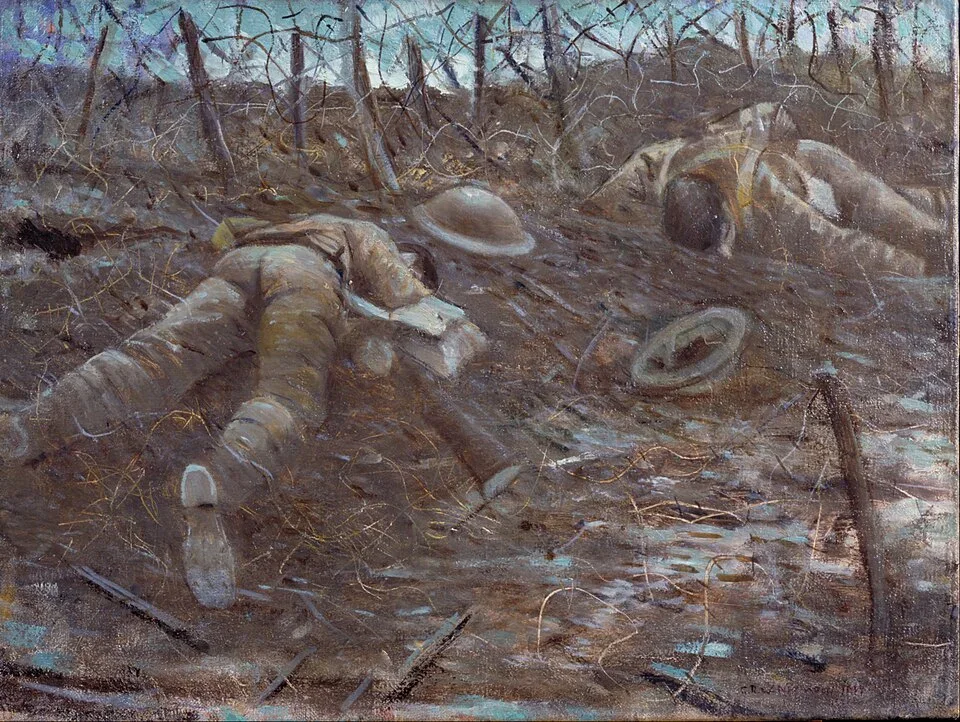
Paths of Glory
Sent to France in 1917 as an official war artist, Christopher Nevinson set aside the modernist style he had worked in. He painted what he saw in a plain, realistic way. Two British soldiers lie dead, face down in the mud, unburied, with barbed wire and the wreckage of war around them. The title comes from an old poem, a line about the paths of glory leading only to the grave. The army censor in France refused to allow dead bodies to be shown, saying they would hurt the war effort. He put the painting into his official exhibition at the Leicester Galleries in March 1918 anyway. A strip of brown paper ran across the bodies, bearing the word censored. The War Office reprimanded him for showing a banned image and for using that word without permission. But it brought him publicity, especially as official colour photographs from the front, including real dead bodies, went on show on the fourth of March. The Ministry of Information had commissioned the painting, and the Imperial War Museum bought it straight from that exhibition.
Listen in the appC. R. W. Nevinson · Public domain
06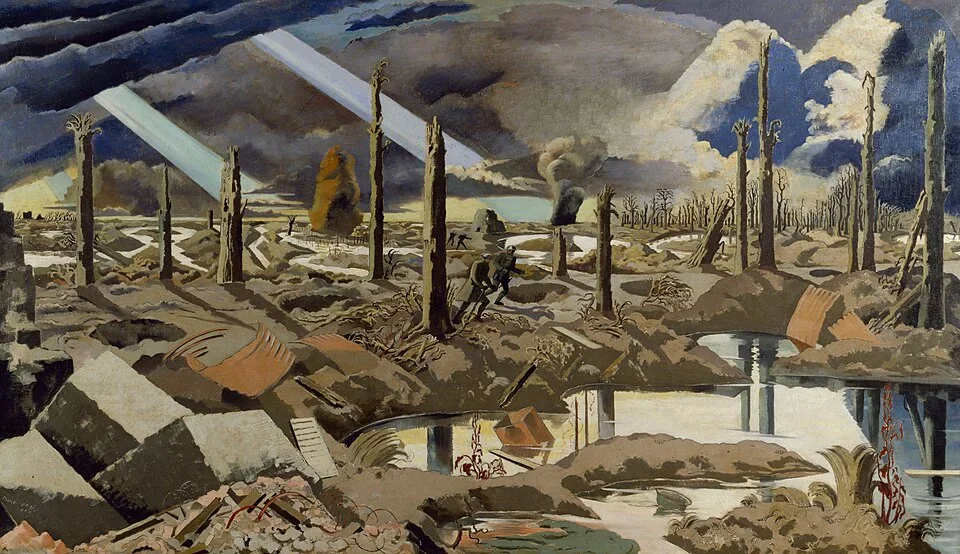
The Menin Road
How would you get out of here? Two soldiers in the middle of the picture are trying to follow a road that is almost unrecognisable. The ground seems to have them trapped. Paul Nash was asked to paint a battlefield for a national Hall of Remembrance, meant as a memorial to the First World War. It was never built. He chose a stretch of the Ypres Salient he knew from the front, a cluster of German pillboxes the British called Tower Hamlets. He thought it was perhaps the most dreaded and disastrous place in any theatre of war. He had come under shellfire travelling along the route, and owed his life to his driver's quick reactions. What he put on the canvas is flooded shell craters and trenches. Shell holes are punched into the road at regular intervals. The one possible way round a mud pool is blocked by a fallen board. Leafless tree stumps point into a sky of cloud and smoke, with shafts of sunlight cutting through it like gun barrels. And to the left, seven zigzag streams. None of them reaches the horizon, or gets out either.
Listen in the appPaul Nash · Public domain
07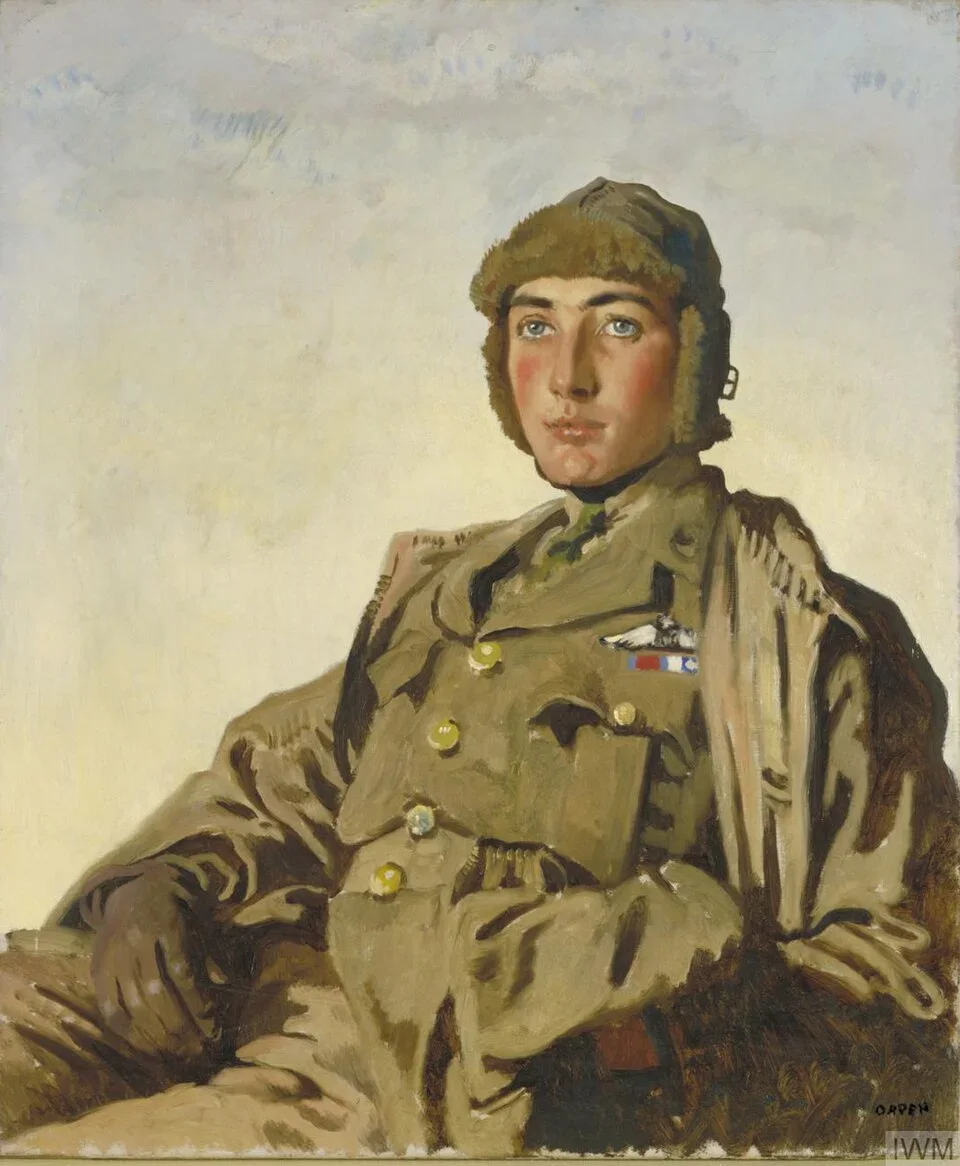
Lieut A. P. F. Rhys Davids, DSO, MC (1897–1917)
Just beneath the winged pilot's badge on his chest is a bar of ribbons. They are the Military Cross and the Distinguished Service Order, the letters after his name in the title. He had earned them young. In September 1917 he shot down the German ace Werner Voss, and that made him famous in Britain. Britain's Department of Information sent William Orpen to France to paint pictures that would publicize the war. He stayed at Cassel, and pilots from the airfield nearby came to eat and sing, and he played table tennis with them. He had met this young pilot only shortly before. But there is no aircraft here, and no dogfight. Only the khaki uniform tells you this is a war. He sits leaning back with one gloved hand on his thigh. A flying helmet lined with fur covers his ears. The face is painted with almost photographic care, the skin smooth and flushed. The eyes are wide and blue, yet they look past us, toward some distant point, perhaps in the sky. A few weeks after the portrait was finished, Rhys-Davids was killed in a dogfight over Belgium, on the twenty-seventh of October 1917. He was twenty years old. They never found his body.
Listen in the appWilliam Orpen · Public domain
08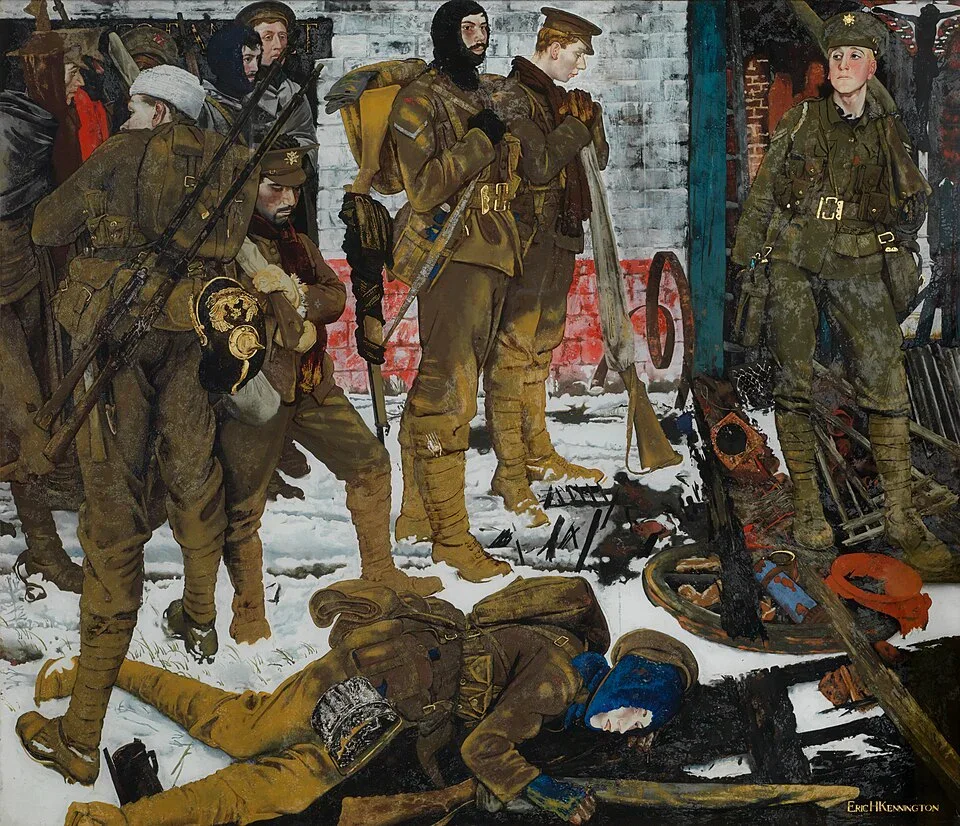
The Kensingtons at Laventie
They have just come through a flooded communications trench after four days and nights in a forward fire trench. They have reached the ruined village of Laventie. Now they wait for the order to fall in and march five miles to sleep for the night out of shelling range. Kennington stands third from the left in a balaclava. These are the men of his own platoon, the Kensingtons. He was wounded in January 1915 and sent home unfit after losing a toe. Before starting, he tracked down former comrades and sketched them. The bandaged man carries two rifles on his back. One belonged to a comrade killed by a sniper beside him in a trench, and a German helmet is attached to his belt. In front, a soldier lies on the ground. He was under age, worn out by service, hard work and lack of sleep. By the time he finished, nine in every ten of the seven hundred who came to France with the battalion had been killed or wounded. When it was shown in 1916, the exhausted men in it caused a sensation and helped bring about an official scheme for British war artists. The whole picture was painted in reverse on glass, with the background laid on last.
Listen in the appEric Kennington · Public domain
09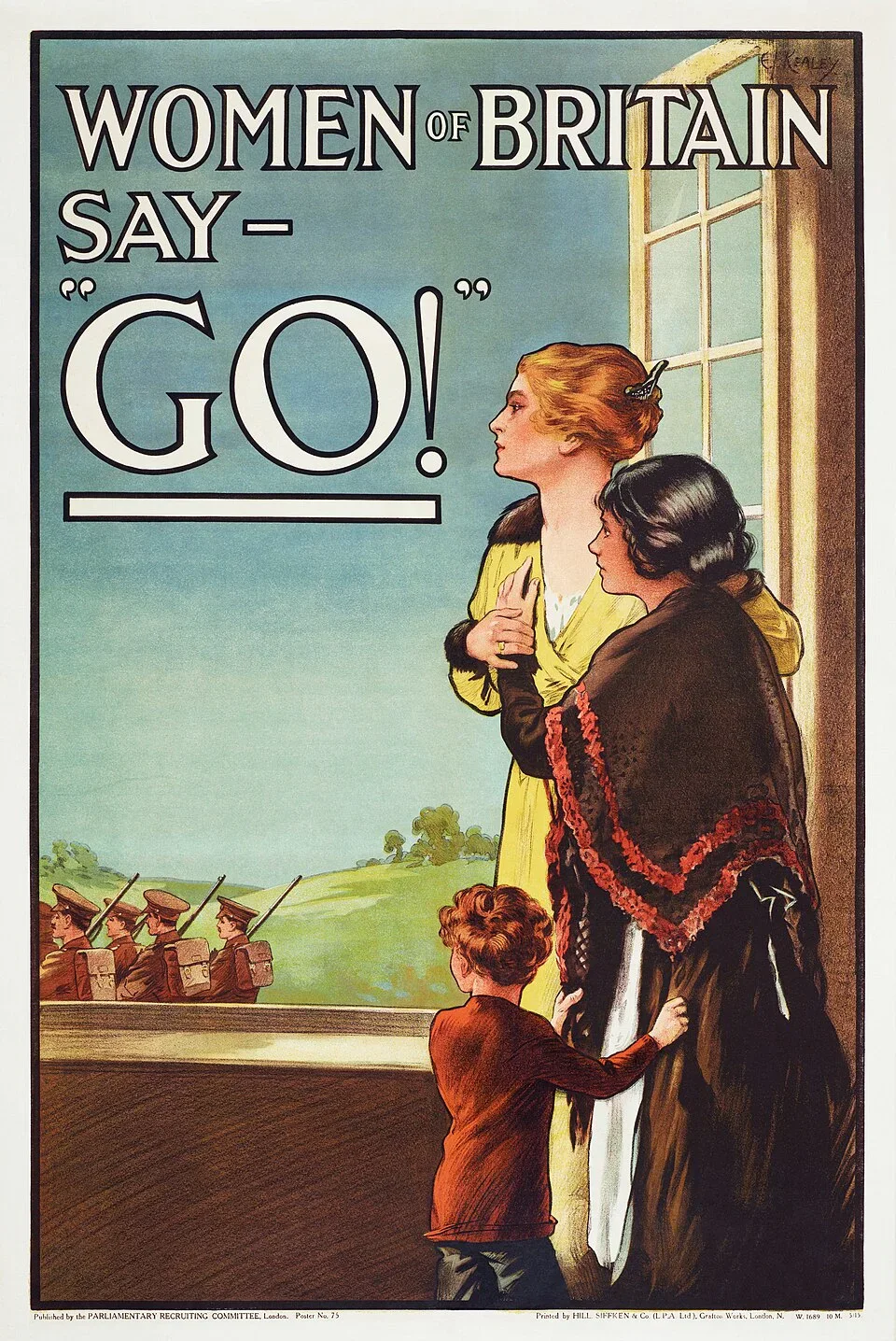
Women of Britain Say 'Go!'
Two women hold on to each other at an open window, proud, watching soldiers march away. A boy clings to one of them. They are the ones urging the men on, and the words above them carry their voice. You might take this for a poster aimed at men. It was aimed at women like these two. Volunteer numbers were falling in 1915, and with no conscription the government needed men to enlist. Edgar James Kealey drew this for the Parliamentary Recruitment Committee, the body behind most early recruitment posters. The words look like an order to the men. But they were really an instruction to women about what to say at home. If your wife or your mother says go, how can you refuse? The child is a boy, suggesting that a man who stays behind is small and vulnerable, like a young boy. The women and the boy stay inside, the soldiers outside, each where they were expected to be. One of those marching men may be the husband of one of the women. Not every woman wanted this. Many tried to bring their men home, and poets like Wilfred Owen and Siegfried Sassoon objected to the whole idea. Beyond the window lies the countryside, the land those men were expected to protect.
Listen in the appEdgar James Kealey / Hill, Siffken & Co. · Public domain
10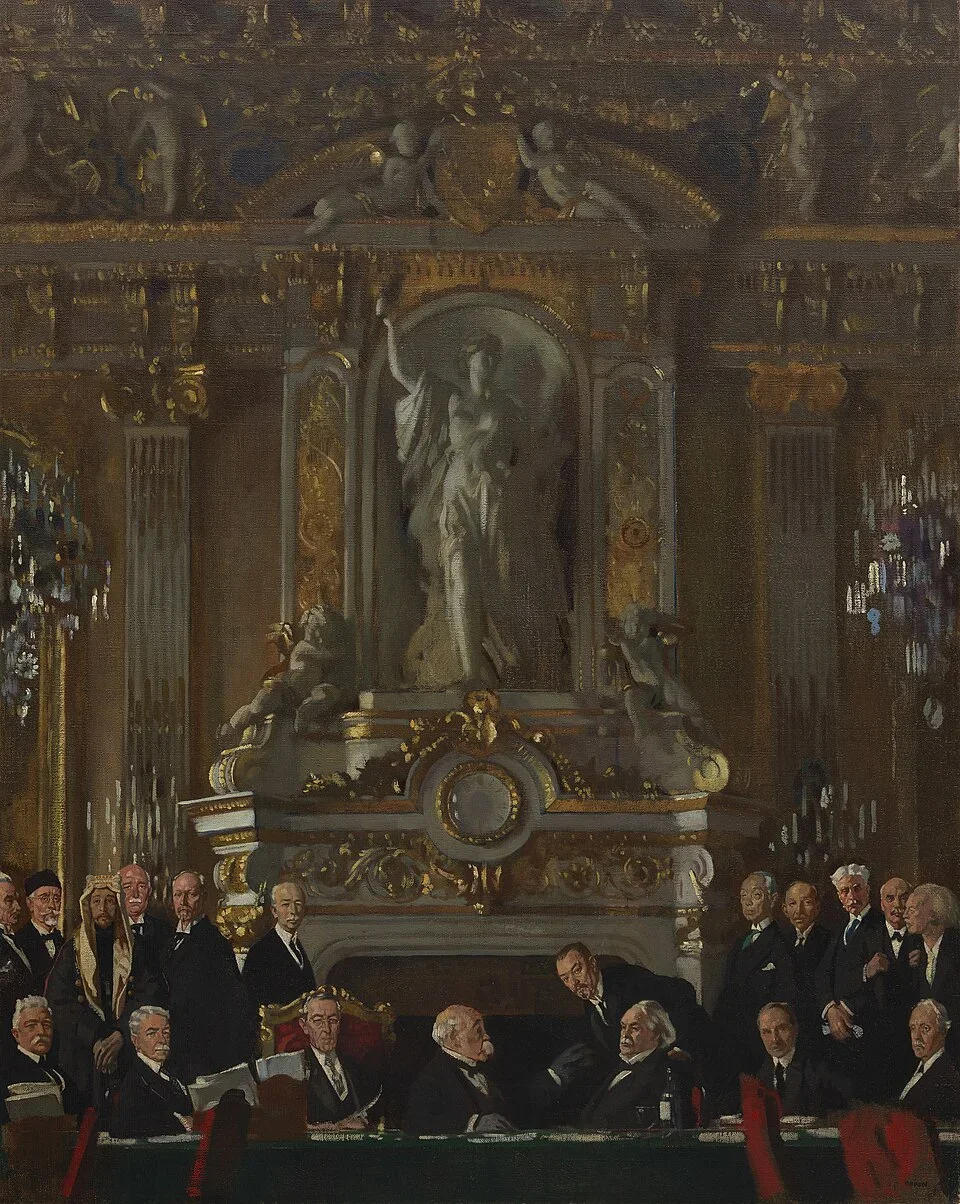
A Peace Conference at the Quai d'Orsay
A long table stands in a high, gilded room, with men sitting and standing around it. Chandeliers hang above, a rich cornice runs along the walls, and a great fireplace rises at the center with a clock set into its mantel. Over the fireplace, a woman lifts a torch. David Lloyd George wanted this painting. At his wish, Orpen came to Paris to record the peace conference, one of three canvases he was asked to paint there. But he gave the room almost three quarters of the picture. All that splendor was there to flatter the men, and instead it leaves them small. Above the fireplace, on either side of the woman with the torch, two small figures carry a globe and a scepter, the symbols of rule.
Listen in the appWilliam Orpen · Public domain
- 11
A Balloon Site, Coventry
Laura Knight · 1942
- 12
Battle of Britain
Paul Nash · 1941
- 13
To the Unknown British Soldier in France
William Orpen · 1923–1927
- 14
The Nuremberg Trial
Laura Knight · 1946
- 15
Over the Top
John Nash · 1918
- 16
Take Off
Laura Knight · 1943
- 17
Sunrise, Inverness Copse
Paul Nash · 1918
- 18
We are Making a New World
Paul Nash · 1918
- 19
Dead Germans in a Trench
William Orpen · 1918
- 20
Youth Mourning
George Clausen · 1916
- 21
The Doctor
C. R. W. Nevinson · 1916
- 22
An Aerial Fight
Louis Weirter · 1918
- 23
The Dispatch
Marjory Violet Watherston · 1917
- 24
Winter Mine-laying off Iceland
Muirhead Bone · 1942
- 25
Snack Time in a Factory
Roland Vivian Pitchforth · 1941
- 26
Self Portrait
William Orpen · 1917
- 27
Camouflaged tank crossing muddy terrain
C. R. W. Nevinson · 1917
- 28
Windston Churchill with a Tommy gun
William George Horton · 1940
- 29
After a Push
C. R. W. Nevinson · 1917
- 30
An Advanced Post, Night
John Nash · 1918
- 31
Loss of HMS Pathfinder, September 5th 1914
William Lionel Wyllie · 1920
- 32
Damaged Tanks being Lowered into the Hold of a Merchant Ship
Bernard Hailstone · 1943
Imperial War Museum
Frequently asked questions
How much does the guide cost?
Free app download. Free until 1 January. Listed guide price: $1.99. Audio guide only. Venue admission is separate.
Can I listen without internet?
Yes. Download the guide’s audio, images, and maps in the app before your visit. Your downloaded content is then available offline.
Can I listen in my language?
In English for now. More languages soon.
Do I need to follow a schedule?
No. This is a self-guided experience. Choose your stops, pause whenever you like, and return to a story at your own pace.
Which artworks are in the Imperial War Museum audio guide?
32 artworks, including Gassed (John Singer Sargent), Ruby Loftus Screwing a Breech Ring (Laura Knight), The Signing of Peace in the Hall of Mirrors, Versailles, 28 June 1919 (William Orpen), Daddy, What Did You Do in the Great War? (Savile Lumley, Johnson, Riddle & Co. Ltd.), Paths of Glory (C. R. W. Nevinson), The Menin Road (Paul Nash), Lieut A. P. F. Rhys Davids, DSO, MC (1897–1917) (William Orpen), and The Kensingtons at Laventie (Eric Kennington). The full list is on this page.
Is this the museum’s official audio guide?
No. Stanza is an independent audio guide app and is not affiliated with Imperial War Museum. Museum admission is separate.
At your own pace
Explore Imperial War Museum.
Download Stanza, then search for “Imperial War Museum”.
Free app download · Guide price shown in the app
Keep exploring
Nearby audio guides
Greater London · 1 km
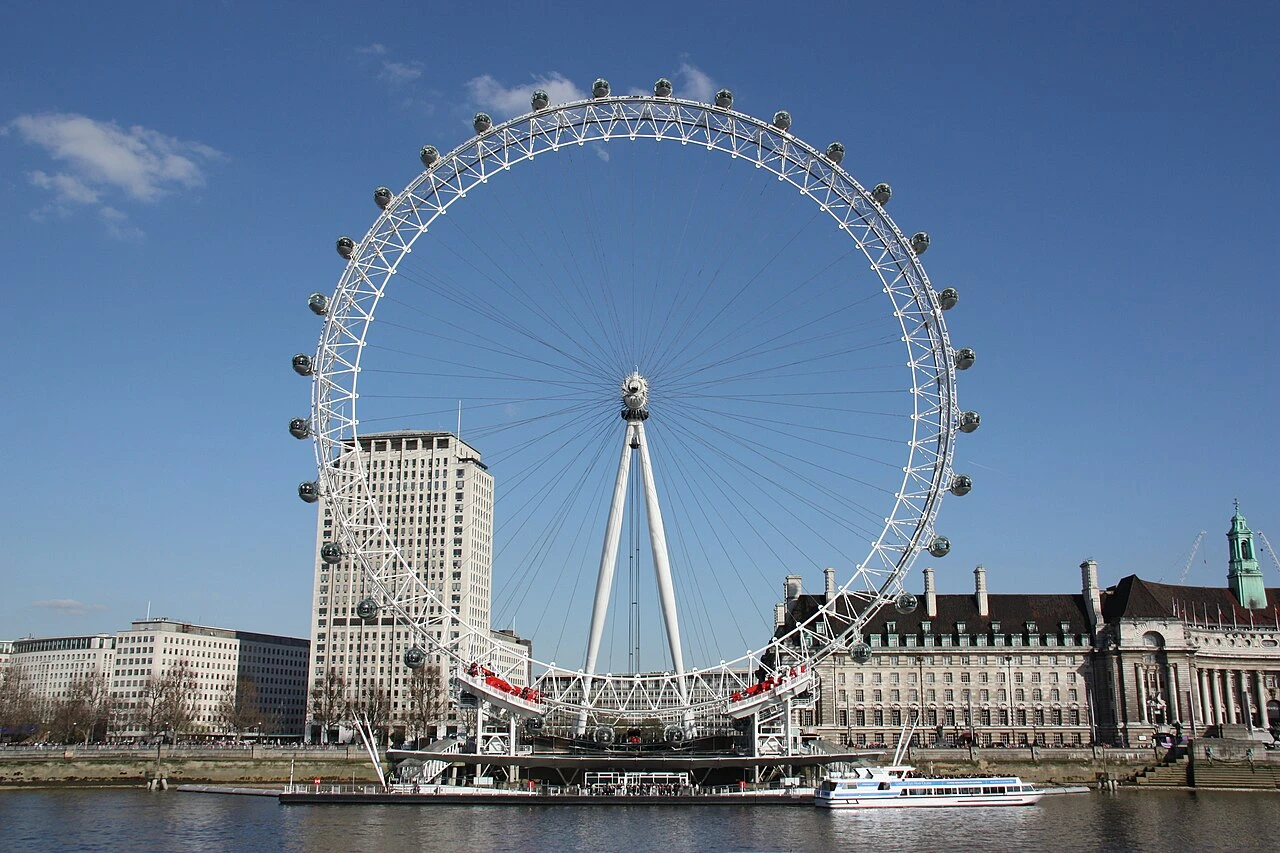
London Eye
Content & sources
Photo: Khamtran · CC BY-SA 3.0
London · 1 km
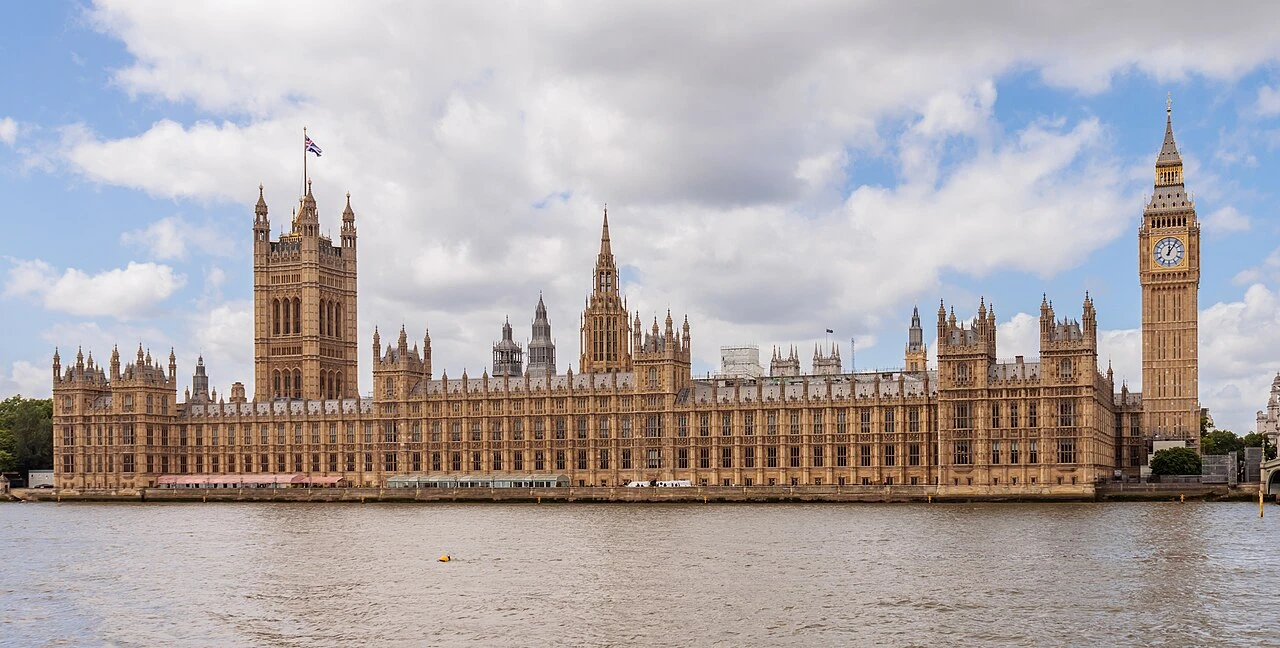
Palace of Westminster
Content & sources
Terry Ott from Washington, DC Metro Area, United States of America · CC BY 2.0
London · 1 km
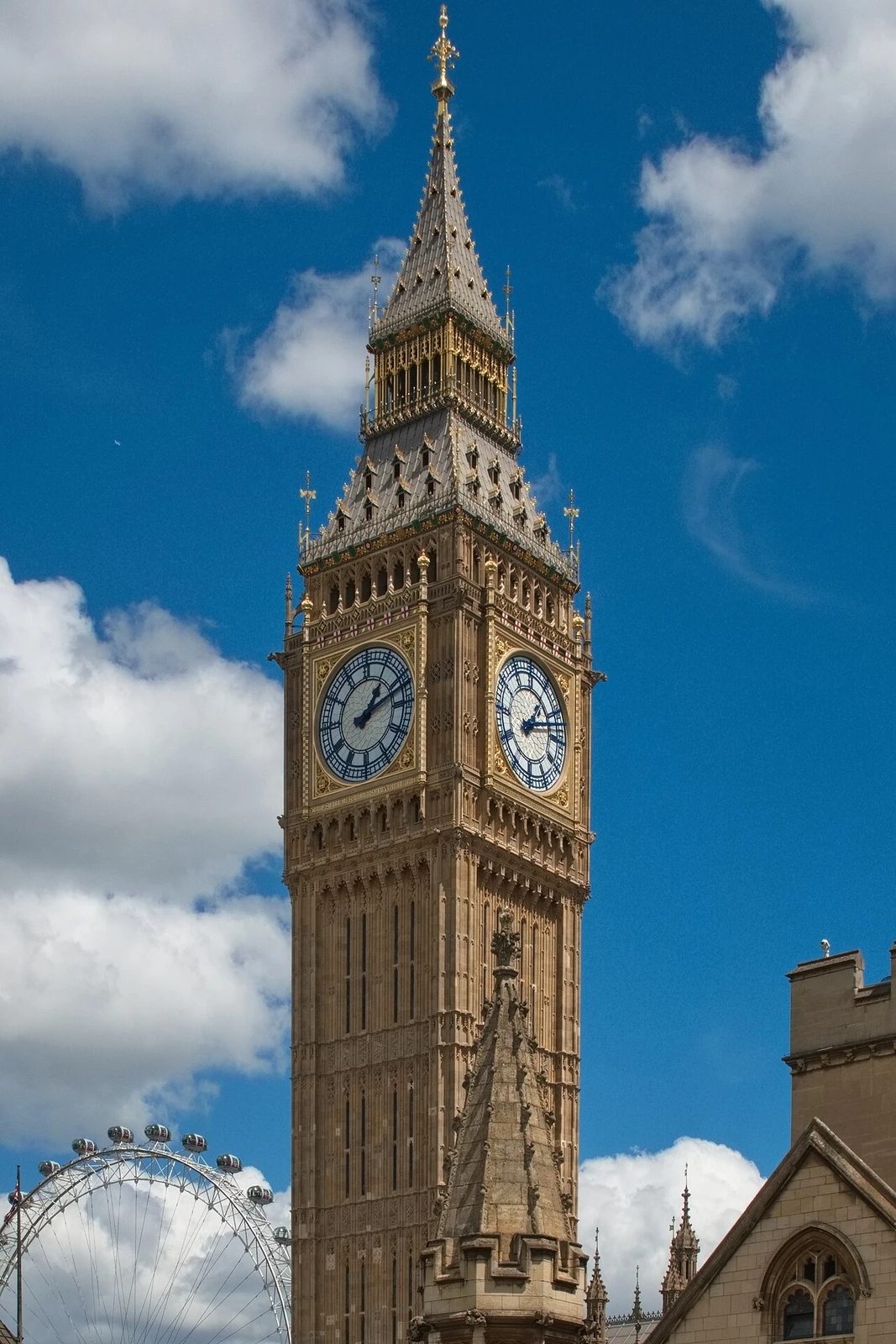
Big Ben
Content & sources
Dave Bezaire · CC BY-SA 2.0
London · 1 km
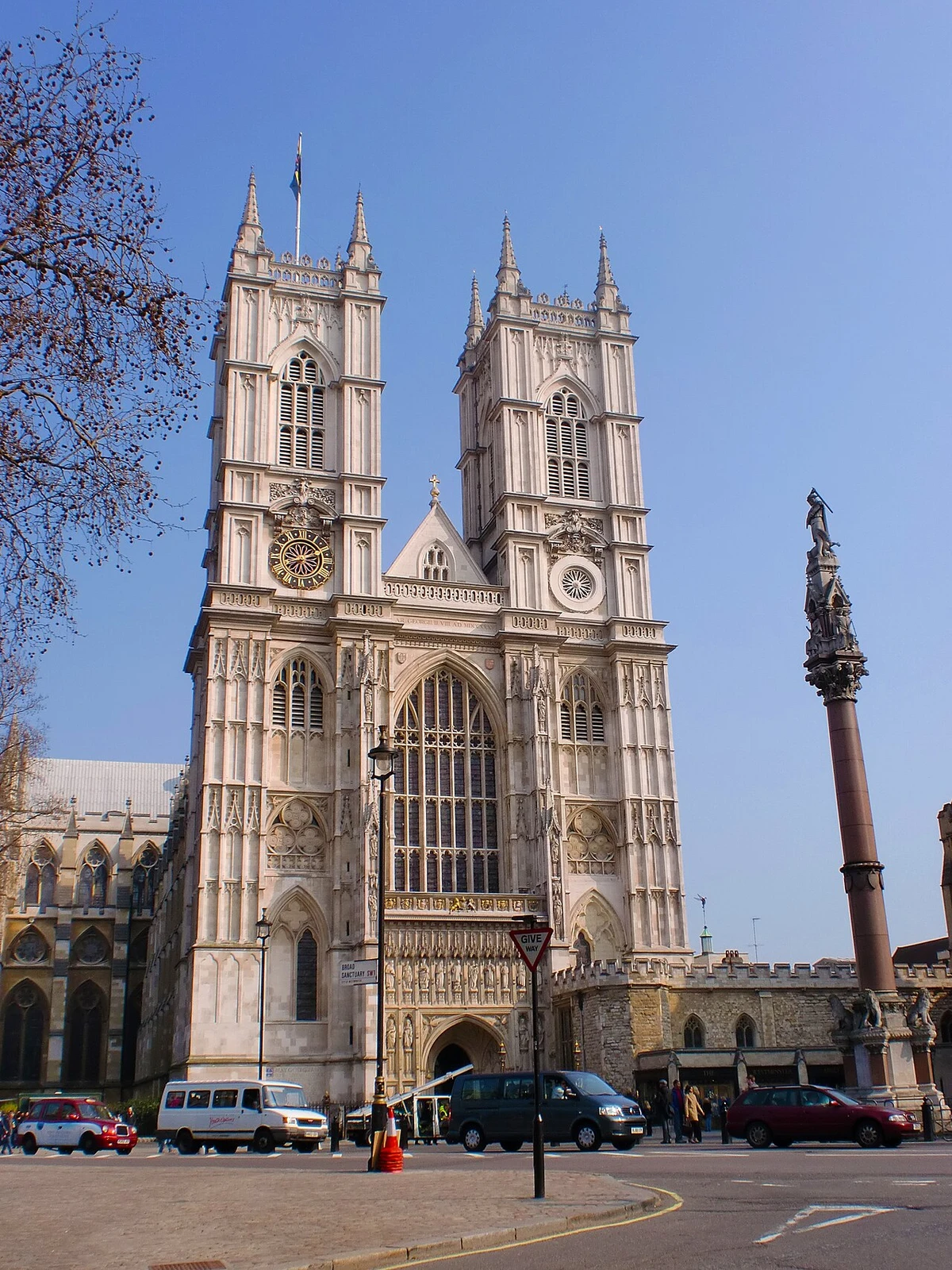
Westminster Abbey
Content & sources
Σπάρτακος · CC BY-SA 3.0
Art museums
More art museum audio guides
London · 133 artworks
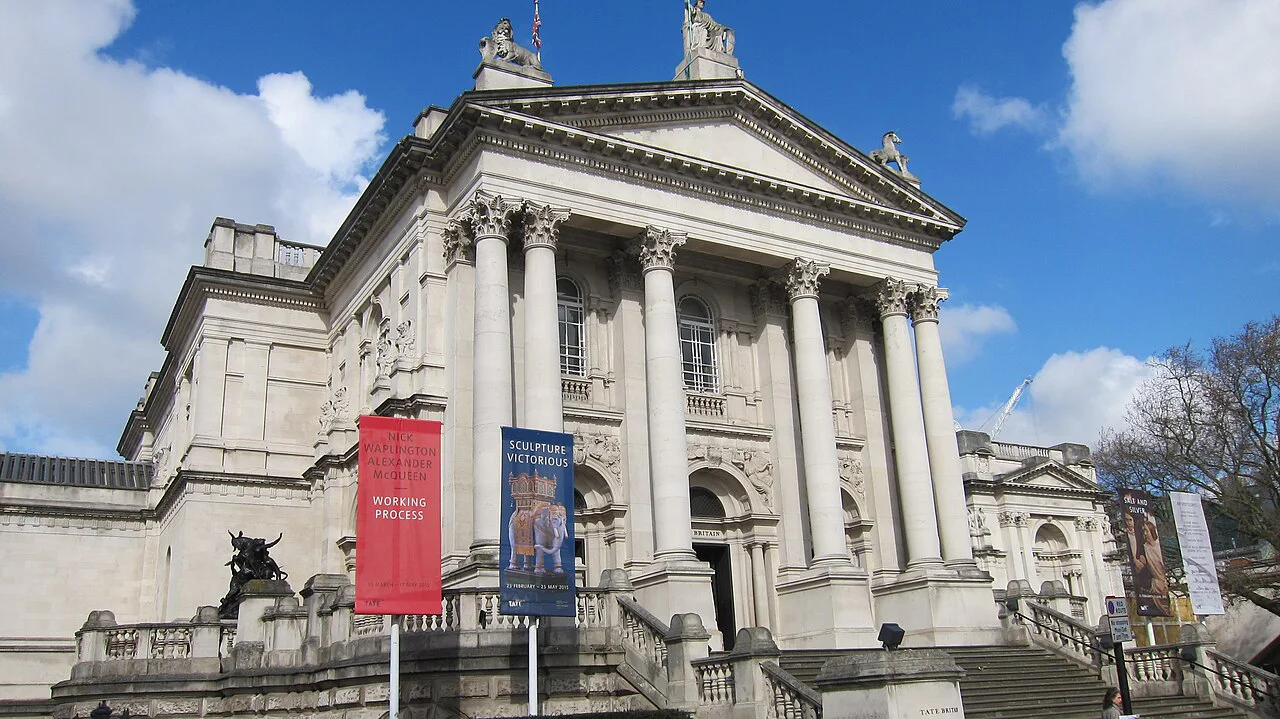
Tate Britain
Content & sources
Carlos Cunha · CC BY-SA 3.0
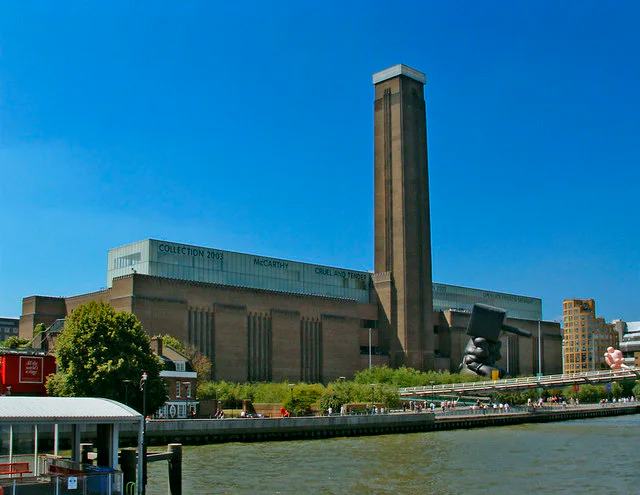
London Borough of Southwark · 15 artworks
Tate Modern
Content & sources
Christine Matthews · CC BY-SA 2.0
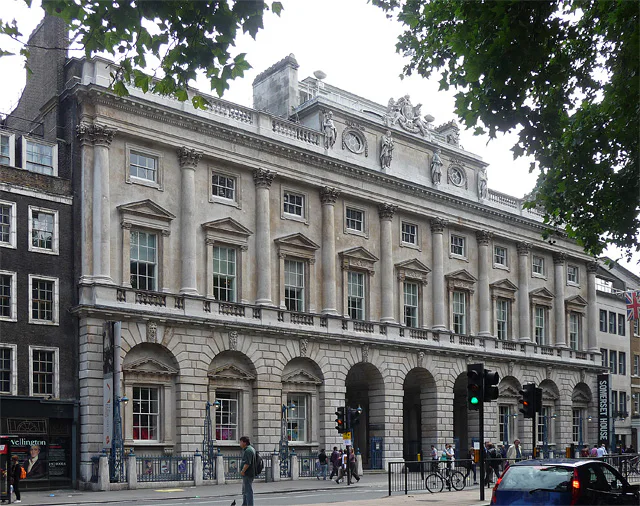
London · 33 artworks
Courtauld Gallery
Content & sources
Stephen Richards · CC BY-SA 2.0
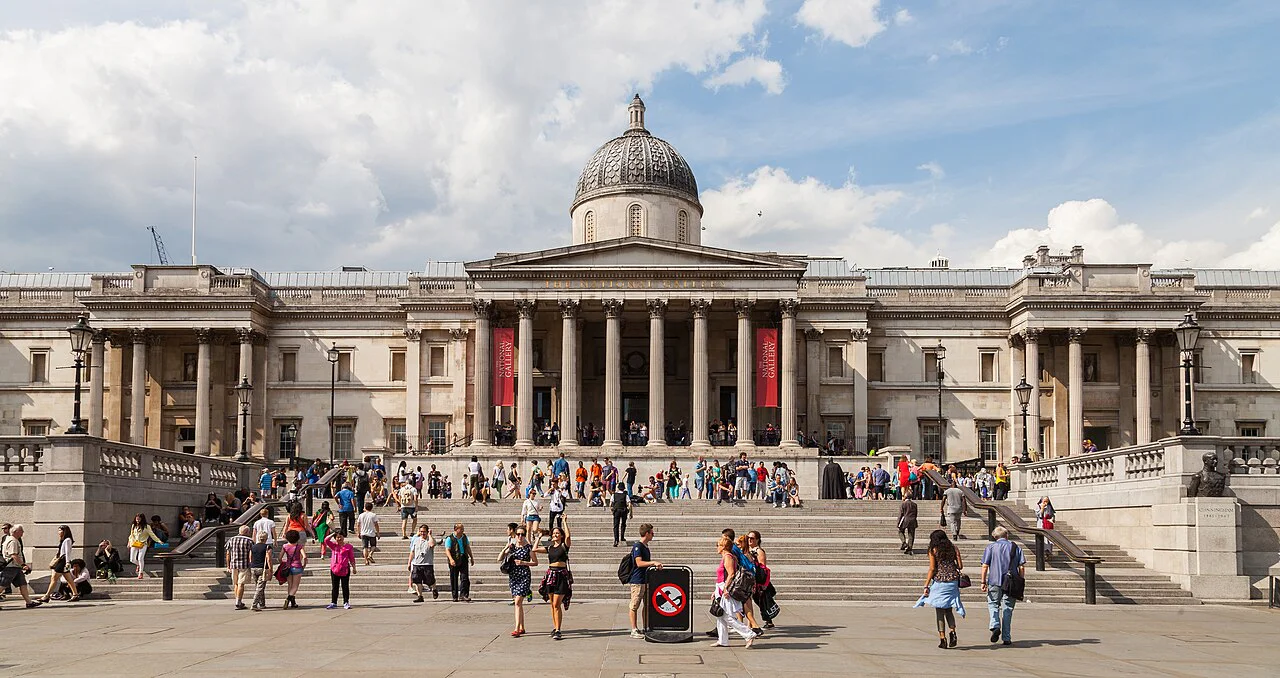
London · 617 artworks
National Gallery, London
Content & sources
Diego Delso · CC BY-SA 4.0
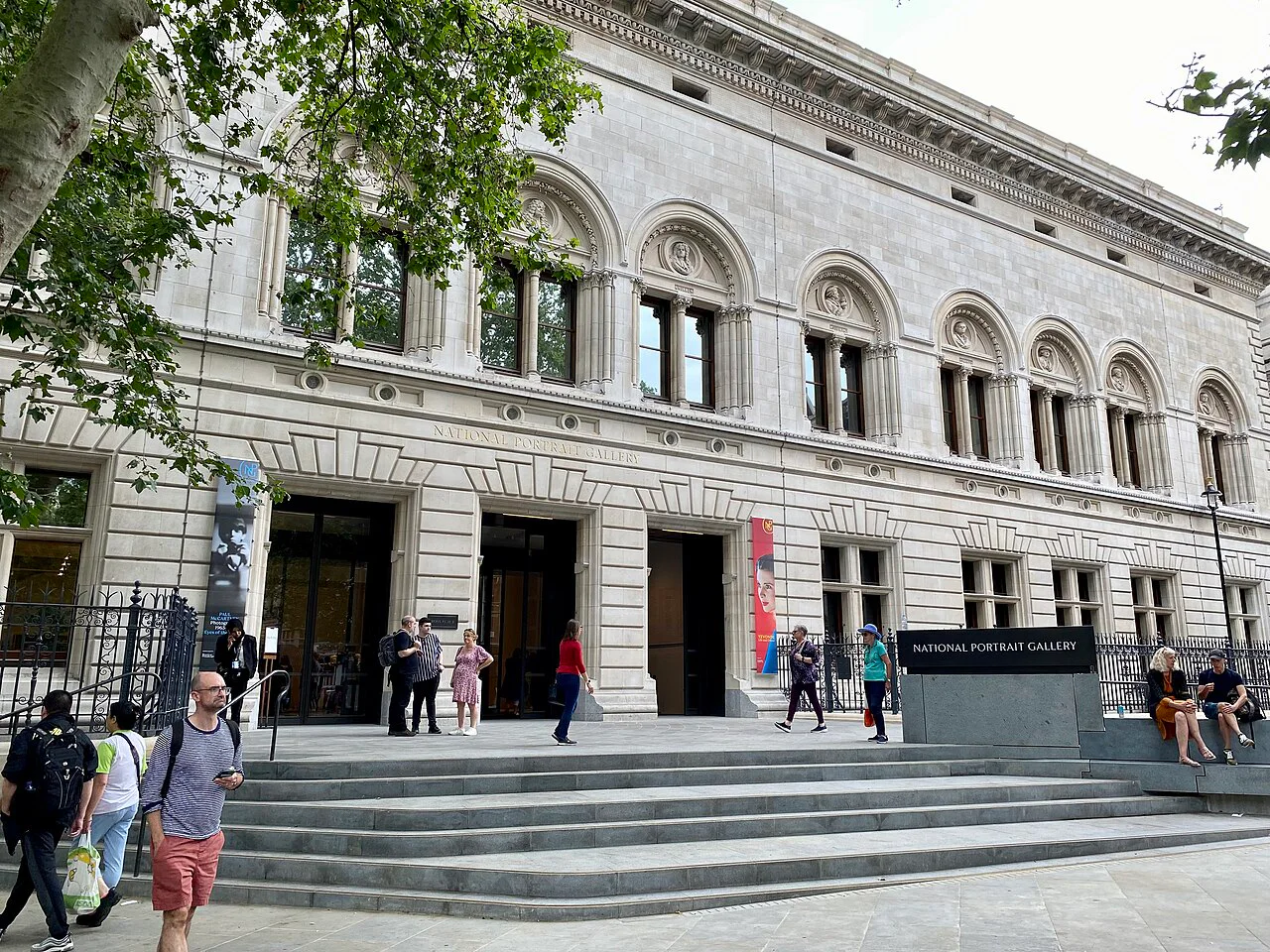
London · 164 artworks
National Portrait Gallery, London
Content & sources
Photo: No Swan So Fine · CC BY-SA 4.0
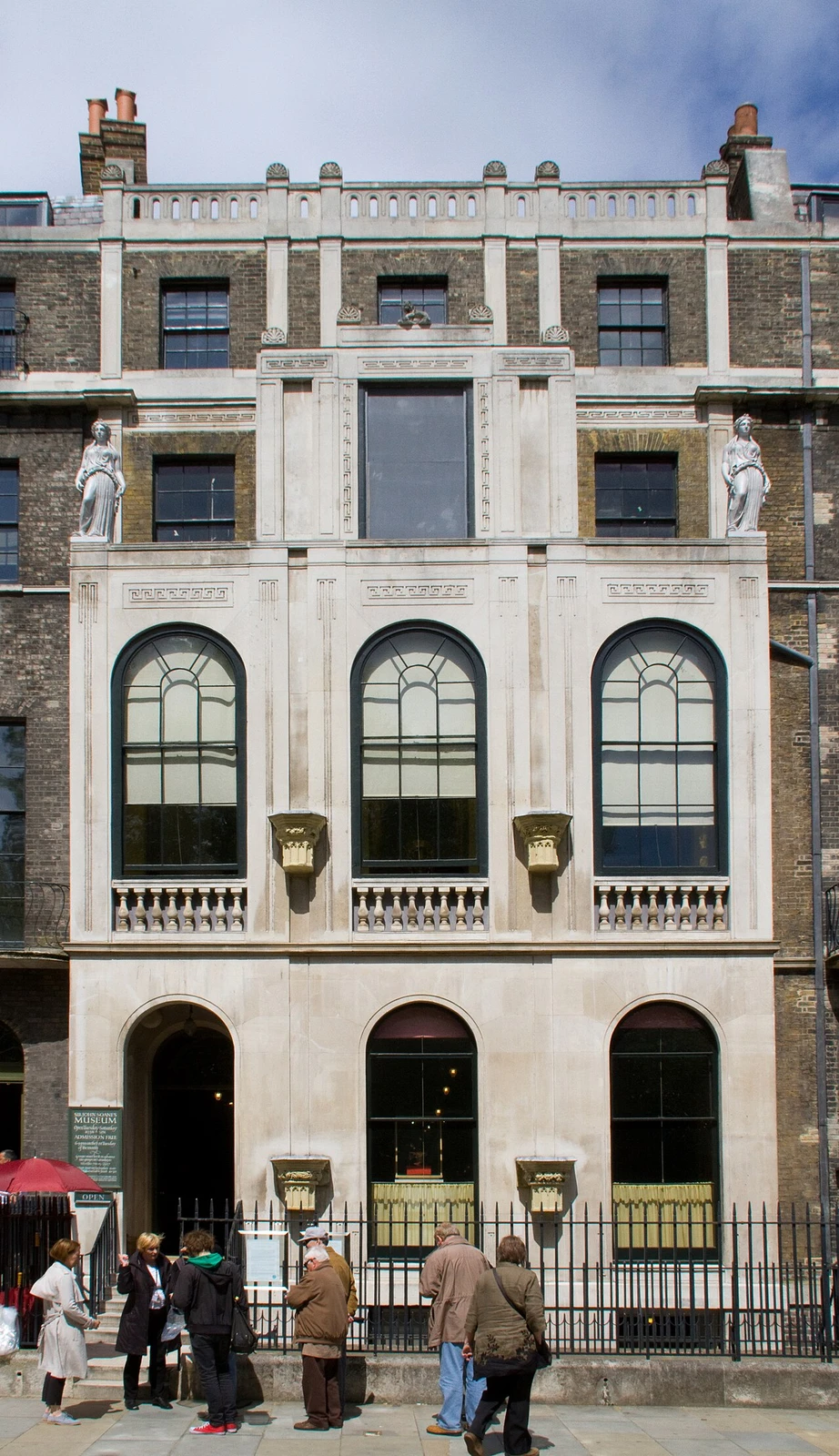
London · 8 artworks
Sir John Soane's Museum
Content & sources
Tony Hisgett from Birmingham, UK · CC BY 2.0