Stanza · Audio guide
Manchester Art Gallery Audio Guide
A place to remember. A story to take with you.
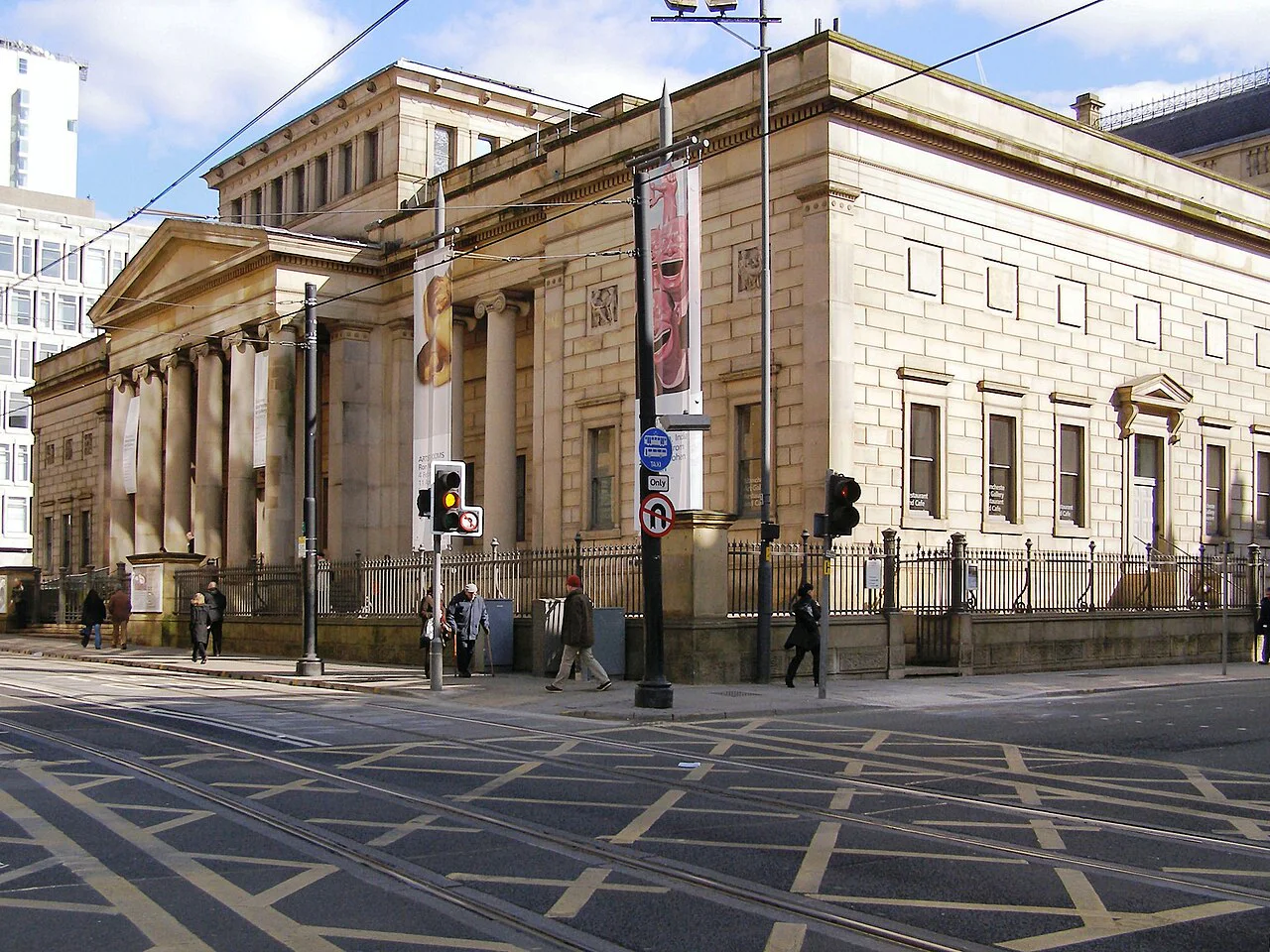
Manchester Art Gallery is a publicly owned art museum located on Mosley Street in Manchester city centre. Its collection occupies three connected buildings, two of which were designed by Sir Charles Barry.
Download Stanza, then search for “Manchester Art Gallery”.
About the tour
One guide. Your kind of visit.
Manchester Art Gallery is a publicly owned art museum located on Mosley Street in Manchester city centre. Its collection occupies three connected buildings, two of which were designed by Sir Charles Barry.
The Manchester Art Gallery guide tells the stories of 65 artworks, including Hylas and the Nymphs (John William Waterhouse), The Shadow of Death (William Holman Hunt), The Hireling Shepherd (William Holman Hunt), The Sirens and Ulysses (William Etty), Autumn Leaves (John Everett Millais), Work (Ford Madox Brown), The Destroying Angel and Daemons of Evil Interrupting the Orgies of the Vicious and Intemperate (William Etty), and Victory O Lord! (John Everett Millais). Every artwork is free to hear in the Stanza app until 1 January.
Ready when you are.
- 01Get the free Stanza app.
iOS & Android
- 02Find your guide.
“Manchester Art Gallery”
- 03Download before you go.
Works offline
Audio guide / 65 artworks
Inside the guide
Get to know a few of the stories before you go. Open a stop to read more.
01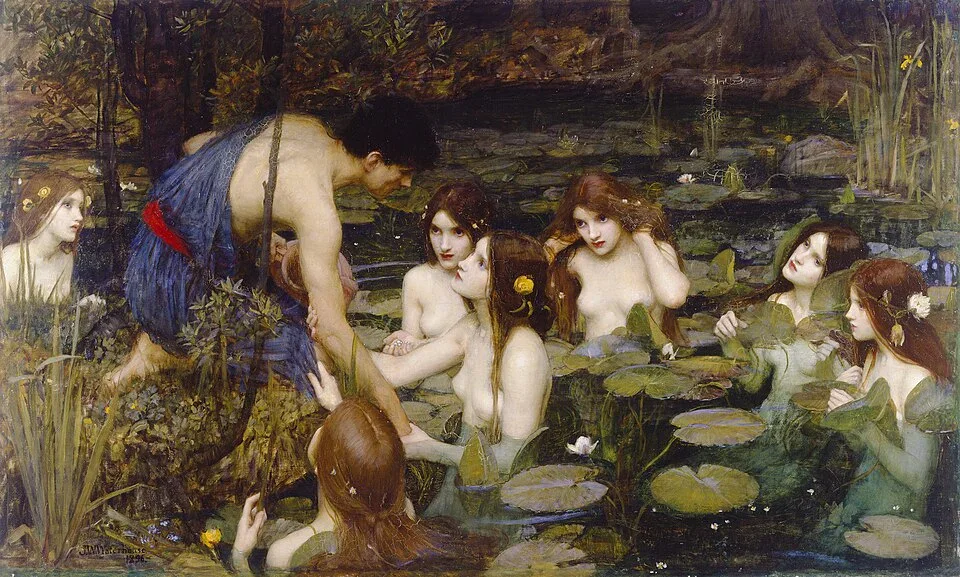
Hylas and the Nymphs
In January 2018, this painting came off the wall. Gallery staff, together with the artist Sonia Boyce, took it down. They were moved by recent campaigns against the way women are treated as objects, like the MeToo campaign and the Presidents Club controversy. They left the bare space with notes for visitors to stick their own views on, and pulled its postcards from the shop. The curator said they wanted to start a conversation, not end one. The painting shows seven young women, water nymphs, rising out of a pond among water lilies. Their faces show clearly, and all of them are watching the youth Hylas. His face, in profile, is in shadow, so you can hardly make it out. One has him by the wrist and elbow. Another pulls at his tunic. A third holds out pearls in her palm. He bends down with his water jar. He had been sent to find fresh water on the voyage of the Argo. There is no sign of Hercules, the companion he sailed with. He is being drawn into water he will not come out of. People objected strongly. Someone who had once put on an exhibition of Waterhouse's work said that taking it down killed the debate they wanted to start. The gallery had bought it from him in 1896. Within a week, the city council put it back on the wall.
Listen in the appJohn William Waterhouse · Public domain
02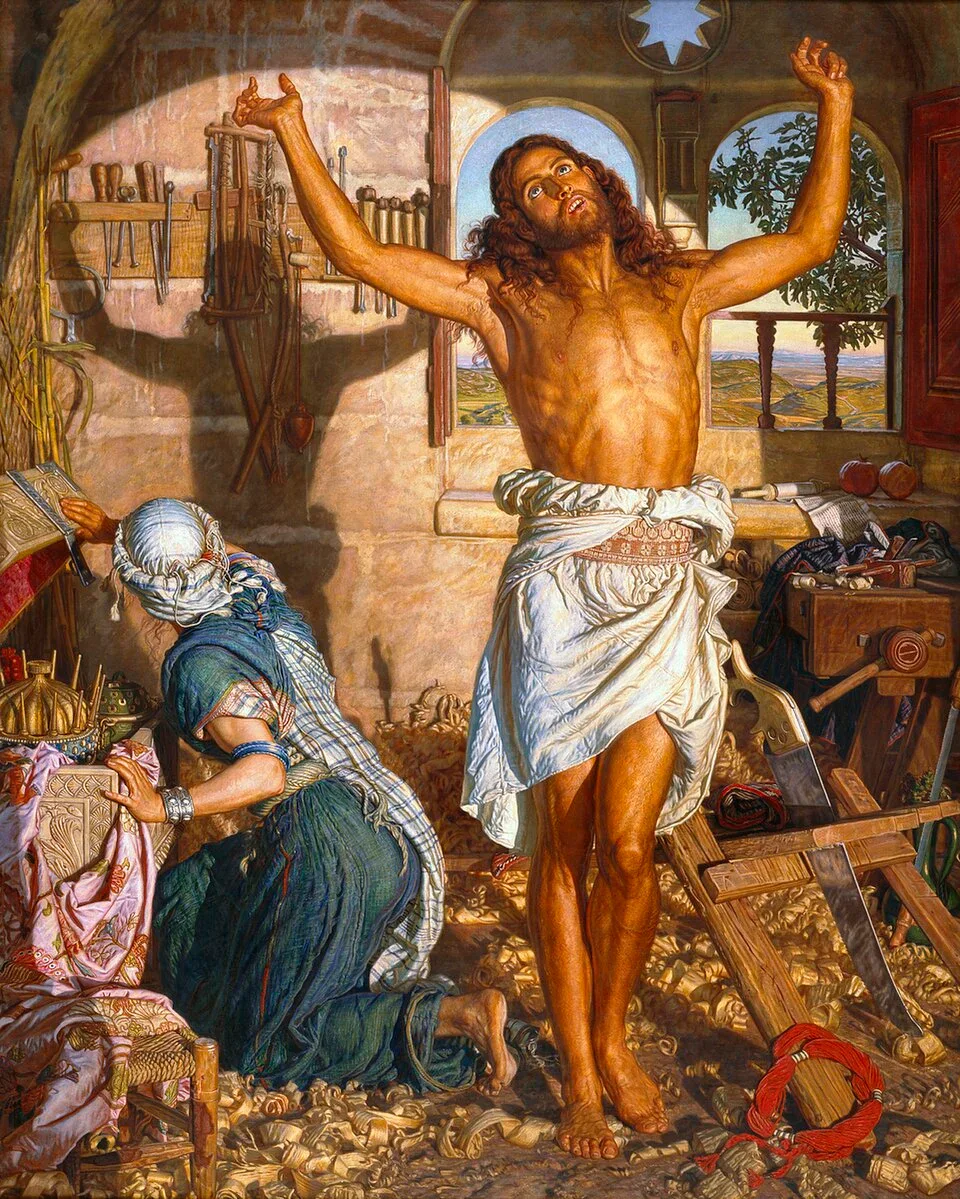
The Shadow of Death
He has just finished sawing. Now he stretches his arms, and their shadow spreads across the beam behind him, where the carpenter's tools hang. That shadow foretells the crucifixion, still years away. The man is Jesus, a young man before his ministry, working as a carpenter. Hunt painted this during his second trip to the Holy Land. He wanted him strong and muscular, a craftsman doing honest work. Years earlier, his colleague Millais had already painted Jesus as a small boy helping his father in the workshop. Critics had attacked that picture, saying the workshop looked squalid. Carlyle may have given him the idea, writing about the spiritual value of labour. The tools hanging in that shadow warn of the torture still to come. Mary kneels with her back to us. She has been looking into the box where she keeps the gifts the Magi brought. Now she gazes up at the shadow her son has cast. The arch of the window makes a halo around his head. On the windowsill sit pomegranates, another sign of the suffering ahead.
Listen in the appWilliam Holman Hunt · Public domain
03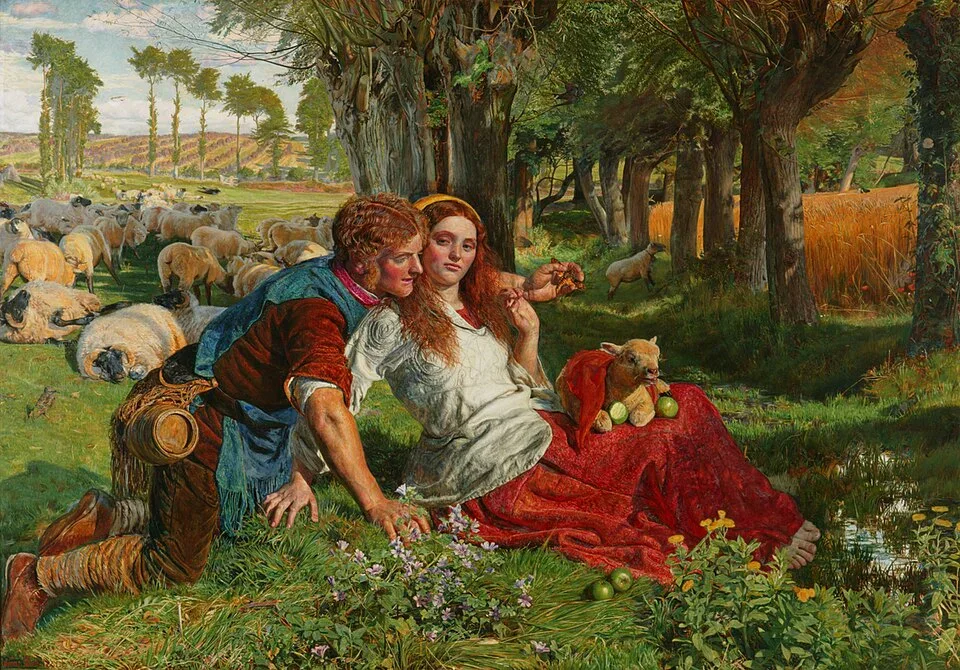
The Hireling Shepherd
What this picture means has never been settled. On the face of it, it is a country flirtation. A shepherd is showing a country girl a moth he has caught. There is a mark on its back like a human skull, and it may stand for death. His arm is round her shoulder, a flask is tied to his belt, and his cheeks are red. He has been drinking, and he seems to be trying to seduce her. Behind them, sheep are crossing a ditch into the wheat, and one has already reached the wheat. On the girl's knees, a lamb bites a green apple, which may recall the forbidden fruit in the story of Eve. When the picture was first shown, his enemies called it vulgar. His supporters said it was country life set down without softening. But Hunt, the most religious of the brotherhood he helped found, hinted at another reading. In it, the couple stand for the pointless arguments churchmen had about doctrine, while their flock goes astray with no one to guide them. The title points to the Good Shepherd set against the hireling who cares nothing for the sheep. Hunt set this out in a letter, when the picture was bought.
Listen in the appWilliam Holman Hunt · Public domain
04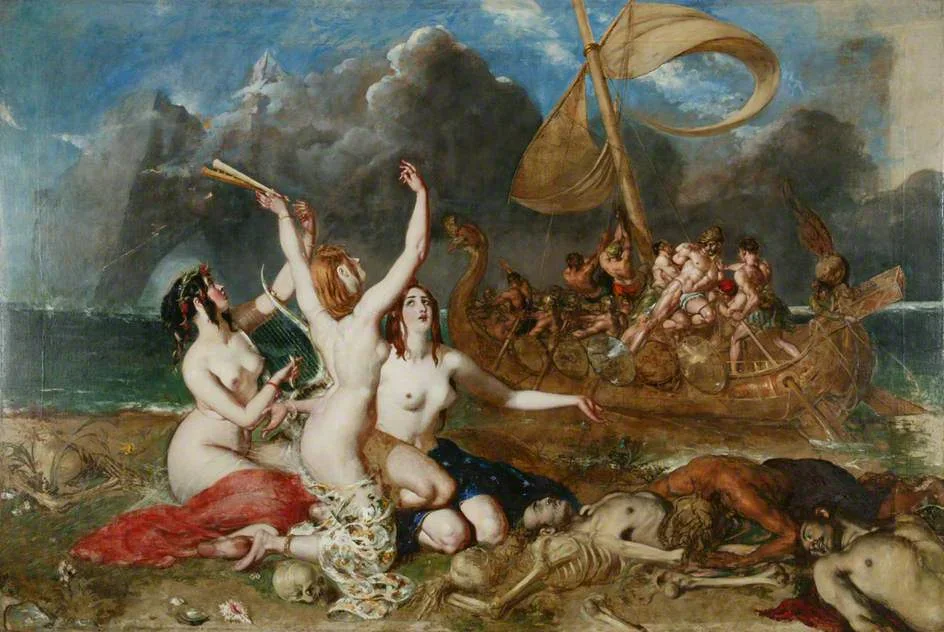
The Sirens and Ulysses
To paint the dead sailors, William Etty went to a mortuary and sketched the bodies there. That is why this island lies covered with corpses in every stage of decay. When this became known, some complained. He was daring with the sirens too. The old stories made them part human and part animal. Etty painted three naked young women, saying that once out of the sea they became fully human. They hold their arms out as they sing, and they look so alike that he may have painted the same model three times. A lawyer, Thomas Myers, suggested the subject in 1834, convinced large paintings would sell. Etty made it his biggest yet, wanting to paint a moral about resisting sensual pleasure. When it was shown in 1837, some praised it and some called it disgusting, a mix of pleasure and decay. The paint itself was already failing. Etty had stirred strong glue into it to hold it steady. It dried hard and brittle, and began to flake as soon as it was finished. Its great size made the canvas bend whenever it moved. After 1857 it was too damaged to exhibit and went into storage. It stayed there for more than a hundred and fifty years, and came back on display here in 2010.
Listen in the appWilliam Etty · Public domain
05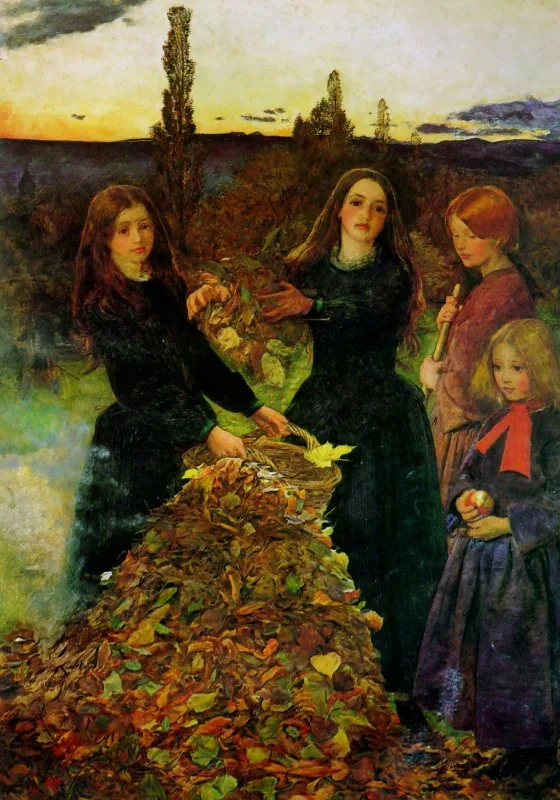
Autumn Leaves
Why does a scene of children gathering leaves feel so grave? Four girls rake fallen leaves in a garden at twilight. They are building a bonfire, but you cannot see the fire. Only smoke comes up from between the leaves. The sun is going down, and their faces are sombre. The youngest girl, on the right, holds an apple. The smoke, the dead leaves and the setting sun all say the same thing. Youth and beauty do not last. That apple may mean innocence lost, the expulsion from Eden. The painter's wife Effie wrote that he wanted a picture full of beauty and no subject. But Millais said himself that he chose burning leaves on purpose. He wanted the solemnity to wake the deepest religious feeling. He had once helped rake leaves at Tennyson's house. The poet's song is about happy autumn fields and days that are gone. And he wrote to Effie that no smell brought back sweeter memories for him than burning leaves. He made the picture in the garden of the family home in Perth, working through the autumn of 1855 and finishing in April 1856.
Listen in the appJohn Everett Millais · Public domain
06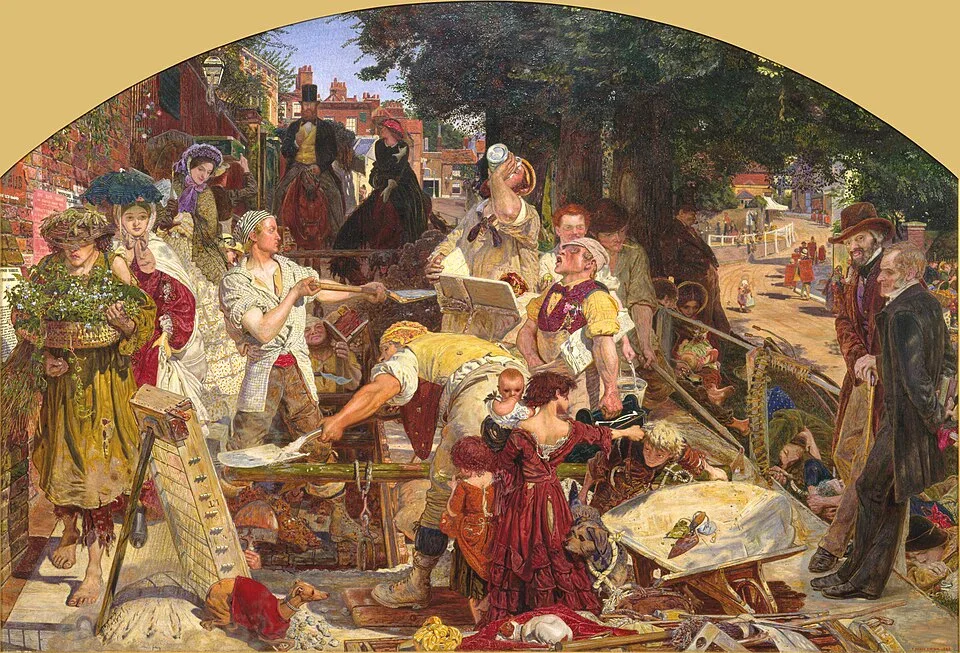
Work
You could walk straight past him. One digger is nothing but a hand and a shovel, coming up out of the hole to push soil onto the platform. The rest of him is down in the shaft. Ford Madox Brown put men like this at the centre of the picture. He wanted the modern British workman treated as worthy of a painting as the street people of Naples, who were thought picturesque. These men are digging up a London road, probably for new sewers to fight typhus and cholera. To paint the place, Brown carried his huge canvas out to Hampstead and set it up there through the summer of 1852. That is why real sunlight falls on the men at work. He chose that light on purpose, because he said it showed work at its hardest. People from every level of Victorian society pass the diggers. On the right, two men watch the workers. They are Thomas Carlyle and Frederick Denison Maurice, whose ideas the picture carries. Carlyle inspired the whole thing. He wrote that a man perfects himself by working.
Listen in the appFord Madox Brown · Public domain
07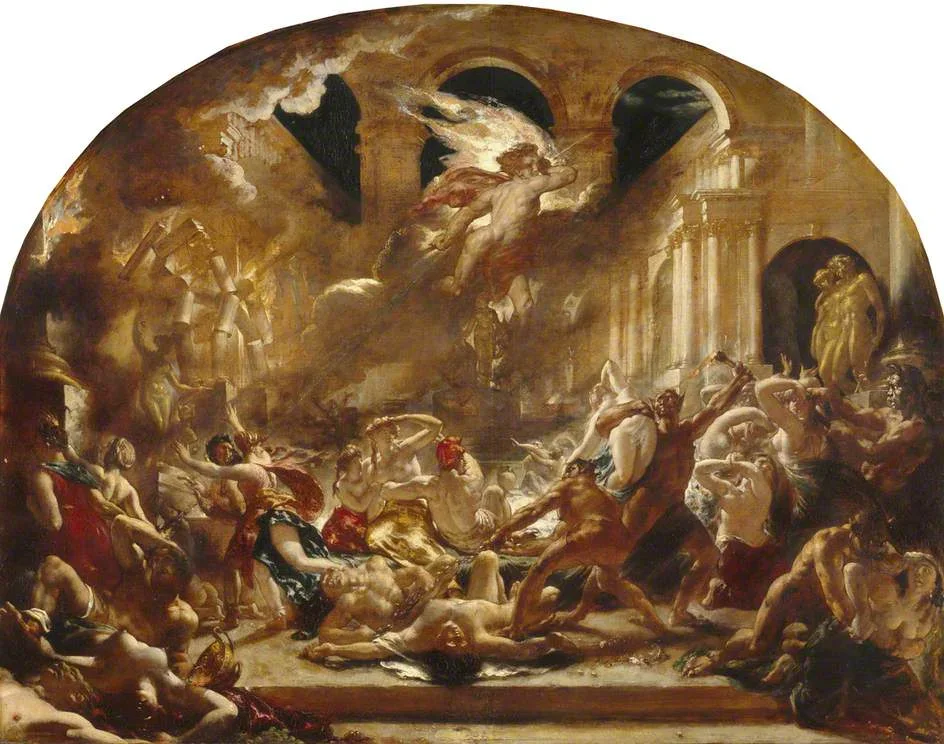
The Destroying Angel and Daemons of Evil Interrupting the Orgies of the Vicious and Intemperate
William Etty wanted to answer the charge that his nudes were indecent. He had made his name with them, and a newspaper kept attacking. In 1822 a Leicester merchant, Henry Payne, commissioned a picture and left him free to paint whatever he chose. For years he did little with it. Then the attacks stung him, and he finished it in 1832 as an openly moral piece. The nearly naked figures are painted paler than he usually did, to suggest death and pallor. In the centre an angel wrapped in smoke has destroyed one side of an imagined temple and is poised to hurl a thunderbolt. On the right, a woman turns to see flames reflected in the eyes of the daemon holding her from behind, horrified guilt on her face. The chained man struggles against his bonds while a daemon pulls one end of the chain. His model was Raving Madness, a sculpture above the entrance to Bethlem Hospital and a symbol of insanity. At its first showing, many admired his skill, but the moral point he wanted to make divided them. Some found depths in him they had never seen. Others thought he had given up his earlier work. A woman behind the chained man shades her eyes. Whether she is blocking the angel's brightness or the horror in front of her stays unclear.
Listen in the appWilliam Etty · Public domain
08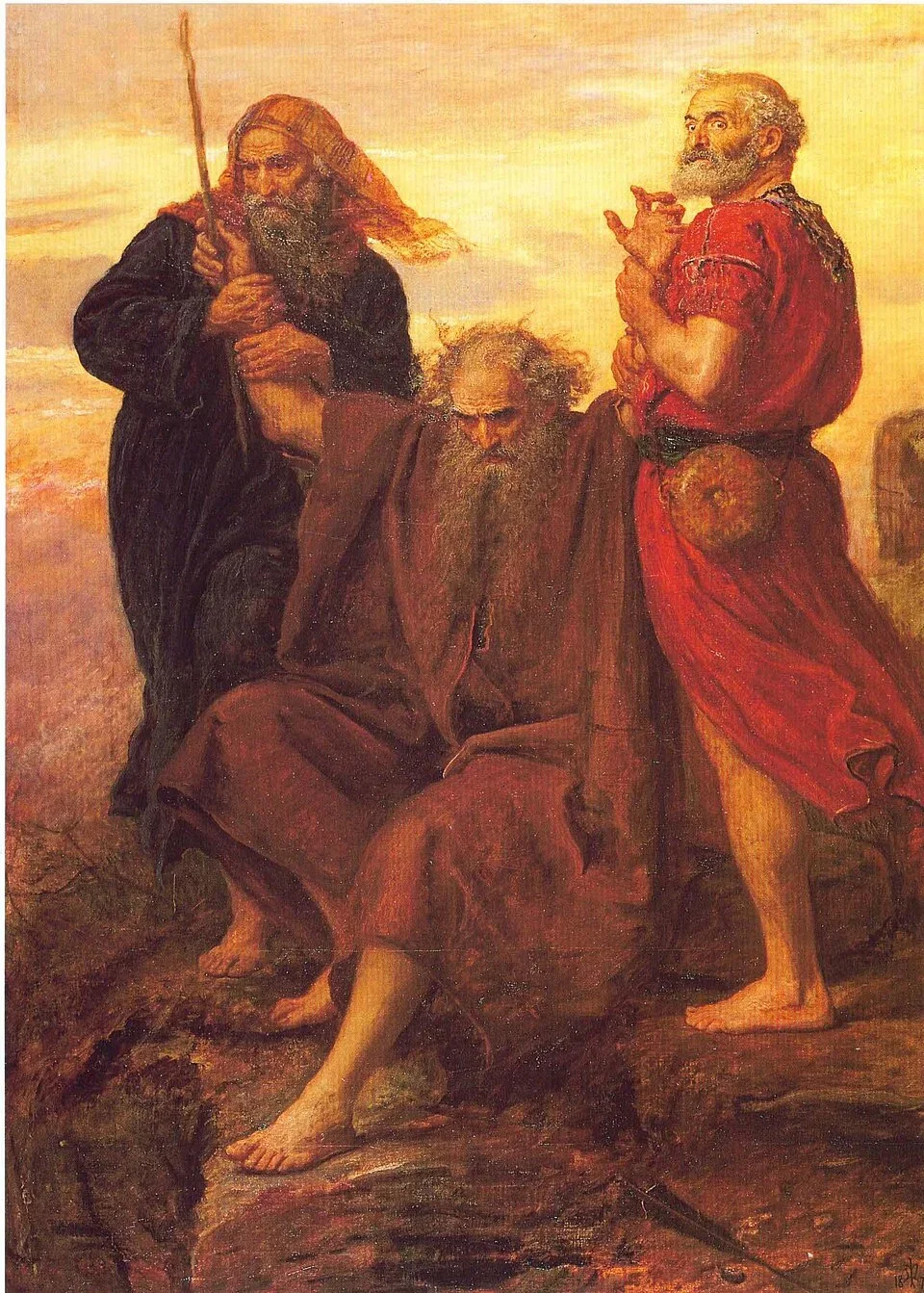
Victory O Lord!
On a hill, two men are holding a third man's arms up. The man in the middle holds a rod in his right hand. Those raised arms are deciding the battle. This is the Battle of Rephidim, from the Book of Exodus. Moses told Joshua to choose men and fight the Amalekites, while he himself went up the hill with the rod of God. As long as Moses kept his hand raised, Israel won. When he let it drop, the Amalekites won. But his hands grew heavy, so Aaron and Hur held them up, one on each side, and kept them steady until the sun went down. Millais chose that last moment of the fight. Aaron, in red, is on the right. The two companions are worn out, while Moses' will holds firm. Down at the bottom right, an arrow shows the battle below.
Listen in the appJohn Everett Millais · Public domain
09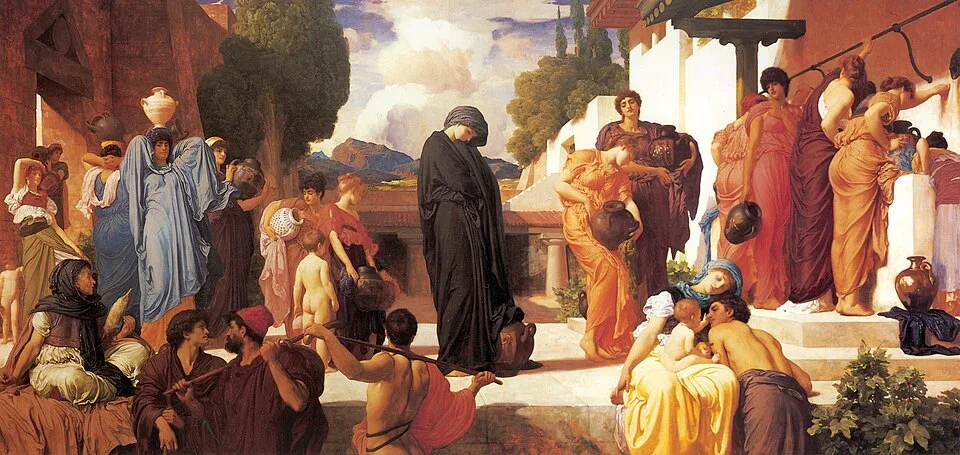
Captive Andromache
A baby's hand touches a man's face. The mother holds the child, and there, at the fountain, they are a family. At the center, a woman wrapped in black is watching them. That is Andromache. She has lost the very thing she is looking at. Her husband Hector was killed, and their little son Astyanax was thrown from the walls of Troy when the Greeks took the city. Now she stands among women and girls who come to draw water from a rectangular fountain. The whole scene looks like an ordinary working day. It comes from Homer's Iliad. Hector, still alive, pictured what would become of his wife if he died in battle. He imagined her carrying water to a fountain strange to her, before any of it had happened. Leighton laid the scene out on a wide, horizontal canvas, shaped like the carved bands that decorated ancient sarcophagi.
Listen in the appFrederic Leighton · Public domain
10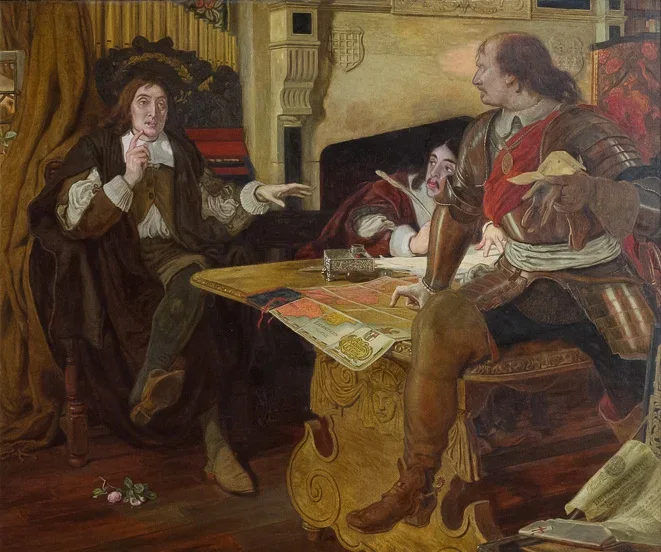
Cromwell, Protector of the Vaudois
A massacre has happened, and now a letter of protest is being dictated. Milton, who is blind, raises one finger as he speaks. Marvell, his secretary, is about to write it down. Cromwell sprawls across the desk, a man of action. The desk beneath him is balanced on a curved base with small feet that steady it. It could tip. Ford Madox Brown painted this for Charles Rowley, who had asked for a picture of Milton, and gave him all three men working together. The letter was about the Easter massacre in Piedmont in 1655. The Vaudois were a persecuted Protestant sect in northern Italy. Cromwell took up their cause. He wrote letters, raised money for the victims and threatened military action. While he lived, the attacks were held back. After his death, the Vaudois were persecuted again and again.
Listen in the appFord Madox Brown · Public domain
- 11
Jack the Ripper's Bedroom
Walter Sickert · c. 1906–1907
- 12
Thomson's Aeolian Harp
J. M. W. Turner · 1809
- 13
Manfred on the Jungfrau
Ford Madox Brown · 1842
- 14
Stages of Cruelty
Ford Madox Brown · 1856–1890
- 15
Atalanta
Francis Derwent Wood · 1909
- 16
Marshal Ney Supporting the Rear Guard During the Retreat from Moscow
Adolphe Yvon · 1856
- 17
Doves (Group)
Barbara Hepworth · 1927
- 18
The Earl of Warwick's Vow Previous to the Battle of Towton
Henry Tresham · 1795
- 19
Only a Lock of Hair
John Everett Millais · 1857–1858
- 20
Claude Duval
William Powell Frith · 1860
- 21
Still Life: Roses in a Glass Vase
Henri Fantin-Latour · 1879
- 22
Sappho
Charles Mengin · 1877
- 23
Coast Scene with British Man of War
Joseph Vernet · 1766
- 24
Pygmalion and Galatea
Louis Gauffier · 1797
- 25
Ira Aldridge as Othello, the Moor of Venice
James Northcote · 1826
- 26
Christ Blessing Little Children
Charles Lock Eastlake · 1839
- 27
Berengaria's Alarm for the Safety of Her Husband, Richard Coeur de Lion, Awakened by the Sight of His Girdle Offered for Sale at Rome
Charles Allston Collins · 1850
- 28
Catherine of Aragon
William Bromley · 1866
- 29
The Vision of Endymion
Edward Poynter · 1902
- 30
Hush!
James Tissot · 1875
- 31
The Ides of March
Edward Poynter · 1883
- 32
The Origin of the Harp
Daniel Maclise · 1842
- 33
A Roman Flower Market
Lawrence Alma-Tadema · 1868
- 34
Balaclava
Elizabeth Thompson · 1876
- 35
The Duke of Monmouth's Interview with James II
John Pettie · 1874–1882
- 36
Homage to Manet
William Orpen · 1909
- 37
The Fortress of Konigstein: Courtyard with the Brunnenhaus
Bernardo Bellotto · 1757
- 38
Sir Gregory Page-Turner
Pompeo Batoni · 1768
- 39
A Farrier's Shop
George Morland · 1793
- 40
The Bromley Family
Ford Madox Brown · 1844
- 41
Samson Betrayed
Frederick Richard Pickersgill · 1850
- 42
The Defeat of Shylock
James Clarke Hook · 1850
- 43
Wandering Thoughts
John Everett Millais · c. 1854
- 44
The Goths in Italy
Paul Falconer Poole · 1851
- 45
The Last of the Crew
Clarkson Frederick Stanfield · 1853
- 46
Byron's Early Love, 'A Dream of Annesley Hall'
Edward Matthew Ward · 1856
- 47
From under the Sea
James Clarke Hook · 1864
- 48
A Spate in the Highlands
Peter Graham · 1866
- 49
The Dinner Hour, Wigan
Eyre Crowe · 1874
- 50
The Last of the Garrison
Briton Rivière · 1875
- 51
Crabbers
James Clarke Hook · 1876
- 52
The Norman Archipelago (Channel Islands)
John Brett · 1885
- 53
Glen Birnam
John Everett Millais · 1891
- 54
Pont de la Clef in Bruges, Belgium
Camille Pissarro · 1903
- 55
Joli Coeur
Dante Gabriel Rossetti · 1867
- 56
Albert Square, Manchester
Pierre Adolphe Valette · 1910
- 57
The Death of Romeo and Juliet
John Everett Millais · c. 1848
- 58
A Flood
John Everett Millais · 1870
- 59
Astarte Syriaca
Dante Gabriel Rossetti · 1877
- 60
A Village Street. Louveciennes
Camille Pissarro · 1871
- 61
Saint John the Baptist
Giovanni Battista Gaulli · c. 1676
- 62
The Bower Meadow
Dante Gabriel Rossetti · 1866–1872
- 63
La Donna della Fiamma
Dante Gabriel Rossetti · 1870
- 64
Vivien
Frederick Sandys · 1863
- 65
Prince Arthur and Hubert
William Frederick Yeames · 1882
Manchester Art Gallery
Frequently asked questions
How much does the guide cost?
Free app download. Free until 1 January. Listed guide price: $1.99. Audio guide only. Venue admission is separate.
Can I listen without internet?
Yes. Download the guide’s audio, images, and maps in the app before your visit. Your downloaded content is then available offline.
Can I listen in my language?
In English for now. More languages soon.
Do I need to follow a schedule?
No. This is a self-guided experience. Choose your stops, pause whenever you like, and return to a story at your own pace.
Which artworks are in the Manchester Art Gallery audio guide?
65 artworks, including Hylas and the Nymphs (John William Waterhouse), The Shadow of Death (William Holman Hunt), The Hireling Shepherd (William Holman Hunt), The Sirens and Ulysses (William Etty), Autumn Leaves (John Everett Millais), Work (Ford Madox Brown), The Destroying Angel and Daemons of Evil Interrupting the Orgies of the Vicious and Intemperate (William Etty), and Victory O Lord! (John Everett Millais). The full list is on this page.
Is this the museum’s official audio guide?
No. Stanza is an independent audio guide app and is not affiliated with Manchester Art Gallery. Museum admission is separate.
At your own pace
Explore Manchester Art Gallery.
Download Stanza, then search for “Manchester Art Gallery”.
Free app download · Guide price shown in the app
Keep exploring
Nearby audio guides
Liverpool · 49 km
Walker Art Gallery
Content & sources
Rept0n1x · CC BY-SA 3.0
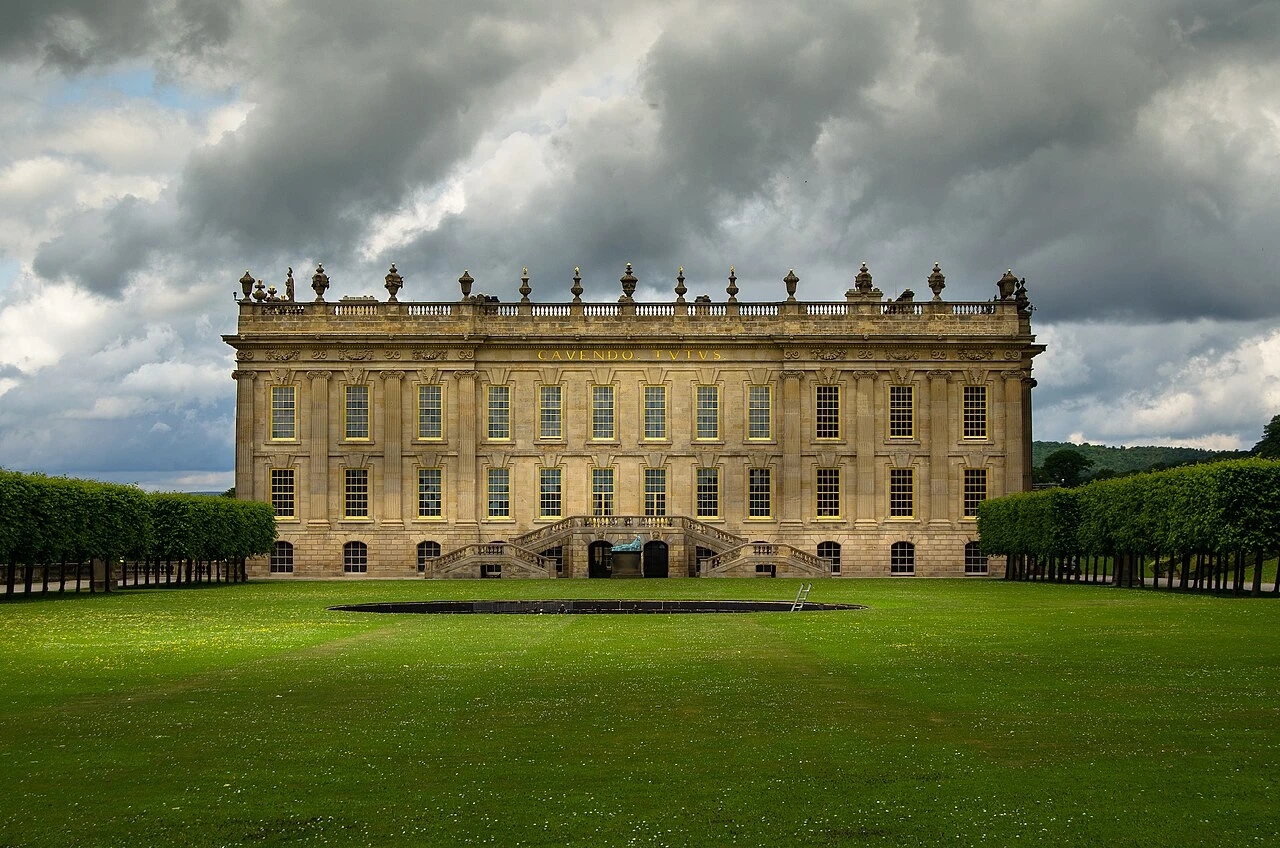
Derbyshire Dales · 50 km
Chatsworth House
Content & sources
Photo: Rprof · CC BY-SA 3.0
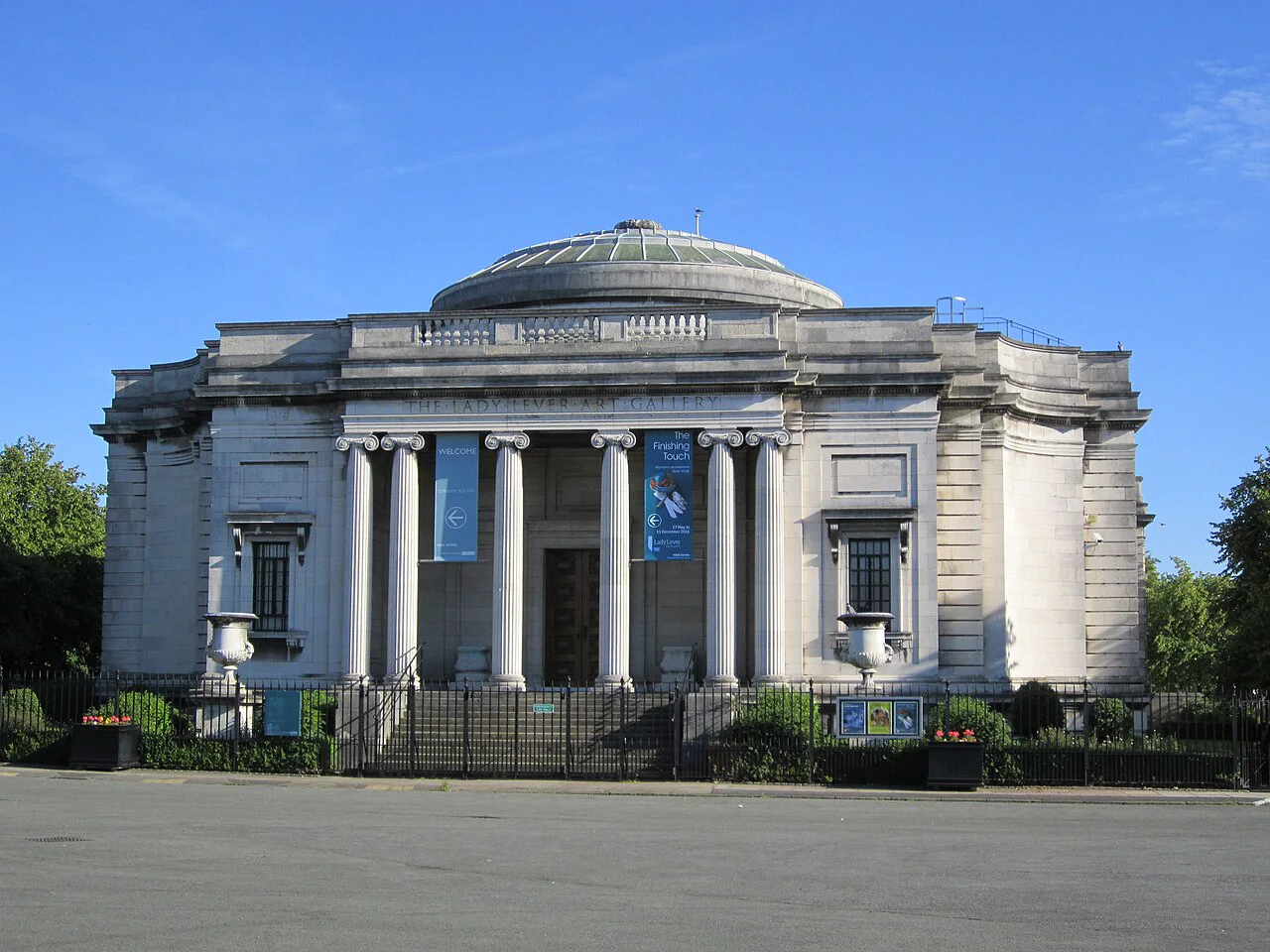
Port Sunlight · 52 km
Lady Lever Art Gallery
Content & sources
Rept0n1x · CC BY-SA 3.0
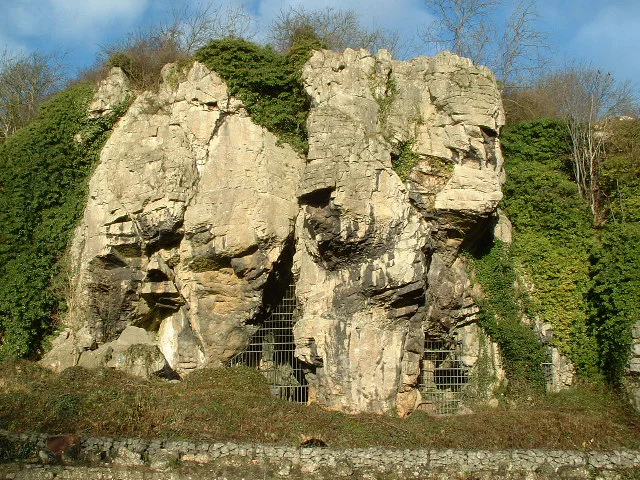
Elmton with Creswell · 73 km
Creswell Crags
Content & sources
Nigel Homer · CC BY-SA 2.0
Art museums
More art museum audio guides
Liverpool · 54 artworks
Walker Art Gallery
Content & sources
Rept0n1x · CC BY-SA 3.0
Port Sunlight · 28 artworks
Lady Lever Art Gallery
Content & sources
Rept0n1x · CC BY-SA 3.0
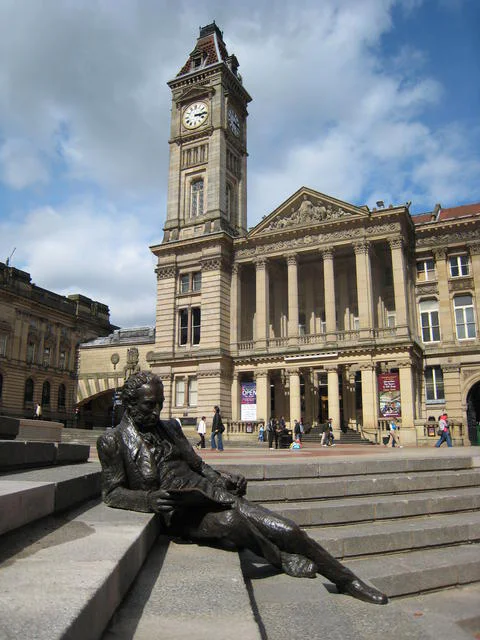
Birmingham · 42 artworks
Birmingham Museum and Art Gallery
Content & sources
David Stowell · CC BY-SA 2.0
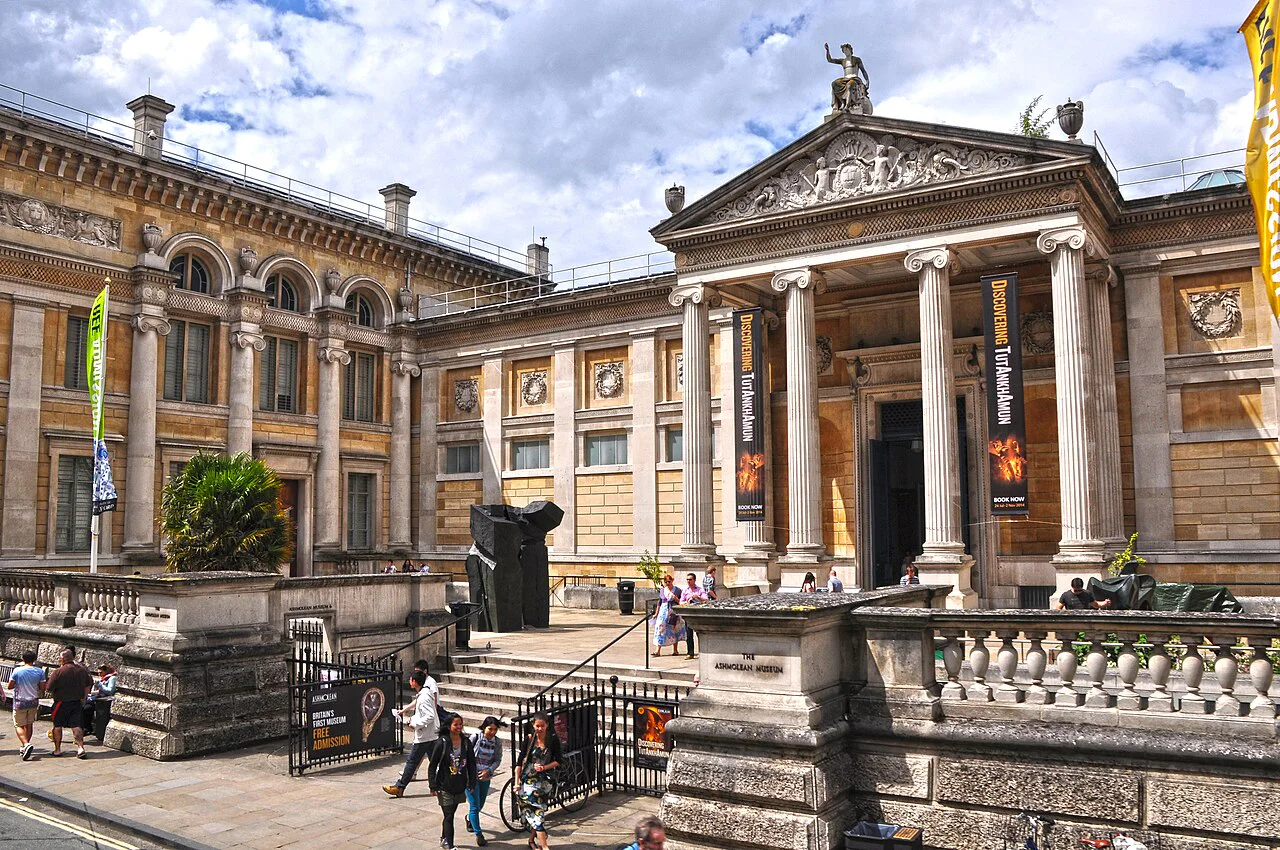
Oxford · 68 artworks
Ashmolean Museum
Content & sources
Lewis Clarke · CC BY-SA 2.0
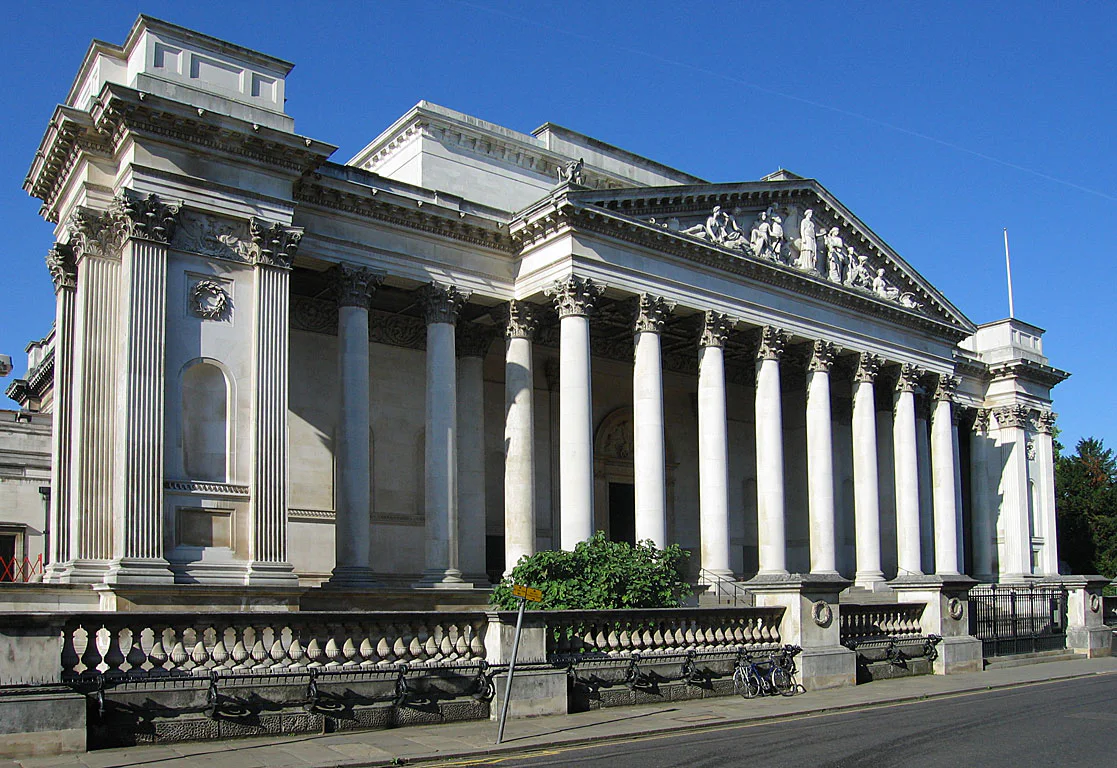
Cambridge · 51 artworks
Fitzwilliam Museum
Content & sources
Photo: Solipsist~commonswiki · CC BY-SA 2.0

Cardiff · 23 artworks
National Museum Cardiff
Content & sources
Ham II · CC BY-SA 3.0