Stanza · Audio guide
Musée des Augustins de Toulouse Audio Guide
A place to remember. A story to take with you.
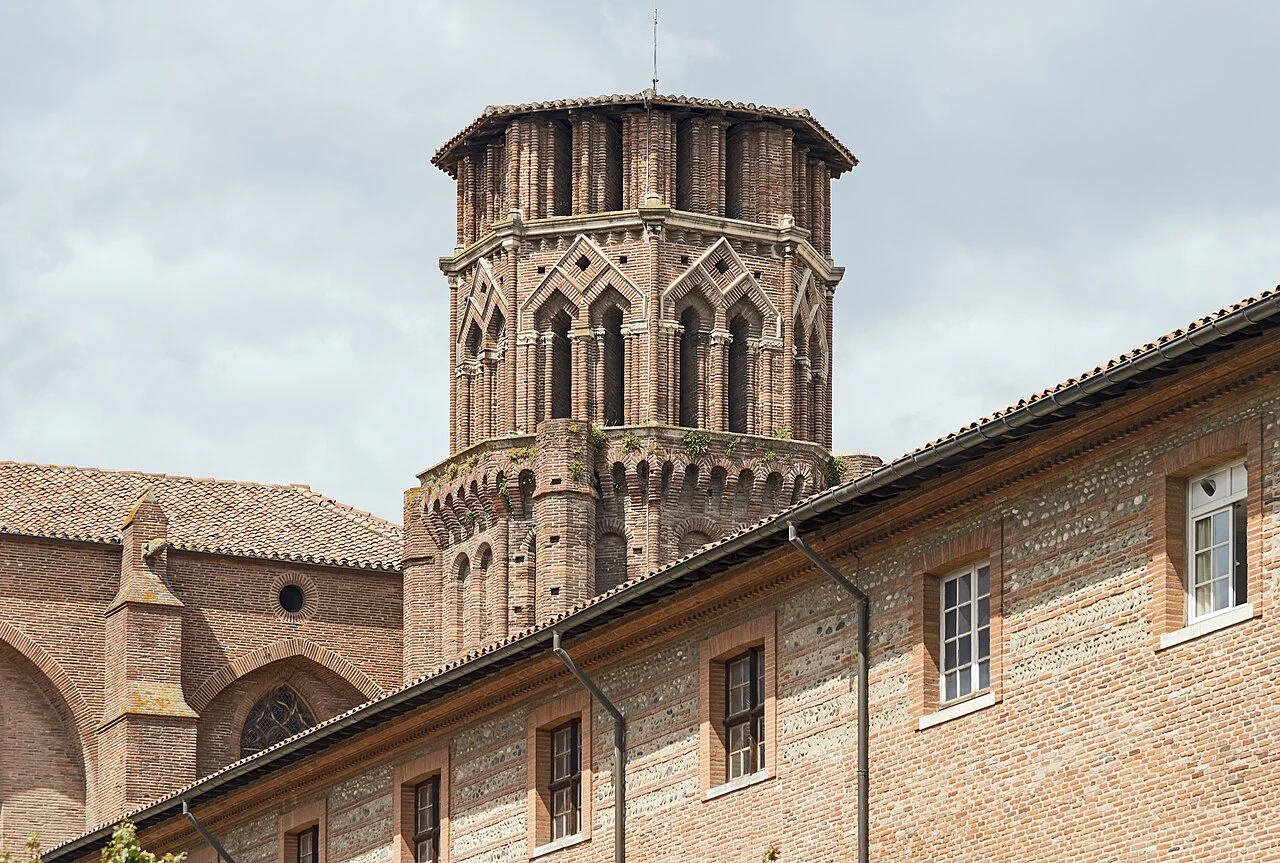
The Musée des Augustins de Toulouse is a fine arts museum in Toulouse, France, conserving a collection of sculpture and paintings from the Middle Ages to the early 20th century. Its paintings come from…
Download Stanza, then search for “Musée des Augustins de Toulouse”.
About the tour
One guide. Your kind of visit.
The Musée des Augustins de Toulouse is a fine arts museum in Toulouse, France, conserving a collection of sculpture and paintings from the Middle Ages to the early 20th century. Its paintings come from throughout France, while its sculptures represent the Occitan culture of the region, including a particularly rich assemblage of Romanesque sculpture.
The Musée des Augustins de Toulouse guide tells the stories of 89 artworks, including Muley-Abd-Err-Rahmann, sultan du Maroc sortant de son palais de Mequinez (Eugène Delacroix), Virgil reading The Aeneid before Augustus, Livia and Octavia (Jean-Auguste-Dominique Ingres), Marguerite de Conflans (Édouard Manet), The Death of Cleopatra (Jean-André Rixens), Young girl in a park (Berthe Morisot), Greek Women of Souli Running to Their Death (Dance of Zalongo) (Constance Blanchard), Man Between Vice and Virtue (Henri-Jean Guillaume Martin), and Le Père Desmarets (Jean-Auguste-Dominique Ingres). Every artwork is free to hear in the Stanza app until 1 January.
Ready when you are.
- 01Get the free Stanza app.
iOS & Android
- 02Find your guide.
“Musée des Augustins de Toulouse”
- 03Download before you go.
Works offline
Audio guide / 89 artworks
Inside the guide
Get to know a few of the stories before you go. Open a stop to read more.
01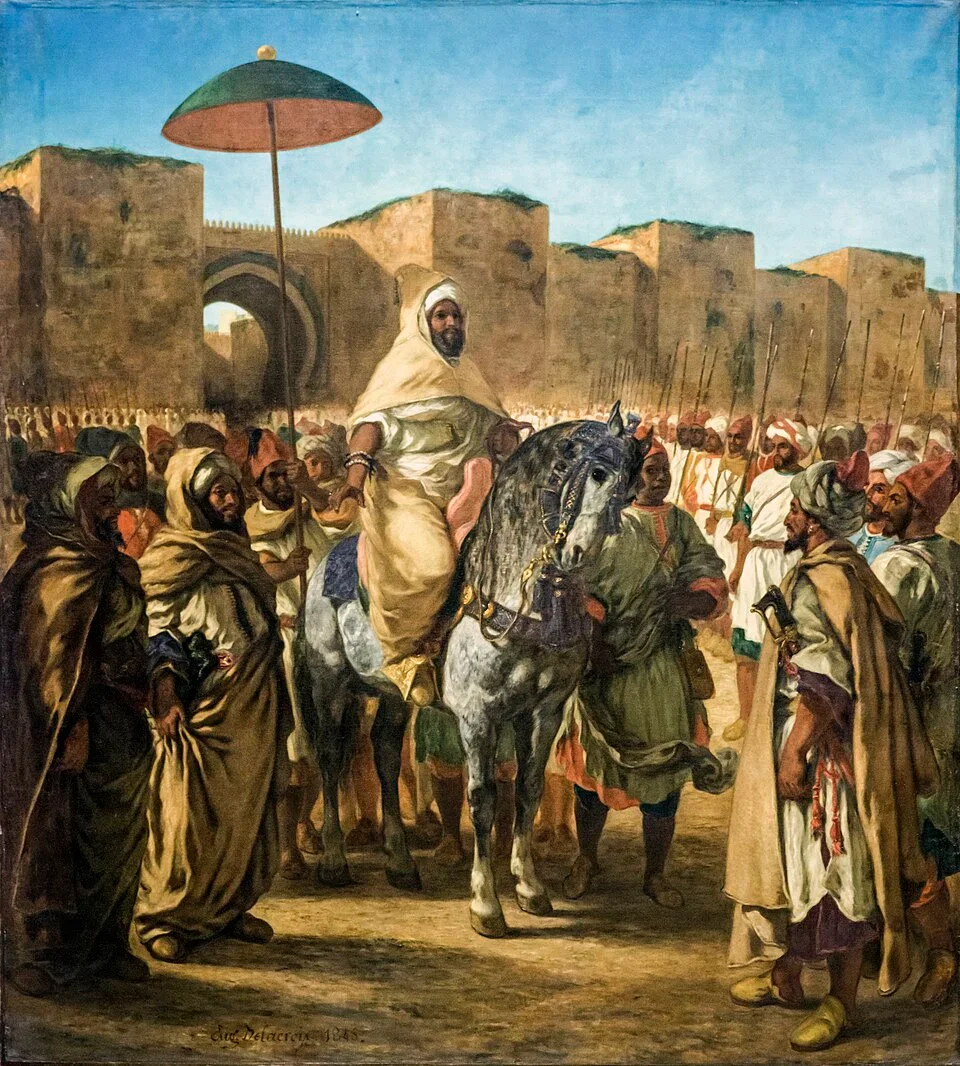
Muley-Abd-Err-Rahmann, sultan du Maroc sortant de son palais de Mequinez
The Sultan's free hand makes a gesture. It seems to draw the eyes of two men in the foreground, standing with their backs to you. His other hand holds the bridle firmly. You stand in the empty foreground, and that closes the circle around him. He is the only rider. The brightest light starts at him and fades toward the edges. His armed guards stretch far into the distance behind him. The great arched gate of Meknes stands across the background. But that was not the first plan. In 1832 the French king sent an ambassador, Charles Edgar de Mornay, to Morocco. His task was to stop the fighting in Algeria from spreading there and calm the Sultan's fears. Delacroix went with him. The first sketches told the story of that meeting, meant to celebrate the ambassador's success. The mission failed. In 1844 France attacked Morocco, and the Sultan was defeated. So the French were left out of the picture. No ambassador, no delegation. Just the Sultan, towering above the crowd, looking toward the horizon. A defeated ruler, painted as unbreakable. What Delacroix meant by it is still not known.
Listen in the appDidier Descouens · Public domain
02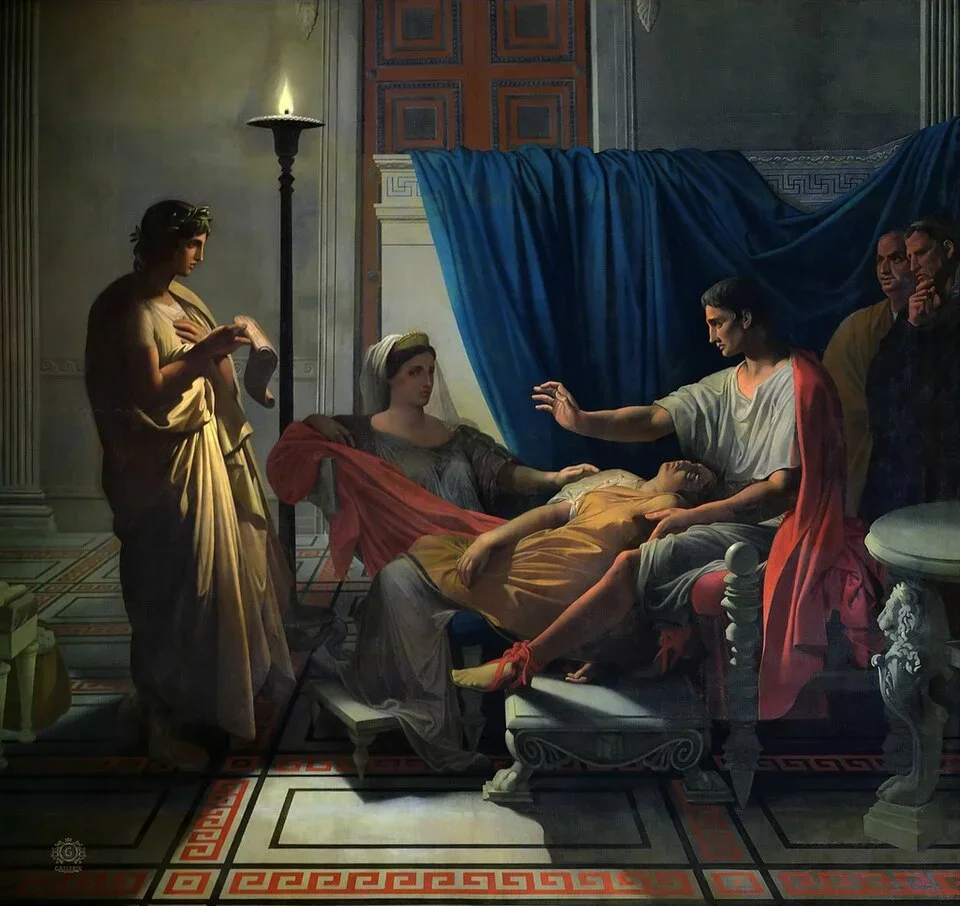
Virgil reading The Aeneid before Augustus, Livia and Octavia
One of the three people listening to this reading has fainted. The man reading is Virgil, reciting his Aeneid to the emperor Augustus, his wife Livia and his sister Octavia. He has reached the lines that speak of a boy who died before his time. The boy is Marcellus, Octavia's son, dead only a short while. When she hears his name, she faints with grief. But Livia does not faint. She stays cold as marble. Ingres said she was holding herself in, because the moment could betray her. Marcellus may not have simply died. Livia may have had him killed, so that her own son Tiberius would be next in line to rule the Roman Empire. The governor of Rome, General Miollis, ordered the painting in 1811 for his own house. He adored Virgil and had once put up a statue to the poet, so the subject was almost certainly his choice. Ingres, for his part, was drawn to the dark and moving side of the scene. He never let it go. Across fifty-three years he came back to it in more than a hundred drawings and watercolours and three oil paintings. After 1835 he bought this one back and added the two men watching in the background, Augustus's advisers Agrippa and Maecenas. He died in 1867 with the painting still unfinished, and he left it to the city of Toulouse.
Listen in the appJean-Auguste-Dominique Ingres · Public domain
03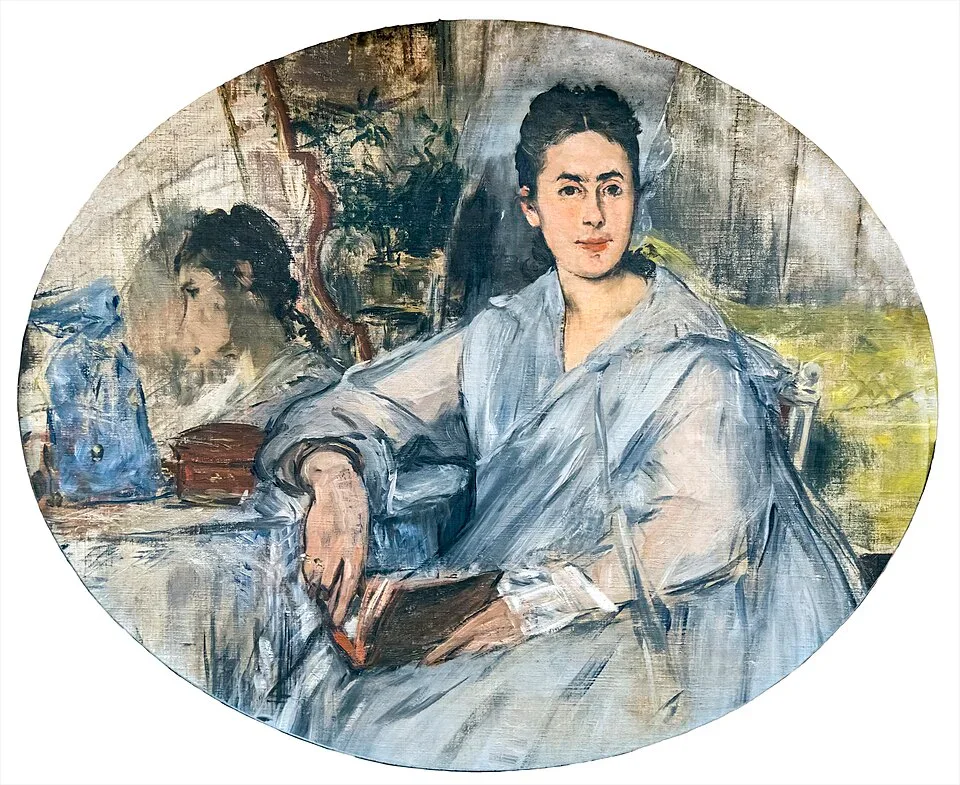
Marguerite de Conflans
Manet wanted Marguerite de Conflans at her ease in her own room, not posed for company. She sits on the right, turned a little toward the left, with an open book across her knees. The ribbons of her white muslin dressing gown are left untied, and her sleeves are almost transparent. The bed behind her tells you this is her bedroom. Her face turns toward you, but she does not quite look at you. He painted her five times, drawn to something original about her. He met her at receptions his wife gave, and she came with her mother. This was the painter of Olympia. After the uproar over that picture, you might expect another challenge. But this portrait is small and painted quickly, probably meant for Marguerite herself, or for a small circle who knew her. The mirror above the dressing table shows her face from another angle, a device he borrowed from Ingres and rarely used. Her reflection in it is barely there, only suggested, with the bare canvas showing through.
Listen in the appDidier Descouens · Public domain
04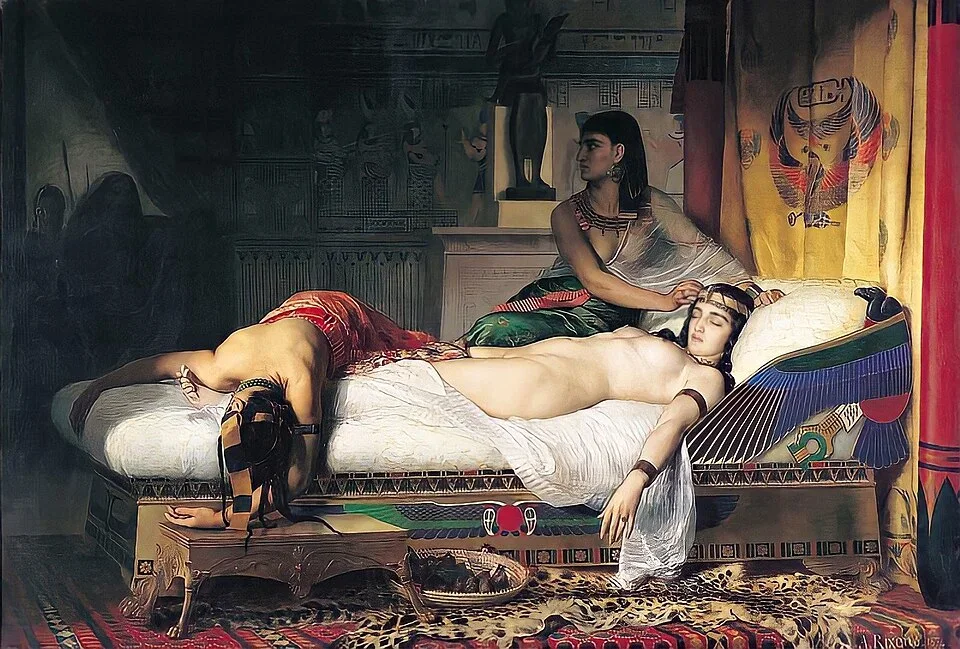
The Death of Cleopatra
Cleopatra has just died. She lies lifeless on her bed, her eyelids closed, her face framed by two black braids. One of her women is dead at her feet. The other, Charmion, is still setting the golden diadem straight on her mistress's head. She looks defiantly at the Roman soldiers moving toward them in the shadows. In a moment she will fall dead too. Cleopatra had chosen this. After the battle of Actium, beaten by Octavian's forces, she could not bear the defeat. She may have ordered an asp hidden under figs and leaves, so that it would bite her as she reached for the fruit, without seeing it. If so, she saw the reptile and held out her bare arm to the bite. Her left arm has two gold rings on it and hangs into the empty air. It leads your eye toward the basket of figs on a panther skin in the foreground. The asp is not there. Her skin is milk white and catches the light, echoing the milk baths she used to take. Behind Charmion stands the statue of Isis. Cleopatra had it brought into the room and gave her love for Mark Antony into the goddess's hands, certain they would be joined beyond life. Rixens painted this scene so he could practice the anatomy he had studied at the morgue.
Listen in the appJean-André Rixens · Public domain
05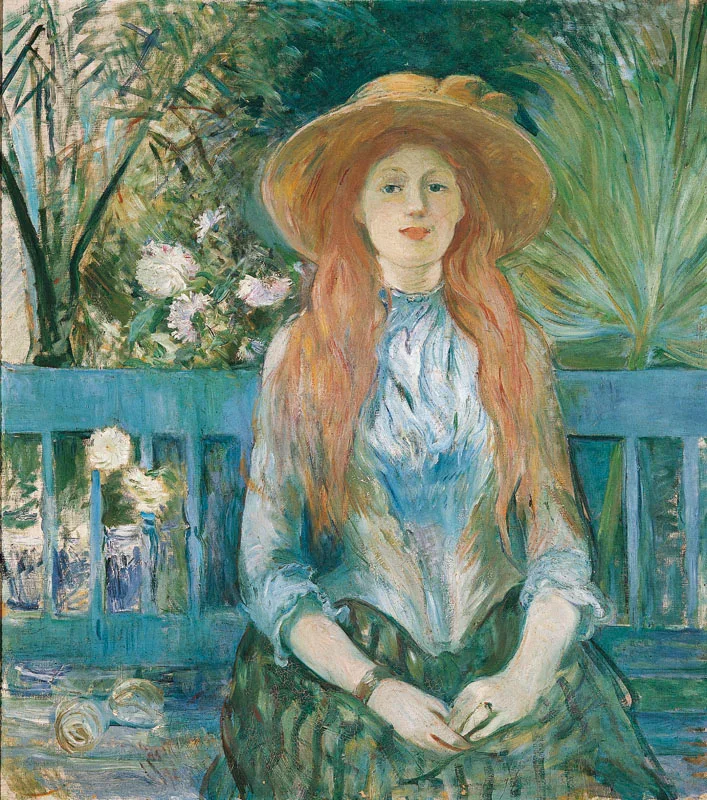
Young girl in a park
A young girl faces you from a bench, a little right of center, the frame cutting her off at the legs. She wears a wide beige hat, and wavy red hair falls over her shoulders around a soft face with the trace of a smile. Behind her the garden grows thick. But there is a stiffness in her. Her bust is straight, her hands rest on her thighs, and her gaze holds still. She sits alone on the bench. The spring light is soft, the colors gentle, and her hair and the garden carry a sense of movement. The peaceful place softens that stiffness. Morisot began the canvas in 1888, with a young woman named Jeanne-Marie sitting for her. She soon set it aside. When her own exhibition came in 1892, it was still unfinished and could not be shown. She returned to it in 1893, two years before her death, but Jeanne-Marie was no longer available to sit. So she carried on without a model and turned to her daughter Julie for the face instead. That is why the face is slightly fixed. The public first saw it in 1896, at an exhibition after her death, under the name On the Bench.
Listen in the appBerthe Morisot · Public domain
06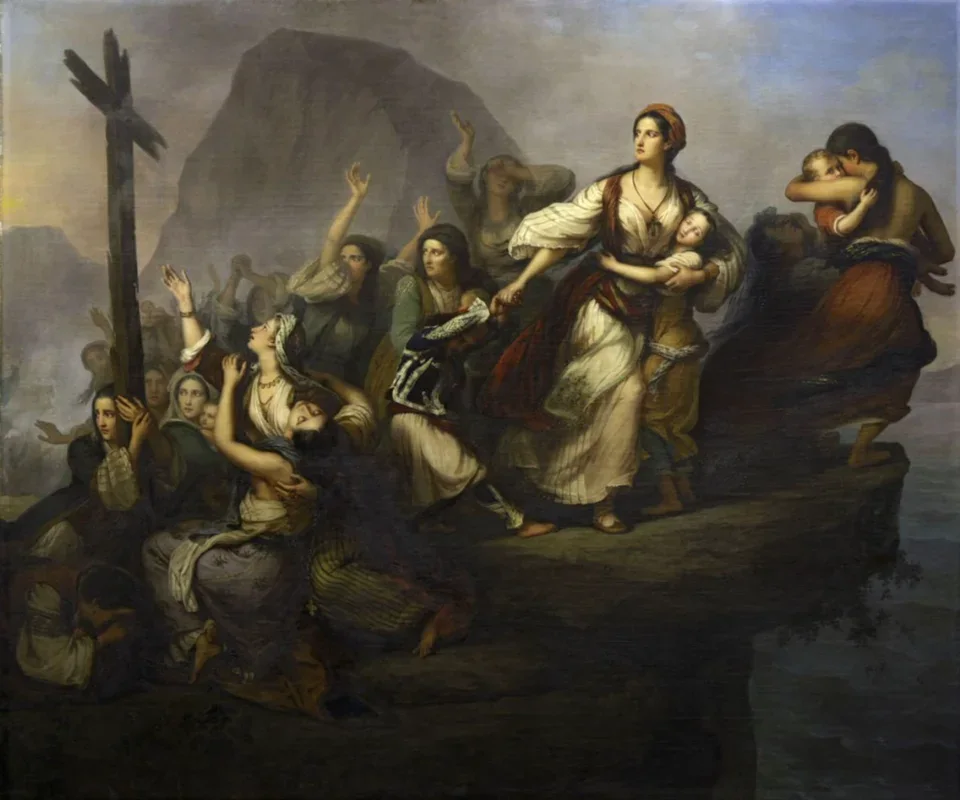
Greek Women of Souli Running to Their Death (Dance of Zalongo)
This was an enormous painting when Constance Blanchard showed it at the Paris Salon in 1838. It marked the end of romanticism and the start of realism. The story was spreading in articles across Europe and America, and other artists were taking it up. At the far left, behind a cross, soldiers come through the smoke from their fire, and the smoke darkens the sky. The legend says sixty women and children fled to Mount Zalongo and were trapped there. Surrender meant lifelong enslavement, torture and rape. So they threw their children from the cliff and followed them onto the rocks, singing and dancing as they fell. Haunted faces and frightened gazes fill the crowd of women, with children scattered among them and some held tight to their chests. One woman on the left embraces the cross, and another prays to it with her right arm raised. A young mother in a turban climbs the cliff, a little girl in yellow at her breast. She drags a boy behind her in a white fustanella and a blue jacket. He plants his feet and refuses to fall into the sea below, onto the distant rocky coast.
Listen in the appConstance Blanchard · Public domain
07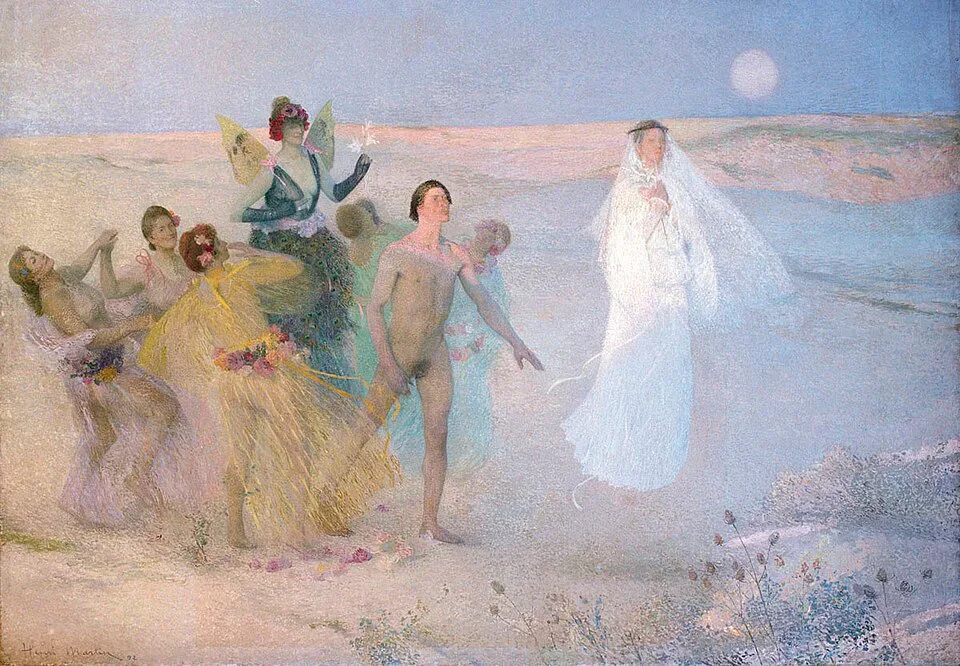
Man Between Vice and Virtue
Notice the woman at the center of the group. Her skirt is patterned with peacock feathers, and she wears butterfly wings. Those feathers and wings stand for vice in all its forms. She is one of several women in sheer, flower-covered veils, who seem to dance and sing to pull the man's attention. He is naked, and he seems to grope his way forward, with the women following behind him. Ahead, floating on the right of the painting, is a woman in a long white dress, with a halo of light around her. That is Virtue. Henri Martin based this on a line by Alfred de Musset, about a man who followed Virtue because she seemed to him the more beautiful. He had joined the Rosicrucians, a secret society founded by Sar Péladan. It stood for art in the service of beauty and the search for an ideal, and it urged people to turn from vice and draw nearer to virtue. The empty, bare landscape fits a man alone, pulled in two by opposite desires. His forehead is low and his jaw juts forward, and the body is painted with a realism out of keeping with the painter's usual work. The State bought the painting at the Salon in 1892 for four hundred francs, and in 1897 the artist asked that it be sent here.
Listen in the appHenri-Jean Guillaume Martin · Public domain
08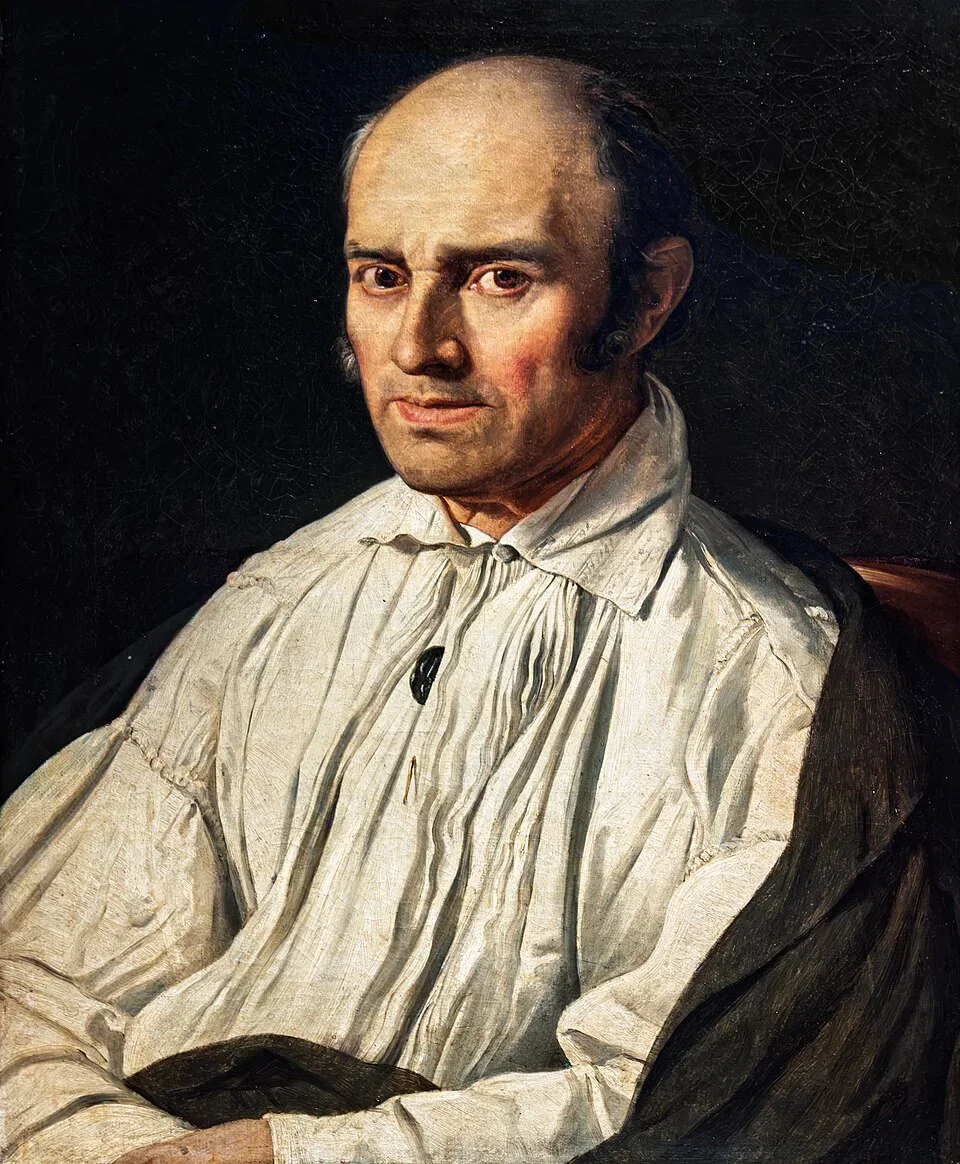
Le Père Desmarets
This portrait was bought for Hitler's museum in Linz. The Nazis paid three hundred thousand reichsmarks for it, through Hildebrand Gurlitt. In 1945 the Allies brought it back to France. It spent time at the Louvre, then came here to Toulouse. The painting had been sold in Paris in December 1941, for one of that year's record prices. That sale was later judged not to have been forced, so it stayed in French public collections and was not returned. On the left of the canvas, Ingres signed his name and the year, 1805. He wrote the title himself, in his notebooks and on the canvas. What is still not known is who the man in this portrait really was.
Listen in the appDidier Descouens · Public domain
09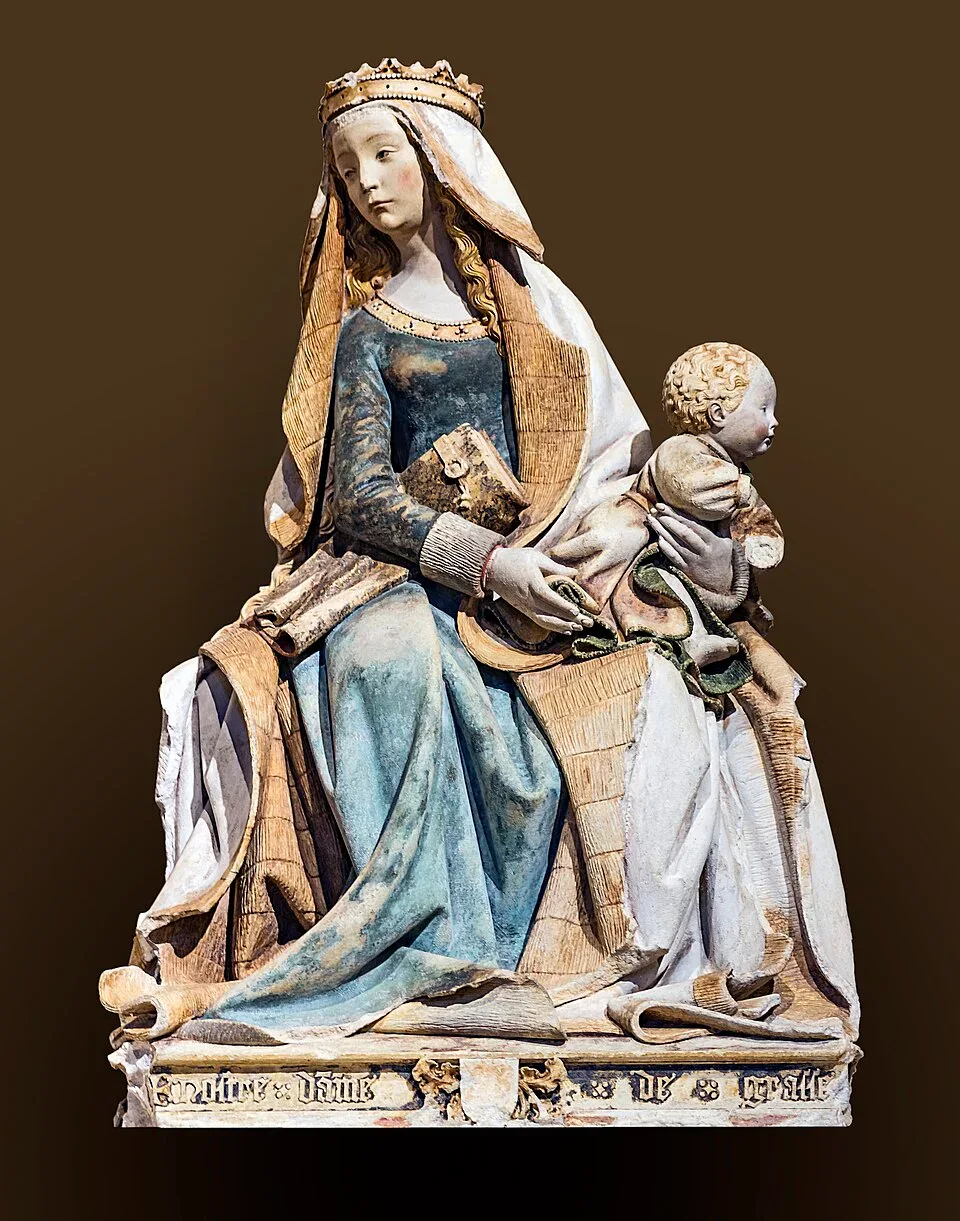
Madonna with Child, named Nostre Dame de Grasse
Was this Virgin and Child always this colorful? Her dress is blue, her cloak pale, its golden lining made to look like fur. The Child wears red over green. Those are the colors the first painter gave her. But it was repainted four times, from the sixteenth century to the very end of the eighteenth. In the twentieth century, attempts to clean it, probably by brushing and scraping, cost it more of the original color. Then between 2002 and 2004 a scientific restoration lifted the later layers away and brought the first colors back. It showed how careful that first painter had been. Under the skin lay a white layer, and beneath that an oily one that sealed the stone. Then came soft pinks, with a pale brown around the nails. No one knows who made it. The restoration caught the painter changing his mind. On the back of the book's cover, and along the top molding of the base, green went down first, then bright red over it. Red is what stayed. The whole figure was carved from one block of limestone, and its back was left flat, made to be set against a surface.
Listen in the appDidier Descouens · Public domain
10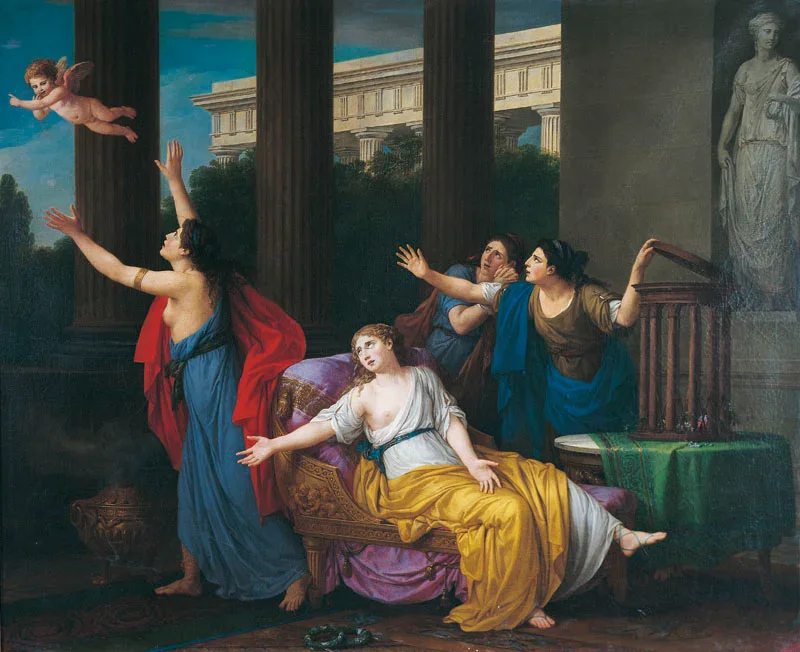
Love Fleeing Slavery
Madame du Barry already owned a picture called The Cupid Seller. She wanted one to hang beside it. The Duke of Brissac asked Joseph-Marie Vien to paint a companion, and he finished it in 1789. High in the left of the canvas, Cupid is already in flight, just out of a cage. On the right, a young woman in classical dress still holds the lid raised. She and three companions watch him go, their arms up in panic. The first picture sold him. This one catches him getting out. That year it was listed first in the Paris Salon catalogue. Then the Revolution seized it. It has hung here since 1876.
Listen in the appJoseph-Marie Vien · Public domain
- 11
Lady Tholose
Jean Rancy · 1544–1550
- 12
William Tell Overturning the Barque of Gessler
François-André Vincent · 1795
- 13
The Generosity of Alexander
Jérôme-Martin Langlois · 1819
- 14
Paris, vu des hauteurs du Père Lachaise
Louise-Joséphine Sarazin de Belmont · 1842–1859
- 15
Beauty
Henri-Jean Guillaume Martin · 1900
- 16
Cicero discovering the tomb of Archimedes
Pierre-Henri de Valenciennes · 1787
- 17
Saint John Chrysostom and the Empress Eudoxia
Jean-Paul Laurens · 1893
- 18
The Suicide of Cato the Younger
Jean-Paul Laurens · 1863
- 19
Perseus and the Gorgon
Laurent Marqueste · 1887
- 20
Hercules and Diomedes
Antoine-Jean Gros · 1835
- 21
La Soif de l'or
Thomas Couture · 1844
- 22
The Madness of Titania
Paul Gervais · 1897
- 23
Dans le bleu
Amélie Beaury-Saurel · 1894
- 24
Charles VI frightened in the forest of Le Mans
Antoine-Louis Barye · 1833
- 25
Paul Claudel at sixteen
Camille Claudel · 1884
- 26
Adoration of the Magi
Matthias Stom · c. 1640
- 27
Lucrèce au travail
Willem de Poorter · 1633
- 28
Glory of all the saints
Guercino · 1645–1647
- 29
Martyrdom of Saints John and Paul
Guercino · 1627–1632
- 30
Quand même !
Antonin Mercié · 1882
- 31
Nymphs and satyrs in a landscape
Cornelius van Poelenburgh · 1601
- 32
Vitellius
Auguste Préault · 1851
- 33
The Hague Seen from the North (The Bird Nesters)
Anthonie van Croos · 1655
- 34
The depravity of mankind before the flood (Genesis 6:5-8; Matt. 24:37-39)
Cornelis van Haarlem · 1616
- 35
The Rialto-Bridge in Venice
Francesco Guardi · 1760
- 36
Head of an Old Man
Pieter Hermansz Verelst · 1648
- 37
Horse standing under a gate
Pieter Cornelisz Verbeeck · 1630–1654
- 38
Flowers in a Vase
Willem van Aelst · 1651
- 39
Mystical marriage of Saint Catherine
Francesco Cairo · 1650
- 40
Portrait of a Woman
Nicolaes Maes · 1674
- 41
Painting: Saint Felix of Cantalice (photograph after retouching)
Antonio Verrio · 1635–1707
- 42
The Hague, the Path Leading to Rijswijk
Paulus Constantijn la Fargue · 1751
- 43
Saint Ignatius of Loyola and Saint Francis Xavier, Baciccio, 17th century, Musée des Augustins, Toulouse
Giovanni Battista Gaulli · 1675–1685
- 44
Anacreon, Bacchus and Eros
Jean-Léon Gérôme · 1848
- 45
Judith
Valentin de Boulogne · 1625–1628
- 46
Gargouilles de l'ancienne église des Cordeliers
Unknown Artist · 1200
- 47
Saint John the Evangelist and Saint Augustine
Pietro Perugino · c. 1502–1512
- 48
Bataille de Constantin contre Maxence
Nicolas Tournier · c. 1638
- 49
Diana by Alexandre Falguière
Alexandre Falguière · 1882
- 50
The Stream at Puits-Noir
Gustave Courbet · 1856–1870
- 51
Conquête de passage
Henri de Toulouse-Lautrec · 1896
- 52
Twin Column Capital: Story of Job
Anonyme toulousain · 1180–1196
- 53
The Chapter House at the Musée des Augustins
Antoine-Marie Roucole · 1894
- 54
Snakes, toads and butterflies
Otto Marseus van Schrieck · 1667
- 55
Apollo and Marsyas
Guido Reni · 1620
- 56
Christ en croix entre la Vierge, saint Jean et les donateurs présumés, le roi Charles VII et le Dauphin
Unknown Artist · 1460s
- 57
La femme au paon by Falguière-Ra 960
Alexandre Falguière · 1890
- 58
Le Cauchemar by Eugène Thivier
Eugène Thivier · 1894
- 59
Deposition from the Cross
Nicolas Tournier · c. 1630
- 60
Christ carried to the tomb
Nicolas Tournier · 1635
- 61
The Lute Player - Nicolas Tournier
Nicolas Tournier · c. 1628–1630
- 62
King Midas, by Nicolas Tournier
Nicolas Tournier · 1620–1625
- 63
Vision of Zechariah
Ambroise Crozat · 1722
- 64
The Death of Saint John the Baptist. Engaged Twin Column Capital
Gilabertus
- 65
Portrait of a Woman
Francesco Solimena · 1705
- 66
Saint Peter
Nicolas Tournier · c. 1625
- 67
Portrait of Martino Widmann
Bernardo Strozzi · 1631–1644
- 68
Portrait of a Woman
Andrea Commodi · 1590
- 69
Self-portrait
Francesco Trevisani · 1701–1746
- 70
Christ on the Cross, the Virgin, Saint John and Magdalene
Lorenzo Monaco, Neri di Bicci · 15th century
- 71
Scene from the Life of Esther (?), Carlo Francesco Nuvolone, c. 1636
Carlo Francesco Nuvolone · c. 1636
- 72
Christ on the cross before the praying Cardinal Guilhem Peire Godin
Unknown Artist · 1400
- 73
The Hunt
Giovanni di Francesco · 1450–1460
- 74
(Toulouse) Democritus and Heraclitus - Giuseppe Maria Crespi - Musée des Augustins
Giuseppe Maria Crespi · 1730
- 75
Christ carrying the cross
Nicolas Tournier · c. 1632
- 76
Baronne de Crussol
Élisabeth Louise Vigée Le Brun · 1785
- 77
The four functions of the Capitoulat of Toulouse
Jacques Boulbene · 1576–1600
- 78
Still Life with Apricots
Louise Moillon · 1634
- 79
Nature morte aux mûres
Louise Moillon · 1629–1641
- 80
Saint Diego of Alcalá before the cross
Bartolomé Esteban Murillo · 1645–1646
- 81
Corbeille de prunes et panier de fraises
Louise Moillon · 1632
- 82
Nina Singing Romance
Henri Nicolas van Gorp · 1776
- 83
Augustins - The Farewell of Consul Boetius to His Family - Victor Schnetz
Jean Victor Schnetz · 19th century
- 84
Virgin and Child between St. Sebastian and St. Ursula
Marco Basaiti · 1480
- 85
Portrait of an Officer, also known as Presumed Portrait of General Barthélémy Joubert (1769-1799)
Antoine-Jean Gros · 1799
- 86
Portrait of Jean de Caulet as a crowned Apollo
Jean Chalette · 1635
- 87
Unknown Old Man
Jacques Gamelin · 1791
- 88
Saint Dominic
Unknown Artist · 1600
- 89
Belisarius receiving hospitality from a peasant who served under his command
Jean-François Pierre Peyron · 1779
Musée des Augustins de Toulouse
Frequently asked questions
How much does the guide cost?
Free app download. Free until 1 January. Listed guide price: $0.99. Audio guide only. Venue admission is separate.
Can I listen without internet?
Yes. Download the guide’s audio, images, and maps in the app before your visit. Your downloaded content is then available offline.
Can I listen in my language?
In English for now. More languages soon.
Do I need to follow a schedule?
No. This is a self-guided experience. Choose your stops, pause whenever you like, and return to a story at your own pace.
Which artworks are in the Musée des Augustins de Toulouse audio guide?
89 artworks, including Muley-Abd-Err-Rahmann, sultan du Maroc sortant de son palais de Mequinez (Eugène Delacroix), Virgil reading The Aeneid before Augustus, Livia and Octavia (Jean-Auguste-Dominique Ingres), Marguerite de Conflans (Édouard Manet), The Death of Cleopatra (Jean-André Rixens), Young girl in a park (Berthe Morisot), Greek Women of Souli Running to Their Death (Dance of Zalongo) (Constance Blanchard), Man Between Vice and Virtue (Henri-Jean Guillaume Martin), and Le Père Desmarets (Jean-Auguste-Dominique Ingres). The full list is on this page.
Is this the museum’s official audio guide?
No. Stanza is an independent audio guide app and is not affiliated with Musée des Augustins de Toulouse. Museum admission is separate.
At your own pace
Explore Musée des Augustins de Toulouse.
Download Stanza, then search for “Musée des Augustins de Toulouse”.
Free app download · Guide price shown in the app
Keep exploring
Nearby audio guides
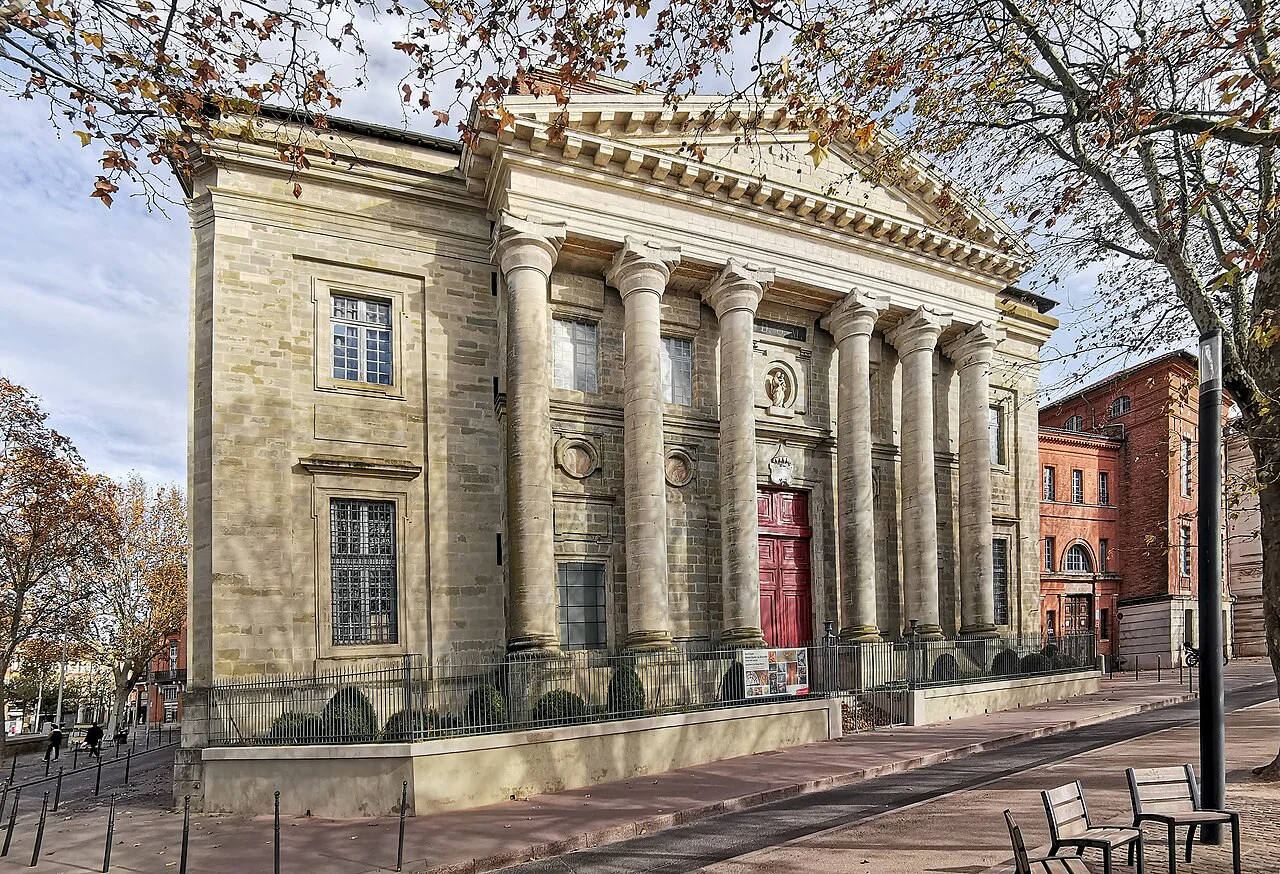
Toulouse · 1 km
Basilique Notre-Dame de la Daurade
Content & sources
Didier Descouens · CC BY-SA 4.0
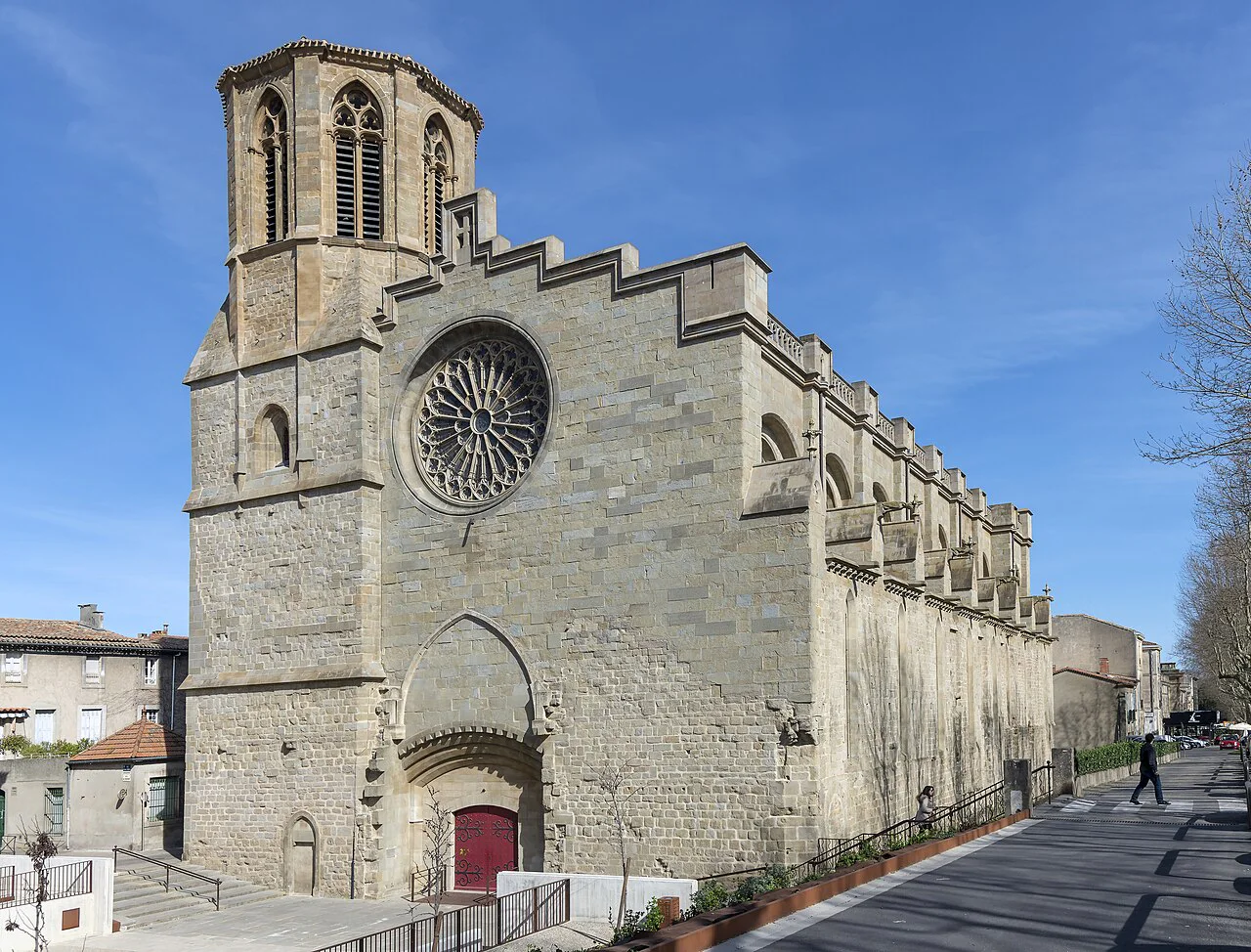
Carcassonne · 85 km
Cathédrale Saint-Michel de Carcassonne
Content & sources
Didier Descouens · CC BY-SA 4.0

Carcassonne · 86 km
Cité de Carcassonne
Content & sources
Photo: Jondu11 · CC BY-SA 4.0
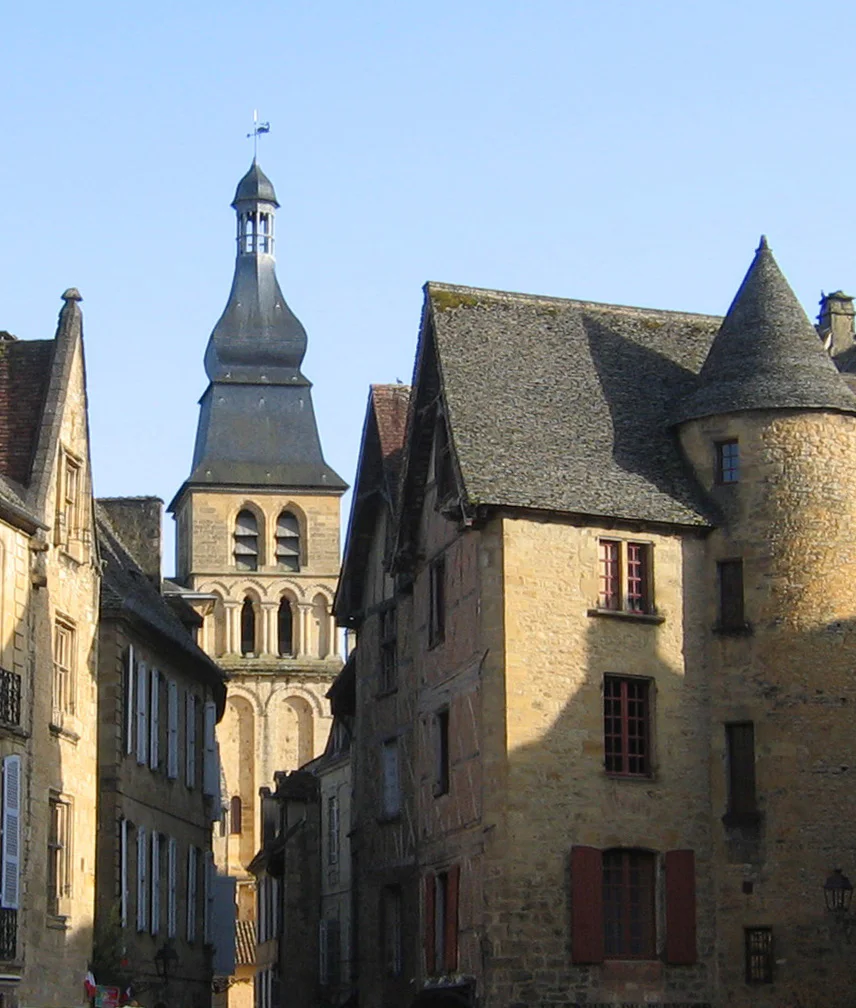
Sarlat-la-Canéda · 144 km
Cathédrale Saint-Sacerdos de Sarlat
Content & sources
Gilbert Bochenek · Public domain
Art museums
More art museum audio guides
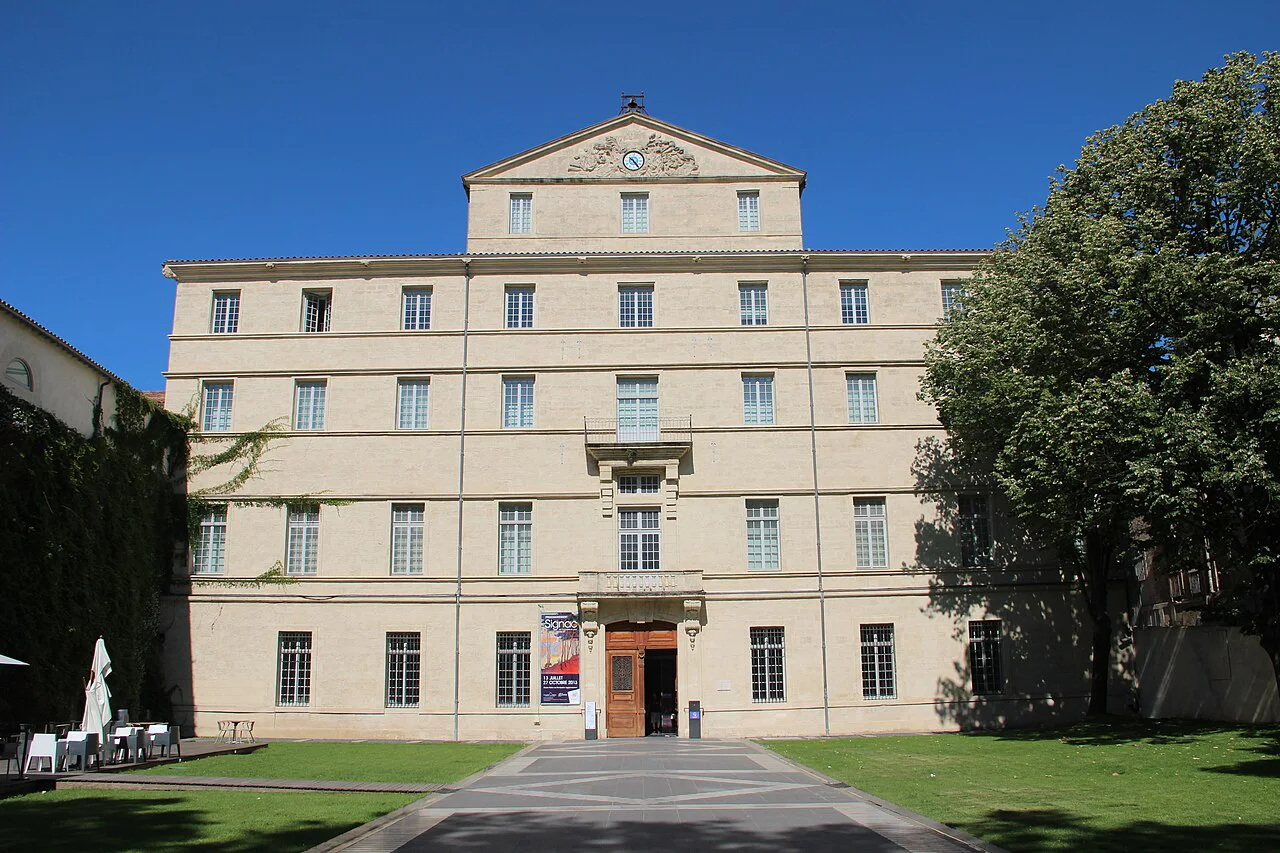
Montpellier · 84 artworks
Musée Fabre
Content & sources
Björn S. · CC BY-SA 3.0
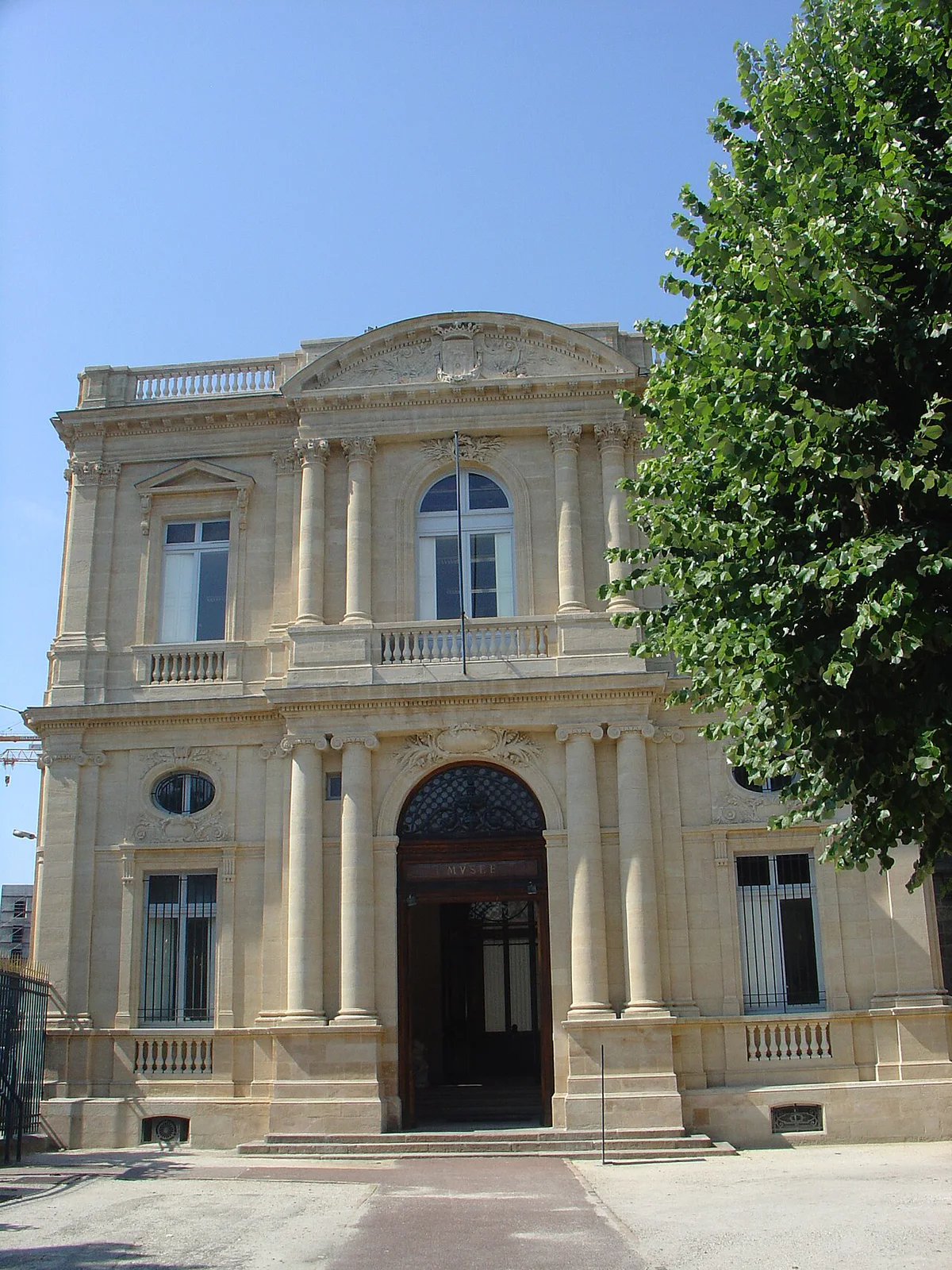
Bordeaux · 44 artworks
Musée des Beaux-Arts de Bordeaux
Content & sources
Photo: Michel BUZE · CC BY-SA 3.0
Bayonne · 28 artworks
Musée Bonnat-Helleu
Content & sources
Photo: Jvillafruela · CC BY-SA 4.0
Bilbao · 43 artworks
Museo de Bellas Artes de Bilbao
Content & sources
Photo: Xabier · CC0
Lyon · 159 artworks
Museum of Fine Arts of Lyon
Content & sources
Photo: Jastrow · CC BY 2.5
Grenoble · 53 artworks
Musée de Grenoble
Content & sources
Photo: Milky · CC BY-SA 3.0