Stanza · Audio guide
Cathédrale Saint-Sacerdos de Sarlat Audio guide
A place to remember. A story to take with you.
Sarlat Cathedral is a Roman Catholic church and former cathedral located in Sarlat-la-Canéda, France. It is a national monument.
Download Stanza, then search for “Cathédrale Saint-Sacerdos de Sarlat”.
About the tour
One guide. Your kind of visit.
Sarlat Cathedral is a Roman Catholic church and former cathedral located in Sarlat-la-Canéda, France. It is a national monument.
Ready when you are.
- 01Get the free Stanza app.
iOS & Android
- 02Find your guide.
“Cathédrale Saint-Sacerdos de Sarlat”
- 03Download before you go.
Works offline
Audio guide / 7 narrated stops
Inside the guide
Get to know a few of the stories before you go. Open a stop to read more.
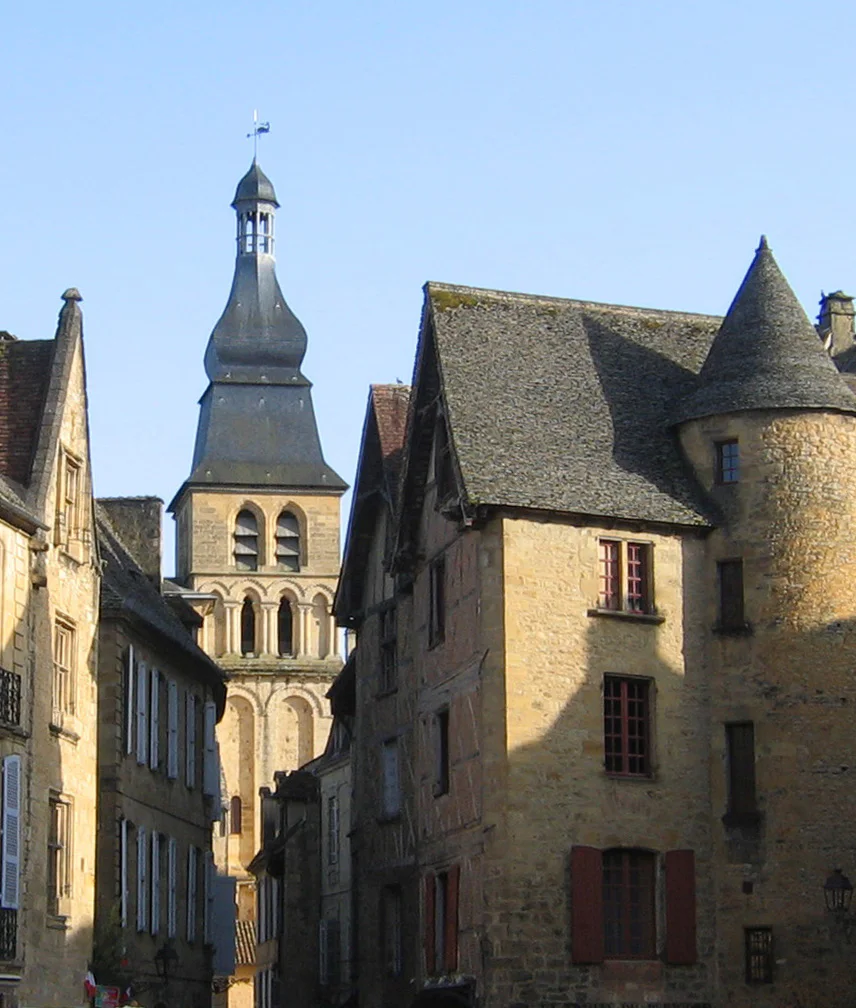
01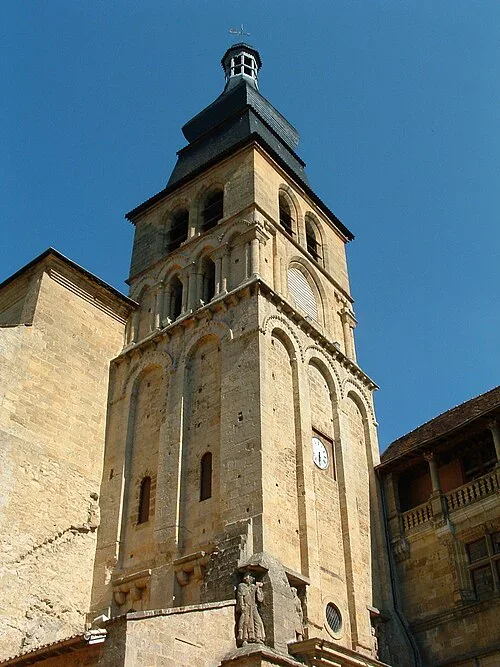 Cathedral Exterior and the Bulbous DomeThe Romanesque Bell-Porch and Its Bulbous Dome
Welcome to Sarlat, and to a church that has been an abbey, a cathedral and a parish in its time. The tower over the porch is the oldest fabric on the site, built in the twelfth century when the abbey was rebuilt in the Romanesque style. It did double duty as the fortified entrance to the abbey, a bell tower and a gatehouse in one. Sarlat's abbey ranked among the six great abbeys of the Périgord, and it was the only one the Viking raids spared. It stood away from the Dordogne and its tributaries, beyond the reach of the raiders' boats. Historians place its foundation in the early ninth century, under Pépin, king of Aquitaine, though the true origin is lost in legend. A few accounts push the belfry itself back before the twelfth century; the tower standing here belongs to the Romanesque rebuilding. The medieval spire above it was destroyed by lightning, and after 1721 the roof took the shape it still has, a bulbous dome that is rare in this region. The carved figures above the entrance hold the next piece of the story.
Photo: MOSSOT · CC BY-SA 4.0
02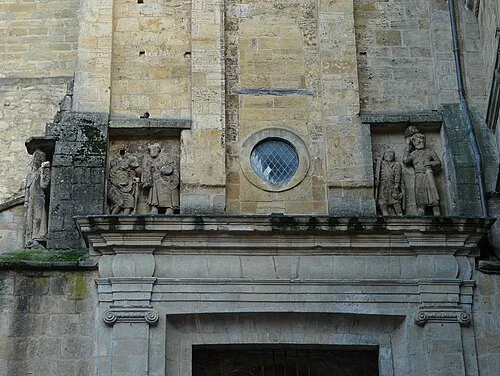 Romanesque Bell-Porch EntranceThe Saints Above the Portal
The figures above these heavy doors are worn and hard to name, but the name of the church itself is clear. Saint-Sacerdos honours a man, Sacerdos of Limoges, not the Latin word for priest. Two French saints bear that name, and this church received the relics of the Limoges one in the Middle Ages. When they arrived, nobody can say for certain. Jean Tarde, a chronicler writing in 1624, already admitted the date was unknown. Some tie the transfer to the Viking attacks that began in 848. Others put it in the mid-tenth century, when the church took the new name of Saint-Sauveur and Saint-Sacerdos. Either way, the relics drew pilgrims for centuries, and then they disappeared during the Wars of Religion. One legend clings to this place too: Saint Bernard passed through Sarlat in 1147, and the story says he multiplied bread there, the miracle of the loaves. The twelfth-century tower rises directly above this doorway.
Photo: Père Igor · CC BY-SA 4.0
03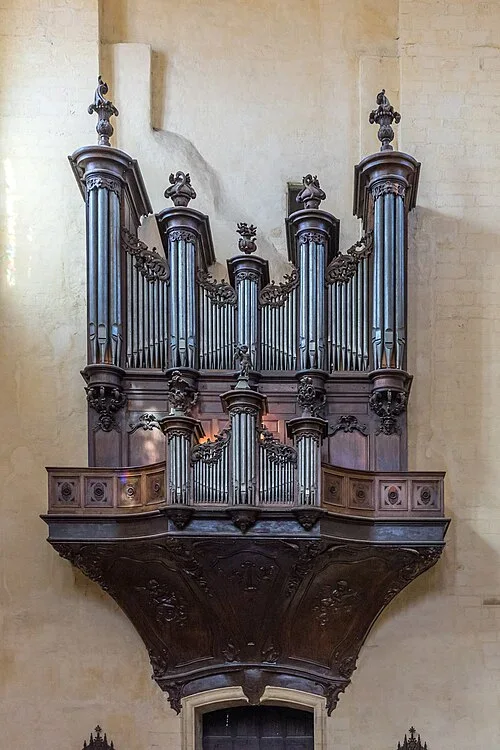 The Swallow's Nest OrganThe Swallow's Nest Organ of 1752
High on the wall above the main portal hangs something that looks far too heavy to be there: the organ, set on a swallow's-nest gallery that juts from the stone with nothing beneath it. Jean-François L'Épine built the instrument in 1752, and it still hangs where he put it. The carved case is crowned with sculpted figures, and the polished pipes rise in tiers behind it. While the organ was under construction, L'Épine hired a local apprentice, a Sarlat man named Guillaume Monturus. Monturus went on to become a recognised organ builder in his own right, so the instrument trained a craftsman as well as playing. Its installation was part of the last wave of work that completed the cathedral's restoration in the mid-eighteenth century. Both parts of it are protected in their own right, the mechanism since 1952 and the case since 1976. How the nave beneath it finally came together comes next.
Listen in the appPhoto: Jean-Christophe BENOIST · CC BY 3.0
04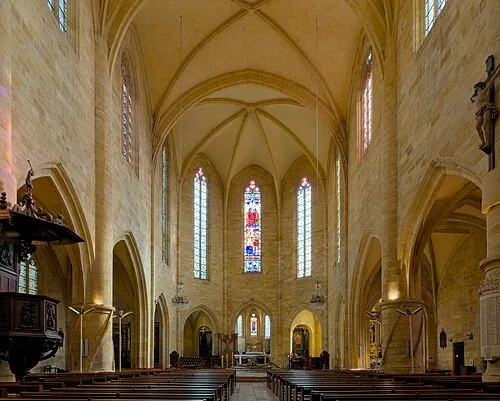 The Late Gothic NaveThe Gothic Nave and the Long Gap
The tall Gothic vaults overhead are younger than they look, because every one of them is seventeenth-century work. The story begins in 1504, when Bishop Armand de Gontaud-Biron launched a full Gothic rebuilding of the old abbey church. Pierre Esclache drew up the project, and the master mason Blaise Bernard led the first works. Nave and choir were torn down that year. Only the choir rose again quickly; the money ran out before the nave could follow. For nearly two centuries the choir and the old tower stood apart, separated by open air where the nave should have been, and churchgoers crossed the gap outside. Work resumed in 1682, thanks to François III de Salignac de la Mothe-Fénelon, uncle and godfather of Fénelon, the archbishop of Cambrai who tutored the Dauphin. By 1685 the vaults were closed. The builders chose Gothic on purpose, out of a wish for one harmonious whole and trust in a technique they knew would hold.
Listen in the appBenjamin Smith · CC BY-SA 4.0
05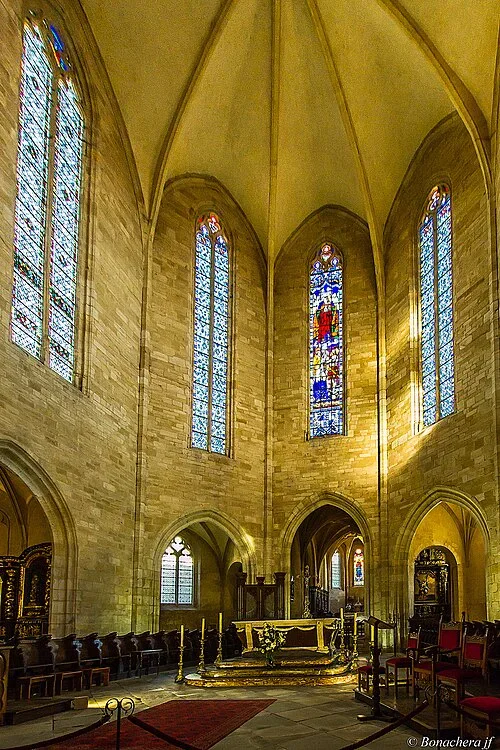 The Gothic Choir and High AltarThe Gothic Choir
The choir was the first finished piece of the new cathedral, rebuilt by 1519. When the demolition of 1504 cleared the old church, this east end rose quickly while everything behind it waited. The style comes from the Gothic of northern France: one tall central vessel with two lower side aisles running beside it. The builders reused parts of the Romanesque abbey church in the new walls, so the twelfth century is folded into the Gothic work. Tall stained-glass windows pour coloured light down the pale stone of the choir. Above the altar the vaults draw together in a smooth crown, and the whole east end glows with the light they give it. The seats that lined this space for the clergy come next.
Listen in the appPhoto: Bonachera jf · CC BY-SA 4.0
06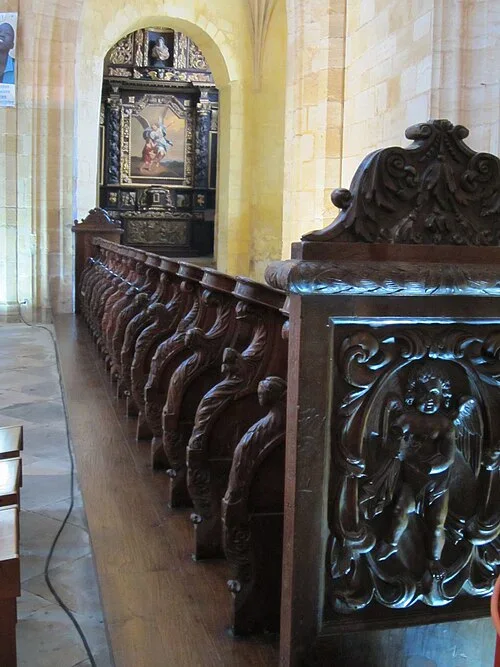 The Gothic Choir and High AltarThe Choir Stalls of the Canons
These carved oak seats are the trace of the men who served the cathedral. In 1317 Pope John XXII created a batch of new dioceses across Aquitaine, after the French crown's victory over the count of Toulouse and the Cathars. Sarlat's abbey church became a cathedral, and its abbot became the new bishop. A bishop called Raymon de Roquecorn then turned the monastic community into a chapter of fifty canons. They met here every day to sing the offices, which is what these stalls were made for. The chapter later went through hard times, secularised in 1561 amid epidemics and war, yet it endured. The stalls are what remains of that daily company.
Listen in the appPhoto: Xfigpower · CC BY-SA 3.0
07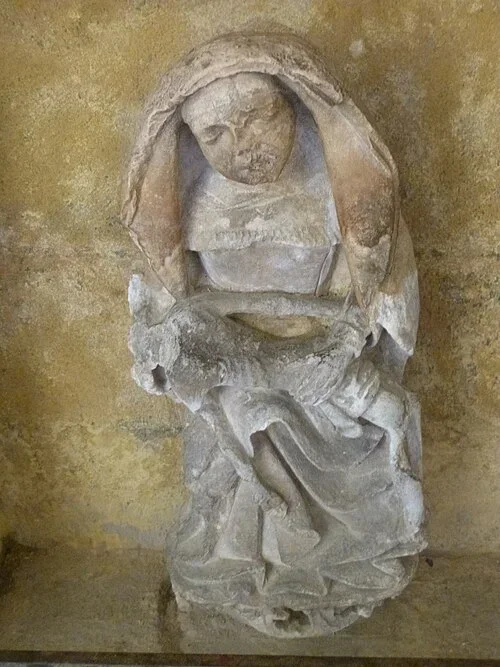 The Side Chapels and Sacred ArtThe Vierge de Pitié and the Parish Church
A hooded woman in worn stone holds a body across her lap, the Vierge de Pitié, the Virgin mourning her son. Her face and her folds are rubbed smooth, the mark of hands and centuries of quiet devotion. Sculptures like this were made for prayer up close rather than display, and this one still sits within the church that keeps it. Under the Concordat of 1801 the diocese of Sarlat was abolished and its territory joined to Périgueux. The former cathedral became simply the parish church of Sarlat, though it keeps the title of co-cathedral of the diocese of Périgueux and Sarlat. From abbey church to cathedral to parish, it has kept serving the town that grew up around it.
Listen in the appPhoto: Thérèse Gaigé · CC BY-SA 4.0
Cathédrale Saint-Sacerdos de Sarlat
Frequently asked questions
How much does the guide cost?
Free app download. Listed guide price: $0.99. Guide price shown in the app. Audio guide only. Venue admission is separate.
Can I listen without internet?
Yes. Download the guide’s audio, images, and maps in the app before your visit. Your downloaded content is then available offline.
Can I listen in my language?
This audio guide is available in 15 languages, including English.
Do I need to follow a schedule?
No. This is a self-guided experience. Choose your stops, pause whenever you like, and return to a story at your own pace.
At your own pace
Explore Cathédrale Saint-Sacerdos de Sarlat.
Download Stanza, then search for “Cathédrale Saint-Sacerdos de Sarlat”.
Free app download · Guide price shown in the app
Keep exploring
Audio guides — France
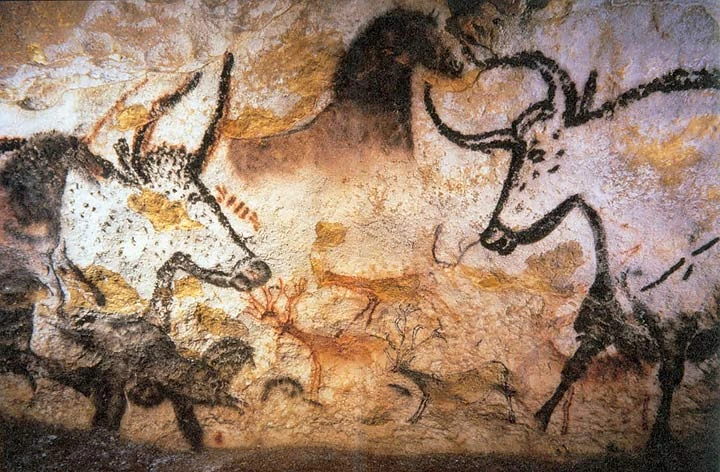
Montignac-Lascaux · 18 km
Grotte de Lascaux
Content & sources
EU · Public domain
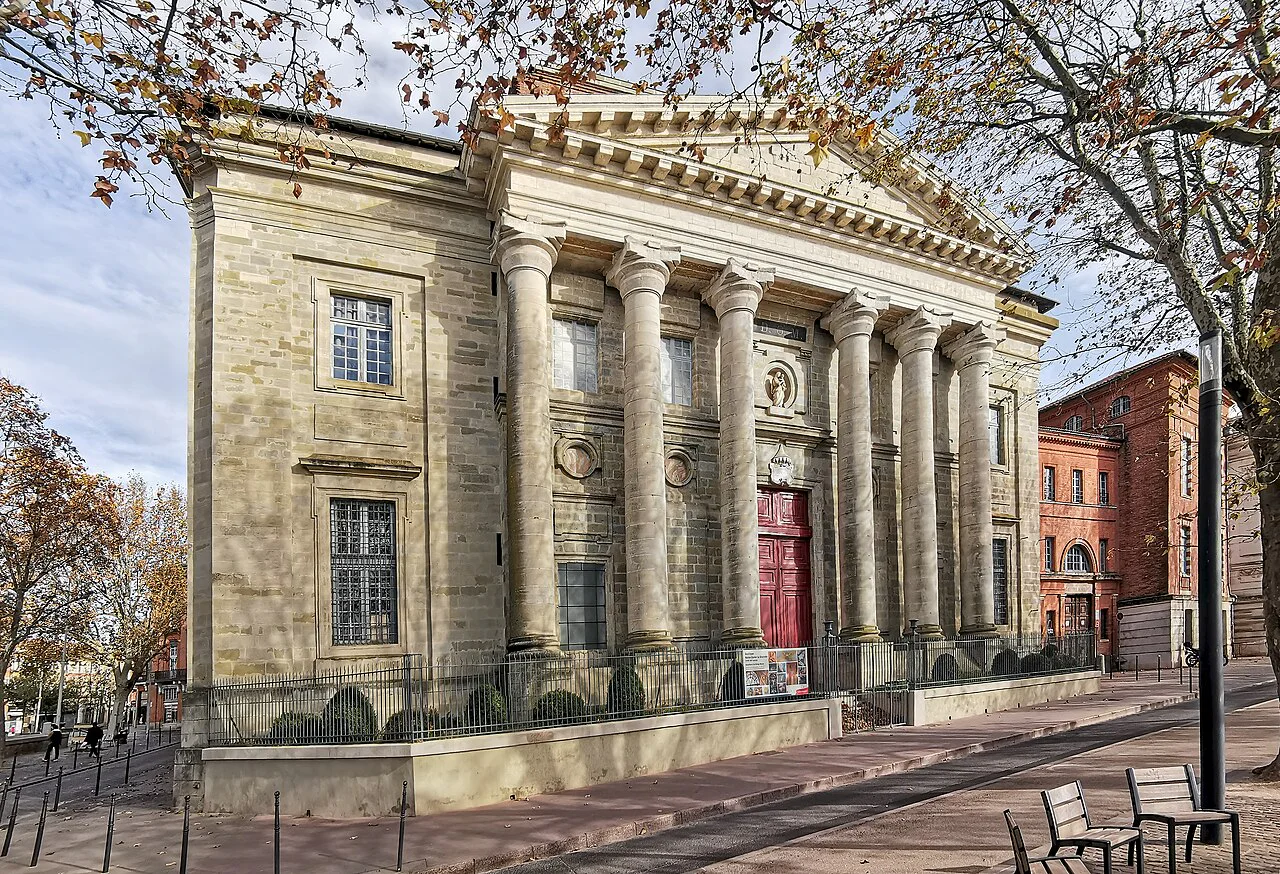
Toulouse · 144 km
Basilique Notre-Dame de la Daurade
Content & sources
Didier Descouens · CC BY-SA 4.0
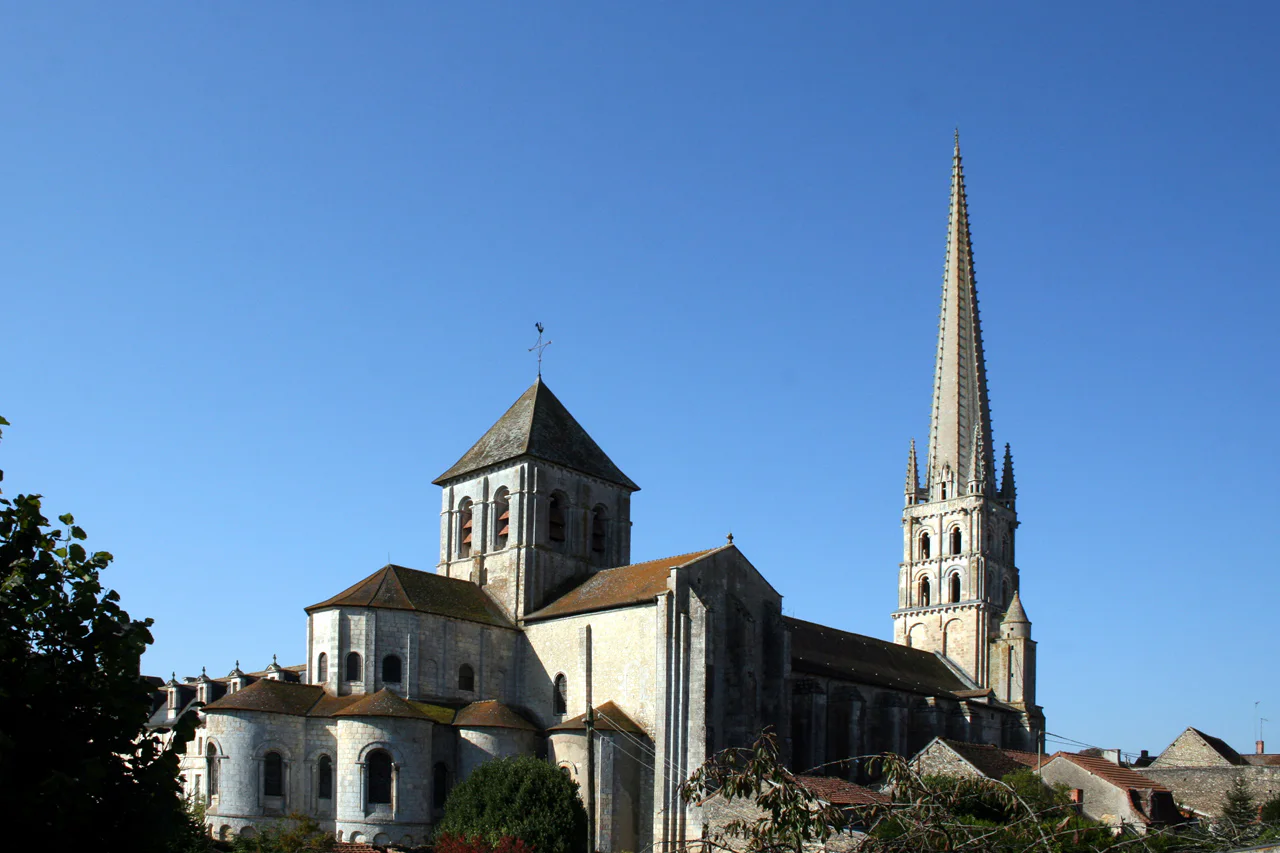
Saint-Savin
Abbaye de Saint-Savin-sur-Gartempe
Content & sources
Remi Jouan · CC BY-SA 3.0
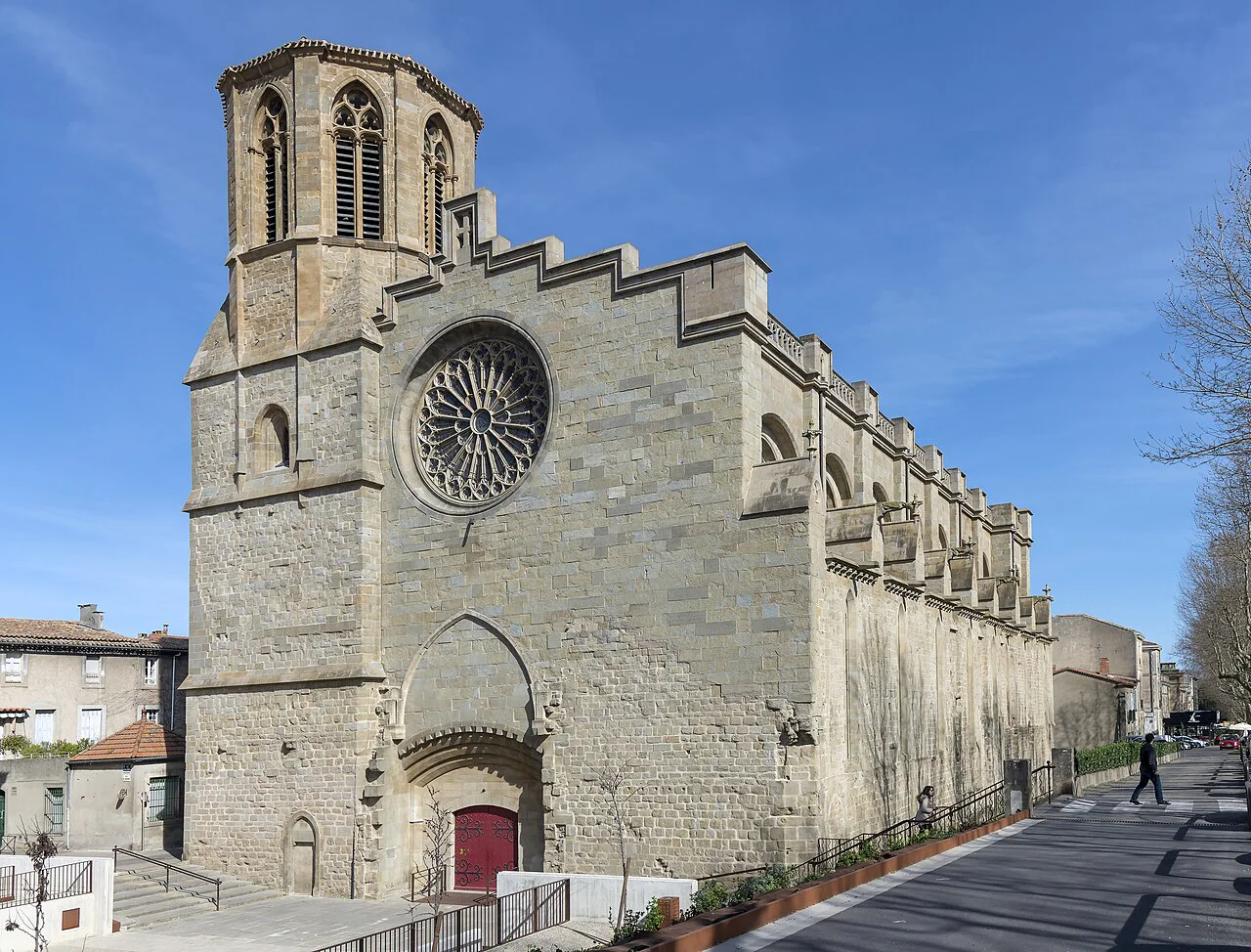
Carcassonne
Cathédrale Saint-Michel de Carcassonne
Content & sources
Didier Descouens · CC BY-SA 4.0