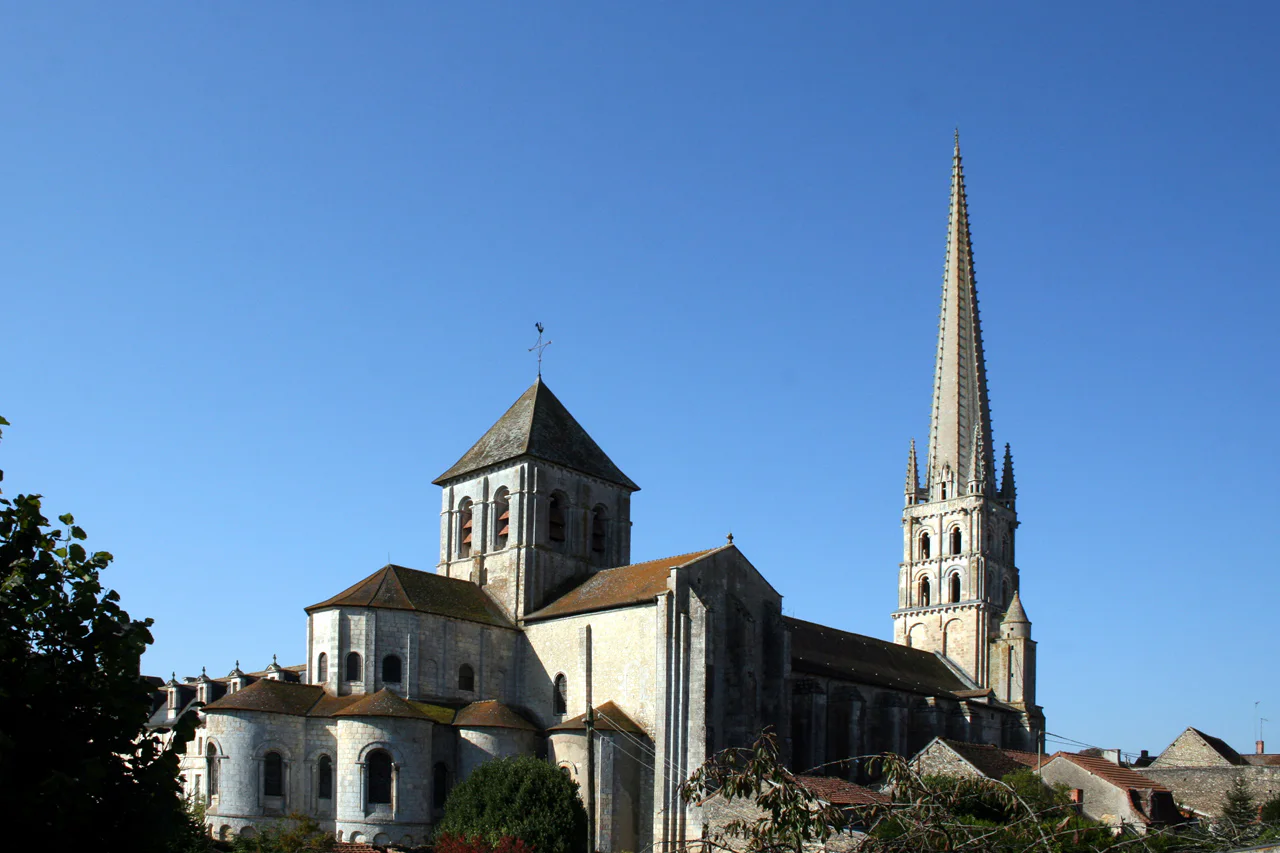
Stanza · Audio guide
Abbaye de Saint-Savin-sur-Gartempe Audio guide
A place to remember. A story to take with you.
The Abbey Church of Saint-Savin-sur-Gartempe is a Romanesque church located in France that was begun in the mid-11th century. It is a UNESCO World Heritage Site known for its well-preserved 11th- and…
Download Stanza, then search for “Abbaye de Saint-Savin-sur-Gartempe”.
About the tour
One guide. Your kind of visit.
The Abbey Church of Saint-Savin-sur-Gartempe is a Romanesque church located in France that was begun in the mid-11th century. It is a UNESCO World Heritage Site known for its well-preserved 11th- and 12th-century murals.
Ready when you are.
- 01Get the free Stanza app.
iOS & Android
- 02Find your guide.
“Abbaye de Saint-Savin-sur-Gartempe”
- 03Download before you go.
Works offline
Audio guide / 15 narrated stops
Inside the guide
Get to know a few of the stories before you go. Open a stop to read more.
01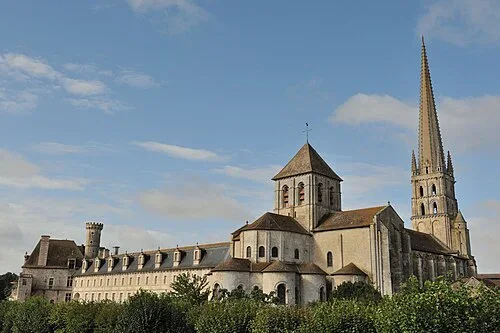 Exterior Facade and Clocher-PorchThe Abbey Complex from the West
Welcome to the abbey of Saint-Savin-sur-Gartempe, in Poitou. Over the next stops, this tour follows the church and its paintings, from the west front to the riverbank. The place exists because of two martyr brothers, Savin and Cyprian. Tradition holds that a church was raised here to shelter their relics, and pilgrims came to seek them. The abbey itself is thought to have been founded by Saint Benoît d'Aniane, under the protection of Charlemagne and his immediate successors, though its early history remains obscure. What stands today is a Romanesque church begun in the mid-eleventh century. It runs about seventy-six metres from end to end, with the monastic buildings ranged beside it. Near their far end a small crenellated tower rises above the roofs. Since 1983 the whole site has been a UNESCO World Heritage Site.
Photo: GuyFrancis · CC BY-SA 3.0
02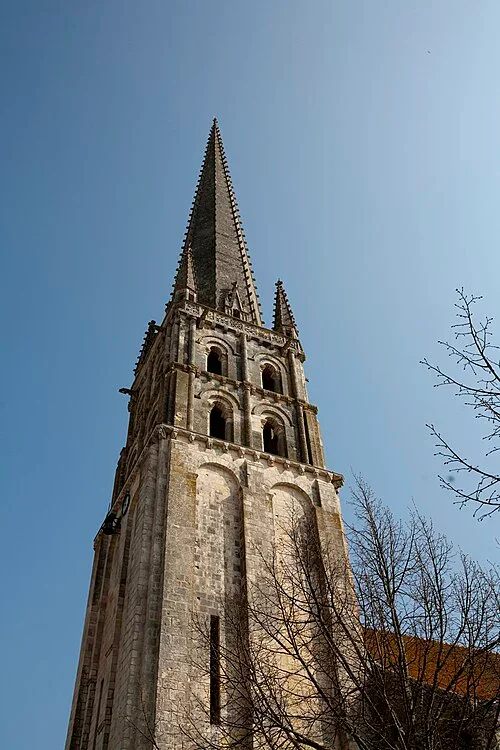 Exterior Facade and Clocher-PorchThe Clocher-Porch and Its Spire
Everything here begins with a woman's gift. In 1010, Aumode, Countess of Poitou and Aquitaine, gave the abbey a considerable sum for the salvation of her soul and her family's. That money paid for the church standing today. Building and decoration ran on for half a century, directed by the abbots Odon and Gervais. The masons worked from the far end inward: transept first, then the choir with its ambulatory and chapels, then the first bays of the nave. A last campaign, around 1090, raised this bell tower. It also added the six final bays of the nave. The tower does double duty, because its ground floor serves as the entrance porch of the church. Above it rises the stone spire, added in the fourteenth century. It was restored in the nineteenth, and its height is usually given as seventy-seven metres. During works in 1884, the sarcophagus of Abbot Odon came to light near the north transept. The limestone bears a Latin line: "Hic requiescit Oddo abbas". Here lies Abbot Odon.
Photo: PMRMaeyaert · CC BY-SA 3.0
03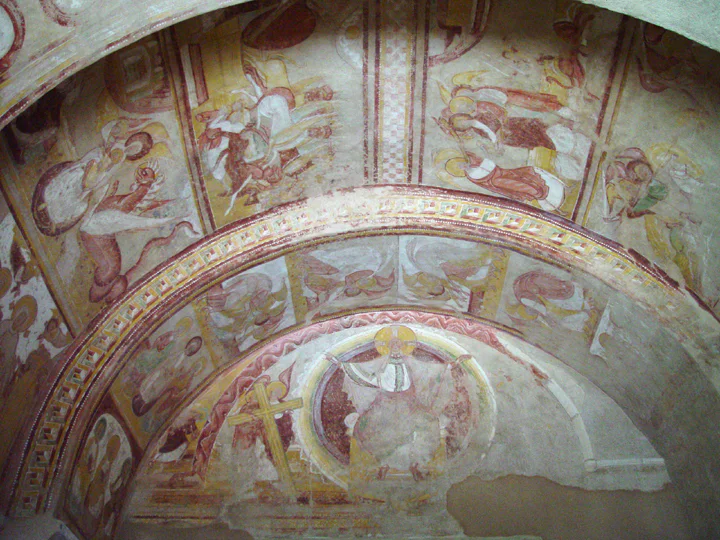 Entrance Porch and Apocalypse NarthexThe Avant-Nave Vault: Visions of the Apocalypse
Beyond the tower's ground floor, the vault overhead carries the Book of Revelation. Christ sits in glory, ringed by angels carrying the instruments of the Passion, while groups of apostles greet him. Around him, episodes from Saint John's vision unfold. In one scene the fifth trumpet sounds, and an angel opens the well of the Abyss. Out come monstrous locusts, with horses' bodies, crowned human heads, lion's teeth and scorpion tails. For five months they torment anyone without the seal of God on their forehead. Medieval churches usually gave the Apocalypse to the west end, and this one follows the rule: the scenes sit by the entrance, so pilgrims met the vision first. The light here is dimmer than in the nave, so the painters chose stronger, more contrasting colours. Time has not been kind. Weathering has partly destroyed these paintings, and some figures are hard to make out.
Listen in the appAnne C. Richardson, Jim Womack · Public domain
04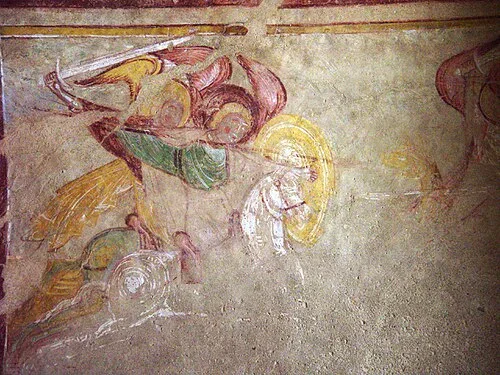 Entrance Porch and Apocalypse NarthexSaint Michael and the Dragon
One scene from that cycle deserves its own moment. Saint Michael, mounted on a white horse, strikes down the dragon. Angels with drawn swords ride beside him. The painter gave the archangel a great sweep of wings and an arm raised high for the blow. Below, the beast goes down beneath the horse's feet. Medieval painters loved this combat: the archangel, bright and armed, against the creature of the abyss. On this wall the fight is still caught mid-motion.
Listen in the appanonymous · Public domain
05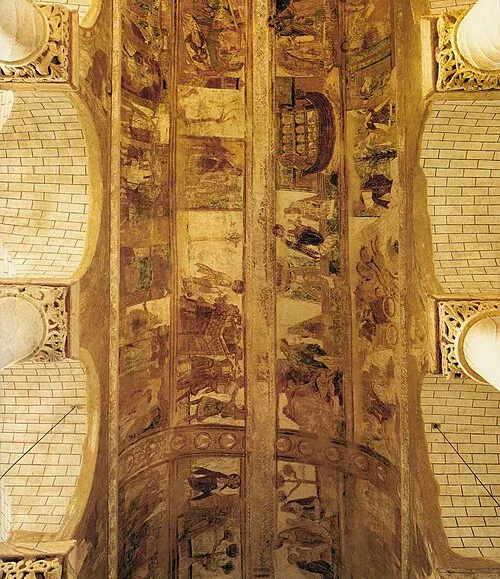 Main Nave - Western BaysThe Painted Barrel Vault of the Nave
The painted vault over the nave earned the church its nickname, the Romanesque Sistine Chapel. Only Old Testament scenes fill it, drawn from the first two books of the Pentateuch, Genesis and Exodus. Two registers of painting run on either side of a ridge frieze that divides the vault along its whole length. The whole thing reads like a great book, from the west end eastward, page after page. The painters worked in the years just before and after 1100. Their surface covers four hundred and twelve square metres, every part of it painted. The images had an educational purpose, so they had to make sense from the floor. The painters used bold outlines and broad areas of colour to make the figures pop. The manner is the Angevin style: flat linear design, with colour silhouettes setting light against dark. The colours are still striking today, a glimpse of painted surfaces of the period that are otherwise lost. In 1967 restorers began work on the vault and its paintings. The campaign spread to the crypts, the choir and the tribune.
Listen in the appUnknown author · Public domain
06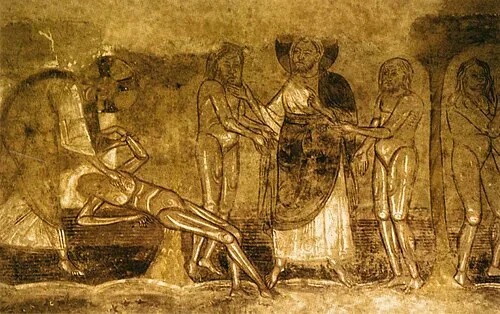 Main Nave - Western BaysThe Creation of Adam and Eve
The painted book opens with Genesis. God creates the first human couple, presents Eve to Adam, and the serpent tempts her. Then come the forbidden fruit, the original sin, and God's rebuke to the disobedient pair. These westernmost scenes are the most damaged in the church. The west end stood open to the weather, and rain and wind wore the paintings there away. Parts of the Creation cycle are lost, while later pages survive far better. In what is left, God's figure still stands clear against the dark ground. The expulsion from Eden is among the scenes almost gone.
Listen in the appUnknown author · Public domain
07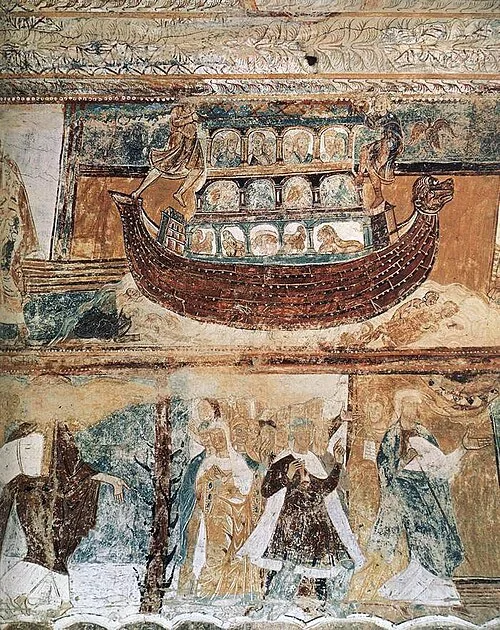 Main Nave - Western BaysNoah's Ark
Noah's Ark is one of the vault's most celebrated images. God speaks to Noah, and the Flood follows. The painters drew the ark like a ship of their own day, a long hull without oars or sails, its prow carved with a monster's head that eyes the raven flying overhead. The Bible gives the ark three decks. Two held the animals, and under each arch of the third sits a human couple. The roof has been lifted off so the survivors and the beasts can disembark. The water below is strewn with the drowned. A raven flies out to learn whether the land is dry. What the painters knew best, shipbuilding and carpentry and the boats on their own rivers, became the biblical boat, plain to read from the floor.
Listen in the appUnknown author · Public domain
08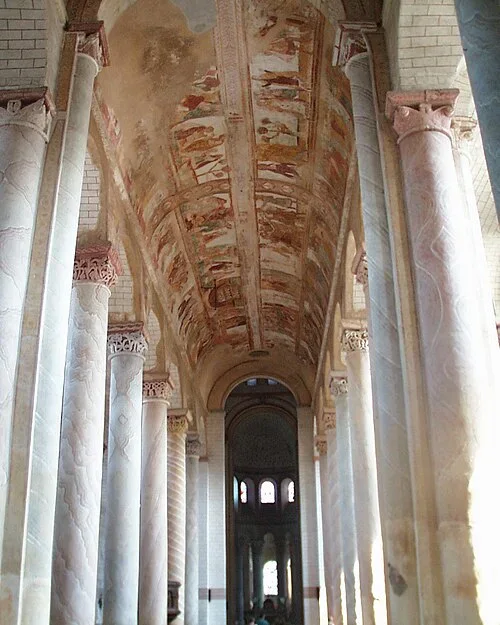 Main Nave - Eastern BaysInside the Nave: Pillars and Painted Light
The nave is the masterwork of the whole ensemble. It runs forty-two metres, and the central vessel rises eighteen metres high. With its aisles it spans seventeen metres. Rows of smooth cylindrical columns, fifteen metres tall and painted in soft faux marble, carry the vault directly. In the Poitevin manner the aisles are almost as high as the nave, and their tall windows light the vault indirectly. From the avant-nave, five steps lead down to a floor that slopes gently toward the choir. All of this was arranged to show the paintings off. And the paintings nearly did not survive. In 1833 the prefect Alexis de Jussieu arrived to find the mayor having a fissure in the nave blocked and the murals whitewashed. He raised the alarm with Ludovic Vitet, the first inspector general of historic monuments. Prosper Mérimée, the second holder of that post, arranged the most urgent restorations from 1836. In 1835 he had appealed directly to the minister François Guizot. In 1840 the church entered the first list of protected monuments in France, at the very creation of the country's heritage protection.
Listen in the appOriginal uploader was Accrochoc at fr.wikipedia · CC BY-SA 3.0
09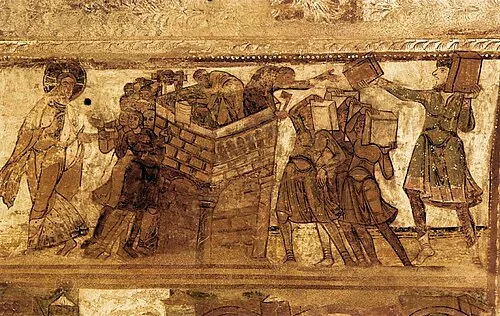 Main Nave - Eastern BaysThe Building of the Tower of Babel
Farther east, the book reaches Babel. Genesis tells how men set out to build a tower up to the level of God. In the painting they haul stones and baskets up scaffolding while the structure climbs. Then God scatters their speech. Unable to understand one another, the workers abandon the site. The masons who raised this very church would have recognised the scene. The same organised labour, the same loaded baskets and ladders, filled their own building sites. The tower in the picture climbs brick by brick, exactly the way theirs did.
Listen in the appUnknown author · Public domain
10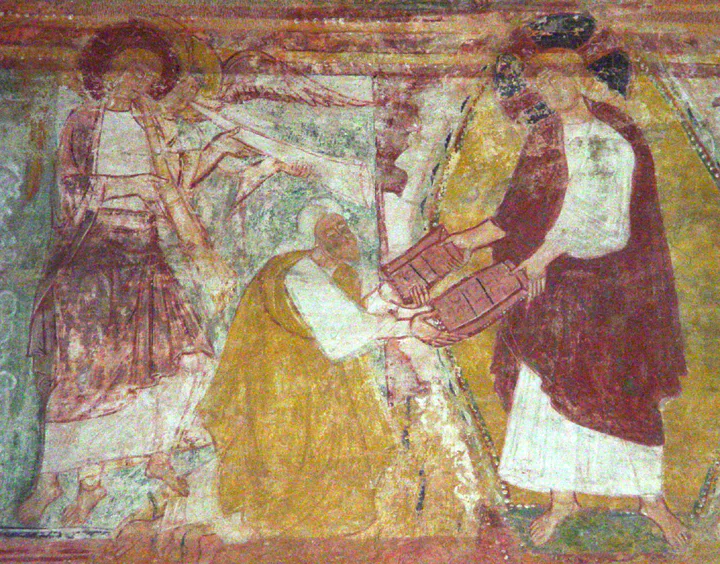 Main Nave - Eastern BaysMoses Receiving the Tablets of the Law
The great book ends not with a story but with a law. From the book of Exodus comes the final scene: Moses kneels to receive the tablets of the Law from the hand of God. Angels sound their trumpets to mark the solemn moment. It is a fitting close for the vault of a monastic church, where a community lived under a rule, day after day.
Listen in the appanonymous · Public domain
Abbaye de Saint-Savin-sur-Gartempe
Frequently asked questions
How much does the guide cost?
Free app download. Listed guide price: $1.99. Guide price shown in the app. Audio guide only. Venue admission is separate.
Can I listen without internet?
Yes. Download the guide’s audio, images, and maps in the app before your visit. Your downloaded content is then available offline.
Can I listen in my language?
This audio guide is available in 15 languages, including English.
Do I need to follow a schedule?
No. This is a self-guided experience. Choose your stops, pause whenever you like, and return to a story at your own pace.
At your own pace
Explore Abbaye de Saint-Savin-sur-Gartempe.
Download Stanza, then search for “Abbaye de Saint-Savin-sur-Gartempe”.
Free app download · Guide price shown in the app
Keep exploring
Nearby audio guides
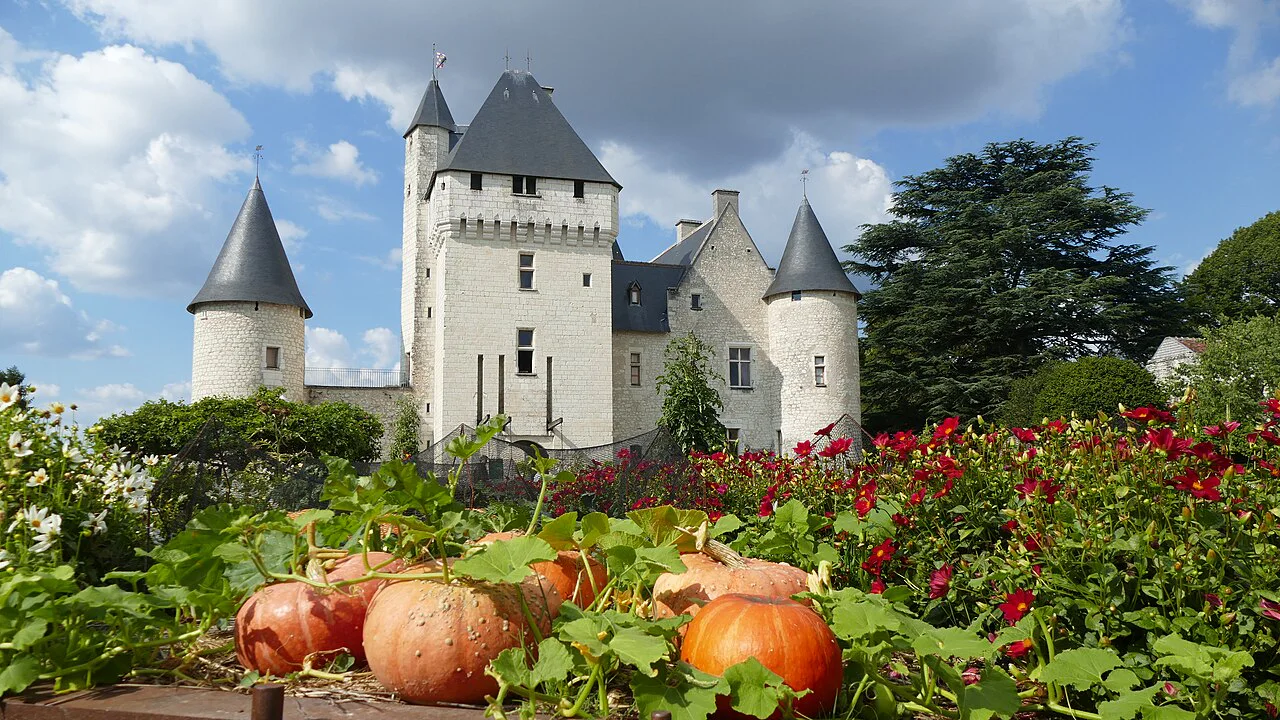
Lémeré · 73 km
Château du Rivau
Content & sources
Photo: Aliasse16 · CC BY-SA 4.0
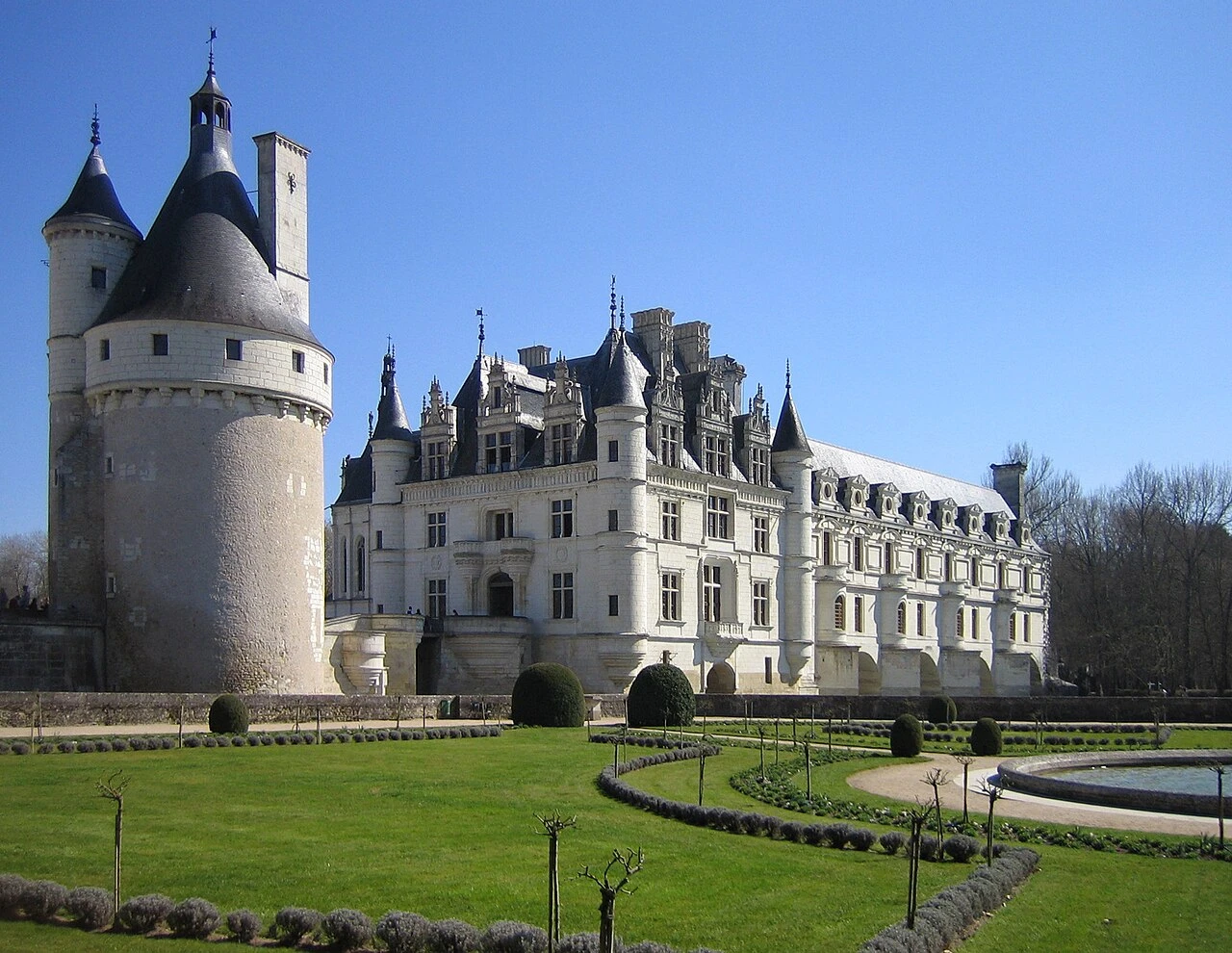
Chenonceaux · 86 km
Château de Chenonceau
Content & sources
Photo: Manfred Heyde · CC BY-SA 3.0
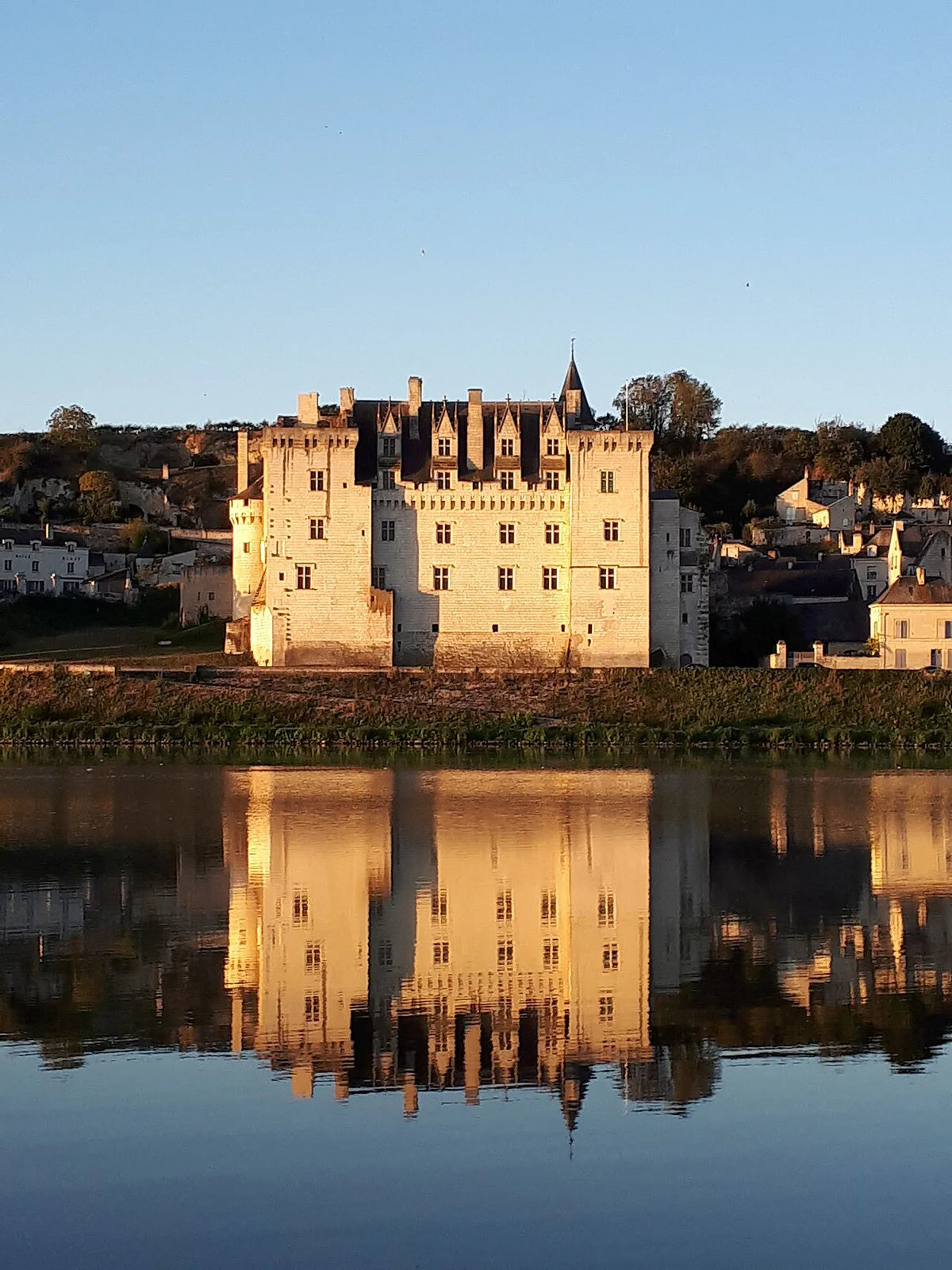
Montsoreau · 95 km
Château de Montsoreau
Content & sources
Photo: Suavemarimagno · CC BY-SA 4.0
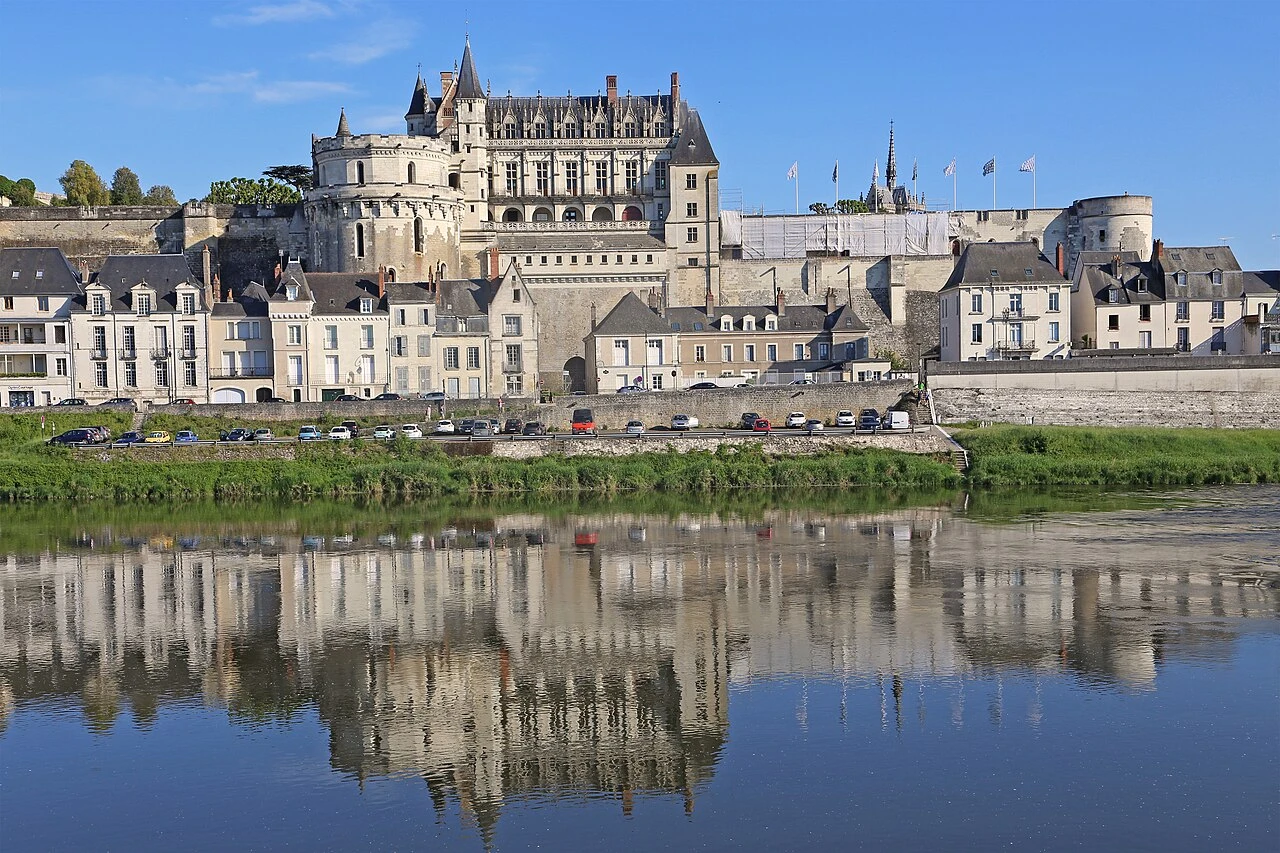
Amboise · 95 km
Château d'Amboise
Content & sources
Photo: W. Bulach · CC BY-SA 4.0