Stanza · Audio guide
Château de Montsoreau Audio guide
A place to remember. A story to take with you.
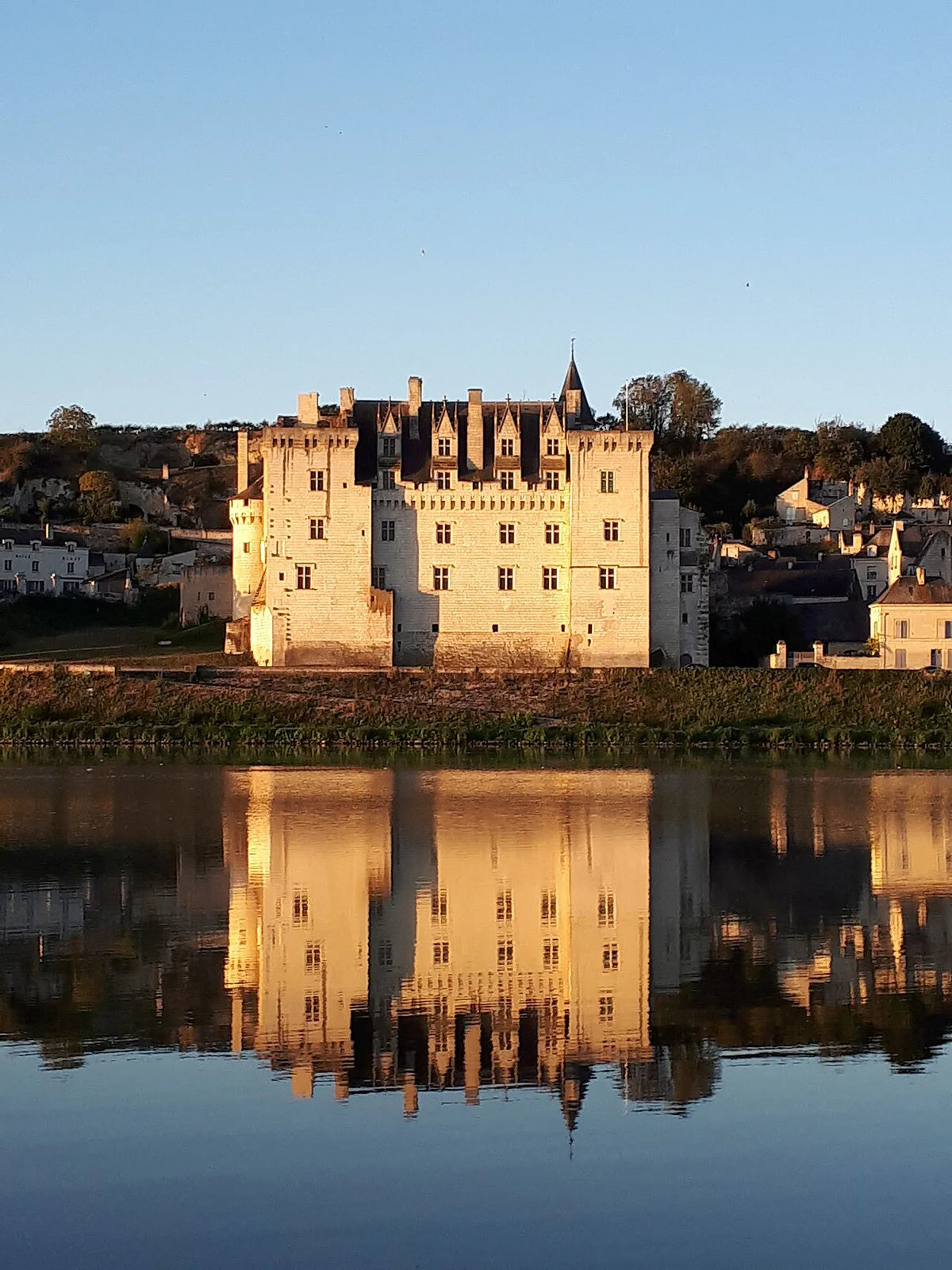
The Château de Montsoreau is a Flamboyant Gothic castle located in the Loire Valley of France. It is built directly in the Loire riverbed and serves as the location for the museum of contemporary art.
Download Stanza, then search for “Château de Montsoreau”.
About the tour
One guide. Your kind of visit.
The Château de Montsoreau is a Flamboyant Gothic castle located in the Loire Valley of France. It is built directly in the Loire riverbed and serves as the location for the museum of contemporary art.
Ready when you are.
- 01Get the free Stanza app.
iOS & Android
- 02Find your guide.
“Château de Montsoreau”
- 03Download before you go.
Works offline
Audio guide / 14 narrated stops
Inside the guide
Get to know a few of the stories before you go. Open a stop to read more.
01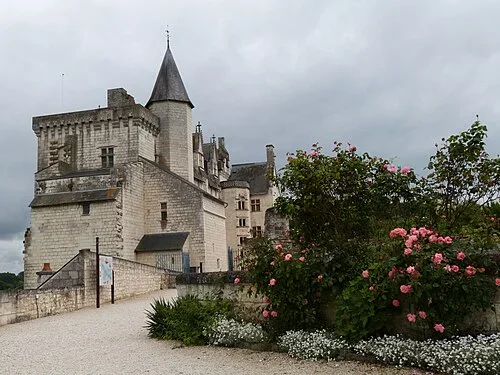 The Courtyard and Historic EntranceThe Approach to the Château
Welcome to the Château de Montsoreau, a Flamboyant Gothic castle rising from the banks of the Loire. The white stone ahead was raised in the middle of the fifteenth century for Jean II de Chambes, a councillor and chamberlain who served kings Charles the Seventh and Louis the Eleventh. He was one of the wealthiest men in the kingdom. The site sits where the Loire and the Vienne meet, and where three old provinces touch: Anjou, Poitou and Touraine. People have used this rock for a very long time. Some kind of administrative or religious building stood here as early as Gallo-Roman times. The name Montsoreau first appears in 1086, written in Latin as Mons Sorello. Mons means a rocky promontory. Nobody knows what Sorello meant, though some read it as bald, others as red. The path in crosses ground that once formed part of the defences. A deep dry moat, said to be about twenty metres across, ran along three sides of the castle. It held no water except when the Loire flooded. That was defence enough, most of the time.
Photo: Thérèse Gaigé · CC BY-SA 3.0
02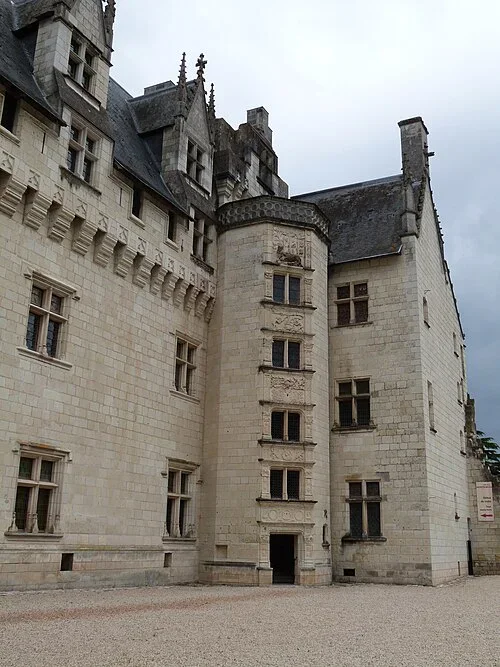 The Courtyard and Historic EntranceThe Courtyard Facade
The courtyard side of the château tells you, in one glance, what kind of building this wanted to be. Along the top runs a defensive walkway carried on moulded consoles and crowned with machicolations, the openings through which defenders could drop stones. Its parapet is decorated with trilobed arches in varied shapes, a surprising touch of elegance for military stonework. Below it, tall mullioned windows light the residence, and Gothic dormers break across the roofline. The whole building is dressed in tuffeau, the soft white limestone of the region, cut in a quarry hollowed into the cliff nearby. Roman numerals carved on many inner walls are not masons' signatures. They record the exact height each stone should sit at, evidence of a very organised building site. The roofs carry slates from Angers, as was the custom throughout the valley. One oddity deserves attention. The two flanking wings are square, at a time when round towers were the norm. That strange choice foreshadows the corner pavilions of classical architecture. Defence was fading into a gesture, and comfort was taking over.
Photo: Thérèse Gaigé · CC BY-SA 3.0
03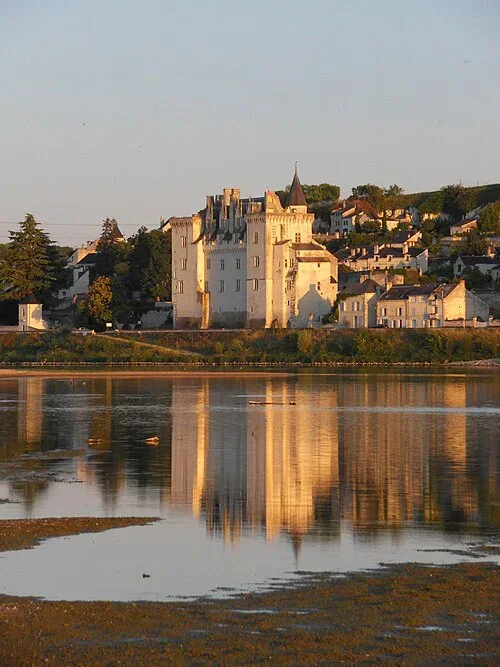 The Riverbed and ConfluenceThe Castle in the Riverbed
From the far bank of the Loire, the main building shows its boldest decision. It was built directly into the bed of the river, at the foot of the hillside, its northern front almost touching the water. The site was reckoned militarily impregnable. The castle commands a plateau of some thirty hectares, hemmed between two small valleys with steep slopes to the east and west. Whoever held it controlled traffic on the Loire. The river also set the rhythm of life here, and floodwater was a recurring fact of existence. Survival was never guaranteed. The property was sold after 1804, and nineteen different homeowners followed, each reshaping the place. By 1910 the château had fallen into such disrepair that the French Archaeological Society raised the alarm. A senator named Geoffre pressed the department to act, and from 1913 it began buying the property piece by piece. Restoration started in 1923 and continued until the Second World War. A further programme ran from 1997 to 2001. On the sixth of July 2001 the château opened to visitors, drawing about thirty-five thousand people a year.
Listen in the appPhoto: Neige19 · CC BY-SA 3.0
04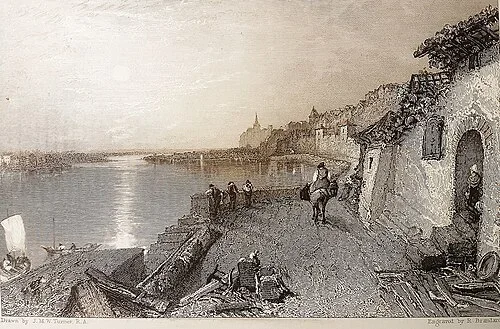 The Riverbed and ConfluenceTurner's Montsoreau
In October 1826, a small steamboat traveller on the Loire turned his pencil toward Montsoreau. Joseph Mallord William Turner spent a short stay on the river's banks that autumn and took twenty-one views of it. The château and its surrounding scenery became one of his watercolours, now kept at the Ashmolean Museum in Oxford. In 1832 it was engraved, and prints of it travelled far beyond the artist's own circles. This was the moment the silhouette entered the Romantic imagination. Painters and writers of the age were hunting for scenes exactly like this one, a pale castle mirrored in a wide river. Their images drew nineteenth-century travellers down the Loire in search of the views they knew. A copy of the engraved watercolour is kept at the château today, in the building it portrays.
Listen in the appPhoto: Philippe49730 · CC BY-SA 4.0
05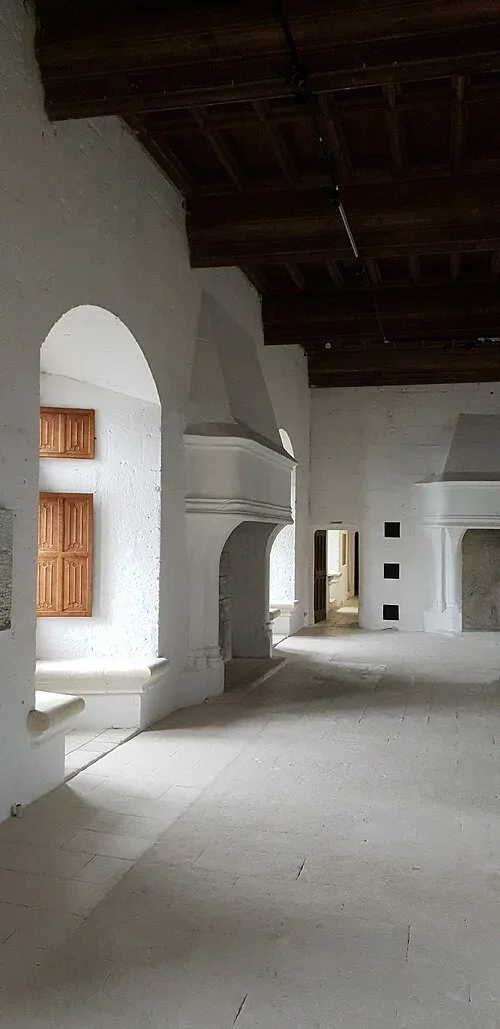 The Grand Halls and Transition to PalaceThe Great Hall
Inside, the central dwelling is divided into two halls of unequal size. The larger one stretches seventeen metres, lit by five windows and heated by two monumental chimneys, one facing the Loire and one to the east. The smaller hall beside it has a single fireplace. Around 1450 the castle counted about twenty-five chimneys in all. In a building that still kept its defences, that number was a declaration of luxury. This floor also worked for a living. The ground-floor rooms and the courtyard-side cellars allowed the lord's men to control navigation on the Loire, and one of those rooms opens straight onto the river. The lords of Montsoreau collected a toll from the boats passing their water, a right they kept until 1631. Part of the moat on the south side holds a deep cellar with a vaulted ceiling, almost certainly used for storage. Goods came off the river, and a share of their value stayed here.
Listen in the appPhoto: TCY · CC BY-SA 3.0
06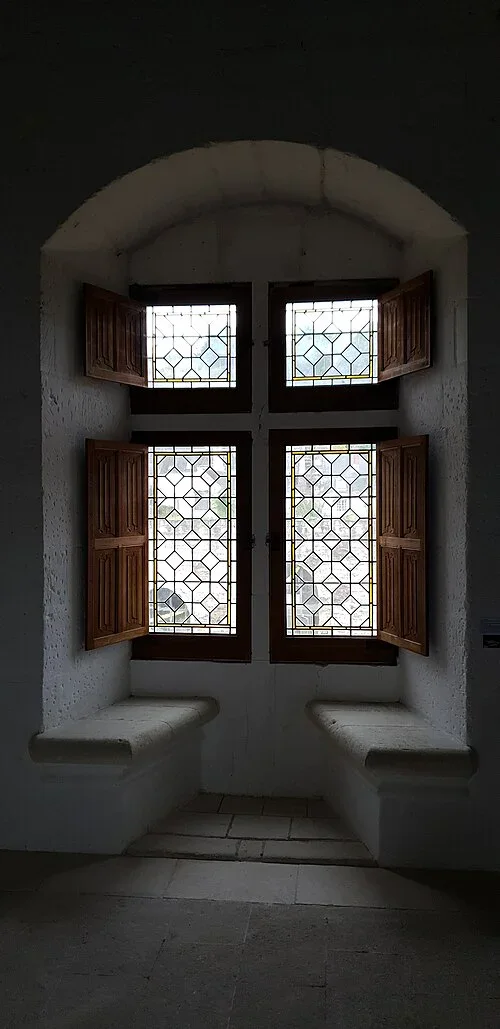 The Grand Halls and Transition to PalaceThe Window Seats
Set into the thick window embrasure are two stone benches, facing each other across the opening. They are called coussièges, and they were built into the masonry from the very start. The large windows around them were themselves a statement, flooding the rooms with a light no fortress window allowed. The benches served two purposes, depending on the room. In some they were watch benches, seats for those keeping an eye on the approaches. Elsewhere they were favoured spots for reading and writing, close to the best natural light in the house. Either way, the message is the same. This was a place designed around the comfort of the body, not only around arrows and gates.
Listen in the appPhoto: TCY · CC BY-SA 3.0
07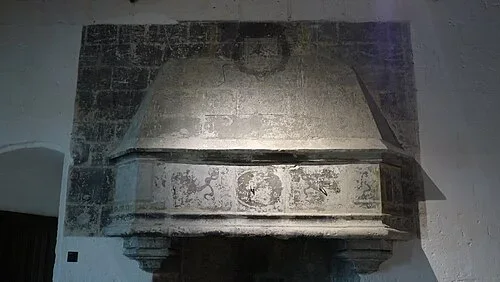 First Floor Residential RoomsThe David and Goliath Fireplace
The hood of this fireplace carries a sixteenth-century fresco, set in a medallion ringed with foliage and fruit tied with ribbons. A warrior lies stretched on his back, and a figure dressed as a shepherd is about to strike him. It is probably meant as David and Goliath. Below, the arms of the Chambes family appear with their motto, Lenitate vel vi. By gentleness, or by force. The later Chambes family lived that motto brutally. In August 1572, after the massacre of Saint Bartholomew began in Paris, Jean the Fourth de Chambes organised the killings at Saumur and then at Angers. He carried them out with zeal even though King Charles the Ninth had ordered them stopped. His reward was elevation from baron to count. His brother Charles married Françoise de Maridor, whose name stayed attached to the killing of Louis de Bussy d'Amboise. Alexandre Dumas retold that story in his novel La Dame de Monsoreau, written in the 1840s, and the book fixed the castle's name in popular memory.
Listen in the appPhoto: Bo35bo35 · CC BY 4.0
08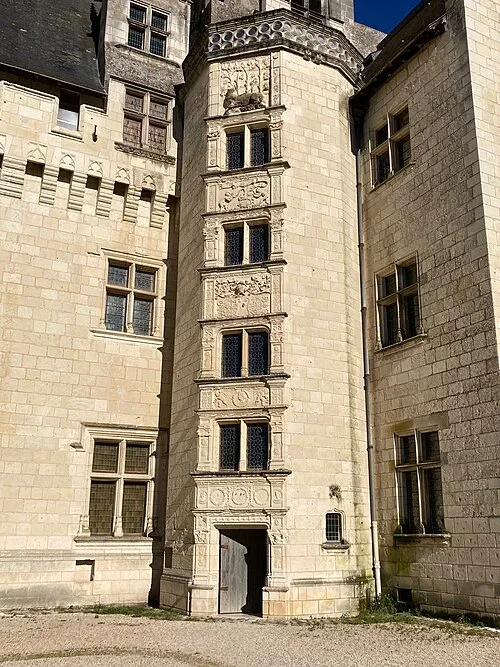 The Renaissance Staircase TowerThe Renaissance Staircase Tower
Set into the right-hand corner of the courtyard facade, this octagonal tower completed the château's transformation. Jean the Third de Chambes began it after he succeeded his father in 1473. Its polygonal shaft rises to a terrace, crowned with a balustrade of two rows of stone rings closed by round slate plates. The doorway below has a basket-handle arch, and above it four windows climb one above the other, their sides framed by carved pilasters that pull the eye upward. The decoration borrows from Italy. Medallions frame the stair's progress, and they may show Jean the Third himself and his wife, Marie de Châteaubriant. Further up, medallions are joined by putti and candelabra carried on lion's paws. A spiral staircase probably stood here before this tower ever rose. Two things inside it deserve their own telling: the vault at the very top, and a small carved monkey on the way up.
Listen in the appPhoto: Staab.a · CC BY-SA 4.0
09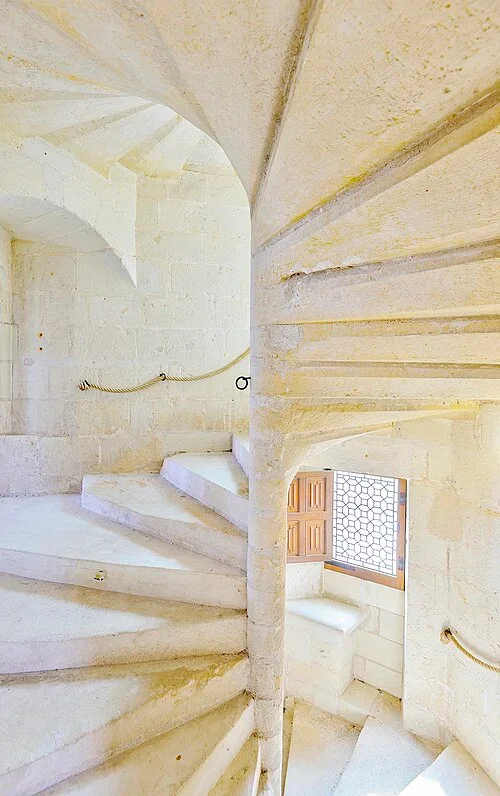 The Renaissance Staircase TowerThe Spiral Staircase
The steps themselves are cut from the same pale tuffeau as the walls, winding upward around a solid core. A simple rope serves as the handrail, looped through rings along the wall. Climbing a stair like this was the ordinary business of the house, the daily vertical journey between floors. This grand flight probably had a predecessor. A narrower spiral staircase is thought to have existed here before the Renaissance tower replaced it. The château also keeps a second turret on the west side, known as the medieval staircase. Its restoration was completed in 1937, during the twentieth-century rescue of the castle. Stone worn smooth by centuries of feet is hard to fake.
Listen in the appPhoto: Suavemarimagno · CC BY-SA 4.0
10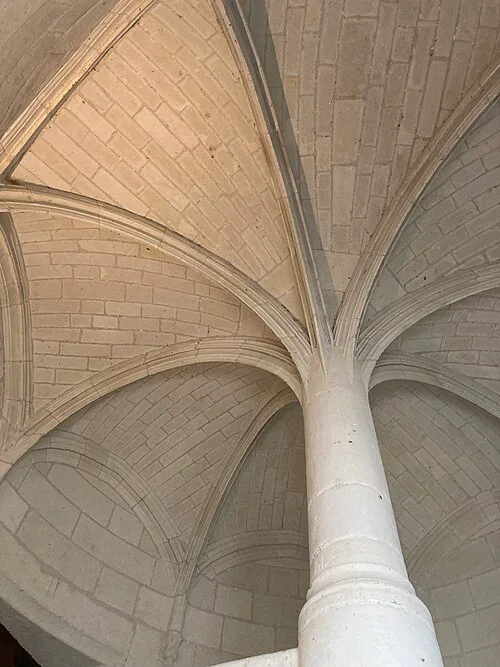 The Renaissance Staircase TowerThe Palm-Tree Vault
At the top of the stairs, the ceiling opens into one of the château's most celebrated pieces of stonework. Eight ribs fan out from a central column, spreading across the ceiling like the fronds of a palm. That is exactly where the name comes from: a palm-tree vault. The column continues the very core of the staircase, so the whole flight seems to grow into the stone above it. The form is rare. Close relatives exist at the logis Barrault in Angers, at the town hall of Saumur, and at the castle of King René in Baugé. What it signalled was ambition. A stair is a purely functional thing, yet here its crowning ceiling was treated as sculpture, in the newest taste of the Renaissance. The family put its finest carving where every guest would pass, and look up.
Listen in the appPhoto: Staab.a · CC BY-SA 4.0
Château de Montsoreau
Frequently asked questions
How much does the guide cost?
Free app download. Listed guide price: $2.99. Guide price shown in the app. Audio guide only. Venue admission is separate.
Can I listen without internet?
Yes. Download the guide’s audio, images, and maps in the app before your visit. Your downloaded content is then available offline.
Can I listen in my language?
This audio guide is available in 15 languages, including English.
Do I need to follow a schedule?
No. This is a self-guided experience. Choose your stops, pause whenever you like, and return to a story at your own pace.
At your own pace
Explore Château de Montsoreau.
Download Stanza, then search for “Château de Montsoreau”.
Free app download · Guide price shown in the app
Keep exploring
Nearby audio guides
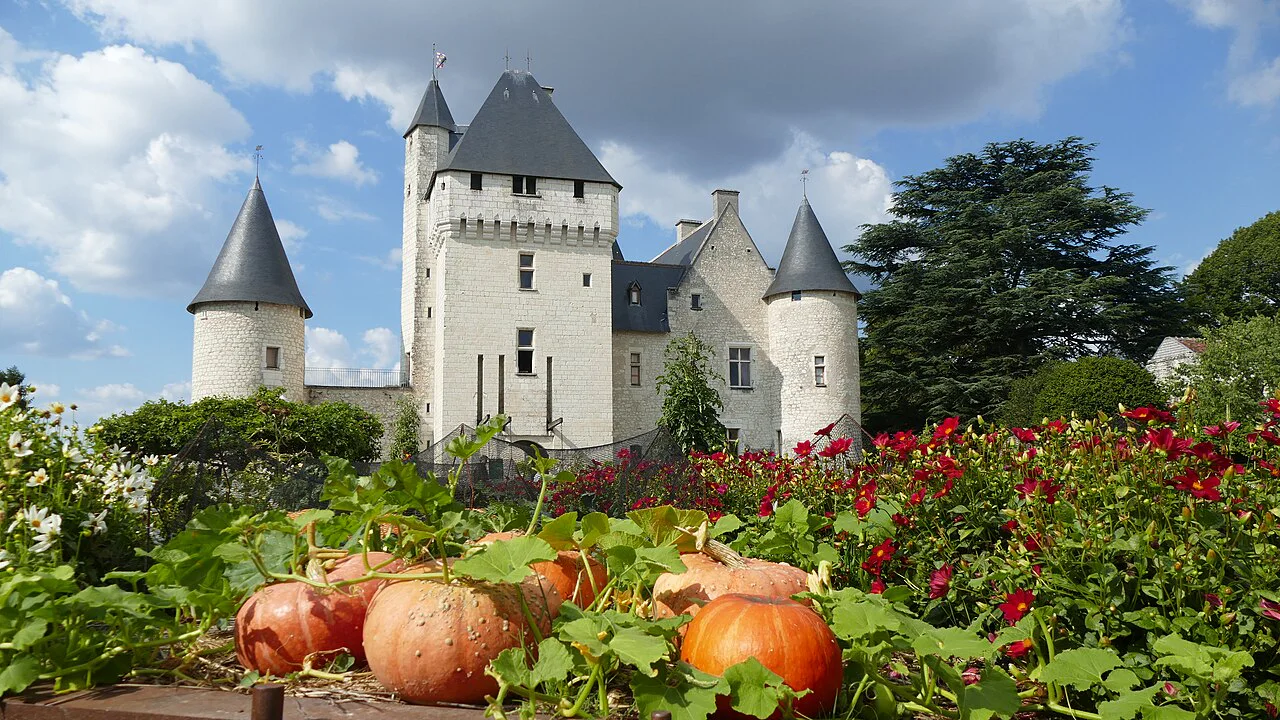
Lémeré · 23 km
Château du Rivau
Content & sources
Photo: Aliasse16 · CC BY-SA 4.0
Écuillé · 63 km
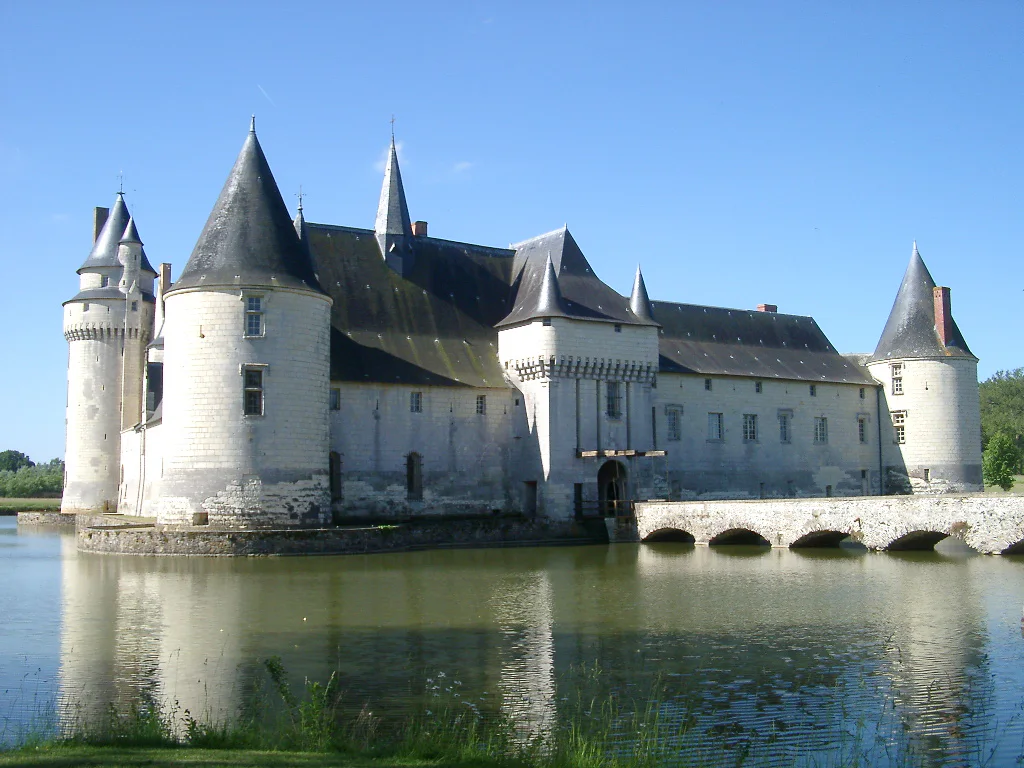
Château du Plessis-Bourré
Content & sources
The original uploader was NonNobis at French Wikipedia. · CC BY-SA 3.0
Amboise · 73 km
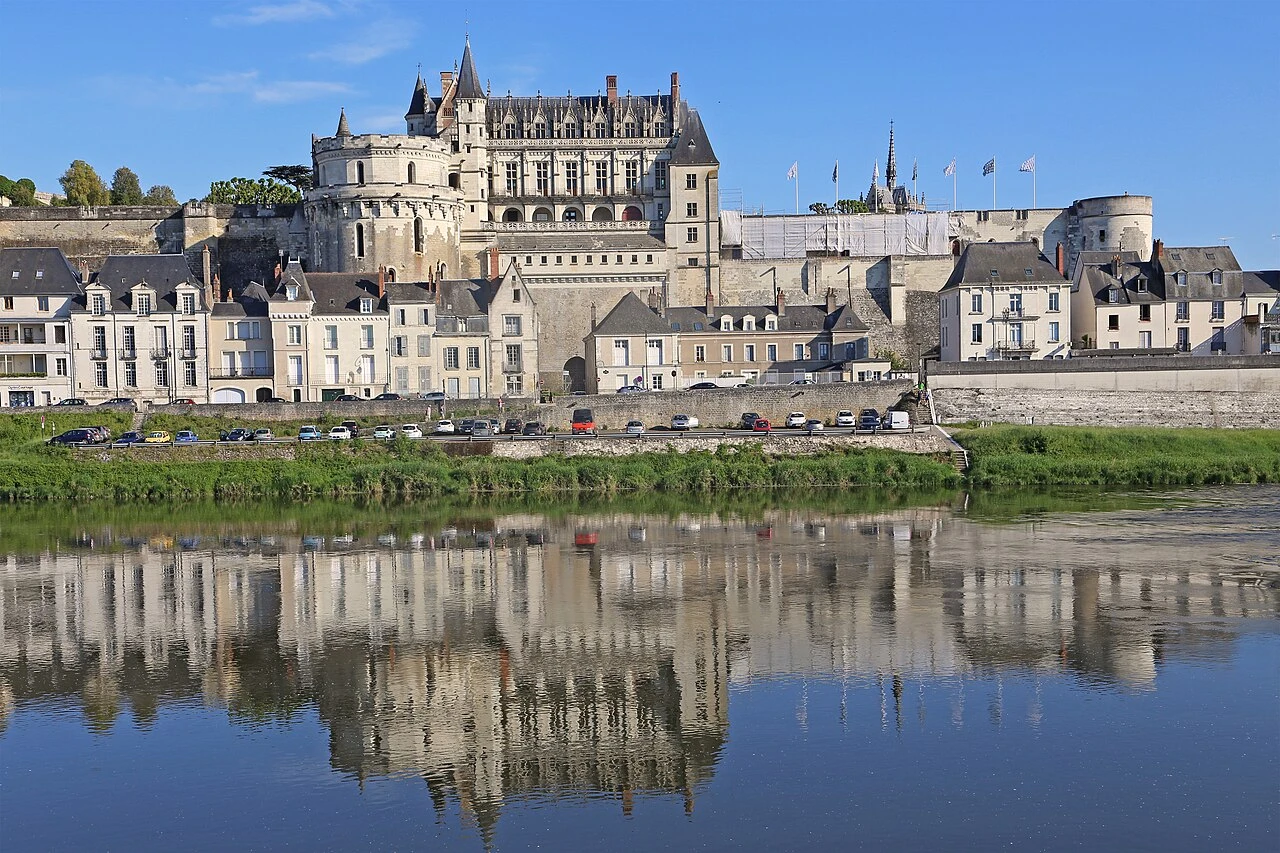
Château d'Amboise
Content & sources
Photo: W. Bulach · CC BY-SA 4.0
Chenonceaux · 77 km
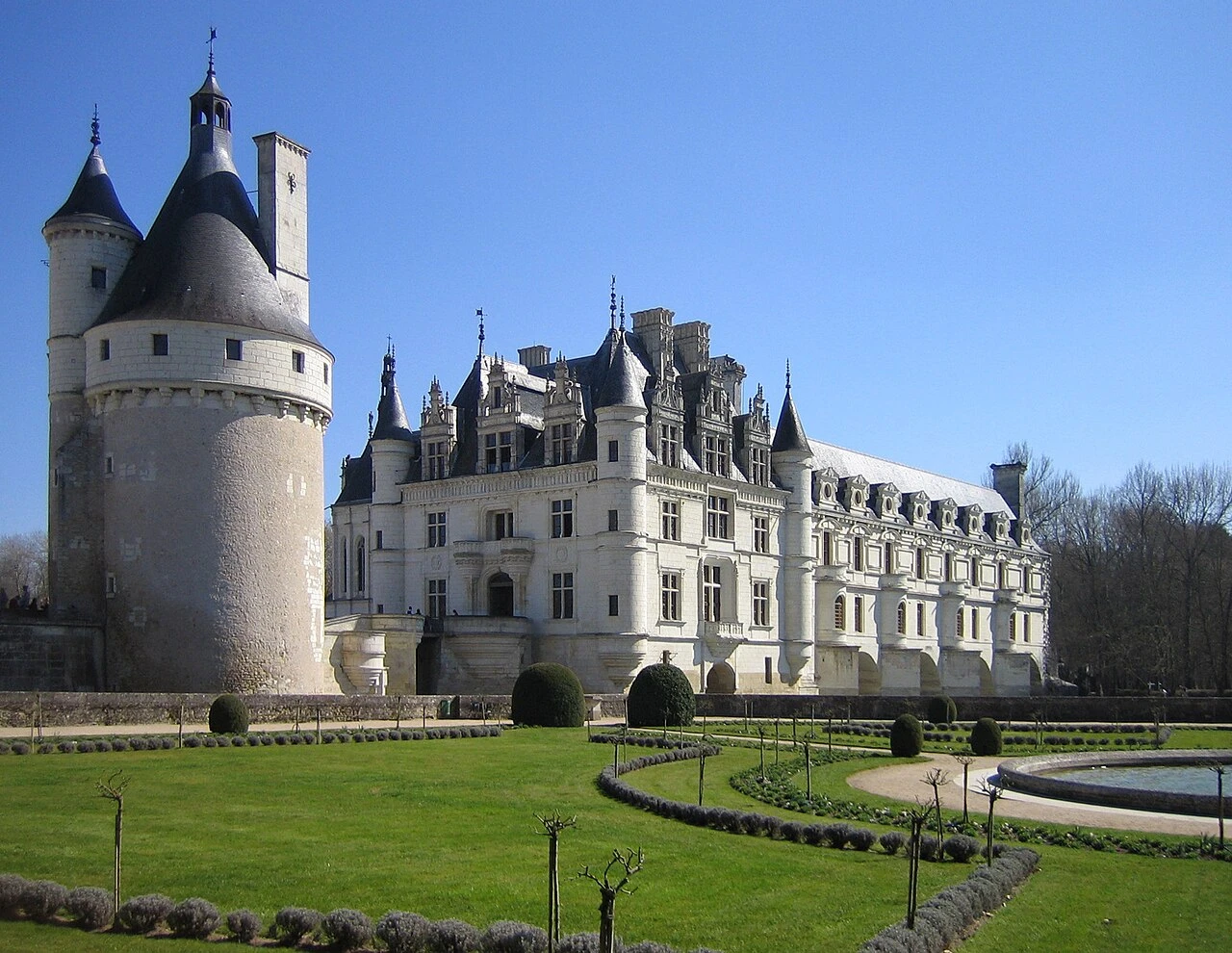
Château de Chenonceau
Content & sources
Photo: Manfred Heyde · CC BY-SA 3.0