Stanza · Audio guide
Cathédrale Saint-Michel de Carcassonne Audio guide
A place to remember. A story to take with you.
Carcassonne Cathedral is a cathedral and designated national monument in Carcassonne, France. It is the seat of the Roman Catholic Bishop of Carcassonne and Narbonne.
Download Stanza, then search for “Cathédrale Saint-Michel de Carcassonne”.
About the tour
One guide. Your kind of visit.
Carcassonne Cathedral is a cathedral and designated national monument in Carcassonne, France. It is the seat of the Roman Catholic Bishop of Carcassonne and Narbonne.
Ready when you are.
- 01Get the free Stanza app.
iOS & Android
- 02Find your guide.
“Cathédrale Saint-Michel de Carcassonne”
- 03Download before you go.
Works offline
Audio guide / 9 narrated stops
Inside the guide
Get to know a few of the stories before you go. Open a stop to read more.
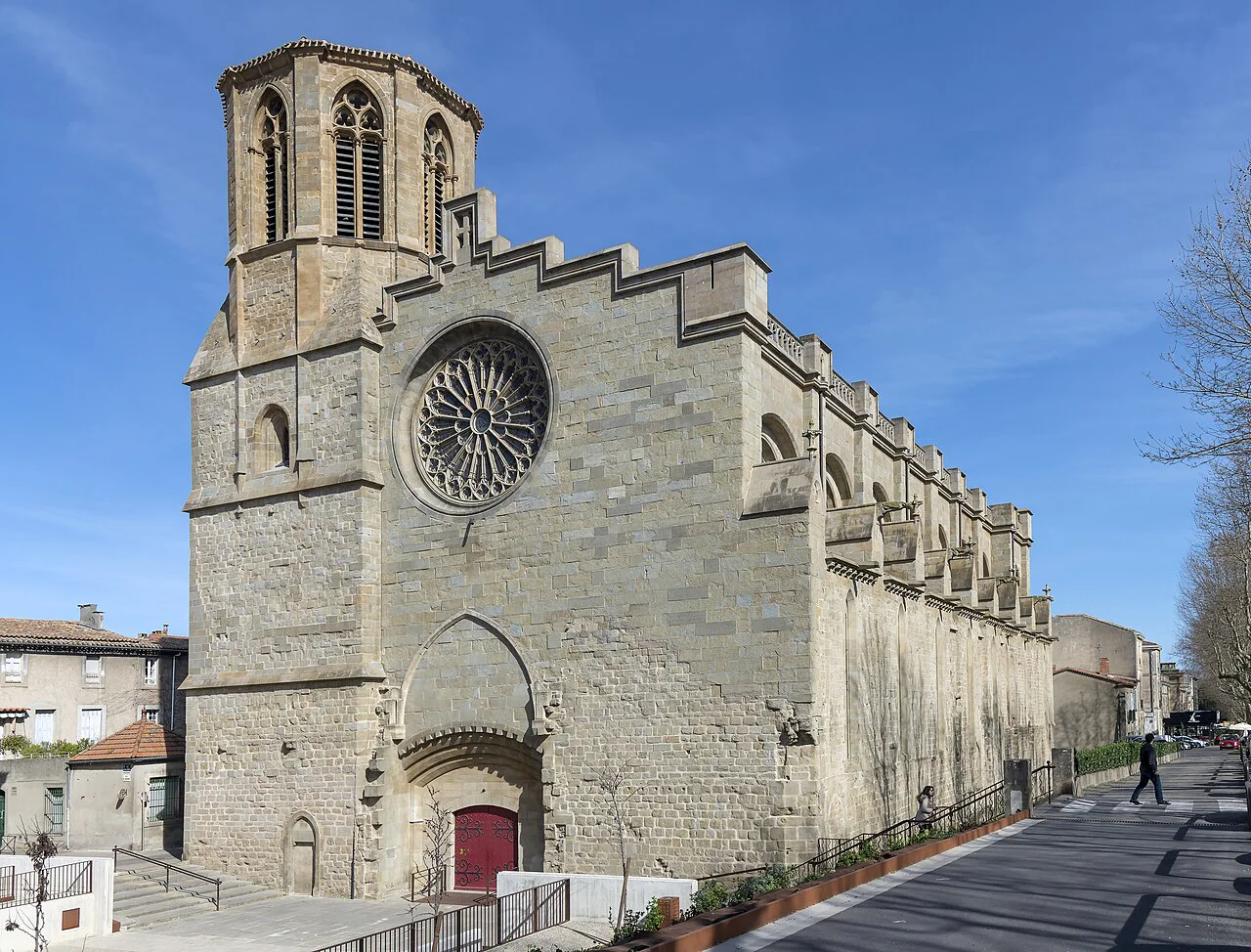
01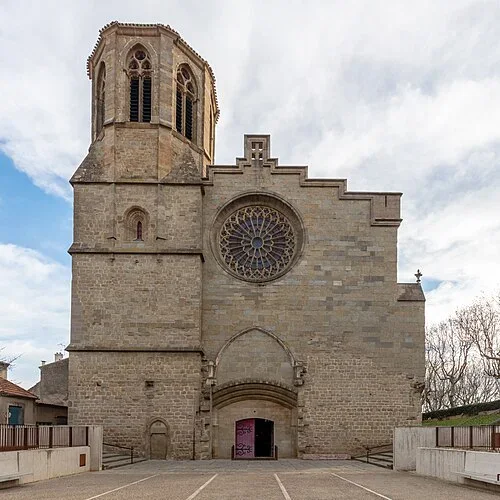 West Façade and Bell TowerWest Façade and Bell Tower of Saint-Michel
Welcome to the cathedral of Saint-Michel, in the lower town of Carcassonne. The hilltop Cité has its famous walls, but this stone church is the seat of the bishop. It was begun in 1247, on the order of King Louis IX, the king later called Saint Louis. He wanted a replacement for an older sanctuary destroyed during the siege of 1240, when Raymond Trencavel attacked the town. So this church was born from war, in the new bastide Saint-Louis below the hill. The façade greets you plainly, with almost no carving, flanked by a very massive bell tower. That tower rises through three rectangular storeys before turning octagonal at the top. Inside it hang eight bells, swung by hand for the services.
Diego Delso · CC BY-SA 4.0
02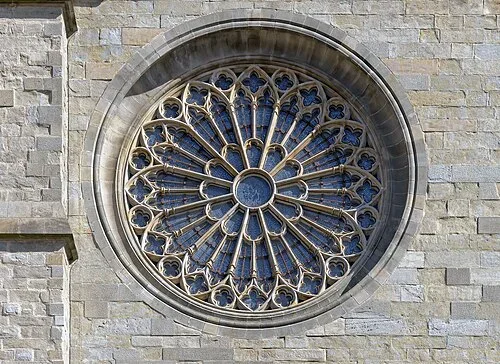 West Façade and Bell TowerThe Eight-Metre Rose Window
One great circle dominates this wall. The rose window measures eight metres across, and it is the only decoration the façade allows itself. No sculpted portal, no rows of saints, just this single wide opening filled with tracery. That restraint is a signature of the Southern Gothic churches of this region. Their builders preferred thick, sober walls pierced by one grand rose. The old cathedral of Saint-Nazaire, up in the Cité, wears its façade the same way. Here, the rose gathers light into the nave through a single flower of stone.
Didier Descouens · CC BY-SA 4.0
03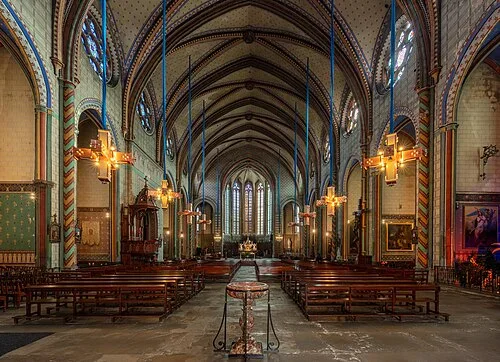 The Southern Gothic NaveThe Single Nave of the Bastide
The plan of this church is strikingly simple: one wide nave, with no dividing aisles. It runs for eight bays, each of remarkable breadth, lined with side chapels. That openness is the Southern Gothic manner, a hall built so one voice could carry to a whole congregation. The building was almost too small as soon as it was finished, so it was enlarged from 1283 onward. The stone vaults overhead came very late. From 1657 to 1752, masons raised the ogival vaults over the nave, replacing an open timber roof. The choir, by contrast, has kept its thirteenth-century vaulting. Above the chapels, small rose windows catch the light, added in the nineteenth century by Viollet-le-Duc.
Listen in the appDiego Delso · CC BY-SA 4.0
04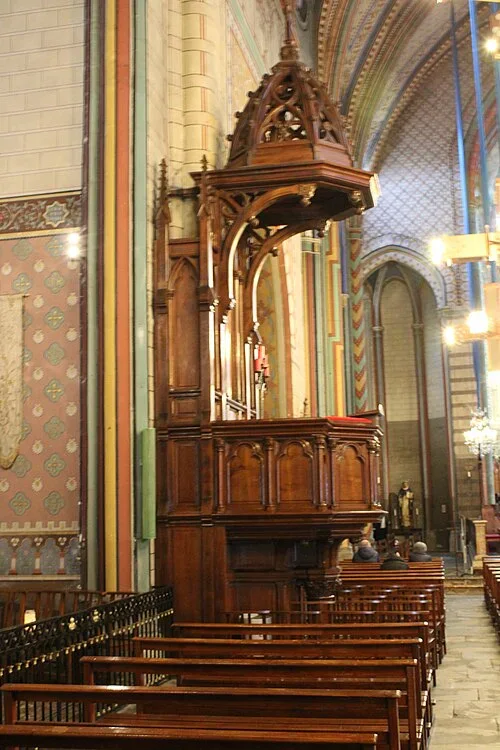 The Southern Gothic NaveThe Preaching Pulpit
Against one of the nave piers stands a richly carved wooden pulpit, with a canopy like a small crown above it. In churches of this Southern Gothic type, the pulpit was a focal point of parish life. The wide, undivided nave meant a preacher standing here could address everyone at once, across the whole breadth of the building. No columns broke the sightline, and no wall stood far from the sound. Sermons, announcements and instructions for the parish all flowed from a perch like this one. The carved tracery and the little stair were built for a speaker, not a soloist. It remains one of the plainest reminders that this was, for centuries above all, a parish church.
Listen in the appPhoto: Selmoval · CC BY-SA 4.0
05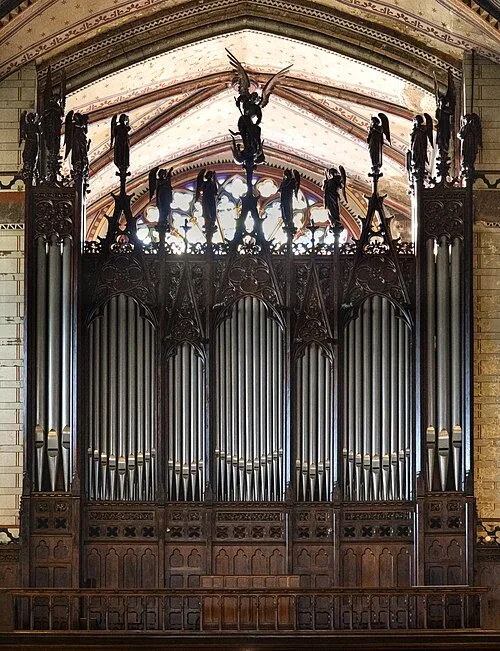 The Grand Cavaillé-Coll OrganThe Grand Cavaillé-Coll Organ
High at the back of the nave rises one of the great French organs. Aristide Cavaillé-Coll built this instrument in 1860. It replaced an older organ installed in 1687 by Jean de Joyeuse. That old case did not go to waste; it was rebuilt for a church in Poligny, in the Jura. The new Cavaillé-Coll carries forty-four stops over three manuals and a pedalboard, with fully mechanical action. Its inauguration was played by Lefébure-Wély, one of the most famous organists of the day. The instrument has been tended ever since, with restorations in 1929, 1937 and 1963. In 1998 the Manufacture languedocienne de grandes orgues, from Lodève, gave it a complete overhaul.
Listen in the appDidier Descouens · CC BY-SA 4.0
06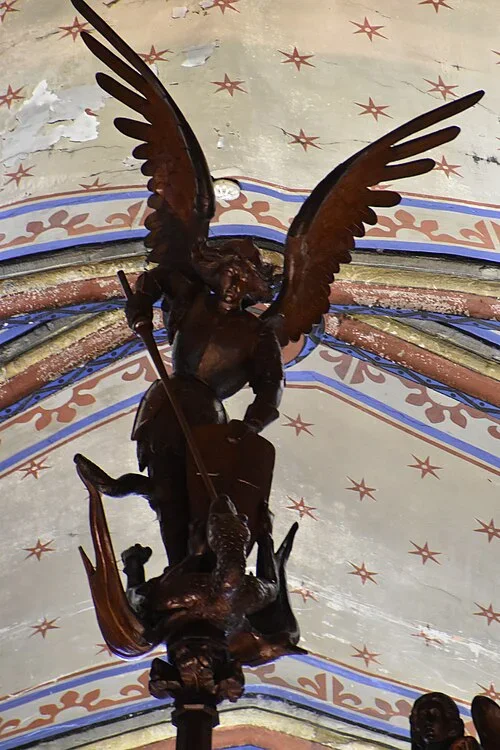 The Grand Cavaillé-Coll OrganSaint Michael Slaying the Dragon
At the very top of the organ case, a winged figure strikes down a dragon. This is Saint Michael, the archangel of the heavenly host and the church's own patron, carved in oak. The whole case was designed by Eugène Viollet-le-Duc in the neo-Gothic style, without tourelles and without a positive case. Around Saint Michael stand thirteen statues, life-size, of angels playing instruments, so the organ seems guarded by a heavenly choir. The man who designed them arrived by way of disaster. After the fire of 1849, the direction of the restoration works was first entrusted to Léon Ohnet, from 1850. In 1857 it passed to Viollet-le-Duc, already at work on the walled city on the hill, and this church became his first great project in the lower town.
Listen in the appPhoto: Tylwyth Eldar · CC BY-SA 4.0
07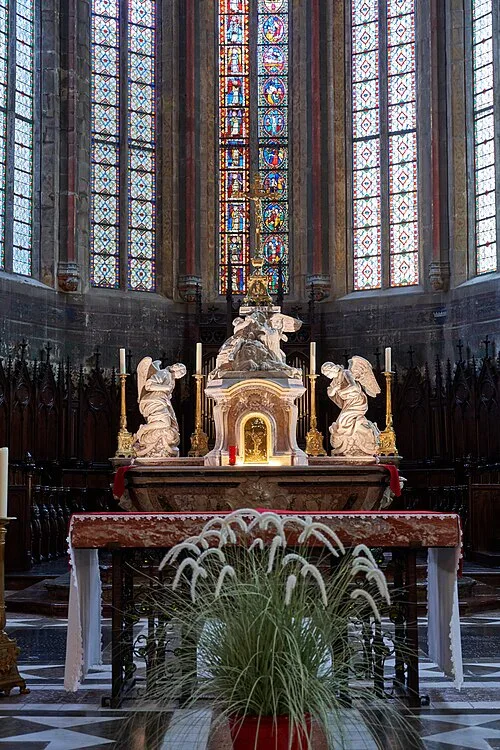 The Choir and 14th-Century Stained GlassThe Choir and High Altar
The church ends in an apse of seven sides, with two small absidioles branching off it. Its vaults date from the thirteenth century, the oldest vaulting in the building. Here, in 1803, the story of the parish church changed for good. After the Revolution and the Concordat, it was decided to move the bishop's seat from Saint-Nazaire in the Cité to this church. Saint-Michel took the title of cathedral, and the city's religious life shifted from the hilltop to the bastide below. The choir keeps its bishops close. Bishops of the diocese are buried here, among them Arnaud-Ferdinand de La Porte, bishop from 1802 to 1824. He was the first to hold the see in its new home.
Listen in the appPhoto: Jean-Christophe BENOIST · CC BY-SA 4.0
08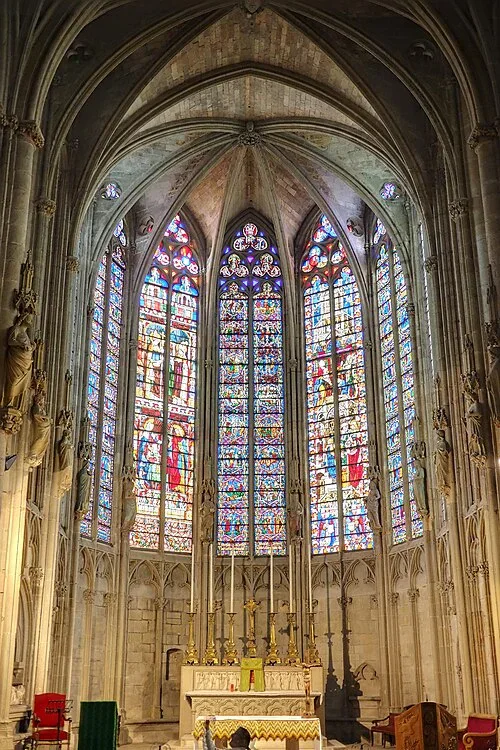 The Choir and 14th-Century Stained GlassThe Fourteenth-Century Stained Glass
The wide pointed bays of the apse still hold their stained glass from the fourteenth century. Deep blues, reds and golds tell their stories down seven tall windows. These panels came close to vanishing one November night. On the night of the fourth to the fifth of November 1849, a fire swept the church. It struck just as the building was being adapted for its new role as cathedral, and it badly disrupted the works. The fire was accidental, but its consequences shaped everything around the apse. Shortly afterwards, the master glazier Alfred Gérente meticulously restored the fourteenth-century glass. What glows over the high altar today is medieval glass, carried through the flames by nineteenth-century hands.
Listen in the appPhoto: KL KL · CC BY-SA 3.0
09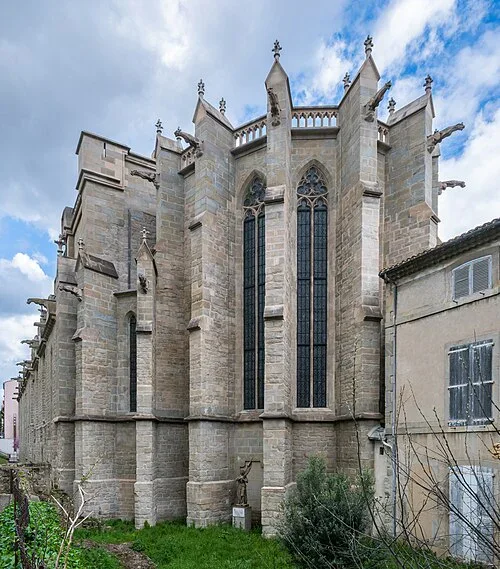 The Fortified Apse and Military TowerThe Fortified Apse and Military Tower
From outside, the east end of the church looks ready for a fight. In 1355, in the Hundred Years' War, the troops of the Black Prince burned the bastide of Carcassonne. Saint-Michel was one of the few buildings left standing, but it had suffered terrible damage. During the rebuilding that followed, a decision was taken to fold the church into the town's new fortifications. Beside the apse there still survives a cylindrical tower with the look of a military work. Ditches up to ten metres wide were cut around the building, turning the house of God into part of the defence. Those ditches were eventually filled in, and in the nineteenth century a broad public promenade took their place. The cathedral has been classed as a historic monument since the twelfth of July 1886. A parish church, a fortress and a cathedral, all in one stone body.
Listen in the appPhoto: Tournasol7 · CC BY-SA 4.0
Cathédrale Saint-Michel de Carcassonne
Frequently asked questions
How much does the guide cost?
Free app download. Listed guide price: $0.99. Guide price shown in the app. Audio guide only. Venue admission is separate.
Can I listen without internet?
Yes. Download the guide’s audio, images, and maps in the app before your visit. Your downloaded content is then available offline.
Can I listen in my language?
This audio guide is available in 15 languages, including English.
Do I need to follow a schedule?
No. This is a self-guided experience. Choose your stops, pause whenever you like, and return to a story at your own pace.
At your own pace
Explore Cathédrale Saint-Michel de Carcassonne.
Download Stanza, then search for “Cathédrale Saint-Michel de Carcassonne”.
Free app download · Guide price shown in the app
Keep exploring
Nearby audio guides
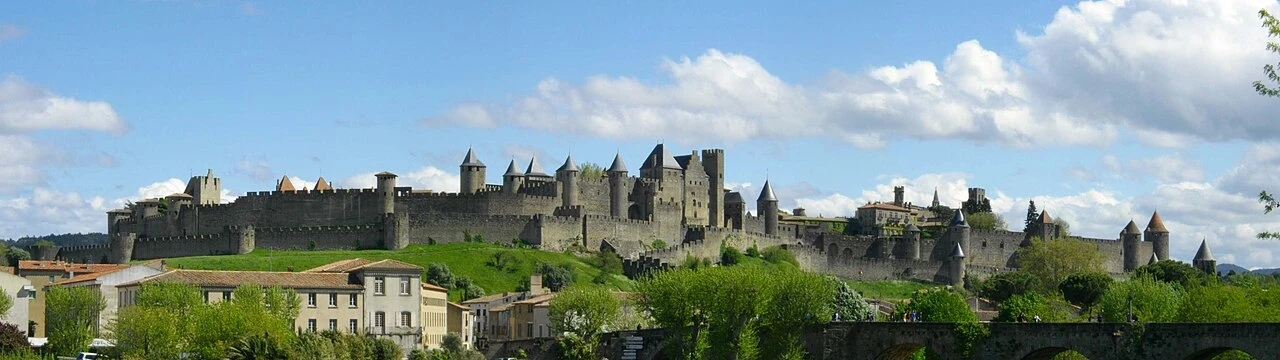
Carcassonne · 1 km
Cité de Carcassonne
Content & sources
Photo: Jondu11 · CC BY-SA 4.0
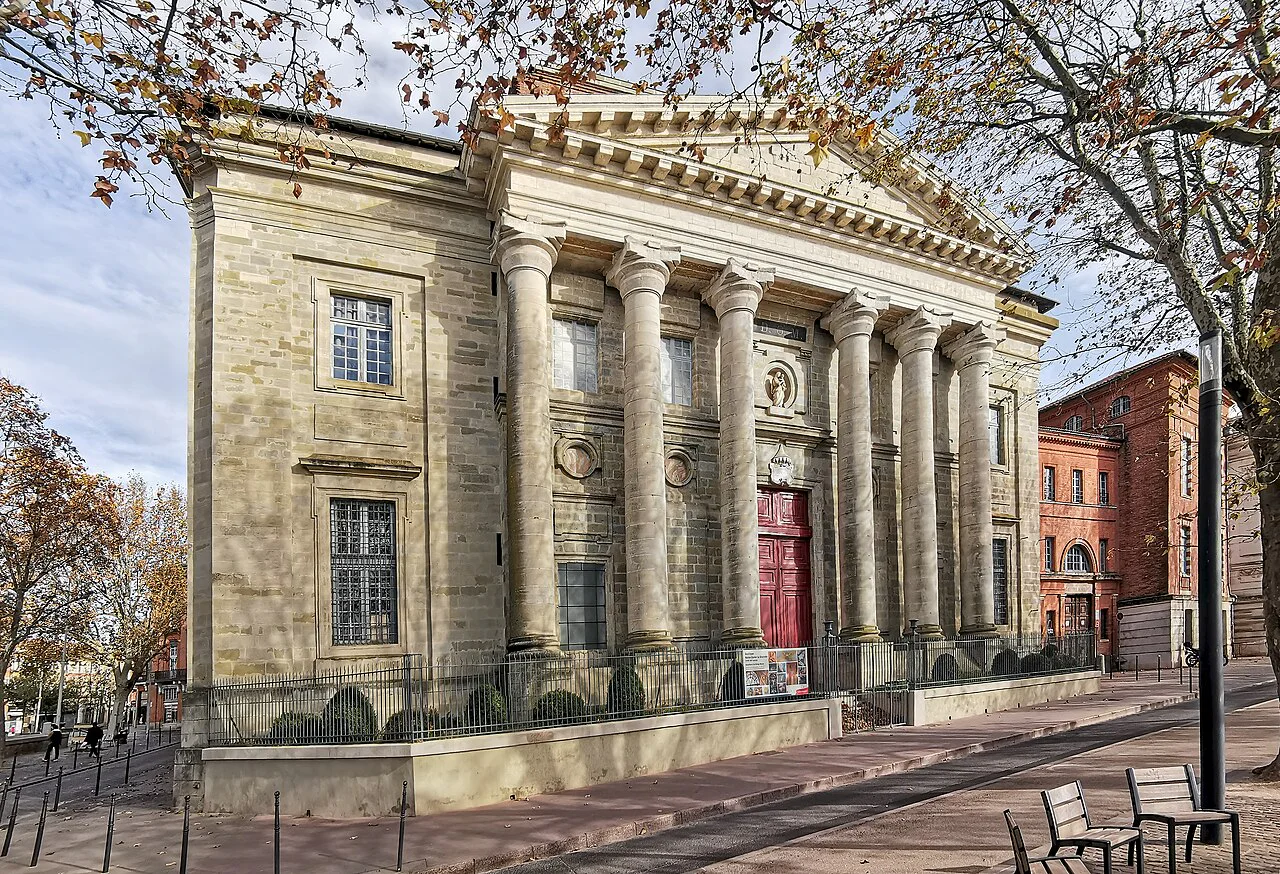
Toulouse · 85 km
Basilique Notre-Dame de la Daurade
Content & sources
Didier Descouens · CC BY-SA 4.0
L'Escala · 135 km
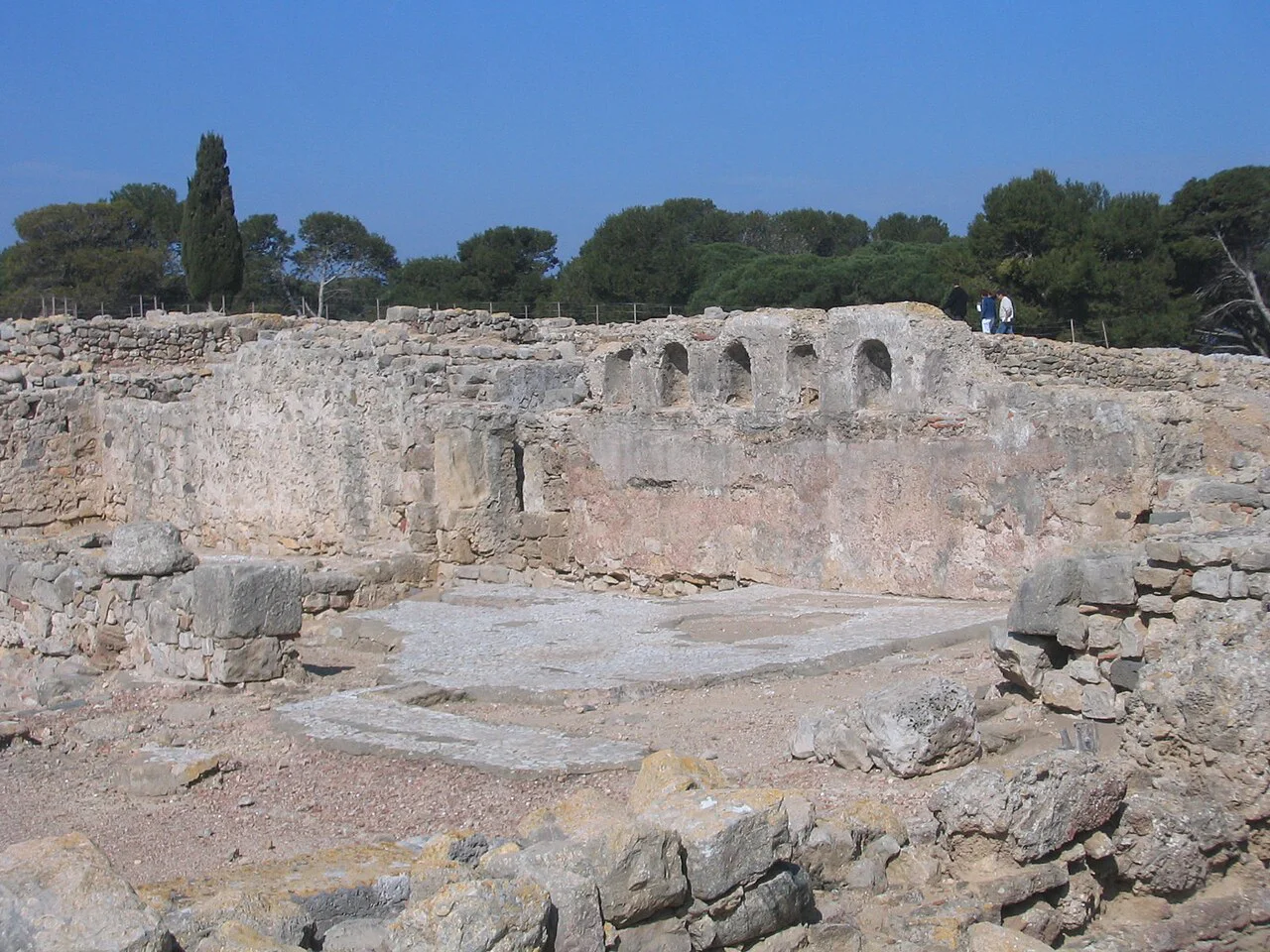
Ampurias
Content & sources
Photo: David Mateos García · CC BY 2.0
Girona · 141 km
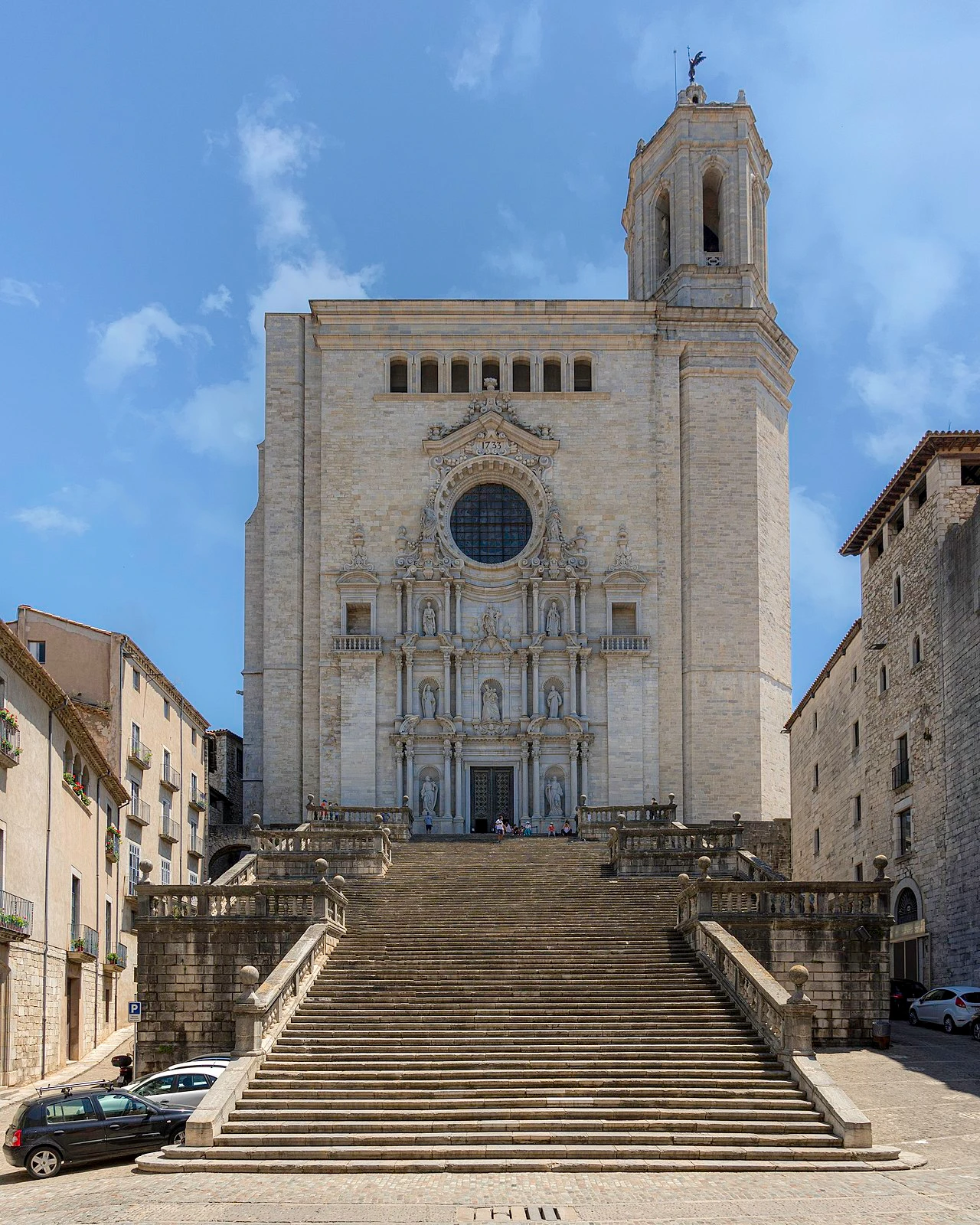
Girona Cathedral
Content & sources
Photo: Fernando · CC BY-SA 4.0